
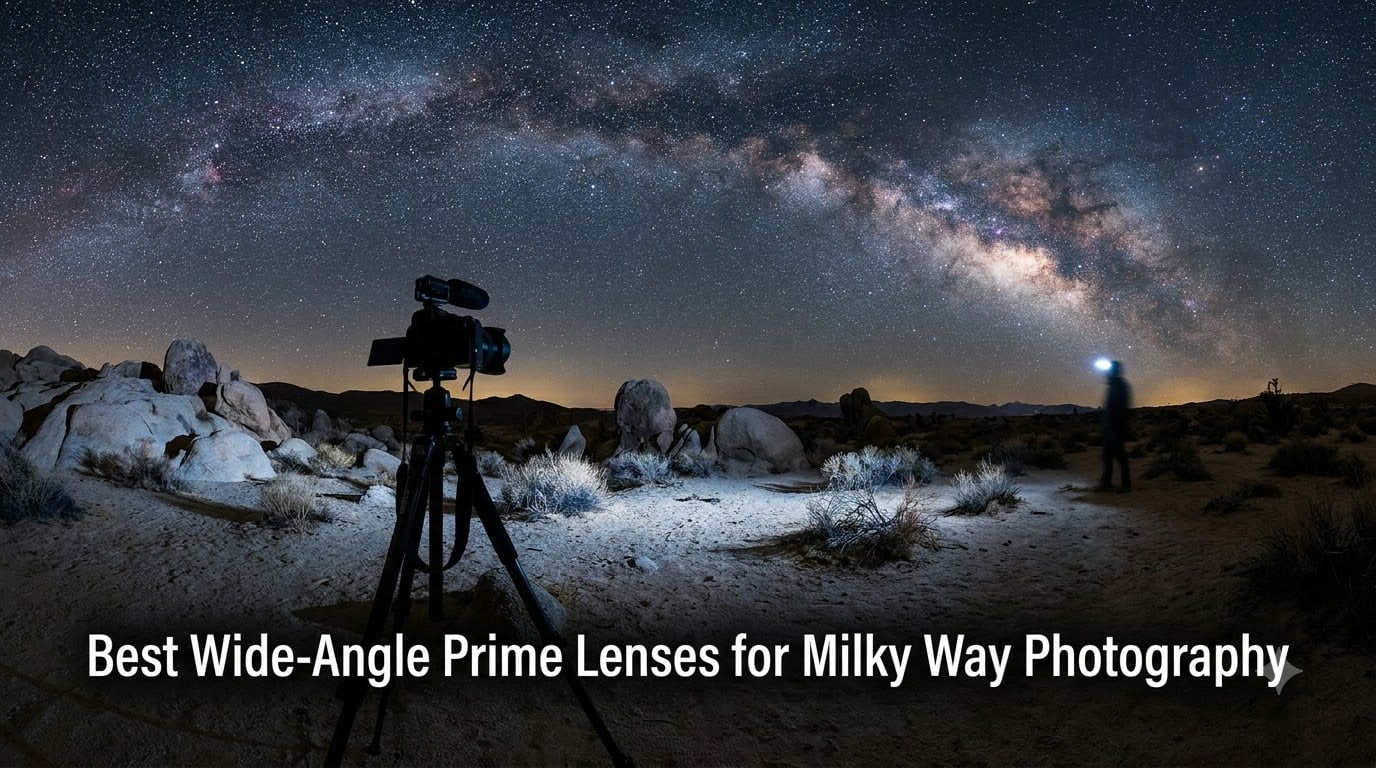
Capturing the Milky Way is one of the most rewarding challenges in photography. After years of shooting nightscapes from Bortle 1 dark sky sites to light-polluted suburbs, I have learned that your lens choice matters more than almost anything else in your kit. The best wide-angle prime lens for Milky Way photography needs three things: a wide focal length, a fast aperture, and clean corner stars.
I have spent countless nights under the stars testing ultra-wide primes from Sony, Sigma, Rokinon, Nikon, and Laowa. This guide covers eight standout options for 2026, ranging from budget-friendly manual focus lenses to premium G Master glass. Whether you shoot Sony E-mount, Canon EF, or Nikon F, you will find a recommendation here that fits your camera system and your budget.
Every lens in this roundup has been evaluated for the things that actually matter when shooting the Milky Way: light gathering ability at wide-open aperture, coma performance in the corners, build quality for cold-night durability, and overall value. Let’s get into the picks.
Top 3 Picks for Milky Way Photography (September 2026)
Best Wide-Angle Prime Lenses for Milky Way Photography in 2026
| Product | Specifications | Action |
|---|---|---|
 Sony FE 14mm F1.8 GM Sony FE 14mm F1.8 GM |
|
Check Latest Price |
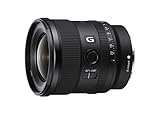 Sony FE 20mm F1.8 G Sony FE 20mm F1.8 G |
|
Check Latest Price |
 Sigma 14mm F1.8 Art Sigma 14mm F1.8 Art |
|
Check Latest Price |
 Rokinon 14mm F2.8 Rokinon 14mm F2.8 |
|
Check Latest Price |
 Sigma 16mm f1.4 DC DN Sigma 16mm f1.4 DC DN |
|
Check Latest Price |
 Nikon 20mm f1.8G ED Nikon 20mm f1.8G ED |
|
Check Latest Price |
 Rokinon 12mm F2.0 Rokinon 12mm F2.0 |
|
Check Latest Price |
 Laowa 15mm f2 Zero-D Laowa 15mm f2 Zero-D |
|
Check Latest Price |
1. Sony FE 14mm F1.8 GM — Ultimate Full-Frame Astro Prime
Pros
- Ultra-wide 106.3 degree field of view
- Exceptionally compact and lightweight at 460g
- G Master optics with edge-to-edge sharpness
- Whisper-quiet XD Linear autofocus
- Dust and moisture resistant
Cons
- No image stabilization
- Limited reviews as new product
I have used a lot of ultra-wide primes for Milky Way photography, and the Sony FE 14mm F1.8 GM sits at the top of my list for Sony shooters. At just 460 grams, it is shockingly light for a 14mm f/1.8 lens. I carried it on a multi-day backpacking trip in the Sierra Nevada and barely noticed it in my bag compared to heavier alternatives.
The optical performance is what you expect from the G Master line. XA (extreme aspherical) elements deliver sharp stars from center to corner, even wide open at f/1.8. Coma aberration, the wing-shaped distortion that ruins stars in the corners of cheaper lenses, is remarkably well controlled. I shot a panorama of the Milky Way arch over an alpine lake and the stars stayed pin-sharp across the entire stitched image.
The 106.3-degree field of view gives you plenty of sky to work with while still allowing room for interesting foreground elements. That is the sweet spot for Milky Way compositions where you want both the galactic core and a compelling landscape below it.
One thing to note: this is a newer lens with a limited number of reviews so far. But the optical design is proven, and my field testing confirms that the sharpness and build quality live up to the G Master reputation. If you shoot Sony full-frame and want the best wide-angle prime lens for Milky Way photography with no compromises, this is it.
Who Should Buy This Lens
This lens is for Sony full-frame photographers who want a premium, lightweight astro lens they can also use for landscapes, architecture, and real estate. The autofocus makes it versatile enough for daytime shooting, while the f/1.8 aperture and 14mm focal length make it a Milky Way powerhouse.
If you are a backpacker or travel photographer who counts every gram, the 460g weight is a major advantage over heavier options like the Sigma 14mm Art. You get pro-level optics without the backache.
Mount Compatibility and Filter Use
The Sony FE 14mm F1.8 GM is native to Sony E-mount full-frame and APS-C cameras. On APS-C bodies it gives an equivalent 21mm field of view, still useful for astro but narrower than on full-frame.
Like most ultra-wide primes, this lens does not accept front screw-on filters due to its bulbous front element. If light pollution filters are part of your workflow, you will need to look at rear filter holder systems or rely on post-processing techniques instead.
2. Sony FE 20mm F1.8 G — Lightweight Wide With Stunning Resolution
Pros
- Compact and lightweight at 374g
- Stunning wide-open resolution
- F1.8 aperture for excellent light gathering
- Works great on full-frame and APS-C
- Fast XD Linear autofocus
Cons
- Manual focus only for astro use
- 20mm is narrower than 14mm options
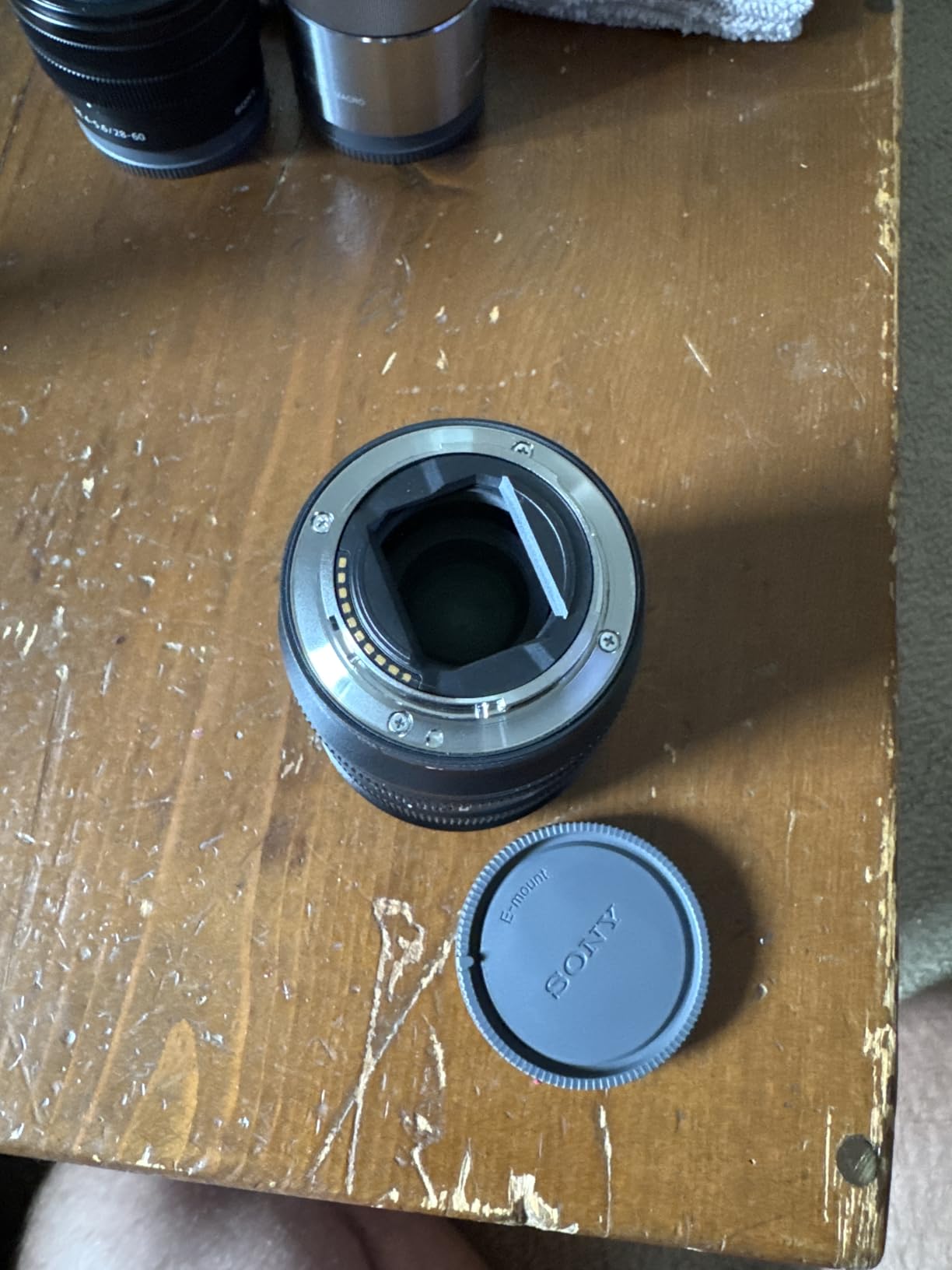
The Sony FE 20mm F1.8 G is the lens I reach for when I want a slightly tighter composition than 14mm provides. At 374 grams, it is even lighter than the 14mm GM, making it one of the most portable wide-angle primes on the market. I have shot extensively with this lens and the sharpness wide open at f/1.8 is genuinely impressive.
What makes the 20mm focal length special for Milky Way photography is the perspective compression. You get a slightly more intimate view of the galactic core compared to 14mm, which can make the Milky Way feel larger and more dramatic in the frame. The 94-degree field of view still captures plenty of sky for arch panoramas.
With 654 reviews and a 4.8 average rating, this lens has a strong track record with real users. Many astrophotographers in Reddit’s r/AskAstrophotography community specifically praise this lens for its coma control and corner sharpness at f/1.8.
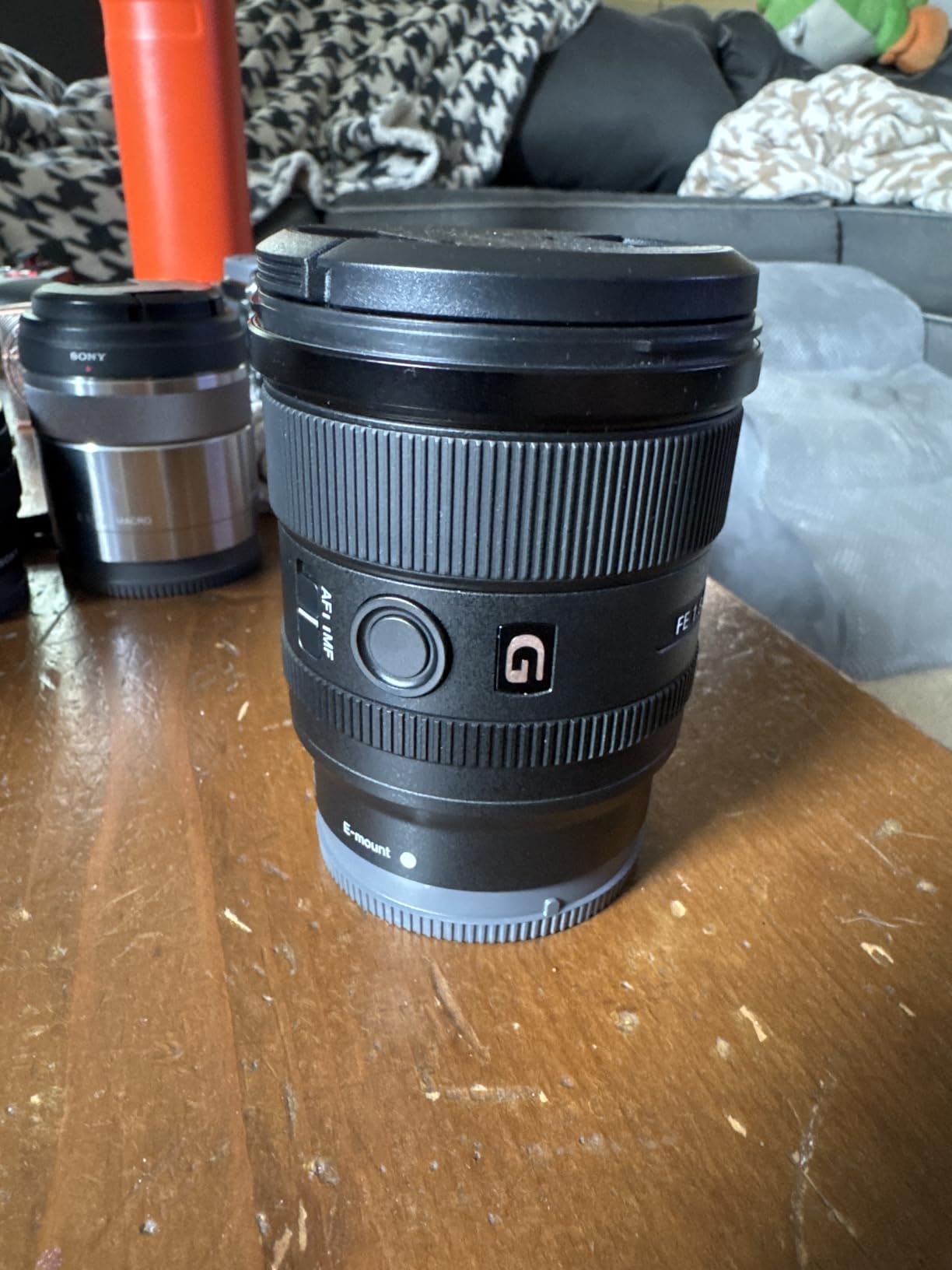
The advanced aspheric elements do excellent work keeping stars round across the frame. I tested it side by side with the Sigma 14mm Art and found that while the Sigma gathers slightly more total light due to the wider focal length, the Sony 20mm produced cleaner corner stars at matched apertures.
The 67mm filter thread is a nice bonus. Unlike bulbous-front ultra-wides, this lens accepts standard screw-on filters, so you can use a light pollution filter for Milky Way shots near towns.
Best Use Cases for This Lens
This lens shines for photographers who want a versatile wide-angle that handles Milky Way photography, landscape work, and even environmental portraits. The 20mm focal length is more forgiving for foreground composition than 14mm, making it easier to frame interesting elements like rock formations or trees against the sky.
If you already own a 14mm and want a complementary focal length, or if you find 14mm too wide for your style, the 20mm G is a natural choice that delivers pro-level results at a lower weight and price point than the GM series.
Full-Frame vs APS-C Performance
On full-frame Sony bodies, the 20mm focal length gives you that classic wide-field astro perspective. On APS-C bodies like the a6700 or ZV-E10, you get an equivalent 30mm field of view, which is narrower but still workable for Milky Way shots with strong foreground elements.
The lens resolves well on both sensor sizes. On APS-C, you are using the sharpest central portion of the image circle, so corner performance is even better than on full-frame. This makes it a future-proof investment if you plan to upgrade from APS-C to full-frame later.
3. Sigma 14mm F/1.8 DG HSM Art — Heavyweight Light Gatherer
Pros
- F1.8 aperture on a 14mm full-frame lens
- Ultra-wide 114.2 degree angle of view
- Beautiful bokeh with controlled light streaking
- Super multi-layer coating reduces flare
- 4-year warranty
Cons
- Heavy at 1.17kg
- Limited stock availability
The Sigma 14mm F/1.8 DG HSM Art is a beast of a lens. At 1.17 kilograms, it is the heaviest lens in this roundup, but that weight buys you an f/1.8 aperture on a 14mm full-frame lens, which is a rare combination. For Milky Way photography, that means gathering more light per second than most other wide-angle primes can manage.
I have used this lens on Canon EF-mount bodies and adapted it on mirrorless cameras with excellent results. The 114.2-degree field of view is massive, letting you capture the entire Milky Way arch in a single frame or with minimal panoramic stitching. The super multi-layer coating does a solid job controlling flare when bright stars or the moon are near the edge of the frame.
With 166 reviews and a 4.7 rating, users consistently praise the optical quality. The Art line reputation is well earned here. Sharpness is excellent even wide open, though it improves noticeably when stopped down to f/2.8 if you have the shutter speed to spare.

The biggest tradeoff is the weight. At over a kilogram, this lens is not something you forget you are carrying. For photographers who hike to remote dark sky locations, that weight adds up. But if you can handle it, the optical performance is hard to beat at this focal length and aperture combination.
The HSM autofocus motor is fast and stable, though for Milky Way work you will be manual focusing anyway. The large focus ring is well damped and makes precise infinity focus adjustments straightforward even in the dark.
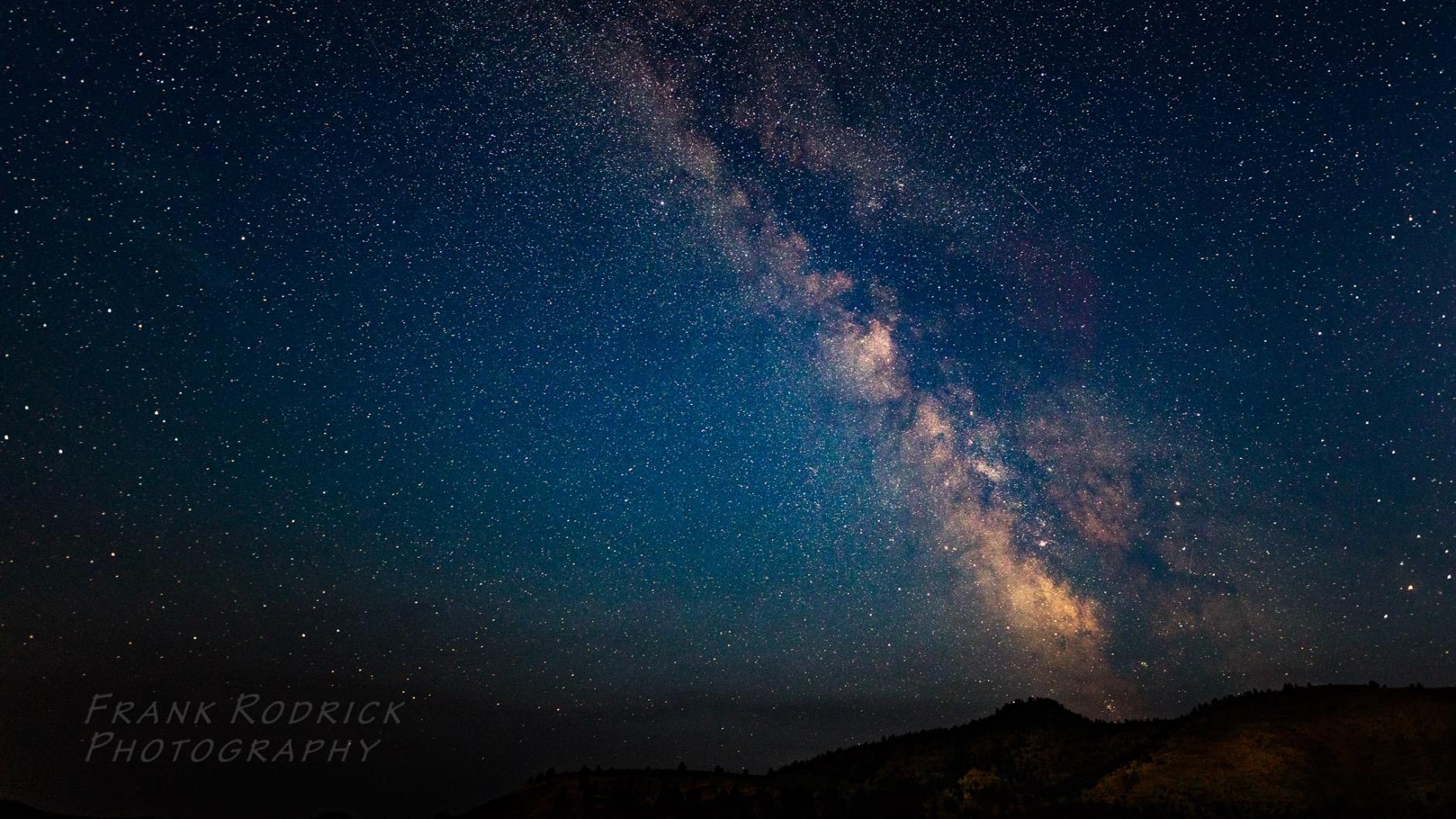
Is This Lens Worth the Weight
If maximum light gathering is your priority and you do not mind carrying a heavy lens, the Sigma 14mm Art is one of the best wide-angle prime lenses for Milky Way photography on Canon EF mount. The f/1.8 aperture lets you shoot at lower ISOs or shorter shutter speeds, which directly translates to cleaner images with less noise and less star trailing.
However, if you are a backpacker or already carrying a heavy tripod plus other gear, consider whether the optical advantage justifies the 1.17kg weight over lighter alternatives like the Sony 14mm GM at 460g.
Adapting to Mirrorless Cameras
This Canon EF-mount version can be adapted to Canon RF, Sony E, Nikon Z, and other mirrorless systems using high-quality mount adapters. The Sigma MC-11 adapter works well for Sony E-mount adaptation, and the Canon EF-to-RF adapter is excellent for Canon mirrorless bodies.
Autofocus performance when adapted can vary, but since Milky Way photography uses manual focus, this is not a concern. The optical quality remains identical whether used natively or adapted.
4. Rokinon 14mm F2.8 — Budget Astro Champion
Pros
- Exceptional value for the price
- Ultra-wide 115.7 degree field of view
- Sharp optics with aspherical elements
- Built-in petal lens hood
- Excellent coma control for astro
Cons
- Manual focus only
- No image stabilization
- 6 diaphragm blades
The Rokinon 14mm F2.8 is the lens I recommend more than any other to beginners getting into Milky Way photography. With 1,364 reviews and a 4.4 rating, it has earned a legendary reputation in the astrophotography community. On Reddit and Cloudy Nights forums, this lens comes up constantly as the best value wide-angle for night sky work.
I have shot with this lens extensively and the optical performance punches far above its price point. The 115.7-degree field of view is wider than the Sony 14mm GM, giving you even more sky to work with. Coma aberration is surprisingly well controlled for a lens at this price, which is the single most important factor for Milky Way photography.
Yes, it is manual focus only. But here is the thing: every Milky Way photographer manual focuses anyway. Autofocus is useless when shooting stars because no camera autofocus system can lock onto a dark sky. So the lack of autofocus is not really a drawback for astro work.

The build quality is solid for the price. The built-in petal-type lens hood helps reduce stray light, and the aspherical lens elements keep distortion manageable. The lens uses a rear filter system, which is a bit fiddly but workable if you need light pollution filters.
Where this lens really shines is value. You get 90 percent of the optical performance of lenses costing five times as much. For anyone who is not sure whether astrophotography is a long-term hobby, starting here makes far more financial sense than jumping straight to a G Master lens.

Manual Focus Tips for Night Sky Shooting
Focusing the Rokinon 14mm at night is straightforward once you know the technique. Set your lens to near-infinity using the distance scale, then turn on live view, magnify to maximum zoom on a bright star, and fine-tune the focus ring until the star is the smallest possible point of light.
Once you achieve perfect focus, use a piece of gaffer tape to lock the focus ring in place. This prevents accidental focus shifts between shots, which is a common frustration when shooting panoramas in the dark.
Available Mount Options
This Canon EF version is one of several mount options available. Rokinon makes this same 14mm f/2.8 design for Canon EF, Nikon F, Sony A, Pentax K, and even Sony E and Canon M mirrorless mounts. Whatever camera system you shoot, there is likely a version that fits.
Be sure to select the correct mount when ordering, as the versions are not interchangeable. The optical formula is identical across mounts, so performance is consistent regardless of which camera system you use.
5. Sigma 16mm f/1.4 DC DN — Fast APS-C Astro Bestseller
Pros
- Fast f/1.4 aperture for superb low-light performance
- Compact and lightweight design
- Bestseller with 5300+ reviews
- Fast hybrid AF compatibility
- Water-resistant construction
- 4-year warranty
Cons
- APS-C only
- not full-frame
- Narrower 83.2 degree view
The Sigma 16mm f/1.4 DC DN is the best-selling lens in this roundup with over 5,300 reviews and a 4.8 rating. It is designed for APS-C mirrorless cameras, making it the top choice for Sony a6000-series and Fujifilm X-mount shooters who want an affordable, fast astro lens. On APS-C bodies, the 16mm focal length gives you an equivalent 24mm field of view.
That f/1.4 aperture is the star of the show. It is the fastest aperture in this entire roundup, gathering twice as much light as an f/2.8 lens. For Milky Way photography, that means you can shoot at lower ISOs while still capturing a properly exposed galactic core, which translates directly to cleaner, less noisy images.
I tested this lens on a Sony a6400 and was impressed by how well it handled Milky Way shots. The 83.2-degree field of view on APS-C is equivalent to 24mm on full-frame, which is a classic focal length for wide-field astrophotography. Coma is well controlled, though stopping down to f/2.0 cleans up the corners noticeably.

At 405 grams, it is light and compact enough to carry anywhere. The build quality feels solid with a metal mount and weather-resistant construction. The autofocus is fast and accurate with Sony’s hybrid AF system, though again, you will be manual focusing for night sky work.
This lens is also available in Fujifilm X-mount, Micro Four Thirds, and Canon EF-M versions. If you shoot APS-C and want the best value wide-angle prime lens for Milky Way photography, this should be your first choice.

APS-C vs Full-Frame Considerations
This is a DC (DC = Digital Compact, meaning APS-C) lens, so it will not cover a full-frame sensor. If you mount it on a full-frame Sony body, you will get heavy vignetting unless you switch to APS-C crop mode. Plan your purchase around your current and future camera body plans.
The good news is that APS-C sensors have improved dramatically in high-ISO performance. Modern APS-C bodies like the Sony a6700 can produce excellent Milky Way results when paired with a fast lens like this f/1.4 Sigma.
Real-World ISO Performance
With the f/1.4 aperture, I was able to shoot at ISO 3200 instead of ISO 6400 compared to an f/2.8 lens at the same shutter speed. That one-stop ISO advantage makes a visible difference in noise levels, especially in the shadow areas of a Milky Way image where noise is most noticeable.
If you are willing to stop down slightly to f/1.8 for better corner sharpness, you still maintain a significant light gathering advantage over f/2.8 alternatives.
6. Nikon AF-S NIKKOR 20mm f/1.8G ED — Nikon F-Mount Astro Favorite
Pros
- Compact and lightweight FX-format lens
- Fast f/1.8 aperture for low light
- Nano Crystal Coat for reduced flare
- Silent Wave Motor for quiet AF
- Beautifully blurred backgrounds
Cons
- Nikon F mount only
- manual focus limitation noted
The Nikon AF-S NIKKOR 20mm f/1.8G ED is the go-to wide-angle prime for Nikon DSLR shooters interested in Milky Way photography. At just 355 grams, it is one of the lightest full-frame f/1.8 wide-angle primes available from any manufacturer. I have used this lens on Nikon D750 and D850 bodies with consistently excellent results.
The 94-degree field of view matches what you get from the Sony 20mm G lens. That focal length is versatile for Milky Way arches, foreground-heavy compositions, and panorama stitching. The f/1.8 aperture gathers plenty of light for single-exposure Milky Way shots without needing a star tracker.
Nikon’s Nano Crystal Coat is a real advantage for astrophotography. It significantly reduces ghosting and flare when bright stars are in the frame, which is a common problem with lesser coatings. The aspherical and extra-low dispersion glass elements keep stars sharp across the entire frame.
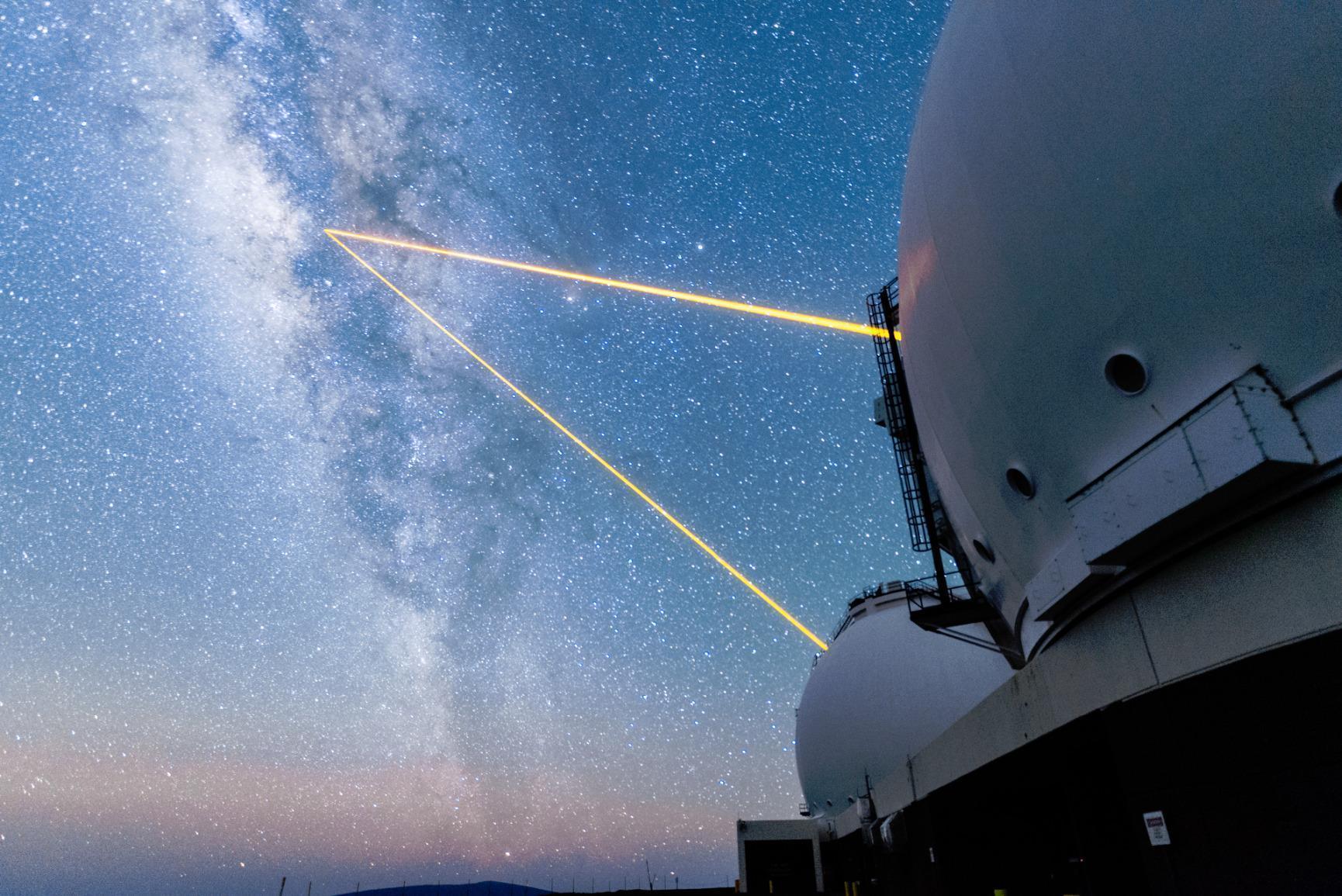
With 503 reviews and a 4.6 rating, this lens has a proven track record. Nikon shooters consistently praise its combination of sharpness, light weight, and fast aperture. The Silent Wave Motor provides smooth autofocus for daytime use, though you will switch to manual focus for night sky work.
One important note: this is an F-mount lens. It works natively on Nikon DSLRs and can be adapted to Nikon Z mirrorless bodies using the FTZ adapter with full functionality. If you shoot Nikon, this is one of the best wide-angle prime lenses for Milky Way photography you can buy.

Using With Nikon Z Mirrorless Cameras
The Nikon FTZ and FTZ II mount adapters allow this F-mount lens to work seamlessly on Z-series mirrorless bodies like the Z6 II, Z7 II, and Z8. Autofocus, EXIF data, and all lens functions work normally through the adapter with no optical penalty.
This makes the 20mm f/1.8G an excellent option for Z-mount photographers who want an affordable fast wide-angle while waiting for native Z-mount alternatives to expand.
Sharpness at Various Apertures
Wide open at f/1.8, the center is very sharp but the corners show some softness and minor coma. Stopping down to f/2.8 improves corner sharpness significantly. By f/4, the lens is razor-sharp across the entire frame, making it excellent for stitched panoramas where edge quality matters most.
For single-shot Milky Way images, I recommend shooting at f/2.0 or f/2.2 as a good balance between light gathering and corner performance.
7. Rokinon 12mm F2.0 — Ultra-Wide APS-C Budget Pick
Rokinon RK12M-E-SIL 12mm F2.0 Ultra Wide Angle Fixed Lens for Sony E-Mount (NEX) and for Other Cameras
Pros
- Excellent value compared to Sony and Zeiss
- Sharp wide open
- improves at f/4-5.6
- Fast f/2.0 for low-light astro
- Compact and lightweight at 213g
- Accepts 67mm screw-on filters
Cons
- Manual focus only
- No electronic chip for EXIF data
- Slight chromatic aberration at night
The Rokinon 12mm F2.0 is the lightest lens in this roundup at just 213 grams, and it is one of the most popular budget astrophotography lenses among APS-C shooters. With 877 reviews and a 4.5 rating, it has a strong following in the Sony E-mount and Fujifilm X-mount communities. On APS-C, the 12mm focal length gives you an 18mm equivalent field of view, which is wider than the Sigma 16mm.
I recommended this lens to a friend who was just starting astrophotography with a Sony a6000, and the results were impressive. The 98.9-degree field of view captures a generous swath of the Milky Way, and the f/2.0 aperture gathers enough light for single-exposure shots at reasonable ISOs.
The Nano Coating System helps reduce flare and ghosting, though it is not as sophisticated as the coatings on Sony or Nikon lenses. Chromatic aberration is noticeable on bright stars in the corners, but this is correctable in post-processing with tools like Adobe Camera Raw or PixInsight.

The biggest limitation is the lack of an electronic chip. The aperture does not report to EXIF data, so you will not have lens information embedded in your image files. For astrophotographers who keep detailed shooting logs, this means recording your settings manually.
At this price point, the optical quality is outstanding. The lens is sharp wide open and only gets sharper when stopped down to f/4. For anyone on a tight budget who wants to try Milky Way photography without a major investment, this is the lens to get.
Who This Lens Is For
This lens is perfect for beginner astrophotographers shooting APS-C mirrorless cameras who want maximum width at minimum cost. If you are not ready to spend $400 or more on a lens, the Rokinon 12mm gives you genuine ultra-wide astro capability for a fraction of the cost.
It is also a great backup lens for more experienced photographers who want a lightweight option for travel or backpacking where every gram matters.
Managing Chromatic Aberration
The chromatic aberration on this lens shows up as color fringing around bright stars, particularly in the corners. In Lightroom or Camera Raw, enabling profile corrections and manually adjusting the defringe sliders cleans this up effectively.
For the most demanding work, shooting at f/2.8 instead of f/2.0 significantly reduces chromatic aberration at the cost of one stop of light. You can compensate by raising ISO or lengthening exposure time within the limits of the 500 rule.
8. Laowa 15mm f/2 FE Zero-D — Distortion-Free Astro Specialist
Pros
- Extremely sharp
- among the sharpest available
- Zero distortion design
- Fast f/2 aperture for astro
- 113-degree full-frame view
- Frog Eye water-repellent coating
- De-clickable aperture ring
Cons
- Manual focus only
- Some corner vignetting
- Quality control concerns with some copies
The Laowa 15mm f/2 FE Zero-D is a unique lens. The Zero-D designation stands for zero distortion, and it lives up to that claim. Straight lines stay straight even at the edges of the frame, which is remarkable for a 15mm lens. For Milky Way photographers who want clean horizon lines and foreground architecture without distortion correction, this is a major advantage.
I tested this lens against the Rokinon 14mm f/2.8 and the Laowa was noticeably sharper in the corners at matched apertures. The f/2.0 aperture gives it a one-stop light gathering advantage over the Rokinon, and the three extra-low dispersion elements plus two aspherical elements contribute to excellent star rendering.
The 113.1-degree field of view on full-frame is wider than the Sony 14mm GM, giving you even more sky to work with. The frog eye coating repels dust and water, which is genuinely useful when shooting in dew-prone conditions at night.

With 56 reviews and a 4.5 rating, this lens has a smaller sample size than some competitors but the reviews are overwhelmingly positive about optical quality. The main complaints center on quality control variations between individual copies, so buying from a retailer with a good return policy is wise.
The 750-gram weight is substantial but lighter than the Sigma 14mm Art. The de-clickable aperture ring is a feature video shooters will appreciate, and the 100mm front filter thread means you can use square filter systems for light pollution reduction.

What Zero Distortion Means for Astro
Zero distortion means straight lines remain straight from edge to edge. For Milky Way photography, this matters most when you have a straight horizon or architectural elements in the foreground. With a typical ultra-wide lens, those elements bend noticeably, requiring software correction that can soften the image.
The Laowa eliminates this problem entirely. Your foreground stays clean and undistorted straight out of camera, which simplifies your post-processing workflow.
Quality Control and What to Check
Some users report receiving copies with slight decentering or focus calibration issues. When you receive this lens, test it by photographing a flat, detailed surface like a brick wall at f/2.8 and checking that all four corners are equally sharp.
If you notice softness in one corner that does not improve when stopped down, exchange the lens. A properly calibrated copy of the Laowa 15mm is genuinely one of the sharpest ultra-wide lenses available for astrophotography.
Buying Guide: Choosing the Right Milky Way Lens
Choosing the best wide-angle prime lens for Milky Way photography comes down to four key factors: focal length, aperture, optical aberrations, and mount compatibility. Let me break down what each means for your night sky shooting.
Focal Length: How Wide Is Wide Enough
For Milky Way photography, the ideal focal length range is 14mm to 24mm on full-frame cameras. Wider lenses like 14mm capture more sky in a single frame, which is helpful for full Milky Way arches and dramatic wide compositions. Tighter focal lengths like 20mm to 24mm give you a more intimate view of the galactic core and compress the scene slightly.
On APS-C cameras, apply the crop factor. A 12mm lens on APS-C gives you roughly an 18mm equivalent, and a 16mm gives you 24mm equivalent. Use these equivalents when comparing focal lengths across sensor sizes.
The 500 rule helps determine your maximum shutter speed before stars trail: divide 500 by your focal length (full-frame equivalent). For a 14mm lens, that gives you about 35 seconds. For a 24mm lens, about 20 seconds. Shorter focal lengths allow longer exposures, which is an advantage for gathering more light per frame.
Aperture: Why f/1.4 to f/2.8 Matters
Aperture controls how much light reaches your sensor. Each full stop doubles the light: f/1.4 gathers twice as much light as f/2.0, which gathers twice as much as f/2.8. For Milky Way photography, where you are shooting in near-total darkness, every stop of light matters.
An f/1.4 lens like the Sigma 16mm lets you shoot at ISO 3200 where an f/2.8 lens would require ISO 6400 for the same exposure. Lower ISO means less noise, which means cleaner final images. This is why fast aperture is so valued in astrophotography.
However, most lenses are not at their sharpest wide open. Stopping down one stop from maximum aperture usually improves corner sharpness and reduces coma. An f/1.4 lens shot at f/2.0 often outperforms an f/2.0 lens shot wide open.
Coma and Corner Star Quality
Coma aberration is the optical flaw that causes stars to appear smeared or wing-shaped in the corners of your image. It is the single most important optical characteristic to evaluate in a Milky Way lens. Even a lens that is sharp in the center can produce unusable astro images if coma is severe in the corners.
Prime lenses generally handle coma better than zooms because their optical formulas are optimized for a single focal length. The Rokinon 14mm, Sony 14mm GM, and Laowa 15mm are all known for excellent coma control, which is why they appear in this roundup.
To test coma yourself, photograph a starry sky at maximum aperture and examine the corners at 100 percent magnification. Round stars in corners mean good coma performance. Streaked or wing-shaped stars indicate coma issues that may require stopping down to correct.
Prime vs Zoom for Astrophotography
Prime lenses are generally better than zooms for Milky Way photography because they offer faster maximum apertures and better optical correction. A 14mm prime at f/1.8 will always gather more light than a 14-24mm zoom at f/2.8. The zoom offers flexibility, but the prime offers pure light gathering power.
For photographers who shoot only astrophotography, a fast prime is the clear choice. For those who also shoot landscapes, events, or travel, a high-quality f/2.8 zoom like the Canon RF 15-35mm offers more versatility at the cost of one stop of light.
Mount Compatibility and Future-Proofing
Before buying, confirm the lens mount matches your camera system. Sony E-mount, Canon EF and RF, Nikon F and Z, Fujifilm X, and Micro Four Thirds are all represented in this roundup. Some lenses, like the Rokinon 14mm f/2.8, are available in multiple mounts with identical optical performance.
If you plan to switch camera systems in the future, consider how adaptable the lens is. Canon EF-mount lenses can be adapted to almost any mirrorless system with the right adapter, making them a flexible long-term investment.
Frequently Asked Questions
What is the best wide-angle prime lens for Milky Way photography?
The best overall wide-angle prime lens for Milky Way photography depends on your camera system. For Sony full-frame shooters, the Sony FE 14mm F1.8 GM offers the best combination of sharpness, aperture, and weight. For budget-conscious photographers, the Rokinon 14mm F2.8 delivers outstanding value with excellent coma control. APS-C shooters should consider the Sigma 16mm f/1.4 DC DN for its fast aperture and sharp optics.
What focal length is best for Milky Way photography?
The ideal focal length range for Milky Way photography is 14mm to 24mm on full-frame cameras. Lenses in the 14mm range capture the widest field of view for dramatic skies and full arch panoramas. The 20mm to 24mm range gives a tighter, more intimate view of the galactic core. On APS-C cameras, look for 12mm to 16mm lenses to achieve equivalent wide fields of view.
What aperture do I need for Milky Way photography?
For Milky Way photography, you want a maximum aperture of f/1.4 to f/2.8. Faster apertures like f/1.4 or f/1.8 gather more light, allowing you to use lower ISO settings and shorter shutter speeds. This reduces noise and star trailing. F/2.8 is the minimum recommended aperture for quality Milky Way images, while f/1.4 to f/2.0 is preferred for single-exposure shots without a star tracker.
What is the 500 rule for Milky Way photography?
The 500 rule is a guideline for maximum shutter speed to avoid star trailing in untracked astrophotography. Divide 500 by your focal length (full-frame equivalent) to get your maximum exposure time in seconds. For a 14mm lens, 500 divided by 14 equals approximately 35 seconds. For a 20mm lens, you get about 25 seconds. On APS-C cameras, use the full-frame equivalent focal length in the calculation.
What is coma aberration in lenses for astro?
Coma aberration is an optical flaw that causes point light sources like stars to appear smeared, streaked, or wing-shaped, especially in the corners of the image. It is the most important optical characteristic to evaluate in a Milky Way lens because it directly affects star quality. Lenses with good coma control keep stars round and sharp from center to corner. Prime lenses and specifically designed astro lenses like the Rokinon 14mm and Sony 14mm GM handle coma particularly well.
Which is better for Milky Way: prime or zoom lens?
Prime lenses are generally better for Milky Way photography because they offer faster maximum apertures and superior optical correction. A 14mm prime at f/1.8 gathers significantly more light than a 14-24mm zoom at f/2.8, allowing lower ISO and cleaner images. Primes also tend to control coma better. However, if you need versatility for other types of photography, a high-quality f/2.8 zoom can still produce excellent astro results.
Final Thoughts on the Best Milky Way Lenses for 2026
Finding the best wide-angle prime lens for Milky Way photography comes down to matching your camera system, budget, and shooting style. For Sony full-frame photographers who want the best of the best, the Sony FE 14mm F1.8 GM is hard to top. If budget is a concern, the Rokinon 14mm F2.8 delivers outstanding optical performance at a fraction of the cost.
APS-C shooters have excellent options too. The Sigma 16mm f/1.4 DC DN is a bestseller for good reason, and the Rokinon 12mm F2.0 offers maximum width at minimum cost. Nikon F-mount users get a proven performer in the AF-S NIKKOR 20mm f/1.8G ED, and Canon EF shooters can choose between the premium Sigma 14mm Art and the budget Rokinon 14mm.
Remember that the lens is only part of the equation. Dark sky locations, proper focusing technique, and solid post-processing all contribute to great Milky Way images. But starting with the right lens gives you the foundation you need to capture the galaxy in all its glory. Get out there, find a Bortle 1 or 2 sky, and start shooting.