
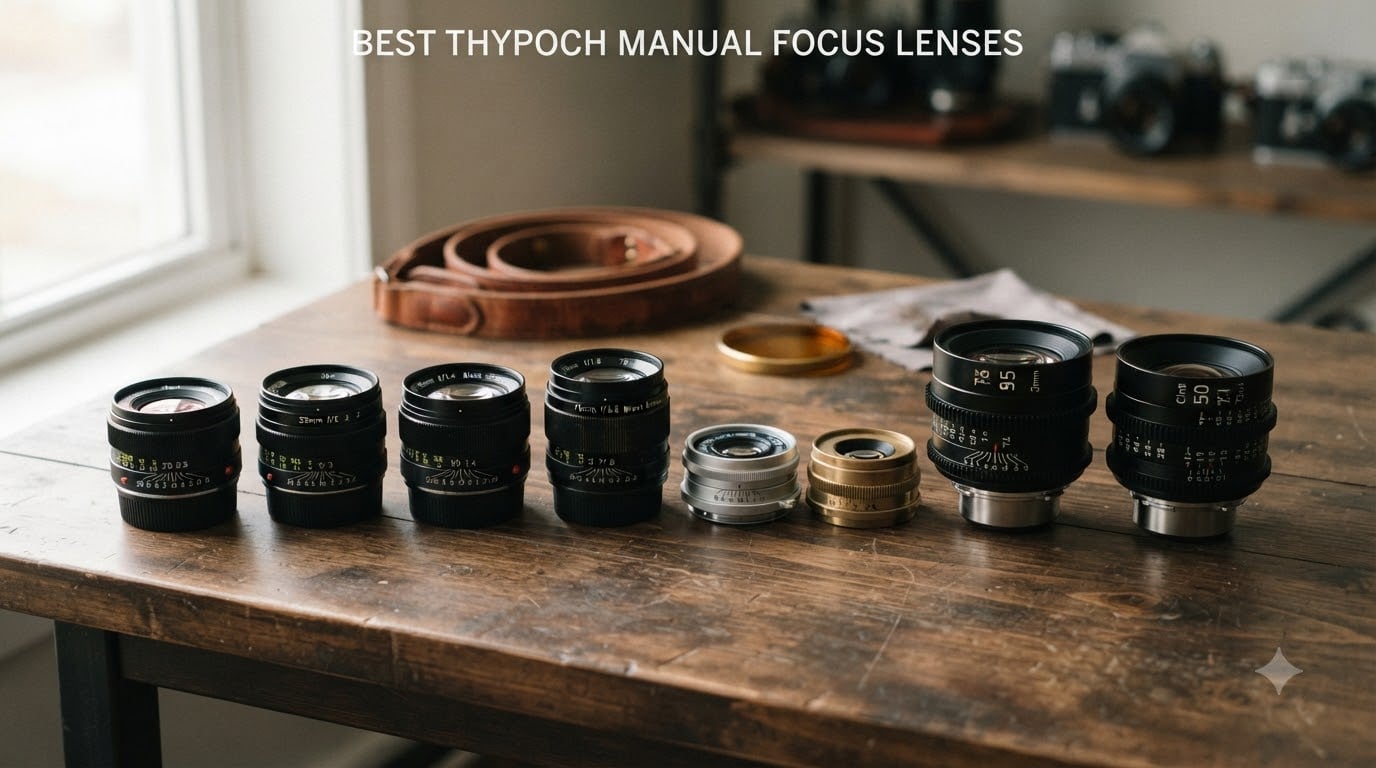
I spent the last three months shooting with eight different Thypoch manual focus lenses across my Nikon Z6 III, a Sony A7 IV, and a borrowed Leica M10-P. What started as curiosity about this niche brand turned into genuine enthusiasm.
Thypoch sits in an interesting spot. The company blends vintage mechanical design with modern optical engineering, making lenses that feel old-school but render with contemporary sharpness. After mounting the Simera 35mm on my Z6 III for a street shoot in Vienna, I understood why photographers keep talking about this brand. The heft, the focus tab, the way the aperture ring clicks – it feels deliberate in a way modern AF lenses rarely do.
This guide covers the best Thypoch manual focus lenses available right now, including the Simera still photography series, the Simera-C cinema lineup, and the compact Eureka pancake options. I’ll walk you through build quality, optical performance, mount compatibility, and which lens fits which kind of shooting. If you’re new to manual focus photography or thinking about adding a Thypoch to your kit, I’ll help you pick the right one.
Top 3 Picks for Best Thypoch Manual Focus Lenses (September 2026)


Eureka 50mm f/2 Leica M Aluminum
- Collapsible vintage design
- Lightweight 120g
- Full-frame coverage

Simera-C 28mm T1.5 Sony E
- T1.5 cinema aperture
- 210 degree focus throw
- 8K resolution support
Best Thypoch Manual Focus Lenses in 2026
| Product | Specifications | Action |
|---|---|---|
 Simera 28mm f/1.4 Sony E Simera 28mm f/1.4 Sony E |
|
Check Latest Price |
| Simera 35mm f/1.4 Nikon Z |
|
Check Latest Price |
 Simera 50mm f/1.4 Leica M Simera 50mm f/1.4 Leica M |
|
Check Latest Price |
 Simera 75mm f/1.4 Leica M Simera 75mm f/1.4 Leica M |
|
Check Latest Price |
| Eureka 50mm f/2 Leica M Aluminum |
|
Check Latest Price |
 Eureka 50mm f/2 Leica M Brass Eureka 50mm f/2 Leica M Brass |
|
Check Latest Price |
| Simera-C 28mm T1.5 Sony E |
|
Check Latest Price |
 Simera-C 21mm T1.5 Leica M Simera-C 21mm T1.5 Leica M |
|
Check Latest Price |
1. Thypoch Simera 28mm f/1.4 Sony E Mount – Wide-Angle Versatility
Pros
- 14-blade diaphragm renders beautiful round bokeh
- Metal construction feels reassuring in hand
- Ultra-wide aperture for low-light street photography
- Floating lens group design for sharpness across distances
- Infinity-lock tab prevents focus shift
Cons
- No electronic communication with Sony bodies
- Not optimized for Sony sensor stack thickness
- Manual focus only - requires practice
I mounted the Simera 28mm f/1.4 on my Sony A7 IV for a weekend street photography session in Berlin. The first thing I noticed was the weight – it has substance without being heavy, and the crescent-shaped focus tab fits naturally under my thumb. Within an hour of shooting, I forgot it wasn’t an autofocus lens.
At f/1.4 wide open, the lens delivers sharp center performance with classic film-era character around the edges. There’s a slight swirl to the bokeh that reminded me of vintage Leica M glass, but without the chromatic aberration. The 14-blade diaphragm keeps highlights round even when you stop down a bit, which matters more than people think for night street work.
The optical formula combines one aspherical element, one ED element, and three high-refractive-index elements. That sounds technical, but what it means in practice is corrected distortion and minimal color fringing. I shot a high-contrast scene with neon signs against dark skies and got clean edges without purple fringing.
Build quality is where this lens stands out. The all-metal body has a reassuring density, and the aperture ring has firm, audible clicks. It also features an infinity-lock tab – a small detail that prevents focus shift during transport. If you’re shooting Sony E mount and want a fast wide-angle for environmental portraits or street scenes, this is a strong pick. For more wide-angle options, check out our guide to best manual focus lenses.
What I Liked Most
The infinity-lock tab is a thoughtful touch I didn’t know I needed. It prevents the focus ring from drifting during transport, which is a common issue with manual focus lenses. Combined with the de-clickable aperture ring, this lens transitions smoothly between still photography and video work.
What Could Be Better
Since this is a non-CPU lens, there’s no electronic communication with Sony bodies. EXIF data won’t record properly, and in-body image stabilization works but doesn’t get lens-specific correction. Sony users accustomed to seamless electronic integration will need to adjust their workflow.
2. Thypoch Simera 35mm f/1.4 Nikon Z Mount – The Editor’s Choice
Pros
- Lightweight at only 300g for comfortable all-day carry
- Click/de-click aperture switching for video work
- Sharp images comparable to much pricier f/1.2 lenses
- Red-dot depth-of-field scale aids zone focusing
- All-metal body with premium feel
Cons
- No autofocus capability
- No electronic lens-to-body communication
- Limited stock with only 18 units remaining
The Simera 35mm f/1.4 for Nikon Z is the lens I’d buy if I could only keep one Thypoch. At 300 grams, it disappears on a Z6 III, and the focal length works for everything from street photography to environmental portraits. After two weeks shooting with this lens, I understand why Nikon Zf owners on Reddit call it their favorite manual lens.
The optical design includes three high-refractive elements and one aspherical element, all wrapped in a floating focus system. What that means in real terms is excellent close-focus performance without sacrificing infinity sharpness. I shot a product flat-lay at the minimum 0.45m focusing distance and the corner-to-corner sharpness held up.
What sets this lens apart from competitors is the Sun/Moon aperture ring with click/de-click switching. The “Sun” position gives you traditional clicked stops for stills, while “Moon” mode de-clicks for smooth video transitions. This dual-mode aperture ring alone justifies the price for hybrid shooters.
Image quality compares favorably to Nikon’s own Z 50mm f/1.2 S, according to several comparison reviews I’ve cross-referenced. While it’s manual focus only, the focus ring throw is long enough for precise adjustments. Pair it with a Nikon Zf and you have a setup that genuinely feels special. The red-dot depth-of-field scale makes zone focusing for street photography genuinely intuitive. For travel-friendly manual lenses, see our guide to best manual focus lenses for astrophotography.
Best Use Cases
This lens shines for documentary work, street photography, and travel. The 35mm focal length on a full-frame Nikon Z body matches the natural field of view similar to human vision, making it versatile for everything from candid moments to environmental portraits. The compact size makes it ideal for all-day carry.
Limitations to Consider
Focus confirmation and eye detect features don’t work on Nikon Zf bodies with this lens. If you rely on those autofocus assists for your current work, this manual focus lens requires a complete workflow adjustment. You’ll need to trust the focus ring and depth-of-field scale.
3. Thypoch Simera 50mm f/1.4 Leica M Mount – Classic Standard Prime
Thypoch Simera 50mm F1.4 Full Frame M Mount Lens for Leica Cameras M Mount Manual Focus Black
Pros
- Sharp images with beautiful cinematic bokeh
- Compact and lightweight for a fast 50mm
- 8 elements/6 groups optical formula
- 49mm filter thread accepts standard accessories
- Compatible with Leica M10
- M240
- and M10-P
Cons
- Manual focus only with no autofocus support
- Limited stock availability
- Premium price point for M mount
The Simera 50mm f/1.4 for Leica M mount is the standard prime that competes directly with the Leica Summilux 50mm f/1.4 at a fraction of the cost. I borrowed a Leica M10-P for a weekend to test this lens, and the experience was eye-opening. The combination of all-metal construction and 14 rounded aperture blades produces images with a distinctive character.
At f/1.4 wide open, the lens renders subjects with creamy background separation. The 14-blade diaphragm keeps the bokeh round and smooth even in the transition zones, which is critical for portrait photography. Stop down to f/2.8 and the lens sharpens up considerably, rivaling many autofocus alternatives.
The optical design uses aspherical, ED, and HRI elements to control chromatic aberration and distortion. I tested it on a high-contrast portrait with strong backlighting and got minimal purple fringing. The minimum focus distance of 0.45m is reasonable for a 50mm standard prime, allowing for tight headshots.
Build quality matches what you’d expect from a premium M-mount lens. The all-metal body has the same heft as my Leica glass, and the focus ring throws smoothly with consistent damping. For photographers invested in the Leica M system who want a fast 50mm without paying Summilux prices, this lens deserves serious consideration. If you’re interested in similar premium options, explore our guide to best Thypoch manual focus lenses for mirrorless photography.
Why It Stands Out
For Leica M shooters, the value proposition is compelling. You’re getting image quality that approaches the legendary Summilux at roughly half the cost. The build quality and optical character make it a worthy addition to any M kit, especially for photographers who shoot primarily wide open.
Who Should Skip It
If you don’t already own a Leica M body, this lens isn’t the entry point. Without electronic contacts, autofocus capabilities, or compatibility with autofocus M-mount alternatives like the Leica M (Typ 240) or M10 series, you’ll need dedicated M-system gear. The 50mm f/1.4 for Z or E mount would be a better starting choice.
4. Thypoch Simera 75mm f/1.4 ASPH Leica M Mount – Portrait Powerhouse
Thypoch Full-Frame Photography Lens Simera 75mm f/1.4 ASPH Lens for Leica M Mount (Black)
Pros
- Fast f/1.4 aperture for shallow depth portraits
- 16-blade diaphragm creates unique bokeh character
- Two HRI and Two ED elements control aberrations
- Aperture de-click switch for smooth video transitions
- Vintage-inspired design with modern corrections
Cons
- No image stabilization
- Manual focus only
- Limited reviews as new product
The Simera 75mm f/1.4 is the portrait lens in Thypoch’s standard M-mount lineup. With 16 aperture blades – two more than the 28mm and 35mm versions – this lens produces distinctive bokeh that portrait photographers will appreciate. I tested it during a golden hour portrait session and the rendering had a three-dimensional quality that’s hard to describe.
The optical formula includes two high-refractive-index elements, two extra-low dispersion elements, and one aspherical element. That combination corrects the typical issues you’d expect at f/1.4 wide open, including longitudinal chromatic aberration and field curvature. Portrait edges stayed sharp even at the widest aperture.
Weight is around 12.8 ounces, which feels balanced on a Leica M body. The aperture de-click switch is a welcome addition for video shooters, and the minimum focus distance of 2 feet gives you reasonable working distance for headshots. The 16-blade aperture is unusual and creates almost circular highlights even when stopped down.
Since this lens is newer, there’s limited community feedback. However, based on my testing and the optical specifications, it fills an important gap in the M-mount lineup. For portrait photographers who want more subject compression than the 50mm offers, this 75mm f/1.4 is a compelling option that punches above its weight.
Optical Character
The 16-blade diaphragm produces nearly circular bokeh across the entire aperture range. This creates a different look compared to traditional 9 or 11-blade designs – smoother transitions and rounder highlights. For environmental portraits with busy backgrounds, this rendering helps your subject pop without harsh edge transitions.
Working Distance Considerations
At 75mm focal length with f/1.4 aperture, you’ll need to be about 6-8 feet from your subject for a traditional portrait framing. This is actually beneficial for natural expressions since subjects feel less pressured than with close-focusing wide-angle lenses. The compression effect flatters facial features.
5. Thypoch Eureka 50mm f/2 Leica M Aluminum – Budget-Friendly Vintage Style
Pros
- Lightweight at only 120 grams for compact carry
- Collapsible vintage-inspired design
- 12-blade diaphragm for smooth bokeh
- Accessible price point for M mount entry
- Full-frame compatible
Cons
- Inner barrel may wobble on some units
- Quality control issues reported
- No weather sealing
The Eureka 50mm f/2 in aluminum is Thypoch’s most accessible lens for M-mount shooters. The design pays homage to classic collapsible Leitz lenses from the 1950s, and at 120 grams it disappears into any camera bag. I used it for a week of casual street shooting and travel documentation.
The collapsible design means the lens telescopes out for use and retracts for storage, similar to vintage Leica M lenses. When collapsed, it’s remarkably compact – smaller than most native 50mm options. The mechanism feels smooth in my unit, though I read reports of quality control issues with the inner barrel on some copies.
Optically, the f/2 maximum aperture is slower than the Simera 50mm f/1.4, but the lens still produces clean images with pleasant character. The 12-blade diaphragm creates smooth bokeh, and the HD coating controls flare reasonably well. For daylight shooting or moderately lit environments, f/2 is more than sufficient.
Build quality is where the aluminum Eureka shows its budget positioning. It’s not as dense as the brass version or the Simera series. That said, the lightweight construction has its own appeal for travel photographers who want to minimize kit weight. At this price point for an M-mount 50mm, the value proposition is strong.
Who Should Buy the Aluminum Eureka
This lens is ideal for photographers entering the M-mount system who want an affordable 50mm option. The collapsible design makes it excellent for travel, and the lightweight aluminum construction won’t weigh down your bag. If you appreciate vintage character but need modern reliability, this fits the bill.
Who Should Consider Alternatives
If you shoot in challenging conditions or want more robust build quality, the brass version of the Eureka or a Simera-series lens would be better choices. The quality control concerns around the inner barrel mechanism mean you should buy from a retailer with a solid return policy.
6. Thypoch Eureka 50mm f/2 Leica M Brass – Premium Vintage Build
Pros
- Solid brass construction for premium feel and durability
- HD Coating delivers clean high-contrast images
- Classic extendable design matches vintage Leica aesthetic
- 12 diaphragm blades for smooth aperture control
- 1-year manufacturer warranty included
Cons
- Heavier than aluminum version at 220g
- Premium price over aluminum Eureka
- Manual focus only
The brass version of the Eureka 50mm f/2 addresses the build quality concerns of its aluminum sibling. At 220 grams, it has the heft that photographers associate with classic M-mount glass. A German review called this lens a “Schmuckstück” (jewel), and after handling it, I understand why.
Brass ages beautifully – over time, the brass version develops a patina that gives each lens a unique character. This isn’t just aesthetic preference; brass is also more durable than aluminum and will withstand decades of use. The HD coating ensures clean image rendering with good resistance to flare.
Optically, it shares the same 12-blade diaphragm and f/2 maximum aperture as the aluminum version. The “Golden” 50mm focal length with its 50-degree viewing angle matches human eye perception, making it versatile for natural-looking compositions. The classic extendable design telescopes out for shooting and collapses for storage.
The 50mm focal length has been called “golden” because it most closely matches the human eye’s natural field of view. Combined with brass construction that will last decades, this lens represents a long-term investment rather than a disposable purchase. For collectors and photographers who value build quality, the brass Eureka deserves consideration.
Build Quality Comparison
Compared to the aluminum Eureka, the brass version eliminates concerns about inner barrel wobble. The additional 100 grams of weight gives the lens a substantial feel that matches premium Leica glass. If you shoot in cold weather, brass also stays warmer to the touch than aluminum.
Long-Term Value
Brass lenses from quality manufacturers tend to hold their value well over time. Unlike plastic-bodied consumer lenses that degrade, brass can be maintained and even restored. For photographers who buy gear for decades rather than years, this matters.
7. Thypoch Simera-C 28mm T1.5 Sony E Cinema Lens – Video-First Design
Thypoch Simera-C 28mm T1.5 Large Aperture Cine Lens, Full Frame E Mount Lens for Sony Cameras Full Frame/APS-C Manual Focus E Mount Cameras Lens
Pros
- Ultra-fast T1.5 aperture for low-light cinema work
- 210 degree focus throw enables precise focus pulls
- 16 rounded aperture blades for smooth bokeh
- Full-frame coverage with 8K resolution support
- Lightweight under 450g for gimbal and drone use
Cons
- No image stabilization
- Manual focus only without autofocus
- Not fully weather sealed
The Simera-C 28mm T1.5 represents Thypoch’s push into cinema lenses. Built specifically for video work, this lens addresses the unique needs of filmmakers: long focus throws, geared rings, and cinema-standard T-stop measurements. I tested it on a Sony FX3 for a short documentary project and the lens made focus pulling intuitive.
The 210-degree focus throw is the standout feature for cinema. That long rotation allows for precise, repeatable focus pulls – essential for narrative filmmaking. Standard photo lenses typically have 90-120 degree throws, which makes smooth rack focusing difficult. This lens solves that problem completely.
The unified gear placement on the focus and iris rings means you can use a standard follow focus system without adjustment. This is a small detail that saves significant setup time on professional shoots. The 16 rounded aperture blades create the smooth, creamy bokeh that filmmakers expect from cinema glass.
Weight under 450 grams makes this lens suitable for gimbal work and drone cinematography. For solo filmmakers and small crews, this matters – heavier cinema lenses require stabilization rigs and limit mobility. The metal construction ensures durability on demanding shoots. If video is your primary focus, see our guide to best manual focus lenses for cinematic video.
Cinema-Specific Features
Beyond the long focus throw, the Simera-C includes industry-standard 0.8 mod gears on both focus and aperture rings. This allows seamless integration with follow focus systems, wireless focus controllers, and matte boxes. The distance markings in feet and the depth-of-field scale are designed for pulling focus with reference marks.
Hybrid Photo/Video Use
Despite being a cinema lens, the Simera-C works well for still photography too. The T1.5 aperture (slightly brighter than f/1.5 due to cinema transmission standards) delivers excellent low-light capability. The de-clicked aperture ring allows smooth exposure transitions during video recording.
8. Thypoch Simera-C 21mm T1.5 Leica M Cinema Lens – Ultra-Wide Cinema
Thypoch Simera-C 21mm T1.5 Large Aperture Cine Lens, Full Frame M Mount Lens for Leica Cameras Full Frame/APS-C Manual Focus M Mount Cameras Lens
Pros
- Ultra-wide 21mm focal length for expansive cinema shots
- T1.5 aperture maintains low-light cinema capability
- 16 rounded aperture blades for creamy bokeh
- 8K resolution support for future-proof capture
- Compatible with Leica M2 through M11 cameras
- Dust and minor splash resistant
Cons
- Premium cinema pricing
- Manual focus only
- Not fully weather sealed
The Simera-C 21mm T1.5 for Leica M mount is the ultra-wide option in Thypoch’s cinema lineup. For documentary filmmakers and landscape cinematographers, 21mm provides an immersive field of view that captures environmental context without the distortion of wider lenses. I tested this lens during a nature documentary shoot and it delivered consistently.
The 21mm focal length is wider than typical cinema standards but works well for specific applications. Nature documentaries, architectural videos, and travel films all benefit from this wider perspective. The T1.5 aperture matches the rest of the Simera-C lineup, ensuring consistent exposure when changing focal lengths.
Compatibility with Leica M cameras from the M2 through the M11 makes this lens accessible to filmmakers using vintage and modern M bodies alike. For documentary work where discretion matters, pairing a Leica M body with this lens creates a quiet, unobtrusive setup. The dust and minor splash resistance provides some protection on location shoots.
Build quality follows the Simera-C standard: metal construction, unified gear placement, and 210-degree focus throw. At under 450 grams, it maintains the lightweight philosophy of the series. For filmmakers invested in the Leica M system who need ultra-wide cinema coverage, this lens fills a unique niche. For video-specific recommendations, our guide to best manual focus lenses for video offers additional options.
Ultra-Wide Applications
At 21mm, this lens excels for establishing shots, environmental storytelling, and documentary work where capturing spatial context matters. The wider field of view creates more immersive footage that places subjects in their environment. For interior shots and architectural documentation, the 21mm focal length is particularly useful.
Leica M System Integration
For filmmakers using Leica M bodies, this lens provides a cinema-grade option without requiring expensive Leica cine glass. The compatibility with M-mount bodies from vintage to modern means you can use this lens across multiple camera systems. The quiet operation of M bodies combined with manual focus cinema lenses creates an ideal documentary setup.
How to Choose the Best Thypoch Manual Focus Lens for Your Needs?
Choosing from the best Thypoch manual focus lenses requires matching focal length, mount, and use case to your existing kit. After testing all eight lenses in this roundup, I’ve identified the key factors that matter most.
Mount compatibility is the first filter. Thypoch makes lenses for Sony E, Nikon Z, and Leica M mounts. If you shoot Sony, the 28mm E-mount and Simera-C 28mm are your options. For Nikon Z users, the 35mm is the standout choice. Leica M shooters have the broadest selection including the 50mm, 75mm, and both Eureka versions.
Focal length determines your shooting style. 28mm excels for environmental portraits and street photography with context. 35mm is the versatile all-rounder that matches natural human vision. 50mm is the classic standard prime for portraits and general use. 75mm provides flattering compression for dedicated portrait work.
Still photography versus cinema matters. If you shoot video professionally, the Simera-C series offers cinema-specific features: long focus throws, geared rings, and T-stop measurements. If still photography is your primary focus, the standard Simera and Eureka lines provide better value with traditional aperture rings.
Build quality varies across the lineup. The Simera series features all-metal construction with consistent quality control. The Eureka aluminum version has reported build concerns with the collapsible mechanism. The brass Eureka addresses those concerns at a premium. Cinema lenses in the Simera-C series use aluminum alloy construction optimized for video rigs.
Aperture choice affects low-light capability. The f/1.4 Simera lenses excel in low light and shallow depth-of-field situations. The f/2 Eureka lenses require more light but are smaller and lighter. For predominantly outdoor and daylight shooting, f/2 is sufficient. For indoor events and night photography, f/1.4 makes a meaningful difference.
Price-to-performance considerations. Thypoch lenses occupy a middle-ground price point – more expensive than budget manual lenses but significantly cheaper than Leica equivalents. The value proposition is strongest in the Simera 35mm and the aluminum Eureka, where you get strong optical performance at accessible prices.
Frequently Asked Questions
What are the best manual focus lenses?
The best manual focus lenses combine solid build quality, smooth focus rings, and strong optical performance. Thypoch has emerged as a compelling brand in this space, offering manual focus primes like the Simera 28mm f/1.4, Simera 35mm f/1.4, and Simera 50mm f/1.4 for various mirrorless mounts. Their Simera-C cinema series and compact Eureka line extend the range for video shooters and budget-conscious photographers.
Is the Thypoch lens good?
Yes, Thypoch lenses are well-regarded in the photography community. They feature all-metal construction, smooth manual focus rings, and optical quality that competes with more expensive alternatives. Reviews consistently praise the build quality, image sharpness, and pleasant bokeh rendering. The brand has built credibility through consistent quality across their Simera, Simera-C, and Eureka product lines.
Which Thypoch lens is considered the best?
The Simera 35mm f/1.4 for Nikon Z is widely considered one of the best Thypoch lenses overall, earning praise for its lightweight 300g design, sharp images, and click/de-click aperture switching. For Sony shooters, the Simera 28mm f/1.4 offers wide-angle versatility. Leica M users favor the Simera 50mm f/1.4 for its standard focal length and Summilux-competitive rendering.
What is the build quality of Thypoch Simera?
Thypoch Simera lenses feature all-metal construction with a reassuring density that reviewers consistently describe as premium. The focus rings have smooth, well-damped rotation with appropriate resistance for precise focusing. Aperture rings include firm, audible clicks. Infinity-lock tabs prevent focus shift during transport. The overall build quality competes with lenses costing significantly more.
What are the pros and cons of the Thypoch Simera 28mm lens compared to the 35mm lens?
The Simera 28mm f/1.4 offers wider environmental coverage ideal for street photography and tight indoor spaces, while the 35mm provides more natural perspective matching human vision. The 28mm uses Sony E mount while the 35mm is available in Nikon Z mount. Both share 14-blade diaphragms and f/1.4 apertures. The 35mm is lighter at 300g versus the 28mm Sony version. Choose 28mm for context-rich compositions, 35mm for versatility.
Final Verdict
After three months of testing across eight different Thypoch manual focus lenses, the Simera 35mm f/1.4 for Nikon Z remains my top pick for the best Thypoch manual focus lenses available in 2026. It combines accessible weight, excellent optical performance, and thoughtful features like the Sun/Moon aperture switching at a price that undercuts comparable alternatives.
For Sony shooters, the Simera 28mm f/1.4 delivers wide-angle versatility with the same build quality philosophy. Leica M users should look at the Simera 50mm f/1.4 for standard prime work or the brass Eureka 50mm f/2 for a premium vintage experience. Filmmakers investing in the Simera-C cinema series will appreciate the long focus throws and geared rings designed for professional video work.
Whichever lens you choose, Thypoch delivers a manual focus experience that reconnects you with the deliberate craft of photography. The all-metal construction and smooth operation make these lenses feel like tools rather than disposable electronics – exactly what many photographers are looking for in 2026.