
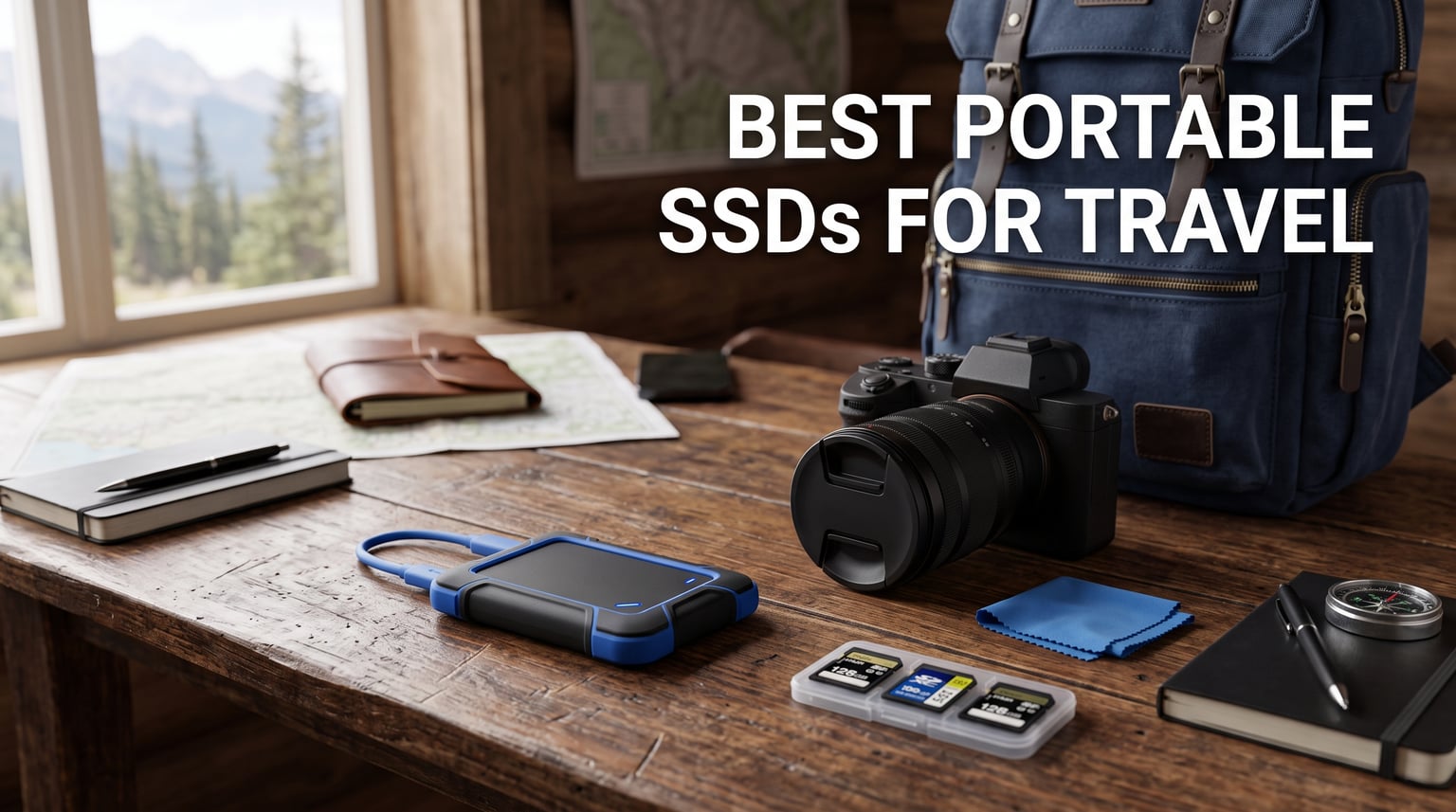
A portable SSD is one of the smallest pieces of travel gear that can save a whole shoot. It gives photographers, videographers, and remote workers a fast place to copy files without relying on hotel Wi-Fi, a fragile spinning drive, or the last free space on a laptop.
My shortlist of the best portable SSDs for travel focuses on the details that matter after the plane lands: a compact body, a useful cable or connector, credible drop and weather protection, and a connection your devices can actually use. Peak transfer numbers are helpful, but they only happen when the computer, tablet, or phone has a port that supports the same USB mode.
For most trips, a 1TB portable solid state drive is a practical starting point for stills and normal work files. Long video trips can fill that much space quickly, so I would plan a two-drive backup routine rather than treating a single external SSD as the only copy of important work.
Every pick below is based on the supplied product specifications, stated protection claims, warranty terms, and customer-review data. I have not treated a listed maximum speed as a guaranteed result; cable quality, file sizes, drive heat, and the host device all affect the transfer you see.
The top three picks answer most travel-storage needs (September 2026)
If you want the short answer, choose the Samsung T9 for sustained fast work and a long warranty, the Crucial X10 for high speed with strong stated travel protection, or the Crucial X9 for a balanced 1TB backup drive. These three cover demanding creator use, rougher weather, and straightforward multi-device file storage.
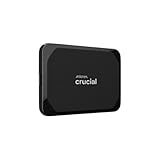
Samsung T9: up to 2,000MB/s read and write, AES 256-bit hardware encryption, thermal management, and a five-year limited warranty.
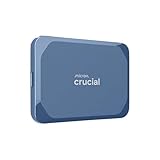
Crucial X10: up to 2,100MB/s read, IP65 dust and water resistance, and stated drop resistance up to 9.8 feet.
Crucial X9: up to 1,050MB/s read, IP55 protection, 7.5-foot drop resistance, and broad compatibility.

Samsung T9 Portable SSD 1TB
- 2000MB/s read and write
- AES 256-bit encryption
- 5-year warranty
These portable SSDs make the travel shortlist in 2026
The comparison below puts all eight products in one place. A fast USB 3.2 Gen 2×2 drive can still run at a lower rate on a USB 3.2 Gen 2 host, so check your device manual before choosing a model mainly for its 2,000MB/s-class rating.
| Product | Specifications | Action |
|---|---|---|
| Samsung T9 Portable SSD 1TB |
|
Check Latest Price |
| Crucial X10 1TB Portable SSD |
|
Check Latest Price |
| Crucial X9 1TB Portable SSD |
|
Check Latest Price |
 PNY RP60 1TB Portable SSD PNY RP60 1TB Portable SSD |
|
Check Latest Price |
 Lexar D70E 1TB Dual Drive Lexar D70E 1TB Dual Drive |
|
Check Latest Price |
 SanDisk 1TB Portable SSD SanDisk 1TB Portable SSD |
|
Check Latest Price |
 Lexar ES3 1TB External SSD Lexar ES3 1TB External SSD |
|
Check Latest Price |
 SSK 500GB Portable SSD SSK 500GB Portable SSD |
|
Check Latest Price |
1. Samsung T9 Is the Fastest Pick for Travel Creators
Pros
- 2000MB/s read and write
- Thermal management
- AES 256-bit encryption
- 5-year warranty
- iPhone 15 Pro 4K support
Cons
- Heavier than some rivals
- Needs compatible host for peak speed
The Samsung T9 is the clear choice when the drive will do more than hold a safety copy. Its stated read and write speeds both reach 2,000MB/s, which makes it the most compelling option here for moving large photo folders, editing from the drive, or offloading video at the end of a long day.
I would put it at the top of the list for a travel photographer who needs one drive to move between a laptop, desktop, and supported mobile gear. The listed compatibility includes Mac, PC, tablets, and iPhone 15/16, while the manufacturer also states support for iPhone 15 Pro recording in 4K at 60fps.
Speed alone is not the whole story on a trip. Samsung lists Dynamic Thermal Guard and an advanced thermal solution, features intended to manage heat during sustained transfers rather than just a short benchmark run.
Its AES 256-bit hardware encryption is a meaningful extra if the drive will contain client files, identification scans, or work documents. Samsung also includes Magician Software for firmware updates and drive-health monitoring, which gives a careful owner a way to check the drive before a major departure.
The T9 makes sense when sustained file work is the priority
Choose the T9 if your laptop has a connection capable of taking advantage of a 2,000MB/s-class external SSD and you regularly handle large RAW batches or video. A slower port will not make the drive bad; it simply means the host becomes the limit.
The 4.32-ounce listed weight is still easy to pack, though it is not the lightest model in this group. I would carry it in a small padded pouch, keep the included cable with it, and use it as the active work drive instead of tossing it loose into a bag.
The T9 suits security-minded travelers who want a long warranty
The five-year limited warranty is the longest stated term among these picks. That matters to travelers planning to keep the same external SSD in a repeatable backup kit for several years.
The trade-off is simple: its peak speed needs a capable connection, and it weighs more than the ultra-light models. If your workflow is basic copying from a standard USB-C port, a 1,050MB/s drive may be all the performance you will see in practice.
2. Crucial X10 Is the Best Rugged Fast Drive for Outdoor Trips
Pros
- 2100MB/s read
- IP65 dust and water resistance
- 9.8-foot drop rating
- Compact 32g weight
- Broad device compatibility
Cons
- Peak speed needs compatible USB support
- 3-year warranty
The Crucial X10 brings the strongest stated combination of speed and physical protection in this roundup. It is rated for up to 2,100MB/s read speed, IP65 water and dust resistance, and drops up to 9.8 feet, all while listing a 32-gram weight.
That mix is appealing for travel photography where a drive moves from a camera bag to a café table to a damp roadside stop. IP65 means protection against dust and water jets, not permission to submerge it, so I would still dry the enclosure and connector before plugging it in.
Crucial lists compatibility across Windows, Mac, iPad Pro, Chromebooks, Android, Linux, PS4, PS5, and Xbox. That range is useful when one travel party has mixed devices or when the same drive is used for a laptop backup and a console library at different times.
The package includes a USB-C to USB-C cable and three-month codes for Mylio Photos+ and Acronis True Image. Those extras can help start a photo catalog or scheduled backup habit, but the valuable part remains a second local copy made before cards are formatted.
The X10 works best for photographers who travel in dust or rain
If your itinerary includes beaches, hiking, overland travel, or unpredictable weather, the X10’s IP65 claim and 3-meter drop resistance stand out. Put the drive away before a storm, rather than treating the rating as a reason to copy files in exposed conditions.
Its compact 1.96 by 2.55 by 0.39 inch listed dimensions also make it easy to separate from a laptop in a different pocket or bag. Physical separation is a simple protection against one lost bag taking every copy of the trip with it.
The X10 needs the right port to deliver its headline speed
The X10 is a fast external SSD, but any portable drive is limited by the cable and port at the other end. Before buying for speed, confirm that your computer or tablet supports the required USB standard rather than assuming every USB-C-shaped port behaves the same way.
Its stated warranty is three years, shorter than the Samsung T9’s five-year term. For someone who prizes faster transfers and stronger stated physical protection over a longer warranty period, that is a reasonable exchange.
3. Crucial X9 Is the Most Balanced 1TB Travel Backup Drive
Pros
- 1050MB/s read
- IP55 water and dust resistance
- 7.5-foot drop rating
- Broad compatibility
- Backup software included
Cons
- Write speed not specified
- Peak transfer can vary by host
The Crucial X9 is the sensible middle ground for travelers who want a 1TB portable SSD with meaningful weather protection but do not need the fastest connection tier. Its stated 1,050MB/s read speed is plenty for day-to-day photo backups, project folders, and ordinary file transfers.
Crucial lists IP55 water and dust resistance and drop resistance up to 7.5 feet, or 2 meters. It is also listed at 32 grams, which makes it the kind of drive I would leave permanently in a small travel-tech pouch instead of saving only for big assignments.
Compatibility is one of its main strengths. The X9 is specified for Windows, Mac, iPad Pro, Chromebooks, Android, Linux, PS4, PS5, and Xbox, helping it fit a household or field kit with more than one operating system.
Crucial includes a USB-C to USB-C cable, Mylio Photos+, and Acronis True Image. The software can be useful, although I would test any automated task at home before trusting it on a limited-power or no-internet trip.
The X9 is right when straightforward backups matter more than peak benchmarks
A 1,050MB/s-rated drive offers a substantial step up from older portable storage for copying camera files and handling a working library. The X9 does not need to be the fastest choice to be a dependable fit for a normal travel backup routine.
Its 4.6 rating is drawn from 7,794 listed reviews, the largest review count among the 1TB products here. Review volume does not replace a personal backup plan, but it gives this model a larger pool of buyer feedback than newer entries.
The X9 favors broad device support over high-end USB speed
Buyers who do most transfers through common USB-C ports may find its stated performance tier easier to match than a Gen 2×2 model. That can make it a better fit where real-world compatibility is more important than a high number on the box.
The product listing does not specify a write-speed figure, so I would not make time-critical write performance the reason to select it. The three-year limited warranty and its stated protective ratings are the more concrete travel benefits.
4. PNY RP60 Is the Strongest Protection-Focused Alternative
Pros
- 2000MB/s read
- 1800MB/s write
- IP65 protection
- 3m drop resistance
- Acronis software
Cons
- Needs USB 3.2 Gen 2x2 for peak speed
- Smaller review base
The PNY RP60 deserves attention from travelers whose bags take a beating. It combines stated read speeds up to 2,000MB/s and write speeds up to 1,800MB/s with IP65 water and dust resistance, a rubberized outer shell, and drop resistance up to 3 meters.
That specification set puts it in the same practical category as a fast field drive for photo and video work. The compact design includes a clip loop, a small feature that can make a difference when cables, card readers, batteries, and drives are all competing for the same pocket.
PNY states that its maximum speed needs USB 3.2 Gen 2×2. This is important: a USB-C connector tells you the plug shape, not the data rate, so look up the laptop or tablet port specification before expecting the highest transfer number.
Acronis True Image Data Protection software is included for backup tasks. I would use it only after creating and checking a sample backup, then keep the original camera cards untouched until the copied files have been opened from the drive.
The RP60 is built for a rougher travel kit
The stated 3-meter drop resistance is tied for the strongest drop claim in this list, and the IP65 rating adds dust and water-jet protection. Those claims make the RP60 a convincing choice for outdoor shoots, frequent road travel, and gear bags that see hard use.
Its 54.8-gram listed weight is modest, and the rubberized shell should be easier to grip than bare metal when hands are cold or wet. It is still electronics, so a dry case and a protected connector remain sensible habits.
The RP60 is a better match for Gen 2×2 systems
Creators with a matching USB 3.2 Gen 2×2 host can pursue the listed 2,000MB/s read and 1,800MB/s write ratings. Those using a more ordinary port should compare it with the Crucial X9 or Lexar ES3, since the connection may narrow the practical gap.
The RP60 has a 4.4 rating from 380 listed reviews, so the review base is smaller than the Samsung and Crucial models above. I would weigh that smaller consensus alongside its useful physical-protection specification and three-year limited warranty.
5. Lexar D70E Is the Best Cable-Free Option for Mixed Devices
Pros
- Cable-free dual connectors
- 2000MB/s read
- 1800MB/s write
- 55g metal body
- 5-year warranty
Cons
- Only 34 listed reviews
- Metal can scratch items in a bag
The Lexar D70E solves a familiar travel problem: reaching for a backup drive and realizing the one necessary cable is on a desk at home. Its cable-free design has both USB-C and USB-A connectors, allowing it to connect directly to newer and older devices without carrying a separate data lead.
It is rated for up to 2,000MB/s read and 1,800MB/s write through USB 3.2 Gen 2. The listed metal housing, integrated lanyard loop, and 55-gram weight make it a compact option for a day bag or a pocket in a tech organizer.
The dual-connector layout is particularly useful for travelers moving files between a USB-C phone or tablet and a USB-A computer. Lexar lists compatibility with laptops, smartphones, and tablets, plus iPhone 17 compatibility in the supplied data.
Its Lexar App offers automatic photo and video backup. Automation can reduce missed copies, but I would verify that the folder structure and file counts match before erasing anything from a phone or memory card.
The D70E removes the cable-management problem
This is the pick I would consider first if a missing cable has interrupted transfers on past trips. The built-in connector approach reduces one accessory to track and gives USB-C and USB-A devices a direct path to the same 1TB drive.
Direct connection also means taking care with port strain. Support the device while it is plugged in, avoid leaving it protruding from a laptop in a crowded seat, and store it where the exposed connector will not collect lint or grit.
The D70E is promising but has limited buyer feedback
The supplied data shows a 4.6 rating from 34 reviews. That is encouraging early feedback, but it is a far smaller sample than the established Samsung, Crucial, or SSK listings in this guide.
Lexar lists a five-year limited warranty, which is a welcome long-term provision. The metal enclosure can be durable, though I would put it in a sleeve if it shares space with a phone, camera screen, or other scratch-prone items.
6. SanDisk Portable SSD Is the Easiest Drive to Clip to a Bag
Pros
- 800MB/s read
- 2m drop protection
- Rubber attachment hook
- USB-C to USB-A cable
- 3-year warranty
Cons
- Slower than newer drives
- Write speed not specified
The SanDisk 1TB Portable SSD is the uncomplicated travel-storage choice for people who value a small, easy-to-carry drive over high benchmark figures. It is specified for read speeds up to 800MB/s and weighs 1.44 ounces, so it takes very little room in a personal-item bag.
Its defining travel feature is the tough rubber hook, designed for a belt loop or backpack attachment. The supplied data also lists up to two-meter drop protection and a USB Type-C to USB-A cable, helpful for a traveler whose laptop has older USB-A ports.
This model is a better fit for backing up images, documents, and normal-sized projects than for chasing the fastest portable SSD for video editing. The listing does not state a write speed, and several of the newer models have much higher stated read ceilings.
Forum research for this guide showed that reliability is travelers’ main concern and that some users report concerns about SanDisk reliability. That is not a finding about this specific model; it is a reason to maintain two verified copies regardless of brand.
The SanDisk fits travelers who value a simple attachment point
The rubber hook makes this model convenient to clip inside a backpack rather than burying it at the bottom. I would clip it to an internal loop, not an exterior location where an SSD could catch on something or be exposed to heavy rain.
At 800MB/s stated read performance, it should still feel quick for a travel backup drive. It just will not match the speed headroom of the Samsung T9, Crucial X10, PNY RP60, or Lexar D70E on a compatible host.
The SanDisk requires a careful backup routine, not blind trust
The product has a 4.6 rating from 10,801 listed reviews and a three-year limited manufacturer warranty. That large feedback base is useful context, but no review average can protect irreplaceable travel work from loss.
For any portable SSD, copy the day’s files, open a selection from the copied folder, and retain the original memory card until another verified copy exists. That practice addresses the broader reliability concern more effectively than loyalty to any one label.
7. Lexar ES3 Is the Slim Pick for Encrypted Everyday Storage
Pros
- 1050MB/s read
- 1000MB/s write
- 10.5mm thin
- 256-bit AES software
- 42g listed weight
Cons
- Older iPhones not compatible
- Peak speed needs USB 3.2 Gen 2
The Lexar ES3 is a thin 1TB external SSD for travelers who want clear read and write specifications without stepping into the higher-speed class. It lists up to 1,050MB/s read and 1,000MB/s write, USB 3.2 Gen 2 support, and a 10.5mm-thick design.
Its listed 42-gram weight and 3.96 by 1.97 by 0.41 inch dimensions make it easy to place in a document pouch or laptop sleeve. Lexar also includes DataShield 256-bit AES encryption software, a useful feature for files that should not be casually accessible if the drive is misplaced.
Compatibility covers iPhone 17 series devices, Mac, PS5, Xbox, laptops, and PCs in the supplied product data. The same data says it is not compatible with iPhone 14 and older models, so phone users should check their own device rather than assuming every iPhone will connect.
A Type-C cable is included, and the drive is designed for plug-and-play use. That does not mean every phone has sufficient power or file-system support for every task, so test the exact phone-to-drive workflow before the trip begins.
The ES3 works for a light and private travel archive
The ES3 is a good match when a small 1TB drive needs to hold documents, photos, and work files with encryption software available. Its specified 1,000MB/s write speed gives a more complete expectation for copying files than products that list read speed only.
Encryption is only as useful as the recovery details you retain. Store the required credentials securely and keep a separate copy of essential travel documents, because an encrypted drive that cannot be opened is not a useful emergency backup.
The ES3 depends on device compatibility and USB support
Its stated maximum performance requires USB 3.2 Gen 2 support. A lower-capability connection can still work, but transfer speeds may fall below the product’s listed ceiling.
The three-year limited warranty matches several other drives here, while the 4.4 rating comes from 826 listed reviews. Consider it for its slim form and specified write speed, not as a universal phone drive for older iPhones.
8. SSK 500GB Is the Compact Pick for Phone Video Clips
Pros
- 1050MB/s read
- 1000MB/s write
- USB-C and USB-A cables
- iPhone ProRes support
- S.M.A.R.T. monitoring
Cons
- 500GB fills quickly
- Small LED can be hard to see
The SSK Portable SSD is the only 500GB model in this group, making it a compact choice for travelers with a defined task rather than a large full-trip archive. It lists up to 1,050MB/s read, 1,000MB/s write, USB 3.2 Gen 2, and support for iPhone ProRes HDR video capture at 4K60Hz.
Both USB-C and USB-A cables are included, so it can move between a phone, tablet, and older laptop without an adapter in many setups. The aluminum alloy case is specified for heat dissipation, and the product data lists S.M.A.R.T. monitoring, TRIM technology, SLC caching, and an activity LED.
For the best portable SSDs for travel, capacity needs an honest look. A 500GB drive can be excellent as a dedicated phone-video transfer drive, a second copy for a short trip, or a handoff drive, but it is not my first choice for weeks of RAW stills or high-bitrate video.
The listed power use is less than 2.4 watts, which is useful context for bus-powered travel setups. Still, run a real transfer with your exact phone and cable before depending on it during a shoot.
The SSK is useful when a 500GB role is enough
Choose this drive when the smaller capacity has a clear boundary: daily phone footage, a selected portfolio, or a second backup of the current day. That defined role can be more practical than treating one small drive as a universal archive.
The product data says the available capacity may appear as roughly 465GB in Windows because of capacity-calculation differences. Build your space plan around the capacity your operating system reports, not only the number printed in the specification.
The SSK offers useful monitoring features for a small travel drive
S.M.A.R.T. monitoring and TRIM support can help keep an eye on drive health and consistent write behavior. They are worthwhile supporting features, though they do not replace checking copied files and keeping two copies of irreplaceable work.
Its 4.5 rating comes from 3,503 listed reviews. The small LED may be hard to see, so use the operating system’s transfer confirmation and safe-eject process rather than relying on a light alone.
A travel SSD should match your port, files, and backup routine
Start with the device you will actually connect. USB-C is only a connector shape: a laptop, tablet, or phone may support a much lower data rate than a USB 3.2 Gen 2×2 drive, which means a 2,000MB/s product can still transfer at a lower speed.
For most travel photography, a drive rated around 1,000MB/s is already quick for copying image folders and browsing a working library. The 2,000MB/s class is more attractive when you move large video files, edit directly from external storage, or have a confirmed high-speed host connection.
A 1TB drive is the sensible starting capacity for most camera trips
One terabyte is the right starting point for many photographers and remote workers because it leaves room for a trip’s working files, exports, and a local backup. It is not a universal answer: high-resolution RAW files, long 4K clips, and ProRes recording can exhaust it much faster than casual travel photos.
Think in daily output rather than broad labels. Estimate one heavy day of shooting, multiply it by the number of days, add space for edits, then leave headroom so the SSD does not begin the return trip nearly full.
A rugged rating helps, but it does not make an SSD waterproof
IP55 and IP65 ratings distinguish the Crucial and PNY picks from models without a stated ingress rating. IP65 is a useful shield against dust and water jets, while it is not an underwater rating and does not protect an open connector from moisture.
Drop ratings also describe a limited test claim, not unlimited abuse. Use a small case, keep the cable from pulling on the port, and do not leave the drive plugged into a laptop that could be knocked from a tray table.
An offline backup plan is safer than a single drive or cloud upload
Internet access can be slow, expensive, or absent while traveling, so a local copy matters. A practical sequence is copy camera cards to the primary SSD, open a selection of files from that SSD, and make a second copy to another drive or keep the original card unchanged.
Store those copies separately. Put one SSD with the laptop and the other in a different bag, pocket, or accommodation safe when appropriate, because a single theft, spill, or dropped bag should not erase the whole trip.
Air travel favors keeping portable SSDs in your carry-on bag
A portable SSD is compact, bus powered, and contains no large battery pack, which makes it straightforward to keep in a carry-on with the rest of your electronics. Carry-on storage also lets you protect it from baggage impacts and gives you access to files during delays.
Airport screening rules can change by location, so follow the instructions at the checkpoint. Place the drive where it is easy to identify, and do not pack it deep among loose metal accessories that could scratch the enclosure or damage a connector.
Temperature and humidity call for simple handling habits
Do not move a cold SSD straight into a warm, humid environment and immediately connect it. Let the drive reach the room temperature in a dry bag or pouch first, which reduces the chance of visible moisture around the casing and ports.
Avoid leaving any external SSD in a hot parked vehicle or direct sun. Heat management features can help during active work, but they do not turn storage electronics into gear that should sit in extreme conditions for hours.
Security starts with encrypted storage and ends with sensible copies
The Samsung T9 includes AES 256-bit hardware encryption, while the Lexar ES3 includes 256-bit AES encryption software. These are useful choices for sensitive files, provided you remember the password or recovery information and test access before leaving home.
Do not place the only copy of a passport scan, client work, or booking archive behind credentials that are stored solely on the same drive. Keep a secure, separate record and maintain a second verified copy.
These travel SSD questions have direct answers
What SSD external drives do you use for travel?
For a fast creator drive, choose the Samsung T9. For speed plus stated IP65 and 9.8-foot drop resistance, choose the Crucial X10. For straightforward 1TB backup with broad compatibility, choose the Crucial X9. Match the drive to the USB capability of the device you will use.
What is the best portable SSD for photographers?
The Crucial X10 is the best fit for photographers who need a compact drive with up to 2,100MB/s read speed, IP65 dust and water resistance, and 9.8-foot drop resistance. The Samsung T9 is the better pick for sustained fast transfers, hardware encryption, and its five-year limited warranty.
Which portable SSD has the best durability for travel?
The Crucial X10 and PNY RP60 have the strongest stated travel-protection specifications in this list. Both are IP65 rated and list drop resistance up to 9.8 feet or 3 meters. An IP65 rating protects against dust and water jets, not submersion.
How fast should a portable SSD be for travel photography?
A drive rated around 1,000MB/s is sufficient for most photo backup and ordinary editing work. A 2,000MB/s-class SSD can help with larger video transfers or external editing, but only if the computer, tablet, cable, and port support the required USB mode.
What capacity do I need in a travel SSD?
Start with 1TB for most travel photography, documents, and normal work files. Choose more capacity or carry two drives for long trips with high-resolution RAW images, 4K clips, or ProRes video. A 500GB drive is best for a defined smaller task such as phone-video transfers.
The Samsung T9 is the best all-round travel SSD for demanding work
The Samsung T9 is my all-round recommendation for people who need fast transfers, encryption, and a five-year limited warranty. Choose the Crucial X10 if weather and drop protection lead your checklist, or the Crucial X9 when a widely compatible 1TB backup drive is the better fit.
The best portable SSDs for travel in 2026 are only one part of a safe workflow. Check your port, test the cable and copy routine before departure, and always keep a second verified copy of files that cannot be recreated.