
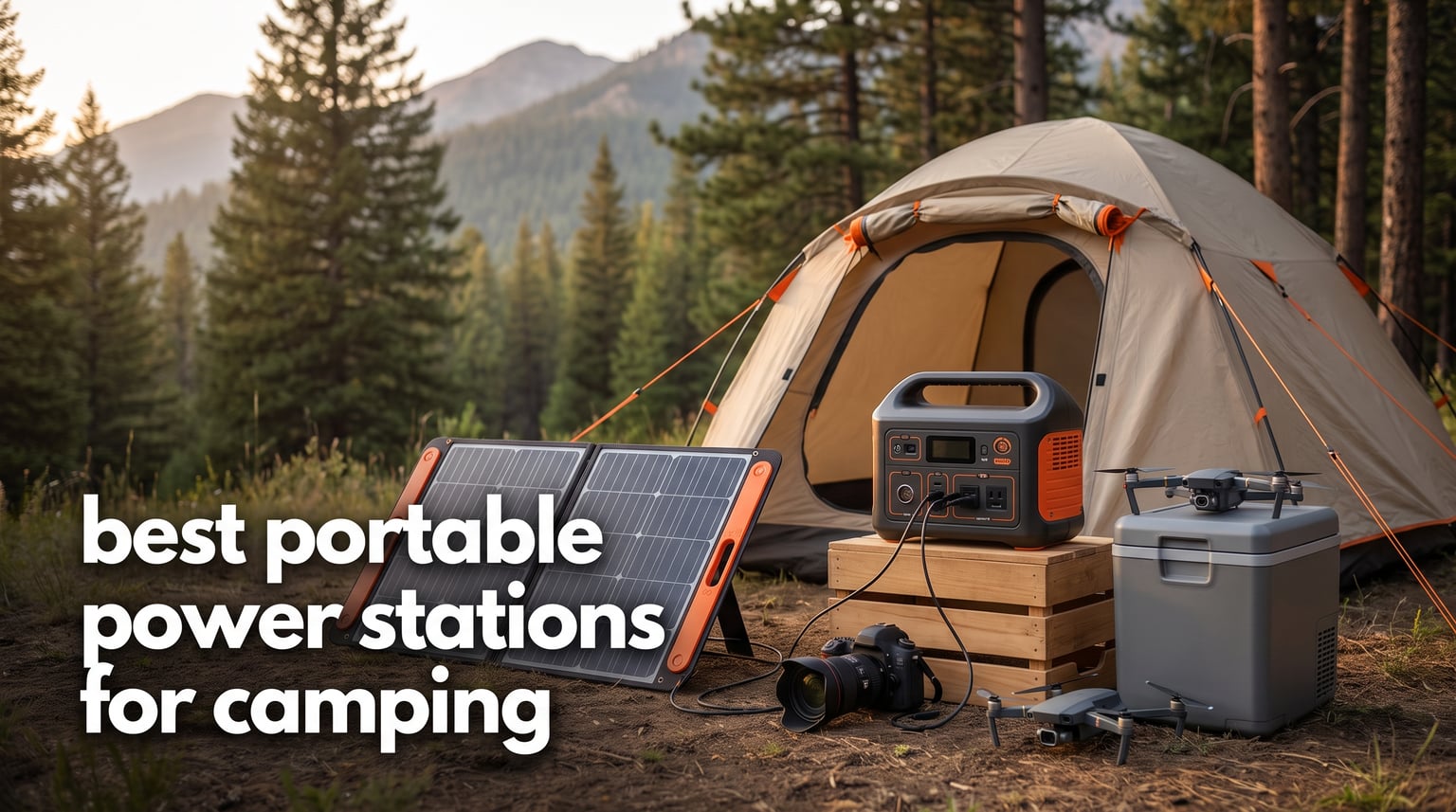
The best portable power stations for camping give you quiet electricity for a fridge, lights, cameras, phones, and a laptop without bringing fuel, fumes, or generator noise into camp. The practical choice is not the biggest battery by default; it is the one with enough watt-hours, outlet power, and carryability for the gear you genuinely use.
For 2026, the eight models here range from a 5.73-pound, 192Wh unit for essentials to 1kWh-class stations built for a camp fridge and several devices. I compared the manufacturer-listed capacity, continuous output, surge capability, ports, weight, charging claims, battery chemistry, warranty information, and review data supplied for every model.
One important boundary: these are product-data comparisons, not invented field-test results. I will show the camping implications of the listed specifications, flag limitations openly, and help you calculate a realistic load before you pack a battery power station.
The top three picks are Jackery for capacity, EcoFlow for carryability, and OUPES for high-output camping.
If you want one direct answer, the Jackery Explorer 1000 v2 is the broadest fit because it combines 1,070Wh, 1,500W AC output, a 23.8-pound body, and a stated 4,000-plus-cycle LiFePO4 battery. The EcoFlow River 2 Max 500 is the easier carry for campers who still want up to 1,000W, while the OUPES Mega 1 is for people whose appliances need more headroom or whose future setup may grow.
Choose the Jackery when a weekend fridge, charging shelf, and larger appliances are all part of the plan. Choose EcoFlow when you want to carry the station from vehicle to tent without lifting nearly 24 pounds, and choose OUPES when a 2,000W continuous-output ceiling matters more than shaving pounds.
The quick overview is that capacity and appliance watts decide the right camping power station.
Start with the load rather than the brand. A 192Wh to 299Wh portable battery station suits phones, headlamps, a camera battery charger, LED lighting, and perhaps a laptop; a 499Wh to 640Wh model adds breathing room for a modest refrigerator or CPAP plan; and roughly 1,000Wh is the more comfortable starting point for a fridge-centered weekend.
Then check watts. Capacity tells you how long stored energy can last, but the inverter rating tells you whether the station can start and run an appliance at all. A 300W station is not the same tool as a 1,500W or 2,000W station, even if both have USB-C PD and AC outlets.
Weight is the third decision point campers repeatedly raise. A station may be portable in the product category yet still be a poor match for a walk-in site, so I would reserve the 23.8- and 27.8-pound models for car camping, RV use, road trips, or a short carry from the vehicle.
| Product | Specifications | Action |
|---|---|---|
 Jackery Explorer 1000 v2 Jackery Explorer 1000 v2 |
|
View on Amazon |
 LIBRIDS C600 LIBRIDS C600 |
|
View on Amazon |
 Anker SOLIX C300 Anker SOLIX C300 |
|
View on Amazon |
 EF ECOFLOW River 2 Max 500 EF ECOFLOW River 2 Max 500 |
|
View on Amazon |
 OUPES Mega 1 OUPES Mega 1 |
|
View on Amazon |
 VTOMAN Jump 600X VTOMAN Jump 600X |
|
View on Amazon |
 BLUETTI Elite 30 V2 BLUETTI Elite 30 V2 |
|
View on Amazon |
 DaranEner NEOZ DaranEner NEOZ |
|
View on Amazon |
The table is a fast shortlist, not a runtime promise. Real use changes with appliance cycling, ambient temperature, inverter losses, screen brightness, and whether you are charging from solar or your vehicle during the day.
1. The best overall choice is the Jackery Explorer 1000 v2 for fridge-focused car camping.
Pros
- 1070Wh capacity
- 1500W AC output
- one-hour fast charge
- 4000 plus cycles
- app control
Cons
- Solar panels not included
- solar use limited to Jackery panels
- emergency mode needs app
The Jackery Explorer 1000 v2 is the model I would put first for car campers who want one station to cover more than phones and lanterns. Its 1,070Wh capacity and 1,500W AC output create a far broader appliance envelope than the compact stations in this list, while the 3,000W starting rating offers additional room for devices with a startup draw.
At 23.8 pounds, it is not a backpacking battery. It makes sense when the campsite is near the car, in an RV, at a base camp, or anywhere the carry is short and the extra stored energy is more useful than minimal pack weight.
The supplied product data lists three AC outlets, two USB-C ports, one USB-A port, a DC car port, LED lights, and seven total outlets. That mix lets a camp table serve several jobs at once, but I would still add every device wattage before using all outputs together so the total stays inside the 1,500W continuous limit.
Its capacity suits an overnight fridge and shared-device camp setup.
A 1,070Wh rating is the right class for a group that wants a refrigerator, lights, phones, camera batteries, and a laptop from one camp power supply. Many campers report that about 1kWh can cover a weekend of small-device charging, LED lights, and a small fridge, but a fridge’s compressor duty cycle and settings can change that result substantially.
For a conservative plan, treat the battery rating as stored energy rather than power delivered unchanged to an appliance. AC conversion and the station’s own overhead reduce the energy that reaches the load, so leave a reserve rather than planning around the entire 1,070Wh.
Its fast recharge and long-life rating suit repeat campers.
Jackery states that emergency charging through its app can reach a full charge in one hour, although the supplied review information says the mode must be enabled in the app each time. That may be useful when you return from a trip and need to prepare quickly, but it is a procedure worth learning before departure rather than at camp.
The listed LiFePO4 battery is rated for more than 4,000 charge cycles with 70 percent capacity retention and a stated 10-year lifespan. Solar panels are optional, and the supplied data says solar charging is compatible only with Jackery panels, so confirm the complete solar setup before counting on daytime replenishment.
2. The easiest 1,000W-class carry is the EF ECOFLOW River 2 Max 500.
Pros
- 13.3 pound carry weight
- 1000W output
- one-hour AC recharge
- 220W solar input
- 5-year service
Cons
- Solar panel sold separately
- less capacity than 1kWh stations
The EF ECOFLOW River 2 Max 500 solves a common camping compromise: you want meaningful AC output but do not want to carry a 24-pound battery. It lists 499Wh of LiFePO4 capacity, up to 1,000W output, and a 13.3-pound weight, making it a practical middle ground for a couple’s campsite or a solo overlanding setup.
Its 11 total outlets also stand out for a station of this size. Outlet count is not a reason to ignore the total 1,000W output ceiling, but it does make it easier to keep a laptop, phones, lights, a camera charger, and low-draw accessories connected without rotating plugs all evening.
The best portable power stations for camping are often judged by capacity alone, yet a 13.3-pound body changes how willingly you will bring it. That weight makes the River 2 Max more realistic for tent sites where the parking pad is not directly beside the picnic table.
Its 499Wh capacity fits moderate overnight loads rather than unattended long runs.
This is a good camping power station for people who want device charging and limited appliance use, not a substitute for a full 1kWh unit when a refrigerator must run without recharge for a long weekend. A 499Wh rating gives you a useful buffer, but a fridge can use energy in irregular bursts as its compressor cycles and outside temperatures rise.
I would make the load list before choosing it: note the wattage of the fridge, CPAP, laptop brick, heated item, and camera charger, then estimate each one’s hours. That simple step is more dependable than judging capacity by the number printed on the front panel.
Its charging claims favor travel days and solar-aware campers.
EcoFlow states a one-hour AC recharge and solar charging in 2.3 hours with 220W solar input. Those are manufacturer claims made under their stated conditions, so sunlight angle, cloud, panel output, and cable setup will all matter outside the driveway.
The supplied data also lists a 5-year service period and a LiFePO4 battery intended for 10-plus years of use. Bring the optional solar panel only after checking connector compatibility and input limits, and use vehicle charging as a helpful top-up rather than an assumed replacement for a complete solar plan.
3. The strongest appliance-ready choice is the OUPES Mega 1 with 2,000W output.
Pros
- 2000W continuous output
- expands to 5kWh
- 0 to 80 percent in 36 minutes
- dual 100W USB-C
- app control
Cons
- 27.8 pounds
- not Prime eligible
- expansion battery separate
The OUPES Mega 1 is the most appliance-focused option in this group. It pairs 1,024Wh of LiFePO4 storage with 2,000W continuous output and a 4,500W surge rating, so it has much more inverter headroom than the 300W and 600W choices.
That distinction matters when your camp routine includes a higher-draw appliance that stays within the listed rating. A 1kWh battery does not make every appliance an all-day load, but a 2,000W inverter means you have fewer immediate exclusions based on running watts.
The trade-off is clear: 27.8 pounds. I would call this portable for vehicle-based camping and road trips, not for carrying across a large campground or down a trail.
Its expandable design suits campers whose power needs may grow.
OUPES says the Mega 1 can expand to 5kWh with B2 extra batteries. That is a meaningful planning option for RV trips, extended off-grid stays, or a future camp setup with more charging and refrigeration, although the added batteries are separate equipment rather than included capacity.
The listing also names pass-through charging, Bluetooth app control, a smart battery management system, dual 100W USB-C PD ports, and a less-than-20-millisecond UPS transfer time. For camping, the direct value is the ability to recharge devices and manage a varied collection of loads; the UPS feature is chiefly relevant when the station also serves at home.
Its fast wall-charge claim helps only before or between campsites.
The manufacturer states that the Mega 1 can charge from zero to 80 percent in 36 minutes on AC power. That is helpful at home or at a powered stop, but it does not remove the need to plan your off-grid energy source once you are parked.
Its LiFePO4 battery is listed for more than 3,500 cycles and the warranty is listed as five years. If cold conditions are expected, keep every lithium battery out of severe exposure when possible, consult its manual for charging-temperature limits, and do not assume normal cold-weather capacity without manufacturer guidance.
4. The practical mid-capacity choice is the LIBRIDS C600 for many connected devices.
Pros
- 640Wh capacity
- 8 output ports
- 1.5-hour charging
- pure sine wave
- 5-year warranty
Cons
- Lower review count
- indoor-use label needs checking
- 600W output limit
The LIBRIDS C600 sits between a small personal power bank and a 1kWh camp generator. It lists 640Wh of LiFePO4 capacity, 600W continuous output, 1,200W peak output, four AC outlets, and eight ports in all, which is a sensible profile for a camp with several smaller loads.
Its 600W limit needs to drive the appliance list. It can be a better fit than a 300W unit for a moderate setup, but it is not the choice I would make for a high-watt cooking appliance or another load that exceeds its continuous rating.
The available source does not provide a product weight, so I would not make a carryability claim without it. Check the seller’s current specification and think about where the unit will live: under a vehicle seat, at the tent entrance, or in a bin with cables and solar accessories.
Its port layout supports a shared campsite charging station.
Four AC outlets and eight overall outputs give a group more connection options than many compact units. The source also identifies a pure sine wave inverter, a useful feature for sensitive electronics such as laptop chargers and camera battery chargers.
Use the DC and USB outputs for compatible gear when practical, because running a small USB device through an AC power brick adds conversion steps. Campers frequently ask which port to use; the simplest rule is to use the direct, correctly rated output that the device accepts.
Its fast charging and warranty add reassurance, with one label to verify.
LIBRIDS states a 1.5-hour AC charge, more than 4,000 cycles, a 10-millisecond UPS switch, and a five-year warranty. These are attractive support and lifecycle details for a station intended to be used across repeated trips.
The supplied review data also notes an indoor-use-only label tied to a UL safety requirement despite camping appearing in its recommended uses. Read the current manual and product labeling before placing any power station outdoors, and protect it from rain, standing water, dirt intrusion, and direct weather regardless of model.
5. The vehicle-support choice is the VTOMAN Jump 600X with regulated 12V output.
Pros
- Regulated 12V outputs
- 600W constant power
- expands to 939Wh
- 60W USB-C
- pass-through charging
Cons
- Jumper cables separate
- extra battery separate
- 2-year warranty
The VTOMAN Jump 600X is especially interesting for car campers who use 12V equipment. It combines 299Wh capacity with 600W continuous power, a 1,200W starting rating, three regulated 12V and 10A DC outputs, PD 60W USB-C, and a stated 14.6-pound weight.
The regulated DC outputs are the feature that separates it from a generic small station. The supplied product information specifically calls them suitable for car refrigerators and CPAP equipment, which can simplify a campsite where 12V gear is part of the regular packing list.
It also has a 2-in-1 position as a power station and car jump-start system, but the source says jumper cables are sold separately. I would treat that as an optional vehicle-support capability and verify every required accessory is in hand before relying on it during a trip.
Its output and expansion option fit campers who start small.
The 299Wh base capacity suits charging, lighting, small electronics, and modest DC loads, rather than a long unattended fridge weekend. VTOMAN says an extra battery can expand capacity to 939Wh, which gives buyers a path to add storage later without abandoning the original station.
Its 600W constant-power rating is also more useful than a label alone suggests because it sets a continuous load limit to plan around. Add all simultaneous loads, include the appliance’s starting draw when applicable, and stay within the stated 600W continuous figure.
Its three charging paths support road-trip logistics.
The product data lists wall, car, and solar recharging, pass-through charging, and a recharge to 80 percent within 2.7 hours. A car-charging option is valuable on multi-stop trips, though its real contribution depends on drive time and the vehicle’s outlet capability.
The listed LiFePO4 battery has 3,000 life cycles, and the warranty is stated as two years. If you favor this model for a 12V fridge, make a fridge-specific energy budget first: the 12V socket matching the appliance does not change the station’s total 299Wh stored-energy limit.
6. The light 600W option is the BLUETTI Elite 30 V2 for short car-camping trips.
Pros
- 9.4 pound weight
- 600W continuous power
- fast 0 to 80 percent charge
- 140W PD
- 5-year warranty
Cons
- 288Wh capacity
- not for loads above 600W
- not Prime eligible
The BLUETTI Elite 30 V2 has one of the best weight-to-output combinations in this list. At 9.4 pounds, it lists 288Wh capacity, 600W continuous output, nine ports, 140W PD fast charging, and a Power Lifting mode described as handling up to 1,500W when needed.
That makes it attractive for campers who want a relatively light box but do not want to be limited to a 300W inverter for every task. The core planning number remains 600W continuous output, so I would not select it around an appliance that regularly runs beyond that rating.
Its compact role is clear: this is a portable solar generator for an overnight camp, a camera-and-laptop base, or a simple vehicle camp setup. It is not a 1kWh replacement if your plan centers on operating a fridge through multiple days without a recharge source.
Its low weight makes it easier to bring power away from the car.
At 9.4 pounds, the Elite 30 V2 is far easier to shift from vehicle to tent than a 23.8- or 27.8-pound station. That difference matters because the unit you will actually carry to a walk-in site is often more useful than a larger model that stays in the trunk.
Its nine ports offer flexibility for a compact station, but keep the watt budget visible when several people plug in. Phone charging is small; a laptop, camera charger, heated blanket, or appliance using an AC outlet changes the calculation quickly.
Its fast charge and UPS are secondary benefits for camping.
BLUETTI states that its 380W fast wall charging can take the station from zero to 80 percent in 45 minutes, with a full charge time listed as 70 minutes. That is convenient for pre-trip preparation and for powered stops between destinations.
The source also lists eight charging modes, a 10-millisecond UPS backup, and a 60-month warranty. The UPS feature matters more at home than under a tent canopy, while the five-year warranty and LiFePO4 chemistry matter to campers thinking about repeated seasonal use.
7. The compact short-trip pick is the Anker SOLIX C300 for quiet personal power.
Pros
- Compact form
- 25dB listed operation
- 140W two-way USB-C
- 8 ports
- 5-year warranty
Cons
- 288Wh capacity
- solar panel separate
- some Anker panels incompatible
The Anker SOLIX C300 is a focused choice for campers who want personal power with a compact footprint. It has 288Wh of stated capacity, 300W power in its product title, eight versatile charging ports, two-way 140W USB-C fast charging, and a LiFePO4 battery rated for 3,000 cycles.
Anker describes the housing as 15 percent smaller than similar models, and the supplied product data lists a 4.13-kilogram battery weight. That compactness is appealing for a tent-camping kit where the power station competes with food, water, sleeping gear, and camera equipment for vehicle space.
The manufacturer also lists 25dB operation. Quiet operation is a real campground consideration, and this specification makes the C300 worth a look for campers who want clean battery power instead of a running engine near quiet hours.
Its 288Wh capacity is best for essentials and planned charging.
A 288Wh station is a deliberate small-load tool. I would allocate it to phones, a headlamp collection, lights, USB-C devices, a camera battery charger, and occasional laptop use, while avoiding expectations that it will operate a refrigerator or electric cooking gear for long.
One useful approach is to charge USB-C and USB-A equipment directly, then reserve the AC outlets for devices that have no DC charging option. This reduces unnecessary inverter use and leaves more stored energy for the devices that truly need AC.
Its solar compatibility needs checking before a solar purchase.
The product information says the SOLIX C300 works with a 100W solar panel, and it lists the solar panel as optional. It also explicitly says it is not compatible with Anker PS30, PS200, or PS400 panels, so do not assume any panel sharing the brand name will work.
The source lists a five-year warranty and states that it can reach 80 percent in 50 minutes through rapid charging. Confirm the current compatible panel, connector, and input limits with the manufacturer before buying solar hardware for an off-grid trip.
8. The lightest essentials-only choice is the DaranEner NEOZ at 5.73 pounds.
Pros
- 5.73 pound weight
- 3500 plus cycles
- pure sine wave
- 60W USB-C
- SOS LED light
Cons
- 192Wh capacity
- 300W output limit
- solar input only 60W
The DaranEner NEOZ is the straightforward pick for a very light camping power station. It lists 192Wh capacity, 300W pure sine wave output, a 5.73-pound weight, two AC outlets, USB-C PD 60W, USB-A ports, 12V DC, and a built-in LED light with an SOS mode.
Its small capacity is not a weakness if your goal is appropriately small. For an overnight tent camp where the job is phone charging, a headlamp, a camera battery, a small light, and a laptop top-up, a 5.73-pound unit can be more practical than transporting a much larger box.
It is not the station for a high-watt appliance or a fridge-centered weekend. The 300W maximum is a firm boundary to respect, and 192Wh offers much less energy reserve than the 499Wh, 640Wh, and 1kWh options above.
Its small size suits basic tent-camping and camera charging kits.
This unit can charge up to six devices at once according to the supplied features, which covers a compact personal kit well. Its pure sine wave output and smart battery management system are useful protections listed for sensitive electronics and battery operation.
The four-mode LED light, including SOS, is a practical backup rather than a reason to leave a dedicated headlamp at home. Keep the station dry, keep cables organized, and place it where its display and ports remain accessible without becoming a tent-trip hazard.
Its recharge limits make energy discipline important.
DaranEner lists AC charging at 100W, solar charging at 60W, and car charging as its three replenishment methods. The 60W solar input means daylight recovery is likely to be modest compared with a station that accepts 220W, so match it to a low-energy itinerary.
The listed LiFePO4 battery has more than 3,500 cycles. Solar panels and car charging cables are not included according to the source, so check the required accessories before leaving for an off-grid campsite.
The right buying guide starts with a watt-hour budget and an appliance-watt check.
A portable power station stores energy in watt-hours, abbreviated Wh. A 1,000Wh rating means the battery stores about 1,000 watt-hours in principle, while the output rating in watts tells you the maximum power it can supply at a given moment.
Start by writing down each planned device, its running watts, any stated starting watts, and its expected hours of operation. Add the watt-hours by multiplying watts by hours, then leave room for AC inverter losses, charging losses, and a reserve for unexpected device charging.
A 192Wh to 299Wh station is enough for small electronics and lights.
Choose this size for a phone, headlamp, LED lights, GPS, camera batteries, a small USB fan, and limited laptop work. The DaranEner NEOZ, Anker SOLIX C300, BLUETTI Elite 30 V2, and VTOMAN Jump 600X fall into this portable end of the group, though the latter three differ significantly in watt output and features.
Do not buy this size based on an occasional appliance that needs 600W, 1,000W, or more. Capacity and output are separate tests: a station can have enough stored energy on paper but still lack the inverter power to run the appliance.
A 499Wh to 640Wh station is the middle ground for a modest powered camp.
The EcoFlow River 2 Max 500 and LIBRIDS C600 are the middle-capacity choices here. They fit campers who need room beyond personal electronics but want less bulk than a 1kWh station.
This is also the range where a portable camp fridge becomes a planning question rather than an automatic yes. Review the fridge label, estimate its average daily consumption, account for warm-weather compressor cycling, and decide how much daylight charging or driving you will have.
A 1kWh station is the more comfortable starting point for a fridge-centered weekend.
The Jackery Explorer 1000 v2 and OUPES Mega 1 each list just over 1,000Wh. That capacity class is better suited to a shared camp, a refrigerator, more camera and laptop charging, and appliances that need more stored energy, although runtime still depends on the actual loads.
Forum discussions repeatedly describe 1kWh as sufficient for a weekend of phone charging, LED lighting, and a small fridge. Treat that as a useful user-reported starting point, not a guarantee, because a fridge running in sun on a hot weekend behaves differently from a lightly loaded unit in mild weather.
Usable energy is lower than the nameplate capacity after conversion losses.
Do not expect every rated watt-hour to arrive at an AC appliance. The battery stores DC energy, and the inverter converts it to AC; that conversion, the station’s electronics, and the device’s charging brick all consume some energy along the way.
A practical planning method is to avoid allocating the entire rating to your load calculation. Keep a reserve for overnight phone charging, a surprise weather delay, or the fact that battery output and charging behavior can be affected by temperature.
The correct output rating is higher than your largest likely simultaneous load.
Add the running watts of devices you will use at the same time, then compare the result with the station’s continuous AC output. The compact DaranEner and Anker models are 300W class, the LIBRIDS, VTOMAN, and BLUETTI list 600W continuous output, EcoFlow lists 1,000W, Jackery lists 1,500W, and OUPES lists 2,000W.
Starting or surge watts matter for certain motor-driven appliances. A station may list a higher brief surge figure, but its continuous rating remains the figure for a load that keeps running.
The better solar plan matches panel input to daily energy use.
Solar charging can extend a trip, but it is not unlimited power by itself. Check the station’s maximum solar input, compatible connector, acceptable voltage range, panel specifications, sun exposure, and how much energy the camp uses each day.
As a planning example, a station that accepts 220W solar input has more potential for daylight replenishment than the DaranEner NEOZ’s listed 60W solar input. The product’s maximum input is not the same as guaranteed daily harvest; clouds, shade, low sun, panel angle, and heat can all reduce production.
Buy compatible panels at the same time when solar is central to the trip. The available data specifically warns that Jackery solar use is limited to Jackery panels and that the Anker C300 is not compatible with several named Anker panel models, which shows why a connector check is non-negotiable.
The easiest station to carry is often the better station to own.
Think in terms of the complete kit: power station, charging brick, vehicle cable, solar panel, extension cable, and protective bag. A 5.73-pound DaranEner or 9.4-pound BLUETTI is easier to move than a 23.8-pound Jackery or 27.8-pound OUPES, but larger stations can deliver far more capacity and output.
For backpacking, even the 5.73-pound option may be too much once water and overnight gear are included. These are best considered car-camping, overlanding, RV, festival, and base-camp tools unless your hiking distance and load plan genuinely permit the weight.
The longest-lived battery needs sensible storage and temperature care.
All eight stations in this article use LiFePO4 chemistry according to their source data, with listed lifecycle claims from 3,000 to more than 4,000 cycles where specified. This chemistry is commonly selected for long service life, but it still benefits from the manufacturer’s storage, charging, and temperature instructions.
Do not leave a power station in rain or standing water, and avoid placing it where the tent’s condensation, dust, or cooking spills can reach ports. In cold conditions, check the manual before charging because lithium battery charging limits can differ from discharge behavior and can be more restrictive.
Camping power station answers are simple when you separate capacity from output.
What is the best portable power station for camping?
The Jackery Explorer 1000 v2 is the best all-around choice in this group for car camping because it lists 1,070Wh of LiFePO4 capacity, 1,500W AC output, and a 23.8-pound weight. Choose the EcoFlow River 2 Max 500 when carrying weight matters more, or the OUPES Mega 1 when 2,000W output and expandability matter most.
How long can a 1000Wh power station run a fridge?
A 1,000Wh-class power station can often support a small camp fridge through a weekend when it is also charged during the day, but no fixed runtime is reliable. Refrigerator energy use varies with compressor cycling, temperature setting, ambient heat, insulation, door openings, and AC conversion losses, so use the fridge label and leave a capacity reserve.
Will these charge while I am driving to the campsite?
Several listed models support vehicle charging: the VTOMAN Jump 600X and DaranEner NEOZ list car charging, and the other models may have vehicle options depending on their current accessories. Check the manual, included cable, vehicle outlet rating, and expected driving time because vehicle charging is usually a top-up plan rather than an instant full recharge.
How much solar do I need for unlimited camping power?
No fixed panel size creates unlimited camping power because solar harvest changes with weather, shade, season, panel angle, and daily load. Match panel wattage and compatibility to the station input and your daily energy budget; for example, EcoFlow lists 220W solar input for the River 2 Max, while DaranEner lists 60W solar input for the NEOZ.
What size power station do I need for camping?
Choose 192Wh to 299Wh for lights and small electronics, 499Wh to 640Wh for a moderate camp with more reserve, and about 1,000Wh for a fridge-centered weekend or a group setup. Also check output watts: your station must exceed the combined running watts of devices used at the same time.
The best portable power station for camping is the one that matches your actual camp load.
For 2026, pick the Jackery Explorer 1000 v2 for a broadly capable 1kWh car-camping setup, the EcoFlow River 2 Max 500 when lower carry weight is a priority, or the OUPES Mega 1 when 2,000W output and future expansion lead the decision. The smaller BLUETTI, Anker, VTOMAN, LIBRIDS, and DaranEner models make more sense when the job is targeted charging rather than all-weekend appliance power.
Before you choose, list your watts, estimate your watt-hours, measure the carry from vehicle to camp, and confirm the solar accessories you need. That one-page plan will do more for a quiet, reliable off-grid weekend than selecting a station by capacity alone.