
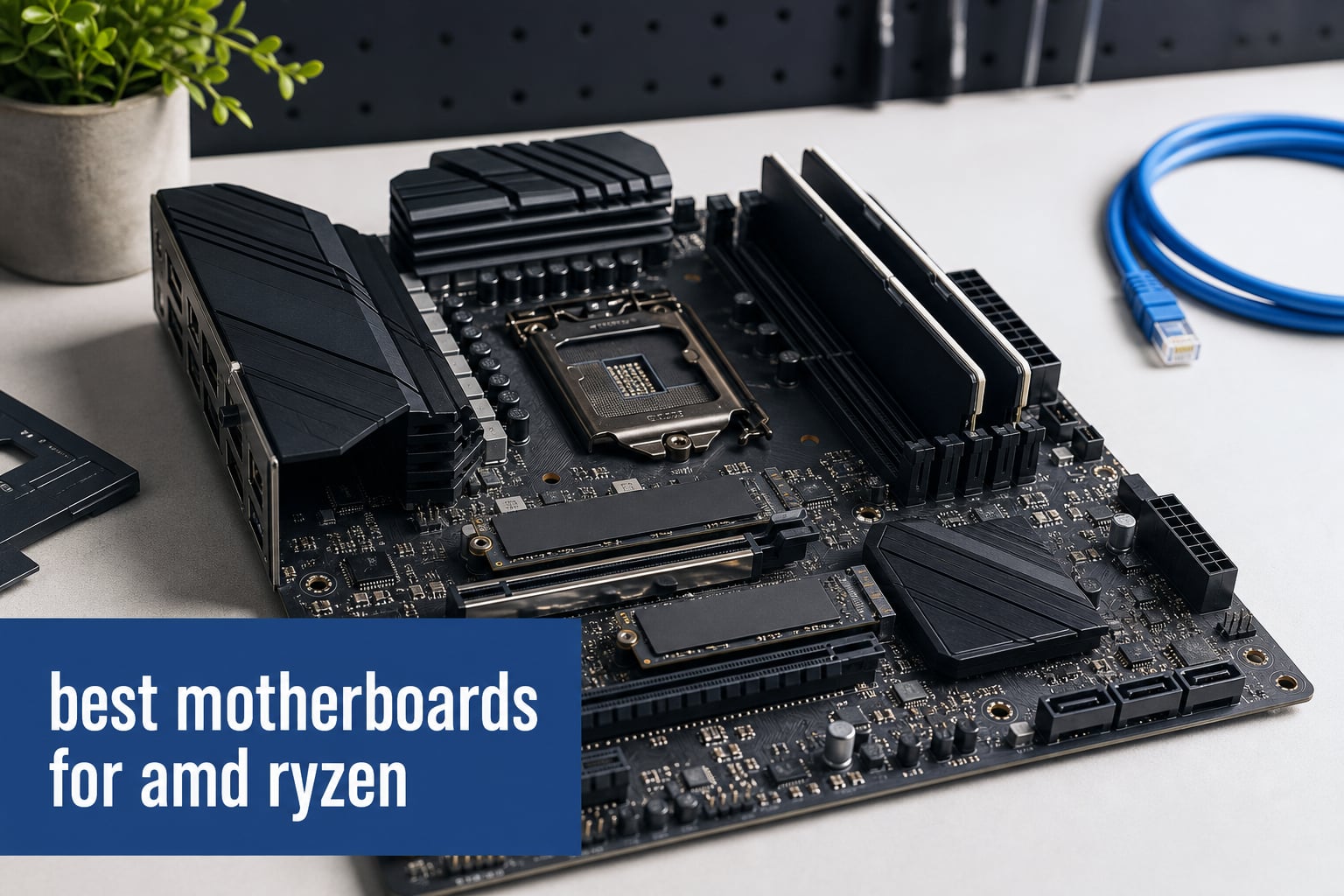
The best motherboards for AMD Ryzen are AM5 boards that match your processor, case, storage plan, and rear-I/O needs rather than simply the board with the longest feature list. For a Ryzen 7000, 8000, or 9000 desktop build, AM5 also means DDR5 memory, while the chipset tier determines how much connectivity and expansion you get.
I would start with the processor and case, then check the fine print on M.2 slots, USB ports, networking, and BIOS support. That order prevents a familiar building mistake: buying a capable AMD motherboard, then finding its front-panel header, lane layout, or physical size does not suit the rest of the system.
This 2026 guide compares eight verified AM5 options across B650, B850, X870, and X870E naming tiers. The selection includes full-size ATX boards for gaming and heavy I/O, compact micro-ATX choices, and boards with BIOS Flashback for builders who may need to update firmware before installing a newer Ryzen CPU.
One important boundary: this is a feature-led comparison of the supplied product information, not a claim that every board was run in the same lab. I have prioritized clear power-delivery information, storage choices, networking, and stated compatibility, and I call out limitations such as two-DIMM layouts or fewer M.2 slots where the product data provides them.
The top three picks cover most Ryzen AM5 builds In 2026
For an uncomplicated all-round AM5 build, the MSI MAG B850 Tomahawk MAX WiFi offers the strongest balance in this group of power delivery, Gen5 storage, Wi-Fi 7, 5Gbps LAN, and USB 20G Type-C. The GIGABYTE X870 Eagle WIFI7 is the straightforward pick when dual USB4 and four M.2 slots matter, while the ASRock B850M-X R2.0 keeps essential AM5 features in a smaller, more basic package.

The best motherboards for AMD Ryzen in 2026 are these eight AM5 choices
The overview below puts all eight choices in one place. Every board listed supports Socket AM5 and DDR5, but the full-size models offer different combinations of M.2 capacity, cooling hardware, USB4, and faster wired networking; the smaller boards trade some expansion room for compact dimensions.
| Product | Specifications | Action |
|---|---|---|
| MSI MAG B850 Tomahawk MAX WiFi |
|
Check Latest Price |
 GIGABYTE B850 AORUS Elite WIFI7 GIGABYTE B850 AORUS Elite WIFI7 |
|
Check Latest Price |
 ASUS ROG Strix X870E-E Gaming WiFi ASUS ROG Strix X870E-E Gaming WiFi |
|
Check Latest Price |
 MSI MPG X870E Carbon WiFi MSI MPG X870E Carbon WiFi |
|
Check Latest Price |
 GIGABYTE X870 Eagle WIFI7 GIGABYTE X870 Eagle WIFI7 |
|
Check Latest Price |
 GIGABYTE B850M Gaming X WIFI6E GIGABYTE B850M Gaming X WIFI6E |
|
Check Latest Price |
 ASRock B850M-X R2.0 ASRock B850M-X R2.0 |
|
Check Latest Price |
 ASRock B650M-HM.2+ ASRock B650M-HM.2+ |
|
Check Latest Price |
B650 remains a sensible AM5 route when its I/O and expansion match the build. B850 boards here add newer platform choices, while the X870 and X870E-named models focus on higher connectivity and broader storage provision; compare the exact board specification instead of treating a chipset name as a complete feature list.
1. MSI MAG B850 Tomahawk MAX WiFi is the best all-round Ryzen board
Pros
- 14 Duet Rail 80A SPS VRM
- Two Gen5 M.2 slots
- Wi-Fi 7 and Bluetooth 5.4
- 5Gbps LAN
- USB 20G Type-C
Cons
- 256GB stated memory capacity
- ATX case required
The MSI MAG B850 Tomahawk MAX WiFi is my first choice for a Ryzen gaming or mixed-use PC because its supplied specifications cover the decisions builders usually make later. It pairs a 14 Duet Rail 80A SPS VRM with extended heatsinking, 7W/mK MOSFET thermal pads, Wi-Fi 7, Bluetooth 5.4, and 5Gbps LAN.
Storage is unusually well covered for the group: MSI lists four M.2 connectors, including two Gen5 x4 positions, one Gen4 x4, and one Gen4 x2. The PCIe 5.0 x16 slot and USB 20G Type-C also make this a sensible starting point for builders who want a modern graphics and external-storage path.
The stated DDR5 Memory Boost support reaches 8400+ MT/s when overclocked, but memory stability depends on the CPU, DIMM kit, and firmware. I would treat that figure as a capability to verify against the board’s memory-support documentation, not a promise that any four-stick kit will run at that setting.
The board lists 256GB as its memory capacity, which is generous for gaming, editing, and most desktop workstation work. Its ATX format calls for an ATX-compatible case, so compact-case shoppers should move down to one of the micro-ATX choices instead.
The MSI is right when fast networking and multiple SSDs are part of the plan
A creator moving large project folders over a capable local network can put the 5Gbps LAN to work, while Wi-Fi 7 is useful when Ethernet is impractical. Two Gen5 M.2 positions also give a builder room to choose fast NVMe storage without immediately crowding the board.
The FROZR GUARD, extended heatsink, and M.2 cooling hardware speak directly to sustained-load concerns. That makes this a better fit for a higher-core Ryzen system than a bare-bones board with the same socket but little thermal detail.
The MSI needs an ATX case and a deliberate memory plan
This is not a micro-ATX solution, and a four-DIMM installation should be planned around a validated DDR5 kit. Use AMD EXPO only after a stable first boot, then check for the latest appropriate BIOS before attempting aggressive memory settings.
Builders who only need one SSD and standard wired networking may not benefit from its extra storage and networking provision. In that case, a simpler B850 option can be a cleaner match.
2. GIGABYTE B850 AORUS Elite WIFI7 is the balanced AM5 ATX alternative
Pros
- 14+2+2 power design
- VRM and M.2 Thermal Guard
- Three M.2 slots
- Wi-Fi 7 and 2.5GbE
- EZ-Latch design
Cons
- 128GB stated memory capacity
- No video output listed
GIGABYTE’s B850 AORUS Elite WIFI7 targets builders who want a current AM5 ATX board with a less elaborate storage layout than the Tomahawk. Its 14+2+2 power design, VRM and M.2 Thermal Guard, PCIe 5.0 support, three M.2 slots, USB-C, Wi-Fi 7, and 2.5GbE LAN make its role easy to understand.
The product listing reports compatibility with Ryzen 7000, 8000, and 9000 series processors. That gives a builder a broad AM5 CPU choice, although it never removes the need to confirm the shipped BIOS version with the seller or manufacturer when using a Ryzen 9000 CPU.
I like the practical focus here: three M.2 slots are enough for an operating-system drive, a working or game drive, and an archive drive in many PCs. EZ-Latch is another small but worthwhile detail for someone who expects to install or swap expansion hardware without turning a routine task into a knuckle-scraping job.
The supplied data sets memory capacity at 128GB, and it lists four DDR5 DIMMs. That is sufficient for many gaming and creative workflows, but users with unusually large memory requirements should compare the stated limit closely with the 256GB boards in this roundup.
The AORUS Elite suits a mainstream Ryzen 7 or Ryzen 9 ATX build
The declared 14+2+2 power design and covered VRM cooling are reassuring starting points for a system that will render, compile, or game for long periods. It is a strong candidate when you want more than entry-level power hardware without paying for five M.2 slots or dual USB4.
It is also one of the clearest best motherboards for AMD Ryzen choices when your priorities are DDR5, Wi-Fi 7, 2.5GbE, and three-drive flexibility. Those specifications align well with a full-size gaming system that will be upgraded over time.
The AORUS Elite is less suitable for extreme storage or memory plans
Three M.2 slots leave less internal NVMe expansion than the X870 boards reviewed below. A build that needs multiple fast scratch disks, capture storage, and a separate project library may be better served by a board with four or five slots.
No integrated-graphics display output is listed in the supplied product information. Anyone intending to use the display engine in a compatible Ryzen CPU should check the exact rear-I/O diagram before choosing it.
3. ASUS ROG Strix X870E-E Gaming WiFi is the feature-rich Ryzen 9 choice
Pros
- 18+2+2 110A power stages
- Five M.2 slots
- Dual USB4 Type-C
- Wi-Fi 7 and 5GbE
- Tool-light Q features
Cons
- 192GB stated memory capacity
- Large ATX board
The ASUS ROG Strix X870E-E Gaming WiFi is the board I would look at for a feature-heavy Ryzen 9 system where expansion and high-speed I/O matter as much as basic compatibility. ASUS lists an 18+2+2 power solution rated at 110A per stage, dual ProCool II power connectors, large heatsinks with an L-shaped heat pipe, and several firmware tuning tools.
Its storage list is the standout: three PCIe 5.0 M.2 slots and two PCIe 4.0 M.2 slots. Pair that with dual USB4 Type-C, front-panel USB 20Gbps, Wi-Fi 7, and 5Gb Ethernet, and it makes sense for a workstation that moves data among external devices, network storage, and several internal NVMe drives.
ASUS includes Dynamic OC Switcher, Core Flex, asynchronous clock controls, PBO Enhancement, and AI overclocking tools. These are configuration aids, not substitutes for cooling, a stable power supply, and a careful stability check after any CPU or DDR5 change.
The stated 192GB memory capacity is substantial, though it is not the same as the 256GB limit listed on several alternatives. The board’s physical dimensions also belong in the build checklist because its broad ATX footprint deserves a case with enough clearance around cables and radiators.
The ASUS is a good fit for USB4-heavy workstation and creator builds
Dual USB4 ports and five total M.2 slots are meaningful when the PC will carry fast external storage, multiple local project drives, or both. Its 5Gb Ethernet adds another useful path for a home server, shared work volume, or high-throughput local network.
For a Ryzen 9 9950X-class project, the published 18+2+2 110A-stage design and large thermal hardware offer more power-delivery detail than a basic AM5 board. That does not mean every user needs it, but it gives a demanding build clear headroom in the board design.
The ASUS is excessive when the PC has simple expansion needs
A single-GPU gaming PC with one or two SSDs may leave much of this board’s I/O unused. In that case, B850 models can retain AM5, DDR5, PCIe 5.0, and newer wireless connectivity with fewer extras to pay attention to during setup.
Before buying for a custom loop or a packed air-cooled build, compare the 14.4-inch by 11.1-inch stated dimensions with the case manual. Connector placement and cable routes matter just as much as board size.
4. MSI MPG X870E Carbon WiFi is the high-connectivity enthusiast pick
Pros
- USB 40Gbps connectivity
- Wi-Fi 7 and Bluetooth 5.4
- 5Gbps LAN
- Heavy plated MOSFET heatsink
- EZ PCIe Release
Cons
- Regional availability can vary
- ATX form factor
The MSI MPG X870E Carbon WiFi is aimed at the enthusiast who puts external throughput and thermal hardware near the top of the requirement list. It supports Ryzen 7000, 8000, and 9000 series processors on AM5, with DDR5, Gen5 PCIe, USB 40Gbps, Wi-Fi 7, Bluetooth 5.4, and 5Gbps LAN in the supplied data.
Its thermal package includes a heavy plated MOSFET heatsink with a heat pipe, 7W/mK MOSFET thermal pads, extra choke pads, and an M.2 Shield Frozr. Those details are relevant for a high-load CPU build, especially one with multiple warm NVMe drives and modest case airflow.
MSI also specifies dual LAN for intranet and internet connections. That is a specialized feature, but it can be useful where a PC needs access to a local device network while retaining a separate internet connection.
The EZ PCIe Release button is not a performance feature, yet it has real day-to-day value for anyone who has removed a large graphics card from a tightly built PC. The supplied data notes that availability can vary by region, so confirm stock and the exact board revision before planning a time-sensitive build.
The Carbon is best when USB 40Gbps and network separation solve real needs
USB 40Gbps is worth targeting when fast external drives or a compatible dock are a defined part of your workflow. A board with that connection can reduce compromises around large media transfers, provided the attached device and cable support the same standard.
Dual networking is also more than a specification-sheet flourish for a home lab, editing workstation, or test machine. For a conventional desktop with one Ethernet cable, it may simply be unused capacity.
The Carbon requires a feature checklist before it earns its place
Do not choose it only because it carries the X870E Carbon name. Write down the number of internal drives, the external devices, the wired-network requirement, and the case format first, then see if USB 40Gbps and dual LAN answer those needs.
It is an ATX model, so a micro-ATX enclosure is not an option. Builders who need a compact system should choose a smaller board rather than force a full-size design into the wrong chassis.
5. GIGABYTE X870 Eagle WIFI7 is the practical USB4 and four-drive pick
Pros
- Four M.2 slots
- Dual USB4
- 14+2+2 power design
- Wi-Fi 7 and 2.5GbE
- EZ-Latch design
Cons
- 2.5GbE rather than 5GbE
- ATX case needed
The GIGABYTE X870 Eagle WIFI7 is the clearest recommendation when four M.2 slots and dual USB4 are more useful than the extra enthusiast tuning features on premium boards. It combines an X870 chipset, AM5 support for Ryzen 7000, 8000, and 9000 processors, four DDR5 DIMMs with AMD EXPO support, and a 14+2+2 power design.
GIGABYTE lists VRM and M.2 Thermal Guard hardware, PCIe 5.0, front and rear USB-C, Wi-Fi 7, and 2.5GbE LAN. The dual USB4 ports make it stand out among the middle options because they answer a real compatibility requirement for some docks and high-speed external storage.
Four M.2 slots are the right amount for users who keep the operating system, active games or applications, media cache, and longer-term project data separate. It is a more comfortable storage plan than trying to add expansion cards later or deciding which existing drive to remove.
As with every AM5 board, the CPU support line is not a reason to skip a BIOS check. Forum discussions repeatedly show that firmware versions and first-boot behavior confuse new builders, so I would update only with the correct file for the exact board model and follow the manufacturer procedure.
The X870 Eagle makes sense for a high-I/O system without 5GbE requirements
Dual USB4 plus four M.2 slots makes a clear case for this board in a creator PC, a multi-drive gaming PC, or a desktop that uses a high-speed dock. Wi-Fi 7 and 2.5GbE cover current wireless and wired networking needs for many households.
The reported 256GB memory capacity gives it another advantage for people who expect a system to grow beyond a typical gaming configuration. Use a compatible DDR5 kit and check the board’s support list before expecting overclocked settings.
The X870 Eagle is not the choice for every advanced network setup
Its specified wired connection is 2.5GbE, not 5GbE. If a workstation already has faster network storage and you want to transfer at those higher speeds without an add-in card, an option in this list with 5Gbps LAN is the more direct fit.
It is also ATX, which brings the usual case-space check. Measure the chassis and think about cable access to front USB-C before deciding that its I/O outweighs a compact build goal.
6. GIGABYTE B850M Gaming X WIFI6E is the compact four-DIMM option
Pros
- Compact micro-ATX size
- Four DDR5 DIMM slots
- 10+2+2 power design
- 2.5GbE LAN
- EZ-Latch and USB-C
Cons
- Two M.2 slots only
- Wi-Fi 6E rather than Wi-Fi 7
The GIGABYTE B850M Gaming X WIFI6E is the sensible bridge between a full ATX board and an entry-level compact board. At 9.6 inches by 9.6 inches, the micro-ATX layout fits many smaller cases while retaining four DDR5 slots, a 10+2+2 power-phase design, fully covered MOSFET heatsinks, PCIe 5.0, USB-C, Wi-Fi 6E, and 2.5GbE LAN.
The four DIMM slots are its major differentiator against the two-DIMM budget boards below. They give a builder more flexibility when starting with two modules and later expanding capacity, though four populated DDR5 slots can have different stability limits than a two-stick configuration.
There are two M.2 slots, four SATA ports, eight total USB ports, one HDMI output, and two PCIe ports listed. That is an honest compact-build feature set: enough for a standard graphics card, a pair of NVMe drives, and a few SATA devices, but not intended for a dense multi-drive workstation.
It supports Ryzen 7000, 8000, and 9000 series CPUs, and it includes a five-year manufacturer warranty in the product data. I see it as a better match for someone who values compact case compatibility but refuses to give up four memory slots and wired 2.5GbE.
The B850M Gaming X suits compact gaming systems that may add more RAM
Micro-ATX is a useful middle ground: it can fit smaller towers while leaving more physical room than mini-ITX for slots and connectors. Four DIMMs let you set up a modest DDR5 kit now and assess future capacity needs without immediately replacing all memory.
The 10+2+2 power design and covered MOSFET heatsinks make it more purposeful than the most stripped-back compact options. It can serve a Ryzen gaming build that needs an AM5 upgrade path and ordinary modern connectivity.
The B850M Gaming X limits storage expansion to two M.2 drives
Two M.2 slots are plenty for an OS drive and a large game or work drive. They are not ideal for an internal SSD collection that also needs separate cache, archive, or sample-library drives, so calculate that requirement before selecting micro-ATX.
Its wireless connection is Wi-Fi 6E rather than Wi-Fi 7. That is not automatically a problem, but shoppers building around a Wi-Fi 7 router and compatible clients should decide whether the newer radio standard is a must-have.
7. ASRock B850M-X R2.0 is the straightforward budget AM5 starter
Pros
- BIOS Flashback
- Gen5 M.2 and Gen4 M.2
- PCIe 5.0 x16
- Wi-Fi 6E and 2.5G LAN
- Four SATA ports
Cons
- Two DDR5 slots
- 6+1+1 power design
The ASRock B850M-X R2.0 is a basic AM5 route that still keeps several features beginners should actively look for. It supports Ryzen 7000, 8000, and 9000 processors, carries two DDR5 DIMM slots with stated support to 8200+ overclocked speeds, provides a PCIe 5.0 x16 slot, and includes both a Gen5 x4 and Gen4 x4 M.2 position.
Its 6+1+1 Dr.MOS power architecture is simpler than the 14+2+2 and 18+2+2 designs in this guide. I would pair it with a CPU and workload that match that simpler design rather than assuming all AM5 boards are interchangeable for long, heavily threaded loads.
BIOS Flashback is particularly useful in a budget build because it gives a path to update firmware without relying on a previously supported CPU. The board also specifies Wi-Fi 6E, Bluetooth support, 2.5G LAN, four SATA ports, and Realtek ALC897 7.1-channel audio with Nahimic Audio.
Only two DIMM slots and a listed 128GB maximum capacity are the trade-offs. A two-stick DDR5 kit is often the cleanest initial setup anyway, but it means future expansion generally requires replacing the existing modules rather than adding another pair.
The ASRock B850M-X is best for a carefully scoped Ryzen 5 or Ryzen 7 build
This board makes sense when the goal is an AM5 gaming PC with a single graphics card, one or two NVMe drives, and a two-module DDR5 kit. It retains practical features many builders appreciate, including 2.5G LAN, a Gen5 M.2 slot, and firmware recovery options.
Its 13 listed USB ports and four SATA ports also give it useful peripheral and bulk-storage flexibility for a compact board. Check the manual for the specific rear versus internal header allocation so the case’s front-panel needs are covered.
The ASRock B850M-X is not built around maximum RAM and power-delivery headroom
Two memory slots are a firm planning constraint, as is the 6+1+1 power design. A buyer who expects to pursue a very high-core CPU with sustained heavy work or maximum memory capacity should compare the stronger ATX options rather than outgrowing this board.
Community discussion around AM5 boards often focuses on startup and BIOS issues, not just raw specifications. BIOS Flashback is a welcome safety net, but use the exact BIOS file and do not interrupt a firmware update.
8. ASRock B650M-HM.2+ is the basic B650 option with useful legacy storage
Pros
- BIOS Flashback
- Gen5 and Gen4 M.2
- Four SATA3 ports
- HDMI and DisplayPort outputs
- USB Type-C
Cons
- Two DIMM slots
- Only Gigabit LAN
- Six total USB ports
The ASRock B650M-HM.2+ is the most basic motherboard in this comparison, but it still brings AM5, DDR5, a PCIe Gen5 x4 M.2 slot, a second PCIe 4.0 M.2 slot, four SATA3 ports, USB Type-C, and BIOS Flashback. It supports Ryzen 7000, 8000, and 9000 series processors according to the supplied technical details.
Its most distinctive practical feature is the combination of NVMe slots with four SATA connections. That suits a builder who is bringing over several SATA SSDs or hard drives from an older PC while still wanting a current NVMe boot drive.
The board offers HDMI and DisplayPort outputs for the built-in AMD RDNA 2 graphics listed in the product information. That can be helpful for initial setup or a system that uses a compatible Ryzen processor without a separate graphics card; confirm the CPU’s graphics capability before depending on those ports.
It has a 6+1+1 Dr.MOS power-phase design, two DDR5 slots with support listed to 6400+ overclocked speed, Gigabit LAN, and six total USB ports. Those limits make its purpose clear: this is for a straightforward AM5 build, not a high-I/O or expansion-heavy machine.
The B650M-HM.2+ is useful when existing SATA drives are part of the build
Four SATA3 ports offer a simple migration path for an older storage collection, while the Gen5 and Gen4 M.2 slots can handle newer NVMe drives. That mix is more useful than a board with a single M.2 slot if you need both new and carried-over storage.
BIOS Flashback and Auto Driver Installer also address two setup tasks that can intimidate a first-time builder. They do not replace reading the manual, but they make the update and driver process less dependent on having an older CPU available.
The B650M-HM.2+ is best kept to modest networking and peripheral demands
Gigabit LAN is adequate for common internet connections and ordinary home networks, yet it is slower than the 2.5GbE or 5Gbps connections elsewhere in this list. Anyone with fast local network storage should factor that limitation into the total system plan.
Its two memory slots, six USB ports, and micro-ATX format require an honest checklist before purchase. If you expect lots of USB devices, several NVMe drives, or large DDR5 capacity, move to a board designed around those needs.
The right Ryzen motherboard comes down to socket, expansion, and firmware
All eight boards above use Socket AM5 and DDR5, so they are aimed at Ryzen 7000, 8000, and 9000 desktop processors rather than older AM4 CPUs. The practical choice is less about finding a universally best AMD motherboard and more about refusing to pay for ports, slots, or tuning tools that your build will never use.
The AM5 platform is the right choice for a new Ryzen 7000, 8000, or 9000 build
AM4 and AM5 are physically different sockets, and AM5 boards require DDR5. If you already own a well-balanced AM4 system and compatible DDR4, keeping it can make sense when you are only replacing a part; it is not a direct motherboard path for a Ryzen 7000, 8000, or 9000 processor.
For a new build, AM5 gives the CPU choices covered by this guide and features such as PCIe 5.0 on the listed boards. Choose the CPU first, then verify the board’s published processor-support list and required BIOS version.
The B650 and B850 tiers fit most gaming PCs when I/O needs are modest
B650 and B850 models can be excellent for a Ryzen 7 9700X-class or gaming-focused system when you need one graphics slot, one or two fast SSDs, standard wired networking, and enough rear USB. The B850 boards here range from the modest ASRock B850M-X R2.0 to full ATX models with Wi-Fi 7, higher power-stage counts, and more storage.
Do not infer USB4 from a chipset label alone. The GIGABYTE X870 Eagle and ASUS ROG Strix reviewed here explicitly list dual USB4, while other boards list USB-C or USB 20G Type-C; those descriptions are not interchangeable.
The X870 and X870E choices make sense when USB4 or broad storage is mandatory
The X870 options in this article are for a different kind of build: multiple M.2 drives, fast external devices, higher-speed LAN, or more elaborate thermal and tuning hardware. The ASUS supplies five M.2 positions and dual USB4, while the GIGABYTE X870 Eagle lists four M.2 and dual USB4.
That capacity is useful only when it maps to a real device list. A gaming system with one NVMe drive and a standard Ethernet connection may perform its daily tasks just as well on a B850 board with a good CPU, RAM, cooling, and graphics card.
The VRM design should match sustained CPU demand rather than a marketing label
VRM means voltage-regulator module: it supplies controlled power to the CPU. More phases or higher current ratings are not a simple performance score, but a board that specifies 14+2+2 or 18+2+2 power hardware with substantial heatsinks offers more design detail for a high-demand processor than a basic 6+1+1 layout.
For everyday gaming, a well-matched midrange board may be enough. For long rendering, compiling, encoding, or tuning sessions, look at the board’s power hardware, MOSFET cooling, case airflow, and the CPU cooler as one system.
The M.2 and PCIe layout needs to be counted before the board is ordered
List every intended SSD, SATA drive, graphics card, capture card, and high-speed external device. Then compare that list against the exact M.2 slots, SATA ports, PCIe slots, and USB headers, because some board layouts share lanes or affect a slot’s operation when several devices are installed.
The product data makes the spread clear: the ASUS lists five M.2 slots, the GIGABYTE X870 Eagle lists four, the MSI Tomahawk lists four, and the smaller boards listed here offer two. This is often the deciding difference between two otherwise compatible AMD motherboard options.
The case form factor must be confirmed before every other feature
ATX boards need an ATX-compatible case, while micro-ATX boards such as the GIGABYTE B850M Gaming X, ASRock B850M-X, and ASRock B650M-HM.2+ fit micro-ATX cases and many larger cases. A smaller board can be a smart choice, but check how many PCIe slots, M.2 drives, and front-panel connections it retains.
Also check cooler, radiator, graphics-card, and cable clearance in the case manual. A board can fit the case on paper yet become inconvenient if a large cooler blocks access to memory latches or a thick cable presses against the side panel.
The BIOS update should be planned before the CPU is installed
A board can support a Ryzen 9000 processor but still require a newer BIOS than the one it ships with. The ASRock B850M-X R2.0 and B650M-HM.2+ explicitly list BIOS Flashback, a useful recovery and update feature when handled according to the manufacturer instructions.
Forum discussions show why this deserves attention: new builders often mistake a firmware or memory-training delay for a failed system, and users have reported post issues with some AM5 models. Use the correct board-specific BIOS file, follow the manual’s power and USB requirements, give first boot time to train DDR5, and change one variable at a time if troubleshooting is needed.
The FAQ answers the main Ryzen motherboard compatibility questions
Which motherboard is best for Ryzen?
The MSI MAG B850 Tomahawk MAX WiFi is the best all-round pick in this list for a Ryzen AM5 build because it combines a 14 Duet Rail 80A VRM, two Gen5 M.2 slots, Wi-Fi 7, 5Gbps LAN, USB 20G Type-C, and support for Ryzen 7000, 8000, and 9000 processors. Choose a different board if you need dual USB4, five M.2 slots, micro-ATX size, or a basic two-DIMM layout.
What motherboard is compatible with AMD Ryzen?
Compatibility starts with the CPU generation and socket. The boards in this guide use AM5 and support the listed Ryzen 7000, 8000, and 9000 series processors with DDR5 memory. Older Ryzen AM4 CPUs need an AM4 motherboard and DDR4-compatible platform, not an AM5 board.
Which motherboard is best for AMD?
The best AMD motherboard is the one that matches the processor, case, storage, network, and USB requirements. For a broad AM5 feature set, choose the MSI MAG B850 Tomahawk MAX WiFi; for dual USB4 and more storage, consider the GIGABYTE X870 Eagle WIFI7 or ASUS ROG Strix X870E-E Gaming WiFi.
What are the top 5 motherboards?
The top five picks in this comparison are the MSI MAG B850 Tomahawk MAX WiFi for all-round AM5 builds, GIGABYTE B850 AORUS Elite WIFI7 for balanced ATX systems, ASUS ROG Strix X870E-E Gaming WiFi for five M.2 slots and dual USB4, MSI MPG X870E Carbon WiFi for USB 40Gbps, and GIGABYTE X870 Eagle WIFI7 for four M.2 slots and dual USB4.
The best final choice matches the rest of your Ryzen build
The MSI MAG B850 Tomahawk MAX WiFi is the best all-round option here, the GIGABYTE X870 Eagle WIFI7 is a compelling dual-USB4 and four-M.2 choice, and the ASRock B850M-X R2.0 covers a more basic micro-ATX AM5 build. For a workstation that genuinely needs five M.2 slots, dual USB4, and 5Gb Ethernet, the ASUS ROG Strix X870E-E Gaming WiFi stands apart.
Before choosing among the best motherboards for AMD Ryzen in 2026, confirm the CPU support list, BIOS plan, case form factor, DDR5 kit, number of internal drives, and exact USB or network requirements. That short checklist will do more for a trouble-free build than chasing a chipset name alone.