
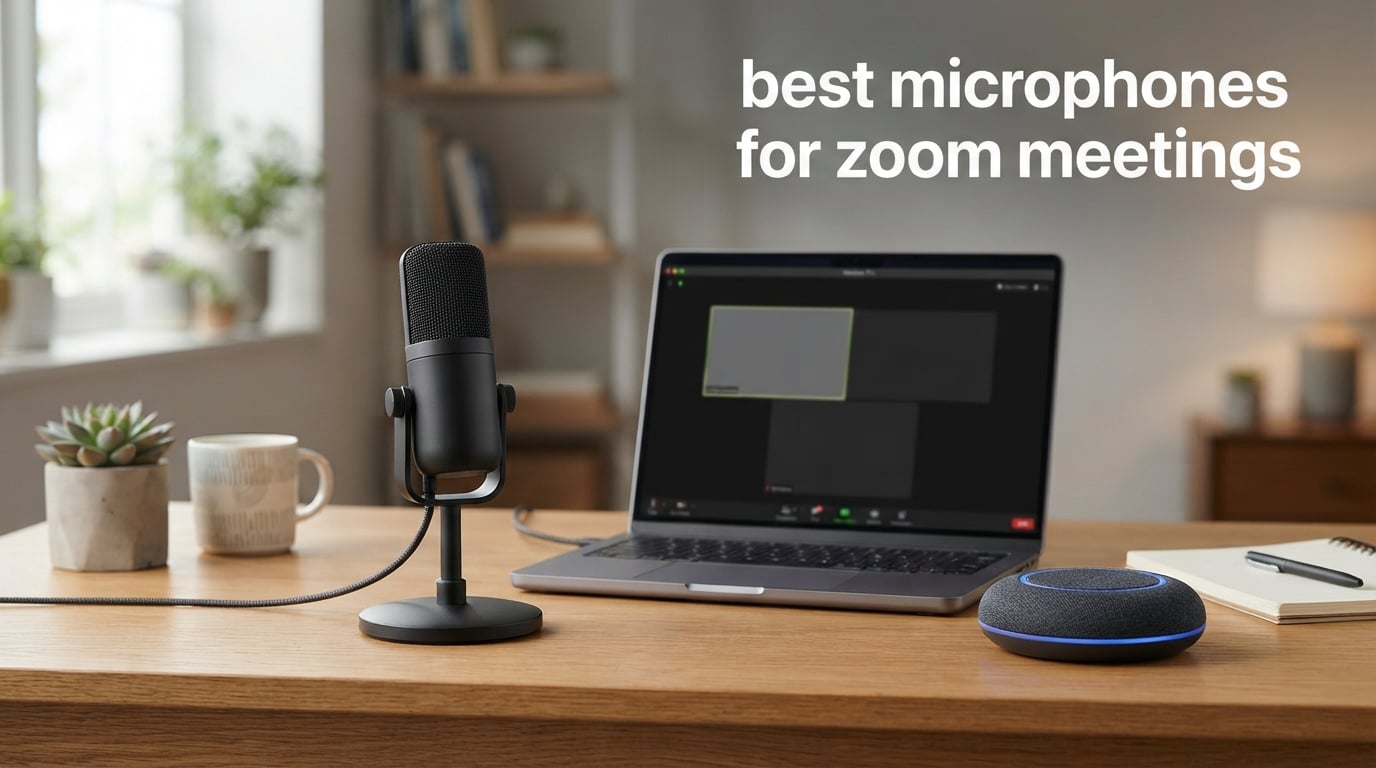
The best microphones for Zoom meetings make one change that a laptop microphone often cannot: they put your voice ahead of the room. Clear speech means fewer requests to repeat yourself, less listening fatigue, and a more composed impression when a client, class, or team call matters.
I compared the supplied product specifications, connection types, pickup patterns, controls, and review summaries for 10 current options. The result covers focused USB condenser microphones for one person, clip-on mics that stay off the desk, and omnidirectional speakerphones for shared calls.
A quality USB microphone with a cardioid or supercardioid pattern is the straightforward choice for a solo desk because it prioritizes the voice in front of it. A conference speakerphone is the better answer when several people will speak from around a table, since its pickup is designed for a wider area.
The practical details matter more than a long feature list. Forum discussions repeatedly point to keyboard noise, room echo, microphones in the camera frame, and unnecessary setup friction, so I have called out each product’s fit rather than pretending one type suits every Zoom meeting.
The top 3 picks answer the most common Zoom setups (September 2026)
Choose the Elgato Wave:3 MK.2 if you want a focused personal mic with onboard level help, the Razer Seiren V3 Mini if desk space and a fast mute control come first, or the Yealink SP92 if portable small-group calls are your regular routine. Those are three very different jobs, which is why the best choice begins with how many people need to be heard.

Yealink SP92 Speakerphone
- Bluetooth and USB-C
- 360 degree pickup
- 20 hour battery
- Teams certified
For an external microphone for a laptop, I favor a directional desk mic when only one speaker is on camera. For a small meeting room, pick a speakerphone instead; its room coverage and built-in speaker solve a different problem from a close-talked USB condenser.
The 10 microphones for Zoom meetings in 2026 cover solo desks and group rooms
The overview below includes every analyzed model. Use the pickup pattern as your first filter: supercardioid and cardioid options work best when the speaker stays near the microphone, while omnidirectional conference devices are meant to collect people spread around a table.
| Product | Specifications | Action |
|---|---|---|
 Elgato Wave:3 MK.2 Elgato Wave:3 MK.2 |
|
Check Latest Price |
 C G CHANGEEK Conference Mic C G CHANGEEK Conference Mic |
|
Check Latest Price |
 Razer Seiren V3 Mini Razer Seiren V3 Mini |
|
Check Latest Price |
 Ynoonvon Conference Speakerphone Ynoonvon Conference Speakerphone |
|
Check Latest Price |
 Audio-Technica AT2020USB-X Audio-Technica AT2020USB-X |
|
Check Latest Price |
 Fyvadio Conference USB Mic Fyvadio Conference USB Mic |
|
Check Latest Price |
 Sennheiser Profile Sennheiser Profile |
|
Check Latest Price |
 TONOR TM310 TONOR TM310 |
|
Check Latest Price |
| Yealink SP92 |
|
Check Latest Price |
 BALILA CM400 BALILA CM400 |
|
Check Latest Price |
Do not read a high review count as a substitute for matching the device to your room. The smaller personal microphones below are for close placement, whereas the speakerphones bring both microphone pickup and playback to a table-based conversation.
1. Elgato Wave:3 MK.2 is the best for controlled personal voice processing
Pros
- Auto Gain calibration
- Clipguard 2.0 protection
- Onboard voice effects
- Direct headphone monitoring
- Tap-to-mute control
Cons
- USB-C connection required
- Condenser design hears room detail
The Wave:3 MK.2 is the most complete solo-desk choice in this group because Elgato combines a supercardioid condenser capsule with Auto Gain and Clipguard 2.0. Its 4.7 rating is drawn from more than 10k reviews, and the listed features focus on the exact moments that interrupt a live meeting: level changes, accidental clipping, and a quick need to mute.
I like that the mic has a multifunction dial, visible LED feedback, and a headphone jack for direct monitoring. The onboard voice enhancer, compressor, and EQ also give someone who records or streams alongside video calls more room to shape the signal without adding a separate interface.
The Wave:3 MK.2 works best when you can speak close to the mic
Place this USB-C microphone about a hand span from your mouth and aim the front toward you, not the keyboard. That close position lets its focused pattern do its job and is preferable to pushing it to the far side of a large desk.
The supplied listing names PC and Mac use through USB-C, so select it as Zoom’s microphone after connecting it. Its stand and included adapters give a starting point, while the listed 3/8-inch and 5/8-inch adapters leave room for a later boom-arm setup.
The Wave:3 MK.2 fits people who want live level safeguards
Auto Gain is useful for a work from home microphone when your speaking volume changes from call to call. Clipguard 2.0 is especially relevant when you move from a measured speaking voice to an energetic presentation and do not want harsh overloads.
The trade-off is that this is a sensitive condenser mic, not a room-wide conference device. I would not select it for several people seated apart, and a very reflective or noisy room still benefits from closer placement and fewer hard surfaces nearby.
2. C G CHANGEEK Conference Mic is the compact pick for flexible device connections
Pros
- USB-A and USB-C connection
- AI noise reduction
- 360 degree pickup
- One-touch mute
- Compact portable body
Cons
- 16 kHz listed response
- 65 dB signal-to-noise ratio
This tiny conference microphone has a practical appeal: it includes a 2-in-1 USB-A and USB-C connection and is listed for computers, phones, and tablets. The circular omnidirectional pickup is designed to collect voices from every direction, with the listing claiming coverage up to 3 meters.
Its AI noise reduction and echo filtering target the common complaint of keyboard clicks, traffic, and other home-office distraction. The 4.7 rating comes from only 16 reviews, though, so I would treat that rating as a small sample rather than the same kind of evidence as a long-established model.
The C G CHANGEEK microphone is best for a portable tabletop call
The 51-gram body and 2-meter cable make this a simple item to move between a home desk, classroom, and temporary conference spot. Put it in the center of the speakers rather than at one participant’s seat to make its omnidirectional design useful.
A one-touch mute button with LED status is a sensible privacy control when you need to step away. It is also plug and play according to the supplied specifications, which keeps the setup lighter than an interface-and-XLR path.
The C G CHANGEEK microphone is less suited to voice recording detail
The 16 kHz listed frequency response and 65 dB signal-to-noise ratio put this in a different category from the studio-style desktop condensers. It is a conference call microphone first, rather than the option I would pick for polished voiceover or detailed podcast recording.
Wide pickup also means placement matters. Keep noisy fans, a mechanical keyboard, and open windows as far from the unit as the room allows, because an omnidirectional mic is meant to hear more than a tight cardioid pattern.
3. Razer Seiren V3 Mini is the best compact mic for a focused single speaker
Pros
- Focused supercardioid pattern
- Tap-to-mute with LED
- Built-in shock absorber
- Compact tilting stand
- No-driver setup
Cons
- USB-A only
- Plastic enclosure
The Razer Seiren V3 Mini is a direct answer for a one-person desk that has little spare space. It pairs a supercardioid pickup pattern with a custom condenser capsule, a tiltable stand, and a built-in shock absorber in a body that is just 6.38 inches tall.
Its 4.6 rating is based on 978 reviews, and the product listing identifies it as a strong computer-microphone seller. The top-mounted tap-to-mute sensor is the feature I would notice most in a meeting, because it gives a fast and visible way to stop sound before a private aside.
The Seiren V3 Mini works best when your mic must stay close but unobtrusive
Use the tilt adjustment to point the capsule toward your mouth, then leave the mic near the edge of the desk rather than hidden behind a monitor. A supercardioid pattern needs a reliable speaking position, which is a fair exchange for suppressing more side noise.
The included USB connection is plug and play for PC, with no drivers stated as necessary. The stand can also detach for a boom arm, a helpful option if keeping the microphone low and out of your camera frame becomes important.
The Seiren V3 Mini is best when fast mute awareness matters
The LED indicator makes the tap-to-mute state readable at a glance. That small control reduces the chance of talking while muted or leaving the microphone live while you take a call-side break.
It uses USB Type-A rather than USB-C, so check the ports on a newer laptop before choosing it. The mic’s focused pattern will not replace a speakerphone when two or more people need equal pickup from different seats.
4. Ynoonvon Conference Speakerphone is the direct USB option for shared tabletop meetings
Pros
- 360 degree voice pickup
- AI noise reduction
- Echo cancellation
- Full-duplex calling
- Plug-and-play USB
Cons
- USB-only connection
- Small review sample
The Ynoonvon is a speakerphone rather than a bare microphone, so it handles both sides of a Zoom conversation from one tabletop unit. Its high-sensitivity microphones are specified for 360-degree voice pickup, while full-duplex audio lets people on both sides speak without the system cutting one side off.
AI noise reduction and echo cancellation are the relevant features here, particularly for a shared home office or a small room where laptop speakers and laptop mics can create a loop. The 4.6 rating is based on 34 reviews, which gives some feedback but not a broad history.
The Ynoonvon speakerphone works best for small groups at one table
Center the unit so every participant has a roughly similar distance to it. This placement is more important than trying to position it near the computer, because the microphone array is being asked to collect several voices.
The product is listed as USB plug and play for Zoom and Teams. I would use it where the built-in speaker is an advantage, not at a solo desk where headphone monitoring and a close directional mic provide more privacy.
The Ynoonvon speakerphone fits calls that need natural back-and-forth conversation
Full-duplex audio is useful during quick team discussions because it permits simultaneous speaking. That can feel less restrictive than half-duplex communication, where one person’s words may suppress another’s.
Touch controls and a compact tabletop format make it easy to keep the meeting setup simple. It is USB only, however, so it is less flexible for people who need to take the same speakerphone to calls without a laptop connection.
5. Audio-Technica AT2020USB-X is the best for detailed voice capture and monitoring
Pros
- 24-bit/96 kHz conversion
- Direct headphone jack
- Capacitive mute button
- Directional pickup
- Extended response
Cons
- USB only
- Single unidirectional pattern
The AT2020USB-X is a strong choice for a speaker who wants a professional microphone for video calls that can also cover voiceover, podcast, and home-studio work. It combines a large-diaphragm condenser design with high-resolution 24-bit/96 kHz conversion and directional pickup that minimizes background noise.
Its built-in headphone jack is a major practical advantage. I prefer direct monitoring when checking whether a fan, hard desk reflection, or distant noise has become audible before an important meeting begins.
The AT2020USB-X works best for a quiet desk with a consistent speaking position
Point the directional side toward your mouth and keep the back of the microphone toward the noisiest part of the room. Large-diaphragm condensers can sound natural and detailed, but they reward a quieter space and a stable distance.
The soft-touch capacitive mute button and blue-to-red LED ring give a clear control point during calls. Select the mic as Zoom’s input, then use its headphone jack to hear the result without relying only on visual level meters.
The AT2020USB-X is best when one mic must serve meetings and recordings
The extended frequency response and stated 24-bit/96 kHz conversion make this more than a basic laptop accessory. It is a sensible fit if your remote meeting microphone will also record narration or podcast material outside the workday.
There is no XLR output in the supplied data and no omnidirectional mode, so it is not built as a growth path for a multi-mic room. For several people around a desk, a speakerphone remains the more suitable form factor.
6. Fyvadio Conference USB Mic is the simple portable choice for basic group pickup
Pros
- 360 degree pickup
- Built-in noise reduction
- Mute LED indicator
- No-driver setup
- Compact metal body
Cons
- No built-in speaker
- Micro USB connection
The Fyvadio is a microphone-only puck for people who already have a suitable speaker or use headphones. It lists 360-degree sound capture up to 10 feet, built-in noise reduction, and a 2-meter USB cable, making it a compact way to improve a shared laptop call without adding a speakerphone.
There are 493 reviews behind its 4.6 rating, and the supplied review summary points to clear audio, easy setup, and omnidirectional pickup. Its metal body and small 62 mm diameter also make it less of a permanent desk fixture than a full-size condenser.
The Fyvadio microphone works best with headphones or a separate speaker
Because it has no speaker, I would pair this model with headphones when avoiding echo is a priority. That is especially useful in a room where a laptop’s speakers would otherwise feed back into the same table microphone.
Place it centrally and leave its blue/red LED mute indicator visible. The listed plug-and-play connection means your next step is simply choosing the device in Zoom’s audio input menu.
The Fyvadio microphone fits lightweight group calls rather than studio capture
Its omnidirectional pattern helps several nearby participants, while its 60 dB signal-to-noise ratio and 25 dB audible-noise figure make it a different proposition from a close personal mic. Use it for understandable group discussion rather than highly isolated narration.
The Micro USB connector is worth checking before you buy, since many current laptop accessories use USB-C. An adapter may be needed depending on the computer’s available ports, but no adapter is listed with this product data.
7. Sennheiser Profile is the best for warm voice tone and physical controls
Pros
- Cardioid condenser capsule
- Warm voice character
- Gain mix and volume controls
- Headphone monitoring
- Metal housing
Cons
- Heavier table setup
- 60 dB signal-to-noise ratio
Sennheiser’s Profile pairs a cardioid condenser capsule with the controls that make a desk microphone easier to manage in real time: gain, mix, and volume dials, a mute button, and headphone monitoring. The supplied listing describes its voice as natural and warm, and the metal housing gives the unit a more substantial table presence.
This one is particularly appealing if you do not want to open software to make a basic monitoring or level adjustment. The 4.4 rating comes from 977 reviews, with the review summary highlighting natural sound, build quality, and intuitive controls.
The Sennheiser Profile works best when tactile control is part of your workflow
Gain, mix, and volume each have a separate physical control, which reduces fumbling through audio menus mid-call. I would set the gain before joining, then use the headphone output to verify my own voice and the computer playback balance.
The included table stand and USB-C cable support a quick desk setup. With a cardioid pattern, face the front toward the speaker and keep the rear pointed away from a noisy computer tower or window.
The Sennheiser Profile fits a fixed personal desk better than a travel kit
At 717 grams, this is not the lightest option in the group. That weight can help keep it planted on a desk, but it makes a pocketable, move-between-rooms solution less likely.
Like the other close condenser options, this one is for a single primary voice. It will not replace the broad coverage of an omnidirectional conference device when colleagues gather around the same table.
8. TONOR TM310 is the best monitor-mounted option for keeping the desk clear
Pros
- Monitor clip saves desk space
- Supercardioid pickup
- Angle adjustment
- Mute LED
- USB-C to USB-A adapter
Cons
- Not for smartphones
- Listed noise concerns in reviews
The TONOR TM310 solves a very specific camera and desk problem: its clip-on structure attaches to a computer or monitor rather than occupying the area in front of the keyboard. The microphone has a supercardioid directional pickup, rotates horizontally through 360 degrees, and tilts from minus 25 to 10 degrees for more careful aiming.
It includes a Type-C-to-Type-C cable and a Type-C-to-USB-A adapter, so it gives more connection flexibility than many single-cable USB mics. The 4.3 rating across 514 reviews is solid but lower than several alternatives here, and the review summary mentions user concerns around noise reduction.
The TONOR TM310 works best when the microphone must stay near the screen
Clip it to the monitor and point it down toward your mouth rather than straight at a wall or ceiling. This can keep a zoom meeting microphone out of frame more effectively than a tall desktop stand while preserving the close directional placement it needs.
The mute and noise-reduction control has an LED indicator, which is useful when the mic sits just above the screen. The stated macOS and Windows compatibility and plug-and-play setup keep the installation simple on those computer platforms.
The TONOR TM310 fits individual calls in a controlled room
Its supercardioid pattern is designed for front sound capture, making it better for one speaker than a group. Keep the laptop fan, keyboard, and other sound sources off to the sides or behind the mic’s rejection area where possible.
It is not recommended for smartphones in the supplied data. I would also take the review-summary noise concerns seriously by testing Zoom’s input meter and recording a short local sample before a major presentation.
9. Yealink SP92 is the best portable speakerphone for four to eight people
Pros
- AI noise cancellation
- 13 foot room coverage
- 20 hour battery
- Bluetooth and USB-C
- Full-duplex audio
Cons
- No dongle in this variant
- Mono speaker output
The Yealink SP92 is made for a small meeting room, with a listed 13-foot coverage radius for four to eight people, a 360-degree microphone, and a 50 mm speaker. It is also the most mobile group-call choice here thanks to Bluetooth 5.3, USB-C, a stated 20-hour battery life, and a carrying case.
Yealink says its AI noise cancellation filters more than 1,000 noises, and full-duplex audio supports more natural exchanges. The product is Microsoft Teams certified, while the supplied data also describes it as a computer and laptop speakerphone; select it in Zoom as you would any available audio device.
The Yealink SP92 works best for recurring meetings away from one desk
Bluetooth and battery power remove the need to keep the unit tethered, while USB-C gives a wired route when you want one. I would take this to huddle spaces, temporary office rooms, or in-person gatherings where a laptop’s speaker and mic are not enough.
Place it in the middle of the group and do not block the 360-degree microphone path with papers or a laptop. Its claimed 13-foot radius is a room-coverage guide, not a reason to let participants sit in separate rooms.
The Yealink SP92 suits small teams that need a dedicated speakerphone
Microsoft Teams certification is helpful context for offices that use that platform, but it does not make a Zoom selection automatic. The useful point for Zoom is the hardware mix of USB-C, Bluetooth, full-duplex operation, and a voice pickup built for several people.
This variant does not include a dongle, according to the supplied data, and its speaker output is mono. Its 4.2 rating from 122 reviews is respectable but should be weighed alongside the need for portable group coverage.
10. BALILA CM400 is the broad-coverage choice for larger conference rooms
Pros
- 10 AI microphones
- 65 foot wireless range
- Voice isolation
- 5W speaker
- Full-duplex calling
Cons
- Lower 4.0 rating
- Voice-clarity concerns in reviews
The BALILA CM400 is the room-coverage outlier in this list. Its supplied specification calls out 10 AI omnidirectional microphones, a 65-foot voice pickup range, VoiceIA noise isolation, a 5W speaker, and more than 10 hours of talk time, all aimed at conference rooms rather than one-person desks.
That scope makes it a candidate for larger group calls, but the evidence needs a balanced reading. It has a 4.0 rating from 206 reviews, and the review summary says users appreciate the microphone count and range while some report voice-clarity issues.
The BALILA CM400 works best when the meeting involves a larger group in one room
A device built around 10 microphones and a broad pickup range makes more sense for a conference room than placing a small USB condenser in front of one attendee. Keep the speakerphone central and ask remote participants to confirm clarity from the farthest seats during the first minute.
Its full-duplex audio and 5W speaker address both capture and playback. USB-C connectivity with no drivers required, as listed, also reduces the technical barrier for a shared work computer.
The BALILA CM400 needs a short real-room sound check before important calls
The lower rating and reported voice-clarity concerns mean I would not rely only on its advertised coverage figure. Run a test meeting with several voices, background HVAC noise, and normal room distance before using it for an executive or client session.
It has 10-plus hours of stated talk time and a wireless range listed at 65 feet, which can help room flexibility. Still, broad coverage cannot remove every acoustic problem, especially glass walls, bare floors, and loud ventilation.
The right Zoom microphone starts with pickup pattern and meeting size
Start by deciding whether one person or a group needs to be heard. A cardioid or supercardioid USB microphone is the better route for one presenter seated close to a computer, while an omnidirectional microphone or speakerphone is intended to include people around a table.
That one distinction prevents the most common mismatch. A close-talked microphone can reject more side and rear distraction, but it will not reliably cover colleagues across a room; a 360-degree device will cover more people but also has more opportunity to hear the room.
A cardioid or supercardioid mic is the focused answer for a solo desk
Cardioid patterns favor sound from the front, while supercardioid patterns are tighter and generally require more deliberate aiming. In this list, the Elgato, Razer, TONOR, Sennheiser, and Audio-Technica models are the choices to consider when keyboard clicks and fan noise compete with one main voice.
Put the microphone roughly a hand span from your mouth, slightly to one side so breath does not hit it directly. Lower the gain before moving the mic far away; close placement usually gives a clearer voice than extra gain at a long distance.
An omnidirectional speakerphone is the practical answer for shared rooms
The C G CHANGEEK, Fyvadio, Ynoonvon, Yealink, and BALILA options have wider pickup designs. Choose a microphone-only puck if you will use headphones or a separate speaker, and choose a speakerphone if you need a single device for both hearing and being heard.
Put the unit at the table center, keep it clear of notebooks and laptops, and stay realistic about distance. A claimed coverage measurement is helpful, yet a quick test with the farthest participant remains more informative than any specification line.
A condenser microphone is the detailed choice for a quiet personal room
Most personal microphones in this roundup are condenser designs. A condenser can capture articulate voice detail, making it attractive for client video calls, narration, and a podcast microphone for Zoom, but it can also hear more room reflection than a close, less-sensitive microphone setup.
A dynamic microphone is often favored in untreated rooms because close use can reduce how much room sound reaches the signal. None of the analyzed personal picks is presented as a dynamic microphone, so someone in a loud room should prioritize a tight pickup pattern, close placement, and basic noise control.
USB is the plug-and-play answer, while XLR adds equipment and flexibility
Every product here offers a direct computer-oriented connection, chiefly USB, USB-C, or Bluetooth on the Yealink. That is why these are sensible for Zoom: connect the device, then select it as the input in the app instead of building a separate audio chain.
An XLR microphone normally needs an audio interface or mixer before it reaches a computer. That can offer more equipment choices, but it introduces setup work; for most remote meetings, a USB microphone for Zoom is the more direct route.
Zoom settings improve clear hardware when the input is selected correctly
In Zoom’s Audio settings, choose the connected microphone rather than leaving the input on the laptop default. Speak at your normal meeting volume, watch the input meter, and use a short recording or test call to check for clipping, low level, or unwanted keyboard noise.
Turn off a competing microphone in another calling app before a meeting, and use headphones when a tabletop microphone sits near computer speakers. If Zoom’s automatic level adjustment makes your level pump or fluctuate, compare it with a manual level after you have set the microphone gain conservatively.
A quieter desk is the simplest answer to echo and keyboard pickup
Forum users repeatedly mention untreated rooms, typing, and echo. Move the microphone closer, move your keyboard farther to the side, close windows during critical calls, and place soft material such as a rug, curtain, or fabric-covered furniture in the most reflective part of the room.
These changes do not need a studio rebuild. They reduce the noise reaching the mic in the first place, which is usually more convincing than trying to remove a noisy or echo-filled signal after it has been recorded.
The answers below solve the most common Zoom microphone questions
What is the 3 to 1 rule for microphones?
The 3-to-1 rule is a recording guideline for multiple microphones: space microphones at least three times farther apart from each other than each microphone is from its intended sound source. It helps reduce unwanted pickup and phase issues. For a Zoom call with one USB microphone, close placement and a focused pickup pattern matter more than applying the rule literally.
Why can people barely hear me on Zoom?
People may barely hear you because Zoom is using the laptop microphone, the selected input is wrong, your mic is too far away, the gain is low, or background noise is masking speech. Select the external microphone in Zoom Audio settings, move it about a hand span from your mouth if it is directional, and make a test recording at your normal speaking level.
How do I choose a Zoom microphone?
Choose a cardioid or supercardioid USB microphone for one person at a desk, especially if keyboard and room noise are concerns. Choose an omnidirectional microphone or speakerphone for several people around a table. Then confirm the connection your computer supports, whether you need a mute button or headphone monitoring, and whether the mic must remain out of the camera frame.
Which microphone works with Zoom?
A USB microphone that your computer recognizes as an audio input works with Zoom after you select it in Zoom Audio settings. The microphones in this guide use USB or USB-C connections, while the Yealink SP92 also offers Bluetooth. Pick a focused desk mic for one speaker or a conference device for a group.
The best choice is a close personal mic for one voice or a speakerphone for a group
For most individual video calls, the Elgato Wave:3 MK.2 combines a focused pattern, direct monitoring, Auto Gain, and anti-clipping support in a well-rounded USB-C design. The Razer Seiren V3 Mini is the compact alternative, while the Audio-Technica and Sennheiser choices make sense when recording quality outside meetings matters too.
For shared calls, match the room to an omnidirectional solution: the Yealink SP92 for portable small-team meetings, the Ynoonvon for a wired tabletop speakerphone, and the BALILA for a larger-room approach. The best microphones for Zoom meetings in 2026 are not one universal product; they are the ones whose pickup pattern, placement, and controls match the people and room on your call.