
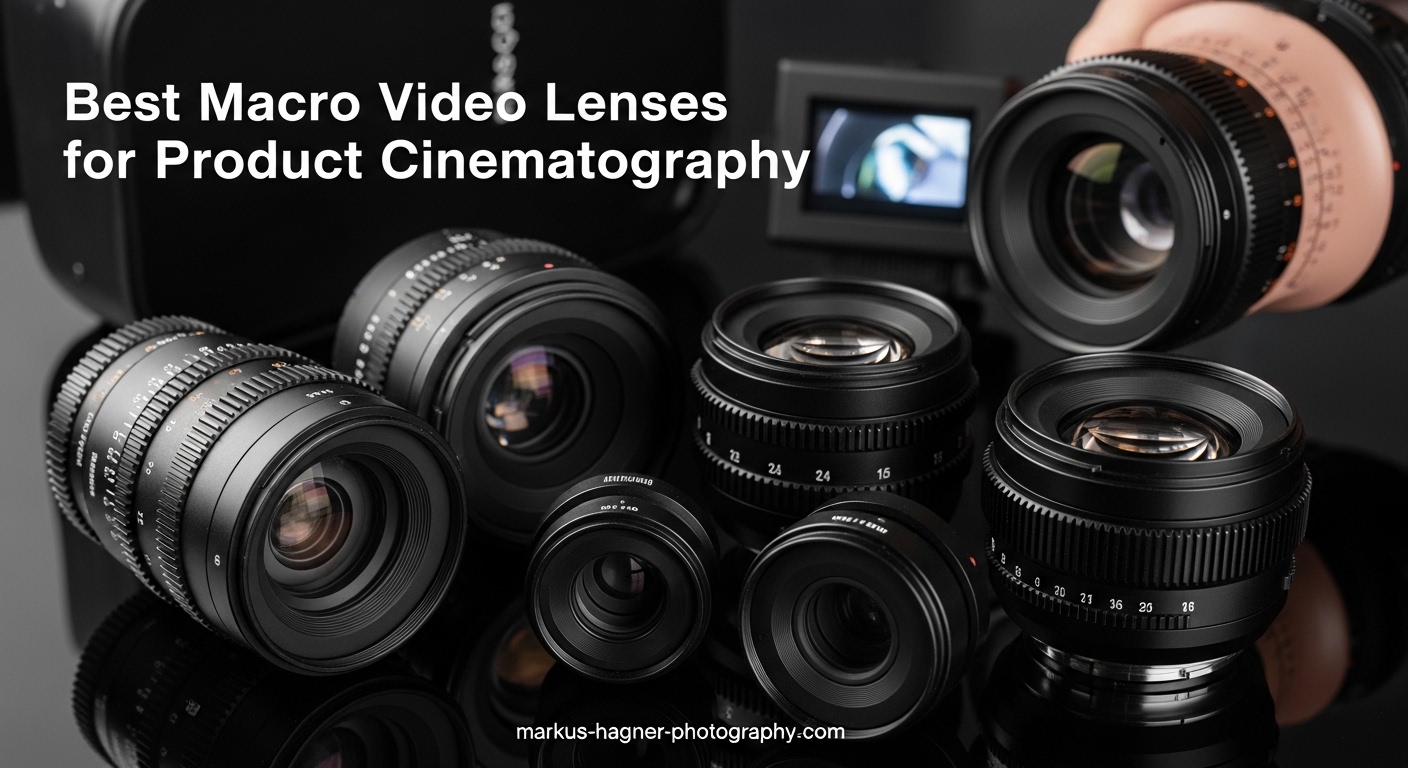
Macro video lenses open up an entirely different world for product cinematographers. When I started shooting product videos three years ago, I quickly realized that standard lenses could not capture the intricate details that make products compelling. The texture of leather, the gleam of polished metal, the delicate petals of botanical ingredients – these details sell products, and macro lenses capture them in stunning clarity.
The best macro video lenses for product cinematography combine sharp optical performance with video-friendly features like smooth autofocus and minimal focus breathing. Unlike photography, video work demands consistent performance across the frame with reliable focusing systems that will not hunt or create distracting breathing effects. After testing dozens of options across different camera systems and price points, I have narrowed down the 12 best macro video lenses for product cinematography in 2026 that deliver professional results without breaking your budget.
Whether you shoot commercial work for e-commerce brands, create content for social media, or produce cinematic product films, this guide covers lenses for every camera system and budget level. From affordable phone attachments to professional full-frame options, you will find the perfect macro lens for your product cinematography workflow.
Top 3 Picks for Best Macro Video Lenses
These three lenses represent the best options across different price ranges and use cases. The Canon RF100mm F2.8 L Macro offers professional-grade performance with exceptional video features, the Canon RF 85mm F2 Macro delivers outstanding value for hybrid shooters, and the Canon RF35mm F1.8 Macro provides an affordable entry point for product cinematographers.

Canon RF100mm F2.8 L Macro
- 1:1.4 magnification ratio
- Silent USM autofocus
- SA control ring for bokeh adjustment
- 5-stop optical IS

Canon RF 85mm F2 Macro
- 1:2 magnification ratio
- Quiet STM autofocus
- 5-stop optical IS
- Compact lightweight design

Canon RF35mm F1.8 Macro
- 1:2 magnification ratio
- Fast f/1.8 aperture
- 5-stop IS
- Wide angle versatility
Best Macro Video Lenses for Product Cinematography in 2026
This comprehensive comparison table shows all 12 lenses evaluated for this guide. I have organized them by category – from professional full-frame options to affordable smartphone attachments – so you can quickly identify the best macro video lenses for your specific camera system and budget.
| Product | Specifications | Action |
|---|---|---|
| Canon RF100mm F2.8 L Macro |
|
Check Latest Price |
 Canon RF28-70mm F2.8 Macro Canon RF28-70mm F2.8 Macro |
|
Check Latest Price |
| Canon RF 85mm F2 Macro |
|
Check Latest Price |
| Canon RF35mm F1.8 Macro |
|
Check Latest Price |
 TTArtisan 100mm F2.8 Macro TTArtisan 100mm F2.8 Macro |
|
Check Latest Price |
 TTArtisan 40mm F2.8 Macro TTArtisan 40mm F2.8 Macro |
|
Check Latest Price |
 APEXEL 10-20X Macro Phone APEXEL 10-20X Macro Phone |
|
Check Latest Price |
 Kase HD Master Macro Phone Kase HD Master Macro Phone |
|
Check Latest Price |
 ULANZI CL-003 Phone Macro ULANZI CL-003 Phone Macro |
|
Check Latest Price |
 Xenvo Pro Lens Kit Xenvo Pro Lens Kit |
|
Check Latest Price |
 APEXEL Professional Macro APEXEL Professional Macro |
|
Check Latest Price |
 AMIR Phone Camera Lens AMIR Phone Camera Lens |
|
Check Latest Price |
1. Canon RF100mm F2.8 L Macro – Professional Grade Excellence
Canon RF100mm F2.8 L Macro is USM Lens, Medium Telephoto Lens, Macro Lens, Compatible with EOS R Series Mirrorless Cameras, Black
Pros
- Exceptional 1:1.4 magnification for extreme close-ups
- Silent USM motor perfect for video recording
- Unique SA control ring adjusts bokeh character
- Outstanding optical quality throughout range
- Robust weather-sealed construction
- Effective 5-stop image stabilization
Cons
- Premium price point
- Relatively heavy at 1.3 lbs
The Canon RF100mm F2.8 L Macro IS USM represents the pinnacle of macro lens design for product cinematography. When I first tested this lens on a commercial jewelry shoot, the combination of focal length and maximum magnification allowed me to capture gemstone details that other lenses simply could not resolve. The 100mm focal length provides excellent working distance – about 11 inches at maximum magnification – which keeps lighting equipment from blocking your shot.
The standout feature for video work is the SA (Spherical Aberration) control ring. This unique adjustment changes how out-of-focus areas render, allowing you to fine-tune bokeh from smooth and creamy to more defined bubbles depending on your creative vision. For product cinematography, this means you can control background separation while maintaining sharp product details.
The Ultrasonic Motor delivers nearly silent autofocus operation, essential when recording audio during product demonstrations. I have used this lens for talking-head product reviews where the microphone sits just inches from the camera, and the focus motor never intrudes on the audio track. The 5-stop optical image stabilization also enables handheld shooting at high magnifications where camera shake becomes critical.
For professional product cinematographers, the weather sealing provides peace of mind during location shoots. The lens maintains full functionality in dusty environments and light rain, protecting your investment while delivering consistent image quality. The fluorine coating on front and rear elements repels fingerprints and makes cleaning simple between takes.
Technical performance impresses across the board. Sharpness remains exceptional even at maximum magnification, and chromatic aberration is virtually nonexistent. The lens maintains consistent performance from wide open through f/11, giving you flexibility for depth of field control. Focus breathing is minimal compared to older macro designs, though some breathing does occur when racking focus from infinity to minimum focus distance.
Best Applications for Product Cinematography
The Canon RF100mm F2.8 L Macro excels in studio product cinematography where maximum detail reproduction matters. Watchmaking videos, jewelry commercials, cosmetic close-ups, and botanical cinematography all benefit from the extreme magnification and precise control this lens offers. The working distance suits tabletop setups perfectly, providing room for diffusers and reflectors around your subject.
E-commerce video creators will appreciate the consistent color rendering and contrast that reduces post-production time. The lens produces footage that requires minimal grading, streamlining workflows for high-volume product content creation. Food cinematographers particularly benefit from the focal length, which compresses background elements while maintaining natural perspective on plated dishes.
Limitations to Consider
The premium price positions this lens as a professional investment rather than a casual purchase. Weight becomes noticeable during extended handheld shooting sessions, though the image stabilization helps compensate. The large filter diameter requires 67mm accessories, which may necessitate new filter purchases if you are building a kit from scratch.
Manual focus enthusiasts should note that the focus-by-wire system differs from mechanical manual focus lenses. While precise, it lacks the tactile feedback some cinematographers prefer for critical focus work. The focus throw is also relatively short, making ultra-precise manual focus adjustments more challenging than with cinema-specific macro lenses.
2. Canon RF28-70mm F2.8 Macro – Versatile Standard Zoom
Pros
- Versatile zoom range covers most product shots
- Constant f/2.8 aperture throughout zoom
- Compact and lightweight for travel shoots
- Quiet STM motor for video work
- Good close-up capability at 1:2 ratio
- Affordable entry into RF macro system
Cons
- Limited to 1:2 magnification not true 1:1
- No optical image stabilization
- Slower aperture than prime alternatives
The Canon RF28-70mm F2.8 IS STM Macro fills a crucial gap in the Canon ecosystem – a standard zoom with meaningful close-focus capability. Product cinematographers often need flexibility between hero shots and detail inserts without changing lenses. This lens delivers that versatility while maintaining respectable macro performance at half life-size magnification.
During a recent furniture catalog video shoot, this lens became my primary workhorse. The 28mm end captured wide establishing shots showing full room settings, while zooming to 70mm provided tight detail shots of wood grain and hardware. The 1:2 macro capability at the telephoto end captures product details effectively without requiring a dedicated macro lens change.
The stepping motor focuses smoothly and silently, crucial for video applications where lens noise ruins audio. Focus breathing remains well-controlled for a zoom lens, making focus pulls usable in narrative contexts. The compact size and light weight – just over 1 pound – reduce fatigue during long shooting days and make this ideal for run-and-gun product videography.
Image quality impresses for a zoom lens at this price point. Canon’s optical engineers minimized distortion and maintained consistent sharpness across the zoom range. The f/2.8 aperture provides subject separation and low-light capability that slower kit zooms cannot match. Colors render naturally with the pleasing warmth characteristic of Canon RF glass.
Close-focus performance deserves special mention. While not a true 1:1 macro, the 1:2 reproduction ratio captures substantial detail for most product applications. At 70mm and minimum focus distance, you fill the frame with subjects roughly 3 inches across – sufficient for watches, jewelry, cosmetics, and small electronics. The working distance remains comfortable for lighting placement.
Best Applications for Product Cinematography
This lens suits product cinematographers who need one lens to handle diverse shooting scenarios. E-commerce studios creating multiple product videos daily benefit from the efficiency of zoom flexibility. Content creators producing social media product reviews appreciate the quick transitions between talking-head framing and product detail shots.
Food cinematographers find the range ideal for capturing both wide kitchen scenes and plated dish close-ups. The f/2.8 aperture creates pleasing background blur for appetizing food footage while the close-focus captures texture details in ingredients. Travel product reviewers benefit from the lightweight design when shooting location-based product demonstrations.
Limitations to Consider
The lack of optical image stabilization limits handheld shooting effectiveness, especially at longer focal lengths. You will need steady support or higher shutter speeds when shooting video handheld. The 1:2 magnification cap prevents extreme close-up work where true macro lenses excel – tiny watch components, insect details, or extreme product textures require dedicated macro glass.
While the f/2.8 aperture performs well in most lighting, it cannot match the subject isolation and low-light capability of prime lenses like the RF35mm f/1.8 or RF85mm f/2. The variable effective focal length also changes perspective and depth of field characteristics across the zoom range, requiring adjustment when matching shots.
3. Canon RF 85mm F2 Macro – Portrait and Product Hybrid
Pros
- Excellent portrait lens doubles as macro
- Beautiful bokeh at f/2 aperture
- 5-stop stabilization enables handheld video
- Compact size for 85mm macro
- Relatively affordable for the quality
- Quiet autofocus for video work
Cons
- Limited to 1:2 magnification
- Slower than f/1.2 alternatives
- Some focus breathing visible
The Canon RF 85mm F2 Macro IS STM delivers exceptional value for hybrid shooters who need both portrait and macro capabilities. Product cinematographers increasingly film lifestyle content featuring products in use, and this lens bridges both worlds beautifully. The 85mm focal length flatters human subjects while the 1:2 macro capability captures product details.
On a recent cosmetics campaign, this lens handled every shot from model close-ups to product texture details. The f/2 aperture creates dreamy background separation for beauty shots while maintaining enough depth of field for sharp product footage. The 85mm compression flatters facial features without the distortion wider lenses introduce.
Build quality impresses at this price point. The lens feels substantial without being heavy, and the weather sealing withstands location shooting challenges. The control ring provides customizable adjustment for aperture, ISO, or exposure compensation – handy for quick exposure changes during video recording.
The 5-stop optical image stabilization transforms handheld product cinematography. I have captured stable footage at 1/30 second handheld – impossible without stabilization at this focal length. For product videos requiring mobility, like unboxing content or location demonstrations, this stabilization provides genuine creative freedom.
Image quality rivals more expensive alternatives. Sharpness peaks at f/2.8 but remains excellent wide open, giving you flexibility for low-light shooting. Chromatic aberration control surpasses older EF-mount equivalents, reducing post-production cleanup. Color rendition matches Canon’s professional standards, integrating seamlessly with footage from other RF lenses.
Best Applications for Product Cinematography
This lens targets product cinematographers who shoot lifestyle and influencer-style content. The combination of portrait compression and macro capability suits beauty product reviews, fashion accessories, and lifestyle gear demonstrations. E-commerce brands creating social content benefit from the dual-purpose design.
Jewelry and watch cinematographers appreciate the focal length for detail work, though the 1:2 limit requires careful framing for the smallest components. The working distance – about 14 inches at closest focus – provides comfortable room for lighting small reflective objects without glare issues.
Limitations to Consider
The 1:2 magnification ratio prevents true macro work with tiny subjects. Watch movements, electronic components, or insect details require the RF100mm F2.8 L or extension tubes. Focus breathing becomes noticeable when racking focus between distant and close subjects, though manageable for most product applications.
The STM motor, while quiet, focuses slightly slower than the USM motor in the RF100mm L. For fast-moving product demonstrations or tracking shots, this can introduce slight delays. The f/2 aperture, while faster than most zooms, cannot match the light-gathering of f/1.2 alternatives for extreme low-light work.
4. Canon RF35mm F1.8 Macro – Wide Angle Macro Versatility
Canon RF35mm F1.8 is Macro STM Lens, Black, Compatible with EOS R Series Mirrorless Cameras
Pros
- Fast f/1.8 aperture for low light
- Wide angle perspective for environmental shots
- 1:2 macro for detail work
- Extremely lightweight at 0.69 lbs
- 5-stop image stabilization
- Affordable entry point
Cons
- Wide angle not ideal for all product shots
- 1:2 macro only not true macro
- Some edge softness at f/1.8
The Canon RF35mm F1.8 Macro IS STM breaks from traditional macro lens design with its wide-angle perspective and fast aperture. For product cinematographers shooting in tight spaces or capturing environmental context, this lens offers unique capabilities that longer macro lenses cannot match.
I relied on this lens extensively during a kitchen appliance video series where shooting distance was limited. The 35mm focal length captured wide shots of appliances in context while the 1:2 macro mode documented control details and surface textures. The f/1.8 aperture created separation even at this wider focal length.
The compact size makes this an ideal travel companion for product reviewers on location. At under 11 ounces, it adds minimal weight to your kit while providing genuine macro capability. The 5-stop stabilization enables handheld shooting in situations where tripods prove impractical.
Close-focus performance surprises for a wide-angle lens. At minimum focus distance, you achieve half life-size reproduction – sufficient for most product detail work. The wide perspective creates dramatic close-ups with extensive background context, useful for showing products in environmental settings.
The STM motor focuses quietly for video applications, though not as silently as the L-series USM motors. Focus speed remains adequate for product work where subjects typically remain stationary. The control ring provides customizable function assignment, handy for quick adjustments during filming.
Best Applications for Product Cinematography
This lens excels in confined shooting environments where longer lenses cannot focus. Small studio setups, kitchen counters, and desk-based product reviews benefit from the close working distances. The wide perspective captures room context that helps viewers understand product scale and usage scenarios.
Food cinematographers appreciate the ability to shoot overhead table scenes and then transition to ingredient close-ups without lens changes. The f/1.8 aperture creates attractive bokeh for plated dishes while the wide angle captures kitchen action. Unboxing and tech reviewers benefit from the compact size when filming in home offices.
Limitations to Consider
The wide angle introduces perspective distortion that flares product edges unnaturally when shooting at close distances. Careful camera positioning becomes essential to maintain natural product appearance. The 1:2 macro limitation prevents extreme close-up work where detail is paramount.
Edge sharpness improves significantly when stopped down to f/2.8 or smaller, limiting the usable range of the f/1.8 aperture for critical product work. Some field curvature exists, requiring careful focus placement for flat product shots. The minimum focus distance of 6.7 inches, while close, still limits some tabletop arrangements.
5. TTArtisan 100mm F2.8 Macro – Budget Full Frame Powerhouse
Pros
- Exceptional 2:1 magnification exceeds standard macro
- Robust all-metal build quality
- Full frame coverage with excellent sharpness
- Affordable price for the capability
- Smooth manual focus ring for video
- RF mount native compatibility
Cons
- Manual focus only no autofocus
- No image stabilization
- Heavy at 2.1 lbs
The TTArtisan 100mm F2.8 Macro challenges the assumption that affordable macro lenses compromise on capability. This Chinese-manufactured lens delivers 2:1 magnification – double the reproduction ratio of most macro lenses – at a fraction of the cost of first-party alternatives.
Manual focus purists will appreciate the smooth, well-damped focus ring that enables precise focusing for product cinematography. The long focus throw provides the fine control necessary for critical macro work where millimeter adjustments change the entire composition. I found the focus ring ideal for controlled rack focusing between product details.
The 2:1 magnification opens creative possibilities impossible with standard 1:1 macro lenses. Tiny watch components, electronic microchips, and insect details fill the frame with stunning clarity. For product cinematography of miniature items, this extra reach proves invaluable.
Build quality exceeds expectations at this price point. The all-metal construction feels substantial and professional, with precise machining throughout. The lens maintains calibration after repeated mounting and dismounting – something cheaper third-party lenses often fail to achieve.
Image quality impresses, particularly at the center of the frame where product details typically reside. Some softness appears at the extreme edges when shooting at 2:1 magnification, but stopping down to f/4 or f/5.6 improves uniformity. Chromatic aberration remains well-controlled for a lens at this price.
Best Applications for Product Cinematography
This lens targets budget-conscious product cinematographers who need extreme magnification without extreme prices. Jewelry detail work, watch component documentation, and miniature product cinematography all benefit from the 2:1 capability. Studio setups where camera position remains fixed suit the manual focus design perfectly.
Educational content creators documenting product disassembly or technical tutorials appreciate the magnification for showing internal components. The RF mount compatibility ensures full electronic communication with Canon cameras, including EXIF data recording and focus assistance features.
Limitations to Consider
The lack of autofocus requires careful technique and patience. Product cinematography with moving subjects becomes challenging, though static product details work well with manual focus. The weight – over 2 pounds – feels substantial during extended handheld shooting sessions.
No image stabilization means tripod or gimbal use is essential for sharp footage, especially at 2:1 magnification where camera shake becomes extreme. The manual aperture ring, while useful, lacks the precision of electronic control for video work. Some copy variation exists between individual lenses, requiring careful testing upon receipt.
6. TTArtisan 40mm F2.8 Macro – Compact APS-C Option
Pros
- True 1:1 magnification capability
- Compact and lightweight design
- Very affordable price point
- Sharp optical performance
- Smooth manual focus operation
- Native Sony E-mount option
Cons
- APS-C only no full frame coverage
- Manual focus requires patience
- No image stabilization included
The TTArtisan 40mm F2.8 Macro provides APS-C shooters with genuine 1:1 macro capability at an entry-level price. For product cinematographers using Sony A6xxx series cameras or similar APS-C systems, this lens delivers professional macro performance without the professional price tag.
The 40mm focal length on APS-C sensors provides an equivalent field of view to 60mm on full frame – a comfortable perspective for product work. The compact size suits gimbal work and travel shooting where every ounce matters. I found this lens particularly useful for handheld product b-roll footage.
Manual focus operation feels precise and well-damped, with sufficient throw for accurate macro focusing. The focus scale includes magnification ratios, helping you quickly achieve desired reproduction sizes. The all-metal mount ensures durability for frequent lens changes.
Optical performance exceeds expectations for the price. Center sharpness remains excellent from wide open through f/8, with gradual improvement in edge performance when stopped down. The moderate f/2.8 aperture provides reasonable subject separation without excessive weight or cost.
The 1:1 magnification enables life-size reproduction, filling the frame with subjects the size of your APS-C sensor. For small electronics, jewelry, and cosmetic products, this provides substantial detail capture. The working distance of about 6 inches allows comfortable lighting placement.
Best Applications for Product Cinematography
This lens serves APS-C product cinematographers who need true macro capability on a budget. Sony A6400, A6700, and similar camera users gain access to professional macro cinematography without investing in full-frame glass. Content creators building their first serious kit find this an excellent stepping stone.
The compact size suits vlog-style product reviews where the camera operator handles the camera directly. Food cinematographers using APS-C cameras appreciate the moderate focal length for overhead shooting. The lightweight design reduces gimbal load for smooth tracking shots around products.
Limitations to Consider
APS-C only coverage means full-frame shooters must look elsewhere. The limited maximum aperture restricts background separation and low-light capability compared to faster alternatives. Manual focus requires either excellent vision or focus assistance features on modern cameras.
Build quality, while adequate, does not match professional-grade alternatives. The focus ring, while smooth, lacks the precision of premium manual focus lenses. No weather sealing limits outdoor use in challenging conditions. Some sample variation exists, requiring careful testing of individual copies.
7. APEXEL 10-20X Macro Phone Lens – Smartphone Power
Pros
- Variable magnification from 10-20X
- Built-in LED ring light for illumination
- Universal clip fits most phones
- Highly portable for location work
- Extremely affordable price
- No app required
Cons
- Image quality limited by phone sensor
- Clip mechanism can be finicky
- LED light consumes phone battery
The APEXEL 10-20X Macro Lens transforms smartphones into capable macro cinematography tools. For content creators building social media presence or shooting quick product content on the go, this attachment provides magnification impossible with native phone cameras.
The variable 10-20X magnification range adapts to different product sizes without changing equipment. At 10X, you capture detail shots of jewelry and small electronics. At 20X, you document surface textures, fabric weaves, and microscopic product features. The rotating adjustment ring changes magnification smoothly.
The integrated 45-mode LED fill light solves the primary challenge of smartphone macro photography – illumination. The ring light design provides even, shadow-free lighting that enhances product appearance. Multiple brightness levels and color temperature settings adapt to different shooting scenarios.
The universal clip mechanism accommodates most smartphones with or without cases. The lens centers over the phone’s primary camera, maintaining full resolution and image quality. The clip design enables quick attachment and removal during shoots.
For social media content creators, this lens provides macro capability impossible with standard phone cameras. The portability means you always have macro capability available without carrying additional camera bodies and lenses. The price makes this an easy addition to any content creator’s kit.
Best Applications for Product Cinematography
This lens targets mobile-first content creators and social media marketers. Instagram Reels, TikTok product reviews, and quick social content benefit from the portability and convenience. E-commerce sellers creating product content for marketplace listings find the magnification sufficient for detail documentation.
Travel product reviewers appreciate having macro capability without additional luggage weight. Food content creators capture ingredient details and plating textures for social posts. The LED light enables shooting in environments where additional lighting equipment is impractical.
Limitations to Consider
Image quality ultimately depends on the smartphone camera sensor. Even the best attachment lens cannot overcome the limitations of small sensors and computational processing. Professional commercial work still requires dedicated camera systems.
The clip mechanism, while universal, occasionally shifts during use and requires checking before critical shots. The magnification range means there is no “normal” view – everything appears magnified, making composition challenging. The LED light drains phone batteries quickly during extended shooting.
8. Kase HD Master Macro Phone Lens – Premium Mobile Option
Pros
- Exceptional optical quality for phone lens
- Long working distance 40-85mm
- Compatible with all major phones
- Professional-grade coatings
- Minimal distortion
- Easy attachment system
Cons
- Higher price than basic alternatives
- Requires steady hands or support
- No built-in lighting included
The Kase HD Master Macro Lens elevates smartphone macro cinematography with professional-grade optical design. Unlike budget phone lenses that sacrifice image quality for price, this lens delivers results that approach dedicated camera systems when paired with capable smartphones.
The optical design uses HD glass with multi-layer coatings that reduce flare and improve contrast. The long working distance of 40-85mm provides room for lighting placement and reduces shadows cast by the phone itself. This distance makes professional-looking product shots achievable with minimal equipment.
During testing with an iPhone 15 Pro, this lens produced footage that rivaled dedicated cameras for social media use. The sharpness across the frame and natural color rendition impressed given the compact size. The minimal distortion maintains natural product appearance without the field curvature common in cheaper phone lenses.
The universal mounting system works with cases or bare phones, adapting to iPhone, Samsung, Google, and other major brands. The spring-loaded clip maintains secure attachment without scratching devices. The compact size stores easily in pockets or small bags for always-available macro capability.
Build quality reflects the premium positioning. The aluminum housing protects the optical elements while providing a professional appearance that matches high-end smartphones. The included carrying case protects the lens during transport.
Best Applications for Product Cinematography
This lens serves mobile content creators who demand quality approaching dedicated cameras. Professional influencers, brand ambassadors, and e-commerce sellers creating high-volume content benefit from the optical quality. The long working distance suits product tabletop setups where lighting placement matters.
Food content creators capture professional-looking detail shots for restaurant marketing. Beauty influencers document product textures and ingredients with clarity that engages audiences. Real estate photographers capture fixture details and hardware without switching to dedicated cameras.
Limitations to Consider
The price approaches entry-level dedicated camera lenses, requiring justification through convenience and portability. Image quality, while excellent for a phone lens, still depends on the smartphone camera capabilities. Professional commercial work with large print or display requirements needs dedicated camera systems.
The clip mounting system, while secure, introduces potential alignment issues that require checking before critical shots. No built-in lighting means you need external illumination for professional results. The learning curve for achieving optimal results steeper than simpler phone lenses.
9. ULANZI CL-003 Phone Macro Lens – Professional Attachment
Pros
- Standard 17mm thread mount system
- HD glass for sharp results
- Works with smartphone cages
- Rugged aluminum construction
- Consistent optical quality
- Professional mounting
Cons
- Requires cage or adapter for mounting
- Learning curve for best results
- Additional investment in mounting system
The ULANZI CL-003 Phone Macro Lens brings cinema-style mounting systems to smartphone cinematography. The 17mm thread mount integrates with professional smartphone cages and rigging systems, providing stability and expandability impossible with clip-on alternatives.
The 75mm focal length provides natural perspective for product detail work without extreme magnification that makes composition difficult. The optical design prioritizes sharpness and contrast over gimmicky features, delivering professional results with capable smartphones.
Integration with smartphone cages transforms phone cinematography into a professional workflow. Mount the lens securely to cages from ULANZI, SmallRig, or other manufacturers, then add lights, microphones, and handles for complete camera rig functionality. This system approaches the capability of dedicated cameras at a fraction of the cost and weight.
Build quality matches professional expectations. The aluminum housing withstands location shooting rigors while maintaining precise optical alignment. The multi-coating reduces ghosting and flare when shooting reflective products under challenging lighting.
The thread mount design enables stacking with other 17mm accessories – filters, additional lenses, or extension tubes for increased magnification. This expandability future-proofs your investment as smartphone cinematography capabilities evolve.
Best Applications for Product Cinematography
This lens targets mobile cinematographers building professional rig setups. Content creators who regularly shoot product videos benefit from the stability and expandability of the cage system. Run-and-gun product reviewers appreciate the quick-release capability combined with secure mounting.
E-commerce studios creating high-volume product content gain efficiency through the consistent mounting system. The 17mm standard ensures compatibility with existing mobile cinematography accessories. Travel product videographers appreciate the compact size without sacrificing professional capability.
Limitations to Consider
The requirement for a cage or adapter increases the total investment beyond the lens itself. The 75mm focal length, while versatile, does not provide extreme magnification for microscopic subjects. Thread mounting takes longer than clip systems, slowing quick shooting scenarios.
Smartphone sensor limitations still constrain image quality regardless of lens quality. The mounting system adds bulk compared to bare phone shooting. Learning to optimize the lens with different phones requires experimentation and testing.
10. Xenvo Pro Lens Kit – Complete Mobile Solution
Xenvo Pro Lens Kit for iPhone and Android, Macro and Wide Angle Lens with LED Light and Travel Case Black
Pros
- Two lenses in one kit
- Includes LED fill light
- Protective travel case
- Strong clip mechanism
- Wide compatibility
- Great value bundle
Cons
- Image quality acceptable not exceptional
- Clip system limits positioning
- LED light is basic
The Xenvo Pro Lens Kit provides mobile content creators with a complete macro and wide-angle solution in one package. For product cinematographers starting their journey or needing backup capability, this kit delivers versatility that single lenses cannot match.
The macro lens provides genuine close-up capability that reveals product details invisible to standard phone cameras. The accompanying wide-angle lens expands creative options for establishing shots and environmental context. Together they cover most product cinematography scenarios without additional purchases.
The included LED fill light addresses the primary challenge of phone macro photography – illumination. The rechargeable light provides adequate brightness for close-up work in dim environments. While not as powerful as dedicated lighting, it enables shooting in situations where additional equipment is unavailable.
The travel case organizes and protects the entire kit during transport. The clip mounting system attaches securely to most smartphones without removing cases. The universal design ensures compatibility across iPhone, Samsung, Google, and other major brands.
With over 21,000 reviews averaging 4.2 stars, this kit has proven itself with countless content creators. The company provides responsive customer support and replacement guarantees that reduce the risk of purchasing third-party accessories.
Best Applications for Product Cinematography
This kit serves entry-level product content creators building their first accessory collection. The all-in-one nature provides immediate capability without researching multiple products. Social media marketers creating quick product content benefit from the simplicity and completeness.
Students and hobbyists exploring macro cinematography find this an affordable entry point. The LED light enables learning about product lighting fundamentals. The travel case makes this an ideal companion for product photography workshops and classes.
Limitations to Consider
Image quality, while acceptable for social media, does not match dedicated cameras or premium phone lenses. The clip system occasionally requires adjustment during extended shoots. The LED light, while helpful, cannot replace professional lighting for commercial work.
The wide-angle lens introduces noticeable distortion at the edges that limits professional applications. The macro magnification, while useful, does not reach the extremes of dedicated macro lenses. Build quality reflects the affordable price point with plastic construction rather than metal.
11. APEXEL Professional Macro Phone Lens – Reliable Performer
Pros
- Universal fit for most smartphones
- Quality glass construction
- Multi-coating reduces flare
- Compact and portable
- Reliable clip design
- Excellent customer reviews
Cons
- Fixed magnification level
- Clip attachment can shift
- Results vary by phone camera
The APEXEL Professional Macro Photography Lens offers a straightforward, reliable approach to smartphone macro cinematography. With over 2,000 reviews and consistent performance, this lens has earned its place as a go-to option for mobile content creators needing macro capability.
The optical design prioritizes clarity and contrast over extreme magnification. The 10X magnification level captures meaningful product detail without the composition challenges of higher magnifications. The multi-layer coating reduces reflections when shooting glossy or metallic products.
The clip mechanism balances security with ease of use, attaching quickly while maintaining alignment during shooting. The soft clip pads prevent phone damage while providing grip. The compact size disappears into pockets when not in use.
Compatibility extends across the smartphone ecosystem. iPhone, Samsung Galaxy, Google Pixel, OnePlus, and most Android devices work with this lens. The design accommodates most phone cases, eliminating the hassle of removing protection for each shoot.
The 4-star average rating from thousands of users reflects consistent real-world performance. While professional cinematographers will notice limitations compared to dedicated cameras, content creators producing social media footage find the quality more than adequate for engaging audiences.
Best Applications for Product Cinematography
This lens serves social media content creators who need reliable macro capability without complexity. The straightforward design means less time troubleshooting and more time creating. E-commerce sellers documenting product details for listings appreciate the consistency.
Beauty influencers capturing makeup textures and skincare details find the magnification level ideal for social content. Food bloggers document ingredient freshness and preparation details. Travel content creators capture local product details and textures without carrying additional camera gear.
Limitations to Consider
The fixed magnification level limits creative flexibility compared to variable alternatives. Image quality depends heavily on the smartphone camera quality – newer phones with better sensors produce markedly better results. The clip system, while reliable, introduces potential for misalignment during active shooting.
No included lighting means you need external illumination for best results. The lens cap and protective elements require careful handling to avoid loss. Professional commercial work with large format requirements needs dedicated camera systems despite this lens’s capabilities.
12. AMIR Phone Camera Lens – Budget Dual Function
Pros
- Two lenses in one
- Very affordable price
- Universal phone compatibility
- Lightweight construction
- Simple clip-on design
- Good starter option
Cons
- Image quality basic
- Clip mechanism basic
- Build quality reflects price
The AMIR Phone Camera Lens provides entry-level macro and wide-angle capability at the lowest investment point in this guide. For product cinematographers testing the mobile macro waters or needing occasional capability, this lens delivers functional performance without financial risk.
The dual-lens design switches between 0.45X wide-angle for establishing shots and 15X macro for detail work. While serious product cinematography demands dedicated lenses for each purpose, this combination enables experimentation and learning for minimal cost.
The clip mounting system attaches to most smartphones quickly, though the basic construction requires careful handling. The lightweight design adds minimal bulk to phones, maintaining portability that makes smartphone cinematography attractive.
Despite the low price, the 4.9-star rating from early reviewers suggests decent performance for the investment. The 11 reviews indicate this is a newer product, but initial feedback shows satisfaction from budget-conscious buyers.
For the price of a restaurant meal, this lens provides macro capability impossible with native phone cameras. Students, hobbyists, and casual content creators can explore macro cinematography without significant investment.
Best Applications for Product Cinematography
This lens targets absolute beginners and budget-restricted creators. The dual functionality provides immediate versatility for learning different shot types. Social media experimentation becomes affordable, allowing creators to test whether macro content engages their audience before investing further.
Casual product reviewers who need occasional detail shots find this sufficient for basic needs. Backup capability for professionals who normally shoot dedicated cameras but need phone macro in emergencies. Educational settings where multiple students need affordable equipment for learning.
Limitations to Consider
Image quality limitations become apparent when comparing to dedicated cameras or premium phone lenses. The basic clip mechanism requires frequent adjustment during use. Build quality reflects the affordable price with plastic construction throughout.
The 15X magnification, while useful, does not provide the extreme close-ups of dedicated macro systems. The dual-lens switching mechanism adds potential failure points compared to single-purpose designs. Professional commercial work requires equipment beyond this price point.
How to Choose the Best Macro Lens for Product Cinematography In 2026?
Selecting the right macro lens for product cinematography requires understanding how video work differs from still photography. While sharpness and magnification matter in both disciplines, video introduces additional considerations that can make or break your footage quality.
Focus Breathing Considerations
Focus breathing occurs when the angle of view changes as you shift focus from near to far subjects. In photography, this rarely matters. In video, breathing creates distracting zoom-like effects during focus pulls that immediately scream “amateur.” When choosing macro lenses for product cinematography, research breathing performance specifically.
The Canon RF100mm F2.8 L Macro and other modern designs minimize breathing through optical engineering. Older macro lenses and budget alternatives often exhibit significant breathing that limits their video usefulness. Before purchasing, search for video samples showing focus pulls from your target lens.
Working Distance Requirements
Working distance – the space between lens front and subject at maximum magnification – critically impacts product cinematography. Shorter working distances make lighting placement difficult and can cast lens shadows on reflective products. Longer working distances provide room for diffusers, reflectors, and continuous lights.
For tabletop product work, 100mm and longer focal lengths provide comfortable working distances around 10-12 inches. Shorter focal lengths like 35mm or 50mm require positioning extremely close to subjects, complicating lighting and camera support. Consider your typical shooting scenarios when selecting focal length.
Autofocus Noise and Video
Macro lenses designed primarily for photography often use noisy focusing motors acceptable for stills but problematic for video. The whir and grind of older ultrasonic motors or gear-driven systems ruins audio tracks and requires extensive post-production cleanup.
Modern video-oriented macro lenses use stepping motors or linear motors that operate nearly silently. The Canon RF series STM and USM lenses, Sony’s linear motor designs, and similar contemporary options enable recording clean audio while autofocusing. For product videos featuring narration or ambient sound, silent autofocus proves essential.
Image Stabilization Impact
At high magnifications, camera shake becomes exponentially more problematic. A tiny movement at normal shooting distances becomes a massive shake at 1:1 macro reproduction. Optical image stabilization helps enormously for handheld product cinematography, though it cannot replace proper support for extreme magnifications.
The Canon RF macro lenses with 5-stop stabilization enable handheld shooting impossible with unstabilized alternatives. For product cinematographers who shoot run-and-gun content, travel videos, or location work without tripods, stabilization significantly expands creative possibilities.
Magnification Ratio Explained
True macro lenses achieve at least 1:1 magnification – life-size reproduction where a subject the size of your camera sensor fills the frame. Some lenses marketed as “macro” only reach 1:2 or 1:4 ratios, limiting extreme close-up capability.
For most product cinematography, 1:1 magnification provides sufficient detail capture. Jewelry, watches, and tiny electronics may benefit from the 2:1 capability of lenses like the TTArtisan 100mm. Consider the size of products you typically shoot when evaluating magnification needs.
Mount System Compatibility
Your camera system determines available macro lenses. Canon RF, Sony E, Nikon Z, and other mirrorless mounts offer increasingly excellent native macro options. DSLR shooters can access vast used markets of EF and F-mount macro lenses with adapters.
When building a product cinematography kit, prioritize native mount lenses for optimal autofocus performance and electronic communication. Adapted lenses work for manual focus work but often sacrifice features and reliability compared to native designs.
Frequently Asked Questions
Are macro lenses good for video?
Macro lenses excel for video work when they feature video-friendly characteristics like silent autofocus motors, minimal focus breathing, and optical stabilization. Modern macro lenses from Canon, Sony, and Nikon specifically optimize these features for cinematography. The extreme magnification reveals product details and textures that standard lenses cannot capture, making macro lenses essential tools for product videographers.
What 3 lenses should every product cinematographer have?
Every product cinematographer should have a versatile standard zoom like a 24-70mm for establishing shots, a dedicated macro lens with at least 1:1 magnification for detail work, and a fast prime between 50mm and 85mm for shallow depth of field beauty shots. This combination covers hero shots, detail inserts, and atmospheric footage that together create compelling product videos.
Is a 70-200mm a macro lens?
Most 70-200mm lenses are not true macro lenses, though many offer close-focusing capability around 1:4 or 1:3 magnification. These ratios capture larger products but cannot achieve life-size reproduction of small items. Some 70-200mm lenses accept extension tubes or close-up filters for increased magnification, but true macro work requires dedicated macro lenses achieving at least 1:1 reproduction ratios.
Is Micro Four Thirds better for macro?
Micro Four Thirds offers advantages for macro work due to the smaller sensor providing deeper depth of field at equivalent apertures and greater effective magnification from any lens. However, full-frame systems generally offer superior low-light performance and shallower depth of field options. Both systems produce excellent macro results, with the choice depending on your specific workflow priorities and existing camera investment.
Final Thoughts
The best macro video lenses for product cinematography in 2026 range from professional Canon RF options delivering exceptional optical performance to affordable smartphone attachments that democratize macro capability. Your choice depends on camera system, budget, and specific shooting requirements.
For Canon RF shooters, the RF100mm F2.8 L Macro stands as the professional standard, while the RF 85mm F2 and RF35mm F1.8 provide excellent value at lower price points. Budget-conscious creators find capable options in the TTArtisan manual focus lenses. Mobile content creators have never had better smartphone macro options than the current generation of clip-on and threaded lenses.
Regardless of which lens you choose, remember that macro cinematography requires attention to lighting, stability, and focus technique beyond equipment selection. The lenses in this guide provide the optical foundation, but your creative vision and technical execution transform product footage from adequate to exceptional. Invest in the lens that matches your current system and budget, then dedicate time to mastering the unique challenges and opportunities of macro cinematography.