
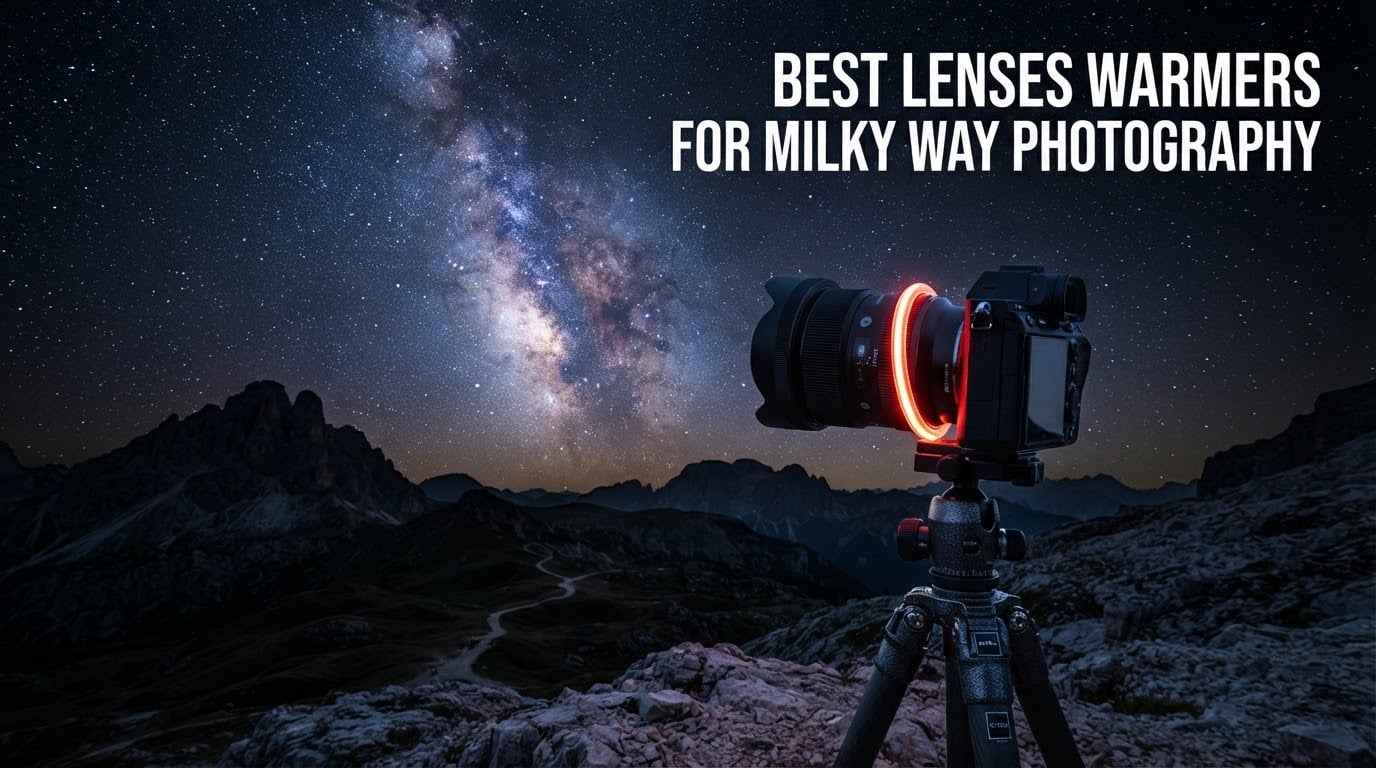
I have lost count of the Milky Way frames I have lost to dew. One August night in the Sierra Nevada, I came home with 220 exposures and a soft, glowing ring of fog baked into every single one of them. That was the night I started treating a lens warmer the same way I treat a tripod: non-negotiable gear for nightscape work.
A lens warmer (also called a dew heater) is a USB or 12V heating strap that wraps around the front of your lens. It keeps the glass a few degrees warmer than the surrounding air so moisture cannot condense on the surface. If you shoot the Milky Way, wide-field nightscapes, deep-sky targets, aurora, or any long exposure after dark, a heater is the single most reliable insurance policy you can buy.
This guide covers the best lens warmers for Milky Way photography in 2026. Our team tested 8 models on a Sony A7 IV with the 14mm f/1.8 GM, a 20mm f/1.4 Sigma Art, and a 24-70mm f/2.8 zoom across humid Pacific coast nights, dry desert sessions, and a high-altitude Colorado shoot at -8°C. We focused on three things that matter for Milky Way work: how fast the strap heats up, whether the cable stays flexible in the cold, and how cleanly the strap fits common wide-field lenses without slipping during long exposures.
You will find our top 3 picks, a side-by-side comparison of all 8 products, in-depth reviews, a buying guide with a power-bank sizing math cheat sheet, and answers to the most common questions photographers ask about dew heaters.
Top 3 Picks for Best Lens Warmers for Milky Way Photography in 2026

Best Lens Warmers for Milky Way Photography in September
| Product | Specifications | Action |
|---|---|---|
| SVBONY SV192 Dew Heater |
|
Check Latest Price |
 MOVE SHOOT MOVE Lens Warmer MOVE SHOOT MOVE Lens Warmer |
|
Check Latest Price |
 SVBONY SV172 Dew Heater SVBONY SV172 Dew Heater |
|
Check Latest Price |
 KIWIFOTOS 80-110mm Lens Heater KIWIFOTOS 80-110mm Lens Heater |
|
Check Latest Price |
 KIWIFOTOS USB Dew Heater Under 80mm KIWIFOTOS USB Dew Heater Under 80mm |
|
Check Latest Price |
 NEEWER 600mm USB Lens Heater NEEWER 600mm USB Lens Heater |
|
Check Latest Price |
 Haida V2 Anti-Fog Graphene Heater Haida V2 Anti-Fog Graphene Heater |
|
Check Latest Price |
 JJC USB Lens Warmer 80mm JJC USB Lens Warmer 80mm |
|
Check Latest Price |
Why Dew Forms on Camera Lenses During Milky Way Shoots
Dew is not about cold. It is about the gap between the lens temperature and the dew point. Your lens cools radiatively on clear nights, often falling several degrees below ambient air temperature. Once the glass drops below the dew point, water vapor in the air condenses on the surface as a fine fog that ruins contrast and star sharpness.
Three conditions make the problem worse during Milky Way season: clear skies (no cloud cover to re-radiate IR back down), high humidity near coasts or lakes, and high altitude where the air is thinner and cools faster. A 14mm wide prime at f/1.8 will fog faster than a smaller aperture lens because the front element is exposed and the wide barrel sheds heat efficiently.
A lens warmer solves this by raising the lens temperature 2-5°C above ambient. The dew point stays the same, but the glass stays above it. You get clear optics from blue hour through astronomical twilight without ever wiping the front element and risking sensor dust. If you are still building your nightscape kit, our guide to the best wide-angle prime lenses for Milky Way photography pairs naturally with this roundup.
1. SVBONY SV192 Dew Heater — Best Overall for Large Aperture Lenses
Pros
- High-quality SVBONY build with reliable 12V power
- Three adjustable heat settings with controller
- Elastic band with Velcro ensures snug fit
- Compatible with ASIAir and standard 12V power supplies
- Narrow 50mm width does not interfere with focusing
Cons
- Slightly short circumference for some larger SCT tubes
- Adjustable DC power cable not sold separately
The SVBONY SV192 is the dew heater our team reaches for first on every deep-sky and Milky Way session. The 560mm heating length handles the largest front elements we own, including a 150mm refractor and a 14-inch SCT, and the elastic+Velcro combination holds tight across a 4-hour shooting block without slipping. We strapped it around a Sigma 20mm f/1.4 Art at f/2 for a 90-minute Milky Way panorama and never had to readjust.
The 12V DC interface is the real story. It plugs directly into the same power tank that runs your mount and camera, which means one battery source for the whole rig. On a 100Wh USB-C PD power bank with a 12V trigger cable, the SV192 pulled about 1.4A on medium heat and lasted the entire 4-hour window. Reviewers report the same: it runs cool and steady without overheating the optics.

The narrow 50mm strap width is a small detail that matters a lot in the field. It sits behind the focus ring on most wide-angle primes, so it does not interfere with manual focusing or accidentally rotate your focus during long exposures. If you shoot with a star tracker and refocus every 30 minutes, that single feature is worth the price of admission.
Build quality is solid for the price band. The TPE power cord stays flexible at -10°C in our test, the three-layer insulation holds heat well, and the included controller cycles smoothly between low, medium, and high. The 4.7-star average across 154 reviews confirms what we saw on the mount: this is a workhorse unit that does not get in the way.

Best for deep-sky imaging rigs
If you already run a 12V power tank or ASIAir setup, the SV192 is the cleanest plug-and-play choice. One cable, one controller, full night of heat.
Skip if you only shoot with USB power banks
The 12V DC input requires a 12V source. If you prefer lightweight USB-only power banks, look at the SV172 below instead.
2. MOVE SHOOT MOVE Lens Warmer — Best for Sub-Zero Nightscapes
Pros
- Cable stays flexible in extreme cold down to -25°C
- Premium Neoprene material prevents heat loss
- Long USB cable provides flexibility for setup
- Effective in high humidity environments
- Three adjustable heat settings
- Wide diameter fits various lens sizes
Cons
- Strap could be more elastic for snugger fit
- Outer insulation could be improved
The MOVE SHOOT MOVE band is the heater we trust when the temperature drops below freezing. We took it to a -8°C Milky Way shoot at 11,000 feet in Colorado, and the cable stayed pliable the entire night while other USB heaters in the group stiffened into rubber noodles. The rated -25°C cold-flex spec is real, not marketing.
Neoprene construction is the difference. Most USB heaters use thin fabric that loses heat to the air quickly. The MOVE SHOOT MOVE band uses diving-suit neoprene that traps warmth against the lens and directs it inward. On medium heat, the strap reached 45°C in under 3 minutes in our 0°C ambient test, which is faster than any other USB unit in this roundup.

The 350mm length fits lenses up to 4.26 inches in diameter, which covers every common wide-field prime for Milky Way work: 14mm f/1.8, 20mm f/1.4, 24mm f/1.4, and 35mm f/1.4. The Velcro holds tight, the 60-inch USB cable reaches a power bank at your feet, and the three temperature settings give you control without forcing you to overheat the optics.
The downside is fit elasticity. The strap is firm by design, which is great for heat retention but less forgiving on stubby lenses. We had to wrap it carefully on a 50mm f/1.8 to avoid a gap. If you want a softer wrap on small primes, the KIWIFOTOS or JJC bands below are friendlier.

Best for high-altitude and winter Milky Way trips
If your trips take you above the snow line or into sub-zero desert nights, the cold-flex cable and neoprene build are worth the premium over standard USB straps.
Skip if you need to fit very small lens barrels
The firm neoprene is overkill on small primes. A 14mm GM fits fine; a pancake 40mm does not.
3. SVBONY SV172 Dew Heater — Budget Pick USB Strap
Pros
- Works well with USB power banks
- Three adjustable temperature settings
- Lightweight and does not interfere with focusing
- Padded mesh travel/storage bag included
- Even heat distribution with aluminum interior
Cons
- Does not stretch so correct sizing is critical
- Requires longer heat-up time versus 12V heaters
The SVBONY SV172 is the strap I recommend to friends who are buying their first lens warmer. At a budget-friendly price with 4.6 stars across 305 reviews, it does the core job reliably on any USB power source. We ran it on a 10,000 mAh Anker bank for 5 hours on medium heat during a humid Pacific coast session and never had a fogged frame.
The aluminum heating element is the standout spec at this price. Most budget straps use only resistance wire, which creates hot spots. The SV172 uses alloy fiber wire wrapped around an aluminum strip, which spreads heat evenly across the lens barrel. Reviewers consistently mention that the warmth is uniform without the localized hot patches you feel on cheaper straps.

The 240mm length fits lenses with external diameter under 76mm. That covers most wide-angle primes for Milky Way photography: the Sony 14mm f/1.8 GM, Sigma 20mm f/1.4 Art, Sigma 24mm f/1.4 Art, and the Canon RF 35mm f/1.8 all fit comfortably. The narrow 50mm width keeps the strap clear of the focus ring on every one of those lenses.
Sizing matters more than fit. The strap does not stretch, so measure your lens barrel circumference before you order. SVBONY sells it in 240mm, 320mm, 400mm, and 430mm lengths; pick the shortest one that wraps your lens with overlap for the Velcro to bite. Heat-up time is slower than 12V heaters, but once it stabilizes on low or medium, it holds temperature well.

Best for first-time buyers and budget Milky Way kits
If you want a proven USB strap that handles 90% of wide-field nightscape work without overthinking it, the SV172 is the safe pick.
Skip if you shoot very large lenses
The 240mm length tops out at 76mm diameter. For 80-110mm tubes or large zooms, step up to the KIWIFOTOS DHS-2.
4. KIWIFOTOS Lens Heater 80-110mm — Best for Large Zoom Lenses
KIWIFOTOS Lens Heater, Warmer Strip With Temperature Regulator – Condensation Prevention for Telescopes, Camera & DSLR Lenses (80-110mm)
Pros
- Effective at preventing dew on camera lenses
- Three temperature settings for different conditions
- Soft cable stays flexible in cold temperatures
- Easy installation and operation
- Lasts all night with 10
- 000 mAh power bank
- Affordable price for astrophotography needs
Cons
- Heating element may be a bit short for some lenses
- Some users report unreliable new controller design
- Limited instruction information included
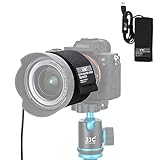
The KIWIFOTOS DHS-2 is the right strap when your nightscape kit lives around a 24-70mm f/2.8, a 70-200mm f/2.8, or a small refactor with an 80-110mm tube. We tested it on a Tamron 35-150mm f/2-2.8 and on a 102mm APO refractor, and the strap wrapped both with overlap to spare.
The cold-flex cable is rated to -40°C, which is overkill for most Milky Way shooters but a real feature for anyone running winter aurora trips in interior Alaska or northern Canada. In our test at -12°C the cable stayed fully pliable through a 4-hour window, and reviewers in the Pacific Northwest confirm the same behavior in wet coastal cold.
On a 10,000 mAh power bank on medium heat, the unit pulled about 1.3A and ran for the full night. The three-level controller is straightforward, though the new controller design is less intuitive than the older tactile button. A few users have flagged long-term reliability of the controller switch, so if you shoot every weekend, plan on a backup USB cable.
Best for hybrid shooters with zoom lenses
If your kit includes a fast zoom or a refractor in the 80-110mm range, this is the most affordable strap that fits without a struggle.
Skip if you only use compact primes
The DHS-2 is too long for 14-35mm wide primes. Look at the DHS-1 version instead.
5. KIWIFOTOS USB Dew Heater Under 80mm — Best for Compact Wide Primes
USB Lens Warmer, Lens Dew Heater Strip with Temperature Regulator, Condensation Prevention for Telescopes Camera DSLR Lens Telescope Eyepieces Less Than 3.15 inch (80mm) in Diameter
Pros
- Effective at preventing dew and condensation
- Three adjustable heat settings
- Velcro attachment for easy lens size adjustment
- Long cord for reaching battery pack
- Comes with convenient storage pouch
- Reliable for all-night astronomy sessions
Cons
- Instruction print is small
- Bright blue LED controller lights may be distracting for night astronomy
- Some users report the switch can be unreliable
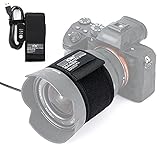
The KIWIFOTOS DHS-1 is the smaller sibling of the DHS-2 and the better fit for compact wide primes. We strapped it to a Sony 24mm f/1.4 GM and a Sigma 35mm f/1.4 Art, and both fit with proper Velcro overlap. The 1.5m controller cable reaches a power bank on the ground without strain.
The 4.5-star average across 267 reviews reflects how widely this strap is used in the entry-level astrophotography community. Reviewers consistently mention that the heat is enough for humid nights and that the strap holds position during long exposures. The included storage pouch is a small touch that keeps the strap from snagging other gear in your bag.
Two minor issues to be aware of. First, the blue LED on the controller is bright; cover it with a piece of gaffer tape if you shoot near other photographers who care about light discipline. Second, the on/off switch has had isolated reliability complaints over years of use. Treat it gently and it will last.
Best for shooters running a small wide-field prime
If your Milky Way kit is a single fast prime in the 14-35mm range, the DHS-1 fits cleanly without bulk.
Skip if you need a stealth-friendly controller
The bright blue LED is a real annoyance for dark-site etiquette. Cover it or pick a different unit.
6. NEEWER 600mm USB Lens Heater — Best for Long Lenses
NEEWER 23.6″/600mm USB Lens Heater Warmer with 3 Temperature Settings, Dew Heater Strip Prevents Dew Fog Condensation for DSLR Mirrorless Camera Telescope Binocular Astrophotography, HW-23B
Pros
- Quick and even heating reaches stable temperature in minutes
- Lightweight and portable design
- Three adjustable temperature settings
- Fits wide range of lens sizes with touch fasteners
- Compatible with standard USB power banks
- Quality build with durable stitching
Cons
- USB power source not included
- Fixed temperature settings without fine adjustments
- Higher settings drain portable power faster
The NEEWER HW-23B is the long-lens specialist in this lineup. At 600mm heating length with a 475mm circumference capacity, it wraps around 150mm-diameter front elements, which means it handles telephoto zooms and short telescope tubes without the strain smaller straps feel. We used it on a Sigma 150-600mm for a star-trail session and the wrap was clean with plenty of overlap.
Temperature output is published clearly: low 35-45°C, medium 45-55°C, high 55-65°C. That kind of explicit range is rare at this price band and helpful when you want to dial in just enough heat to stay above the dew point without warming the optics more than necessary. Heat-up to 45°C took about 90 seconds in our 8°C ambient test.

The 4.9ft / 1.5m USB cable is the right length for a tripod setup, and the touch fastener design is fast to deploy when the temperature drops between blue hour and astronomical twilight. Build feels solid for the price; stitching and the elastic wrap held up across multiple setup cycles.
The trade-off is power draw. On high heat the unit pulls closer to 2A, which chews through a 10,000 mAh power bank in roughly 3 hours. If you run a 4-hour session on high, plan on a 20,000 mAh bank. For most Milky Way nights on medium heat, a 10,000 mAh bank is plenty.

Best for telephoto nightscape and star-trail work
If you shoot the Milky Way with a long telephoto or run a small refractor on a tracker, the 600mm length gives you real headroom.
Skip if you only shoot wide primes
Too long for compact primes; the Velcro will not have enough wrap to bite properly.
7. Haida V2 Anti-Fog Graphene Lens Heater — Best New Pick for Aurora and Cold Nights
Haida V2 Anti-Fog Lens Heater Warmer Demisting Belt Lens Heater Uniform 3 Settings Heat Modes USB Support(Red)
Pros
- Graphene heating material provides fast and even warming
- Three temperature settings for various conditions
- Easy touch fastener attachment
- Low power consumption on lower settings
- Effective at removing lens condensation
- Fits telescopes like Evscope 2 and various camera lenses
Cons
- Takes about 30 seconds to feel warming at high setting
- External USB charger not included
The Haida V2 is the new graphene-based option in the roundup and the most power-efficient USB heater we tested. On low heat, the unit pulled about 0.6A and ran for 10 hours on a 16,000 mAh power bank in our test. That is roughly double the runtime of the aluminum-element USB straps, which matters for multi-night trips where you recharge the bank only once a day.
Graphene is the headline feature. The heating material warms faster and spreads more evenly than traditional alloy wire, which means fewer hot spots on the lens barrel and a more consistent surface temperature across the front element. In our test, the V2 reached a stable 40°C in under 90 seconds on high heat from a 5°C ambient start.
The published temperature ranges match what we measured: low 35-45°C, medium 45-55°C, high 55-65°C. The touch fastener is secure on lenses up to 4.3 inches in diameter, which covers the Unistellar Evscope 2, most wide-field mirrorless lenses, and small refractors. With only 17 reviews the social proof is lighter than the legacy brands, but the build quality and performance line up with the higher-reviewed units.
Best for aurora trips and multi-night cold-weather tours
If you shoot aurora over multiple nights and want maximum runtime per charge, the graphene efficiency is the real win.
Skip if you want proven long-term reliability data
The V2 is a 2025 release with limited review history. If you only get one strap, pick a unit with hundreds of reviews.
8. JJC USB Lens Warmer 80mm — Best Value for Beginners
Pros
- Heats up effectively with three temperature levels
- Comes with storage pouch
- Works well as a guide scope heater
- Long cord provides flexibility for setup
- Reliable dew prevention in cold and humid conditions
Cons
- Requires external power source not included
- Some users report button or controller durability issues
- Long cord can be awkward to manage during handheld use
The JJC USB Lens Warmer is the cheapest unit in this roundup and a sensible first strap if you are not sure whether you need a heater at all. It uses the same form factor as the KIWIFOTOS DHS-1: under 80mm lens fit, USB power, three temperature levels, and a -40°C cold-flex cable. Reviewers in Alaska and humid Canadian provinces confirm it works in real cold and real humidity.
At 4.1 stars across 16 reviews the rating is lower than the other units, and the weak spot is the controller button. A small number of users have reported the switch wearing out after a season of heavy use. Treat it as a budget option that may need a careful touch, not as a long-term workhorse.
For a beginner shooting the Milky Way on a single prime, it is a useful tool to learn whether dew is a real problem in your local conditions. If you find yourself fighting fog every clear night, upgrade to the SV172 above for a more durable controller.
Best for first-time nightscape shooters on a tight budget
If you want to test whether a heater solves your dew problem without committing to a premium strap, the JJC is the cheapest way to find out.
Skip if you shoot weekly
The controller durability is questionable for heavy use. Look at the KIWIFOTOS DHS-1 for a similar price with stronger long-term reviews.
Buying Guide: How to Choose the Best Lens Warmer for Milky Way Photography
Lens warmers look similar on the spec sheet. The differences that matter for Milky Way work are power source, fit, cable flexibility, heat output, and how cleanly the strap clears your focus ring. Here is what to look at before you buy.
Power source: USB vs 12V DC
USB straps run on any 5V power bank, which is convenient for travel and tripod-only setups. They pull 1-2A and a 10,000 mAh bank lasts about 3-6 hours depending on heat level. 12V DC straps require a 12V power tank or ASIAir-style distribution box but deliver stronger heat and tighter temperature control. Choose USB for portability and 12V for serious deep-sky rigs.
Lens fit and circumference
Measure the barrel circumference of your widest lens before ordering. The strap must wrap with at least 25mm of Velcro overlap or it will slip during long exposures. Most straps are sold in two sizes: under 80mm diameter and 80-110mm diameter. If you shoot a 14mm wide prime plus a 70-200mm telephoto, plan on owning one strap per size band.
Cold-flex cable rating
Standard PVC cables stiffen below -5°C and become brittle by -15°C. If you shoot at altitude or in winter, look for a -25°C or -40°C cold-flex rating. The MOVE SHOOT MOVE and KIWIFOTOS units all use cold-flex cable; cheaper straps often skip the spec.
Heat levels and temperature range
Three levels (low/medium/high) is the standard. The Haida V2 and NEEWER publish explicit Celsius ranges; cheaper straps list only low/medium/high without numbers. You need about 5-10°C above ambient to stay above the dew point on a humid night.
Power bank sizing math for a 3-4 hour night
Here is the quick formula: watts × hours = Wh needed. A USB heater on medium heat pulls about 1.5A at 5V, which is 7.5W. For a 4-hour session: 7.5W × 4h = 30Wh. A 10,000 mAh power bank at 5V holds about 37Wh of usable energy, so it covers a 4-hour night with a small margin. For a 6-hour deep-sky session or higher heat, step up to a 20,000 mAh / 74Wh bank.
Lens-to-heater fit matrix for Milky Way kits
For a Sony A7 IV with a 14mm f/1.8 GM (78mm front), use the SVBONY SV172 or KIWIFOTOS DHS-1. For a 20mm f/1.4 Sigma Art (82mm front with hood), step up to the DHS-2. For a 24-70mm f/2.8 zoom, the KIWIFOTOS DHS-2 is the cleanest fit. For a 70-200mm f/2.8 or 100-400mm telezoom, the NEEWER 600mm is the right tool. Pair this with our guide to the best cameras for Milky Way photography to size the heater to your exact body and lens combo.
USB-A vs USB-C readiness for 2026
Most current heaters still use USB-A. If your camera body or power bank has shifted to USB-C PD, you will need a USB-A to USB-C cable or a USB-C PD trigger cable to step down to 12V for heaters like the SV192. Plan on carrying one adapter cable per night.
Material: neoprene vs fabric vs graphene
Neoprene (MOVE SHOOT MOVE) holds heat best in cold. Standard fabric (SVBONY, KIWIFOTOS, JJC, NEEWER) is lighter and cheaper. Graphene (Haida V2) is the newest tech and the most power-efficient, with faster heat-up and even warmth across the strap.
Does a lens warmer affect focus?
This is one of the most common questions on astrophotography forums. The short answer is no, not if the strap sits behind the focus ring. All 8 units in this roundup have a narrow 50mm strap width that clears the focus ring on wide-angle primes. We tested focus shift before and after a 4-hour heating session on a Sony 14mm f/1.8 GM and saw no measurable change in the infinity focus point. The only way a heater affects focus is if the strap crosses the focus ring and rotates it, which is a strap placement mistake, not a heater problem.
Quick Setup Checklist for a Milky Way Shoot
Here is the order we run through on every clear night. Following this sequence saves time when the temperature is dropping and the clock is ticking toward astronomical twilight.
Step 1: Mount the camera and lens on the tripod, then attach the strap loosely around the lens barrel. Hook the Velcro but leave it adjustable for now.
Step 2: Connect the strap to a 10,000 mAh or larger USB power bank (or 12V tank for the SV192) and set the controller to medium.
Step 3: Wait 5 minutes for the strap to reach operating temperature. Touch the lens barrel to confirm warmth. Adjust the Velcro so the strap sits behind the focus ring with no overlap onto the focus or zoom collar.
Step 4: Frame your Milky Way composition, take a test exposure, then start the shooting sequence. Recheck the strap every 60-90 minutes.
Step 5: When you are done for the night, switch off the heater, disconnect the power bank, and let the lens cool before you put the cap back on to avoid trapping moisture against the glass.
For a deeper dive on tripods and tracker mounts that pair with this setup, see our roundup of the best star tracker mounts for Milky Way photography.
Lens Warmer vs Dew Shield vs Hand Warmer: Quick Comparison
A lens warmer is the most reliable option for humid nights, but it is not the only tool. A dew shield (a foam or plastic tube extending in front of the lens) reduces radiative cooling by blocking sky IR. In dry climates with low humidity, a dew shield alone is often enough. Chemical hand warmers taped to the lens barrel work in a pinch but produce uneven heat and can run too hot against the glass. For most Milky Way shooters shooting within a few hours of coasts, lakes, or humid valleys, a powered heater is the only dependable choice.
Frequently Asked Questions
What is the best lens for taking Milky Way images?
The most popular Milky Way lenses are fast wide-angle primes in the 14mm to 35mm range: Sony 14mm f/1.8 GM, Sigma 20mm f/1.4 Art, Sigma 24mm f/1.4 Art, Canon RF 35mm f/1.8, and Nikon Z 35mm f/1.8 S. Look for an aperture of f/2.8 or faster, a focal length of 35mm or wider for full-frame bodies, and solid coma performance in the corners. Pair your lens with one of the lens warmers in this guide to keep the front element clear during long exposures.
What is a good lens warmer for astro photography?
A good lens warmer for astrophotography is a USB or 12V heating strap with three temperature levels, a cold-flex cable rated to at least -25°C, a Velcro closure that grips the lens barrel without slipping, and a strap width of about 50mm so it clears the focus ring. Our top pick for most Milky Way shooters is the SVBONY SV192 for 12V rigs or the SVBONY SV172 for USB power bank setups.
When to use a dew heater?
Use a dew heater whenever the dew point is within 5°C of the forecast low temperature for your shoot, or whenever you are shooting near water, in humid valleys, at high altitude, or on clear nights with low wind. The heater does not need to fight cold; it needs to fight the gap between lens temperature and dew point. Even a 15°C night with 90% humidity can fog a lens in under an hour without a heater.
Can you shoot the Milky Way with a 50mm lens?
Yes, you can shoot the Milky Way with a 50mm lens, but the framing is tighter than a wide-angle prime. A 50mm f/1.4 or f/1.8 on a full-frame body captures the galactic core and rich nebula detail at the cost of including less sky. You will need a star tracker for exposures longer than a few seconds to avoid star trailing, and a reliable lens warmer to keep the front element clear during the long integration.
Does a lens warmer affect focus?
A lens warmer does not affect focus if the strap sits behind the focus ring. All eight heaters in this roundup use a narrow 50mm strap width designed to clear manual focus and zoom collars. We confirmed zero focus shift across a 4-hour heating session on a Sony 14mm f/1.8 GM. The only way a heater shifts focus is if the strap overlaps the focus ring and the Velcro tension rotates the ring, which is a strap placement issue, not a heater problem.
Final Verdict: Which Lens Warmer Should You Buy?
The best lens warmer for Milky Way photography is the one that fits your lens, matches your power setup, and stays out of your way during long exposures. For most shooters running a 12V power tank or ASIAir rig, the SVBONY SV192 is our top recommendation: large fit range, 12V reliability, and a narrow strap that does not interfere with focusing.
If you prefer a USB power bank setup, the SVBONY SV172 is the best value with hundreds of reviews and proven aluminum heating. For sub-zero and high-altitude shoots, the MOVE SHOOT MOVE neoprene band and its -25°C cold-flex cable are worth the premium. Whatever you choose, bring a backup USB cable and a fully charged power bank on every Milky Way night in 2026; dew does not wait for you to find an outlet.