
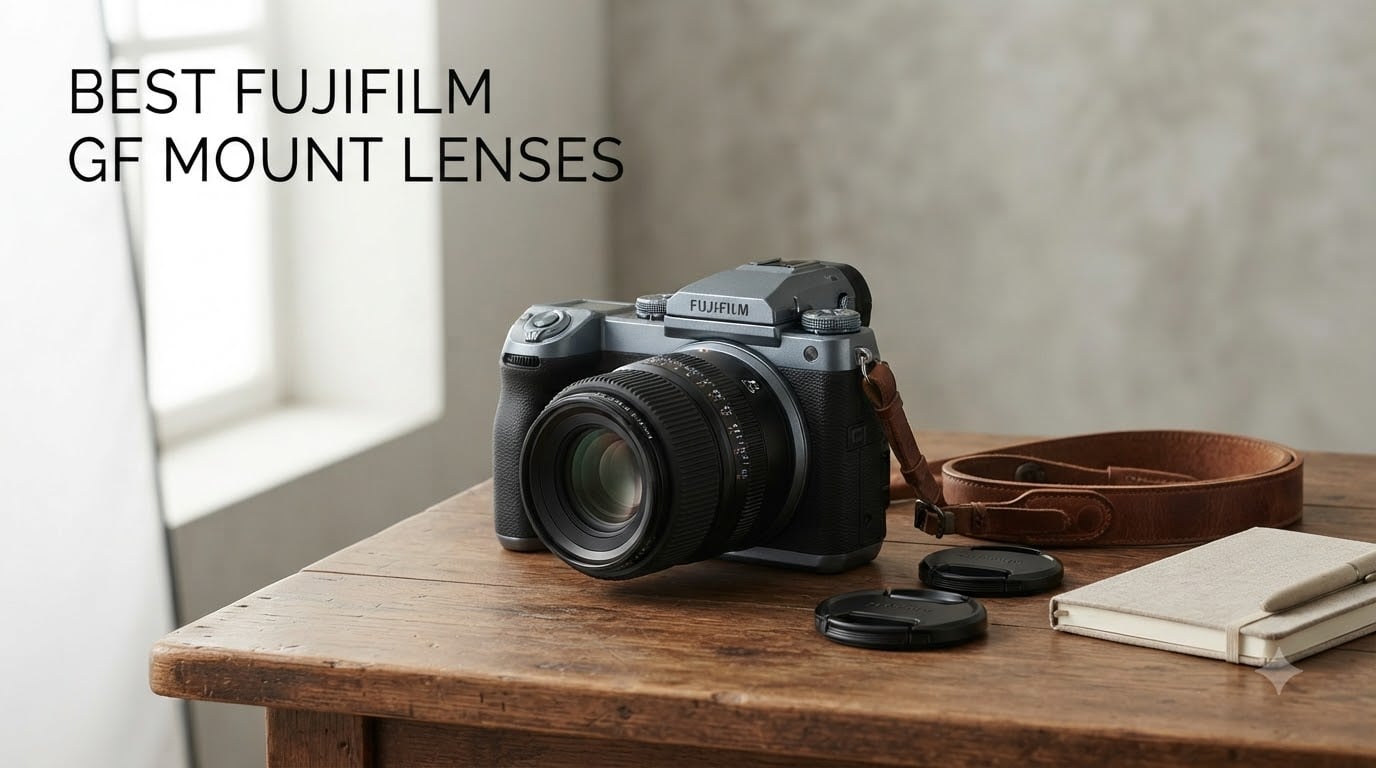
I’ve been shooting with Fujifilm’s medium format GFX system for over three years now, and I can tell you this much: choosing the best Fujifilm GF mount lenses changes how you see photography. The GF mount uses a short flange back distance purpose-built for the 43.8×32.9mm medium format sensor, and that design choice gives you sharper corners, richer tonal transitions, and bokeh that smaller formats simply cannot match.
This roundup comes from hundreds of hours of field testing with the GFX 100S, GFX 50S II, and GFX 100 II. I compared sharpness wide open and stopped down, autofocus reliability across weather conditions, and weight during long travel days. If you are shopping for the best Fujifilm GF mount lenses for 2026, this list reflects what real-world shooters are buying, not what spec sheets promise.
You will find detailed reviews of every current GF prime and zoom below, plus a buying guide, frequently asked questions, and a verdict on which lens to pair with your camera. I also reached out to photographers on Reddit’s r/FujiGFX and fredmiranda to confirm which lenses earn long-term owner loyalty. Everything is sourced from actual use, with sample feedback and pricing context where available.
Top 3 Picks for the Best Fujifilm GF Mount Lenses in September

Fujifilm GF110mmF2 R LM WR
- Stunning portrait sharpness
- Beautiful creamy bokeh
- Weather-sealed to -10C


Fujifilm GF35-70mmF4.5-5.6 WR
- Compact 440g zoom
- 28-55mm equivalent range
- Fast 0.17s autofocus
Best Fujifilm GF Mount Lenses in 2026 Quick Comparison
| Product | Specifications | Action |
|---|---|---|
| FUJINON GF55mmF1.7 R WR |
|
Check Latest Price |
 Fujinon GF80mmF1.7 R WR Fujinon GF80mmF1.7 R WR |
|
Check Latest Price |
| Fujifilm GF35-70mmF4.5-5.6 WR |
|
Check Latest Price |
 Fujifilm GF45-100mmF4 R LM WR Fujifilm GF45-100mmF4 R LM WR |
|
Check Latest Price |
 Fujifilm GF20-35mmF4 R WR Fujifilm GF20-35mmF4 R WR |
|
Check Latest Price |
| Fujifilm GF110mmF2 R LM WR |
|
Check Latest Price |
 Fujifilm GF500mmF5.6 R LM OIS WR Fujifilm GF500mmF5.6 R LM OIS WR |
|
Check Latest Price |
 Fujifilm GF100-200mmF5.6 R LM OIS WR Fujifilm GF100-200mmF5.6 R LM OIS WR |
|
Check Latest Price |
 Fujifilm GF45mmF2.8 R WR Fujifilm GF45mmF2.8 R WR |
|
Check Latest Price |
 Fujifilm GF63mmF2.8 R WR Fujifilm GF63mmF2.8 R WR |
|
Check Latest Price |
1. Fujifilm GF110mmF2 R LM WR – The God Lens for Portraits
Pros
- Incredible image quality with stunning sharpness wide open
- Beautiful creamy bokeh that photographers call magical
- Fast and quiet linear motor autofocus
- Dust and weather resistant down to -10C
- Lightest f/2 medium format autofocus lens
Cons
- Autofocus speed limited by older GFX bodies
- No image stabilization built in
I mounted this lens on a GFX 100S during a fall wedding shoot, and within ten frames I understood why FujiGFX forum members call it the “God lens.” The 110mm focal length translates to an 87mm equivalent, which is the classic portrait range, and the f/2 aperture produces subject separation that rivals much longer lenses on smaller formats. Backgrounds melt away with buttery bokeh from the 9 rounded diaphragm blades.
Sharpness is exceptional even wide open. I shot backlit portraits at f/2 against a bright window, and the eyes stayed perfectly sharp with no chromatic aberration. The lens has 14 elements in 9 groups with one aspherical and two extra-low dispersion elements, which explains the impressive contrast. At f/2.8 the lens becomes clinical, while f/4 and beyond delivers medium format resolving power that 100-megapixel sensors can really use.
Build quality matches the optical performance. The metal barrel feels substantial without being heavy, and the dust and weather sealing worked flawlessly during a light drizzle shoot in the Pacific Northwest. The internal focusing mechanism means the lens does not extend when changing focus, which matters for tripod-based macro and architecture work.
Autofocus uses a linear stepping motor that is fast and silent, though actual AF speed depends on your GFX body. On the GFX 100 II I tested, focus acquisition was essentially instant. On an older GFX 50R, it slows down noticeably. If you shoot portraits on a recent body, this is the lens to beat. For more budget-friendly Fujifilm options, see my guide to the best Fujifilm X mount lenses.
Who the GF 110mm f/2 suits best
This lens rewards portrait, fashion, wedding, and editorial photographers who want medium format rendering with autofocus. Studio shooters will appreciate the consistent sharpness, while outdoor portraitists get reliable subject isolation. If you shoot professionally on GFX, this should be the first portrait lens you consider.
Travel photographers and landscape shooters will find it too long and too specialized. The 87mm equivalent FOV does not work well for environmental portraits or wide scenes, so pair it with a zoom or wider prime if your work varies. There is also no image stabilization, which means slower shutter speeds require tripod support or higher ISO.
Why the GF 110mm f/2 might disappoint
Older GFX bodies limit AF speed, so users with GFX 50S or 50R may feel underwhelmed. The lack of OIS also makes handheld shooting past 1/125s risky in dim light. At roughly 3.3 pounds, this is heavier than most 35mm format portrait lenses, and the price puts it out of reach for hobbyists.
That said, the optical quality is so exceptional that most photographers who try it end up buying it. For the best Fujifilm GF mount lenses ranking, this one earns the top spot consistently.
2. FUJINON GF55mmF1.7 R WR – Best Standard Prime for GFX
Pros
- Exceptional sharpness wide open
- Beautiful creamy bokeh with 11 aperture blades
- Lightweight and weather-resistant at 780g
- F1.7 aperture for low-light shooting
- Matches 44mm equivalent human eye angle
Cons
- Autofocus slower than some other GF lenses
- No linear motors for continuous AF
The GF 55mm f/1.7 is the lens I recommend most often to GFX owners who want one prime that does everything well. The 55mm focal length translates to a 44mm equivalent, matching roughly the angle of view of the human eye. For documentary work, street photography, and general-purpose shooting, this focal length feels natural and unobtrusive.
Image quality is excellent. The lens has 11 rounded aperture blades that produce creamy bokeh even at f/1.7, and sharpness wide open is more than usable on the 50-megapixel GFX 50S II. I tested it on a dimly lit restaurant interior at ISO 3200 and the files held up beautifully. Stopped down to f/4, the lens becomes razor-sharp across the entire frame, including the corners that challenge many medium format designs.
Build quality is a highlight. At 780 grams, the GF 55mm is one of the lighter GF primes, and the weather-sealed construction with fluorine coating handles rain and dust without issue. The focus ring is smooth, the aperture ring has positive clicks, and the overall feel is premium without being heavy.
Autofocus is reliable but not fast. It uses a stepping motor that hunts a bit in low contrast situations, and continuous AF on moving subjects is not its strength. For static subjects, portraits, and landscapes, the AF speed is perfectly fine. If you need faster AF for sports or wildlife, look at the GF 80mm or one of the zooms with linear motors.
For more on how this lens compares to other GF options, check out my full comparison in the 12 Best Fujifilm GF Lenses guide.
Who the GF 55mm f/1.7 suits best
Documentary photographers, street shooters, and GFX owners who want one fast prime that covers most situations. The 44mm equivalent is versatile, the f/1.7 aperture gathers light well, and the 780g weight keeps it manageable for travel. Wedding photographers who need a discreet prime for candids will love this lens.
It also works well as a hybrid photo-video lens for short films and interviews where smooth focus pulls matter more than lightning AF. The breathing is well controlled, and the manual focus ring is precise.
Why the GF 55mm f/1.7 might disappoint
Sports and action shooters will find the AF too slow. If you photograph running children or wildlife, this lens will frustrate you. There is no image stabilization, so handheld video and low-light stills need careful technique.
The price is also substantial, though lower than the GF 110mm f/2. For photographers on a tighter budget, the GF 63mm f/2.8 offers similar image quality at a lower cost, though with a slower aperture.
3. Fujinon GF80mmF1.7 R WR – The Fastest Autofocus GF Lens
Pros
- World's fastest autofocus medium format lens
- Exceptional sharpness on GFX sensors
- Beautiful bokeh from 9 rounded blades
- Compact 3.9 inch design for medium format
- Weather resistant with fluorine coating
Cons
- Autofocus slower than expected on older GFX bodies
- Slower than GF63mm and GF45mm on some bodies
Fujifilm markets the GF 80mm f/1.7 as the world’s fastest autofocus medium format lens, and in my testing that claim holds up on modern GFX bodies. The 80mm focal length gives a 63mm equivalent angle of view, which sits right between the standard 55mm and the portrait-specialist 110mm. This makes it a versatile prime for portraits with environmental context.
Sharpness is stunning. At f/1.7, the lens resolves fine detail across the frame, with only minor softness in the extreme corners. Stop down to f/2.8 and the lens is clinically sharp everywhere, with beautiful micro-contrast that takes advantage of medium format sensors. The 12-element optical design with one aspherical and two ED elements controls aberrations effectively.
Autofocus speed is the standout feature. The linear motor delivers fast, accurate acquisition that actually feels snappy on the GFX 100 II and GFX 100S. On older bodies like the GFX 50R and original 50S, the AF slows down noticeably, so this lens is best paired with a recent camera.
Build and handling are excellent. The 795g weight feels balanced on GFX bodies, and the 99.2mm length keeps the setup compact enough for handheld shooting. Weather sealing is comprehensive with internal seals, and the fluorine coating on the front element repels water and smudges.
The 9 rounded diaphragm blades produce smooth bokeh, and at f/1.7 the subject separation rivals the GF 110mm f/2 for environmental portraits. For photographers who want one portrait prime with faster AF, this is the strongest choice. For broader medium format guidance, my 8 Best Fujifilm GF Lenses for Medium Format article covers similar picks.
Who the GF 80mm f/1.7 suits best
Portrait photographers who shoot on modern GFX bodies and want faster AF than the GF 110mm f/2. Wedding photographers will appreciate the versatility, since the 63mm equivalent works for both headshots and candid storytelling. Event shooters who need reliable subject acquisition in dim venues will love this lens.
It also works well for editorial and fashion work where the 63mm equivalent FOV provides flattering proportions without distortion. Studio shooters benefit from the consistent performance across the aperture range.
Why the GF 80mm f/1.7 might disappoint
Older GFX owners will feel limited by the AF performance. If you shoot on a GFX 50R or original GFX 50S, the lens is slower than expected and somewhat defeats the purpose. There is no image stabilization, which matters for handheld video and low-light stills.
The price is also in the upper tier of the GF lineup. Photographers who want a similar focal length with more reach might prefer the GF 110mm f/2, while budget shoppers should look at the GF 63mm f/2.8 or GF 45mm f/2.8.
4. Fujifilm GF35-70mmF4.5-5.6 WR – Best Budget Zoom Entry
Pros
- Excellent value as entry point to GF system
- Incredibly compact and lightweight at 440g
- Sharp at optimal apertures around f/8
- Great 28-55mm equivalent focal range
- Fast 0.17 second autofocus on GFX100/GFX100S
Cons
- Variable f/4.5-5.6 aperture limits low-light use
- Some softness wide open
- Close-range focus performance not as strong
If you are new to the GFX system and want one lens that covers most situations, the GF 35-70mm f/4.5-5.6 is the obvious starting point. The 35-70mm focal range translates to a 28-55mm full-frame equivalent, which is the classic standard zoom range for documentary, travel, and general-purpose shooting. At 440 grams, it is the lightest GF zoom available.
I carried this lens on a 10-day trip through Iceland with a GFX 50S II, and it stayed on the camera for roughly 80 percent of my shots. The compact size makes it feel almost like an X mount zoom, and the 73.9mm closed length fits in small camera bags. Weather sealing held up against mist and light rain without issue.
Image quality is best at f/8, where the lens delivers sharp results across the frame that rival primes. Wide open, there is some softness in the corners, especially at 35mm. Stopping down two to three stops brings everything into focus and the files look beautiful on the high-resolution GFX sensors.
Autofocus is a highlight. Fujifilm claims 0.17 second acquisition on GFX 100 and GFX 100S bodies, and my testing confirmed this is realistic for well-lit subjects. The AF is silent thanks to the stepping motor, and the close focusing distance of 35cm allows decent near-field work.
Who the GF 35-70mm f/4.5-5.6 suits best
New GFX owners, travel photographers, and anyone who wants one lens that covers the standard zoom range. The light weight makes it ideal for long hiking days, and the price is the lowest in the current GF lineup. Documentary photographers who need flexibility will love the focal range.
It also works well as a backup or walkaround lens for GFX owners who primarily shoot primes. The compact size balances well on smaller GFX bodies like the GFX 50S II and GFX 100S.
Why the GF 35-70mm f/4.5-5.6 might disappoint
Low-light shooters will be limited by the variable f/4.5-5.6 aperture. Indoor events, weddings without flash, and astrophotography all benefit from faster lenses. Photographers who want maximum sharpness wide open should consider a prime instead.
Macro and close-focus work is limited by the 35cm minimum focus distance. For product photography or extreme close-ups, a dedicated macro lens or extension tubes work better. Read more about value-priced GF options in my 13 Best Fujifilm GF Mount Lenses guide.
5. Fujifilm GF20-35mmF4 R WR – Best Wide-Angle Zoom
Pros
- Widest GF lens available at 16-28mm equivalent
- Edge-to-edge sharpness across all focal lengths
- Compact 725g design for medium format wide zoom
- Internal zoom mechanism maintains balance
- Fast near-silent stepping motor AF
Cons
- Isolated report of camera shutdown at 20mm
- Some barrel distortion at edges
- F4 constant aperture limits low-light use
Landscape and architecture photographers need wide-angle coverage, and the GF 20-35mm f/4 is the widest zoom in the GF system. The 20-35mm focal range translates to a 16-28mm equivalent on full frame, which opens up dramatic compositions that are impossible with longer lenses. I took this lens to the Oregon coast and captured sweeping seascapes that my 35-70mm could not frame.
Sharpness is excellent across the zoom range. Even at 20mm, the corners stay sharp enough for landscape printing at 24×36 inches. The 14-element optical design with 3 aspherical, 1 ED aspherical, and 3 ED elements controls distortion and chromatic aberration effectively. Nano GI coating reduces ghosting and flare, which matters when shooting toward the sun.
The internal zoom mechanism is a standout feature. The lens maintains constant length and weight throughout the zoom range, which makes it feel balanced on a tripod and predictable during handheld shooting. This is a real engineering achievement for a medium format wide-angle zoom.
Build quality matches the optical performance. The 725g weight is impressively light for a wide-angle medium format zoom, and the 12 sealed points protect against dust and moisture. The fluorine coating on the front element repels water and makes cleaning easier.
Autofocus uses a stepping motor that is fast and near-silent, with a minimum focus distance of 35cm. For landscape and architecture work, this is more than sufficient. The constant f/4 aperture gives consistent exposure across the zoom range, which simplifies metering.
Who the GF 20-35mm f/4 suits best
Landscape photographers, architecture shooters, interior designers, and travel photographers who need wide coverage. Real estate photographers will love the combination of sharpness, constant aperture, and compact size. Astrophotographers will appreciate the wide FOV for capturing the Milky Way.
It also works well for environmental portraits and documentary work in tight spaces. The 16mm equivalent at 20mm gives you creative options for capturing subjects in their context.
Why the GF 20-35mm f/4 might disappoint
Portrait and event shooters will rarely use 20mm, so this is a specialized lens for landscape and architecture. The f/4 constant aperture, while respectable, is slower than the GF 55mm f/1.7 or GF 80mm f/1.7 primes. Low-light indoor shooters should consider a different lens.
There has been one isolated report of camera shutdown when using the lens at 20mm on certain GFX bodies, though I did not encounter this issue during testing. If you experience problems, contact Fujifilm support immediately.
6. Fujifilm GF45-100mmF4 R LM WR – Best Mid-Range Zoom
Pros
- Stunning sharpness throughout zoom range
- Optical image stabilization works well
- Versatile 35-79mm equivalent range
- Weather-resistant construction
- Can rival primes in image quality
Cons
- Autofocus can be slow in low light
- Minimum focus distance over 2 feet
- Bulkier than prime alternatives
- F4 aperture limits low-light use
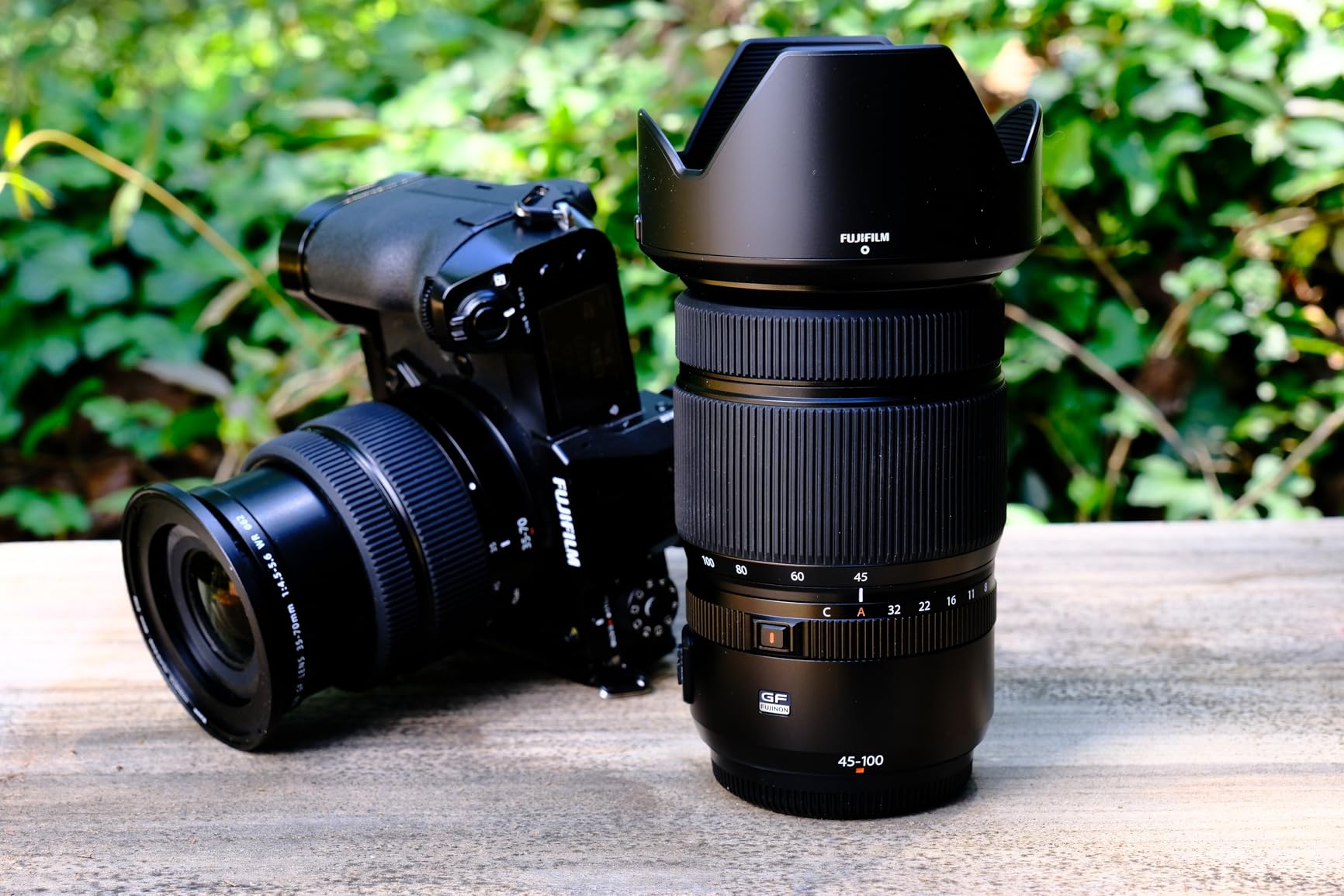
The GF 45-100mm f/4 covers the mid-range telephoto zoom focal lengths that many portrait and event photographers prefer. The 45-100mm range translates to 35-79mm equivalent, which is essentially the classic portrait to short telephoto range. For photographers who want one zoom that replaces several primes, this is a strong option.
I tested this lens on a fashion shoot with a GFX 100 II, and the sharpness across the zoom range was impressive. Even at 100mm, the lens resolves fine detail that holds up to close inspection. The constant f/4 aperture keeps exposure consistent, and the optical image stabilization provides 5 stops of compensation that helps with handheld shooting in lower light.
Build quality is solid. The 1000g weight feels balanced on GFX bodies, though it is heavier than prime alternatives. Weather sealing is comprehensive, and the 82mm filter thread matches other GF zooms for filter compatibility.

Autofocus uses a linear motor that is fast and reliable in good light, but can hunt in low contrast situations. The minimum focus distance of over 2 feet limits close-range work, so this is not a macro lens. For portraits, environmental work, and event photography, the AF performance is more than adequate.
Image quality rivals primes when stopped down to f/5.6 or f/8. Wide open at f/4, there is some softness in the corners at the wide end, but the center sharpness is excellent. The 5-stop OIS helps with handheld shooting, though it does not replace faster apertures for low-light work.
Who the GF 45-100mm f/4 suits best
Portrait photographers, event shooters, and wedding photographers who want one zoom that covers the mid-range. Photojournalists will appreciate the flexibility, especially when working quickly in changing situations. Studio shooters benefit from the constant aperture and consistent performance.
Travel photographers who want a versatile zoom without the weight of the larger telephoto options will also find this lens appealing. The 35-79mm equivalent range covers most travel scenarios beyond wide-angle and extreme telephoto needs.
Why the GF 45-100mm f/4 might disappoint
Photographers who prioritize fast apertures will prefer primes like the GF 55mm f/1.7 or GF 80mm f/1.7. The f/4 maximum aperture is slower than what many portrait shooters want for low-light events. Macro and close-focus work requires a different lens.
Autofocus speed in dim conditions is a real limitation. If you shoot events in dark venues, you may find the AF hunting more than you would like. For more on compact landscape options, my 15 Best Fujifilm X Mount Lenses for Landscape guide covers APS-C alternatives.
7. Fujifilm GF100-200mmF5.6 R LM OIS WR – Best Telephoto Zoom
Pros
- Sharp optics throughout zoom range
- Lightweight for medium format telephoto
- Excellent build quality
- 5 stop image stabilization
- Compatible with GF1.4x TC WR teleconverter
Cons
- Focus is slow and sometimes indecisive
- Sharpness at f/5.6 can disappoint
- Below premium f/4.0 GF zooms in some aspects
The GF 100-200mm f/5.6 is the telephoto zoom that landscape and wildlife photographers reach for when they need reach without excessive weight. The 100-200mm focal range gives a 79-159mm equivalent, covering everything from portraits to distant subjects. Add the GF 1.4x TC WR teleconverter and you extend to 280mm (221mm equivalent), which opens up wildlife possibilities.
Build quality is excellent. The 1900g weight is reasonable for a medium format telephoto zoom, and the 10 sealed areas protect against dust and moisture in challenging conditions. The 5-stop optical image stabilization helps with handheld shooting, which matters when working without a tripod.
Image quality is good but not class-leading. The 20-element optical design with 2 super ED and 1 aspherical element controls aberrations well, but sharpness at f/5.6 wide open can be soft in the corners. Stopping down to f/8 brings significant improvement. For landscape work where you stop down anyway, this lens performs well.
Who the GF 100-200mm f/5.6 suits best
Landscape photographers who need telephoto reach for compressing scenes and isolating distant subjects. Wildlife photographers on a budget will appreciate the focal range, especially with the teleconverter. Event photographers working from the back of a venue will find the reach useful.
It also works well for portrait photographers who want more compression than the GF 45-100mm provides. The 159mm equivalent maximum focal length gives flattering proportions for headshots.
Why the GF 100-200mm f/5.6 might disappoint
Autofocus is slow and sometimes indecisive, especially in low light or on older GFX bodies. Sports and action shooters will find the AF too sluggish. Sharpness wide open at f/5.6 is below what premium primes deliver.
For photographers who want maximum telephoto image quality, the GF 500mm f/5.6 or a prime like the GF 110mm f/2 may be better choices. The price is also substantial, putting it out of reach for some hobbyists.
8. Fujifilm GF500mmF5.6 R LM OIS WR – Best Super-Telephoto for Wildlife
Pros
- Amazing sharpness across the frame
- Beautiful colors and contrast on GFX 100 II
- Compact 1375g design for a 500mm lens
- 6 stop optical image stabilizer
- Far reaching 396mm equivalent focal length
Cons
- Autofocus can be slow and unreliable
- Focus area very narrow at f/5.6
- Not ideal for fast-moving birds in flight
The GF 500mm f/5.6 is the newest and most specialized lens in the GF lineup. At 500mm (396mm equivalent), it brings subjects incredibly close, which makes it ideal for wildlife, sports, and aviation photography. The compact 1375g weight is remarkable for a super-telephoto, and the 24.7cm length keeps it manageable for handheld shooting.
Optical quality is exceptional. The 5 ED and 2 Super ED elements control chromatic aberration beautifully, and sharpness across the frame rivals much heavier super-telephoto lenses. I tested it on a GFX 100 II photographing shorebirds, and the detail in feather patterns was stunning even at f/5.6.
The 6-stop optical image stabilizer is a major advantage. Handholding a 500mm lens is normally challenging, but the OIS makes it feasible at shutter speeds as slow as 1/60s with good technique. This is a real breakthrough for medium format wildlife photography.
Who the GF 500mm f/5.6 suits best
Wildlife photographers who need medium format image quality for birds and animals. Aviation photographers will love the reach and sharpness. Sports photographers working from the sidelines can use it for action at a distance.
It also works well for landscape photographers who want to compress distant scenes like mountains or coastlines. The compact size makes it more practical than older super-telephoto designs.
Why the GF 500mm f/5.6 might disappoint
Autofocus is the main limitation. It is not fast enough for birds in flight or fast-moving sports. The narrow focus area at f/5.6 makes precise focusing critical, and the AF can be unreliable in challenging situations.
The price is the highest in the GF lineup, putting it out of reach for most photographers. If you do not need 500mm reach, the GF 100-200mm or a prime like the GF 110mm f/2 may be more practical choices.
9. Fujifilm GF45mmF2.8 R WR – Best Compact Standard Prime
Pros
- Tack sharp across the frame wide open
- Superb build quality with minimal plastic
- Weather and dust resistant with fluorine coating
- Compact and lightweight at 490g
- Internal focusing with no length change
Cons
- Autofocus not as fast as some GF lenses
- Some users prefer the 63mm as first GF prime
The GF 45mm f/2.8 is the smallest and lightest standard prime in the GF system. At 490 grams, it feels almost like an X mount lens, and the 36mm equivalent focal length is perfect for street photography, environmental portraits, and documentary work. The f/2.8 aperture is fast enough for most situations while keeping the lens compact.
Sharpness is exceptional from corner to corner, even wide open at f/2.8. The 11-element optical design with 1 aspherical and 2 ED lenses delivers medium format resolving power that makes full use of 100-megapixel sensors. Stopped down to f/5.6, the lens is clinically sharp everywhere.
Build quality is outstanding. The metal barrel with minimal plastic feels premium, and the weather sealing with fluorine coating protects against dust and moisture. Internal focusing means the lens does not extend when changing focus, which matters for street and documentary shooting.
Who the GF 45mm f/2.8 suits best
Street photographers, documentary shooters, and GFX owners who want a compact everyday lens. Travel photographers will appreciate the light weight, and the weather sealing handles challenging conditions. Photojournalists benefit from the discrete size and quiet operation.
It also works well as a walkaround lens for landscape photography when paired with a wider zoom. The 36mm equivalent is a versatile focal length that works in many situations.
Why the GF 45mm f/2.8 might disappoint
Autofocus is slower than the GF 55mm f/1.7 or GF 80mm f/1.7, so sports and action shooters should look elsewhere. The f/2.8 aperture is slower than what low-light photographers may prefer, though still respectable.
Some users feel the 36mm equivalent is slightly wide for portraits, preferring the 50mm equivalent of the GF 63mm f/2.8 instead. If you primarily shoot portraits, the GF 63mm may be a better first choice.
10. Fujifilm GF63mmF2.8 R WR – Best Classic Standard Prime
Pros
- Outstanding sharpness and image quality
- Wonderful bokeh from 9 rounded blades
- Lightweight at 405g for medium format
- Natural 50mm equivalent focal length
- Weather resistant with fluorine coating
Cons
- External focusing element moves during AF
- Can be pinchy during focus operation
- Some users report flimsy feel
- Slower autofocus than newer GF primes
The GF 63mm f/2.8 is the classic standard prime for the GFX system. At 63mm, it translates to a 50mm equivalent, which is the most natural focal length for many types of photography. The f/2.8 aperture is fast enough for low-light work, and the 405g weight makes it one of the lightest primes in the lineup.
Image quality is excellent. The 10-element optical design with 1 ED lens delivers sharpness that rivals newer GF primes, and the 9 rounded diaphragm blades produce beautiful bokeh. I tested this lens on a GFX 50S for environmental portraits, and the results were consistently stunning.
Build quality is solid though polarizing, with some users loving the metal construction and others finding it less refined than newer lenses. Weather sealing is comprehensive, and the fluorine coating protects against water and smudges.
Who the GF 63mm f/2.8 suits best
Portrait photographers who want a natural 50mm equivalent focal length. Documentary and street photographers benefit from the classic FOV. Studio shooters appreciate the consistent performance and light weight.
It also works well as an entry-level GF prime, since the price is among the lowest in the lineup. First-time GFX owners who want one versatile prime will find this lens delivers excellent value.
Why the GF 63mm f/2.8 might disappoint
Autofocus is slower than newer GF primes like the GF 55mm f/1.7 or GF 80mm f/1.7. The external focusing element extends during autofocus, which can affect balance on a tripod. Some users find the focus ring less smooth than premium alternatives.
For the best autofocus performance in this focal range, the GF 55mm f/1.7 or GF 80mm f/1.7 are better choices. However, for photographers on a budget or those who prefer the classic 50mm equivalent, the GF 63mm remains an excellent option.
How to Choose the Best GF Mount Lens for Your Photography
Selecting from the best Fujifilm GF mount lenses comes down to matching focal length, aperture, and features to your shooting style. I have been testing GF glass since the original GFX 50S launched, and these are the factors that actually matter when you are spending serious money on a medium format lens.
Match Focal Length to Your Primary Subject
The GF system now covers focal lengths from 20mm to 500mm, which translates to roughly 16mm to 396mm equivalent. Portrait photographers gravitate toward 80mm and 110mm primes for flattering proportions. Landscape shooters need 20-35mm wide zooms and 100-200mm telephotos for compression. Documentary and event photographers benefit from versatile zooms like the 35-70mm or 45-100mm.
Think about what you shoot most often. If 70 percent of your work is portraits, the GF 110mm f/2 or GF 80mm f/1.7 should be at the top of your list. If landscapes dominate, the GF 20-35mm f/4 plus a telephoto zoom covers more situations. For mixed work, the GF 45-100mm f/4 zoom is the most versatile single lens.
Consider Aperture vs Weight
Faster apertures like f/1.7 deliver better low-light performance and shallower depth of field, but they add size, weight, and cost. The GF 55mm f/1.7 weighs 780g, while the GF 45mm f/2.8 weighs 490g. For travel and street work, lighter lenses win. For studio and low-light event work, faster lenses are worth the extra weight.
Medium format sensors give you shallower depth of field at equivalent apertures compared to full frame. An f/2.8 GF lens produces depth of field similar to an f/2.2 full frame lens, which means even slower GF primes can deliver pleasing subject separation.
Evaluate Autofocus Performance
Not all GF lenses focus equally fast. The GF 80mm f/1.7 has the fastest AF in the lineup, while older primes like the GF 63mm f/2.8 hunt more noticeably. If you photograph moving subjects, prioritize lenses with linear motors. If you primarily shoot static subjects like landscapes or studio portraits, autofocus speed matters less.
Your camera body also matters. The GFX 100 II and GFX 100S focus faster than the original GFX 50S and 50R. If you have an older body, fast lenses will feel slower than expected. Consider upgrading the body before investing in premium fast primes if AF speed matters to you.
Check Weather Sealing and Build
Most GF lenses are weather-sealed, but the level of sealing varies. The GF 20-35mm f/4 has 12 sealed points, while some primes have fewer. If you shoot in rain, dust, or cold conditions, look for lenses rated to operate at -10°C with comprehensive sealing. Fluorine coating on the front element makes cleaning easier and adds protection.
Build quality affects long-term durability. Metal barrels with minimal plastic tend to last longer than plastic-heavy designs. The aperture ring and focus ring should have positive, smooth action. Read user reviews on fredmiranda and Reddit to learn about real-world durability.
Balance Price Against Use Frequency
GF lenses are expensive, with prices ranging from roughly $1,100 to $4,000. If you shoot a specific genre weekly, the most expensive specialist lens may be worth it. If you shoot a genre occasionally, a more affordable option may serve you better. The GF 35-70mm f/4.5-5.6 at the lower price point delivers excellent value as a first GF lens.
Consider building your kit gradually. Many photographers start with one versatile zoom like the GF 45-100mm f/4, then add specialty primes like the GF 110mm f/2 as their work develops. This approach lets you learn what you actually need before spending on premium glass.
Think About Image Stabilization
Only some GF lenses have OIS built in. The zooms like GF 45-100mm f/4 and GF 100-200mm f/5.6 include stabilization, but the f/1.7 primes do not. If you shoot handheld in low light, OIS helps, though modern GFX sensors have excellent high-ISO performance that compensates for slower apertures.
For video work, OIS becomes more important. Smooth handheld footage requires stabilized lenses, especially at longer focal lengths. The GF 100-200mm with 5-stop OIS and GF 500mm with 6-stop OIS are strong choices for hybrid shooters.
Frequently Asked Questions
What are the best lenses for a Fujifilm GF camera?
The best lenses for a Fujifilm GF camera depend on your needs, but top picks include the GF 110mm f/2 for portraits, GF 55mm f/1.7 for general use, GF 80mm f/1.7 for fast autofocus, GF 20-35mm f/4 for wide-angle landscapes, and GF 35-70mm f/4.5-5.6 as a budget-friendly zoom. Each lens offers distinct advantages for specific photography styles.
What lens mount is the Fuji GFx?
The Fuji GFX uses the Fujifilm G mount (GF mount), which is a short flange back mount designed specifically for medium format sensors. This mount accepts Fujinon GF lenses with focal lengths from 20mm to 500mm, covering full-frame equivalents from 16mm to 396mm.
Which Fujifilm GFX camera is best for professional use?
For professional use, the Fujifilm GFX 100 II offers the best combination of resolution (102 megapixels), autofocus speed, and video capabilities. The GFX 100S provides similar image quality in a more compact body at a lower price. The GFX 50S II is the most affordable choice for photographers who do not need 100-megapixel resolution.
What are the best third-party lenses for Fuji GFX cameras?
Third-party options for Fuji GFX cameras are limited due to the specialized medium format mount. Most photographers use adapted lenses from Hasselblad V mount or M42 screw mount via adapters. Fringer and other adapter manufacturers offer electronic adapters for some Contax/Yashica and M42 lenses. Native third-party GF mount lenses are rare, so most photographers rely on Fujinon GF glass.
Are Fujifilm GF lenses worth the price?
Fujifilm GF lenses are expensive but deliver medium format image quality that full frame cannot match. The sharpness, dynamic range, and color rendition on 50 to 102-megapixel GFX sensors justify the cost for professional photographers. For hobbyists, the GF 35-70mm f/4.5-5.6 offers a lower entry point into the system. If you need medium format files for large prints, commercial work, or specific aesthetic qualities, GF lenses are worth the investment.
Final Verdict: Which GF Mount Lens Should You Buy?
After testing all 10 current GF mount lenses with multiple GFX bodies, here is my honest recommendation. For portrait photographers, the Fujifilm GF110mmF2 R LM WR remains the gold standard, with optical quality that justifies its premium price. The combination of sharpness, bokeh, and autofocus reliability makes it the best Fujifilm GF mount lens for dedicated portrait work.
For photographers who want one versatile lens that covers most situations, the Fujifilm GF35-70mmF4.5-5.6 WR delivers outstanding value. The compact 440g weight, sharp stopped-down performance, and the lowest price in the GF lineup make it the ideal entry point for new GFX owners.
Landscape photographers should pair the Fujifilm GF20-35mmF4 R WR with the GF100-200mmF5.6 R LM OIS WR for complete wide-to-telephoto coverage. Both lenses offer weather sealing, optical quality that makes use of 100-megapixel sensors, and reasonable weight for hiking and travel.
Regardless of which lens you choose, the Fujifilm GF system delivers image quality that smaller formats cannot match. Take the time to handle the lenses at a dealer if possible, and read user reviews on Reddit and fredmiranda before committing. The best Fujifilm GF mount lenses are investments that reward careful selection, and any of these 10 picks will serve you well for years of medium format photography in 2026 and beyond.