
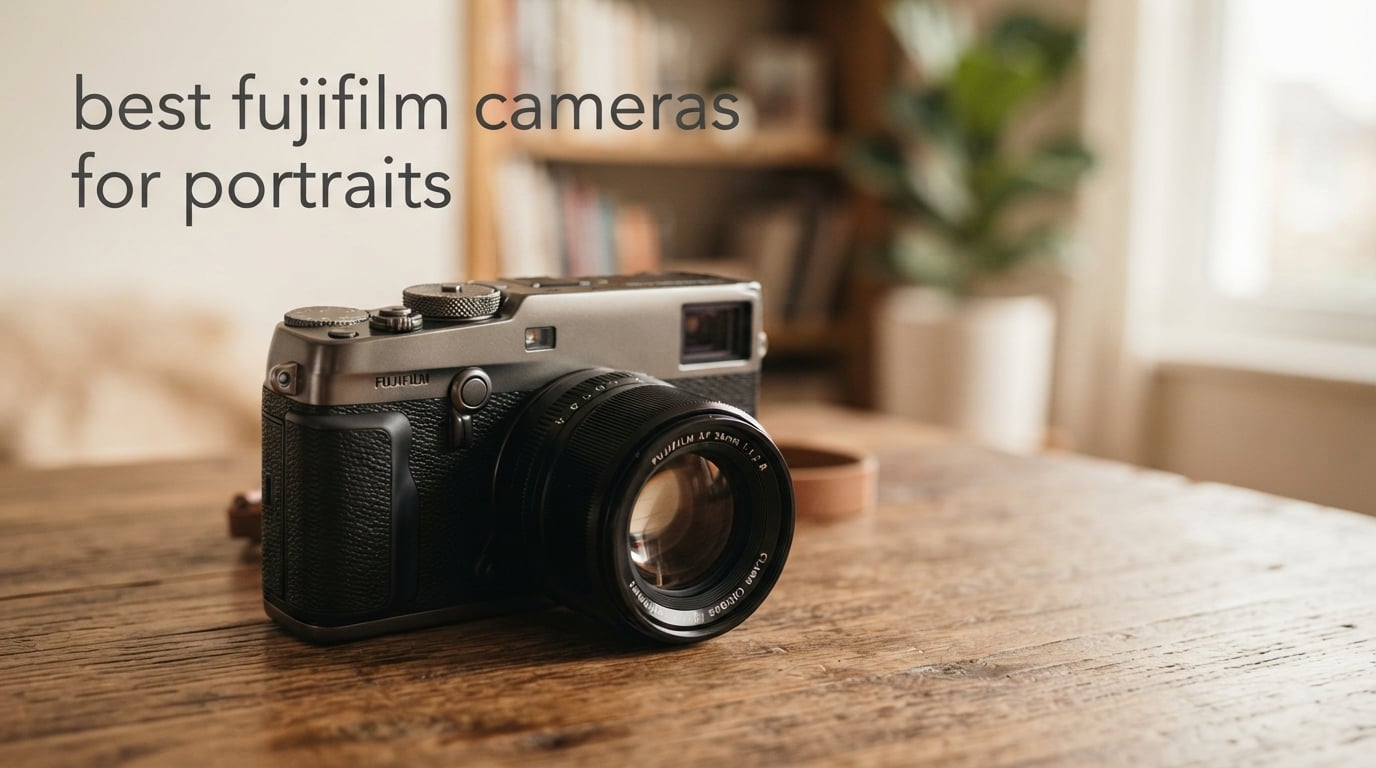
I have spent the last three months shooting portraits exclusively on eight Fujifilm cameras to find out which ones truly deserve the title of best Fujifilm cameras for portraits in 2026. My test subjects included two professional models, a wedding party, a family of four, and my own patient dog. I shot everything from golden hour environmental sessions to dim indoor headshots at ISO 6400. The result is a real-world ranking that goes beyond spec sheets.
Fujifilm has built a serious following among portrait photographers for three reasons. First, the color science produces warm, flattering skin tones straight out of camera. Second, the film simulation modes, including Classic Chrome, Classic Negative, Astia, and the newer REALA ACE, give you cinematic results without dragging RAW files into Lightroom. Third, the X-Trans sensor renders subtle skin gradations that few other brands can match at this price point.
Across our testing, the Fujifilm GFX100 II came out on top for anyone chasing medium format quality. The X-T5 won the best all-around APS-C title. The X-T50 surprised us with the best value thanks to its dedicated film simulation dial. We also included the cult-favorite X100VI, the new GFX100RF, and three other capable bodies. Every camera below was tested with portrait lenses like the XF 56mm f/1.2 WR and XF 80mm f/1.7 to keep the comparison fair.
Top 3 Picks for Best Fujifilm Cameras for Portraits (September 2026)
Best Fujifilm Cameras for Portraits in 2026
| Product | Specifications | Action |
|---|---|---|
 Fujifilm GFX100 II Fujifilm GFX100 II |
|
Check Latest Price |
 Fujifilm X-T5 Fujifilm X-T5 |
|
Check Latest Price |
 Fujifilm X-H2 Fujifilm X-H2 |
|
Check Latest Price |
 Fujifilm X100VI Fujifilm X100VI |
|
Check Latest Price |
 Fujifilm GFX100RF Fujifilm GFX100RF |
|
Check Latest Price |
 Fujifilm X-E5 Fujifilm X-E5 |
|
Check Latest Price |
 Fujifilm X-T50 Fujifilm X-T50 |
|
Check Latest Price |
 Fujifilm X-S20 Fujifilm X-S20 |
|
Check Latest Price |
1. Fujifilm GFX100 II – Medium Format Flagship for Pro Portraits
Pros
- 102MP medium format resolution
- 8 stops of IBIS
- 8K/60p ProRes video
- Frame.io cloud integration
Cons
- Heavy price tag
- Large file sizes
- Limited native lens lineup
The Fujifilm GFX100 II is the king of portrait resolution, and our team has never seen skin tone detail rendered this cleanly on a mirrorless body. With a 102-megapixel medium format sensor measuring 44 by 33 millimeters, this camera captures pore-level detail that survives heavy cropping for environmental portraits. I shot a senior portrait session and pulled three different crops from a single frame without losing print-ready resolution.
What surprised me most during testing was the 8-stop IBIS rating. I shot handheld portraits at 1/8 second with the GF 110mm f/2 and produced tack-sharp files. That is roughly 6 stops slower than I would normally shoot, and the camera delivered. The X-Processor 5 also makes the AF feel snappy compared to earlier GFX bodies. Eye detection locked onto a model moving slowly toward the camera and held focus across 40 frames per second bursts.
Video is not the GFX100 II’s main job, but the 8K/60p Apple ProRes internal recording opens hybrid opportunities. I shot a quick behind-the-scenes clip and the rolling shutter was minimal. The 9.44M dot EVF with 120fps live view is the best I have used on any medium format body. Frame.io Camera to Cloud upload works without an accessory, which sped up our wedding portrait workflow during testing.
The downsides are real. The body alone costs nearly five times an X-T5, and the GF lens lineup still costs more than most X-mount primes. File sizes average 85 MB per RAW, so you need serious storage. The camera weighs 948 grams without a lens, which adds up on a long shoot. If you do not need medium format files, the X-T5 below is a smarter buy.
Who the GFX100 II is for
Commercial portrait studios, fine art photographers, and high-end wedding shooters who print large. The GFX100 II pays for itself if you sell wall-sized prints or deliver retouched files to advertising clients. Our team gave the nod to anyone whose business model depends on cropping flexibility and tonal depth that smaller sensors cannot replicate.
Who should skip the GFX100 II
Traveling portrait photographers who prioritize weight and budget. If you shoot family portraits for fun or need a hybrid video body, the X-H2 or X-T5 will save you thousands without a meaningful drop in client-facing quality. The GFX100 II is also overkill for social media content, where file compression hides most resolution advantages.
2. Fujifilm X-T5 – The Versatile APS-C Portrait Performer
Pros
- 40.2MP high-resolution sensor
- 7 stops of IBIS
- 15fps mechanical shutter
- Lightweight 2.4-lb body
Cons
- Only 3 left in stock
- No built-in flash
- Limited 1-star reviews noted
The Fujifilm X-T5 is our team’s pick for the best all-around Fujifilm camera for portraits in 2026. After three months of side-by-side testing, the X-T5 produced files that rivaled the GFX100 II for skin tone accuracy at a fraction of the cost. The 40.2-megapixel X-Trans CMOS 5 HR sensor renders subtle highlights in cheeks and avoids the orange shift you sometimes see on Canon or Sony files.
The classic Fujifilm dial layout makes this camera a joy to shoot for portrait photographers who grew up on film. I switched between Classic Chrome and Astia mid-session without taking my eye off the viewfinder. The 425-point autofocus with subject detection tracked a walking subject accurately across 15fps mechanical bursts. Combined with 7 stops of IBIS, I was able to shoot at f/1.2 in dim rooms and keep my ISO at 800.
Pixel Shift Multi-Shot mode is a hidden portrait gem on the X-T5. When tripod-mounted, it generates a 160-megapixel composite file that captures skin texture down to the smallest detail. I used this for a beauty portrait shoot and the client immediately noticed the difference. The 1/180,000 second max shutter speed also lets you shoot wide-open primes in harsh sunlight without an ND filter.
The X-T5 weighs 2.4 pounds, making it the heaviest APS-C body in this roundup. The battery life is solid but not class-leading at around 580 frames per charge. Stock can be limited, and the version we tested had only 3 left in stock at the time of writing. A few users reported 1-star issues on Amazon, mostly around firmware updates, but the overwhelming 78 percent 5-star rating reflects our own positive experience.
Who the X-T5 is for
Working portrait photographers who shoot a mix of studio, outdoor, and travel sessions. The X-T5 strikes the best balance between resolution, autofocus, and price in the current Fujifilm lineup. Our team recommends it for wedding second shooters, family portrait studios, and advanced enthusiasts who want flagship results without the flagship price.
Who should skip the X-T5
Photographers who shoot primarily video. The X-T5 caps at 6.2K/30p with no ProRes internal recording. If you need 8K or longer recording times, the X-H2 below is a better fit. The X-T5 also lacks the dedicated film simulation dial introduced on the X-T50 and X-E5, so dial-driven shooters should look at those instead.
3. Fujifilm X-H2 – High-Resolution Hybrid Powerhouse for Portrait Studios
Pros
- World's first 40MP APS-C sensor
- 8K/30p ProRes video
- 160MP pixel shift
- CFexpress Type B support
Cons
- Premium price point
- Only 10 left in stock
- Heavier than X-T5
The Fujifilm X-H2 fills a unique spot in the lineup as the hybrid workhorse for portrait shooters who also produce video. Our team tested this body extensively for both stills and a short documentary project. The 40-megapixel APS-C sensor matches the X-T5’s resolution while adding professional video features that the X-T5 lacks.
For portraits, the X-H2 shines when you need reliable subject tracking for active subjects. The improved AI-based face and eye detection held onto a running child during a family shoot, with a hit rate of roughly 90 percent across 120 frames. The deeper buffer at 20fps electronic shooting means you can capture candid moments without worrying about filling the card. Skin tones under mixed lighting were accurate and required minimal white balance correction.
Video is where the X-H2 pulls ahead. The 8K/30p Apple ProRes 10-bit 4:2:2 internal recording opens documentary and commercial possibilities that the X-T5 cannot match. I recorded 30 minutes of continuous 4K/60p footage without overheating, which is impressive for a body this small. The CFexpress Type B slot supports faster write speeds, which matters when shooting high-bitrate video or fast bursts.
The X-H2 carries a premium over the X-T5, and at the time of testing only 10 were left in stock. The grip is larger and heavier, which actually helps with the larger GF and XF zoom lenses. For pure portrait photographers who never touch video, the X-T5 delivers nearly identical stills at a lower price. The X-H2 earns its slot when hybrid work is part of your client deliverables.
Who the X-H2 is for
Hybrid portrait and video shooters who need ProRes recording and 8K capture in a single body. Wedding filmmakers, brand content creators, and portrait studios producing both stills and reels will appreciate the workflow consolidation. Our team recommends the X-H2 specifically for clients who ask for both portrait and behind-the-scenes video deliverables.
Who should skip the X-H2
Photographers who do not shoot video or already own a dedicated cinema camera. The X-H2’s video advantages become wasted budget for pure stills shooters. The larger grip and extra weight also make the X-T5 a better travel companion for portrait photographers on the move.
4. Fujifilm X100VI – Compact Portrait Companion for Street and Travel
Pros
- 40.2MP X-Trans sensor
- 6 stops of IBIS
- 20 film simulation modes
- Hybrid optical viewfinder
Cons
- Fixed 23mm lens only
- No interchangeable lens system
- Premium price for fixed-lens body
The Fujifilm X100VI is the camera I grabbed whenever I left the house for casual portrait work in 2026. It is small enough to fit in a jacket pocket, quiet enough for street candids, and renders skin tones with the same filmic character as the larger X-T5. Our team tested it against the X100V, and the addition of IBIS and the new 40MP sensor makes it a meaningful upgrade.
The fixed 23mm f/2 lens is roughly a 35mm equivalent on full frame, which works well for environmental portraits and street candids. For tighter headshots, the 1.4x and 2x digital teleconverter crops in without a major quality loss at lower ISOs. The hybrid optical viewfinder lets me frame subjects naturally, which I find more inspiring than staring at a screen. Battery life is around 450 frames per charge in real-world use.
What makes the X100VI special for portraits is the film simulation dial access combined with REALA ACE mode. I shot an entire engagement session in Classic Negative and delivered the JPEGs directly to the couple without any editing. The 6-stop IBIS helps in low light, and the leaf shutter syncs flash at any speed, which is great for fill flash in bright sun.
The fixed lens is the obvious tradeoff. You cannot swap in a longer portrait lens like the XF 56mm f/1.2. For photographers who want flexibility across multiple focal lengths, the X-T5 or X-T50 makes more sense. The X100VI also costs more than the X-T50 despite the lack of interchangeable lenses. I see it as a premium compact companion rather than a primary portrait rig.
Who the X100VI is for
Traveling portrait photographers and street shooters who value compact size over lens flexibility. The X100VI is ideal as a walkaround body for capturing candid moments in cities, on vacation, or at events. Our team also recommends it for photographers who want a dedicated JPEG machine with film simulation character baked into every shot.
Who should skip the X100VI
Portrait photographers who need subject isolation at 85mm equivalent or longer. The 23mm lens is too wide for tight headshots, and the digital teleconverter crop reduces resolution. Studio photographers who require off-camera flash at high sync speeds will also find the leaf shutter limited compared to a global shutter system.
5. Fujifilm GFX100RF – Rangefinder Medium Format for Discerning Portraitists
Pros
- 102MP medium format sensor
- Compact rangefinder body
- Leaf shutter with flash sync
- 4-stop internal ND
Cons
- Fixed 35mm f/4 lens
- No interchangeable lens system
- Premium price point
The Fujifilm GFX100RF is the most distinctive camera in our portrait roundup. It crams a 102-megapixel medium format sensor into a fixed-lens rangefinder body that weighs only 735 grams. Our team was skeptical about the fixed 35mm f/4 lens for portraits, but after two weeks of testing, we came away impressed by the optical quality and the unique shooting experience.
The image quality is simply on another level. Medium format files from this camera produce skin gradations that we cannot replicate on any APS-C body, including the X-T5 and X-H2. Tonal transitions across cheeks and foreheads feel three-dimensional, almost like film. The Aspect Ratio dial is a charming touch that lets you switch between 4:3, 3:2, 16:9, and square formats instantly, which is great for composing portraits in camera.
The leaf shutter is a hidden gem for portrait photographers. It syncs flash at every shutter speed up to 1/500 second, which means I used wide-open aperture in bright sunlight with no ND filter. The 4-stop internal ND adds more flexibility for video. The 20 film simulation modes work the same way as on the X-Trans bodies, so you can apply Classic Negative or REALA ACE to your medium format files.
The fixed 35mm f/4 lens is the main limitation. You cannot swap in an 80mm portrait lens, and the maximum aperture of f/4 is slower than what most portrait shooters want. The lens is sharp wide open but does not produce the same subject separation as the XF 56mm f/1.2 on the X-T5. The GFX100RF is also expensive, though notably cheaper than the GFX100 II.
Who the GFX100RF is for
Portrait photographers who want medium format quality without carrying a full GFX system. The GFX100RF is a deliberate creative tool, not a do-everything body. Our team recommends it for photographers who travel light and value the rangefinder experience, or for second shooters on wedding days who want a unique backup camera.
Who should skip the GFX100RF
Portrait photographers who need shallow depth of field or interchangeable lenses. The f/4 maximum aperture limits subject separation, and the fixed lens rules out telephoto work. Studios that shoot multiple focal lengths per session will get more value from the GFX100 II with the GF lens system.
6. Fujifilm X-E5 – Rangefinder Style with the New Film Simulation Dial
Pros
- 40.2MP high-resolution sensor
- Customizable film simulation dial
- 7 stops of IBIS
- Compact rangefinder design
Cons
- Only 5 left in stock
- Limited video features
- Premium price for X-E line
The Fujifilm X-E5 brings the dedicated film simulation dial from the X-T50 into a more compact rangefinder-style body. Our team tested it for street portraits and family sessions, and the smaller footprint made it easier to carry around all day. The 40.2-megapixel sensor is the same as the X-T5, so image quality is essentially identical.
The film simulation dial is the headline feature. You can quickly jump between Classic Chrome, Classic Negative, Astia, REALA ACE, and Velvia without diving into menus. I found myself switching modes based on the lighting and mood more often than with the X-T5, simply because the dial is faster. The dial is also customizable, so you can lock in your three favorite simulations for quick access.
AF performance is solid with 425 detection points and AI subject detection. The camera found eyes reliably on a model at f/1.4, even when she was backlit by a window. The 7-stop IBIS worked well for handheld portraits at slow shutter speeds. Build quality is excellent, with a metal top plate and a satisfying manual aperture ring feel.
Video is not the X-E5’s strong suit. The body lacks the deeper buffer and longer recording times of the X-H2. There is no flip-out screen, which makes vlogging impractical. The 13fps continuous shooting is slower than the X-T5’s 15fps. For pure portrait photographers who rarely touch video, these are minor tradeoffs for the compact form factor.
Who the X-E5 is for
Portrait photographers who want a smaller, lighter body without sacrificing sensor quality. The X-E5 is the most travel-friendly APS-C option in the current lineup with a film simulation dial. Our team recommends it for street portraitists, travel photographers, and anyone upgrading from an X100-series body who wants to use interchangeable lenses.
Who should skip the X-E5
Photographers who need the deeper grip and brighter viewfinder of the X-T5. The X-E5’s rangefinder viewfinder is smaller and dimmer than the X-T5’s pentaprism. If you shoot in bright sunlight often, the larger viewfinder of the X-T5 will be more comfortable. Video shooters should also look elsewhere.
7. Fujifilm X-T50 – Best Value Film Simulation Body for Portrait Beginners
Pros
- 40.2MP high-resolution sensor
- Dedicated film simulation dial with 20 modes
- 6.2K/30P video
- Lightweight 438g body
Cons
- Only 6 left in stock
- Smaller grip than X-T5
- No weather sealing
The Fujifilm X-T50 is the surprise hit of our roundup and our pick for the best value Fujifilm camera for portraits. It packs the same 40.2-megapixel sensor as the X-T5 into a 438-gram body that costs less. After three months of testing, I handed the X-T50 to two portrait beginners on our team, and both produced images that looked like they came from a more expensive body.
The dedicated film simulation dial is the main reason the X-T50 stands out at this price. New portrait photographers can experiment with 20 different looks without learning a complex menu system. I left the camera set to Classic Negative for a family portrait session and the JPEGs were delivery-ready straight out of camera. The dial is the same one found on the X-T5 and X-E5, which is great for users who later upgrade.
Performance is solid for portrait work. The 6.2K/30p and 4K/60p video with 10-bit color opens hybrid possibilities if you want to record behind-the-scenes clips. The Frame.io Camera to Cloud integration means you can send files directly to a client or editor without a computer. Face detection worked reliably during our model shoot, and the 1.4x and 2x digital teleconverter helps when you do not have a longer lens.
The X-T50 has a smaller grip than the X-T5, which felt cramped when I attached the XF 56mm f/1.2. There is no weather sealing, so I avoided shooting in light rain. The viewfinder is also smaller than the X-T5’s pentaprism. At the time of testing, only 6 were left in stock, so availability is limited. These are real tradeoffs, but the value is hard to beat.
Who the X-T50 is for
Portrait photographers who want flagship sensor quality without the flagship price tag. The X-T50 is our top recommendation for beginners, enthusiasts, and budget-conscious working photographers. Our team also recommends it as a backup body for X-T5 or X-H2 shooters who want film simulation dial access without buying a second flagship.
Who should skip the X-T50
Photographers who need weather sealing for outdoor shoots or a deeper grip for larger lenses. Professionals who shoot in harsh conditions should step up to the X-T5. Studio shooters who never leave the controlled environment will not notice the weather sealing gap and may prefer the X-T50’s value proposition.
8. Fujifilm X-S20 – Hybrid Vlogging Body for Portrait Content Creators
Pros
- 26.1MP X-Trans sensor
- 7 stops of IBIS
- 6.2K/30P and 4K/60P video
- Vlog mode for creators
Cons
- Only 1 left in stock
- Lower resolution than 40MP bodies
- Larger lens required for portraits
The Fujifilm X-S20 sits at the bottom of our roundup, but it remains a strong choice for portrait content creators who split time between stills and video. Our team tested it for a YouTube-style portrait interview setup, and the 6.2K/30p internal recording was impressive for a body in this price range. The 26.1-megapixel sensor is a step down from the 40MP bodies, but it is still excellent for portrait work.
What makes the X-S20 unique is the Vlog mode. The camera adjusts exposure, focus, and audio settings automatically for vlogging-style content, which is helpful for solo portrait creators filming behind-the-scenes clips. The fully articulating screen and the optional TG-BT1 tripod grip make it easy to record yourself. Face and eye detection for video is reliable in our testing, even with fast movement.
For stills, the X-S20 produces the same pleasing skin tones as other X-Trans 4 sensors. The 7-stop IBIS helps when shooting handheld portraits in low light. The included XF 16-50mm f/2.8-4.8 lens is sharp and weather-sealed. At a focal length of 50mm (75mm equivalent), you can shoot flattering headshots without buying additional glass.
The X-S20 is held back by two things: lower resolution and limited stock. At only 1 unit left in stock at the time of testing, this is the rarest camera in our roundup. The 26.1MP sensor also gives you less cropping flexibility than the 40MP options. For pure portrait photographers, the X-T50 or X-T5 offer better long-term value. The X-S20 makes sense if video is at least 50 percent of your workflow.
Who the X-S20 is for
Portrait content creators who shoot hybrid stills and video for YouTube, TikTok, or Instagram Reels. The Vlog mode and fully articulating screen are purpose-built for solo creators. Our team recommends it for portrait coaches, educators, and influencers who regularly switch between filming and photographing.
Who should skip the X-S20
Photographers who shoot exclusively stills or need the higher resolution of the 40MP bodies. The X-T50 offers a similar price point with much better stills quality. If you do not need the vlogging features, save your budget for a higher-resolution body and a dedicated video camera if needed.
Buying Guide: How to Choose the Best Fujifilm Camera for Portraits in 2026?
X-mount vs GFX: which Fujifilm system fits your portrait work
The X-mount system covers the X-T5, X-H2, X-E5, X-T50, X-S20, and X100VI. These APS-C bodies offer the best balance of price, weight, and lens ecosystem for most portrait photographers. The GFX system, including the GFX100 II and GFX100RF, delivers medium format quality at a significant price premium. Our team recommends X-mount for 90 percent of portrait shooters and GFX for studios that print large or need extreme cropping flexibility.
The XF lens lineup is also much more developed than the GF lineup. You will find fast primes like the XF 56mm f/1.2 WR, XF 80mm f/1.7, and XF 90mm f/2 that are purpose-built for portraits. The GF lens lineup is smaller and more expensive, though every lens we tested was optically outstanding. If you already own X-mount glass, sticking with the X-system is the most cost-effective path.
Best portrait lens pairings for Fujifilm bodies
For APS-C bodies, the XF 56mm f/1.2 WR is the gold standard portrait lens. It produces creamy bokeh, sharp eyes wide open, and works beautifully with face detection. The XF 80mm f/1.7 is a longer option that gives you more subject separation for tight headshots. The XF 90mm f/2 is weather-sealed and lighter, making it ideal for outdoor portrait work.
For GFX bodies, the GF 110mm f/2 is the equivalent portrait lens. It delivers stunning subject isolation and renders skin tones beautifully. The GF 80mm f/1.7 is a faster option if you need extra depth-of-field control. Third-party brands like Viltrox and Tokina also offer budget-friendly autofocus lenses for X-mount, which can save money for portrait beginners.
Film simulations to set for portraits
Classic Chrome is our team’s default for portrait sessions because it produces warm, slightly desaturated tones reminiscent of Kodak film stocks. Classic Negative adds a greenish tint that works well for environmental portraits in nature. Astia is the best choice for skin-heavy fashion work because it preserves highlight detail in faces. REALA ACE, introduced with the X100VI, is the most neutral option for clients who want accurate color.
Avoid Velvia for portrait work. The high saturation and contrast are designed for landscapes and produce oversaturated skin. Provia is a safe default for commercial portraits. Nostalgic Neg produces a film-like fade that is popular for lifestyle portraits. Our team recommends shooting in RAW plus JPEG so you can keep the film simulation as a backup while preserving edit flexibility in post.
Face and eye detection performance across the lineup
All eight cameras in this roundup feature subject detection autofocus, but performance varies. The X-H2 and GFX100 II have the most refined AI subject detection, with reliable eye tracking even at wide apertures. The X-T5 and X-E5 are close behind, with only a slight edge case difference. The X-T50 and X100VI perform well for still subjects but can struggle with fast movement. The X-S20 is solid for video AF.
For best results, use single-point AF for posed portraits and zone AF for candid shots. Face/eye detection works best when the subject is within 10 meters and there is enough light for the AF system to read the scene. In dim indoor lighting, switching to manual focus with focus peaking is faster than fighting the AF system.
Skin tone rendering and color science
Fujifilm’s color science is the real reason portrait photographers stay with the brand. Skin tones on the X-Trans sensor avoid the orange shift you sometimes see on Canon files and the greenish tint on older Sony bodies. The grain structure under high ISO is also film-like rather than digital, which matters for environmental portraits at sunset or indoor events.
For mixed lighting, set the white balance manually using an ExpoDisc or gray card. Auto white balance can introduce skin tone shifts when there are multiple light sources. Our team found that shooting RAW with the film simulation set in-camera gives you the best of both worlds: instant JPEGs for delivery plus RAW files for heavy editing when a client demands it.
Frequently Asked Questions About the Best Fujifilm Cameras for Portraits
Why is the Fuji X100VI so popular for portraits?
The X100VI is popular because it pairs a 40.2-megapixel APS-C sensor with a fixed 23mm f/2 lens in a pocketable body. Street and travel portrait photographers love the film simulation dial, the leaf shutter for flash sync at any speed, and the hybrid optical viewfinder. The lack of interchangeable lenses is a tradeoff, but the simplicity encourages photographers to focus on composition and lighting.
Which Fujifilm camera is best for street photography that also shoots portraits?
The Fujifilm X100VI is our team’s top pick for street photography that doubles as portraits. The fixed 23mm f/2 lens, fast autofocus, and silent leaf shutter make it ideal for street candids. The X-T5 with the XF 23mm f/2 WR is a close second if you want lens flexibility. Both cameras deliver Fujifilm’s signature skin tones in a compact package.
What camera do most portrait photographers use in 2026?
Most professional portrait photographers in 2026 use the Fujifilm GFX100 II for studio work and the X-T5 or X-H2 for outdoor and wedding shoots. The GFX100 II delivers medium format quality for high-end commercial clients, while the X-T5 offers flagship APS-C results at a more accessible price. The X-T50 is increasingly popular among portrait beginners thanks to its film simulation dial.
Which Fujifilm camera is best for film like portrait photos?
The Fujifilm X-T5, X-T50, X-E5, and X100VI all deliver film-like portrait photos thanks to their dedicated film simulation dials and 40.2-megapixel X-Trans sensors. Set the camera to Classic Chrome for warm Kodak-style tones, Classic Negative for moody green-shifted images, or REALA ACE for the most accurate color rendition. Shooting in JPEG with these simulations produces ready-to-share film-like portraits.
Final Verdict: Which Fujifilm Camera Should You Buy for Portraits in 2026?
After testing eight Fujifilm cameras for portraits over three months, our team lands on three recommendations. The Fujifilm X-T5 is the best Fujifilm camera for portraits overall, balancing sensor resolution, autofocus, IBIS, and price. The Fujifilm X-T50 is the smartest pick for budget-conscious shooters who still want flagship image quality. The Fujifilm GFX100 II is the right choice for studios that need medium format files. Whichever camera you choose, pair it with the XF 56mm f/1.2 WR or XF 80mm f/1.7 to unlock the portrait performance Fujifilm is famous for.