
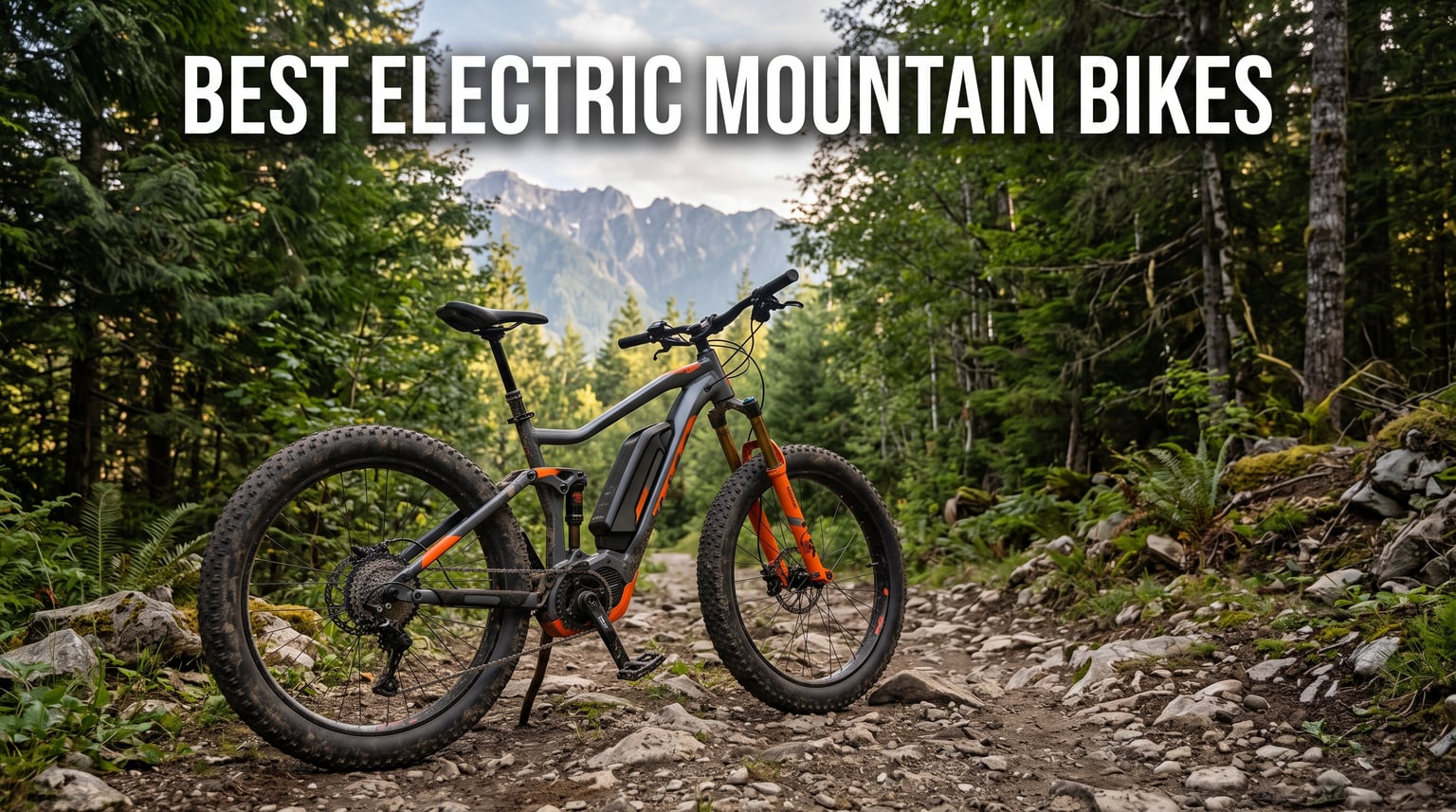
The best electric mountain bikes are not one interchangeable category. A light 26-inch commuter-style e-bike with a front fork can be useful on smooth dirt paths, while a heavy fat-tire model with dual suspension is built around a very different kind of ride.
I built this list from the verified product data available for eight current listings: stated motor output, battery capacity, range claim, brakes, suspension, weight when listed, certification, warranty, and review record. I have not invented trail-test results, suspension travel, motor torque, or service coverage where a listing does not provide it.
An e-MTB is a mountain-oriented bicycle with battery-powered pedal or throttle assistance. It can help a rider keep moving on a climb or cover more ground, but it is still a bicycle: rider control, braking technique, trail rules, fit, and regular maintenance decide whether the experience feels safe and enjoyable.
That distinction matters with this group. Several listings use “mountain bike” in their product names, yet their listed equipment points more strongly toward commuting, hard-packed paths, snow, gravel, or general off-road use than repeated technical descending.
My short answer for 2026 is simple: match the bike to the surface you will actually ride and be skeptical of maximum-range figures. If your local route contains steep, rough, or technical singletrack, confirmed suspension travel, tire casing, brake specification, dealer support, and a purpose-built mid-drive system deserve more attention than a large peak-watt number alone.
Top 3 picks are the ASKGO G26, Jasion Thunder, and Jasion EB5
The ASKGO G26 is my editor’s-choice listing for its stated 1,500W peak output, 65-mile claimed range, dual suspension arrangement, and 365-pound stated capacity. Its 4.9 rating comes from only 12 reviews, so I would treat that score as an early signal rather than final proof of long-term durability.
The Jasion Thunder is the stronger match for riders who want listed hydraulic disc brakes, an 85 N.m torque claim, a 1,040Wh battery listing, 26-by-4-inch tires, and connected security features. The Jasion EB5 is the review-volume pick: its 4.2 rating is lower than several rivals here, but it has more than 2k reviews and a listed weight of 49.6 pounds.
Those are category calls, not promises that one machine is right for every rider. A rider who must lift a bike onto a rack may favor the EB5’s listed weight, while someone carrying cargo or tackling soft ground may accept substantially more mass for fat tires, battery capacity, and suspension.
The eight electric mountain bikes differ most in motor claim, battery size, suspension, and weight
Use this overview as a sorting tool, not as a substitute for a fit check. Range figures are manufacturer claims and are commonly quoted in pedal-assist conditions; hills, rider and cargo mass, tire pressure, headwinds, temperature, assist mode, and throttle use can shorten a ride substantially.
| Product | Specifications | Action |
|---|---|---|
 ASKGO G26 ASKGO G26 |
|
View on Amazon |
 GEMATIO GT-20 GEMATIO GT-20 |
|
View on Amazon |
 INVANTI EB17 INVANTI EB17 |
|
View on Amazon |
 Jasion Thunder Jasion Thunder |
|
View on Amazon |
 Funhang EB-S1 Funhang EB-S1 |
|
View on Amazon |
 Loeook EB-M1 Loeook EB-M1 |
|
View on Amazon |
 TST R004 TST R004 |
|
View on Amazon |
 Jasion EB5 Jasion EB5 |
|
View on Amazon |
The full-suspension labels in this list do not supply suspension-travel figures, damper details, or geometry data. I would not read “full suspension” as evidence that a bike is ready for drops, rock gardens, or aggressive enduro riding without confirmation from the manufacturer and a qualified bike shop.
1. Best for a long claimed range: 1. ASKGO G26 with dual suspension
Pros
- 1500W peak claim
- 65-mile claimed range
- Dual suspension
- 95% pre-assembled
- 36-month warranty
Cons
- Only 12 reviews
- Weight not listed
- Urban terrain is listed
The ASKGO G26 earns the first spot because its listing combines a 1,500W peak motor claim, a 48V 10.4Ah removable battery, 26-inch wheels, seven speeds, and a 65-mile maximum range claim. It also lists dual suspension, disc brakes, a 400-lumen headlight, and a maximum rider-and-load recommendation of 365 pounds.
I would read the stated terrain carefully before calling it a serious technical-trail bike. The product details identify urban terrain, while the broader use list mentions trail, snow, road, and racing, so the evidence supports a versatile general-purpose e-bike more clearly than a specialized downhill or enduro platform.
The battery math is worth pausing on. A 48V 10.4Ah pack is roughly 499Wh by multiplication, and the 65-mile figure should be treated as a best-case listing claim rather than a promise for steep climbs at high assistance.
The assembled-bike claim is useful for first-time buyers, but “95% pre-assembled” does not mean no inspection is needed. I would check axle retention, headset adjustment, brake alignment, rotor bolts, tire pressure, pedal installation, shifting, and the battery latch before the first ride.
The best use is mixed commuting and gentle trail riding
This model suits an adult who wants pedal assistance for longer paved rides, hard-packed paths, mild gravel, or smooth trail connectors. The front-and-seat-post suspension arrangement cited in the listing may take the edge off chatter, while the seven-speed drivetrain gives the rider gears to pair with motor assistance.
For a rider who wants the best electric mountain bikes for everyday terrain rather than race-course descending, the G26’s listed capacity and headlight are practical strengths. I would still favor a certified helmet, gloves, and a cautious first ride in a low assist setting while learning the bike’s braking response.
The limiting factor is the small review sample and missing weight
A 4.9 average looks excellent, but it is based on 12 reviews. That is not enough owner feedback for me to make a broad durability claim, particularly for a machine with electrical, drivetrain, brake, and suspension parts working together.
The listing does not state the bike’s weight, which makes rack transport, stairs, and one-person handling impossible to judge from the verified data. Ask the seller for that number, confirm local service options, and check whether replacement battery and wear parts are obtainable before committing.
2. Best for soft surfaces and high capacity: 2. GEMATIO GT-20 fat-tire e-bike
Pros
- Multiple power options
- UL2849 battery certification
- 20 by 4-inch fat tires
- Full suspension
- Parent speed setting
Cons
- 88-pound listed weight
- Only 25 reviews
- Non-Prime listing
The GEMATIO GT-20 is the heaviest bike in this comparison with an 88-pound listed weight, and that fact should shape the decision from the beginning. In return, the listing offers 20-by-4-inch fat tires, full suspension, multiple motor and battery variants, seven-speed Shimano gearing, and a rider-height range from 5 feet 2 inches to 6 feet 8 inches.
Its advertised range reaches 75 to 90 miles in pedal-assist mode, depending on the version. The listing also specifies battery safety certifications including UL 2271 and UL 2849, which is a meaningful item to confirm on the actual bike and battery labels when electrical safety is a priority.
A fat tire spreads a rider’s load over a larger contact patch and can feel more stable on loose surfaces, snow, sand, or broken paths. That does not make it a free pass through technical terrain: wide tires add rolling resistance, and an 88-pound machine carries much more momentum when speed increases or a descent steepens.
I like that the listing names a parent speed-limit setting and says the bike is largely pre-assembled with a video guide. For households where one bike may be shared, those details matter more than marketing terms, though every rider still needs to understand the controls and stopping distance before riding near traffic or pedestrians.
The best use is low-grip ground and riders who need a broad fit range
The GT-20 makes the most sense for a rider seeking traction and comfort on gravel, snow, packed dirt, and mixed all-terrain routes. Its fat tires and full-suspension designation point toward comfort over uneven ground, while the broad stated height range can simplify fitting for taller and shorter adults.
I would choose the lower assistance modes first on paved paths, then increase support only after getting a feel for steering, braking, and the bike’s mass. A heavy e-bike can be calm at cruising speed, but it takes planning to maneuver around gates, switchbacks, or a tight garage.
The key trade-off is an 88-pound listed weight
At 88 pounds, this is not a casual lift onto a vehicle rack or up an apartment staircase. Confirm that your rack is rated for the bike plus battery, and remove the battery during transport only if the manufacturer’s instructions allow it.
The 4.7 rating is based on 25 reviews, so it gives a useful but limited snapshot. I would place more weight on inspection of the delivered bike, the written warranty for key components, battery handling instructions, and how responsive the seller is to a pre-purchase service question.
3. Best for a lighter listed commuter-trail crossover: 3. INVANTI EB17
Pros
- 58-pound listed weight
- Removable 374.4Wh battery
- 55-mile PAS claim
- 7-speed gearing
- LCD display
Cons
- Iron frame
- Front suspension only
- Mechanical disc brakes
The INVANTI EB17 is a clearer commuter-oriented mountain e-bike than a full-suspension trail machine. It lists a 350W motor with 750W peak output, a 36V 10.4Ah removable battery rated at 374.4Wh, 26-inch by 1.95-inch tires, front-fork suspension, seven speeds, and mechanical disc brakes.
Its 58-pound listed weight is lower than the fat-tire choices in this roundup, although it is still a substantial object to carry. The range claim reaches 55 miles in pedal-assist mode, and the listing identifies suitable rider heights from 5 feet 3 inches to 6 feet 1 inch.
I would see the front suspension as a comfort feature for potholes, small roots, and washboard paths. Without a rear shock and without stated travel, it is not evidence of a bike intended for repeated hard landings or rough technical descents.
The iron frame is another detail worth considering. Steel-based frames can be durable, but frame material alone cannot tell us ride quality, corrosion resistance, weld quality, or total service life; inspecting the frame and keeping it dry after wet rides are sensible steps.
The best use is paved routes, rail trails, and mild unpaved paths
The EB17 is a sensible candidate for a rider whose week includes commuting and occasional smooth dirt or forest roads. The removable battery lets a rider charge indoors, and the LCD display gives a practical way to watch assistance and battery status rather than guessing late in a ride.
I would use the seven-speed gear range actively instead of relying on motor support alone. Selecting an easier gear before a hill can reduce strain on the rider and may help the system work more comfortably than forcing a tall gear at low cadence.
The decision point is front-only suspension and a smaller battery
The 374.4Wh battery is much smaller on paper than the 1,040Wh figure listed for the Jasion Thunder. It may be appropriate for shorter mixed rides, but a rider planning long, steep routes should set expectations conservatively and have a charge plan.
The product has 133 reviews at a 4.6 average, which gives more feedback than the first two listings. The review summary also records a small portion of one-star ratings, so I would read recent feedback for patterns around assembly, battery performance, and support rather than focusing only on the average.
4. Best for a large listed battery and hydraulic brakes: 4. Jasion Thunder
Pros
- 1040Wh listed battery
- 85 N.m torque claim
- Hydraulic disc brakes
- Smart app and remote lock
- 400-pound capacity
Cons
- Weight not listed
- Front suspension only
- No stated suspension travel
The Jasion Thunder is the most feature-dense listing here for someone who wants a large stated battery and safety-focused equipment. It lists an 1,800W peak motor, 85 N.m of torque, a 1,040Wh battery, a claimed maximum range of 80 miles, 26-by-4-inch tires, hydraulic disc brakes, and a stated 400-pound capacity.
It also includes an app, remote security lock, headlight, brake light, and turn signals in the product data. Those features can be useful for an urban rider or someone who uses roads to reach a trailhead, but they do not replace a physical lock, visible clothing, alert riding, or local traffic-law compliance.
The Thunder is described with front suspension rather than a rear shock. That puts it in a different handling category from full-suspension entries such as the GEMATIO GT-20 and TST R004, and I would expect the rider to use body position and tire pressure to manage rougher ground.
The listing does not provide the bike’s weight. Before I would buy a battery this large, I would ask for the complete ready-to-ride weight and whether the battery can be removed for charging and transport, since both details affect storage and handling.
The best use is long mixed-surface rides with a need for lighting and braking features
The Thunder fits a rider who wants to extend a ride beyond smooth pavement while keeping fat-tire contact area, a large listed battery, and hydraulic disc brakes in the conversation. Hydraulic brakes are generally easier to modulate than basic mechanical systems when properly adjusted, though brake setup and pad condition still need regular attention.
I would especially consider it for routes that combine city streets, packed dirt, gravel, and moderate uneven ground. Its passenger-ready frame description should not be interpreted as permission to carry a person unless the manual explicitly permits that use, specifies a secure seating arrangement, and local law allows it.
The unanswered question is handling because the weight is not listed
A 1,040Wh battery is a major capacity figure, but more battery usually adds mass. Without the complete bike weight, it is not possible to judge how the Thunder will feel on a rack, during a tight turn, or when a rider has to lift it over a curb.
Its 4.7 average comes from 85 reviews, and the available summary says 81% are five-star reviews. That is encouraging owner feedback, but I would also inspect the warranty language, locate authorized service options, and check the availability of brake pads, tires, and a replacement battery before choosing it for frequent use.
5. Best for cargo-ready fat-tire utility: 5. Funhang EB-S1
Pros
- UL 2849 certification
- 60-pound rear rack
- 66.6 N.m torque claim
- Turn signals
- Five riding modes
Cons
- 70-pound listed weight
- Front suspension only
- Limited current stock noted
The Funhang EB-S1 is the practical utility pick in this group because its listing combines a 60-pound-capacity rear rack, fenders, lights, turn signals, 26-by-4-inch fat tires, and a 48V 13Ah battery. The stated motor is 500W rated and 1,000W peak, with a listed torque claim of 66.6 N.m and a maximum pedal-assist range claim of 60 miles.
It has front suspension, seven-speed gearing, dual disc brakes, five working modes, and a 70-pound listed weight. The product data also says the complete e-bike is UL 2849 certified and provides a 365-day warranty with lifetime after-sales service.
For a rider carrying a lock, clothing, groceries, or a small load to a trailhead, a built-in rack is more useful than an accessory added later without clear capacity information. The 60-pound rack figure is still a limit, not a target; secure weight low and close to the rack, and do not carry loads that interfere with the wheel, light, or rider movement.
The listing says 163 customers have reviewed the bike, with a 4.5 average. That is a respectable sample for a current listing, but the review record also includes one-star feedback, so I would look for repeat concerns and distinguish delivery or assembly issues from problems that arise after extended use.
The best use is carrying gear across pavement, gravel, and smooth dirt
The EB-S1 makes sense when a conventional backpack is not enough for the trip. Its rack, fenders, light package, and fat tires point toward all-weather errands and recreational routes where a little cargo capacity is helpful.
I would keep cargo expectations realistic on trails. A loaded rear rack changes the bike’s center of mass, can make a front wheel feel lighter on climbs, and requires earlier braking, especially on a 70-pound e-bike.
The main compromise is weight and front-only suspension
The listed 70-pound mass makes this a bike to roll rather than carry whenever possible. It may suit a ground-floor garage, a shed, or a vehicle rack designed for heavy e-bikes, but it is less appealing for frequent stair carries.
There is no rear shock listed, and no suspension-travel measurement is supplied. I would reserve the EB-S1 for smooth singletrack, hard-packed routes, and moderate off-road use rather than assuming it can absorb sustained technical trail impacts like a purpose-designed full-suspension e-MTB.
6. Best for certified battery and bike safety claims: 6. Loeook EB-M1
Pros
- UL 2849 e-bike certification
- UL 2271 battery certification
- Five riding modes
- 56.88-pound listed weight
- 85% pre-assembled
Cons
- 25-50-mile claimed range
- Front suspension only
- High-carbon-steel frame
The Loeook EB-M1 stands out because its listing identifies both UL 2849 certification for the whole e-bike and UL 2271 certification for the battery. For a buyer comparing several direct-to-consumer e-bikes, having those claims in the product data is a good reason to inspect the delivered labels, follow the supplied charging instructions, and avoid substitute chargers.
The bike lists a 500W brushless motor with 1,000W peak output, a removable 48V 374.4Wh IPX5 waterproof battery, front suspension, seven speeds, dual disc brakes, an LCD display, and 26-inch by 1.95-inch tires. Listed weight is 56.88 pounds, with a maximum load recommendation of 300 pounds.
Its listed distance figures are separated by use: 25 to 30 miles in pure-electric operation and 40 to 50 miles with pedal assistance. That is a more useful presentation than one broad maximum claim because it acknowledges that throttle-heavy riding and pedaling do not draw the same amount of energy.
The five listed modes are throttle, pedal assist, pedal-only, cruise, and booster. I would test every mode in a quiet open area, especially cruise and booster functions, because control behavior varies by e-bike and a rider should never discover a function for the first time on a crowded path.
The best use is a safety-conscious rider with short to medium routes
This is a good match for a rider whose priority is documented certification claims alongside a removable battery and manageable listed weight. The front fork, 26-inch wheels, and seven-speed system suit commuting, bike paths, and gentler unpaved routes where a full rear shock is not required.
I would carry the removable battery by its intended handle or housing rather than its wires, charge it on a hard nonflammable surface, and let it cool after a ride before charging. Battery care is a routine ownership task, not an optional extra, regardless of certification.
The range claim and frame material call for realistic planning
A 374.4Wh battery can support useful trips, but a rider seeking long climbs or long days should plan around the lower end of the stated range. Starting with a full battery and recording remaining charge after a familiar route is the most honest way to build a personal range estimate.
The high-carbon-steel frame may add durability or mass depending on its construction, but the listing alone cannot settle that question. The review record of 143 at 4.5 is meaningful feedback, and I would read it alongside a careful assembly check because the listing says the bike arrives 85% pre-assembled.
7. Best for full suspension and a high stated load limit: 7. TST R004
Pros
- Full suspension
- 450-pound listed capacity
- 20 by 4-inch tires
- 60-mile PAS claim
- 318 reviews
Cons
- 66-pound listed weight
- 180-day warranty
- 6-7-hour charge time
The TST R004 is the full-suspension option with the largest stated load capacity in this article: 450 pounds. It lists a 750W motor with 1,500W peak output, a 48V 15Ah removable battery, 20-by-4-inch puncture-proof fat tires, seven-speed gearing, three working modes, and a claimed pedal-assist range up to 60 miles.
Its 66-pound listed weight sits between the lighter 26-inch commuter models and the heaviest fat-tire entries. The listing also identifies mechanical disc brakes, a high-brightness front light, a signaling taillight, and a 180-day limited warranty.
Full suspension can improve comfort and tire contact on rough surfaces, but the specification does not state travel, spring type, damper adjustment, or pivot arrangement. I would treat it as an advantage for broken roads and uneven paths without inferring a level of technical trail capability the evidence does not show.
The 48V 15Ah battery works out to roughly 720Wh by multiplication, though the listing separately states 1,200Wh lithium battery energy content. Because those figures do not line up, I would ask the seller to clarify the usable watt-hour rating printed on the actual battery before estimating range or comparing it against other bikes.
The best use is comfort-focused mixed terrain with heavier rider or cargo needs
The R004 is a candidate for a rider who wants fat tires and a dual-suspension layout without moving to the 88-pound listed mass of the GEMATIO. Its stated 450-pound maximum recommendation is notable for riders carrying gear, though total load should always include the rider, clothing, lock, and any accessories.
I would check tire pressure often, as fat tires feel dramatically different with small pressure changes. Lower pressure may add grip and comfort on loose surfaces, while too little can risk rim strikes and vague steering; follow the tire sidewall and manual rather than guessing.
The ownership question is warranty length and battery specification clarity
A 180-day warranty is shorter than the one-year or longer coverage cited for several other listings. For that reason, I would document the unboxing, retain all packaging until the bike is working correctly, and test lights, brakes, assist modes, charging, and shifting during the return window.
The 4.3 rating from 318 reviews offers the biggest feedback pool among the full-suspension models here, but it also contains more mixed ratings than the higher-scoring entries. The summary highlights praise for range and dual suspension while noting a meaningful share of one-star reviews, so buyer support and component availability deserve close attention.
8. Best for the lightest listed weight and broad owner feedback: 8. Jasion EB5
Pros
- 49.6-pound listed weight
- 500Wh removable battery
- More than 2k reviews
- Four working modes
- Front fork suspension
Cons
- 4.2 average rating
- 25-40-mile claim
- Limited current stock noted
The Jasion EB5 is the easiest entry here to recommend for a rider who must move the bike by hand because its listed weight is 49.6 pounds. It still is not light in the ordinary-bicycle sense, but it is materially less than the 56.88-pound Loeook, 58-pound INVANTI, 66-pound TST, 70-pound Funhang, and 88-pound GEMATIO.
The listing specifies a 1,000W peak motor, 500Wh removable battery, 20 mph top speed, 25-to-40-mile claimed range, 26-inch puncture-resistant tires, front-fork suspension, seven-speed gears, and front and rear mechanical disc brakes. It also lists four modes: pedal assist, electric, pedal, and booster.
Owner feedback is the big reason this model belongs in the roundup. It has more than 2k reviews, far beyond the other listings, although its 4.2 average is lower and the review summary notes both praise for range and durability concerns in lower ratings.
That combination is useful rather than automatically negative. A high review count lets a buyer search for repeated real-world themes, compare recent experiences with older ones, and pay attention to whether reports concern shipping, assembly, consumable parts, electronics, or support.
The best use is frequent everyday riding when lifting weight matters
The EB5 suits a rider who needs an e-bike for regular errands, paved routes, smooth trails, and storage situations where a heavier fat-tire machine would become a nuisance. The removable 500Wh battery is practical for indoor charging, and the listed 26-inch wheels give it a familiar bicycle-like format.
I would use the front suspension as a comfort aid, not as a replacement for line choice and technique on rough ground. Standing slightly on the pedals over a bump, braking before a rough section rather than inside it, and keeping hands relaxed can make a basic front-fork bike feel more controlled.
The decision depends on accepting mixed owner feedback
The 4.2 average is not a reason to dismiss the EB5, but it is a reason to read beyond the headline. The available distribution says 66% of reviews are five-star and 12% are one-star, which suggests that setup, expectations, and support quality are worth examining carefully.
The listing also records limited availability and a one-year warranty. Before choosing it, I would confirm the included basket and accessory fit, inspect the stated seven-speed setup against the product page details, and verify how the seller handles replacement battery, controller, brake, and drivetrain questions.
The right e-MTB depends on terrain, support needs, battery capacity, weight, braking, and fit
The first buying question is not “which motor has the largest peak number?” It is “where will I ride most often?” A smooth neighborhood route, a rail trail, loose gravel, snow, forest roads, and technical singletrack all place different demands on tires, suspension, brakes, handling, and rider skill.
For the eight listings reviewed here, I would group the ASKGO G26, INVANTI EB17, Loeook EB-M1, and Jasion EB5 as 26-inch everyday and light-trail crossovers based on their listed front-fork or light dual-suspension equipment. The GEMATIO GT-20, Jasion Thunder, Funhang EB-S1, and TST R004 add fat tires, with the GEMATIO and TST also listing full suspension.
The best motor choice matches climbing terrain instead of marketing peak output
A mid-drive motor turns the crankset and can work with the bike’s gears, which is why it is common on purpose-built trail e-MTBs. A hub-drive motor is located in a wheel and is common on more general electric bikes; product data for the TST explicitly lists hub drive, while the remaining reviewed listings do not provide enough verified data to classify every motor system.
Peak watts are not a complete performance measure. Torque, controller tuning, rider cadence, gearing, wheel size, battery voltage, total weight, heat management, and traction determine how a bike feels on a climb.
I would not assume that a higher claimed peak number automatically gives better low-speed technical control. For steep, technical climbs, a prospective buyer should look for a clear motor-system name, torque rating, assist behavior, local service support, and an opportunity to test a comparable bike rather than relying on a listing headline.
The most honest range estimate starts below the maximum claim
Battery capacity is usually expressed in watt-hours, abbreviated Wh. If voltage and amp-hours are provided, multiplying them gives an approximate watt-hour figure: a 48V 15Ah pack is about 720Wh, while a 36V 10.4Ah pack is about 374Wh.
Maximum ranges in these listings run from 25 to 90 miles depending on model and riding mode, but none can predict your loop exactly. A heavy rider, cargo, steep grades, cold weather, soft ground, high assist, low tire pressure, frequent stops, and throttle-only riding all ask the battery for more energy.
My practical approach is to make the first few trips shorter than the advertised maximum, record distance and remaining charge, and build a personal baseline on a familiar route. That habit is more useful than a universal mileage number and reduces the chance of a long pedal home on a heavy e-bike.
The safest battery routine uses the supplied charger and a dry charging area
Choose listings that disclose battery certification when it is available, as the Loeook EB-M1 and Funhang EB-S1 do with UL 2849 and the Loeook does with UL 2271 for its battery. Certification claims are not a reason to ignore basic care, but they are an important item to confirm on the actual product documentation and labels.
Use the supplied charger, inspect the battery case and contacts, and do not charge a damaged, wet, swollen, or unusually hot battery. Charge on a hard surface away from exits and combustible materials, and follow the manual’s advice on storage charge and temperature.
Battery life is not only a calendar question. Charge cycles, heat, storage at full or empty charge, repeated deep discharge, and physical damage can all affect capacity, so a removable replacement-battery path and responsive support can matter as much as a range claim.
The best suspension choice follows the roughness of the route
Front suspension reduces shock at the front wheel and can make potholes, curbs, small roots, and washboard surfaces more comfortable. Full suspension adds rear-wheel movement, which can improve comfort and traction over uneven ground, though component quality and setup matter as much as the category label.
None of the listings supplies enough suspension-travel and damper detail for an aggressive-trail verdict. If your routine includes rock gardens, repeated drops, fast descents, or demanding enduro trails, look beyond this product group for a purpose-built full-suspension e-MTB with documented geometry, travel, tire specification, brake system, and dealer support.
For paved paths and mild off-road rides, a simpler front-fork system may be easier to maintain and fully sufficient. I would set sag and damping only according to the manufacturer’s manual or a shop’s guidance, because poor setup can make even good equipment feel harsh or unstable.
The easiest bike to own is the one you can lift, park, and service
Weight shapes almost every ownership task. It affects carrying the bike upstairs, loading it into a vehicle, attaching it to a rack, lifting it over a threshold, recovering from a slow-speed tip-over, and controlling it when the trail gets tight.
In this list, the Jasion EB5 is stated at 49.6 pounds, while the GEMATIO GT-20 is stated at 88 pounds. Before ordering any model with an unspecified weight, ask for the ready-to-ride figure including battery, and check the capacity of your rack, elevator, storage hook, and work stand.
Forum discussions repeatedly highlight dealer coverage, repair cost, motor reliability, and replacement batteries. I agree with that priority: before choosing an unfamiliar brand, contact a nearby shop and ask whether it services that type of e-bike, then identify where you can obtain brake pads, tubes, tires, chains, chargers, and a compatible battery.
The best brake and tire setup gives you control before speed
Hydraulic disc brakes, as listed on the Jasion Thunder, can offer easier modulation when adjusted properly. Mechanical disc brakes, listed on several other products, can work well too, but cable tension, pad wear, rotor alignment, and lever feel require regular checks.
Fat tires can add comfort and grip on loose or soft surfaces, while narrower 1.95-inch tires typically roll more easily on pavement and packed paths. Tire choice does not override route judgment: reduce speed before blind corners, avoid skidding, and use extra following distance on wet leaves, gravel, or loose dirt.
After the first few rides, I would recheck spoke tension, axle hardware, brake caliper alignment, rotor bolts, crank and pedal tightness, headset play, shifter performance, and all lights. That short inspection can catch settling hardware after shipping and assembly before it becomes a bigger repair.
The legal trail choice follows local rules and e-bike class limits
Whether an e-MTB is allowed on a trail depends on land manager rules, e-bike class, motor behavior, local law, and sometimes seasonal conditions. A trail open to bicycles is not automatically open to every e-bike, particularly models with a throttle or listed speeds above common class limits.
Check the official rules for each trail system, obey posted signs, yield appropriately, and use lower assistance near other trail users. Respectful riding protects access for everyone and keeps the electric mountain bike from becoming the problem other riders remember.
These answers cover the most common electric mountain bike questions
Which is the best electric mountain bike?
The best choice in this eight-bike comparison depends on the ride. The ASKGO G26 is the broadest match for its listed 1,500W peak output, 65-mile maximum range claim, dual suspension, and 365-pound capacity, but its 4.9 rating comes from only 12 reviews. For a larger listed battery and hydraulic brakes, compare the Jasion Thunder; for a lower listed carrying weight and a much larger review pool, consider the Jasion EB5.
What are the top electric bike brands to compare?
This article compares ASKGO, GEMATIO, INVANTI, Jasion, Funhang, Loeook, and TST listings because they are the verified products supplied for review. Brand comparison should include more than motor output: check a written warranty, battery certification claims, local repair options, parts availability, current owner feedback, and whether a shop will service the model. For specialized technical trail riding, also compare established purpose-built e-MTB brands through a local dealer.
What e-bikes should you stay away from?
Stay away from an e-bike if the seller cannot provide a clear manual, battery and charger information, warranty terms, service contact, replacement-parts path, and verified weight or load limit. Treat missing safety documentation, unclear battery specifications, unsupported performance claims, and no local service plan as warning signs. A bike that does not fit your route or cannot be carried, parked, or maintained is also the wrong choice even if its listed specifications look impressive.
What is the most reliable electric mountain bike?
No listing data here can prove which model will be most reliable over years of use. The safer decision is the bike with an available replacement battery, clear warranty, documented certification claims where applicable, nearby service support, and a maintenance plan. Forum discussions often favor well-supported motor systems and dealer networks, but a buyer should confirm that a local shop can service the exact model before ordering.
How long do e-MTB batteries last?
Battery life varies with charge cycles, storage temperature, charging practice, riding load, and cell quality. Capacity gradually declines, so maximum range will reduce over time; avoid heat, physical damage, unsuitable chargers, and long storage at an extreme state of charge. Follow the supplied manual, use the supplied charger, and ask about replacement-battery availability before purchase so the bike remains usable when the original pack eventually loses capacity.
The best choice is the bike whose listed limits match your riding
For the best electric mountain bikes in 2026, I would start with the ASKGO G26 for the broad set of listed features, the Jasion Thunder for battery capacity and hydraulic brake claims, and the Jasion EB5 for its lower listed weight and much deeper owner-feedback pool. The right answer changes when cargo, fat tires, certification, full suspension, or fit is your first concern.
Read the current manual, confirm battery and service details, check your local trail rules, and perform a careful setup inspection before the first real ride. A well-matched e-bike can make regular riding more accessible, but the best experience comes from matching the machine’s verified limits to the route and riding within them.