
The best drones under $2500 give photographers a real choice: carry a small camera drone for a hike, fly a guarded FPV model through a scene, or take a larger multi-camera platform to a paid shoot. The strongest picks combine a stabilized camera, reliable GPS flight, and controls that let you concentrate on composition rather than constantly rescuing the aircraft.
I assessed the 12 listings here as a photographer would: sensor size, stated still and video modes, gimbal design, flight package, sensing features, transmission, weight, and the pattern in customer feedback. I did not treat a large pixel number as proof of a better photograph, because a stable gimbal, usable framing, and predictable exposure matter just as much once a drone is airborne.
For most people, the DJI Mini 5 Pro is the most balanced aerial photography drone in this group because its 1-inch sensor, 4K/60 HDR capture, omnidirectional sensing, flexible gimbal, and three-battery package answer the major practical needs. The DJI Mini 4 Pro is a compelling alternative when vertical shooting and extensive tracking take priority, while the DJI Mavic 4 Pro is the specialized choice for photographers who need a 100MP main camera and telephoto perspectives.
Every selection below is within the article’s stated limit, but I intentionally avoid quoting changing product prices. Instead, this guide focuses on the capabilities you receive, the compromises to expect, and the kind of work each aircraft can support.
The three strongest picks cover most photography needs (September 2026)
Which drone is best under $2500? My short answer is the DJI Mini 5 Pro for a compact, photography-first kit, the DJI Mini 4 Pro for a proven small-drone workflow, and the DJI Mavic 4 Pro for the highest stated imaging ceiling. Pick the one whose camera perspective and carry weight fit the work you actually make.
DJI Mini 5 Pro: Best overall for photographers who want a 1-inch CMOS sensor, 4K/60 HDR, vertical filming, tracking, and a compact three-battery setup.
DJI Mini 4 Pro: Best value for creators who want 48MP stills, 4K/60 HDR, omnidirectional sensing, and ActiveTrack 360 in a sub-250 g body.
DJI Mavic 4 Pro: Best premium photography tool for its 100MP Hasselblad main camera, dual tele cameras, 6K/60 HDR video, and 360-degree gimbal.

The best drones under $2500 in 2026 at a glance
This overview gives the fastest route to a shortlist. Look first at the camera and gimbal combination, then at the flight package and safety features that match your locations.
| Product | Specifications | Action |
|---|---|---|
| DJI Mini 5 Pro Fly More Combo |
|
View on Amazon |
 DJI Mini 4 Pro Fly More Combo DJI Mini 4 Pro Fly More Combo |
|
View on Amazon |
 DJI Mavic 4 Pro DJI Mavic 4 Pro |
|
View on Amazon |
 DJI Avata 2 Fly More Combo DJI Avata 2 Fly More Combo |
|
View on Amazon |
 DJI Flip DJI Flip |
|
View on Amazon |
 Potensic ATOM 2 Potensic ATOM 2 |
|
View on Amazon |
 Potensic ATOM 4K Potensic ATOM 4K |
|
View on Amazon |
 DJI Mini 4K DJI Mini 4K |
|
View on Amazon |
 Ruko F11PRO 2 Ruko F11PRO 2 |
|
View on Amazon |
 Potensic ATOM SE Potensic ATOM SE |
|
View on Amazon |
 Bwine F7GB2 Pro Bwine F7GB2 Pro |
|
View on Amazon |
 Holy Stone Sentinel HS600D Holy Stone Sentinel HS600D |
|
View on Amazon |
The DJI Mini 5 Pro is the best compact choice for serious photography
Pros
- 1-inch sensor
- 4K/60 HDR
- omnidirectional sensing
- vertical filming
- three batteries
Cons
- Not Prime eligible
- DJI Fly app reports
The Mini 5 Pro is the small drone I would start with when still-image quality matters more than novelty. Its stated 1-inch CMOS sensor and 50MP still resolution are meaningful on a compact aircraft, and the 4K/60fps HDR mode gives video shooters room for smooth motion or a slower timeline.
The three-battery package matters in the field because it reduces the pressure to rush a sequence after the first landing. DJI lists up to 36 minutes per flight, though wind, temperature, route planning, and a cautious return reserve will reduce usable shooting time.
For framing, the 225-degree gimbal rotation and true vertical filming are the standouts. I see that as a practical advantage for a photographer delivering both wide horizontal stills and vertical social clips from one location without awkward cropping.
The Mini 5 Pro gives photographers a large-sensor compact workflow
Use this one for travel, landscapes, real estate exteriors, and planned short films where a compact bag is part of the assignment. The 42GB internal storage is a welcome backup, but it should not replace carrying a tested microSD card and confirming available recording space before takeoff.
Omnidirectional obstacle sensing and ActiveTrack 360 add confidence for moves around a subject, yet they are support systems rather than permission to fly close to branches, wires, or reflective surfaces. I would set the shot path high and clear before asking the aircraft to track anyone.
The Mini 5 Pro asks users to accept app and availability caveats
The available feedback is very positive overall, with a 4.5 rating from 614 reviews, but some reviews cite DJI Fly app issues. Check device compatibility, update firmware on a stable connection before travel, and practice the controller workflow at home rather than at a once-only shoot.
A sub-250 g listed weight may simplify some recreational registration situations, but local flight rules, location limits, and the purpose of the flight still matter. Treat the aircraft’s weight as one part of compliance, not a universal permission slip.
The DJI Mini 4 Pro is the best balanced sub-250 g all-rounder
Pros
- 48MP photos
- omnidirectional sensing
- vertical shooting
- 20 km transmission
- three batteries
Cons
- Availability can vary
- not Prime eligible
The Mini 4 Pro remains a highly capable answer for creators who want small size without giving up serious shooting tools. It records 4K/60fps HDR video, captures 48MP stills, supports DNG and JPEG formats, and includes a DJI RC 2 controller in this Fly More package.
I especially like the stated 102 minutes of combined flight time from three batteries as a planning feature, not a promise of uninterrupted airtime. It lets you scout, shoot a safe establishing pass, and return for a variation without immediately ending the session.
Its omnidirectional obstacle sensing and ActiveTrack 360 distinguish it from basic beginner craft. Those features can make repeatable tracking moves easier, particularly when a solo creator needs to stay in the shot, but direct visual observation remains part of responsible flying.
The Mini 4 Pro works best for creators who publish across formats
Vertical shooting is the feature I would prioritize for a creator who needs social-first clips beside conventional landscape footage. The 1/1.3-inch CMOS sensor is smaller than the Mini 5 Pro’s stated 1-inch sensor, yet its listed 4K/60 HDR capture and raw-photo support still form a versatile camera drone package.
The 20 km O4 transmission figure describes system capability, not a recommended flight distance. In real use, keep the drone in sight and use a conservative return-to-home reserve, especially when a compelling sunset tempts you to stretch the last battery.
The Mini 4 Pro is less suited to long-lens photography
There is no listed tele camera here, so distant subjects need physical repositioning or careful cropping rather than a true optical alternative. For architectural compression, wildlife distance, or a sequence where changing focal length changes the story, the Mavic 4 Pro is the more appropriate tool.
Customer feedback shows a 4.5 rating across more than 7k reviews, a useful scale signal alongside the specifications. I would still inspect the current package contents, controller, batteries, and any local app requirements at checkout because bundle listings can change.
The DJI Mavic 4 Pro is the strongest option for high-end aerial imaging
Pros
- 100MP Hasselblad
- dual tele cameras
- 360-degree gimbal
- 51-min flight
- night sensing
Cons
- Large carry weight
- DJI Fly app reports
The Mavic 4 Pro is the photography specialist in this list. DJI specifies a 100MP 4/3 CMOS Hasselblad main camera, two tele cameras, and 6K/60fps HDR video, which gives a shooter more than one visual distance from the same takeoff point.
That multi-camera approach is not just a spec-sheet win. I would use the main camera for broad environmental frames, then move to a tele perspective for layered terrain, architectural detail, or a more compressed view of a subject without flying as close.
The stated 360-degree Infinity Gimbal can broaden the motion vocabulary for video work. Pair that with a 51-minute maximum flight claim and the Mavic is designed for deliberate production days rather than ultralight travel alone.
The Mavic 4 Pro answers professional camera needs with focal-length variety
Choose this drone when camera choice is the project, not simply getting an elevated view. The 4/3 main sensor and 100MP stated resolution make it the most ambitious stills platform here, while the dual tele cameras provide perspectives that compact single-camera drones cannot duplicate by moving closer.
The listed 0.1-lux Nightscape omnidirectional sensing is another thoughtful detail for dim conditions. It can help with situational awareness, but it does not remove the need to judge whether low light is appropriate for the subject, airspace, and desired shutter speed.
The Mavic 4 Pro requires a larger travel and compliance plan
At a listed 2,372 g, this is not the aircraft I would pack casually for every walk. It needs a more deliberate case, stronger awareness of wind during launch and landing, and attention to FAA registration and the rules that apply where you fly.
Its 4.4 rating comes from 179 reviews, a much smaller feedback pool than the compact DJI models. I would base the decision on the published camera system and my actual need for telephoto framing, rather than assuming that a flagship designation alone improves every assignment.
The DJI Avata 2 is the best choice for immersive motion footage
Pros
- Goggles included
- motion controller
- 4K/60 HDR
- propeller guard
- 13 km transmission
Cons
- Single battery
- 12MP stills
The Avata 2 is different from the camera drones above: it is an FPV aircraft built around an immersive goggle view and dynamic movement. Its 155-degree field of view, 1/1.3-inch sensor, 4K/60fps HDR video, and RockSteady plus HorizonSteady stabilization target flowing clips rather than traditional aerial still photography.
The supplied Goggles 3 and RC Motion 3 put the pilot inside the flight experience. That can create a direct, energetic look for action, interiors where flight is permitted, and content that needs a low, forward-moving camera angle.
Built-in propeller guards are a sensible feature for an FPV design, and the product lists easy flip and roll moves. I would treat those moves as a creative option after learning basic orientation and stopping control, not as the first task on a first flight.
The Avata 2 creates footage that a hovering camera drone cannot
Select it for immersive travel sequences, sports-adjacent motion, and reveal shots where a camera moves through space rather than observing from above. The wide view can feel dramatic, though it also asks for careful subject placement so the frame does not become visually empty at the edges.
This is a 1.08 kg listed aircraft, so it is not a sub-250 g option. Plan for registration and flight rules before a shoot, and leave more room around people, property, and obstacles than the guard design might suggest.
The Avata 2 is less appropriate when still photos lead the brief
The stated 12MP still resolution and FPV-oriented 155-degree view make it a poor replacement for a multi-camera or high-resolution photographic drone. If the deliverable is printable landscape imagery or restrained real-estate compositions, I would choose a Mini or Mavic platform first.
It has a 4.6 rating from 513 reviews, with customer feedback praising the immersive controls and safety design. The included configuration has one battery, so calculate actual practice and filming windows before treating it as a complete day-long kit.
The DJI Flip makes guarded first flights and quick social clips easier
Pros
- Full propeller guards
- 4K/60 HDR
- 48MP photos
- palm takeoff
- subject tracking
Cons
- App issues reported
- listed weight data conflicts
The DJI Flip combines a 1/1.3-inch CMOS sensor, 48MP stills, 4K/60fps HDR video, and full-coverage propeller guards. It is a thoughtful option for a creator who wants a small camera drone but values physical prop protection for close-range learning and controlled casual scenes.
Palm takeoff reduces setup friction for quick departures, while the 13 km transmission claim, auto return, and subject tracking add familiar camera-drone conveniences. Its listed 31-minute maximum flight time means I would still bring a charging plan for any outing longer than a few carefully planned clips.
There is a data inconsistency in the listing: the title and features say under 249 g, while a product-details field lists 643 g. I would verify the actual takeoff weight on the current manufacturer documentation and package before using weight-based registration assumptions.
The DJI Flip suits creators who want an extra layer of prop protection
The full-coverage guards are the clearest reason to choose this aircraft over a conventional Mini. They can reduce the consequence of minor contact, but they do not make indoor flying or close-proximity flight risk-free; air movement, people, and fragile surfaces still deserve a conservative plan.
I would use the Flip for short travel clips, family moments where flight is lawful, and simple self-shot sequences. Its 4K/60 HDR and three-axis gimbal give it more photographic headroom than many entry models, while the compact concept remains approachable.
The DJI Flip needs specification verification before a rule-sensitive trip
Because the provided listing conflicts on weight, do not rely on the phrase under 249 g until you confirm the exact aircraft and battery configuration. That small check protects you from making a registration or travel decision on a retailer data field that may not apply to your bundle.
Reviews average 4.6 from 936 customers and praise the lightweight design and video quality, while some mention DJI Fly app issues. Install, sign in, and test basic flight functions well before you reach a location with limited connectivity.
The Potensic ATOM 2 offers a feature-rich non-DJI compact option
Pros
- 48MP photos
- AI Track
- AI Night Shot
- vertical mode
- three batteries
Cons
- RF remote characteristics
- 4K limited to 30fps
The Potensic ATOM 2 is a strong alternative for a photographer who does not want every shortlist to end with DJI. It lists a 1/2-inch Sony CMOS sensor, 48MP or 8K photos, 4K/30fps HDR video, vertical shooting, AI Track, and three batteries totaling up to 96 minutes of claimed flight time.
Its AI Night Shot is unusual at this level and could be attractive for twilight city scenes. I would see it as an assistive mode rather than a substitute for understanding noise, shutter speed, and the movement that can ruin an otherwise appealing low-light aerial image.
The 10 km PixSync 4.0 transmission figure and under-249 g listed weight create a portable brief. For a photographer making short travel stories, the mix of vertical video, tracking, QuickShots, and cinematic modes covers a lot of creative ground.
The ATOM 2 is a practical choice for mixed stills and vertical video
Choose it when you want a compact drone with a published 48MP photo mode and a vertical shooting option, but do not require 4K/60fps. The 4K/30fps ceiling is fine for standard motion, while the DJI Mini models are better suited to slow-motion interpretation from a 60fps source.
The three-battery kit is another real field advantage. My approach would be to reserve one battery for scouting and safety, then use the other two for the deliberate shooting passes after I have confirmed light direction and wind conditions.
The ATOM 2 works best when you are comfortable with its control system
The supplied review notes flag RF remote characteristics, which is a reminder to spend time with the actual controller before a client or travel shoot. Check response feel, screen or phone setup, compass prompts, and return behavior in a wide open area first.
With a 4.5 rating from more than 1.8k reviews, the ATOM 2 has a substantial customer base praising its AI options and video modes. I would still test night-related modes on a noncritical flight before building a paid sequence around them.
The Potensic ATOM 4K is the long-flight entry for new aerial photographers
Pros
- Sony CMOS
- three-axis gimbal
- three batteries
- visual tracking
- 6 km transmission
Cons
- Connectivity reports at range
- 4K limited to 30fps
The original Potensic ATOM focuses on the fundamentals that matter more than a long feature list: 4K/30fps recording, a Sony CMOS sensor, a three-axis brushless gimbal, GPS return-to-home, and a three-battery package with up to 96 minutes of total claimed flight.
For a new flyer, that battery package can be more helpful than one flashy automated mode. It creates room to learn takeoff, orientation, gentle pans, and landing practice without trying to capture the perfect image on every battery cycle.
The listing also includes visual tracking, QuickShots, 6 km transmission, and Level-5 wind resistance. I would use the automated modes to study possible movements, then refine the idea manually when the scene needs more intentional timing.
The ATOM 4K offers beginners a gimbal-based learning platform
A three-axis mechanical gimbal is the key advantage for aerial photography because it stabilizes camera movement physically rather than relying on crop-based correction alone. The 4K/30fps format is enough for clean standard-speed clips when you maintain a controlled, gradual flight path.
Its listed 249 g weight is appealing for lightweight packing. Confirm the applicable rules for your flight type and location anyway, because an aircraft’s category or purpose can affect what you need to do before launch.
The ATOM 4K is not the pick for pushing transmission distance
Some customer feedback mentions connectivity trouble at maximum range. That is not a reason to dismiss it for close, legal flights, but it is a good reason not to buy it with the expectation of operating anywhere near the stated maximum transmission figure.
The 4.6 rating from more than 4.1k reviews supports its appeal as a broadly liked entry. Bring the included 64GB microSD card only after checking formatting and recording behavior, and keep the camera protector and spare propellers organized in the supplied bag.
The DJI Mini 4K is the straightforward DJI starter for stabilized 4K video
Pros
- Three-axis gimbal
- 4K video
- GPS return
- 10 km transmission
- Level-5 wind resistance
Cons
- Single battery
- no HDR video
The DJI Mini 4K is the no-frills route into a familiar DJI camera-drone system. It has a 12MP camera, 4K/30fps video, a three-axis gimbal, 10 km O2 transmission, GPS return-to-home, QuickShots, and a stated 246 g weight.
There is value in that simpler specification set for a beginner. I would rather learn to expose a steady 4K/30 clip and return safely on one predictable aircraft than buy extra modes before I understand why a shot needs them.
The included RC-N1C controller and single Intelligent Flight Battery make this a basic package. Its stated 31-minute maximum is a useful benchmark, though weather and flight style mean actual planning should always include an early landing margin.
The Mini 4K is best for photographers learning the core flight skills
Use it to practice slow reveals, top-down frames, and careful horizon alignment. The three-axis gimbal supports smooth camera work, while the Level-5 wind resistance claim gives some reassurance for ordinary outdoor conditions without changing the need to assess gusts before launch.
QuickShots can provide a ready-made orbit or reveal, but I would make manual versions too. That practice teaches the relationship between yaw, pitch, gimbal tilt, and subject distance that automated modes can hide.
The Mini 4K leaves advanced imaging features for later upgrades
There is no listed HDR video, omnidirectional obstacle sensing, or multi-battery package in this configuration. Those omissions are reasonable for a starter drone, but they also explain why a creator who needs polished tracking or difficult-light video may outgrow it.
It holds a 4.5 rating from almost 3.9k reviews and is described as beginner-friendly in the product information. I would add a suitable microSD card, review return-to-home settings, and do several low-altitude flights before working near a scene you care about.
The Ruko F11PRO 2 suits photographers who value a larger beginner platform
Pros
- Three-axis gimbal
- two batteries
- GPS return
- 6K photos
- smart flight modes
Cons
- 357 g weight
- gimbal cover must be removed
The Ruko F11PRO 2 is a larger-format alternative with a stated 357 g weight, 19MP still resolution, 6K photo mode, 4K/30fps video, and a three-axis mechanical gimbal. Two batteries provide up to 70 minutes of total claimed flight time, which is generous for a learning-oriented kit.
Its GPS auto return and one-touch takeoff and landing support a calmer first experience. The product also lists smart flight modes and a 10,000-foot transmission range, though I would fly within legal visual range rather than use a maximum-range number as a target.
For a photographer, the mechanical gimbal is the strongest feature. It makes gentle lateral moves and slow pans easier to keep watchable, which is more valuable than chasing fast flight in most landscape or property work.
The F11PRO 2 suits users who want longer practice sessions
Two batteries let a new pilot divide the session: one for basic handling and the other for deliberately repeating a composition. That separation makes it easier to learn because you are not trying to master controls, camera settings, and a complex shot in the same few minutes.
The published 6K photo and 4K video modes offer useful capture options, but output should be judged on real files rather than resolution labels alone. I would review sharpness at the edge of the frame, fine detail in foliage, and motion stability on a computer after the first flights.
The F11PRO 2 requires registration awareness and preflight habits
At its stated 357 g weight, this is above the familiar sub-250 g distinction. Plan for FAA registration requirements that apply to your operation, and check local airspace and location restrictions before packing the drone for a shoot.
Some customer feedback notes that the gimbal cover must be removed. Add that to a written preflight routine with propeller inspection, battery lock check, home-point confirmation, and a clear landing area so a small setup oversight does not end the session.
The Potensic ATOM SE is the lightweight basic option for daylight practice
Pros
- Under-249g listing
- two batteries
- 4K EIS
- GPS return
- Level-5 wind resistance
Cons
- No microSD card
- uses EIS rather than gimbal
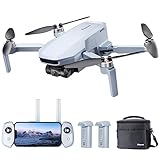
The Potensic ATOM SE is the simplest Potensic option in this group, pairing a 1/3-inch Sony sensor with 12MP photos, 4K/30fps video, electronic image stabilization, two batteries, and up to 62 minutes of total claimed flight time. Its listed 249 g weight and foldable design make it easy to carry.
The main compromise is stabilization. Electronic image stabilization can improve video, but it is not the same as the three-axis mechanical gimbal found on the ATOM 4K, DJI Mini 4K, and several other recommendations above.
It still includes brushless motors, Level-5 wind resistance, GPS features, and Follow Me, Waypoint Flight, and Circle Flight modes. I would treat it as a daylight learning drone where careful, slow flight matters more than demanding cinematic camera movement.
The ATOM SE is a light companion for simple travel shots
Use this model when portability and basic aerial context are the goal: a coastline, a campsite, a family trip, or a wide establishing clip. The 4 km transmission specification is ample on paper, but safe visual-range flying and a clear home point should guide every outing.
Its two-battery bundle is a meaningful advantage over a single-battery starter package. I would reserve time on the second battery for repeating one technique, such as a steady rise or a slow pullback, instead of filming unrelated clips.
The ATOM SE is not intended for demanding gimbal-style footage
If your reference footage contains smooth tracking, controlled pans in wind, or moves that need consistent horizon behavior, begin with a mechanical-gimbal drone instead. EIS can help the final file, but it cannot physically isolate the camera from aircraft movement in the same way.
The ATOM SE has a 4.4 rating from more than 6.7k reviews, and customers often praise its approachable format. The listing says a microSD card is not included, so have a compatible card ready and test it before a trip.
The Bwine F7GB2 Pro is a heavy-duty alternative for GPS flight modes
Pros
- Three-axis gimbal
- three batteries
- GPS modes
- Level-6 wind resistance
- two-year warranty
Cons
- 550 g weight
- fast charger recommended
The Bwine F7GB2 Pro brings a 4K camera with a 120-degree field of view, three-axis gimbal, three batteries, and up to 75 minutes of total claimed flight time. It also lists GPS Follow, Waypoint, Orbit, auto return, and Level-6 wind resistance.
That makes it a sensible option for a pilot who wants automated route ideas plus a more substantial physical platform. Its listed 550 g weight means it is not a casual carry-everywhere model, but the larger form can be attractive when the priority is stable outdoor practice.
The stated 5x digital zoom should be understood as a framing convenience, not an optical telephoto camera. I would preserve image quality by choosing the right launch position and using the gimbal deliberately before depending on digital zoom for a key photograph.
The F7GB2 Pro helps pilots practice repeatable GPS compositions
Waypoint and Orbit modes can be useful for a repeatable property reveal or a broad environmental sequence, provided the route has been checked at a safe altitude. Start the first run slowly and inspect the path visually before trying to create a finished take.
The three-battery package supports that iterative process. I would use one battery to establish the route, one to correct the framing, and one to record the clean pass after the movement is predictable.
The F7GB2 Pro demands a larger-drone preflight routine
At 550 g, registration and applicable flight rules need attention before use. The listing also says its best performance needs a 65W fast charger, so confirm your charging setup and battery state before traveling rather than assuming any USB source will support your plan.
It has a 4.4 rating from 776 reviews, with positive notes for gimbal stabilization and warranty coverage. The published dimensions look unusually small compared with its listed weight, so verify current manufacturer measurements if case fit is a deciding factor.
The Holy Stone Sentinel HS600D is a capable non-DJI choice for windy conditions
Pros
- Sony sensor
- three-axis gimbal plus EIS
- Level-6 wind resistance
- smart track
- two batteries
Cons
- Wi-Fi interference reports
- plastic construction
The Holy Stone Sentinel HS600D rounds out the list with a 1/2-inch Sony CMOS sensor, f/1.8 aperture, 48MP or 8K photos, 4K HDR video, and a three-axis brushless gimbal paired with EIS. It also claims Level-6 wind resistance, 6 km transmission, and up to 80 minutes of total flight with two batteries.
On paper, that is a substantial feature set for photographers who want a non-DJI route. The f/1.8 aperture and stated Sony sensor are the elements I would watch most closely for daylight image quality and lower-light flexibility, while still keeping expectations realistic in moving air.
GPS, optical flow, and TOF positioning are listed along with Smart Track, auto return, and a beginner mode. These systems can make basic positioning more approachable, but I would never use them as an excuse to fly close to structures or over a crowd.
The HS600D is a good match for outdoor creators who face regular breeze
Level-6 wind resistance is its headline practical feature. It may be useful for exposed fields or coastal locations, but wind at ground level can differ from wind where the drone is filming, so check conditions and leave enough battery to fight a headwind home.
The combined three-axis gimbal and EIS approach aims at a stable image. I would keep camera moves slow and fly a simple pass first, then inspect the footage for wobble or Wi-Fi-related preview issues before committing to a more difficult sequence.
The HS600D needs careful Wi-Fi testing before critical work
Review feedback points to possible Wi-Fi interference, and the construction is described as plastic. Those are not automatic deal-breakers for recreational use, but they make an open-area connection test and conservative handling especially sensible before relying on the drone for an important shoot.
Its 4.3 rating from 983 reviews is lower than several leading picks here, though the feature package is broad. I would choose it for its stated wind resistance and controls only after confirming that its app, connection, and camera output meet my particular workflow.
The right photography drone starts with sensor, gimbal, and flight-plan priorities
A drone specification sheet is easier to read when you start with the final image instead of the aircraft. Ask whether you need a printable still, a smooth horizontal film clip, a vertical social video, a telephoto-looking perspective, or an immersive FPV movement; that answer narrows the list faster than counting automated modes.
A larger sensor and a mechanical gimbal matter most for image quality
Sensor size, lens behavior, stabilization, and available formats all affect the file you bring home. The Mavic 4 Pro’s listed 4/3 main sensor, the Mini 5 Pro’s 1-inch sensor, and the 1/1.3-inch sensors in several DJI models should generally offer more photographic headroom than smaller sensors, but exposure and light still decide much of the result.
For video, a three-axis mechanical gimbal is the practical baseline I prefer. It physically counters pitch, roll, and yaw movement, whereas EIS can involve a crop and cannot give the camera the same independent physical control.
RAW support is useful when you expect to adjust highlights, shadows, color, or white balance after the flight. The Mini 4 Pro explicitly lists DNG and JPEG support; for other models, confirm the still format in the current manufacturer materials if raw editing is part of your routine.
Flight time should be planned as usable shooting time, not a headline maximum
Manufacturers state maximum flight figures under particular conditions. Wind, cold, repeated climbs, speed, and the battery percentage you keep for a safe return can all shorten the time you are willing to film.
I plan a battery backward from landing: reserve enough energy to return, descend, and handle an unexpected reroute, then use the remaining time for the shot. A multi-battery combo often improves photographic outcomes because it turns one hurried pass into several calm attempts.
Before takeoff, set the home point, confirm return-to-home height, inspect propellers, and check the storage card. These small steps protect much more than a feature such as a longer transmission figure.
Obstacle sensing reduces workload but cannot see every hazard
Omnidirectional sensing on the Mini 4 Pro and Mini 5 Pro is attractive for tracking and complex camera movement. It can help a pilot avoid a mistake, but thin wires, branches, dark surfaces, glass, low light, and changing wind can challenge any sensing system.
My rule is simple: fly a route that would still be safe if the avoidance system did not intervene. Build space into every side of the move, keep a direct view of the aircraft, and take a higher scouting pass before the dramatic low pass.
Propeller guards on the DJI Flip and Avata 2 add physical protection, yet they do not change the responsibility to keep people and property safe. For most photographers, a clear open location makes better footage and a calmer pilot.
Weight affects travel comfort and may affect registration obligations
Several products are listed under 249 g, including the Mini 5 Pro, Mini 4 Pro, Mini 4K, ATOM 2, ATOM 4K, and ATOM SE. That category is popular because it can reduce the registration burden for some recreational flights, but rules depend on where and how you fly.
Drones listed above that weight, including the Avata 2, Ruko, Bwine, Holy Stone, and Mavic 4 Pro, require an especially deliberate compliance check. Before every trip, consult the FAA and local authorities for current registration, Remote ID, airspace, insurance, and site rules that apply to your flight.
Do not rely on a retailer listing alone when a legal distinction depends on grams. The DJI Flip information in this dataset contains conflicting weight fields, which is exactly why the aircraft’s current documentation should be your source for a rule-sensitive decision.
DJI and non-DJI choices differ most in their system, not just their cameras
DJI dominates this list because it has options from beginner Mini models to FPV and flagship multi-camera aircraft. Forum discussions consistently value its app stability, controller ecosystem, and community troubleshooting support, although some customer feedback in the supplied data mentions DJI Fly app issues.
Potensic, Ruko, Bwine, and Holy Stone offer legitimate alternatives with useful combinations of gimbals, batteries, GPS modes, and compact designs. I would choose a non-DJI option when its specific camera package and controller workflow suit the job, then spend extra time validating app setup, updates, and connection behavior before travel.
Privacy and policy questions deserve a factual approach. The United States has not imposed a blanket consumer ban on every DJI drone; the concern raised in public discussion centers on security, privacy, and policy scrutiny, and availability or rules can change, so check current official guidance for your location.
Filters, cards, and practice improve footage more than extra modes
Bring compatible, tested microSD cards, fully charged batteries, a case, spare propellers, and a landing surface suited to the location. ND filters can help video shooters maintain a chosen shutter speed in bright conditions, and a clean lens check matters before every flight.
For beginner flying, start in an open area, use a conservative altitude, and practice four movements: a slow rise, a controlled pan, a straight pullback, and a gentle descent. Watch the footage afterward and identify one thing to improve on the next battery.
The most satisfying aerial photographs often come from restraint. Choose a strong foreground, fly slowly, keep the horizon intentional, and make the drone’s movement serve the scene rather than treating motion as the subject every time.
The answers to common drone-buying questions are straightforward
Which drone is best under $2500?
The DJI Mini 5 Pro is the best all-round choice in this group for photographers because it combines a 1-inch CMOS sensor, 4K/60 HDR video, omnidirectional sensing, vertical filming, and three batteries in a compact listed 249 g aircraft. Choose the DJI Mavic 4 Pro instead if a 100MP main camera and telephoto perspectives are central to your work.
What is the best drone for the money right now?
The DJI Mini 4 Pro is the strongest feature balance for many creators: it offers 48MP photos, 4K/60 HDR video, a three-axis gimbal, omnidirectional sensing, ActiveTrack 360, vertical shooting, and three batteries. It is a sensible pick when you want a small travel-friendly camera drone but do not need the Mavic 4 Pro’s tele cameras.
Why did the US ban DJI drones?
The United States has not imposed a blanket consumer ban on every DJI drone. DJI has faced security, privacy, and policy scrutiny, so rules, procurement restrictions, and product availability can vary or change; check current official federal, state, and local guidance before purchase or flight.
Are cheap drones worth buying?
A basic drone is worth buying when it has the features you need to learn safely, such as GPS return-to-home, a stable camera system, and enough battery time for repeated practice. For photo and video work, prioritize a three-axis mechanical gimbal over large resolution claims, and expect entry models to omit advanced sensing, HDR, or multi-camera options.
The best choice is the drone that matches your intended aerial photograph
For most photographers comparing the best drones under $2500, I would select the DJI Mini 5 Pro for its compact 1-inch camera package, the DJI Mini 4 Pro for a capable smaller all-rounder, or the DJI Mavic 4 Pro when multi-camera imagery is the goal. The Avata 2 is the clear creative outlier for immersive FPV motion, while Potensic, Ruko, Bwine, and Holy Stone give non-DJI shoppers several credible routes.
Choose your drone in 2026 by the file and movement you need, then practice conservative flight habits until operation is second nature. A planned route, a clean lens, a safe reserve battery, and patient camera movement will do more for your aerial work than a long list of modes.