
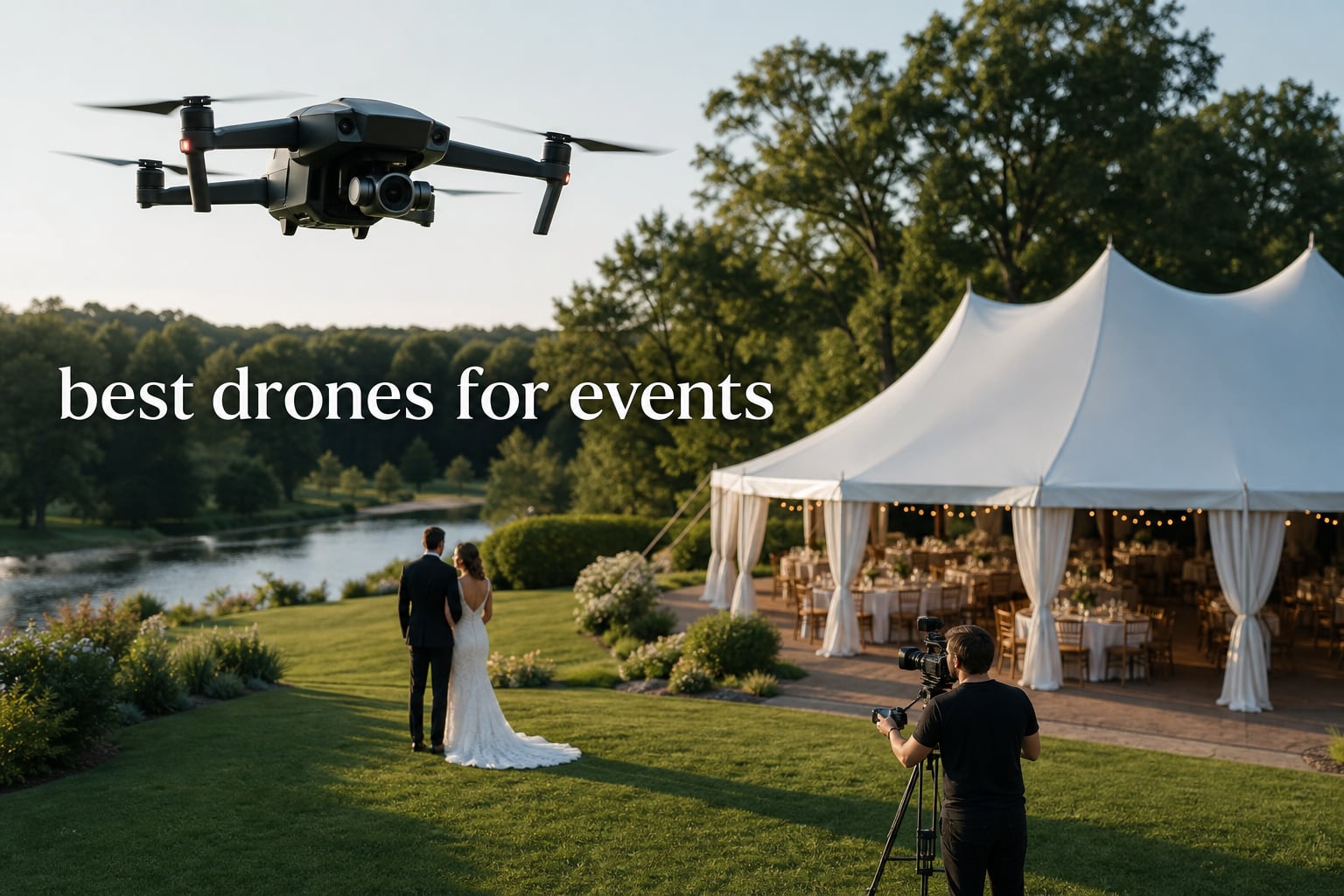
The DJI Mini 4 Pro is my best overall choice for event coverage because it pairs 4K/60fps HDR capture, omnidirectional obstacle sensing, and three-battery endurance in an under-249g body. The best drones for events are not simply the models with the biggest cameras: they need to travel easily, get airborne without disrupting a schedule, and give a pilot enough control to make one safe, deliberate pass.
For weddings and corporate work, I would start with a compact drone that has a stabilized gimbal, GPS return-to-home, and a clear plan for where it will fly. A concert, sports event, or outdoor festival can call for more range, wind resistance, or a stronger camera, but every choice still begins with the venue, the crowd plan, and the pilot’s legal authority to fly.
This guide compares 12 verified models for event drone photography, from palm-launch social clips to 6K flagship footage. I focus on the facts that change an event day: video format, sensor and gimbal setup, stated flight time, tracking, obstacle sensing, portability, and the limits that matter before the first propeller spins.
The top three drones give most event crews a clear starting point (September 2026)
Choose the Mini 4 Pro for the broadest mix of safety assistance, 4K/60 HDR, and multi-battery coverage; choose the ATOM 3 when 4K/60 HDR, a 1/1.3-inch sensor, and a 40-minute stated flight time fit the brief; choose the Neo 2 for tightly framed, short-form shots where palm takeoff, propeller guards, and simple control matter most.

These are the best drones for events in 2026 at a glance
The quick comparison below puts every selected model in one place. A stated transmission range is not permission to fly farther than visual line of sight or venue rules allow, so treat it as a signal-strength and workflow specification rather than a shot list.
| Product | Specifications | Action |
|---|---|---|
| DJI Mini 4 Pro Fly More Combo |
|
Check Latest Price |
 Potensic ATOM 3 Potensic ATOM 3 |
|
Check Latest Price |
 DJI Neo 2 DJI Neo 2 |
|
Check Latest Price |
 DJI Mavic 4 Pro DJI Mavic 4 Pro |
|
Check Latest Price |
 Potensic ATOM 2 Potensic ATOM 2 |
|
Check Latest Price |
 Potensic ATOM 4K Potensic ATOM 4K |
|
Check Latest Price |
 DJI Mini 3 DJI Mini 3 |
|
Check Latest Price |
 HOVERAir X1 PRO HOVERAir X1 PRO |
|
Check Latest Price |
 Antigravity A1 Explorer Antigravity A1 Explorer |
|
Check Latest Price |
 Holy Stone HS600 Holy Stone HS600 |
|
Check Latest Price |
 Holy Stone HS360S Holy Stone HS360S |
|
Check Latest Price |
1. The DJI Mini 4 Pro is the best all-round event drone
Pros
- 4K 60fps HDR
- Omnidirectional sensing
- Three batteries
- 20km transmission
Cons
- Combo is premium
- Stock may vary
I would put the Mini 4 Pro at the front of a wedding, corporate event, or mixed-media event kit because it addresses the usual pressure points without becoming a large aircraft. Its 4K/60fps HDR recording and 48MP photo capture give the editor flexible source material, while the foldable under-249g design reduces the amount of gear competing for room in a packed case.
The supplied Fly More configuration states 102 minutes of total flight time across three 34-minute batteries. That does not mean one uninterrupted event flight; it means a crew can rotate batteries between planned exterior establishing shots, venue reveals, and a final departure shot rather than ending the day after one sortie.
Omnidirectional obstacle sensing is its strongest event-focused feature. In my view, sensing does not replace a spotter or a conservative flight path, but it is a meaningful layer of awareness when poles, trees, façades, and other fixed objects sit near a planned exterior move.
ActiveTrack 360° with customizable trajectories can also help where a subject is moving through an open, controlled area. I would never use a tracking feature as a reason to fly close to guests, but the option is useful for a staged couple walk, an athlete in a clear field, or a presenter arriving at a venue exterior.
The Mini 4 Pro fits crews that need one compact drone for many event types
This is the sensible choice when one aircraft has to cover a quiet pre-ceremony exterior, a corporate campus reveal, and a short social-media deliverable. Forum feedback repeatedly values a small drone that is easy to have with you, and this model’s size, gimbal, and three-battery total support that practical priority.
The 20km O4 transmission specification is generous for maintaining a clean control link in suitable conditions. Event pilots should still preflight the takeoff area, identify interference risks, and keep the aircraft where they can see it and manage it safely.
The Mini 4 Pro is less suitable when the event needs a bigger camera system
Its small airframe makes it convenient, but an operator whose deliverable calls for the most demanding large-sensor imagery may prefer the Mavic 4 Pro. It is also not an indoor free-for-all: a compact drone needs space, air discipline, and permission just as much as any larger model.
I would plan only intentional, brief flights around ceremonies because drone noise can still change the atmosphere. Build the schedule around a quieter exterior window, not around an expectation that safety sensors or a small size make a ceremony flyover appropriate.
2. The Potensic ATOM 3 is the best value for 4K/60 event footage
Pros
- 4K 60fps HDR
- 8K 50MP photos
- 3-axis gimbal
- 16km transmission
Cons
- Newer model
- Limited review history
The Potensic ATOM 3 makes a strong case for outdoor event shooters who want 4K/60fps HDR and a 1/1.3-inch CMOS sensor in a 249g package. I like the stated 40-minute flight time because it gives a wider planning margin for an exterior sequence than many compact single-battery options.
Its 50MP still capture and 8K photo capability fit crews producing both video and large still assets from the same event. The 3-axis gimbal is the important practical piece here, since it is responsible for keeping a slow reveal or lateral venue pass from looking like handheld action footage.
AI Tracking 2.0 gives the pilot another option for predictable movement in an open area. I would rehearse the route and leave generous distance around the subject, because an event shot is only useful if it remains controlled and does not pull attention away from the event itself.
The 16km PixSync 5.0 transmission specification is useful headroom, not a reason to plan distant flights. For a professional event drone workflow, the larger benefit is confidence in a stable video link while staying close enough to observe the aircraft and react to changing conditions.
The ATOM 3 suits outdoor events that need smooth slow-motion-ready footage
Choose it for a daylight wedding venue, sports gathering, or company retreat where 4K/60fps HDR could support fluid motion or a 30fps edit. The 1/1.3-inch sensor also gives it a more ambitious camera specification than entry models built mainly around basic wide-angle clips.
At under 249g, it travels easily beside cameras, lenses, audio equipment, and spare power. That matters for destination events, where forum users often rank portability above extra features that never leave the case.
The ATOM 3 needs a cautious buyer who accepts a shorter review record
The analyzed listing shows 75 reviews and a 4.2 rating, so its user-feedback sample is much smaller than the long-established Mini 4 Pro. I would test app connection, firmware state, battery behavior, and every planned mode before trusting any new aircraft at a paid event.
It has no stated omnidirectional sensing in the verified features. A pilot who wants that particular assistance layer for obstacle-rich exterior work should compare it closely with the Mini 4 Pro or Mini 5 Pro.
3. The DJI Neo 2 is the easiest pick for short, close-range social clips
Pros
- 151g design
- Palm takeoff
- Propeller guards
- ActiveTrack
Cons
- One battery
- No remote included
The DJI Neo 2 is a different kind of event tool: it favors speed and simplicity over a full traditional drone-camera workflow. At 151g, with palm takeoff and landing, gesture control, and full-coverage propeller guards, it is designed for a fast 4K/30fps self-shot or short behind-the-scenes clip.
I would treat it as a supplemental camera rather than the aircraft responsible for an event’s hero aerial footage. Its 12MP still resolution and included single battery point toward short, planned sequences, not a long session covering every part of a wedding or conference.
ActiveTrack can keep a single person centered, and omnidirectional obstacle sensing adds useful awareness. Those features speak directly to the beginner concern seen in forums, where pilots call multi-direction sensing a major confidence aid when they are still building judgment.
The drone-only package does not include a remote controller. That is convenient for a minimal kit, but I would confirm that its gesture and palm-control approach fits the shot before the event rather than discovering the limits while people are waiting.
The Neo 2 suits controlled, brief content capture with a clear subject
It makes sense for a creator greeting guests outside, a performer’s backstage social clip, or a quick venue introduction with a defined launch and landing zone. Its small size and guards can be appealing when packing space is tight, although venue permission and safe separation remain non-negotiable.
The Apple Watch live-view compatibility and SelfieShot mode further position it toward lightweight personal-content production. I would keep expectations centered on simple compositions rather than complex cinematic moves through a crowded room.
The Neo 2 is not the first choice for complete professional event coverage
A full wedding or corporate production usually benefits from multiple batteries, a conventional controller, and a mechanically stabilized three-axis gimbal. The Neo 2 has a specific role, and it performs best when that role is a short complementary shot rather than a day-long primary aerial camera.
Indoor drone events raise the bar for space, airflow, people management, and local permission. Propeller guards reduce one risk, but they do not make a crowded indoor flight safe or automatically allowed.
4. The DJI Mavic 4 Pro is the flagship choice for highest-end event imagery
Pros
- 4/3 Hasselblad sensor
- 6K 60 HDR
- 51 minute flight
- 360 degree gimbal
Cons
- Heavy aircraft
- Smaller review base
The DJI Mavic 4 Pro is the camera-first recommendation for an event team that needs a 100MP Hasselblad 4/3 CMOS camera, 6K/60fps HDR video, and a tri-camera system. It is built for a more demanding production brief than a casual aerial add-on.
I would consider it for a large outdoor corporate launch, an upscale venue film, or a sports event where camera latitude and framing options are a central part of the deliverable. The 360-degree Infinity Gimbal offers much more creative camera movement than standard compact platforms.
Its stated 51-minute maximum flight time is an operational advantage for exterior coverage. That said, a 2.37kg aircraft needs a more deliberate transport, takeoff, crew, and compliance plan than an ultra-light mini drone.
The 30km O4+ transmission number is substantial, but strong event work is still close, planned, and supervised. I would use the link headroom to support a reliable nearby flight, not to expand a mission beyond the site boundaries or visual observation.
The Mavic 4 Pro fits productions where camera quality leads the decision
It is the strongest match in this list for a team that truly needs 6K/60fps HDR, a 4/3 sensor, and 100MP stills. Those specifications can help when footage will be integrated with high-resolution ground cameras or when the event film needs extensive reframing room.
The tri-camera concept also makes it better suited to a controlled, multi-shot plan than a single-purpose selfie drone. Assign a qualified pilot, establish a clear launch zone, and use a spotter whenever the scene or operating rules call for one.
The Mavic 4 Pro is a poor fit for minimal travel and small venues
This is not the aircraft I would choose just because it has the largest numbers on the spec sheet. Its size and stated 2.37kg weight make it less convenient for an indoor event, a fast destination setup, or an operator who wants the smallest possible kit.
The analyzed listing has 179 reviews at a 4.4 rating, so it has less buyer-feedback depth than the Mini 4 Pro. Any crew adding it to paid work should practice the controller, gimbal behavior, batteries, and transport workflow before the job.
5. The Potensic ATOM 2 is a capable multi-battery choice for event stills
Pros
- 8K 48MP photos
- 3-axis gimbal
- 96 min total
- AI Night Shot
Cons
- Digital zoom only
- App reports vary
The Potensic ATOM 2 combines 4K/30fps HDR video, 8K 48MP photo capture, a 3-axis gimbal, and 96 minutes of stated total flight time across its Fly More batteries. I see it as a flexible outdoor event option for shooters who want both stills and video from an under-249g platform.
Its 1/2-inch Sony CMOS sensor and F1.8 aperture are relevant details for a day that starts in sun and continues into the softer light around an outdoor reception. AI Night Shot can be useful as a mode to test, but I would always review footage from the actual lighting conditions before promising a night result.
AI Track includes Spotlight, Follow, and Parallel modes. That range can simplify a rehearsed shot of a subject crossing an open lawn or athletic area, provided the pilot has enough clearance and does not turn automated tracking into a close-crowd maneuver.
The 10km transmission figure and PixSync 4.0 system offer room for a stable nearby operation. Its 4x digital zoom is less useful for image-critical work than optical zoom would be, so I would compose by aircraft position whenever the safe flight plan permits it.
The ATOM 2 fits shooters who need stills and several planned flight windows
The three-battery, 96-minute total is valuable for a schedule that has multiple exterior moments rather than one continuous coverage block. It can support an establishing shot, a transition shot, and a final golden-hour pass while leaving time for battery changes and preflight checks.
Its 48MP and 8K photo specifications also make it worth considering for event marketing imagery. A 3-axis gimbal remains the foundation for stable clips when wind or slow camera moves would otherwise show up in the footage.
The ATOM 2 needs app testing before it goes on an important job
Some users report app connectivity issues in the supplied review insights. I would update and test the app, controller, live view, GPS behavior, return-to-home settings, and each battery at home before treating the system as production-ready.
It also records 4K at 30fps rather than the 60fps modes offered by the ATOM 3, Mini 4 Pro, Mini 5 Pro, and HOVERAir X1 PRO. That is fine for many edits, but it is a real difference when slow-motion delivery is part of the event brief.
6. The Potensic ATOM 4K is a practical starter Fly More event drone
Pros
- Sony CMOS sensor
- Three-axis gimbal
- Three batteries
- Visual tracking
Cons
- Firmware updates
- Beginner learning curve
The Potensic ATOM 4K brings the basics I want in a starter event aircraft: 4K/30fps recording, a Sony CMOS sensor, a three-axis brushless gimbal, GPS auto return-to-home, and three batteries stated to provide 96 minutes in total. It is a reasonable way to learn a disciplined exterior workflow without carrying a large aircraft.
Its 249g weight and foldable-style portability make it easy to pack with standard event camera gear. For a beginner, that convenience should lead to more practice sessions, not an assumption that a compact drone is automatically simple to fly around a venue.
Visual tracking and QuickShots give this drone options for short content sequences. Pull-Away, Rocket, Circle, Spiral, and Boomerang are best used after practice in an open area, because an automated pattern still needs a clear flight path and an attentive pilot.
Level-5 wind resistance is helpful for outdoor planning, although I would judge actual winds at the venue and preserve a safe return margin. The 6km PixSync 3.0 specification is ample for local site work while flying within the rules and the pilot’s sight.
The ATOM 4K suits new event pilots who will practice before booking work
It has a 4.6 rating from 4,131 reviews, with review insights praising camera quality, flight time, and setup. That feedback depth makes it more reassuring than a new model with only a handful of user reports.
I would use it for daylight venue exteriors, small outdoor celebrations, and content where 4K/30fps is enough. Its three-battery total also teaches the useful event habit of treating each takeoff as a planned, limited mission.
The ATOM 4K is not for pilots who need advanced safety sensing
The verified feature list does not state omnidirectional obstacle sensing. For tree-lined venues, construction-heavy sites, or crews that want that added awareness layer, the DJI Mini 4 Pro, Mini 5 Pro, or Neo 2 deserve priority.
The listing notes that firmware updates may be needed for best performance and that a learning curve exists. I would never schedule a first update, first calibration, or first tracking attempt during an event day.
7. The DJI Mini 3 is the compact choice for vertical event delivery
Pros
- 4K HDR
- Vertical shooting
- 38 min flight
- Level 5 wind
Cons
- Plus battery separate
- Fly More is useful
The DJI Mini 3 stands out because True Vertical Shooting puts social-first event delivery at the center of the camera workflow. I would choose it when the final assets need to move quickly to vertical platforms while still benefiting from 4K HDR video, 48MP photos, and a three-axis mechanical gimbal.
The stated 38-minute flight time gives a useful margin for a measured exterior shot. Its optional Plus battery can reach a stated 51 minutes, but that battery is separate, so event planning should be based on the exact kit in hand rather than the maximum figure.
Dual Native ISO Fusion for HDR imagery fits a varied outdoor scene with bright sky and shadowed venue details. I would still expose carefully and make a test pass, since a live event does not give you the luxury of recreating changing clouds or the first arrival of guests.
Its 10km HD video transmission and Level-5 wind resistance add confidence for outdoor work. GPS return-to-home is especially valuable only when the home point, return height, landing zone, and surrounding obstacles have been set and checked deliberately.
The Mini 3 fits teams producing vertical clips alongside standard event footage
True Vertical Shooting can save time for a wedding teaser, corporate recap, or performer announcement destined for a phone-first format. It makes more sense than rotating and cropping every aerial clip later when vertical composition is the agreed deliverable.
At 248g, it is easy to carry between locations. That portability is one reason compact Mini models remain popular in forum conversations about wedding work.
The Mini 3 is less complete for obstacle-rich locations
Its verified specifications emphasize video, gimbal, wind resistance, and GPS return rather than omnidirectional sensing. A pilot who expects to fly near numerous fixed obstacles should prefer a model where that sensing is explicitly part of the documented feature set.
The analyzed listing recommends a Fly More configuration for the full experience. I agree with the principle for any event drone: spare power, a charging plan, and a planned landing window matter more than chasing a single maximum flight-time claim.
8. The HOVERAir X1 PRO is the best match for fast-moving sports event clips
Pros
- 4K 60fps
- Fast tracking
- Foldable 192g
- OmniTerrain
Cons
- 1000 foot range
- One battery
The HOVERAir X1 PRO targets a different event niche: action footage. It records 4K at 60fps, weighs 192g, folds for transport, and states a 42km/h follow speed, making it especially interesting for outdoor sports gatherings, running events, and active brand content.
I would use its automatic flight modes for a compact, repeatable action clip rather than expect it to replace a larger camera drone. Its two-axis gimbal with electronic image stabilization is built for smooth capture, but a three-axis mechanical gimbal remains the more conventional choice for slow cinematic aerial moves.
OmniTerrain claims capability around snow, water, and cliffs. That expands the types of outdoor terrain a pilot may consider, though an event plan still has to account for takeoff and landing hazards, wind, the public, and the need for a clearly managed operating area.
The 32GB internal storage helps when a card is not available, but I would empty and verify storage before call time. Its listed maximum range is 1,000 feet, which makes it better suited to nearby action coverage than broad venue surveying.
The X1 PRO fits active outdoor events with a predictable moving subject
Its high follow speed is its defining advantage for cyclists, runners, skiers, and similar action subjects in an open controlled route. A 4K/60fps source file also gives the editor room for slower movement in a standard timeline.
Hands-free voice or click control can make fast deployment appealing for content creators. I would practice the commands and every automatic mode well away from people before assigning them a role at an event.
The X1 PRO is not intended for long-range or all-day coverage
The listing specifies one included battery and a 1,000-foot maximum range. A full-day event assignment normally needs additional power and a larger operational plan than the standard package suggests.
Its 12MP photo specification is also lower than the 48MP and 50MP options in this roundup. Select it for moving video and portability, not for a still-photography brief that depends on high-resolution aerial files.
9. The Antigravity A1 Explorer is the creative 8K 360 event option
Pros
- 8K 360 capture
- Vision goggles
- Obstacle avoidance
- Three batteries
Cons
- Goggles add complexity
- Limited review history
The Antigravity A1 Explorer Bundle is the specialist choice for event crews that want immersive 8K 360-degree footage rather than conventional forward-camera aerial video. Its Point-to-Fly motion control, Vision Goggles with a 90-degree field of view, and 360 technology make it a creative tool with a more distinctive workflow.
I would consider it for a brand activation, outdoor festival, or experiential event where the edit will genuinely use 360 capture. A standard highlight film may not need that complexity, but a virtual tour, immersive recap, or reframable social campaign can benefit from the extra capture perspective.
The technical listing describes seamless stitching through Insta360 360 technology and omnidirectional obstacle avoidance. Those features support the format, yet this is still an aircraft that needs a conservative flight plan, as 360 capture does not erase safety boundaries or venue restrictions.
The Explorer Bundle has three batteries and a stated 39-minute flight time with a high-capacity battery. I would map battery use to distinct creative shots because goggles, motion control, and post-production choices make preparation more important than with a simple straight-ahead clip.
The A1 Explorer fits events designed around immersive or reframed content
Choose it when the creative team has already decided how 8K 360 footage will appear in the finished campaign. Point-to-fly control can feel approachable, but the distinctive value is the post-production flexibility of immersive capture, not simply the novelty of wearing goggles.
The verified features list a 249g ultra-light option and a 10km range. Confirm the precise battery and configuration being used, because product configurations can change the practical setup that arrives at the venue.
The A1 Explorer is not the simple first drone for a new event pilot
Goggles and motion control introduce a different operating experience, and the analyzed product has 96 reviews. I would build skill in a clear practice area and define crew communication before using it on a time-sensitive event.
For a conventional wedding video, a Mini 4 Pro, Mini 5 Pro, or Mavic 4 Pro offers a more direct camera-drone workflow. The A1 Explorer earns its role when immersive capture is an actual production requirement.
10. The Holy Stone HS600 is the best pick with integrated Remote ID
Pros
- Remote ID built in
- GPS return
- Level 6 wind
- Follow Me
Cons
- Two-axis gimbal
- One battery
The Holy Stone HS600 gives event operators a straightforward compliance-related feature: integrated Remote ID. It also supplies 4K/30fps video, a two-axis gimbal with electronic image stabilization, GPS return-to-home, and stated Level-6 wind resistance for outdoor use.
I would look at it for an exterior event where the documented Remote ID feature is a priority and where a 4K/30fps deliverable is sufficient. Its 20,000-foot transmission specification is more than enough for local event work, but the pilot should retain visual observation and follow the applicable operating limits.
Follow Me and GPS functions can serve simple, preplanned movement in an open location. The two-axis gimbal plus EIS setup is not the same as the three-axis mechanical gimbals on several competitors, so I would expect it to be more sensitive to certain movements and conditions.
The single included battery changes the operational picture. For events, I would only plan one focused exterior mission unless the owner has added and tested additional compatible batteries.
The HS600 fits outdoor pilots who want documented Remote ID hardware
The integrated module is a practical differentiator because it avoids relying on a separate add-on for that feature. It does not settle the whole compliance question; airspace approval, pilot qualifications, venue permission, and crowd management are separate responsibilities.
Level-6 wind resistance is appealing for exposed outdoor spaces. I would still make a real-time wind call at the site, especially around buildings where gusts and turbulence can be very different from a general weather reading.
The HS600 is less suited to image-critical cinematic work
Its 8.29MP still resolution and two-axis stabilization place it behind the high-resolution, three-axis choices for a premium photography assignment. It is a functional GPS event drone rather than the camera-quality leader of this group.
The analyzed review data reports a 4.3 rating from 983 reviews and notes one battery. Test the remote, return-to-home altitude, gimbal behavior, and GPS lock before each operation, and build the event plan around the capabilities actually available.
11. The Holy Stone HS360S is the entry GPS choice for simple daylight shots
Pros
- Under 250g
- GPS return
- Follow Me
- Long control range
Cons
- 20 minute flight
- 8MP stills
The Holy Stone HS360S is the entry-level answer for an operator who wants a lightweight GPS drone with 4K UHD video, a 1/3-inch CMOS GalaxyCore sensor, Follow Me, waypoint flight, and Smart Return Home. At 213g, it is compact enough to carry as a basic daylight event-content tool.
I would position it for simple exterior establishing footage rather than a client’s most demanding event film. Its 20-minute stated flight time per battery means the operator must be disciplined about choosing one good shot, protecting landing reserve, and not improvising a prolonged mission.
The 10,000-foot FPV transmission specification and optical-flow positioning offer useful functionality for the class. GPS positioning and return-home are especially helpful features for newer pilots, but they should be checked at every site rather than used as a substitute for basic orientation and flight planning.
Its 85-degree wide-angle 4K camera can frame a broad venue exterior, a sports field, or a small gathering in open space. The 8MP still resolution is the clear boundary for photographers expecting large, detailed still deliverables.
The HS360S fits beginners practicing simple GPS-assisted exterior moves
The best use is a low-pressure practice workflow: open area, clear weather, a single route, a defined home point, and a deliberate landing. Once those habits are routine, the drone can support straightforward event-content shots within the pilot’s authorization and competence.
Its 4.2 rating across 2,795 reviews gives it a substantial user-feedback sample. Review insights specifically praise its light design and long-range capability, both relevant to a compact travel kit.
The HS360S is not the right tool for low-light or premium still work
A 20-minute flight time and 8MP still capture set clear limits against the larger sensor and multi-battery choices above. If the event requires 4K/60fps, high-resolution aerial photography, or extensive flight coverage, move up to a more capable model.
It also does not document a three-axis gimbal in the verified data. For polished cinematic camera moves, I would favor a drone with a three-axis mechanical gimbal and practice every move before guests or participants arrive.
The right event drone starts with the venue and the shot plan
For weddings, I would prioritize quiet, compact handling, a three-axis gimbal, and a schedule that puts flight well away from vows, speeches, and dense guest activity. The Mini 4 Pro, Mini 5 Pro, Mini 3, and Potensic ATOM models make the most sense when portability and polished exterior footage have to coexist.
For corporate event drone coverage, the key question is whether the goal is a fast social clip, a campus establishing sequence, or a high-end brand film. The Neo 2 and HOVERAir X1 PRO lean toward quick content; the Mini 4 Pro and ATOM 3 balance capability and portability; the Mavic 4 Pro is the camera-led option for a bigger production plan.
The camera and gimbal should match the final deliverable
Choose 4K/60fps when the editor needs smoother motion or room for slow motion, and choose a three-axis gimbal when stable cinematic movement is important. The Mavic 4 Pro’s 6K/60fps HDR and 4/3 Hasselblad camera lead the specification list, while the Mini 5 Pro’s 1-inch sensor gives compact crews a strong image-focused alternative.
Still photographers should also notice stated resolution, but megapixels are not the entire decision. A good event aerial image depends on light, framing, a safe position, and a flight path that was agreed before the guests start moving.
The flight window should be short, rehearsed, and protected
I prefer a flight plan built around one objective: reveal the venue, follow a staged exterior walk, show a sports route, or capture a departure from a controlled location. Define the launch site, home point, safe route, landing zone, and an abort point before takeoff.
Stated flight times are maximum product figures and can be affected by conditions. Carry enough charged batteries for the planned work, preserve a landing reserve, and never let a desired shot turn a low-battery warning into an emergency decision.
The noise decision should protect the event, not the drone shot
Forum discussions repeatedly identify ceremony noise as a concern. No verified listing in this comparison supplies a decibel measurement, so I would not claim one drone is silent or objectively quieter than another.
Instead, plan flights during setup, venue transitions, portraits away from the ceremony, or another approved low-impact window. Ask the planner, couple, venue manager, and sound team where the aircraft can be heard, then make the human experience the deciding factor.
The indoor decision should be conservative because space changes everything
Indoor flying is not simply outdoor flying with a ceiling. GPS can be limited, air currents can be unpredictable, decorations and lighting rigs create obstacles, and guests can move into the intended route without warning.
Models with guards, palm launch, or sensing can reduce certain risks, but no feature replaces space, consent, supervision, and a controlled area. For many indoor events, a ground gimbal camera or a pre-recorded exterior aerial shot is the safer creative choice.
The compliance decision needs confirmation before an event is promised
For U.S. event work, verify the current FAA rules that apply to the specific operation, including pilot qualifications where applicable, registration, Remote ID, airspace, and operations near or over people. Venue permission and local restrictions can be more limiting than the aircraft’s published specification.
Do not assume that an under-250g label resolves a commercial or event-flight question. The HS600’s integrated Remote ID may be convenient, but it does not remove the need to review every rule and obtain the needed authorization before flight.
These answers cover the most common event-drone questions
Why did the US ban DJI drones?
The premise needs care. This guide does not establish a blanket U.S. ban on DJI drones; it identifies security and privacy as a buyer concern raised in competitor research. Before an event, verify the current federal, state, venue, and client requirements for the exact aircraft and operation rather than relying on broad claims.
What are the top 5 best drones for events?
For most event work, the five strongest matches in this guide are the DJI Mini 4 Pro for balanced coverage, Potensic ATOM 3 for 4K/60 HDR value, DJI Mini 5 Pro for a compact 1-inch sensor, DJI Mavic 4 Pro for flagship imagery, and Potensic ATOM 2 for multi-battery 4K and stills work.
Is it legal to fly a drone over a crowd?
Do not assume it is legal to fly over a crowd. Event pilots should verify the current FAA rules for the operation, plus airspace, Remote ID, local requirements, venue permission, and how people will be managed. A safe event plan keeps the aircraft on a controlled route with clear separation rather than treating guests as part of the flight area.
What is the number one drone for events?
The DJI Mini 4 Pro is the number one overall pick here because it combines 4K/60fps HDR, a 48MP camera, omnidirectional obstacle sensing, ActiveTrack 360 degrees, a foldable under-249g body, and a stated 102 minutes of total flight time across three batteries. The Mavic 4 Pro is the better fit when the camera system is the overriding priority.
The DJI Mini 4 Pro is my best overall drone for event work
The best drones for events in 2026 are the ones that fit the venue, the deliverable, and a safety-first flight plan. I would choose the DJI Mini 4 Pro for the best all-round package, the Potensic ATOM 3 for compact 4K/60 HDR value, the Mini 5 Pro for a premium compact camera, and the Mavic 4 Pro when the event calls for flagship image specifications.
Pick the model after you have defined the exterior shot, the flight window, battery needs, sound impact, crew roles, and compliance checks. A clean, short, authorized aerial shot that supports the event is more valuable than any ambitious move that puts people, timing, or the production at risk.