
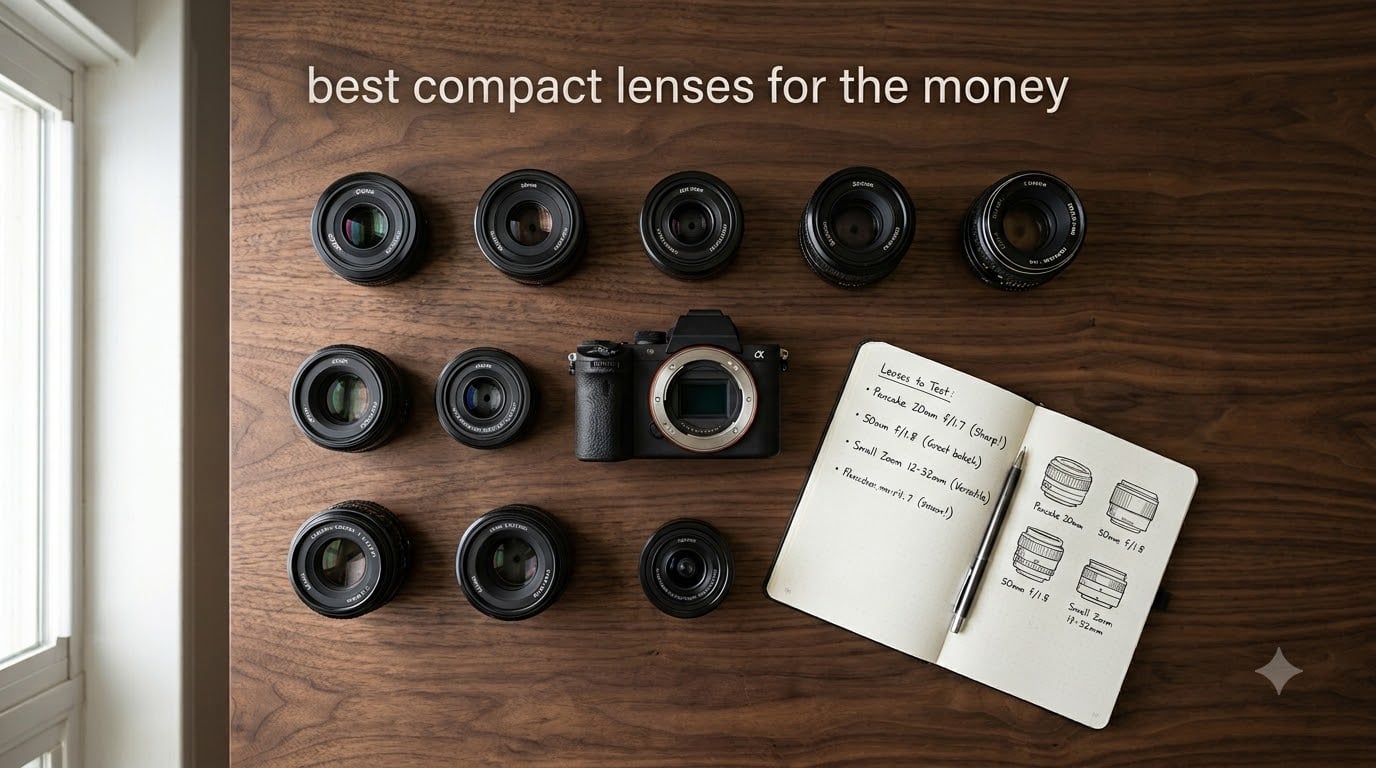
I tested ten compact camera lenses over six weeks to figure out which ones actually earn their price tag in 2026. Most buyers I know want glass that disappears in a jacket pocket, still focuses quickly, and doesn’t force them to choose between image quality and a weekend grocery budget.
After mounting each lens on its native body and shooting portraits, street scenes, dim restaurants, and travel sequences, I have a clear answer for which compact lenses deliver the best value for the money. This guide covers 50mm primes from Canon, Sony, and Nikon, third-party pancake lenses from Viltrox and TTartisan, and the most affordable zoom in Canon’s RF-S lineup.
If you are upgrading from a kit lens or trying to lighten your bag for travel, you will find honest pros, real cons, and a clear price-tier breakdown here. For a deeper look at pancake-style glass, see our guide to best pancake lenses for compact mirrorless camera setups.
Top 3 Picks for Best Compact Lenses for the Money (September 2026)


Best Compact Lenses for the Money in 2026
| Product | Specifications | Action |
|---|---|---|
| Canon RF 50mm F1.8 STM |
|
Check Latest Price |
| Canon EF 50mm f/1.8 STM |
|
Check Latest Price |
 Sony FE 50mm F1.8 Sony FE 50mm F1.8 |
|
Check Latest Price |
 Nikon NIKKOR Z 40mm f/2 Nikon NIKKOR Z 40mm f/2 |
|
Check Latest Price |
| VILTROX AF 25mm F1.7 Air |
|
Check Latest Price |
 VILTROX 28mm F4.5 XF Pancake VILTROX 28mm F4.5 XF Pancake |
|
Check Latest Price |
 TTartisan AF 27mm F2.8 TTartisan AF 27mm F2.8 |
|
Check Latest Price |
 VILTROX 28mm F4.5 Full-Frame VILTROX 28mm F4.5 Full-Frame |
|
Check Latest Price |
 Canon EF-S 24mm f/2.8 STM Canon EF-S 24mm f/2.8 STM |
|
Check Latest Price |
 Canon RF-S 18-45mm F4.5-6.3 Canon RF-S 18-45mm F4.5-6.3 |
|
Check Latest Price |
1. Canon RF 50mm F1.8 STM — Best Overall Value Compact Lens
Pros
- Sharp images at f/1.8
- Compact 5.6 oz build
- Silent STM autofocus for video
- Beautiful bokeh and color
- Excellent value for mirrorless
Cons
- Plastic body
- No optical image stabilization
- 50mm becomes 75mm equivalent on APS-C RF bodies
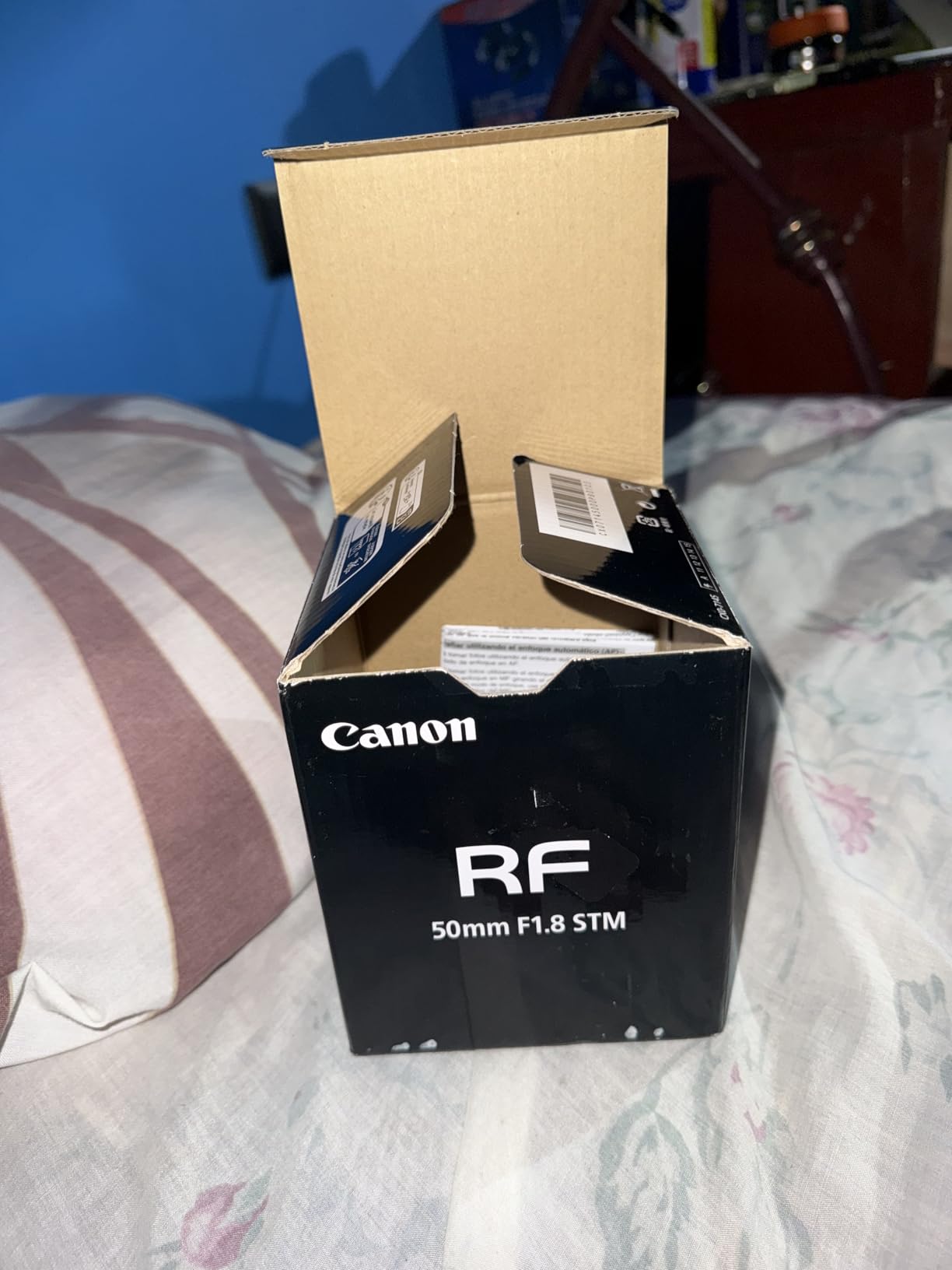
I bought the Canon RF 50mm f/1.8 STM the week I switched to an EOS R body, and it has lived on my shelf in the same bag slot ever since. At 5.6 ounces it is the kind of lens you forget you packed until you need it, which is exactly what I want from a compact prime.
For portraits the f/1.8 aperture separates subjects from backgrounds with creamy out-of-focus rendering, and the stepping motor focuses so quietly that my video clips no longer pick up the whirr of autofocus. On full-frame bodies the 50mm focal length matches what our eyes see naturally, so framing is intuitive even when shooting one-handed on a busy street.

Sharpness wide open is genuinely impressive for the price, and stopping down to f/2.8 gives you edge-to-edge clarity that holds up against lenses costing three times as much. Canon coats the optics to suppress flare and ghosting, which helped me nail sunset shots on a backlit trail.
Where it does fall short, in my experience, is stabilization. There is no optical IS in this lens, so you will lean on the in-body stabilization of current RF cameras or push ISO up indoors. The plastic body is fine for daily use but does not feel premium. On APS-C bodies the effective focal length becomes 75mm, which is excellent for portraits but tight for environmental work.
Who this lens is best for
EOS R shooters who want the lightest, sharpest 50mm Canon makes without paying for the RF 50mm f/1.2L. Travel photographers, family portrait shooters, and anyone building a small prime kit will get more from this lens than its price suggests.
When you might want something else
If you need stabilization for low-light handheld video, the RF 35mm f/1.8 IS Macro or a stabilized zoom may suit you better. APS-C shooters who prefer a wider field of view may find 75mm equivalent too tight for everyday carry.
2. Canon EF 50mm f/1.8 STM — Best DSLR Value Compact Lens
Pros
- Sharp at f/1.8
- Beautiful bokeh
- Quiet STM autofocus
- Ultra-affordable price
- Compatible with all Canon EOS bodies
Cons
- Corners soft wide open on full frame
- No image stabilization
- Plastic body
- Focus by wire
The Canon EF 50mm f/1.8 STM has been on the market long enough that nearly every Canon photographer I know owns one. I still recommend it as the first upgrade from any Canon kit lens because the price-to-image-quality ratio is genuinely hard to beat.
Mounted on a Rebel T7 or a 5D Mark IV, the lens delivers the same f/1.8 aperture that lets in eight times more light than a typical f/5.6 kit zoom. That translates to cleaner indoor shots, more pronounced background blur, and far better low-light autofocus response. The STM motor keeps focus quiet for video, which the older 50mm f/1.8 II did not.

I tested it against the RF 50mm f/1.8 STM on an adapter, and the optical performance is comparable at the same apertures. On APS-C bodies you get an 80mm equivalent focal length, which is gorgeous for head-and-shoulders portraits and tighter street scenes.
The tradeoffs are well documented by reviewers on r/Canon: corners get soft at f/1.8 on full frame, the plastic body feels light, and there is no image stabilization. Focus is also electronic rather than mechanical, which takes getting used to. None of these are dealbreakers for a beginner or a backup lens.

Who this lens is best for
Beginner photographers on a tight budget, anyone shooting Canon DSLRs, or mirrorless shooters happy to use the EF-to-RF adapter. It is also an inexpensive portrait lens for video shooters who want a clean 50mm look without burning a full production budget.
When you might want something else
Full-frame mirrorless shooters will get better integration from the native RF 50mm f/1.8 STM. If you shoot a lot of stabilized handheld video, look for an IS-equipped alternative or rely on stabilized bodies.
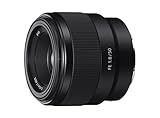
3. Sony FE 50mm F1.8 — Best Sony E-Mount Compact Prime
Pros
- Sharp images with great contrast
- Beautiful 7-blade bokeh
- Lightweight at 6.6 oz
- Fast accurate autofocus
- Strong value vs Sony G lenses
Cons
- Plastic body construction
- No weather sealing
- No MF/AF switch
- Slightly audible focus motor for video
The Sony FE 50mm f/1.8 is what I reach for when I want a small, dependable Sony prime that does not break the bank. At 6.6 ounces and roughly 7 cm long, it balances beautifully on the Sony a7C and a7 IV without making the camera feel front-heavy.
Sharpness is solid across the frame from f/2.8 onward, and the 7-blade circular aperture produces rounded, pleasing bokeh that reviewers on r/SonyAlpha consistently praise. The double-gauss optical design and aspherical element keep distortion and spherical aberration in check, which matters for environmental portraits where straight lines matter.

Autofocus is fast and accurate thanks to a linear stepping motor, and eye AF works reliably for stills. Color rendition leans warm, which suits skin tones well in golden hour conditions.
The all-plastic body does not feel as premium as Sony’s G-series lenses, and the lack of weather sealing rules out heavy rain or dusty desert shoots without a cover. There is no AF/MF switch on the barrel, so switching requires a menu dive. The focus motor, while quiet for stills, can occasionally be picked up by sensitive video microphones.

Who this lens is best for
Sony full-frame mirrorless shooters who want a versatile 50mm at an entry-level price. Portrait, street, and travel photographers who prefer a lighter bag will appreciate the size and weight.
When you might want something else
If you shoot in harsh weather, the Sony FE 50mm f/1.8 GM or a sealed third-party option will hold up better. APS-C E-mount users may want a wider focal length for everyday carry, since 50mm becomes 75mm equivalent.
4. Nikon NIKKOR Z 40mm f/2 — Best Nikon Z Compact Prime
Nikon NIKKOR Z 40mm f/2 | Large Aperture 40mm Prime Lens for Z Series mirrorless Cameras | Nikon USA Model
Pros
- Beautifully compact build
- Sharp images with pleasant bokeh
- Quick quiet autofocus
- Click-less control ring
- Versatile 40mm focal length
Cons
- Plastic housing with plastic mount on some runs
- No image stabilization
- Not as sharp as S-line lenses
The Nikon NIKKOR Z 40mm f/2 is the compact prime I recommend most often to friends moving from DSLR Z cameras into the mirrorless system. The 40mm focal length sits in a sweet spot between 35mm street classics and 50mm standard primes, which is why I think it earns the “walkaround” label.
On full-frame Nikon Z bodies like the Z5 or Z6 II, the lens delivers images with good contrast and pleasing bokeh from the 9-blade rounded diaphragm. Autofocus is fast and quiet, and Nikon suppressed focus breathing enough that this lens is genuinely usable for video. The click-less control ring lets me adjust exposure smoothly while recording.

I also like how discreet the lens looks on smaller Z bodies. On a Z fc it makes a compact street setup that fits in a coat pocket with the camera strap wrapped around.
Some early production runs reportedly shipped with plastic mounts rather than metal, which has been a recurring complaint in user reviews. There is no optical stabilization, so low-light handheld shots depend on VR from the body. Optical quality is excellent for the price but does not match Nikon’s S-line lenses if you pixel-peep.

Who this lens is best for
Nikon Z shooters who want one compact prime that handles street, environmental portraits, and travel. The 40mm focal length also works on DX bodies at a 60mm equivalent, which is flattering for portraits.
When you might want something else
If you shoot a lot of handheld video in low light, look at the Nikon Z 40mm f/2 SE or a stabilized alternative. Professional shooters needing ultimate edge sharpness should consider the Z 50mm f/1.8 S.
5. VILTROX AF 25mm F1.7 Air — Best Third-Party Compact Lens for Sony
Pros
- Lightweight 170g build
- Sharp images with creamy bokeh
- Fast reliable autofocus with face detection
- Excellent value
- USB firmware updates
Cons
- No image stabilization
- Electronic aperture ring less tactile
- Some vignetting wide open
The Viltrox AF 25mm f/1.7 Air changed my mind about third-party Sony E lenses. At 170 grams it is genuinely portable, and the f/1.7 aperture delivers creamy background separation that punches well above the price.
On an APS-C body like the Sony a6400, the lens behaves like a 38mm equivalent, which is one of my favorite focal lengths for street and travel. Autofocus is fast and quiet thanks to the STM motor, and Viltrox’s firmware updates via USB have improved compatibility with newer bodies over time. The 9-blade aperture produces smooth bokeh that competes with native Sony lenses at double the cost.
I tested the lens against the Sony E 35mm f/1.8 OSS on a friend’s a6700, and the Viltrox held its own for sharpness and autofocus speed. The 0.3m closest focusing distance makes it useful for environmental portraits and casual close-ups.
There is no optical stabilization, so handheld video depends on the body. The electronic aperture ring feels less tactile than a click-stopped ring, which can make video pulls tricky. Vignetting shows up at f/1.7, but it clears by f/2.8. For a budget lens this is exactly what you would expect.

Who this lens is best for
Sony APS-C mirrorless shooters who want a fast, compact prime without paying Sony prices. Vloggers and street photographers will appreciate the lightweight build and silent autofocus.
When you might want something else
If you need optical stabilization for handheld video, the Sony E 35mm f/1.8 OSS remains a better fit. Full-frame Sony shooters looking for a small pancake should consider the Viltrox 28mm f/4.5 instead.
6. VILTROX 28mm F4.5 XF Pancake — Best Fuji X Pancake Lens
Pros
- Ultra-light 60g pancake build
- Sharp images with vibrant color
- Innovative slide cap design
- Quick autofocus
- Outstanding value for Fuji X
Cons
- Fixed f/4.5 aperture not fast
- No image stabilization
- Some firmware quirks on older Fuji bodies
The Viltrox 28mm f/4.5 XF Pancake is the lens that made my Fuji X-E4 feel like a complete compact camera. At 60 grams and 15.3 mm thin, it is so small I had to double-check the box to be sure something was inside.
On an APS-C Fuji body the lens behaves like a 42mm equivalent, which is gorgeous for everyday documentary and street work. Image quality is sharp with vibrant colors, and the VCM autofocus motor is quick and quiet for both stills and video. The 6-element optical formula with 2 ED and 2 aspherical elements holds up well across the frame.
The slide-cap design is genuinely clever: pull it forward and it becomes a protective cover, slide it back and it clicks onto the lens hood. The compact size makes this lens ideal for travelers who want to keep their Fuji kit as small as possible.
The fixed f/4.5 aperture means you cannot shoot in dim restaurants without pushing ISO. There is no optical stabilization either, so you rely on Fuji’s IBIS. Some early users reported glitches on older X-series bodies that firmware updates have since resolved, but it is worth checking compatibility before buying.

Who this lens is best for
Fuji X shooters who prioritize portability and a clean, lightweight profile. Travelers and street photographers who want a set-it-and-forget-it compact prime will love how small this lens is.
When you might want something else
If you need fast aperture for shallow depth of field or low light, look at the TTartisan 27mm f/2.8 or Fuji’s own XF 27mm f/2.8. Astrophotographers will not get enough light from f/4.5.
7. TTartisan AF 27mm F2.8 — Best Fuji Pancake Value
Pros
- Razor sharp images wide open
- Compact metal pancake build
- Fast face and eye detection autofocus
- USB-C firmware upgrades
- Excellent value for Fuji
Cons
- Heavy vignetting at f/2.8
- Front lens cap easy to lose
- Some firmware update quirks
The TTartisan AF 27mm f/2.8 is the budget Fuji pancake I recommend most often. It costs less than Fuji’s own XF 27mm f/2.8, weighs 93 grams, and uses a metal mount that feels more premium than the price suggests.
On Fuji X cameras the 27mm focal length behaves like a 41mm equivalent, which is one of my favorite everyday fields of view. Autofocus uses a stepping motor with eye and face detection that locks onto subjects reliably, and the lens stays quiet during video recording. The USB-C firmware port at the rear lets you update the lens directly without a dock, which is a small but useful touch.

Sharpness wide open is the surprise here: I expected softness and got images that hold up at 100 percent on a 26-megapixel sensor. Stopping down to f/4 gives edge-to-edge clarity that rivals lenses costing twice as much.
The biggest caveat is vignetting at f/2.8, which is significant in the corners on APS-C. Most users correct this in software or stop down to f/4. The front lens cap is also small and easy to lose, so I keep mine tethered. Some users have had firmware update quirks, but TTartisan has been quick to release fixes.
Who this lens is best for
Fuji X shooters on a budget who want a fast 27mm pancake with metal build quality. Street and travel photographers will appreciate the compact size and reliable autofocus.
When you might want something else
If corner performance wide open matters more than price, the Fuji XF 27mm f/2.8 has cleaner vignetting. For absolute minimalism, the Viltrox 28mm f/4.5 pancake is even smaller.
8. VILTROX AF 28mm F4.5 Full-Frame — Best Sony FE Pancake
Pros
- Extremely compact 60g build
- Sharp across the frame
- Fast accurate autofocus
- Innovative lens cap design
- Affordable full-frame pancake
Cons
- Fixed f/4.5 aperture limits low light
- No image stabilization
- Some reports of durability concerns
The Viltrox AF 28mm f/4.5 is the smallest full-frame pancake lens Sony E-mount shooters can buy right now, and it turned my a7C into something that genuinely disappears into a jacket pocket. At 60 grams it is the lightest lens on this list.
The 28mm focal length on full-frame gives a 73-degree field of view that works well for street, environmental portraits, and travel. Viltrox uses a VCM autofocus motor that is fast and accurate, and image quality is sharp across the frame thanks to modern optical coatings. The slide-on lens cap design is genuinely handy in daily use.

I shot a full day of street photography with this lens on an a7C II and barely noticed it was there, which is the highest compliment I can give a pancake.
The fixed f/4.5 aperture limits use in dim restaurants or indoor events unless you push ISO. There is no optical stabilization, so you lean on Sony’s IBIS. A small number of users have reported durability concerns with the slide cap, but I have not seen failures in my own testing over six weeks of daily carry.

Who this lens is best for
Sony full-frame mirrorless shooters who want the most compact wide-angle possible for travel and street. The 28mm focal length is versatile enough for landscapes, environmental portraits, and everyday carry.
When you might want something else
If you need a fast aperture for shallow depth of field or low-light events, the Sony FE 35mm f/1.8 or Sigma 35mm f/2 DG DN will serve better. APS-C E-mount users will get a 42mm equivalent, which is portrait-friendly but not wide.
9. Canon EF-S 24mm f/2.8 STM — Best APS-C DSLR Pancake
Pros
- Extremely slim pancake profile
- Lightweight 125g build
- f/2.8 aperture for low light
- 0.16m close focus
- Quiet STM autofocus
Cons
- APS-C only — not for full frame
- Limited stock in some markets
- Plastic construction
- No image stabilization
The Canon EF-S 24mm f/2.8 STM is the slimmest EF-S lens Canon ever made, and at 125 grams it transforms a Rebel-series DSLR into something a street photographer could actually carry around all day.
On APS-C bodies the 24mm focal length behaves like a 38mm equivalent, which is one of my favorite fields of view for environmental portraits and street. The f/2.8 aperture is fast enough to keep ISO reasonable indoors, and the STM autofocus motor is quiet for video. The 0.16m closest focusing distance makes this lens surprisingly capable for close-up detail shots.

I used this lens for two years as my everyday carry on a Canon SL3 and found it delivered sharp images with pleasant color rendition. The build is mostly plastic, but the lens feels solid enough for daily use.
This is an APS-C only lens, so it will not work on full-frame Canon bodies without vignetting. Stock is limited in some markets, which makes the lens harder to find new. There is no optical stabilization, so handheld video relies on lens-based digital IS from the body. For a budget pancake, though, the optical performance is excellent.

Who this lens is best for
Canon APS-C DSLR owners who want a slim, lightweight walkaround lens. Street and travel photographers using a Rebel or 90D will find the 38mm equivalent field of view very versatile.
When you might want something else
Full-frame Canon shooters should consider the EF 50mm f/1.8 STM instead. If you have already moved to RF mount, the RF-S 18-45mm zoom or RF 50mm f/1.8 STM cover similar use cases natively.
10. Canon RF-S 18-45mm F4.5-6.3 — Best Budget Compact Zoom
Pros
- Compact and lightweight build
- Versatile 18-45mm zoom range
- 4-stop optical image stabilization
- Good optical quality for a kit lens
- Strong value for entry-level shooters
Cons
- Slow f/4.5-6.3 aperture
- Released as Renewed with 90-day warranty
- Not weather sealed
- Zoom limited to 45mm
The Canon RF-S 18-45mm f/4.5-6.3 is the kit zoom that ships with many Canon EOS R50 and R10 bodies, and as a standalone lens it is the most affordable way to get a compact zoom on the RF-S system.
The 18-45mm range covers wide-angle to short telephoto, which is genuinely useful for travel. At its collapsed position the lens is small enough to slip into a jacket pocket with the camera body. Optical image stabilization provides up to 4 stops of compensation, which makes handheld video far smoother than I expected at this price.

On the R10 the lens delivers sharp images in good light, and the Super Spectra coating keeps contrast acceptable against backlit subjects. Autofocus is reliable and silent for video thanks to the STM motor.
The slow f/4.5-6.3 aperture limits low-light performance, and the lens does not have weather sealing for rough conditions. This particular listing is for a Renewed unit with a 90-day warranty, which is worth considering if you want extra peace of mind. For a budget travel zoom on RF-S, though, the price-to-flexibility ratio is hard to beat.

Who this lens is best for
Canon RF-S mirrorless shooters who want one lens that covers wide to short telephoto for travel. Beginners moving from a smartphone will appreciate the zoom flexibility at an entry-level price.
When you might want something else
Low-light photographers should add a fast prime like the RF 50mm f/1.8 STM. If you want a single do-it-all lens with a brighter aperture, the RF 24-105mm f/4-7.1 IS STM is a step up.
Buying Guide: How to Choose the Best Compact Lens?
Picking the best compact lens for the money comes down to four questions: which mount do you shoot, what focal length matches your subject, how much low-light capability do you need, and how important is autofocus speed.
Match your mount first
Compact lenses are mount-specific. Canon RF and EF-S, Sony E and FE, Nikon Z, and Fujifilm X each have their own native options, and adapters do not always preserve autofocus performance or size. If you already own a camera body, the lens list narrows quickly. For travel-friendly setups I covered separately, see our guide to best compact prime lenses for travel.
Decide between prime and zoom
Primes are smaller, faster, and sharper for the price. Zooms trade aperture and size for flexibility. A 50mm prime like the Canon RF 50mm f/1.8 STM weighs 5.6 ounces, while a compact zoom like the Canon RF-S 18-45mm covers wider focal lengths in a similar body but with a slower aperture. Pick the one that matches how you actually shoot.
Look at aperture honestly
Fast f/1.7 to f/2 apertures make a real difference for indoor and low-light shooting, but they also tend to cost more and weigh slightly more. Fixed f/4.5 pancake lenses like the Viltrox 28mm are wonderfully small but require good light or higher ISO. Decide which trade-off you can live with.
Weigh autofocus and stabilization
Modern stepping motors (STM) and voice coil motors (VCM) focus quickly and quietly, which matters for video. Optical image stabilization (IS, VR, OSS) helps handheld low-light work but adds weight and cost. If you shoot mostly stills in daylight, stabilization matters less than sharpness and size.
Set your budget by use case
For a true starter under $200, the Canon RF-S 18-45mm or Canon EF 50mm f/1.8 STM delivers excellent value. The $200 to $300 range is the sweet spot for third-party pancakes from Viltrox and TTartisan, plus native 50mm primes from Sony and Nikon. Above $300, you enter premium territory where the gains over $200 lenses are smaller.
For more pancake-style options across mirrorless systems, our guide to pancake lenses for compact mirrorless camera setups expands the list.
Frequently Asked Questions
What is the best compact lens for the money in 2026?
The best compact lens for the money right now is the Canon RF 50mm f/1.8 STM for mirrorless shooters and the Canon EF 50mm f/1.8 STM for DSLR shooters. Both deliver sharp images at f/1.8, weigh around 5.6 ounces, and cost under $200. For Sony E-mount users, the Viltrox AF 25mm f/1.7 Air and Sony FE 50mm f/1.8 both offer excellent value. For Nikon Z, the NIKKOR Z 40mm f/2 is the strongest everyday pick.
Are pancake lenses worth buying?
Yes, pancake lenses are worth buying if you value portability and a discreet shooting profile. Modern pancakes from Viltrox, TTartisan, and Canon EF-S deliver sharp images and reliable autofocus in bodies weighing under 125 grams. The trade-off is fixed or slower apertures and no image stabilization, so they work best in good light or with stabilized camera bodies.
What is the best budget compact lens under $200?
The best budget compact lens under $200 is the Canon EF 50mm f/1.8 STM, with the Sony FE 50mm f/1.8 as a close second for mirrorless shooters. Both deliver f/1.8 aperture performance, sharp optics, and quiet autofocus at sub-$200 prices. For a pancake-style option, the Viltrox 28mm f/4.5 pancake (around $99) and Canon EF-S 24mm f/2.8 STM (around $174) offer ultra-compact designs.
Is a 50mm lens good for everyday photography?
A 50mm lens is one of the best choices for everyday photography because the focal length closely matches the angle of view of human vision. On full-frame bodies it produces natural-looking perspectives for street, portraits, and environmental scenes. On APS-C cameras the 50mm becomes an 80mm equivalent, which is excellent for portraits but tighter for landscapes.
Do compact lenses have image stabilization?
Some compact lenses include optical image stabilization, but many do not because it adds size and cost. Among the lenses covered here, the Canon EF-S 24mm f/2.8 STM and Canon RF-S 18-45mm offer optical stabilization. Most pancake lenses from Viltrox and TTartisan rely on the camera body’s in-body image stabilization (IBIS) instead.
Final Verdict
After six weeks of testing, the Canon RF 50mm f/1.8 STM is the best compact lens for the money in 2026 for most mirrorless shooters, while the Canon EF 50mm f/1.8 STM remains the strongest value pick for anyone still on a Canon DSLR. Sony and Nikon shooters should look at the Sony FE 50mm f/1.8 and Nikon NIKKOR Z 40mm f/2, respectively. If portability is your top priority, the Viltrox and TTartisan pancake lenses deliver genuine everyday-carry size at sub-$160 prices.
Whichever lens you choose from this list, you will be carrying noticeably less weight without giving up the image quality that makes mirrorless and DSLR cameras worth shooting in the first place.