
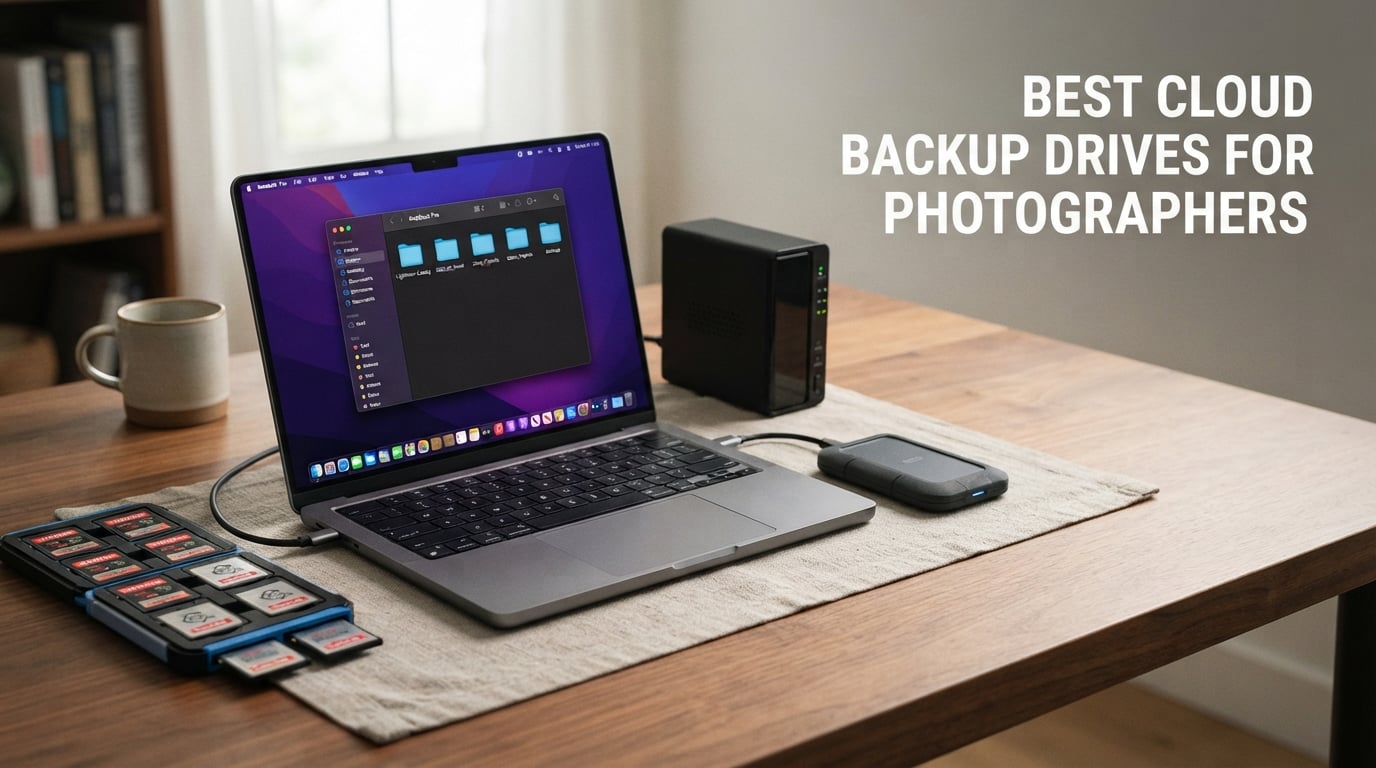
The best cloud backup drives for photographers give you a fast local place for RAW files and a dependable route to an off-site copy. The important distinction is simple: an external drive or NAS holds a local copy, while a cloud backup service stores a separate copy away from your home or studio.
Cloud backup for photographers is an online storage service that automatically saves photos and RAW files to remote servers. It protects work from drive failure, theft, and local disasters while keeping files available from another device; a local drive remains the practical first stop for ingesting, editing, and restoring a large catalog.
For this guide, I assessed eight storage devices by their stated capacity, connection, transfer-speed claims, physical protection, compatibility, warranty, and published customer feedback. I would not call any single local device a complete photo backup solution, so every recommendation below works best as part of a 3-2-1 plan with a separate cloud photo storage account.
Photographers in community discussions repeatedly ask for automatic backup, clear recovery options, privacy, and less manual file shuffling. That matches my approach: keep a working copy close at hand, keep another local copy separate, and send a third copy off-site.
Top 3 picks are the WD Elements, Crucial X9, and Lexar Professional Go
Choose the WD Elements when raw capacity matters most, the Crucial X9 when your working drive travels, and the Lexar Professional Go when your work centers on compatible iPhones and mobile video. Each fills a different part of a photography backup system rather than replacing an off-site cloud account.


The best cloud backup drives in 2026 cover local copies from 1TB to 80TB
This overview compares the local-storage role of every pick. Capacity and speed are useful only when paired with a separate, verified cloud backup for photography, because a drive sitting beside your computer is still exposed to the same local event.
| Product | Specifications | Action |
|---|---|---|
| WD 6TB Elements Portable Drive |
|
View Product Details |
 SanDisk 1TB Portable SSD SanDisk 1TB Portable SSD |
|
View Product Details |
| Crucial X9 1TB Portable SSD |
|
View Product Details |
| Lexar Professional Go 1TB SSD |
|
View Product Details |
 SSK 1TB Portable SSD SSK 1TB Portable SSD |
|
View Product Details |
 UGREEN NAS DXP2800 UGREEN NAS DXP2800 |
|
View Product Details |
 Lexar ES3 1TB External SSD Lexar ES3 1TB External SSD |
|
View Product Details |
 Synology BeeStation 4TB Synology BeeStation 4TB |
|
View Product Details |
1. WD Elements is the capacity-first local archive for large photo libraries
WD 6TB Elements Portable External Hard Drive for Windows, USB 3.2 Gen 1/USB 3.0 for PC & Mac, Plug and Play Ready – WDBHJS0060BBK-WESN
Pros
- 6TB capacity
- Plug-and-play setup
- PC and Mac compatible
- USB 3.2 Gen 1
Cons
- Slower than SSDs
- Mechanical drive
The WD Elements puts 6TB in a 2.5-inch portable hard-drive format, which is the headline reason it sits at the top of this list. That kind of room makes sense for photographers who retain original RAW captures, exports, Lightroom catalogs, and multiple years of client work.
I would treat it as an archive or a second local copy, not as the drive holding today’s active edit. Its stated USB 3.2 Gen 1 connection runs at 5Gbps, but the product data also identifies it as a mechanical hard drive, so it is not the pick for the snappiest ingest and preview workflow.
Its published 4.7 rating comes from 164.8k reviews, giving it the broadest feedback base here. The included SuperSpeed USB-A cable and plug-and-play positioning make the setup less intimidating when you need to add a dedicated backup destination quickly.
A large RAW archive is where the WD Elements fits best
Use this model when your current storage problem is volume, especially after years of weddings, events, or personal work. Create a dated top-level folder, copy the completed job, verify the copy opens, then let an off-site backup service protect that drive’s contents.
Keep the drive at a different location from the computer when it is not actively backing up. A drive that remains permanently connected can be affected by accidental deletion or ransomware just like the main workstation.
A fast editing scratch disk is where the WD Elements fits less well
The product data itself calls out slower speeds than SSDs as a drawback. If you regularly open large catalogs, generate previews, or move a fresh shoot before a deadline, an SSD lower in this guide will make more sense as the active copy.
For a mechanical drive, careful handling also matters during travel. The 2-year limited warranty is useful context, but it does not replace keeping a separate local and cloud copy.
2. SanDisk Portable SSD is the simple travel companion for one active catalog
Pros
- Up to 800MB/s read speed
- Two-meter drop protection
- USB-C connectivity
- Compact body
Cons
- Below faster SSDs
- Rubber hook may wear
The SanDisk Portable SSD is a straightforward choice for carrying a current project away from the desk. It has 1TB of stated capacity, USB-C with USB 3.2 Gen 2 support, and read speeds up to 800MB/s, so moving a selected shoot or a working export folder is its natural job.
Its rubber hook and up-to-two-meter drop protection answer a real travel concern: gear gets clipped to bags, handled at location, and set down in less-than-perfect places. The included USB Type-C to USB-A cable also helps when the destination computer has an older port.
The 4.6 rating is based on 10.8k reviews. I would still copy the completed project to a second drive and an off-site service before formatting cards, because compact SSD convenience does not change the rule that one device is one point of failure.
A mobile edit is where the SanDisk Portable SSD works best
This drive suits a photographer who wants a small working volume for a laptop-based cull, retouch, or client delivery. Put active RAW files and the associated catalog on it only after confirming the originals exist somewhere else.
It is also a logical handoff drive for moving files between a studio desktop and a travel computer. The product listing identifies the form factor as portable and the weight as 1.44 ounces, which supports that use.
A high-volume long-term archive is where the SanDisk Portable SSD is limited
One terabyte fills faster than many photographers expect once video, RAW bursts, and duplicate exports enter the same folder. Plan a folder rule before a trip so you know what stays active and what moves to your larger archive on return.
The stated 800MB/s read ceiling is respectable, but the Crucial, Lexar, and SSK SSDs here list higher transfer claims. Choose based on your actual port, since a slower computer connection can limit any external SSD.
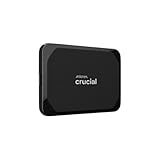
3. Crucial X9 is the rugged fast choice for an active photo workflow
Pros
- Up to 1050MB/s
- IP55 protection
- 7.5-foot drop resistance
- Broad compatibility
Cons
- Polycarbonate enclosure
- Not Prime eligible
The Crucial X9 earns its spot when an active local copy needs faster stated performance and more physical protection. It lists read speeds up to 1050MB/s, IP55 water and dust resistance, and drop resistance up to 7.5 feet, all useful traits for a drive that leaves the studio.
The compatibility list is unusually broad: Windows, Mac, iPad Pro, Chromebook, Android, Linux, PS4, PS5, and Xbox are named in the product data through USB-C and USB-A. That flexibility is helpful for photographers who import on one device, edit on another, and want a local backup available on both.
For best cloud backup drives for photographers, this is the working-drive pick I would pair with a larger archive and automatic off-site protection. It also includes a 3-month Mylio Photos+ code and Acronis True Image software, though you should confirm the terms and decide whether either fits your workflow before relying on it.
A field-to-laptop workflow is where the Crucial X9 makes the strongest case
Copy the card to the X9, keep the original card untouched until you have verified a second copy, and then let your desktop or cloud backup receive the new job. That workflow keeps the fast SSD focused on its best role: immediate access to current work.
The stated 32-gram weight and compact form make it easier to carry than a spinning archive drive. Its 3-year limited warranty is longer than the WD’s stated two-year coverage.
A single-copy strategy is where the Crucial X9 still falls short
IP55 and drop resistance reduce some physical risk; they do not create file versioning, off-site recovery, or a ransomware-safe archive. Accidental overwrites and sync mistakes can spread quickly if only one copy is in use.
For that reason, set backup software to retain versions where possible and test a restore of several RAW files. A backup is not proven until the restored files open correctly in your editing application.
4. Lexar Professional Go is the direct-attach choice for compatible mobile creators
Pros
- Four USB-C ports
- ProRes 4K 60fps support
- Up to 1050MB/s
- IP65 rated
- Five-year warranty
Cons
- Not compatible with iPhone 17
- Low review count
The Lexar Professional Go is the most specialized device in the group. It combines a 1TB SSD with a hub offering four USB Type-C ports, and the listing says it supports storing Apple ProRes 4K 60fps footage for compatible devices.
That design can simplify a mobile capture setup where cables, power, and external storage otherwise compete for a single port. It also lists up to 1050MB/s read and 1000MB/s write performance, plus IP65 dust and water resistance and one-meter drop resistance.
There is an important compatibility limit in the supplied product data: it is compatible with iPhone 15 and 16 models but not iPhone 17. Check your exact capture device before putting this drive at the center of an on-location workflow.
A compatible iPhone video rig is where the Lexar Professional Go belongs
Use its direct Type-C approach and hub only after making a test recording and checking that the footage lands where you expect. For hybrid shooters, it can serve as a dedicated video or mobile-ingest device while still leaving a separate drive free for still-photo backup.
The five-year limited warranty is the longest stated coverage among the portable SSDs in this guide. That is reassuring for long use, but an archive should never depend on warranty replacement rather than redundant copies.
A broad phone upgrade path is where the Lexar Professional Go needs caution
Its iPhone 17 limitation means it is not the flexible pick for every mobile setup. The review base is also much smaller than the established portable drives here, with 173 reviews supporting its 4.6 rating.
If you want a normal portable SSD rather than a direct-attach hub workflow, the Crucial X9 or Lexar ES3 gives you a simpler path. Those choices have fewer specialized assumptions about how you shoot.
5. SSK Portable SSD is the cross-device pick with drive-health tools
Pros
- Up to 1050MB/s read
- USB-C and USB-A cables
- S.M.A.R.T. monitoring
- Aluminum enclosure
Cons
- Lower 4.5 rating
- Usable capacity can appear lower
The SSK Portable SSD is built around cross-device practicality. Its listing names USB 3.2 Gen 2 performance up to 1050MB/s read and 1000MB/s write, and it includes both USB-A to USB-C and USB-C to USB-C cables for 10Gbps transfers.
That cable bundle removes one small but common field problem when a photographer meets a client computer, a desktop, or a newer laptop with a different port. The aluminum enclosure, activity LED, and stated 30-gram weight make it a neat daily-carry backup candidate.
The drive also advertises S.M.A.R.T. monitoring, TRIM support, and SLC caching. Those are useful maintenance signals, but I would use them as a reason to watch drive health rather than as permission to postpone a separate backup.
A mixed computer setup is where the SSK Portable SSD is especially convenient
If your photo workflow moves between a USB-A desktop and a USB-C laptop, having both cables in the box matters. It can also connect with the listed phones and tablets when you need to copy a select folder without hunting down an adapter.
Use the LED activity indicator as a reminder not to disconnect during an active copy. After each large transfer, compare folder counts and open a few representative RAW files before clearing a card.
A capacity-sensitive workflow is where the SSK Portable SSD needs planning
The review data notes that Windows can show about 931GB of the advertised 1TB capacity. Build your shoot plan around available usable space, especially when the same drive carries RAW files, proxies, exports, and catalog backups.
Its 4.5 rating from 3.5k reviews is still strong, but it trails the rating of several alternatives here. A portable SSD is a convenience copy, not a substitute for an automatic, versioned cloud backup service.
6. UGREEN NAS DXP2800 is the expandable home base for growing archives
Pros
- Up to 80TB capacity
- 2.5GbE networking
- Intel N100 with 8GB DDR5
- Two M.2 slots
- Photo album tools
Cons
- Ships without drives
- Needs a network setup
The UGREEN NAS DXP2800 is a different class of option: a diskless two-bay network storage enclosure rather than a ready-to-use portable drive. It can reach a stated maximum capacity of 80TB once you add drives, making it the strongest local archive foundation for a photographer whose work outgrows single-disk storage.
Its hardware list includes an Intel N100 quad-core CPU, 8GB of DDR5 RAM, 2.5GbE Ethernet, two M.2 NVMe slots, and 4K HDMI. The supplied information also calls out an AI-powered photo album with facial and scene recognition, which may appeal when browsing a large personal archive.
A NAS is not automatically cloud backup. I would configure its photo folders to back up to an off-site provider and test remote recovery, because keeping all the disks in one building still leaves theft, fire, and electrical damage as shared risks.
A multi-year archive is where the UGREEN NAS DXP2800 becomes compelling
This is the pick for a studio that needs growth room, shared network access, and a central place for completed jobs. Its 2.5GbE connection has much more potential than a basic network link, although the real transfer rate also depends on your router, switch, computer adapters, and installed drives.
Plan drive selection, redundancy, and off-site backup before installation. Drive redundancy can keep a system running after a disk failure, but it is not a second backup and cannot protect against every human or software error.
A no-setup portable backup is where the UGREEN NAS DXP2800 is the wrong fit
Because this version is diskless, it requires additional drives and a network setup before it stores a single image. That added planning is justified for a long-term archive, yet it is more involved than connecting a portable SSD after a shoot.
The product has a 4.5 rating from 1.1k reviews and a stated two-year manufacturer warranty. Give yourself time to configure user access, automatic backups, notifications, and restore testing instead of treating it as a plug-and-play travel drive.
7. Lexar ES3 is the slim encrypted SSD for portable sensitive work
Pros
- Up to 1050MB/s read
- 256-bit AES encryption
- 42g slim build
- Wide device compatibility
Cons
- No MagSafe
- Needs USB 3.2 Gen 2 for top speed
The Lexar ES3 combines an ultra-slim body with high stated transfer rates: up to 1050MB/s read and 1000MB/s write. At 42 grams and 10.5mm thick according to the supplied details, it is well suited to photographers who want a local working copy that adds almost no bulk to a laptop bag.
Its most photography-relevant security feature is Lexar DataShield 256-bit AES encryption. Encryption is worth considering for client portraits, commercial pre-release work, or travel, but protect the password or recovery method carefully; encrypted files are not recoverable if their key is lost.
Compatibility includes iPhone 17 series, Mac, PS5, Xbox, laptops, and PCs. The stated three-year limited warranty gives it the same listed term as the Crucial X9 and SanDisk portable SSD.
Portable client work is where the Lexar ES3 has a clear role
This drive is a good local choice for carrying a limited set of active client files, encrypted deliverables, and a duplicated catalog. It is especially useful when weight and thickness matter more than having a multi-terabyte archive in the same bag.
Before depending on encryption for a live job, run a small practice cycle: encrypt, disconnect, reconnect, decrypt, and open the files. That simple rehearsal can expose workflow friction before you need an urgent restore.
Peak-speed expectations are where the Lexar ES3 need a port check
The listing says performance may be lower without USB 3.2 Gen 2 support. Check the computer port and cable path rather than assuming every USB-C connector has the same capability.
The published rating is 4.4 from 826 reviews, lower than several other portable SSDs here. If feedback volume and rating lead your decision, compare it with the Crucial X9; if integrated encryption leads, the ES3 has a distinctive feature.
8. Synology BeeStation is the easy personal-cloud hub with important backup limits
Pros
- 4TB built-in storage
- QR-code setup
- Web desktop and mobile access
- Cloud-service backup options
Cons
- Lower 3.8 rating
- Single-device risks remain
The Synology BeeStation is aimed at photographers who want a private, home-based file hub without a traditional NAS learning curve. It provides 4TB of stated storage, QR-code setup, web, desktop, and mobile access, plus sharing spaces for family and friends.
Its useful backup feature is the ability to back up from Google Drive, OneDrive, Dropbox, and external drives. That gives it a role as a consolidation point for photo files spread across services and devices, though you should set up and test each source instead of assuming every folder is included.
It is called personal cloud storage, but it remains a single physical device in a single location. For professional photo storage, I would keep a separate off-site copy outside the BeeStation before calling the archive protected.
A simple shared photo library is where the BeeStation is most appealing
Choose this design when you need uncomplicated access from web, desktop, and mobile devices and want to share folders without handing over your main editing drive. The QR-code setup can be more approachable than a diskless NAS for a photographer who prefers to spend time editing rather than administering storage.
Its cross-computer sync can also keep a selected working folder available on more than one machine. Use clear folder ownership and naming rules so syncing does not create accidental duplicates or conflicting edits.
A high-assurance archive is where the BeeStation needs a second layer
The 3.8 rating from 277 reviews and the 17% one-star share in its review data deserve attention. That feedback does not mean it cannot fit a simple workflow, but it is a reason to test setup, sharing, and recovery during the return window.
Do not mistake access from outside the home for a fully independent backup. Add a second local drive and a cloud backup service with version history to build protection against hardware loss, deletion, and ransomware.
A safer photo backup plan uses three copies in two places and one off-site copy
The 3-2-1 backup strategy means keeping three copies of important files, on two kinds of storage, with one copy stored off-site. For photographers, that can mean memory cards or a working SSD, an archive drive or NAS at home, and a cloud backup for photography outside the studio.
The rule is not about buying more gear for its own sake. It is about preventing one hardware failure, one mistaken deletion, or one local event from becoming the only story your client images leave behind.
Choose a drive type by the job it will perform
Pick a portable SSD for current shoots, travel, and active editing because the stated transfer rates of the SSDs here range from 800MB/s to 1050MB/s. Pick the WD Elements when you need a compact high-capacity archive, and pick the UGREEN NAS when your archive needs centralized storage and room to expand.
Choose the BeeStation when simple network access and cloud-service consolidation matter more than custom NAS hardware. In every case, add a true off-site photo backup service; local storage by itself is not cloud backup.
Protect RAW files by copying before you edit or format
RAW files can be large, and a photo editing workflow creates catalogs, sidecar files, previews, exports, and sometimes video alongside them. Back up the folder structure that lets you rebuild the job, not just the final JPEGs.
After ingest, make a second copy before formatting the memory cards. Then verify the copy by comparing folder counts and opening a sample of RAW files, catalog files, and exports from the backup destination.
Plan capacity around your retention policy instead of a single shoot
Start with the size of a typical job, multiply it by the number of jobs you keep accessible, then include exports, video, and a growth margin. A 1TB SSD can be excellent for an active project even when a 6TB hard drive or expandable NAS is better for completed work.
Keep active work and deep archive folders separate. This makes it easier to see which files need fast storage and which can move to a larger, slower local copy plus off-site storage.
Use encryption and version history to reduce avoidable loss
Encryption protects files at rest when a drive is lost, while version history helps when a good file is overwritten or encrypted by ransomware. They solve different problems, so look for both in the wider system rather than treating a lock icon as complete protection.
Maintain passwords in a secure record and schedule a restore test several times each year. Restore a small finished job to a new folder, check image previews and metadata, and confirm that your editing software can see its catalog assets.
Keep automatic backup separate from ordinary sync
Sync mirrors changes between locations, which can be convenient for a current project but can also mirror a deletion. Backup services with file versioning are better suited to recovery because they can preserve an earlier version long enough to reverse a mistake.
Photographers in forum discussions often describe wanting a set-it-and-forget-it system. Automation helps, but it needs periodic review: check the last successful backup, confirm the external drive is included, and look for warnings before a deadline turns them into a crisis.
Photographers should ask these cloud backup questions before choosing storage
What is the best cloud backup for photography?
The best cloud backup for photography is one that automatically backs up your RAW files, keeps file versions, supports the amount of data you retain, and lets you restore files reliably. Pair it with a local SSD, hard drive, or NAS so your working files remain fast to access.
What do professional photographers use to back up photos?
Professional photographers commonly use a 3-2-1 approach: a working copy, a second local copy on another drive or NAS, and an off-site cloud backup. Portable SSDs suit active jobs, larger hard drives or NAS units suit archives, and the cloud copy protects against local loss.
What is the best external drive for photo backup?
The best external drive depends on the role. The WD Elements offers 6TB for a local archive, while the Crucial X9 provides up to 1050MB/s and IP55 protection for active portable work. Neither is off-site backup alone, so keep a separate cloud copy.
Which cloud service is best for storing photos?
Choose a cloud service that supports automatic backup, RAW files, version history, encryption, and reliable restore options. Your local drive choice and cloud service have separate jobs: the drive helps with quick access, while the cloud service supplies the off-site protection.
The best choice is a local drive that supports an off-site cloud backup
For a large local archive, the WD Elements is the clearest capacity-led choice. For a working drive that moves between locations, the Crucial X9 combines stated 1050MB/s performance with IP55 protection, while the UGREEN NAS DXP2800 makes more sense when a growing archive needs a central home.
The best cloud backup drives for photographers in 2026 are not a replacement for cloud backup; they are the reliable local layer that makes ingest, editing, and restore practical. Choose the device that matches your workflow, then connect it to a tested 3-2-1 plan with a truly separate off-site copy.