
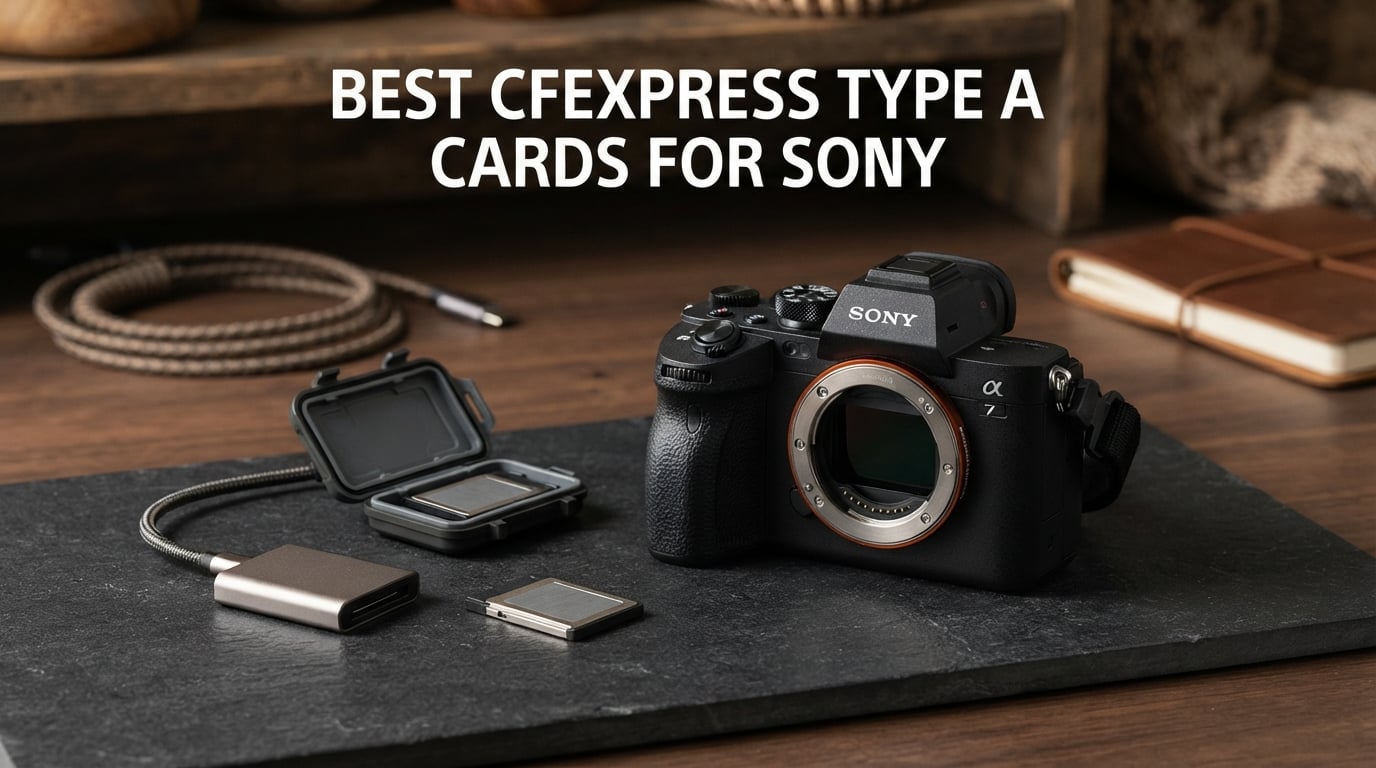
The best CFexpress Type A cards for Sony are not automatically the cards with the largest read-speed number. For Sony Alpha and FX owners, the sensible choice is the card whose sustained write performance, video rating, capacity, and stated camera support match the modes you actually use.
CFexpress Type A is the compact CFexpress format found in select Sony bodies, including models in the α1, α7, α9, and FX lines. It uses a PCIe connection, and its faster write path can make a real difference when a burst buffer is full or a high-bitrate video mode calls for media that a UHS-II SD card cannot support.
I compared every supplied card listing for stated read and write figures, VPG classification, capacity, physical protection, warranty, and Sony compatibility claims. The headline speeds below are manufacturer-listed maximums rather than our in-camera benchmark results, which matters because a camera and card reader can limit what a card delivers in practice.
The top 3 CFexpress Type A cards for Sony cover premium, broadly proven, and accessible needs (September 2026)

My first pick is Angelbird when consistent recording behavior and its data-recovery coverage are the priority. Lexar SILVER is the more broadly reviewed high-speed option, while DAJINGYU is the straightforward pick for a creator who needs listed 4K 120p and 8K 30p support without moving to a higher-capacity card.
Those three choices do not make Sony, SanDisk, ProGrade, or the others redundant. A Sony TOUGH card makes sense for the owner who values Sony-branded media and physical resistance, while VPG400, VPG800, capacity, warranty, and stated thermal features can change the result for a particular shoot.
These CFexpress Type A cards for Sony in 2026 cover every listed capacity and performance tier
| Product | Specifications | Action |
|---|---|---|
| Angelbird AV PRO CFexpress A v4 256GB |
|
View Details |
| Lexar Professional Type A SILVER 256GB |
|
View Details |
 Sony CEA-G TOUGH 320GB Sony CEA-G TOUGH 320GB |
|
View Details |
 CHIPFANCIER Gold II 512GB CHIPFANCIER Gold II 512GB |
|
View Details |
 Lexar Professional Type A GOLD 160GB Lexar Professional Type A GOLD 160GB |
|
View Details |
 ProGrade Digital Gold 480GB ProGrade Digital Gold 480GB |
|
View Details |
 SanDisk PRO-Cinema Type A 480GB SanDisk PRO-Cinema Type A 480GB |
|
View Details |
 novachips Express Type A 400GB novachips Express Type A 400GB |
|
View Details |
 DAJINGYU Professional Type A 256GB DAJINGYU Professional Type A 256GB |
|
View Details |
 Exascend Essential Type A 180GB Exascend Essential Type A 180GB |
|
View Details |
The table is a stated-specification snapshot, not a ranking of real-world buffer-clear times. For recording, begin with the sustained-write figure and VPG designation when supplied; read speed matters most when moving files to a computer through a reader that can support the card.
1. Angelbird AV PRO CFexpress A v4 is the strongest all-around pick for sustained recording
Angelbird AV PRO CFexpress A v4 256 GB – CFexpress 4.0 Type A Memory Card – Compatible with Sony Alpha and FX – up to 8K+ RAW Video and Photo
Pros
- VPG400 certification
- 800MB/s sustained-write claim
- thermal management
- free data recovery
- 3-year warranty
Cons
- 256GB reviewed model
- small 53-review sample
Angelbird’s AV PRO CFexpress A v4 earns the lead position because its listing puts a stable 800MB/s sustained-write figure alongside VPG400 certification. That is the number I would focus on for long takes and demanding codecs, rather than treating its 1800MB/s maximum read claim as a recording guarantee.
The 256GB model is explicitly made for Sony Alpha and FX cameras, and Angelbird names the α1, α1 II, α7 IV, α7R V, α7S III, α9 III, FX3, FX30, and FX6 among compatible bodies. Its listed 4.0 interface is useful for a newer workflow, but the camera and reader remain the ceiling for actual throughput.
Angelbird also lists advanced thermal management and minimal power draw, two claims that speak to the practical worry of a long video session. The included three-year limited warranty and in-house data recovery service add a meaningful safety net for working files.
The limitation is simple: this reviewed configuration is 256GB, and its rating is based on 53 reviews. I would pair it with the Angelbird reader if firmware updates are part of the plan, since the manufacturer states that reader supports those updates.
The recording case is continuous high-bitrate work that needs a stated VPG400 floor
VPG400 means the card carries a Video Performance Guarantee of at least 400MB/s sustained write. It is a more useful shorthand for predictable video capture than a peak read result, especially when the card is warm and the camera is still writing.
Angelbird lists Stable Stream Technology for consistent write behavior. That makes this card a logical candidate for a Sony FX3, FX30, or high-resolution Alpha workflow that puts recording continuity ahead of transfer bragging rights.
The ownership case is a Sony shooter who values service coverage and firmware maintenance
The free data recovery service and firmware-update path are rare practical details in the supplied listings. I would still keep two verified cards and back up footage promptly, because no recovery promise replaces a second copy of important work.
Buy from an authorized source with a clear return path, inspect packaging and the card serial details, then test a new card before a paid shoot. Forum users repeatedly flag counterfeit concerns, so this is a sensible step with any high-performance media.
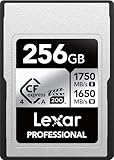
2. Lexar Professional Type A SILVER is the best pick for fast transfers and extensive buyer feedback
Pros
- 1300MB/s sustained-write claim
- IP68 rating
- 5-meter drop resistance
- capacities to 2TB
- lifetime limited warranty
Cons
- VPG200 rather than VPG400
- 256GB reviewed model
Lexar’s Professional Type A SILVER is the card I would scrutinize first if rapid offload and a large feedback base matter to you. It has a 4.8 rating across 1,484 reviews in the supplied data, far more feedback than most of the cards here.
Lexar states a maximum 1750MB/s read speed when used with its Professional CFexpress Type A USB 4.0 Reader. It also states 1650MB/s maximum write and up to 1300MB/s sustained write, which are strong paper specifications for a 256GB Type A card.
For location work, the IP68 dust- and water-resistance rating plus a listed five-meter drop rating give this card a notably clear physical-protection story. The listing also says capacities reach 2TB, useful if you want matching media across more than one camera or a longer recording day.
Its VPG200 rating is still designed for 8K recording according to Lexar, but it is not the same promise as VPG400. Choose it when its stated sustained performance, physical protection, and reader ecosystem fit your workflow, then format it in-camera before important work.
The transfer case is a creator who owns the matching USB 4.0 Type A reader
A card cannot reach its stated reader speed through an older or slower reader. The 1750MB/s figure is specifically tied to Lexar’s Professional CFexpress Type A USB 4.0 Reader, so do not assume a generic USB reader will give the same result.
When editing requires fast offload, use a short certified cable, plug into a compatible port, and copy to two destinations before formatting. That workflow makes the card’s higher read specification meaningful without promising a particular transfer time.
The shooting case is 8K-capable capture with dust and water exposure in mind
Lexar lists VPG200 for 8K recording, which makes it relevant for compatible Sony modes that specify CFexpress Type A. Check the camera manual for the exact codec, frame rate, and card requirement before relying on any card for a critical take.
The lifetime limited warranty and Recovery Tool access add reassurance, but they do not cover an unmade backup. I would regard the card’s rugged rating as protection against an accident, not a reason to skip a protective case or data discipline.
3. Sony CEA-G TOUGH is the straightforward Sony-branded choice for hard-use media
Pros
- Sony-branded media
- 700MB/s write rating
- 320GB capacity
- heat dissipation
- extensive physical resistance
Cons
- Lower stated peak speed than newer 4.0 cards
- 45-review sample
The Sony CEA-G TOUGH 320GB card is the conservative choice for a Sony owner who prefers a Sony-branded accessory and a plainly stated 800MB/s read, 700MB/s write specification. Its numbers are lower than the newest 4.0 claims here, yet they are still substantial for the supported camera modes named in the listing.
Sony lists ILCE-1, ILCE-7M4, ILCE-7SM3, ILME-FX3, and ILME-FX6 compatibility for this version. The card is built around 320GB of space, a useful middle ground for high-resolution files when you want a single card with more room than 160GB or 180GB options.
TOUGH is the bigger story. Sony lists resistance to impact, bending, dust, moisture, humidity, X-rays, electrostatic charge, and ultraviolet radiation, plus effective heat dissipation during high-bitrate transfers.
There are 45 reviews in the supplied data, so I would not treat that 4.8 rating as a large-sample verdict. I would choose this card for its stated durability and Sony fit, not because it wins a maximum-speed contest.
The durability case is outdoor work where media can be bent, wet, dusty, or handled often
Cards are small enough to be damaged in ways cameras are not, especially during rushed media swaps. The TOUGH resistance claims speak directly to that practical reality, and a rigid card case remains a good companion.
Physical resistance does not mean a card is waterproof after every handling error or that it can be neglected. Let a wet card dry according to Sony guidance and never force a card into a slot.
The camera-fit case is a Sony α1, α7 IV, α7S III, FX3, or FX6 owner who prefers first-party media
Sony’s named compatibility list gives this card a clean starting point for those bodies. It remains smart to verify the exact model and firmware in the camera documentation, because media rules can differ by recording format and slot.
For an α1 owner, this card offers a known Type A path rather than a promise that a newer card generation will transform camera-limited transfer behavior. The best memory card for a Sony camera is the one its manual approves for the mode you plan to use.
4. CHIPFANCIER Gold II 512GB is the capacity-led option with a VPG800 claim to verify
Pros
- 512GB capacity
- VPG800 claim
- 1500MB/s sustained-write claim
- stated Sony Alpha and FX support
- 5-year warranty
Cons
- Listing gives differing write figures
- 134-review sample
The CHIPFANCIER Gold II gets attention because it combines a 512GB capacity with an unusually ambitious VPG800 certification claim. If the current package details match the listing, that stated rating puts it in a different category from the VPG200 and VPG400 products in this group.
The supplied details name 1780MB/s sustained read and 860MB/s sustained write in the title, while the review data says maximum read and write can reach 1750MB/s and the feature list says 1500MB/s sustained write. Those differences make verification important before a purchase or a high-stakes shoot.
Its listing names Sony α1, α7S III, α7 IV, α7R V, α9 III, FX3, FX6, FR7, and FX30 compatibility. It also claims protection against shocks, X-rays, magnets, and extreme temperatures, which are welcome qualities for a card intended to carry a large amount of footage.
I like the 512GB capacity for a long event day or a video production that needs fewer card swaps. I would first confirm the carton label, current manufacturer specification, and camera recording requirement rather than selecting it on the VPG800 label alone.
The capacity case is a long-form shoot where fewer card changes reduce operational risk
Every card change creates a chance to misplace media, expose the slot to dust, or interrupt a shot. A larger card reduces that handling, though it also concentrates more footage on one piece of media.
For that reason, I would build a backup plan around offloading at planned breaks instead of filling a card until the end of a job. Capacity is useful only when paired with an organized ingest routine.
The verification case is a buyer who will confirm the exact current write specification before use
The conflicting figures in the supplied listing are not a reason to invent a benchmark result. They are a reason to check the current manufacturer documentation and to perform a full in-camera recording test before a client job.
Use the highest bitrate and frame rate you expect to shoot, let the card warm up, and review the clip for a recording warning. That simple rehearsal is more informative than relying on a peak figure alone.
5. Lexar Professional Type A GOLD is the VPG400 choice for compatible 8K and 4K 120p work
Pros
- VPG400 rating
- minimum 700MB/s write
- 8K and 4K 120p support
- lifetime limited warranty
- capacity options to 320GB
Cons
- 160GB reviewed model
- lower peak read than 4.0 cards
The Lexar Professional Type A GOLD 160GB remains a focused choice because its listing pairs VPG400 with 800MB/s maximum write and a 700MB/s minimum write speed. That minimum figure is the useful part of the specification for shooters who care about a predictable recording floor.
Lexar describes the card as capable of smooth 8K and 4K 120fps capture and rates it VPG400 for 8K RAW video. Those are compelling claims for compatible Sony modes, but the camera manual always has the final word on the required card class.
The 160GB reviewed version is compact in capacity terms, which can be a feature for photographers who prefer multiple cards and distributed backup risk. Lexar also lists capacity options up to 320GB if the same product line suits your filing workflow.
This is not a CFexpress 4.0 speed leader on the supplied maximum read specification, with a listed 900MB/s read result. I would pick it for the VPG400 and minimum-write language, then choose capacity based on the actual media created by a typical session.
The video case is a camera mode that explicitly benefits from VPG400 media
VPG400 makes a direct statement about sustained video write behavior. It matters more to an extended recording than the read rate you may see only during file transfer.
If your Sony body accepts a fast V90 SD card for a preferred mode, CFexpress Type A may not be required. If it requires Type A, a VPG400-rated option like this gives a clearer recording-oriented specification than a generic speed class.
The media-management case is a photographer who prefers several smaller cards over one large card
Using several cards can limit the impact of one lost or corrupted card, provided each card is labeled and backed up. The tradeoff is more swaps, more tracking, and a greater chance of handling error.
I would assign cards by event segment or camera rather than mixing files from every job onto one card. That keeps the 160GB size manageable and makes offload checks easier at the end of a session.
6. ProGrade Digital Gold 480GB is the quality-control-led card for a larger CFexpress 2.0 workflow
Pros
- 480GB capacity
- 100 percent card testing claim
- serialized component tracking
- VPG200
- 3-year warranty
Cons
- 600MB/s sustained write below faster cards
- VPG200 rather than VPG400
ProGrade Digital’s Gold 480GB card stands apart through its quality-control claims rather than a huge maximum-speed headline. The company lists strict 100 percent card testing and serialized tracking of key components and manufacturing data, details that speak to the reliability questions Sony shooters raise in forums.
Its supplied specification is up to 900MB/s read, 600MB/s sustained write, up to 800MB/s write, and VPG200. The 480GB capacity is substantial for a production day, and the card is stated to work with cameras designed for the CFexpress 2.0 specification.
ProGrade also describes its controller and firmware as intended for cinema cameras and 4K, 8K, RAW, and RAW HD workflows. That is a useful statement of intent, but it does not replace a check of your exact Sony codec and recording setting.
The 600MB/s sustained figure is less aggressive than several newer cards here, so I would not select it solely for a maximum-performance goal. I would consider it when 480GB capacity, ProGrade’s stated testing approach, and a three-year warranty matter more than chasing the newest interface generation.
The confidence case is a professional who wants stated traceability and testing practices
Memory-card reliability cannot be measured from a review rating alone. ProGrade’s claims of individual testing and serialized manufacturing records give a buyer specific manufacturing practices to consider alongside camera compatibility and backup behavior.
Whatever brand you choose, label each card, retire media that starts to misbehave, and keep cards away from loose batteries or metal objects. Those habits are more protective than assuming a professional-grade label makes a card failure-proof.
The capacity case is a user who needs 480GB without moving to a multi-card set
A 480GB card can simplify long takes and reduce swaps on a single-camera shoot. Before committing, calculate storage from the bitrate shown by your Sony camera rather than making a broad assumption from the resolution label.
Plan enough free space for retakes, then offload before the card is near capacity. Recording to a nearly full card leaves less room for the unexpected sequence that becomes the most important clip of the day.
7. SanDisk PRO-Cinema Type A is the fast rugged option for 4K, 6K, and 8K capture claims
Pros
- 1800MB/s read
- 1650MB/s write
- VPG200
- IP57 rating
- 7.5-meter drop protection
Cons
- 44-review sample
- VPG200 rather than VPG400
The SanDisk PRO-Cinema 480GB is one of the strongest speed specifications in the collection, with up to 1800MB/s read and 1650MB/s write listed for this Type A model. SanDisk positions it for high-resolution photo work and 4K, 6K, or 8K video capture.
It carries a VPG200 certification, so it belongs in the professional-video conversation even though it does not claim VPG400. The 480GB capacity is also a practical fit for a hybrid shooter who records longer clips but does not want to stop for frequent media changes.
SanDisk lists 7.5-meter drop protection, bend protection up to 150 newtons, and IP57 water and dust resistance. Those physical claims make it particularly compelling for run-and-gun work, travel, or outdoor sets where the card is exposed during transfers and swaps.
The supplied rating is 4.6 from 44 reviews, which is respectable but not a broad evidence base. I would judge it from its stated speed, 480GB capacity, and rugged build, then use an approved reader to avoid turning a fast card into a slow ingest point.
The production case is high-resolution capture that needs a fast stated write ceiling
High maximum write capacity can help a card absorb demanding bursts and video data, but the recording mode still dictates compatibility. Check what your camera requests for each 4K, 6K, or 8K option before treating any card as universal.
VPG200 is a sustained-performance category rather than an assurance for every format at every temperature. For critical work, record a long test clip with the exact camera, codec, and firmware you will use.
The field case is a shooter who needs stated drop, bend, dust, and water resistance
Physical protection matters most when cards leave the camera: on a wet tailgate, in a pocket, or beside a laptop. The listed IP57 and drop protection make SanDisk a sensible candidate for a hard-use kit.
Keep terminals clean and dry despite that protection. A damaged contact surface can stop a perfectly healthy card from mounting, and cleaning a card carefully is easier than recovering a day of work.
8. novachips Express Type A is the flexible-capacity CFexpress 4.0 option with a warranty tradeoff
Pros
- CFexpress 4.0 interface
- 1700MB/s sustained read
- 400GB capacity
- options to 1.6TB
- shock and vibration resistance
Cons
- No warranty listed
- 26-review sample
The novachips Express 400GB card is worth a look for a Sony shooter who wants a CFexpress 4.0 Type A product with larger capacity choices. The supplied details list 400GB, 800GB, and 1.6TB options, a useful range for lengthy productions and high-volume stills.
This reviewed 400GB model lists sustained read at 1700MB/s and a PCIe Gen4 interface. The product details state an 800MB/s write speed, while the technical details specify sustained write up to 1300MB/s for the 1.6TB model, so do not apply the larger model’s figure to the 400GB version.
novachips names Sony A9 III, A1 II, A7R V, A7 IV, FX3, and FX6 in the title. It also lists operation from 14 to 158 degrees Fahrenheit plus 50G shock and 16G vibration resistance, which are concrete field-use claims.
The clear compromise is that the supplied product details list no warranty, and there are only 26 reviews. I would reserve this option for someone comfortable validating the exact capacity variant, seller support, and camera behavior before putting unique footage on it.
The future-facing case is a workflow that can benefit from CFexpress 4.0 and larger capacities
A CFexpress 4.0 card can operate in a compatible Type A workflow, but faster media does not compel an older Sony body to run at a newer interface’s maximum rate. The camera and the reader each set a link in the chain.
That means a 4.0 purchase can make sense for a new reader or future body without making a promise about current in-camera buffer performance. Treat the listed interface as headroom, not an automatic upgrade for every Sony model.
The risk case is a buyer who is comfortable with no listed warranty coverage
Warranty terms matter when a card is a work tool, not only a convenience. With no warranty listed in the supplied data, I would keep redundant cards and test the full workflow early.
A good test includes formatting in the intended Sony camera, recording demanding material, offloading through the intended reader, and checking the copied files. If anything is inconsistent, use the seller’s return route before relying on the card.
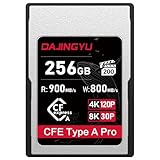
9. DAJINGYU Professional Type A is the accessible VPG200 choice for stated 4K 120p and 8K 30p support
Pros
- VPG200 certification
- stated 4K 120p and 8K 30p support
- wide Sony compatibility
- 5-year warranty
- shock resistance
Cons
- 56-review sample
- listed 256GB configuration
The DAJINGYU Professional 256GB has a direct, useful specification set: 900MB/s maximum read, 800MB/s maximum write, VPG200, and stated support for 4K 120p and 8K 30p RAW. It is the accessible recommendation because it covers the core Type A conversation without making an inflated maximum-speed claim.
The compatibility list is broad, naming Sony A7 IV, A1, A7S III, A7R V, FX3, FX6, FX30, A1 II, A9 III, and A7M5. Treat that list as a reason to check your model, not as a substitute for consulting the manual for the exact video mode.
The card also lists shockproof, temperature-resistant, and X-ray-proof construction alongside a five-year warranty. Those details make it attractive to a creator who wants a documented support period and physical-protection claims in a 256GB format.
Its 4.5 rating comes from 56 reviews, a smaller group than the Lexar SILVER. I would test it thoroughly before using it for irreplaceable footage, which is advice I give for every unfamiliar card brand and every memory-card purchase.
The camera case is a Sony FX or Alpha owner using a mode specified as 4K 120p or 8K 30p
The listing’s stated 4K 120p and 8K 30p support makes DAJINGYU relevant to video-led Sony users. Compatibility still depends on the body and format, because one camera’s 4K 120p requirement can differ from another’s.
Start by setting up the intended recording mode and letting the camera format the card. A successful short clip is only the first check; repeat with a long clip and inspect the file after offload.
The support case is a buyer who wants a listed five-year warranty
A stated five-year warranty is a practical differentiator among the supplied data. Read its current terms when purchasing, especially the claim process and whether any registration is required.
Warranty coverage cannot recover a missed moment, so use dual recording where your Sony camera supports it and keep an on-set backup routine. The goal is to prevent a card issue from becoming a single point of failure.
10. Exascend Essential Type A is the compact VPG200 option with thermal features and modest feedback
Pros
- VPG200 certification
- 8K RAW at 60fps claim
- thermal control
- SmartStream efficiency
- 5-year warranty
Cons
- 4.2 rating from 16 reviews
- 450MB/s listed write figure
The Exascend Essential 180GB is the specialist pick for someone drawn to its stated VPG200 certification and thermal-management language. Exascend lists 8K RAW at 60fps support, SmartStream energy efficiency, Adaptive Thermal Control, and SuperCruise sustained-performance technology.
The supplied product details list up to 900MB/s read and 450MB/s write, while the feature list says up to 800MB/s read and 800MB/s write. Because that is a material difference, verify the exact 180GB model specification directly before deciding that it meets a demanding recording requirement.
The card is listed as compatible with Sony a1, a7S III, a7 IV, FX3, and FX6, and it has a five-year warranty. It also claims dust and X-ray protection, appropriate attributes for media carried between sets and edit stations.
The rating is 4.2 from 16 reviews, the smallest and lowest feedback signal in this guide. I would see the thermal features as interesting, but the limited review sample and differing listed speeds mean it should be tested more carefully than a broadly established alternative.
The thermal case is a long take where steady behavior matters more than a peak number
Adaptive Thermal Control and sustained-performance claims are relevant because heat can affect flash-media behavior during prolonged recording. The useful confirmation is not a marketing phrase but a long test in your own camera and ambient conditions.
Do the test before travel or a paid production, with the card at the capacity you will actually use. Stop if the camera shows warnings, then investigate the card, firmware, temperature, and recording setting rather than gambling on the next take.
The compact-workflow case is a shooter who wants to divide work across smaller cards
At 180GB, this card can suit a rotation of labeled media for stills, shorter shoots, or separate camera bodies. Smaller cards can limit the amount of work held on one card, though they require disciplined swapping and backup.
Use the card only after confirming its exact write specification for your capacity variant. The safest response to conflicting listing data is documentation and testing, never an assumption.
The right Sony CFexpress Type A card starts with the recording mode, not the headline speed
The quickest way to choose is to open the Sony camera manual and identify the exact stills burst or video mode that prompted the purchase. Some modes can use a UHS-II V90 SD card, while other modes require CFexpress Type A; a Type A card is not interchangeable with the larger CFexpress Type B format.
Type A and Type B share a name, not a physical format. Never try to fit Type B media in a Type A slot, and never assume a card reader supports every CFexpress form factor just because it says CFexpress on the box.
The sustained-write and VPG figure answer the recording question better than maximum read speed
Maximum read speed describes how quickly data may leave a card under the right reader setup. During recording, the more relevant data point is sustained write performance, and VPG200, VPG400, or VPG800 is a concise indication of the card’s specified sustained-video class.
A VPG400 card has a higher guaranteed sustained-write class than a VPG200 card, but that does not make it mandatory for every Sony mode. Follow the camera’s own media requirement, then favor a card with enough sustained headroom instead of paying attention only to a maximum read number.
For bursts, the camera buffer, file type, frame rate, and card all work together. No supplied product listing includes a controlled buffer-clear result for every Sony body, so a precise number of burst frames or seconds would be invented; test your camera with its intended settings.
The capacity decision should follow bitrate, shooting duration, and backup intervals
Choose capacity by calculating the footage or image volume from a normal assignment, then add room for retakes and unexpected sequences. High-resolution RAW stills, high-frame-rate recording, and long clips can use space far faster than a card label suggests.
A 160GB or 180GB card can work well when you make frequent verified backups or prefer to spread risk across several cards. A 400GB, 480GB, or 512GB model reduces handling during a long shoot but concentrates more work on one device.
I prefer a deliberate card plan: label each card, format only after verifying two copies of the prior contents, and keep a log during multi-card jobs. That process is more valuable than any single capacity recommendation.
The CFexpress 4.0 label offers interface headroom but cannot override a Sony camera or reader limit
Cards such as Angelbird AV PRO v4, Lexar SILVER, CHIPFANCIER Gold II, and novachips Express list CFexpress 4.0 technology. They can be attractive for a newer workflow, but the resulting speed is limited by the camera’s slot implementation and the reader, cable, computer port, and storage drive used during offload.
Older compatible Sony cameras may not expose the full speed potential claimed by a newer 4.0 card. That does not mean the card will fail to work; it means there is no sound basis for promising that a new interface generation will shorten every buffer-clear or transfer task.
For a Sony α1, check Sony’s media requirements for your selected drive mode and recording format. For an α1 II, A9 III, A7R V, A7 IV, FX3, FX30, or FX6, follow the same method: use the manual first, then select from the compatible cards with an appropriate sustained rating.
The card reader must match the card format and should be treated as part of the purchase
A CFexpress Type A card reader is not optional if fast computer transfer is one reason to choose this format. Lexar explicitly ties its 1750MB/s read claim to its Professional CFexpress Type A USB 4.0 Reader, and Angelbird lists firmware updates through its card reader.
Confirm that a reader specifically supports CFexpress Type A, not merely Type B or SD. Then check the reader’s USB version, computer port, cable, and destination drive; one slow component can reduce the speed of the whole offload chain.
After a shoot, copy media to two locations, open a sample of files from each copy, and only then format in the camera. This protects against a bad cable, interrupted transfer, or mistaken assumption that a copied folder is complete.
The purchase route should favor authorized sellers, current packaging, and an early full test
Forum discussions repeatedly raise concern about counterfeit cards and unfamiliar third-party sellers. Buy from an authorized retailer or the brand’s official storefront, keep the order record, and use a return route that is clear if the card does not match its documentation.
On arrival, inspect the packaging and card for obvious inconsistencies, format the card in-camera, record demanding footage, and copy it through the intended reader. This is not paranoia; it is a practical preflight check before a wedding, sports event, or client production.
Do not rely on a marketplace star rating alone. Review count, warranty, brand documentation, stated compatibility, and your own test each add a different piece of confidence.
These direct Sony CFexpress Type A answers settle the common camera-specific questions
What’s your recommended brand for CF Express Type A cards?
Angelbird is my overall recommendation for its VPG400 rating, stated 800MB/s sustained write, Sony Alpha and FX compatibility list, and data-recovery coverage. Lexar SILVER is a strong alternative when its stated 1300MB/s sustained write, rugged IP68 rating, and much larger review base suit the workflow. Sony TOUGH is the direct first-party choice for stated physical resistance.
What’s the best CF Express A card for Sony A1ii?
For a Sony α1 II, Angelbird AV PRO CFexpress A v4 is the strongest all-around choice in this list because Angelbird explicitly names the α1 II, lists VPG400, and states 800MB/s sustained write. Lexar SILVER and novachips Express also name the α1 II in supplied compatibility information. Confirm the α1 II manual for the exact burst and video mode before selecting capacity.
What is the best CFexpress Type A card for Sony A7IV?
Angelbird AV PRO CFexpress A v4 is the best all-around choice for the Sony A7 IV because its listing names that camera, carries VPG400, and states an 800MB/s sustained write figure. Lexar SILVER, Sony CEA-G TOUGH, DAJINGYU, and novachips also state A7 IV compatibility. Pick the card class required by the A7 IV mode you actually record.
What is the best CFexpress Type A card for Sony FX3?
For a Sony FX3, choose Angelbird AV PRO CFexpress A v4 when you want VPG400 and a stated 800MB/s sustained-write specification. Lexar SILVER, Sony TOUGH, CHIPFANCIER, ProGrade, SanDisk, novachips, DAJINGYU, and Exascend also list FX3 support or compatibility. Verify the specific FX3 codec and frame rate in Sony documentation before recording important footage.
Are CF Express Type A cards worth it?
CFexpress Type A cards are worth it when a Sony camera mode requires them or when faster sustained write behavior improves high-resolution bursts and high-bitrate video recording. They are not automatically necessary for every stills or video mode, since many Sony modes accept UHS-II SD media. Check the manual, then spend on the card specification your chosen mode needs.
The best choice is the card whose sustained rating fits your Sony recording mode
Angelbird AV PRO CFexpress A v4 is my overall recommendation for its VPG400 rating, stated sustained-write behavior, named Sony compatibility, and recovery coverage. Lexar SILVER is the alternative I would choose for its high stated sustained-write figure, rugged rating, and much deeper review record, while Sony TOUGH remains compelling when first-party durability is the priority.
For the best CFexpress Type A cards for Sony, let the camera manual set the minimum, let sustained write and VPG set the recording fit, and let your backup routine protect the finished work. Recheck available models and documentation in 2026, then test new media before it is responsible for footage you cannot recreate.