
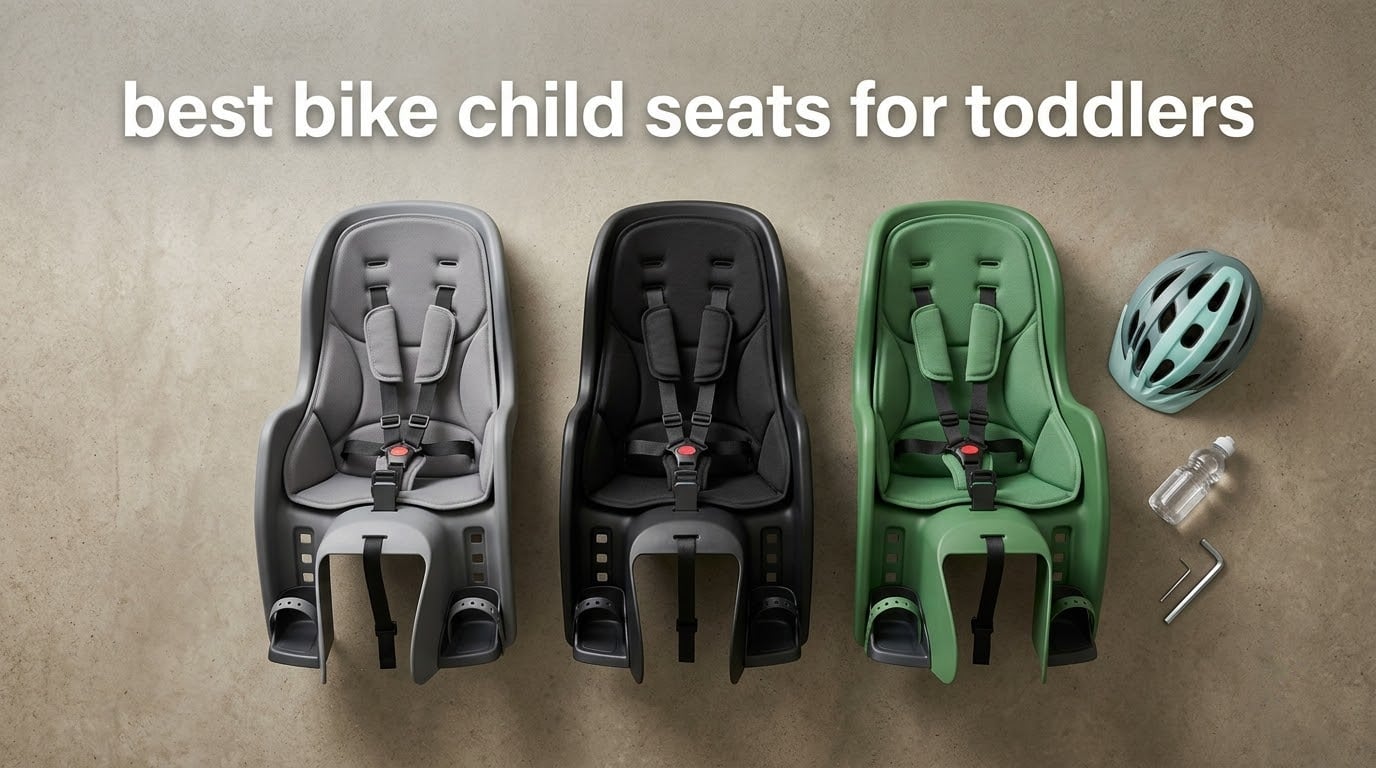
Most families start using a bike seat at 12 months, and that is the number to plan around. The American Academy of Pediatrics advises waiting until a child is at least a year old and can sit unsupported before adding a child seat, then starting with short, flat, low-speed rides so the first trips are boring in the best possible way.
Picking from the best bike child seats for toddlers is harder than it looks, because the deciding factor is rarely the seat itself. It is whether the mount physically fits your bike, and whether the seat will still fit your child a year from now. Those two questions eliminate more options than any feature list does.
We worked through the ten most-reviewed child seats in this category, read the owner feedback in detail, and lined the specs up side by side so you can see where each one actually stops working. Everything below is written for parents of children roughly 12 months to 3 years old, which is the window where bike seats get returned, outgrown, or quietly collected in a garage.
Nothing here is sponsored, and we have not tested every seat on real pavement. Where a number comes from a manufacturer or from owner feedback rather than our own riding, we say so. We also left out the seats sold on marketplace sites with no certification and no track record, because bike compatibility and safety are not places to improvise.
When Can a Toddler Ride in a Bike Seat?
A toddler can ride in a certified bike seat from about 12 months old, once they can sit unsupported, hold their head steady, and grip the child handlebar without support. The four things that actually decide readiness are head control, a harness that fits at the shoulder, a properly fitted helmet, and a route that has no traffic.
Two weight numbers come up constantly and they are not the same. ASTM F1625 is the US standard and it tops out at 40 lb. EN 14344 is the European standard and it allows up to 48.5 lb. Plenty of listings print the higher EU figure on a seat that was never certified to US limits, so treat the US-listed limit as the real ceiling and check the certification line before you buy.
ASTM compliance is not legally enforced for bicycle child seats in the US, which is exactly why uncertified seats are still easy to find. That is a good reason to buy from a brand that publishes its certification and stands behind the seat, and a good reason to skip the marketplace listing with a photograph and no test data.
Front-Mounted vs Rear-Mounted vs Open Mid-Mount Seats
For a 2-year-old, a front-mounted harness seat or a small rear-mounted seat is the right answer, and a rear seat is usually the one that survives past age three. Open mid-mount seats without a harness suit confident riders roughly 2 to 5 years old and up to 60 lb, which is past the toddler stage for most families.
Front-mounted seats clamp to the headset or stem. You can see your child, talk to them, and check the harness without stopping, which is why many parents choose them for a one- or two-year-old. The trade-off is handling: the weight moves forward, steering feels heavier, and short riders can end up pedalling with splayed knees. Front seats also tend to have lower weight limits, so many families buy twice.
Rear-mounted frame and rack seats carry the load behind you. They stay stable at speed, ride smoother, and usually allow a higher child weight. The cost is that you have to twist around to check the harness, and a rear load raises the centre of gravity on loose surfaces. A rear rack seat needs a rack rated for at least 60 lb, and panniers cannot share that rack with a child in the seat.
Open mid-mount seats sit between handlebars and saddle with a grab bar instead of a harness. They are excellent for a confident 4-year-old on a bike with a full-suspension fork, and a poor match for a 2-year-old who still wriggles. None of the ten seats in this roundup are open mid-mount, because the toddler brief rules them out.
Our Top 3 Bike Child Seat Picks for Toddlers in 2026
Schwinn Deluxe Child Carrier
- Frame mount
- ages 1+ to 40 lb
- Quick-release removal
- Removable headrest


Thule Yepp 2 Mounted Seat
- Rack mount
- 9 months to 5 years
- Childproof five-point buckle
- Metal security lock
All 10 Picks at a Glance in September
| Product | Specifications | Action |
|---|---|---|
| Schwinn Deluxe Child Carrier |
|
Check Latest Price |
| Bell Cocoon 300 Rear Seat |
|
Check Latest Price |
 iBert Front Mount Seat iBert Front Mount Seat |
|
Check Latest Price |
 BELL Shell Rear Carrier BELL Shell Rear Carrier |
|
Check Latest Price |
 UrRider Front Mount Seat UrRider Front Mount Seat |
|
Check Latest Price |
 Peg Perego Orion Peg Perego Orion |
|
Check Latest Price |
 XIEEIX Front Seat XIEEIX Front Seat |
|
Check Latest Price |
 XIEEIX Foldable Front Seat XIEEIX Foldable Front Seat |
|
Check Latest Price |
| Thule Yepp 2 Mounted Seat |
|
Check Latest Price |
 OUSEXI Rear Frame Seat OUSEXI Rear Frame Seat |
|
Check Latest Price |
1. Schwinn Deluxe Child Carrier – Best Overall Rear Frame-Mount Seat
Pros
- Most-reviewed seat in the group with 5301 ratings
- Quick-release lets you drop the seat and keep the rack on the bike
- Removable headrest and foam padding
- Converts to a plain rear rack carrier when the child seat comes off
Cons
- Three-point harness gives up restraint compared with five-point systems
- Needs a compatible adult bike rack or frame mount
This is the seat we keep coming back to, and the reason is boring rather than exciting: it has 5301 ratings averaging 4.5, which means the design has been stress-tested by more families than anything else on this list. The shell is polypropylene, the padding is foam, and Schwinn backs it with a limited lifetime warranty.
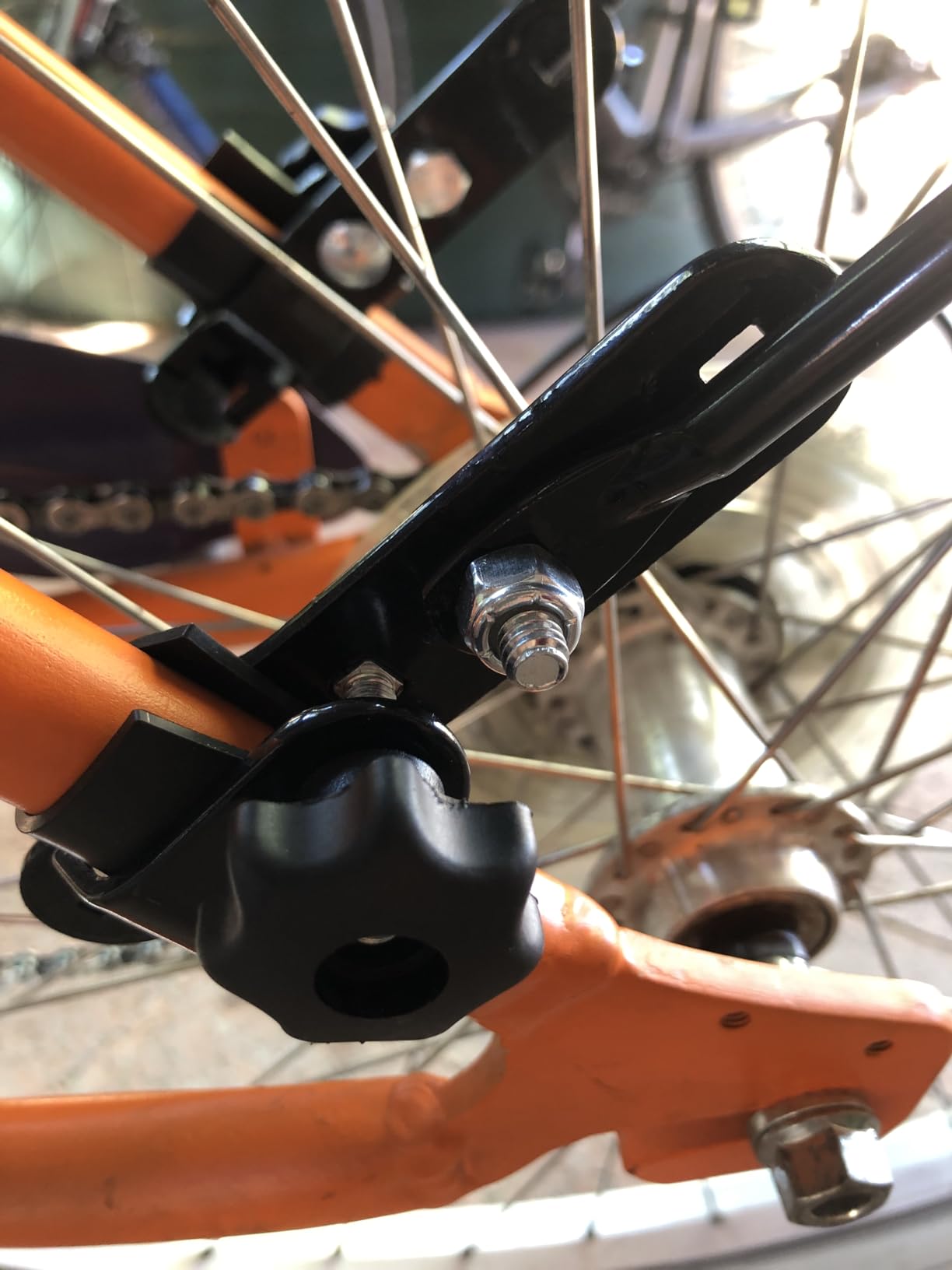
The mount is a rear frame mount, and the quick-release design is the part that changes daily life. You take the seat off in seconds and the rack stays bolted to the bike, which is the difference between a seat you use every day and one that lives in the garage because removing it is a chore.

Owners consistently single out the padding and the removable headrest, and the adjustable footwells that grow with the child. The 3-point harness adds leg restraints, which is a small touch that most seats at this level skip, and it is why this model still works for a 3-year-old even though the number on the label says 40 lb.
The honest drawback is the harness itself. Three points is two fewer than the five-point systems used by the Bell Cocoon and the Thule, and parents of escape-artist toddlers mention reaching back to re-buckle as a routine part of the ride. If your child is the type who works at buckles, weight that against the otherwise excellent fit and finish.
Who this seat suits
Families who want a rear seat, own a bike without a rack, and want one install that works for years. The conversion to a rack carrier also makes it the most useful seat to buy if you have a second child to come, because the same frame carries cargo.
What to check before you buy
Measure your seat tube and confirm the clamps clear your brake and gear cables, since cable routing on the seat tube is the most common reason a frame mount will not go on. The listed maximum is 40 lb, which matches the US certification ceiling rather than exceeding it.
2. Bell Cocoon 300 Rear Seat – Best Low-Cost Five-Point Harness Seat
Pros
- Five-point harness at a fraction of premium carrier cost
- Integrated molded spoke guard keeps feet away from the wheel
- Included rear reflector for visibility
- Hardware and step-by-step instructions in the box
Cons
- Requires an existing compatible rear rack
- Will not fit bikes with rear suspension
- Feels less settled than a frame mount on broken pavement
The Cocoon 300 exists to do one thing properly: give you a real five-point harness without the premium tier price. With 3791 ratings it is the second most-reviewed seat we looked at, and 62% of those ratings are five stars, so the value proposition holds up under a lot of use.
It mounts to an existing rear rack rather than the frame, which is both its cheapest feature and its main constraint. The wrap-around bucket gives side-impact protection, the molded spoke guard is integrated into the shell, and a rear reflector is included, which saves you buying one separately.
Buyers cite the five-point harness and the spoke guard as the two reasons they are happy, and both are the parts a cheaper generic carrier usually leaves out. The harness is adjustable across a real range rather than a token strap, so it fits a 15-month-old and a 3-year-old in the same seat.
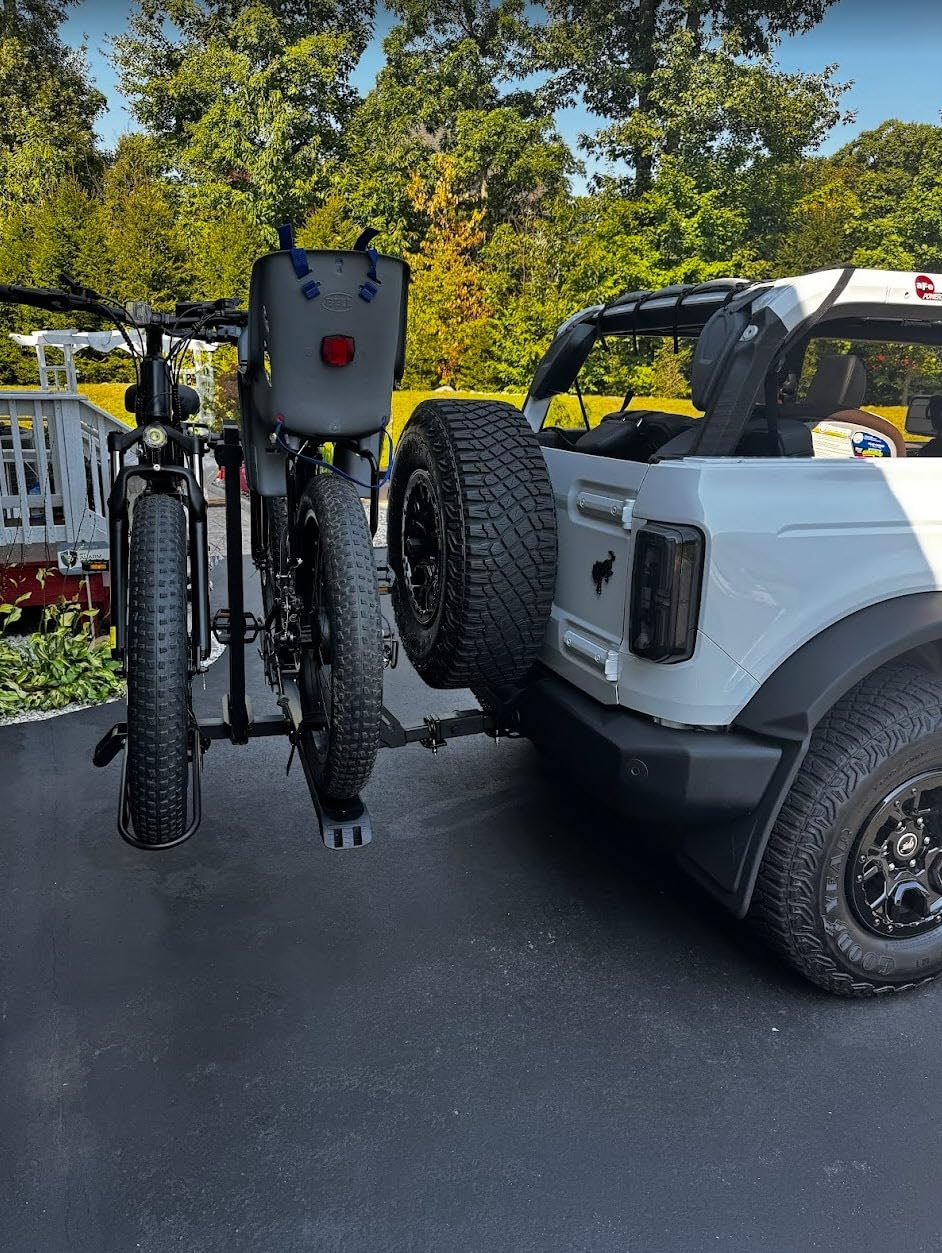
The limit is compatibility. It fits 26-inch and 27-inch bikes without rear suspension, and the rack must already be on the bike and rated for the combined load. If you are starting from a bare frame with no eyelets, this is not a drop-in purchase.
Who this seat suits
Parents on a budget who already own a decent rear rack and want a five-point harness more than they want a frame mount. It is also a good second seat for a second bike, since racks are cheaper than clamps.
What to check before you buy
Confirm the rack weight rating is at least 60 lb before a child goes in the seat, and do not plan to hang panniers on the same rack. Check that the bike has no rear suspension, because the mount geometry does not work with it.
3. iBert Front Mount Seat – Best Front-Mounted Toddler Seat
iBert Front Mounted Child Seat with Patented Mounting for Easy and Secure Installation – Child’s Bike Seat with 3-Point Safety Harness and Adjustable Foot Cups – Durable Plastic Shell, Green
Pros
- Patented narrow stem mount stays clear of the rider knees and bars
- Tool-free install with a full hardware kit
- Child stays in the rider sightline
- Plastic resin shell wipes clean
Cons
- Three-point harness rather than five-point
- Needs 52-62 mm stem spacing
- Front weight changes steering and braking
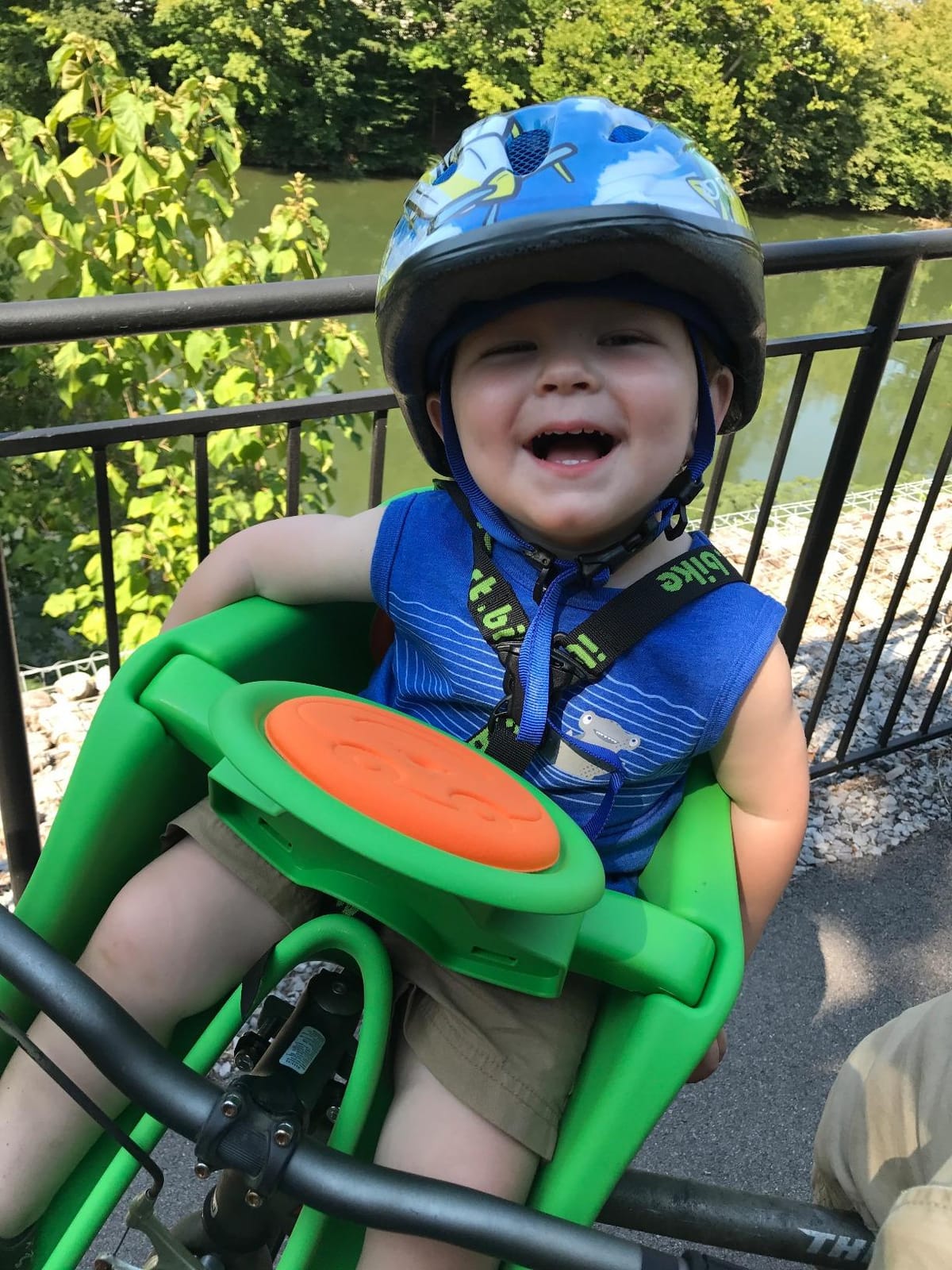
If your child is under 2 and still wiggly, a front seat solves a problem rear seats create: you can check the harness without dismounting. The iBert has 1830 ratings at 4.4 with 70% five stars, and the recurring theme in the feedback is that it disappears out of the way of the adult rider.
That narrow profile is the patented bit. The seat mounts to a stem with 52 mm to 62 mm centre-to-centre bolt spacing using a tool-free bracket, and it clears your knees and your handlebars in a way that most front seats do not. Rated for ages 1 to 3 and heights from 2 ft 5 in to 3 ft 2 in, up to 38 lb.
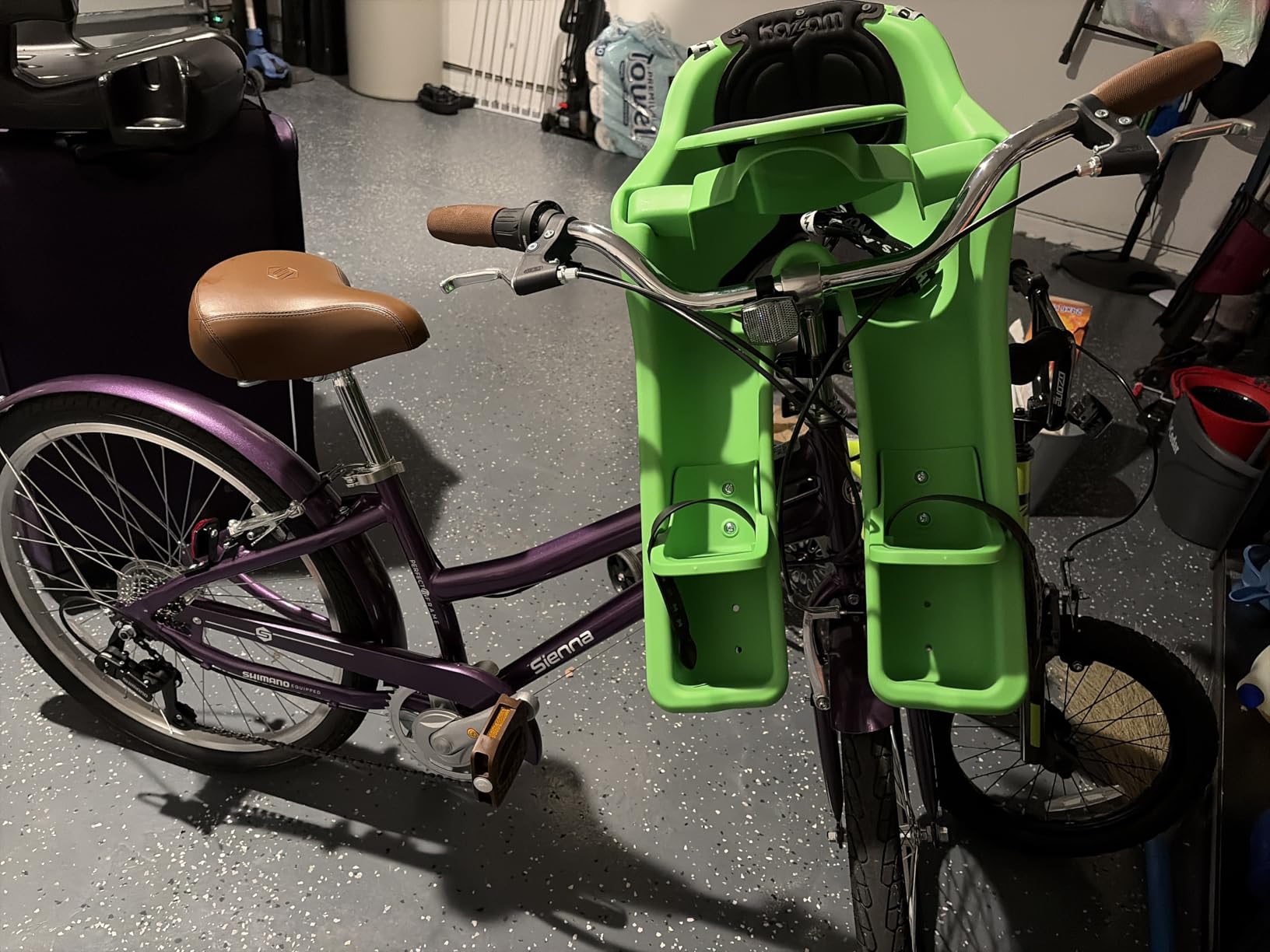
It weighs 3.7 lb, which matters when you are swapping bikes, and the plastic resin shell handles sun and light rain without any special treatment. The small dashboard and steering wheel are not accessories, they are built in, and they occupy your toddler for a surprising number of minutes.
Three cautions come straight from the owner feedback. It is a three-point harness, the front load noticeably changes steering and braking as the child grows, and the 52 to 62 mm stem requirement rules out plenty of bikes, including a good number of older and unusual frames.
Who this seat suits
City, cruiser and hybrid riders with a standard stem who want eye contact and quick harness checks on short trips. It suits a 15-month-old far better than a 3-year-old, because the 38 lb cap arrives early.
What to check before you buy
Measure the stem clamp spacing before anything else, then test your knee clearance while seated. Riders under about 5 ft 4 in often splay their knees around a front seat and end up needing shorter cranks to pedal comfortably.
4. BELL Shell Rear Carrier – Best for Hot-Weather Riding
Pros
- Ventilated shell is the standout feature in summer heat
- Adjustable foot beds grow with the child
- Foam pad is machine washable
- Fast and secure installation on most bikes
Cons
- Three-point harness offers less restraint
- Not compatible with bikes that have rear suspension
- 40 lb listed capacity is the US certification ceiling
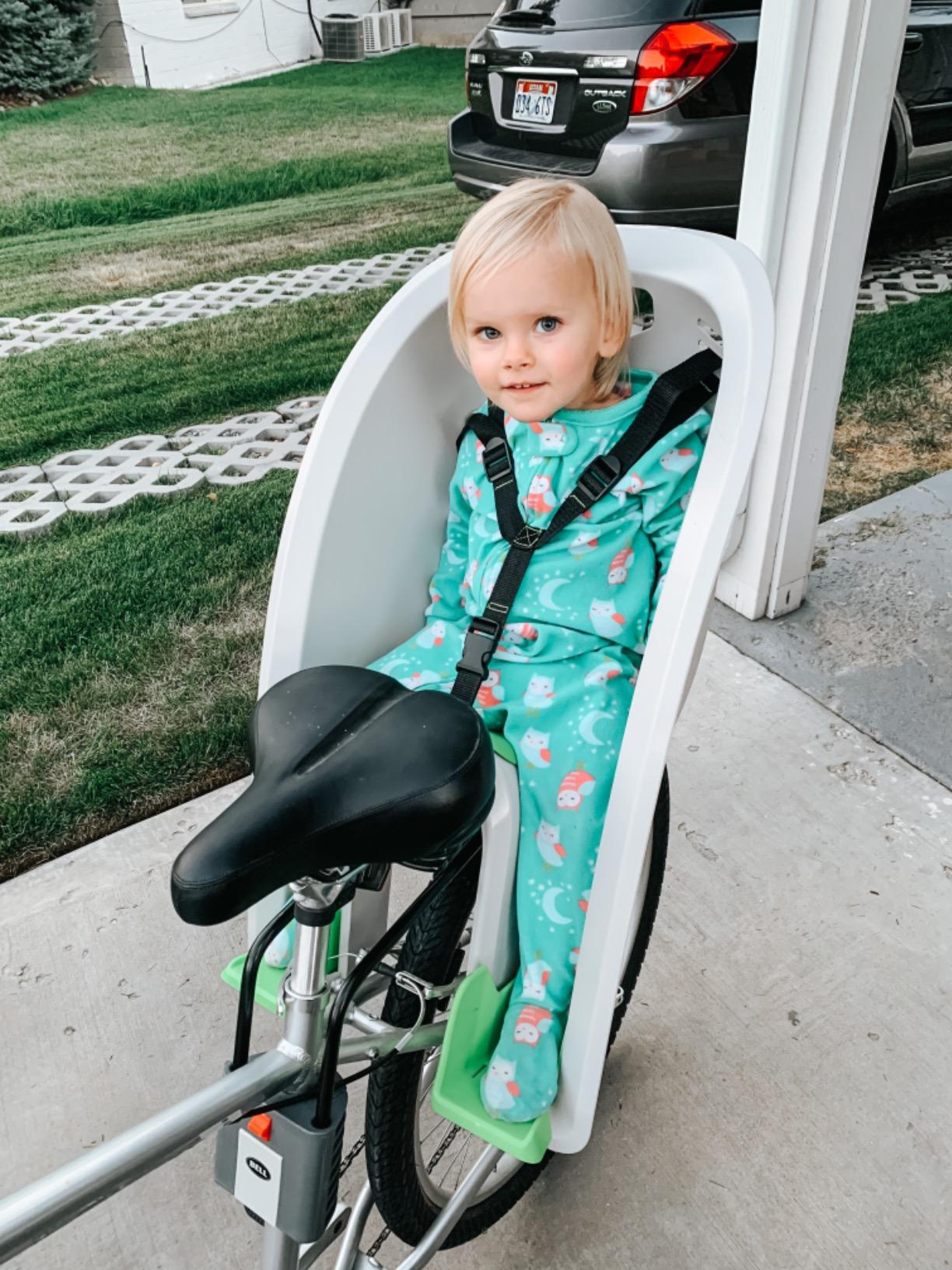
If you ride in a hot climate, ventilation is the first thing to check and this is the only seat in the group built around it. The shell is vented rather than padded shut, and at 1266 ratings averaging 4.1 it has a settled owner base rather than a burst of new reviews.
It is a rear rack carrier holding up to 40 lb, with a 3-point harness, a foam seat pad, and adjustable foot beds designed to grow with the child. The whole thing is 16.75 by 12 by 30.88 inches and the pad is machine washable, which matters more than it sounds after a summer of sticky hands.
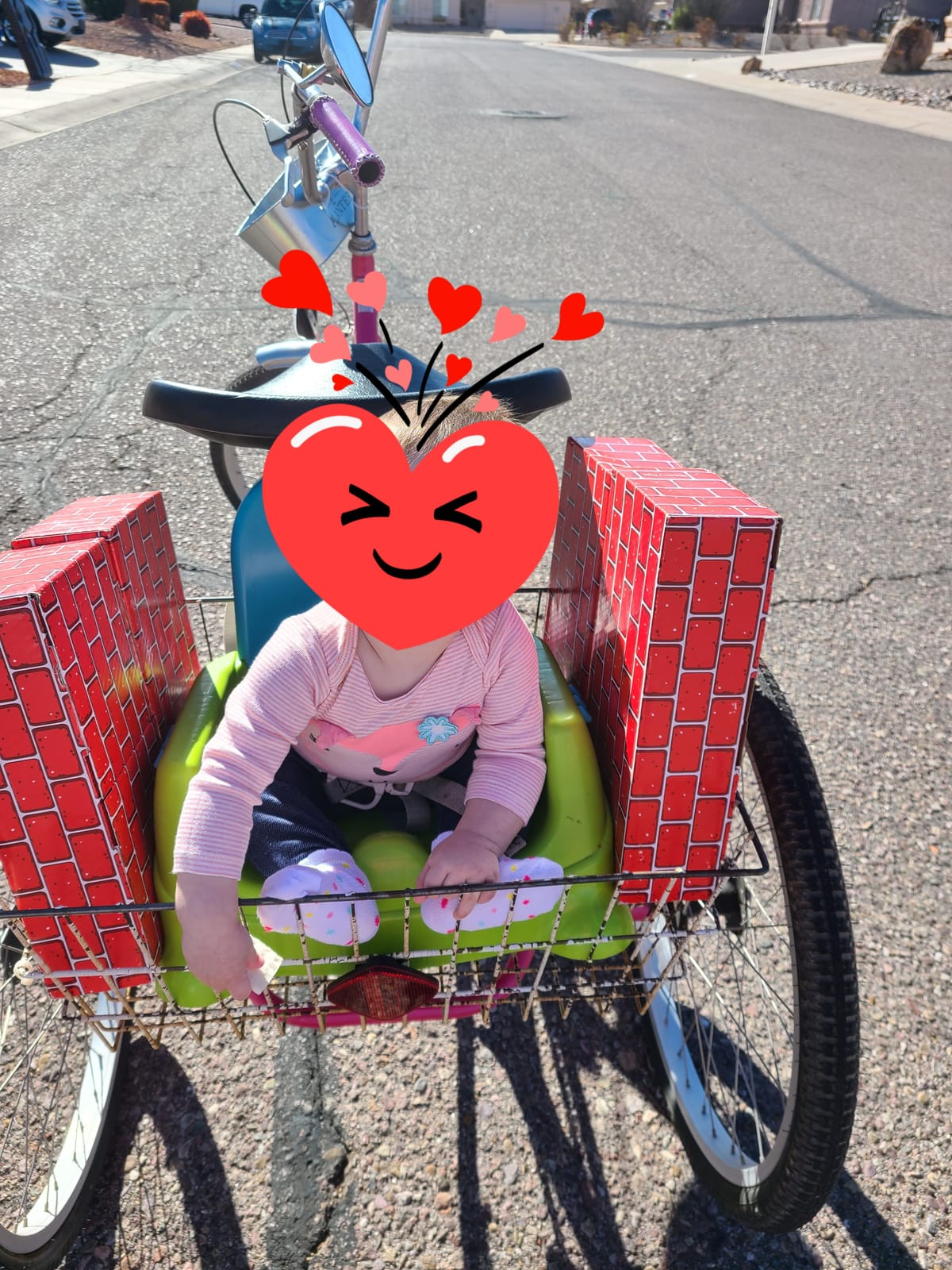
Owners praise the ventilation and how quickly it goes on and comes off. Sixty percent of ratings are five stars, and the complaints cluster in two places: the three-point harness, and the fact that it will not work on a bike with rear suspension.
At 4.1 this is the second-lowest average in the roundup, and the feedback tells you why. Nothing here is a defect, but nothing here is a standout either, which makes it a sensible buy only when the vented shell solves a problem you actually have.
Who this seat suits
Summer riders on rigid-frame bikes with a rack, and parents who launder the padding regularly. The vented shell makes it the most sensible seat here for a child who sweats easily or wears a helmet for the whole ride.
What to check before you buy
Rule out any bike with rear suspension, and check your rack is rated for 60 lb. If your child is already working at buckles, look at a five-point seat instead, because the 3-point harness will not stop them.
5. UrRider Front Mount Seat – Highest Weight Capacity and Lightest Build
Pros
- 60 lb capacity is the highest in the group
- Weighs about 2.9 lb in aluminum and folds for storage
- Installs in about 60 seconds tool-free
- Cushioned seat with child hand grips
Cons
- Requires handlebar beam 5.5 cm or narrower
- Not compatible with road bikes or carbon frames
- Front mounting changes handling with a loaded child
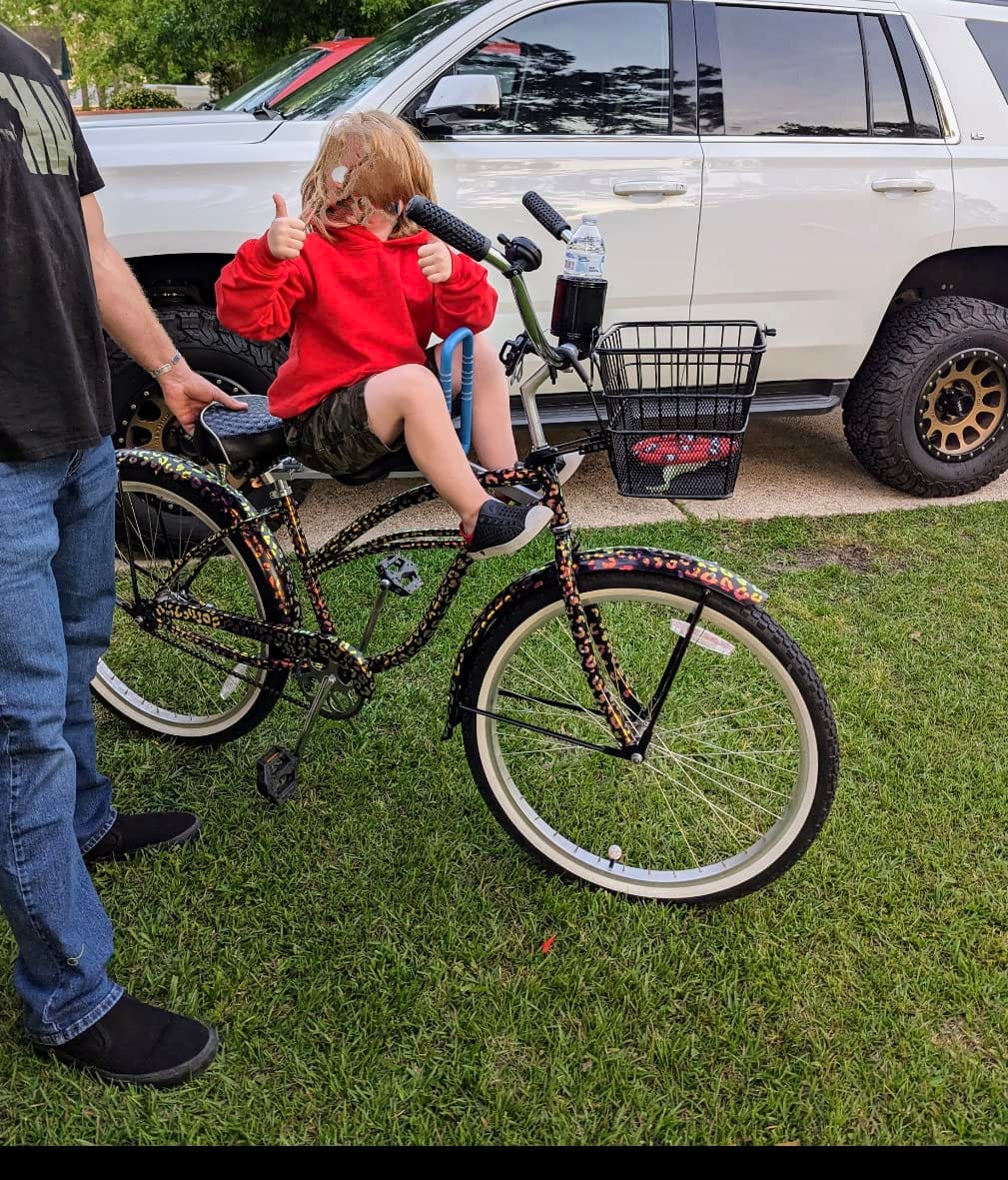
This is the one to buy if your toddler is big for their age, or if you want a single front seat that covers a 2-year-old and a 5-year-old. The 60 lb limit is the highest in the roundup, and the aluminum body weighs about 2.9 lb, which makes swapping between two bikes realistic instead of aspirational.
It holds 4.5 stars across 898 ratings with 75% five stars, and the fitting is genuinely quick: a tool-free quick release that installs in about 60 seconds and comes off in about 30. The seat cushion is foam with child-friendly hand grips, and the frame fits most mountain and hybrid bikes.
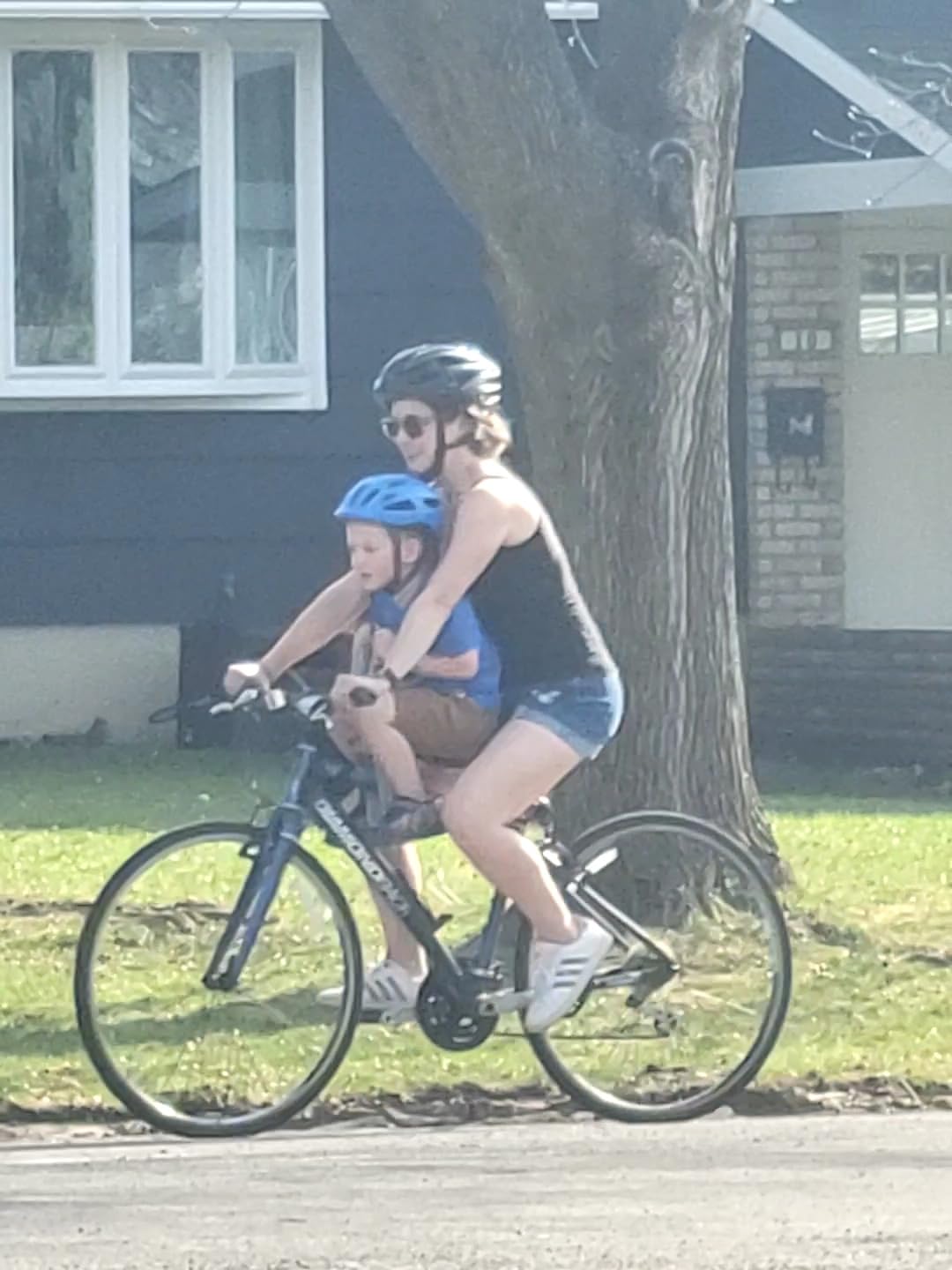
One measurement decides this purchase. The mount needs a handlebar or battery compartment beam 5.5 cm or narrower, so measure before ordering, because a wide modern cockpit will rule it out. Road bikes and carbon frames are explicitly excluded.
Remember this is a 2-to-6-year-old seat. A toddler under 2 will be small in it, and the 60 lb figure is what keeps it in service for years rather than what makes it a good first seat. Handling changes with weight in front, so leave extra stopping distance on descents.
Who this seat suits
A family with a 2-year-old who will still be riding in three years, or a couple with two bikes and one seat. Folding flat and weighing 2.9 lb also makes it the easiest to move in and out of a car.
What to check before you buy
Measure the beam width first. Then check that the seat does not foul your bars through a full steering lock, which is where narrow-cockpit bikes and this kind of seat can fight each other.
6. Peg Perego Orion Front Seat – Best Ride Quality on Small Frames
Pros
- One-click clamp attaches and releases in about 10 seconds
- Support spring in the seat gives a notably smooth ride
- Three-position adjustable footrests
- Compact mount barely registers when riding solo
Cons
- Low 33 lb limit means an early second purchase
- Knee tap on the handlebars in tight turns
- Photo-only instructions
The Orion is the most refined ride in this group and the smallest in terms of who it will fit. With 306 ratings at 4.4 and 70% five stars, it is also the least-reviewed seat here, so treat the feedback as thinner evidence than the numbers on the big names.
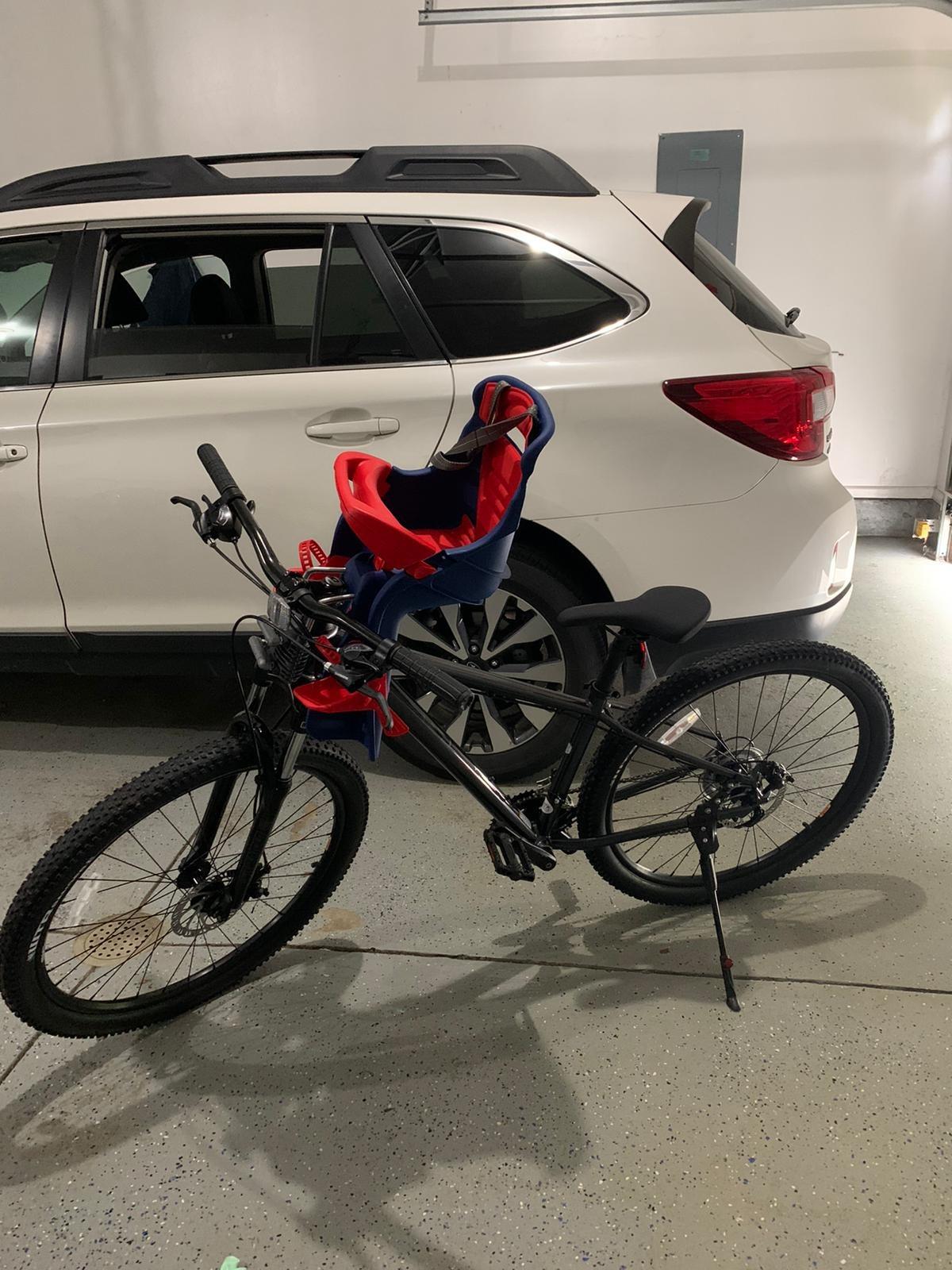
It clamps to bicycle frames from 32 mm to 52 mm, uses a one-click system to attach and detach in roughly ten seconds, and has a gel pad plus a support spring in the seat that owners single out as noticeably smoother than foam-only designs. Three-position adjustable footrests and an adjustable 3-point harness round it out.
The two-year warranty and the 4.9 lb plastic body both read as quality. Dimensions are 17.7 by 13 by 24.3 inches, and the seat is rated for 12 months and up, 33 lb and 36.5 inches tall.
That 33 lb cap is the reason this is a two-year-old purchase rather than a family seat. Reviewers also report that the child’s knees can tap the handlebars in tight turns, and the instructions are photographs only, which can make the first install slower than it should be.
Who this seat suits
Short trips on a small-framed bike where smooth ride quality matters more than longevity. If your frame is a step-through or a small 47 cm, the 32 to 52 mm clamp range is the reason this one fits.
What to check before you buy
Measure your frame tube diameter and your child’s current height. If your child is already near 33 lb or tall for their age, skip this and go to a 40 lb or 60 lb seat to avoid buying twice.
7. XIEEIX Aluminum Front Seat – Best for Unusual Frames
XIEEIX Front Mounted Child Bike Seat, Kids Bike Seat with Guardrail, High Seat Cushion Backrest Mountain Bike Child Bike Seat, Bicycle Child Safety Seat for Children from 1 to 3 Years Old
Pros
- Fits odd frames such as 29-inch big-wheel BMX and folding bikes
- Multi-angle mounting rod with four-hole adjustment
- Integrated one-piece cushion and backrest
- Aluminum telescopic footrest adjusts for length and angle
Cons
- First installation is fiddly
- Side guard rails can catch the rider knees
- Some owners report needing to re-tighten the mount
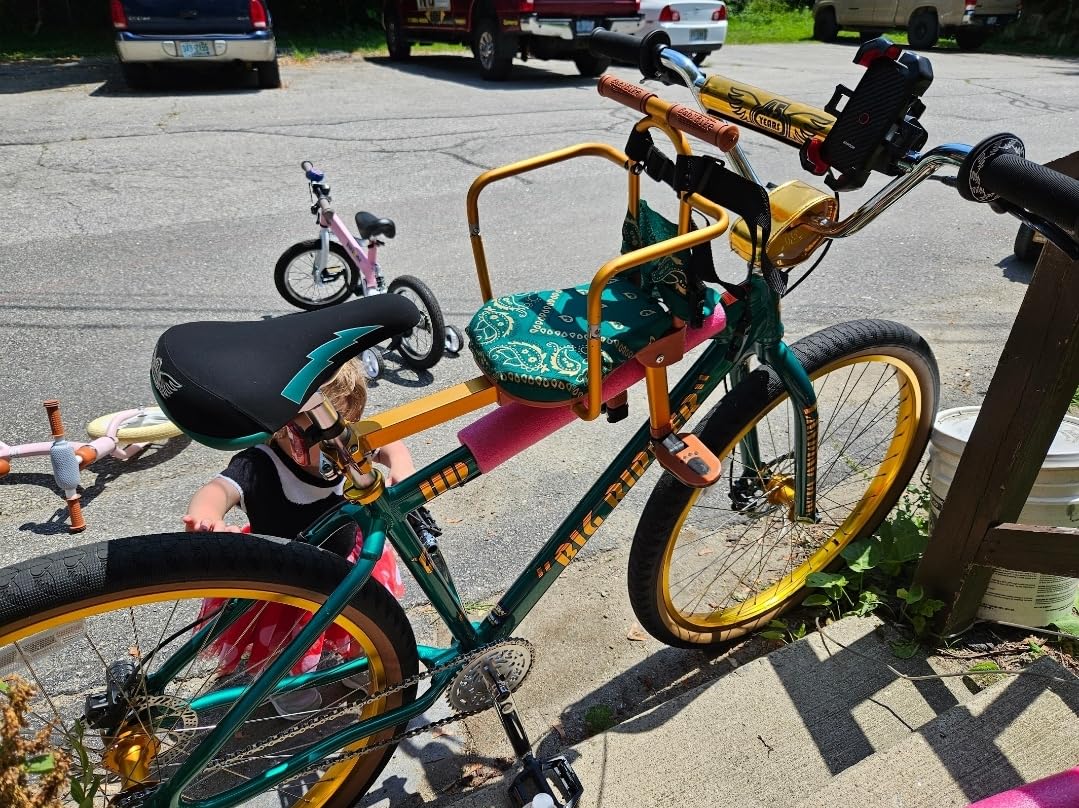
Every other front seat here needs a specific stem spacing or beam width. This one uses a multi-angle mounting rod fixed with four-hole screws, and that flexibility is why owners report it working on 29-inch big-wheel BMX bikes and folding bikes that nothing else would take.
It is aimed at ages 1 to 3, weighs 2.5 kg, and comes as a portable folding design with a foldable handlebar and pedals for compact storage. The seat is a one-piece cushion and backrest rather than separate pads, and the aluminum telescopic pole footrest adjusts for both length and angle.
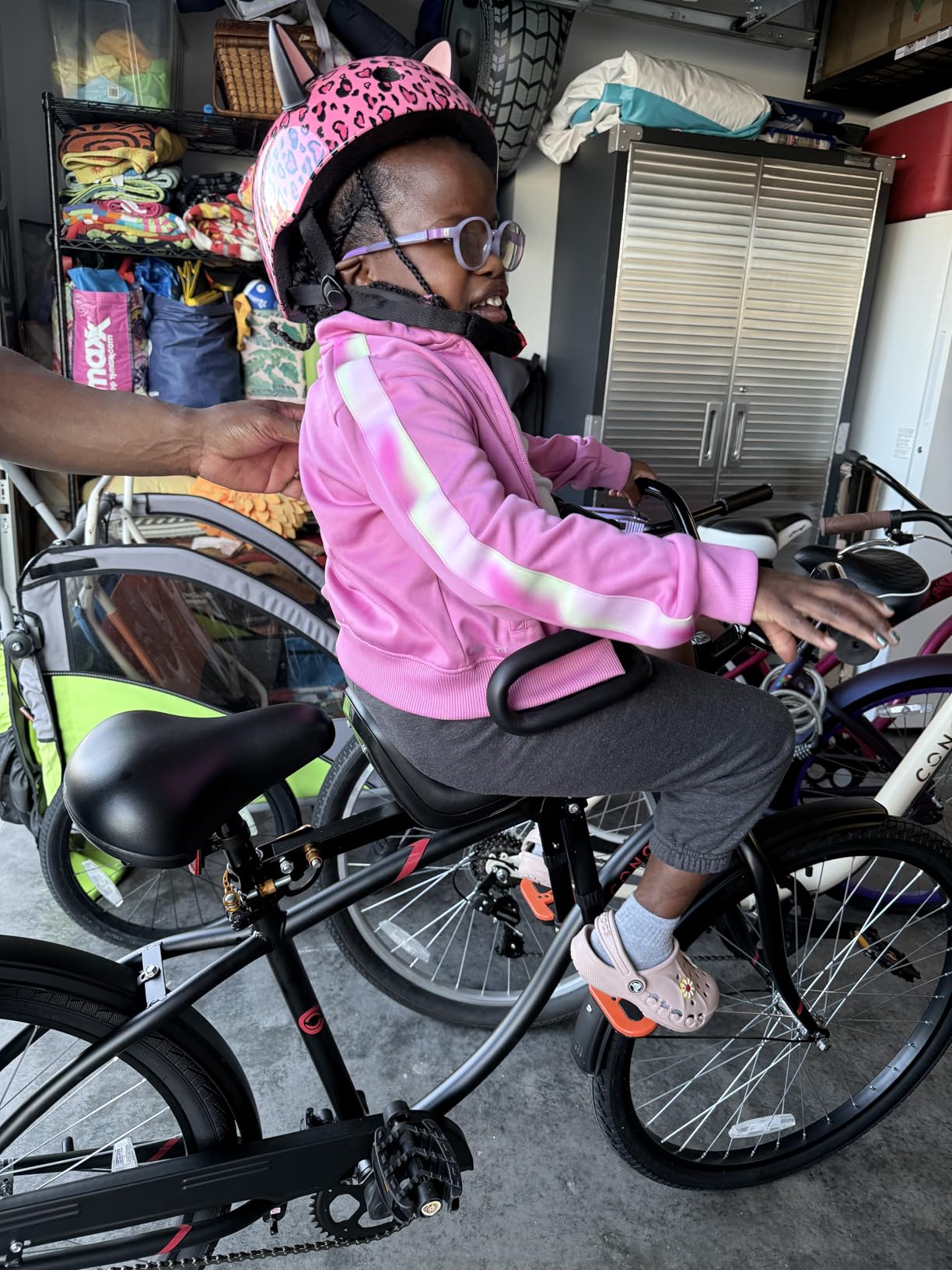
The flip side is at 4.1 stars with a 61% five-star share and a 12% one-star share. Owners report the first installation is genuinely fiddly, and some report the mount needing re-tightening or feeling loose. It is intended for mountain bikes and bikes with a top crossbar.
Guard rails are another recurring theme: they can catch your knees and turn a long ride uncomfortable. For a 20-minute school run that is nothing, for an hour on the weekend it adds up.
Who this seat suits
Owners of folding bikes, big-wheel BMX bikes, or any frame where a stem-mounted seat will not bolt on. The folding handlebar and pedals also make it the easiest to store in a small hallway or garage.
What to check before you buy
Check your knee clearance with the guard rails in place before riding far, and re-check the mount bolts after the first few rides. If you are not comfortable with a rod-style mount, a stem-clamp seat is easier to set up correctly.
8. XIEEIX Foldable Front Seat – Best for Folding E-Bikes
New Aluminum Alloy Kids Bike Seat – Portable, Foldable Front Mounted Child Bicycle Seat for Children 1-3 Years
Pros
- Folds small enough to fit a drawstring backpack
- Front buckle fits beams 1.3 to 1.88 inches wide
- Guard rail plus safety belt for containment
- Aluminium alloy frame with four-level pedal adjustment
Cons
- Side rails force a bow-legged pedalling stance
- Blocks a step-through frame so the bike is hard to mount
- Limits steering range
Rack-mounted rear seats struggle on folding e-bikes because there is rarely a rack to mount to. This seat solves that by clamping the front beam between 1.3 and 1.88 inches wide, and the whole thing folds down into the included carry bag.
It holds up to 50 lb on an aluminum alloy and steel tube frame, with folding armrests and pedals, four-level pedal adjustment, a thick waterproof pad, and a skid-proof armrest. At 1.96 kg it is one of the lighter front mounts, and the safety belt and guard rail keep the child contained.
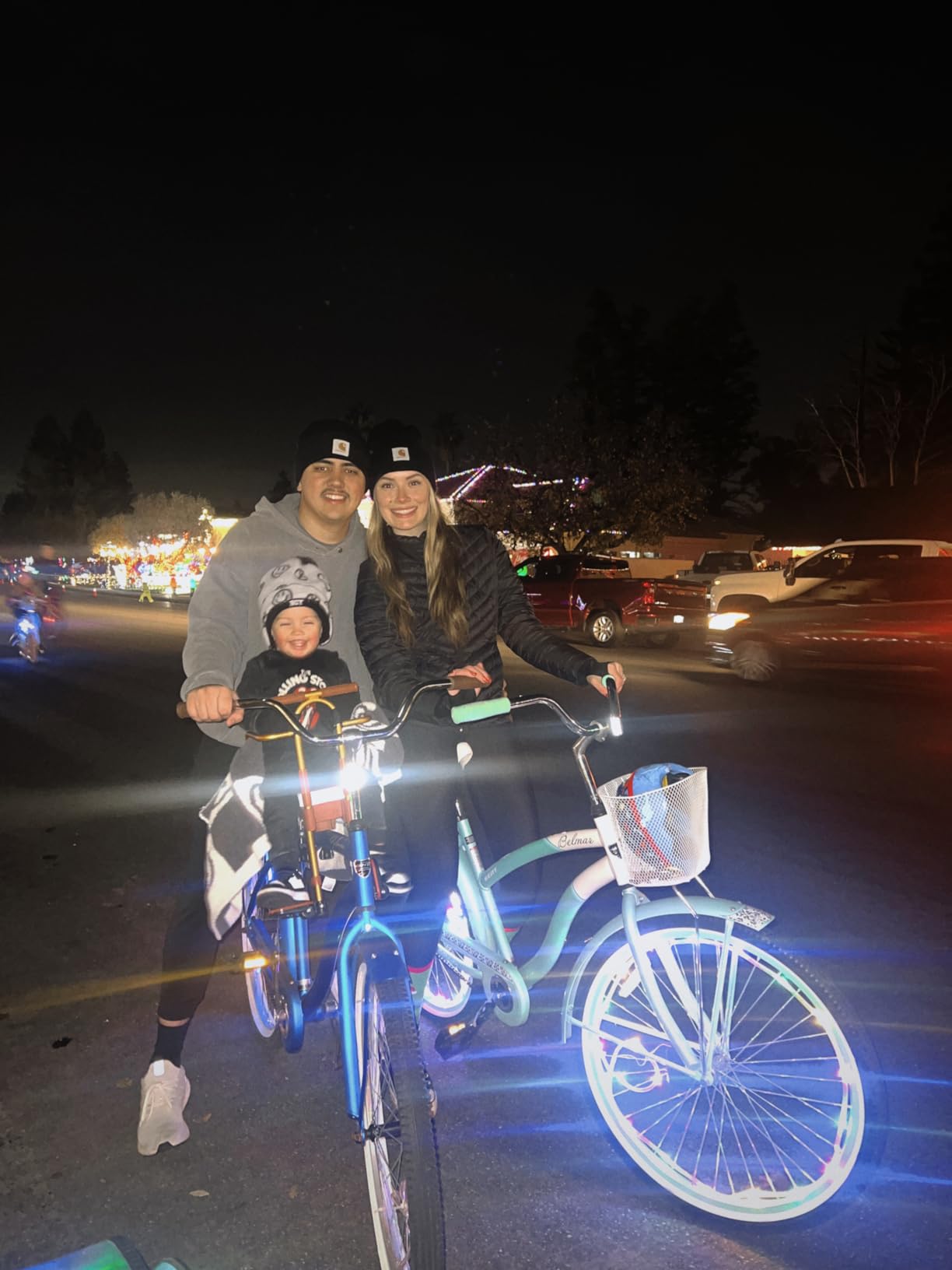
What owners consistently report is that it works well for short leisure rides and swaps between bikes easily. The included quick installation wrench means you are not hunting for tools at a kerbside stop.
The complaints are about your position, not the child. Side rails force a bow-legged stance and rub inner thighs on longer rides, the seat blocks a step-through frame so mounting the bike gets awkward, and shorter riders report reaching on their toes.
Who this seat suits
Folding-bike and folding e-bike owners who need one seat for two bikes, and anyone riding a hybrid or cruiser on short paved trips. The 50 lb limit gives a much longer service life than most front seats.
What to check before you buy
Measure the front beam width and confirm it sits between 1.3 and 1.88 inches. Then pedal for ten minutes in a gear you use daily and decide whether the side rails bother you before committing.
9. Thule Yepp 2 Mounted Seat – Best-Engineered Rear Seat
Pros
- Highest five-star share in the group at 82%
- Childproof buckle on a padded 5-point harness
- Adjustable footrests and footstraps that fit a growing child
- Metal security lock deters theft
Cons
- Harness length adjustment is awkward
- Not a good sleep seat because a dozing child slumps forward
- Dark colourways heat up in direct sun
The Thule Yepp 2 Mounted is the best-engineered rear seat here, and the ratings support that claim: 4.5 stars with 82% five-star ratings, plus a number 2 sales rank in Bike Child Seats. It is the only seat in this roundup rated from 9 months to 5 years, up to 40 lb.
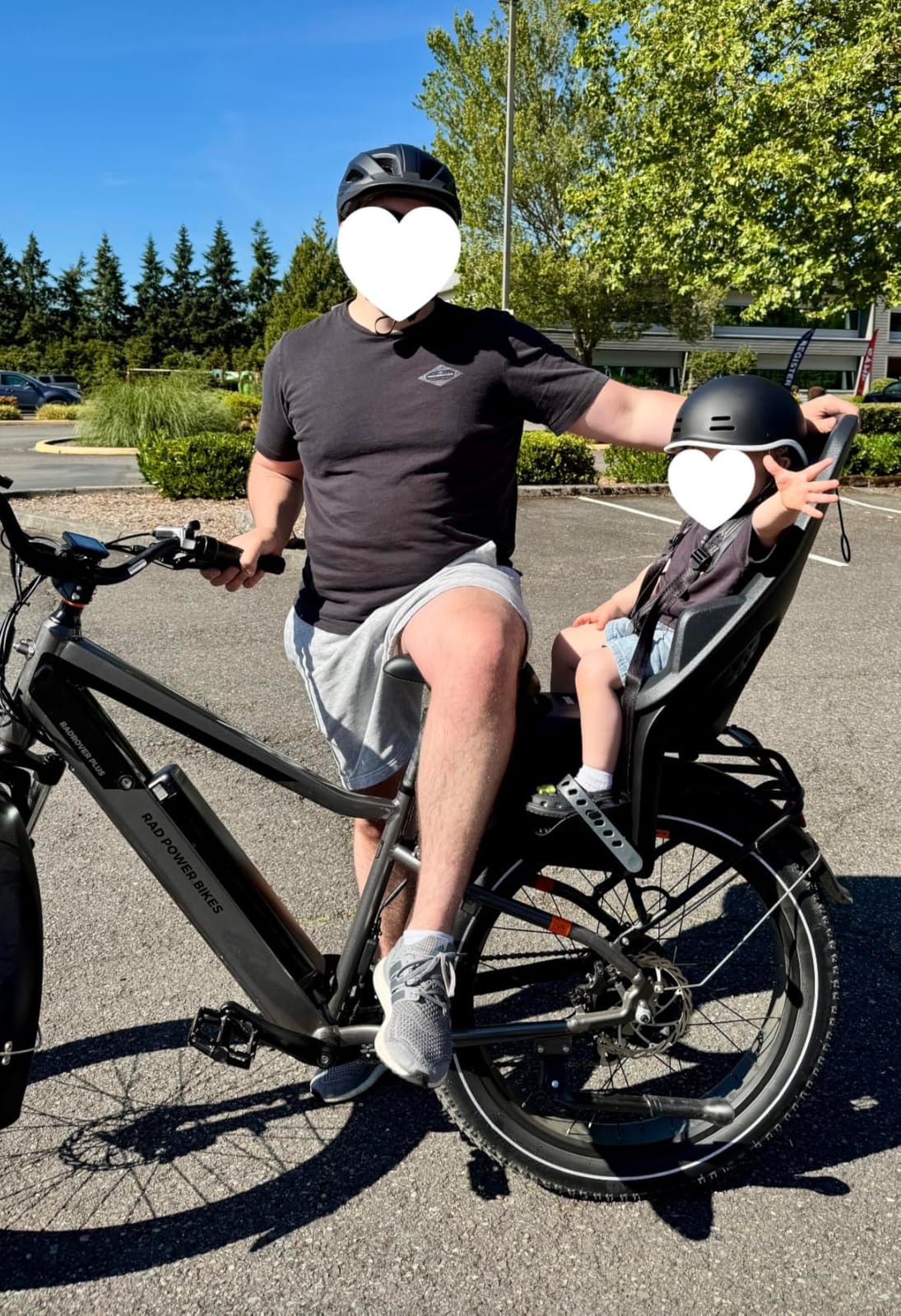
The mount is a universal rack system, so it goes on and off a rear rack quickly and transfers to a second bike without tools. The seat is soft shock-absorbing foam in water-repellent material, footrests and footstraps both adjust, and there is a built-in reflector with a light attachment point plus a metal security lock.
The harness is the safety story: a childproof buckle on an adjustable padded 5-point harness, which answers the buckle-escape problem that shows up repeatedly with 3-point designs. It weighs 4.72 kg and measures 19 by 17 by 36 inches, and Thule backs it with a limited lifetime warranty.
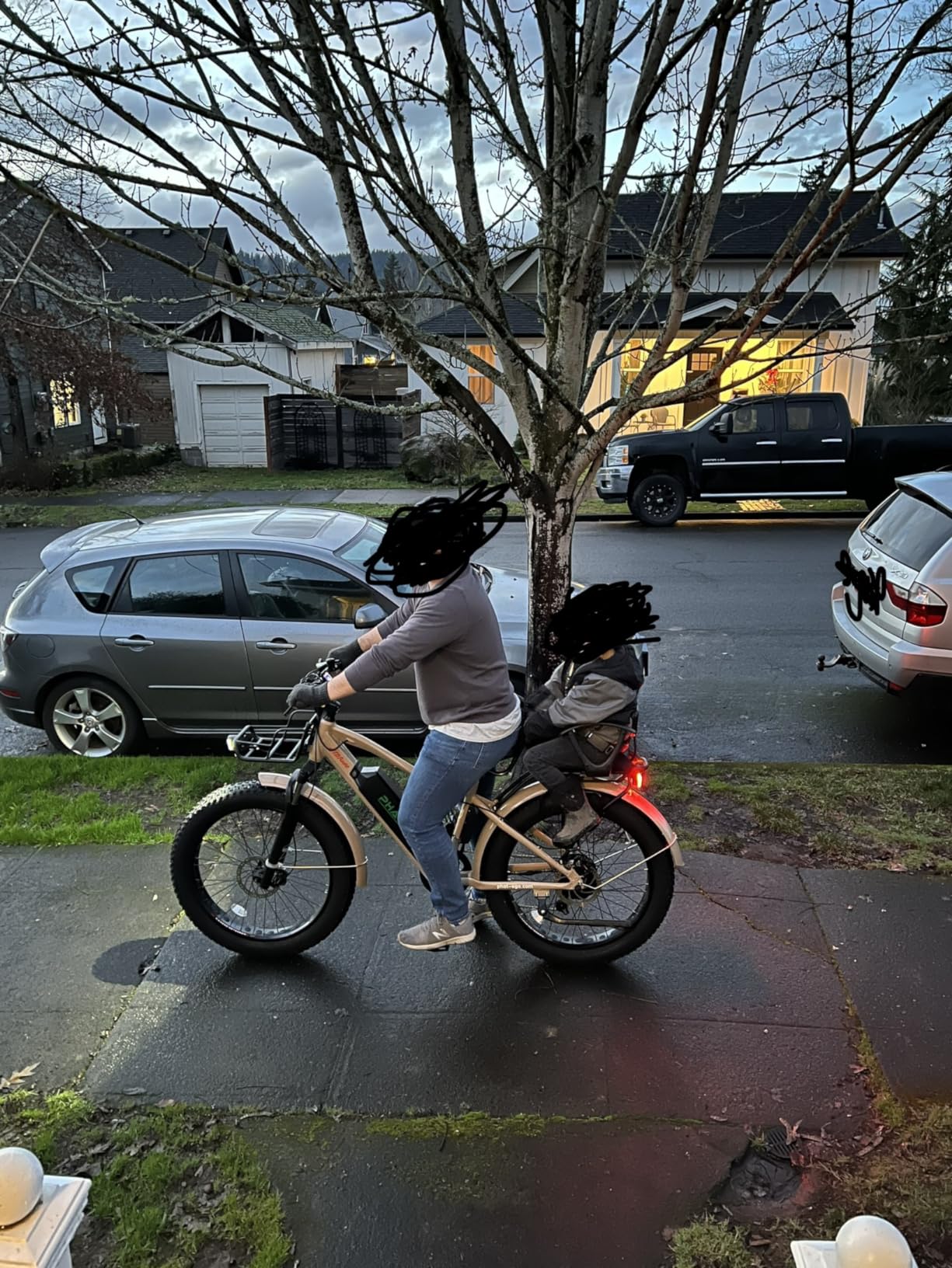
E-bike owners have asked specifically, on r/bicycling threads, whether this seat has been reported to detach with a child in it, and the reports are mixed, with many riders pointing out that correct torque on the rack and a load-rated rack are the deciding factor. Riders also note that a dozing child tends to slump forward, so it is not the nap seat you might hope for.
Who this seat suits
Parents who want a five-point harness with a buckle a child cannot work open, who are moving between two bikes, and who can accept 9 months as a start age and 5 years as the natural end. The soft sand colourway is the better choice in heat.
What to check before you buy
Confirm your rack is rated for at least 60 lb and has proper eyelets, and re-check the harness length every few months as the child grows. If your child naps on every ride, this is not the seat for you.
10. OUSEXI Rear Frame Seat – Best for Recline and Sunshade
OUSEXI 2025 New Rear Child Bike Seat, Child Bike seat for 1-3 Years Old,Rotatable Rear Mounted Toddler Bike Seat
Pros
- Two position modes for sitting upright or reclining
- Removable canopy and lap bar can be stripped off
- Roomy fit that some owners expect to last past age four
- Screw-on frame install with the tool included
Cons
- Foot supports have no safety straps
- Weak mounting straps and hardware reported by owners
- Needs 9.8 inches of frame clearance and under 7.2 inches wide
The distinguishing feature in this roundup is the recline. A split rear frame mount with two adjustable modes lets the child sit upright for the school run and lie back for the longer ride, and the removable sunshade canopy and lap bar strip off to leave a simpler padded seat.
It is rated to 40 lb with a three-point buckle belt, a wide backrest, soft sponge armrests, a seat cushion and thick foot pedals. Owners like the roomy fit, with several expecting it to last for a 4-year-old, and the package includes the seat, a manual and an installation tool.
There are real concerns in the feedback, and you should weigh them carefully at 66% five stars with 9% one-star ratings. The foot supports have no safety straps, which one reviewer linked to an ankle injury, and the mounting straps and hardware are described as weak, with some reports of the backrest detaching early.
Fit is also demanding. The split design screws to the rear frame and needs more than 9.8 inches of frame length clearance with frame width under 7.2 inches, and some frames have no proper mounting points, which forces improvised fixes. The warranty is one year, the shortest in the group.
Who this seat suits
Families on a bike with a compatible rear frame and long, unhurried summer rides where a recline and a canopy genuinely earn their place. Several owners expect the roomy fit to carry a 4-year-old.
What to check before you buy
Measure frame clearance and width before ordering, and inspect the mounting points on your bike. Add foot straps or a foot enclosure of your own, and re-check the backrest fixings before every long ride.
How to Choose a Child Bike Seat That Fits Your Bike
Compatibility is where most disappointed buyers are disappointed, and it is almost always a measurement problem rather than a quality problem. Work through these in order and you will know within five minutes which of the ten seats you can actually buy.
Step one, decide the mount. Frame mount needs a clear seat tube with no brake or gear cables crossing it and no bottle cage boss interference. Rack mount needs existing eyelets and a rack rated for at least 60 lb. Front mount needs a stem with compatible clamp spacing, or a front beam of a specific width range. The Schwinn, Bell Cocoon, BELL Shell, Thule and OUSEXI are rear mounts; the iBert, UrRider, Peg Perego and both XIEEIX seats are front mounts.
Step two, measure. Write down your seat tube diameter and any clearance you have around it, your rack load rating if you have a rack, your stem centre-to-centre spacing or your front beam width, and the top tube length for frame mounts. Owners report that cable routing on the seat tube and a low saddle are the two most common reasons a popular seat simply will not fit.
Step three, match the weight limit to your child, not your hopes. A 33 lb seat is outgrown at about 2 years old, a 38 to 40 lb seat carries most toddlers and many preschoolers, and a 50 to 60 lb seat is a five-year investment. Carbon frames and suspension forks rule out several front mounts outright, and dropper posts complicate frame mounting.
Step four, plan the install. Front beam and stem mounts are usually tool-free and take a few minutes. Rack mounts need a hex key and a load-rated rack. Frame mounts are the fiddliest because of cable interference, and the OUSEXI and Peg Perego clamps have tight dimensional windows. Budget an evening for the first frame mount, ten minutes for everything else, and re-torque the bolts after the first week.
Step five, think about your rider. If you are under about 5 ft 4 in, test knee clearance around a front seat before buying, because splayed knees and toes on the pedals are the most common complaint from shorter parents. If you ride a suspension-fork bike, load it with a child and test a descent early, because riders report the front end diving.
What changes as your toddler grows
At 12 months you need a seat that fits a child who cannot hold their head steady, which means a deep shell, a small back panel, and a recline or head support. Between 18 months and 2 years the harness becomes the thing you fight, and this is when a childproof buckle on a five-point harness starts earning its price. At 2 years the 33 lb front seats are at their limit and the 40 lb rear seats are just starting. By 3 years most families are outgrowing a toddler seat entirely, which is when a 50 to 60 lb front seat or a trailer keeps the ride going.
If the weather is bad and the ride stops, indoor options like our picks for climbing triangles for toddlers and climbing arches for toddlers burn the same energy indoors. For warm-weather trips that are not bike trips, our baby bath seat reviews cover the other end of the toddler equipment list.
Buying a used seat without gambling
Check the certification label first, then the model name against recall databases. The Thule RideAlong had a voluntary recall from March 2021 to October 2023 over DecaBDE flame retardant in the harness padding, and a used unit from before that window is worth checking carefully. Beyond recalls, look for cracks around the mounting clamps and the harness anchor points, check the harness straps for fibre breakage inside the webbing, confirm the buckle still locks in both positions, and make sure every supplied bolt, washer and clip is present. A used seat with a complete hardware set and an unbroken strap is a reasonable saving. A used seat missing hardware is a false economy.
E-bike and cargo bike notes
On an e-bike, torque is the factor people forget. Assist motors add weight to the rear of the bike, so a rack mount needs eyelets and a rack rated for 60 lb or more, and frame mounts must sit where the motor does not interfere. Cargo bikes usually have the built-in rack or MIK HD attachment point that standard racks are designed for, and rack mounts are the simplest path there. If your e-bike has a small seat tube, a front mount with a beam clamp avoids the frame clearance problem entirely.
For longer days on the water or in a vehicle, our pontoon boat seat reviews cover a different vehicle, but the fitting logic is the same: measure first, buy the mount that fits your frame, and skip the marketplace listing with no certification.
Frequently Asked Questions
What is the safest bike seat for a toddler?
The safest bike seat for a toddler is a certified one that fits your bike and your child. Look for ASTM F1625 certification in the US, a 5-point harness with a childproof buckle, a correctly fitted child helmet, and a 12-month minimum age with the child sitting unsupported. Check the harness at the shoulders before every ride and choose routes without traffic. No seat protects a child in an endo crash, so skill and route choice matter as much as the seat.
What kind of bike seat is suitable for a 2-year-old child?
A front-mounted harness seat or a small rear-mounted seat suits most 2-year-olds, who are typically under 33 lb. Front seats let you check the harness while riding, and rear seats handle steering better and usually last longer. Open mid-mount seats without a harness fit confident riders aged about 2 to 5 years and up to 60 lb. For a 2-year-old we would pick a rear frame or rack mount rated to 40 lb.
Are rear mounted bike seats safe?
Yes, rear-mounted bike seats are safe when they are certified, correctly installed, and matched to the bike. Two things matter most: the rack must be rated for at least 60 lb, and panniers cannot share a rack with a child seat. Rear load raises the centre of gravity, so slow down on loose surfaces and descents. A five-point harness with a childproof buckle is the safest configuration in a toddler seat.
What is the best ebike baby seat?
For an e-bike, a rack mount with a load-rated rear rack or a MIK HD attachment point is the simplest option, and a frame mount works when the seat tube is clear of the motor. A front beam-mount seat avoids frame clearance issues on e-bikes with small seat tubes. Whichever you choose, confirm the rack is rated for 60 lb and never attach panniers to the same rack as a child seat.
How do I know if a used child bike seat is safe?
Check the model against recall databases first, since the Thule RideAlong had a voluntary recall from March 2021 to October 2023 over harness padding chemicals. Then look for cracks around the mounting clamps and harness anchor points, check the webbing for fibre breakage, confirm the buckle locks in both positions, and verify that every supplied bolt and clip is present. Replace any seat with a damaged strap or a missing fastener rather than repairing it yourself.
Our Verdict: The Best Bike Child Seats for Toddlers in 2026
The Schwinn Deluxe Child Carrier is the best bike child seat for most toddlers in 2026, with 5301 ratings at 4.5, a rear frame mount that suits most bikes, and a quick release that makes daily use realistic. The Bell Cocoon 300 is the pick if you want a five-point harness and already own a rack. The Thule Yepp 2 Mounted is the best-engineered rear seat and the safest harness design here.
For front mounting, the iBert fits the youngest riders and the narrowest cockpits, while the UrRider covers the widest age range at 60 lb. Whatever you choose, measure the bike first, and remember that 12 months and a properly fitted helmet are the only two numbers that are not negotiable.