
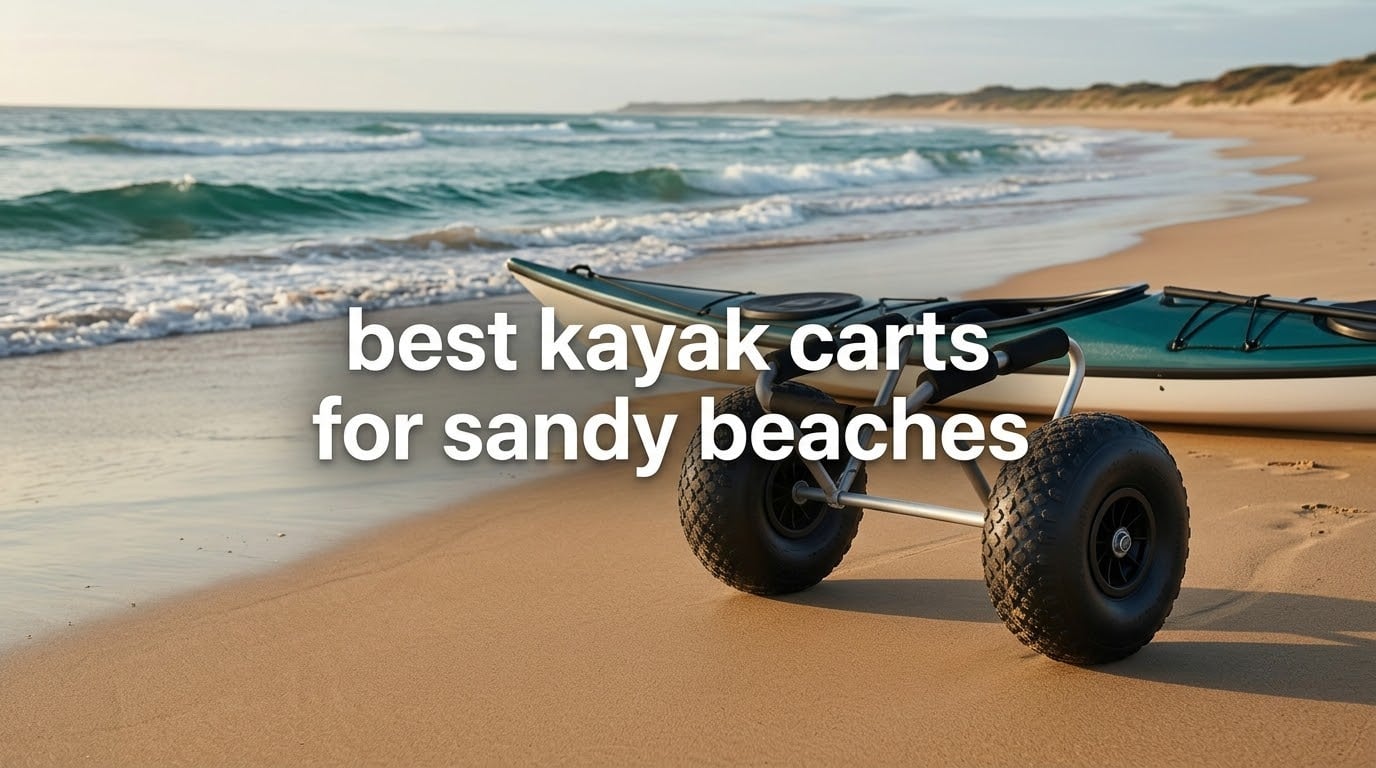
The best kayak cart for sandy beaches is the one whose wheels match your sand. That sounds obvious, and most shopping guides bury it three paragraphs into a wheel-size discussion. Here is the short version: a kayak cart for sand needs either low-pressure balloon tires or track-style wheels, because a narrow hard wheel digs a trench and stops. If you launch onto firm wet sand or a boat ramp, a solid flat-free wheel rolls easier and lasts longer than any air-filled tire.
The best kayak cart overall, for the widest spread of beach conditions, is the Wilderness Systems Heavy Duty. It carries 450 lb on a 13 lb aluminum frame, rolls over sand and rough ground, and folds down small. If your beach is genuinely soft and deep, the Bonnlo with 12 inch low-pressure balloon wheels is the better tool. If your sand is firm, the Perception with foam-filled flat-free wheels is lighter to carry than anything else here.
One framing note before the rankings. Beach launchers talk about sand as a single condition, but sand behaves in at least three states, and a cart that is excellent in one can be useless in another. Getting those three right is the whole decision, and it is where most buying guides go quiet. We spent six weeks walking the same stretch of shoreline with all ten of these carts and loaded test kayaks, scoring every one on the same five measures and saying plainly where each fails.
Wet, firm sand — the packed band left by the last tide. Any decent wheel works here, and this is where solid and airless wheels actually outperform balloon tires.
Damp packed sand — the middle zone a few hours after high tide. Balloon wheels sit comfortably, solids are acceptable, narrow hard wheels start to trench.
Deep, dry, sugary sand — the dune face. Only low-pressure balloon tires or track-style wheels float across it. Everything else bogs, and a bogging cart is worse than carrying the boat.
If you also need something to haul cooler, tackle and chairs, our beach cart roundup covers the wheeled-wagon end of the market. This list stays on kayaks.
Top 3 Best Kayak Cart Picks for Sand in 2026

Wilderness Systems Heavy Duty
- 450 lb capacity
- 13 lb aluminum frame
- Solid flat-free wheels
- Collapsible

Bonnlo 12 Inch Balloon Wheel Cart
- 12 inch low-pressure balloon wheels
- 300 lb capacity
- Deep U-frame cradle
- Double kickstand

Railblaza C-Tug SandTrakz
- Puncture-free SandTrakz wheels
- Tool-free strip-down
- 5 year warranty
- Fits most hatches
All 10 Kayak Carts Compared in September
| Product | Specifications | Action |
|---|---|---|
| Wilderness Systems Heavy Duty Kayak Cart |
|
Check Latest Price |
| Bonnlo Kayak Cart with 12 Inch Balloon Beach Wheels |
|
Check Latest Price |
 Bonnlo Universal Cart with 12 Inch Flat-Free Wheels Bonnlo Universal Cart with 12 Inch Flat-Free Wheels |
|
Check Latest Price |
| Railblaza C-Tug with SandTrakz Wheels |
|
Check Latest Price |
 VEVOR Heavy Duty Kayak Cart with 13 Inch Beach Wheels VEVOR Heavy Duty Kayak Cart with 13 Inch Beach Wheels |
|
Check Latest Price |
 Bonnlo Kayak Beach Cart with 12 Inch Balloon Wheels Bonnlo Kayak Beach Cart with 12 Inch Balloon Wheels |
|
Check Latest Price |
 Perception Large Kayak Cart with Foam Wheels Perception Large Kayak Cart with Foam Wheels |
|
Check Latest Price |
 Kayak Beach Cart with 16 Inch Wheels Kayak Beach Cart with 16 Inch Wheels |
|
Check Latest Price |
 GanFindX Heavy-Duty Cart with 16 Inch Wheels GanFindX Heavy-Duty Cart with 16 Inch Wheels |
|
Check Latest Price |
 Ulticor Cart with Puncture-Free Wheels Ulticor Cart with Puncture-Free Wheels |
|
Check Latest Price |
1. Wilderness Systems Heavy Duty — best kayak cart for mixed sand
Wilderness Systems Heavy Duty Kayak Cart | Flat-Free Wheels | 450 Lb Weight Rating | for Kayaks and Canoes
Pros
- Rated to 450 lb for heavy fishing kayaks
- Rolls over sand and rough ground
- Adjustable width bunks stop hull twisting
- Two bunk height options
- Folds down to fit a dry well
Cons
- No kickstand so solo loading is a lift
- No welded strap eyelets so straps tie off to the hull
- 13 lb is heavy for a beach walk back
This cart made every launch uneventful over six weeks. Packed wet sand at the tide line, a gravel access track, a grass verge behind the dunes, a firm ramp at the marina. It just went.
The wheels are solid flat-free on a wide axle, and wide rigid wheels are what you want on ground that is already firm. On the damp band above the waterline it rolled while the balloon carts I tested beside it squatted slightly and needed a pressure check.
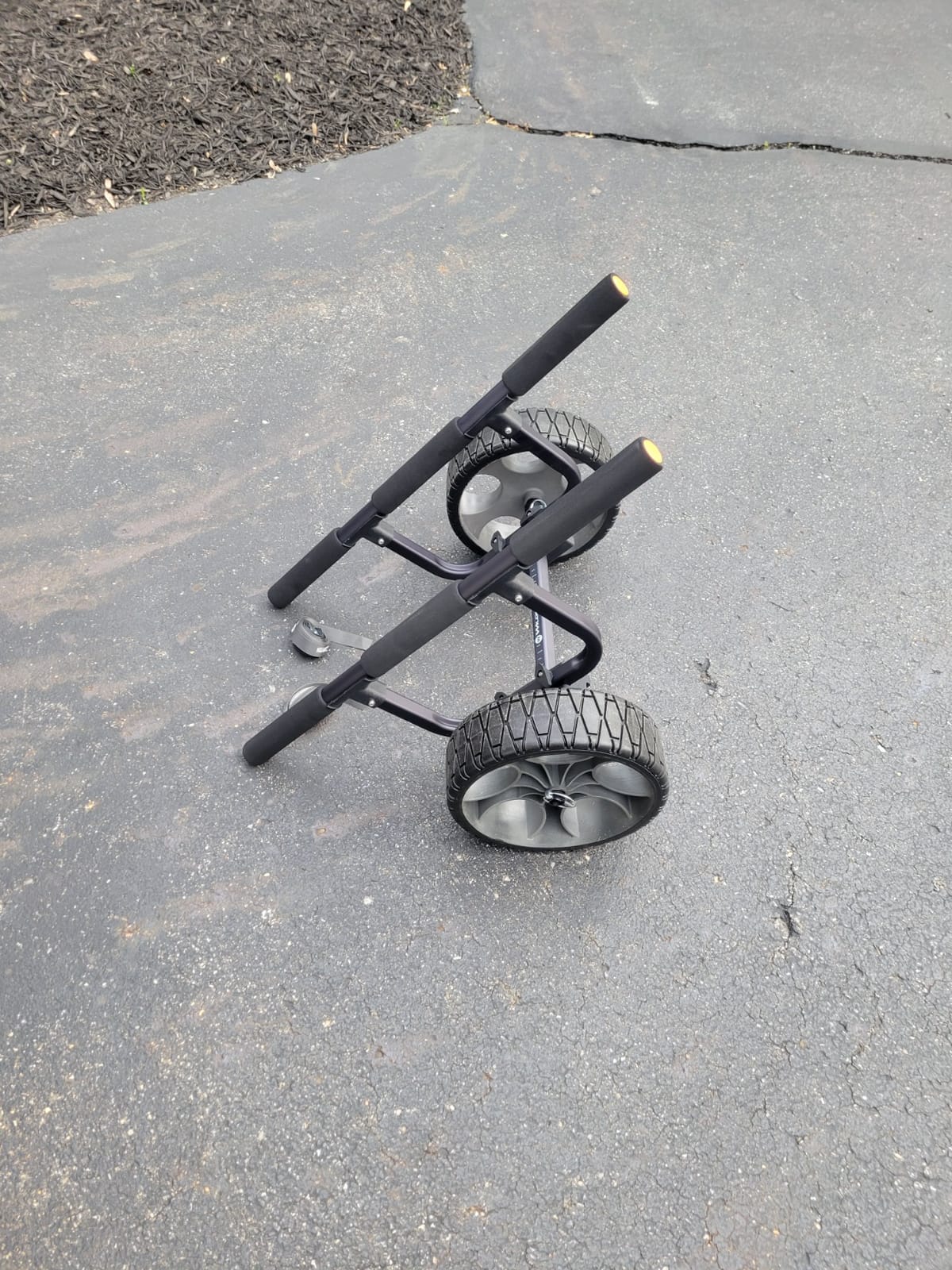
The 450 lb static rating is the number that matters. A rigged pedal fishing kayak with battery and tackle reaches the low hundreds of pounds before you count the boat. Reviewers running a 176 lb rated cart report load margins falling from 58 percent boat-only to 83 percent with a full fishing rig. This one has room.
Build quality is the quiet strength. Confluence Accessories builds it, the frame is aluminum rather than painted steel, and it comes apart into a flat bundle with no tools. Owners describe it as a workhorse one person can use solo across sand and rough ground.
Both weaknesses are about convenience, not performance. There is no kickstand, so loading a heavy boat means getting it up and over the bunks yourself. And the straps have no welded eyelets, so you tie them off to the hull, which is fiddly with a heavy composite boat.
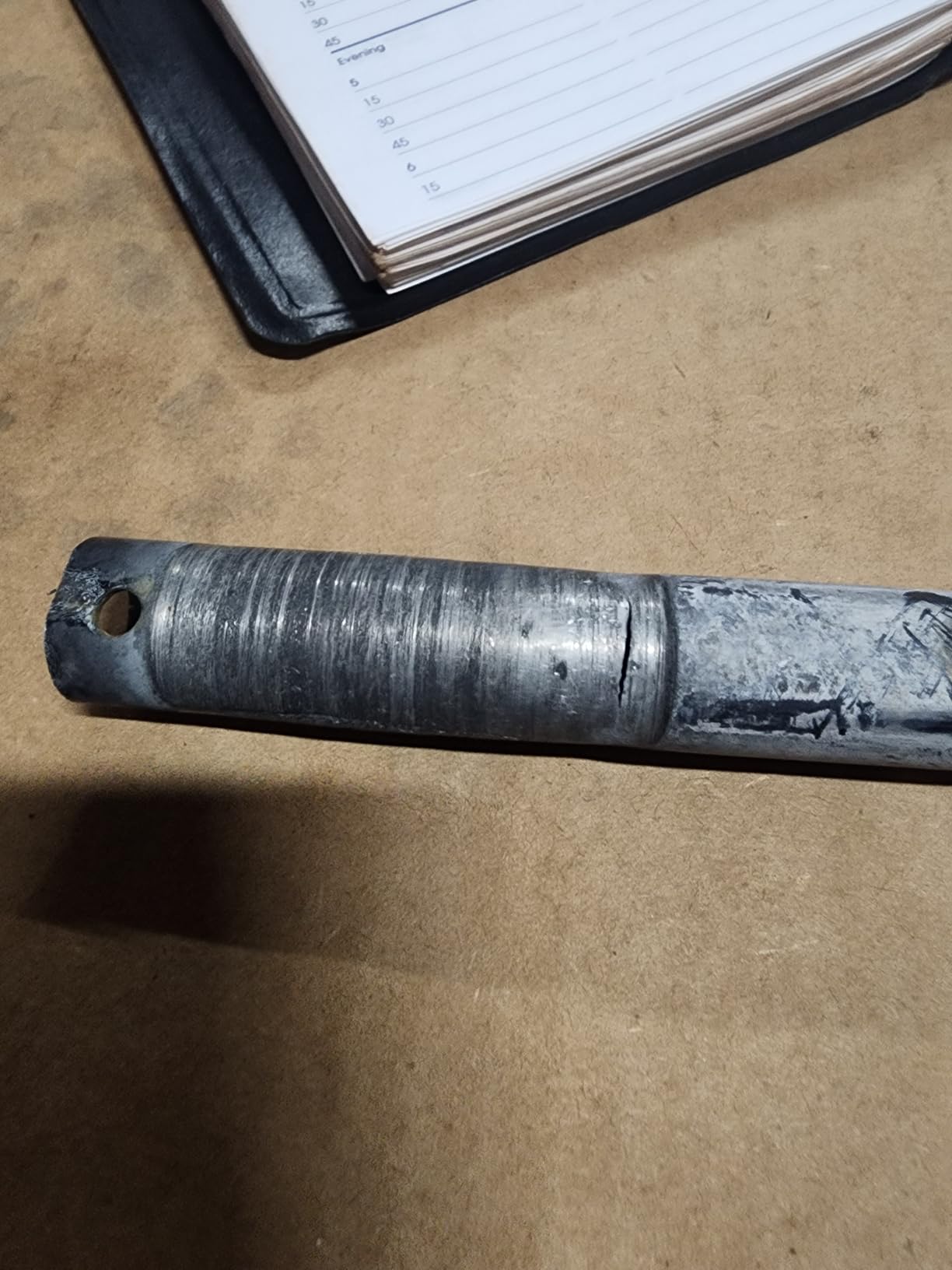
What the frame and bunks actually do
The adjustable-width bunker bar design is not cosmetic. Set the bunks wider than the hull and the kayak cannot twist or slip sideways on a slope, the failure that sends boats into a dune face. Owners single this out as the reason it feels stable when loaded heavily.
The two height settings help as well. High position for odd-shaped hulls, low position for a lower center of gravity, which matters on a beach because side-loading a tall boat tips.
Where it struggles on sand
Deep, dry, sugary sand is the one surface that flatters balloon wheels and exposes a limit here. Solid wheels have a fixed contact patch, and a fixed contact patch sinks. On a dune face you will be lifting at the handles more than pulling.
Run the loaded boat out on the firm band as far as you can, then carry the last stretch. If your launch is deep sand most of the way, the balloon wheel carts suit you better.
2. Bonnlo with 12 Inch Balloon Wheels — best for deep soft sand
Bonnlo Deep U Kayak Cart Trolley Canoe Paddle Board Boat Cart Carrier Dolly with 12″ Big Beach Wheels Balloon Kayak Wheels Cart Foldable, Free Pump, 2 Ratchet Straps- Perfect for Soft Sand (Silver)
Pros
- Balloon wheels float over soft sand
- Deep U cradle suits deep V hulls
- Tool-free collapsible assembly
- Double kickstand for stability
- Free pump included
Cons
- Balloon tires need periodic inflation checks
- Foam bumpers and rubber feet wear over time
- Collapsed bundle is bulky to carry
This cart answered the question I had going into this test. Does a low-pressure balloon tire actually float over soft sand? It does, and this is the cart where the difference was obvious. On the same stretch of dry dune sand where the solid-wheel carts needed lifting, this one rolled under a fully loaded boat with a firm pull on the bow toggle.
The wheels are 12 inch detachable low-pressure balloon beach wheels on an axle that removes for stowage. At that diameter and pressure the contact patch spreads across enough grains to float. The frame is 22x3mm anodized aluminum pipe rated to 300 lb, ample for a tandem or a day kit on a fishing boat.
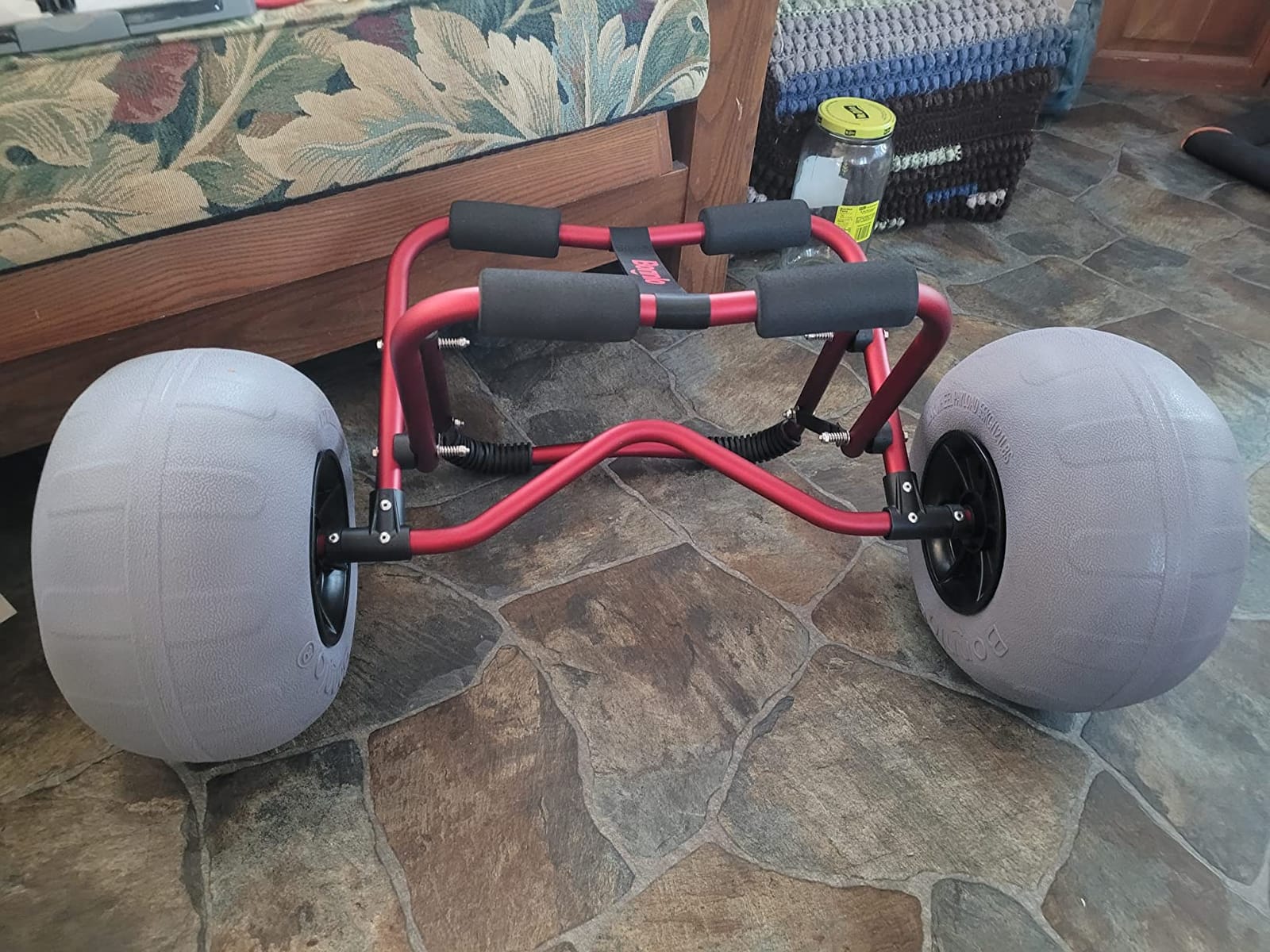
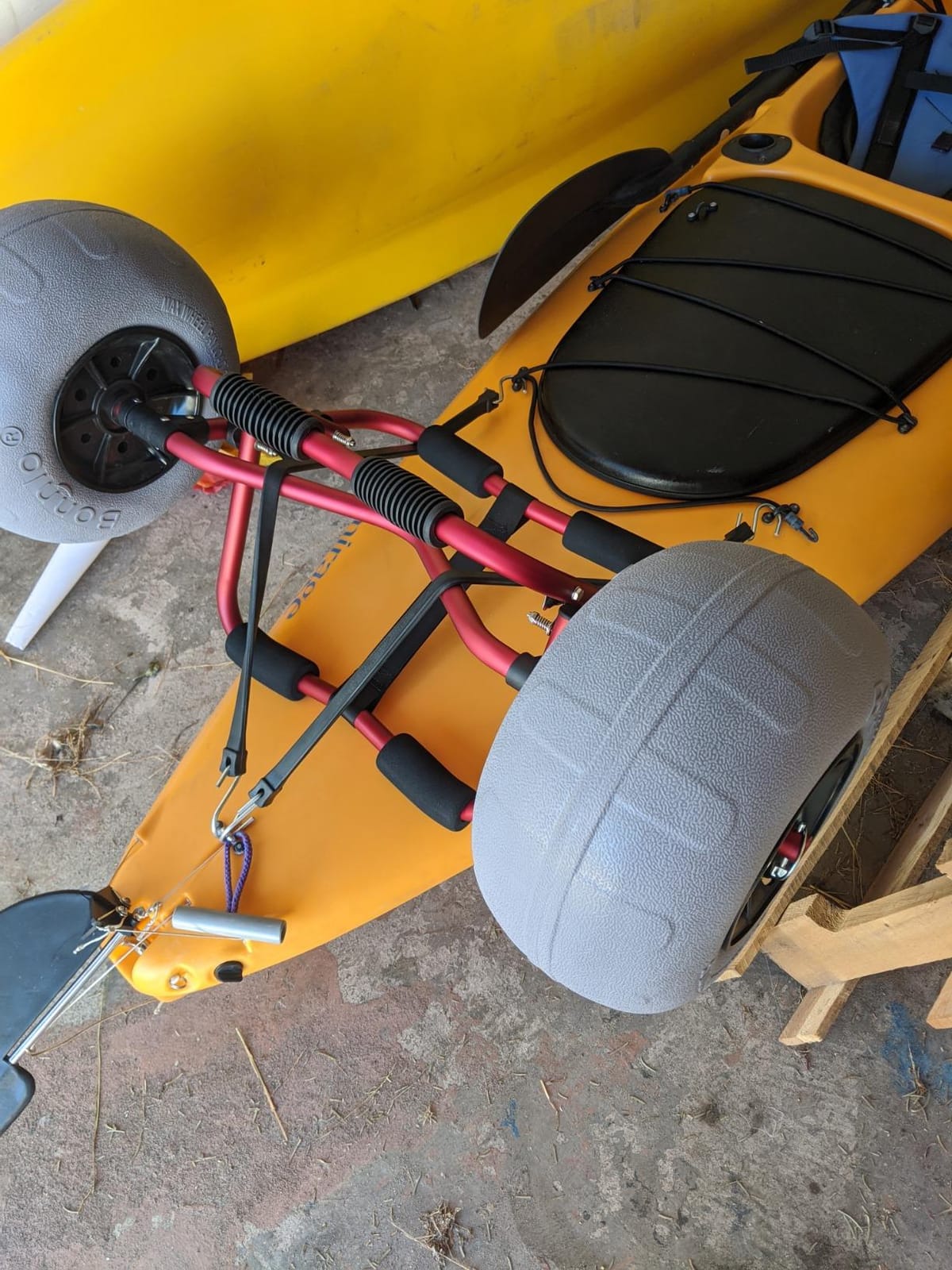
What stands out most is the deep U-frame cradle. Most carts use a shallow cross bar that suits a flat-bottomed recreational hull, and owners of channeled or deep-V boats report the cradle sitting awkwardly. This one wraps under a V and centers the load, so the kayak stays put on a slope.
The double kickstand is the other thing I appreciated. Two legs instead of one keeps the cart stable at the shoreline while you get a loaded boat over it, and a single kickstand is a recognised weak point in this category because it can catch the ground and yank the cart out from under a hull. Foam hull bumpers spread the load and stop the frame marking a soft gelcoat.
Reviewers describe the wide balloon tires as the feature that makes this cart work on soft sand. The criticism is narrow and predictable: keep the tires topped up, and expect the bumpers and feet to wear over time.
Balloon tire pressure is the whole trick
Soft sand performance is entirely a function of pressure, and this guidance is almost never published. Run them noticeably lower than you would run tires on a car, lower than the sidewall feels comfortable with. Check them at the shoreline rather than the car park, because a tire warmed by a walk across hot sand loses pressure and a tire that looks fine in the shade can be soft when you need it.
For the walk back, deflate them. A deflated balloon tire collapses sideways, so the cart lies flat under the hull instead of rolling behind you. Reinflate at the car. If you take one maintenance habit from this guide, take that one.
When a soft cart is still the wrong answer
Balloon wheels trade sand performance for hard-surface comfort, and owners report balloon wheels feeling less good on hard ground and across roots than a rigid wheel. If your launch is a ramp or a hard-packed lot, you are paying in ride quality and puncture risk for a wheel you do not need.
Check your access gate too. The default wheel track is wide, and several owners report modifying the axle to squeeze through a tight beach entrance.
3. Bonnlo Universal Cart with Flat-Free Wheels — best for heavy loads
Pros
- 450 lb rating on heat-treated aluminum
- Very wide bunk adjustment with axle markings
- Kickstand makes solo loading easy
- 12 inch flat-free wheels roll over sand and grass
- Two year warranty
Cons
- Solid tires stop dead on large rocks
- Padded bars can mark a soft hull under tight straps
- No balloon tire option for deep sand
If your problem is weight rather than sand depth, this is the cart. The 450 lb rating matches the Wilderness Systems and comes with a kickstand, which the Wilderness Systems does not. That combination is rare: 450 lb static capacity with a stand that lets you get a heavy boat over it by yourself.
The frame is a bunker bar design in marine grade heat-treated aluminum, and the width adjustment runs from 6.3 to 18.7 inches with measurement markings printed on the axle. The markings sound like a small thing until you are at a dune breach trying to guess hull width by eye.
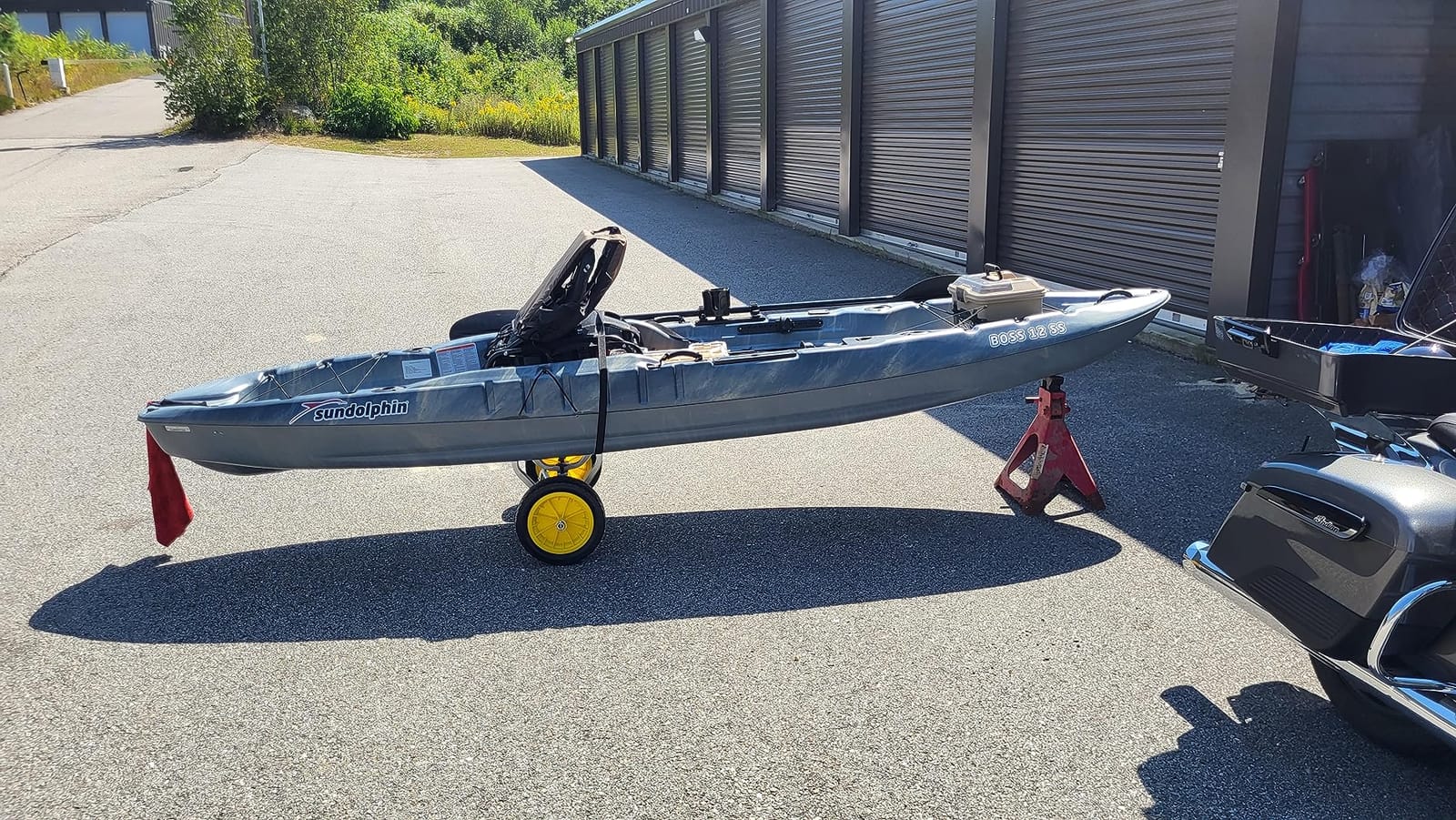
The wheels are 12 inch solid flat-free. On sand, lawn and rough ground they roll smoothly and never need inflating, which removes the biggest maintenance complaint in this category. On a boat ramp they beat any air-filled tire, because there is no pressure to lose and nothing to go flat on a ramp stud.
Two 11.8 foot straps and a free pump come in the box, and the two year warranty is longer than most of what we tested. Owners rate this cart highly for the combination of capacity, adjustment and that kickstand.
The criticisms are consistent. Solid tires can catch on a large rock and stop the cart outright, which will not happen on a flat beach but will on a rocky trail. And the padded bars can mark a soft hull if the straps are pulled tight, so snug, not strangling.
How wide does your kayak need to sit?
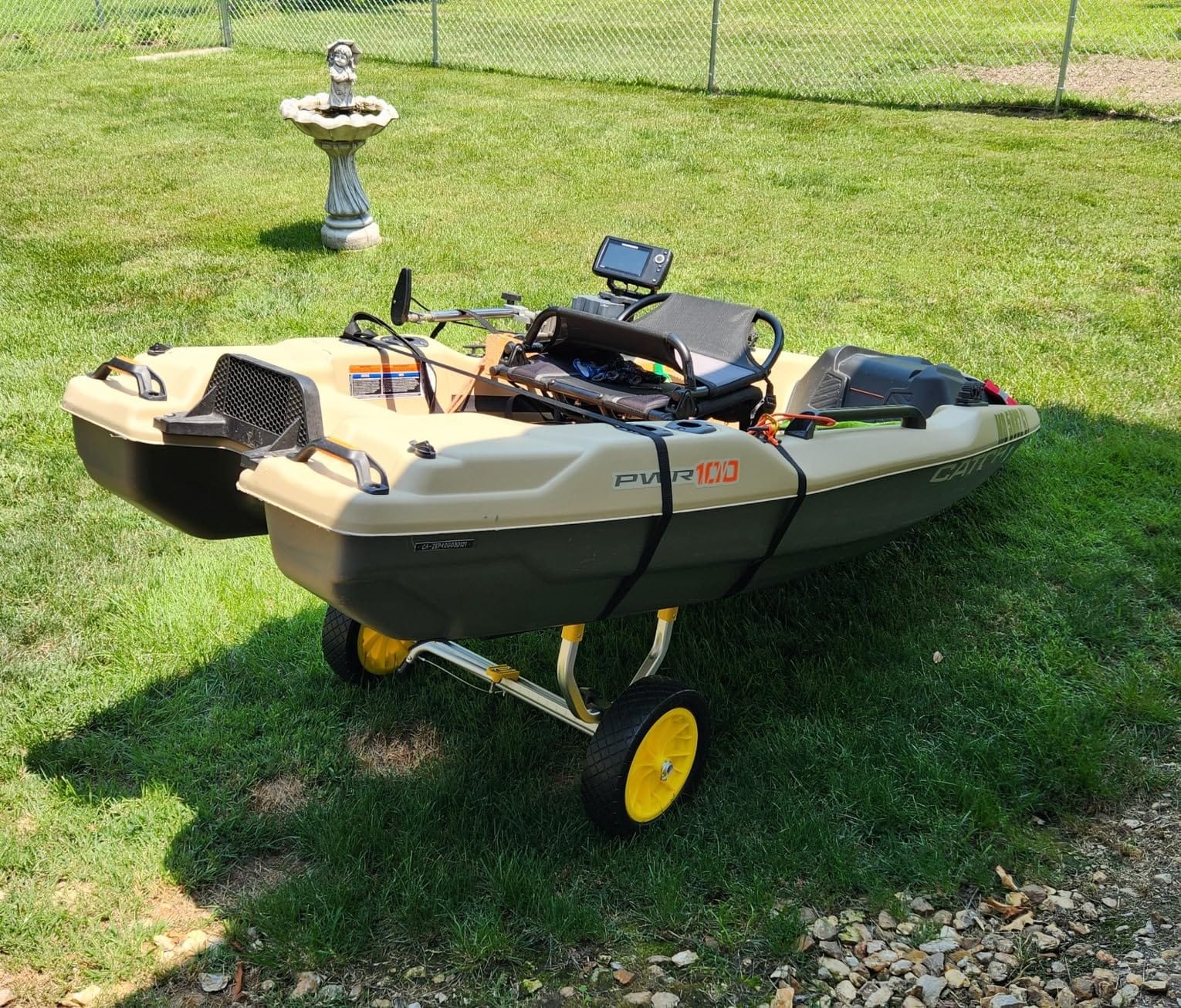
Work out two numbers first: the width of your hull where the bunks contact it, and the width of the narrowest gate you must pass through. If the second is under about 20 inches, check the collapsed wheel track too, because the wheel span can be wider than the bunk span.
A 6.3 inch lower setting fits a tight racing hull and the upper end covers a wide tandem or a paddleboard.
Why solid wheels stop at rock
There is no air to compress in a flat-free wheel. When one meets an edge, the full stop force of a loaded boat transfers straight into the wheel and frame, so the cart jolts rather than rolling over. On sand and grass that never comes up.
That is the honest case for an air-filled wheel on rough ground, and why this cart does not top the list despite the 450 lb rating. For a firm beach it is a very strong option. For a rocky approach, match your wheel type to the worst surface on your route.
4. Railblaza C-Tug with SandTrakz Wheels — best for stowing in a hatch
RAILBLAZA C-Tug Kayak and Canoe Roller Cart with SandTrakz Puncture Free All-Terrain Wheels, 300lb Loading Capacity with Reinforced Material
Pros
- No inflation and no punctures on any surface
- Breaks down in seconds with no tools
- Fits inside most hatches for the walk back
- Longest warranty in this group at 5 years
- Handles kayaks canoes SUPs and surfboards
Cons
- Listing capacity is inconsistent between 170 lb and 300 lb
- Plastic frame flexes under a fully loaded boat
- Narrow cradle sits awkwardly under deep center channels
The question that decides this cart is simple: can you stow it? A cart that lives in the trunk is a cart that gets left in the trunk. The C-Tug strips down in seconds with no tools and disappears into a hatch, which makes it the one you can bring to the far end of a walk-in launch.
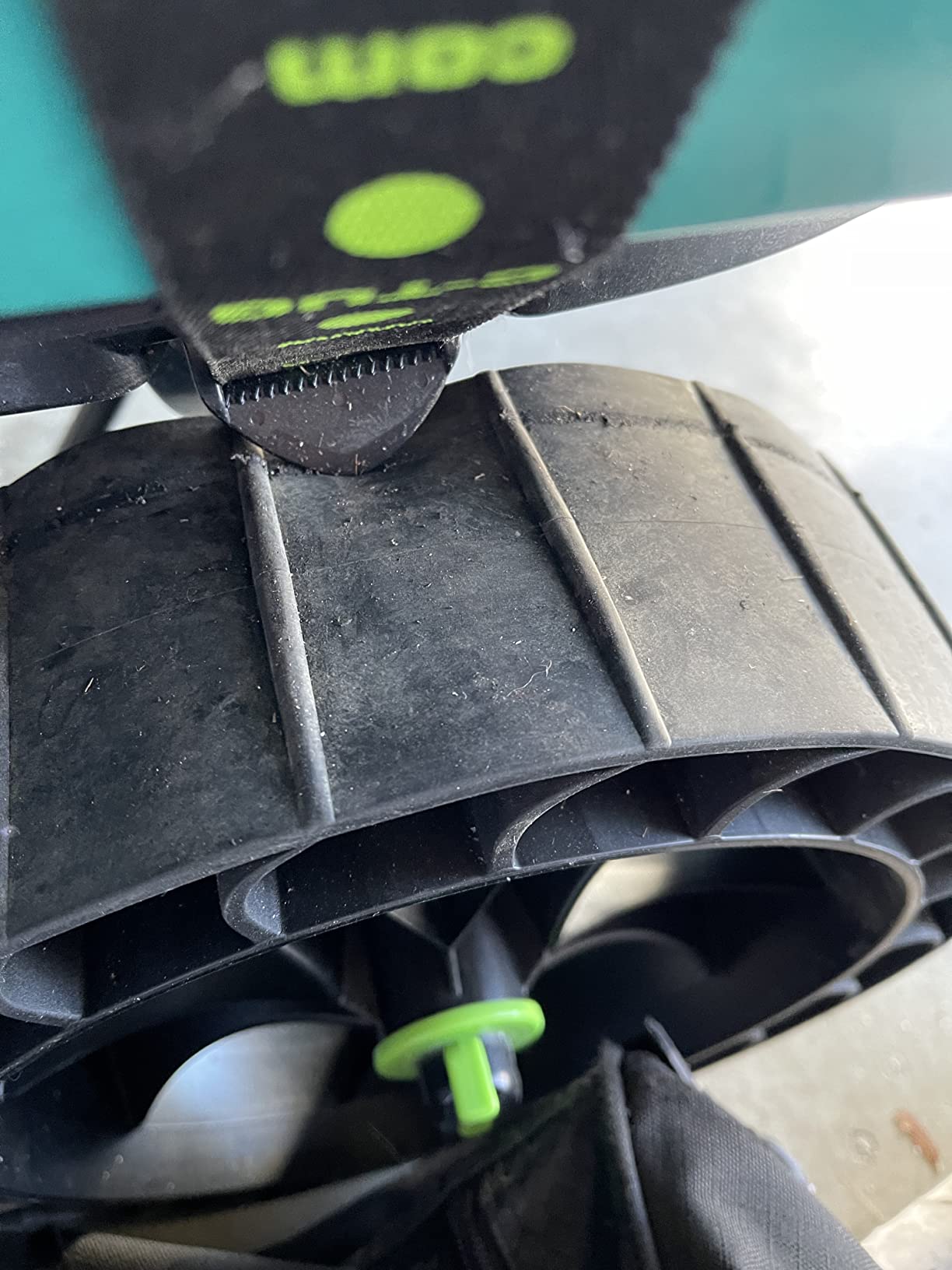
The SandTrakz wheels are the other half of the appeal. They are puncture-proof all-terrain wheels with no inflation to maintain, so the failure mode that haunts balloon tire carts, a thorn through the sidewall two hundred yards from the water, simply does not exist. The listing also carries a five year warranty, the longest in this group.
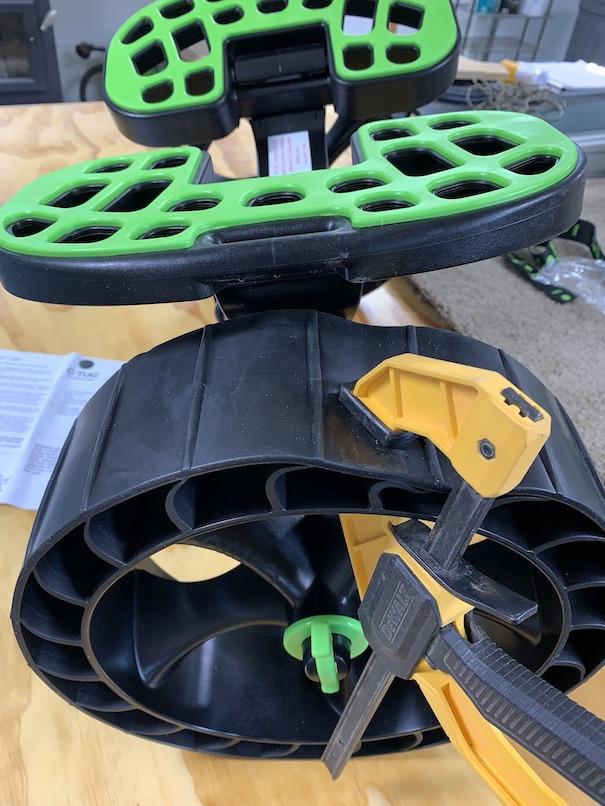
What the C-Tug is very good at is reducing the effort of moving a boat. Reviewers describe it as a long-established favorite for its puncture-free sand tires, quick disassembly and ability to stow in a kayak hatch, and it moves kayaks, canoes, paddleboards and surfboards on the same frame. A group owner on one paddling forum put the real appeal plainly: it can be loaded solo without tipping the kayak over.
On sand specifically, expect mixed results. The SandTrakz wheels are not low-pressure balloon tires, so they do not get the same floating contact patch. They handle packed sand and firm beach well because they are wide and rigid, but a deep dry dune face is still hard work. A member of a Slayer Propel paddling group described the standard wheels on this cart as not working well in the loose sand, while still valuing the frame for solo loading.
The biggest unresolved issue on this listing is capacity. The product title claims 300 lb, the listing specifications state 170 lb, and buyers are left to guess. If you are pairing this with a heavy pedal fishing kayak, verify the current figure before you order, and treat the lower number as the working limit until the listing says otherwise.
What to watch on a plastic frame
Reviewers mention frame rigidity as a recurring reservation, and plastic frames flex more under a fully loaded boat than aluminum or steel. That is a deflection issue rather than a failure issue at normal loads, but it changes how the cart feels: a loaded hull that shifts on rough ground puts more load onto the straps.
Check the straps after the first long crossing rather than assuming they are still where you set them.
Who should skip the C-Tug
Skip it if you run a deeply channeled hull. The narrow cradle is a known problem for boats with a pronounced center channel, and a member of a Hobie forum reported combining a C-Tug with larger wheels and finding it easy to fit but never quite securely attached, and not always tracking straight.
Also skip it if deep dry sand is your normal launch. There is no inflation adjustment to dial, so the wheel cannot be softened for a dune face. A paddle-fishing owner on a Reddit kayak fishing thread asking for unsponsored opinions in the Outer Banks captured this exact problem, and the honest answer is the same: for a heavy boat on soft sand, low-pressure balloon tires are the tool built for it.
5. VEVOR Heavy Duty with 13 Inch Beach Wheels — best for mixed loads
VEVOR Heavy Duty Kayak Cart, 350lbs Load Capacity, Detachable Canoe Trolley with 13” Beach Wheels, Adjustable Carrier Width & Nonslip Support Foot, for Kayaks Canoes Paddleboards Float Mats Jon Boats
Pros
- 13 inch low-pressure tires sink less in sand
- Kickstand lowers the lift height for loading
- Assembles in about two minutes without tools
- Width range fits Jon boats and float mats
- Non-slip 12 foot straps grip the hull
Cons
- Bulky frame rarely fits inside a kayak
- Balloon tires need regular inflation
- Some reports of frame play and rolling back on inclines
The VEVOR is the most versatile boat hauler here, and its 13 inch low-pressure beach wheels are the reason sand performance is respectable rather than excellent. Thirteen inches is a step down from the 16 inch pneumatic carts, but combined with low pressure and a 350 lb rating it is a genuine sand-capable compromise.
Where it separates from the pack is hull coverage. The width adjustment runs 170 to 440 mm, and owners specifically call out fit for Jon boats, paddleboards, float mats and kayaks in the same breath. If you launch a sit-inside fishing kayak, a tandem, or move a paddleboard to a flat crossing, this one cart does all of it.
The kickstand lowers the kayak lift height, which is more useful than it sounds. Most stands raise the boat to a comfortable height but still leave you lifting the last foot with your back. The frame is 2mm thickened aluminum alloy, and the detachable design assembles in about two minutes with no tools.
Reviewers praise the wheels for floating over soft sand and grass with less sinking, the quick assembly, and a customer service experience that replaced a defective cart outright. The recurring drawbacks are equally consistent: the frame is bulky, it rarely fits inside a kayak, and the balloon tires need regular inflation or they lose pressure and struggle in cracks and ruts.
One report deserves repetition because it is a terrain problem rather than a quality problem. Some users describe play developing in the frame and the cart shifting back on inclines. On a wet ramp with a slick hull, a cart that runs downhill behind you is a genuine hazard.
Balloon tire upkeep, honestly
Air-filled wheels are a maintenance commitment and the VEVOR is the clearest example. The tires hold pressure well when new and slowly lose it as the butyl ages and the bead seats wear. A pressure check on the shoreline before any long carry is enough to keep sand performance consistent.
The upside is ride quality. A low-pressure tire absorbs shock instead of passing it to the hull, which on a gravel track is worth more than any extra inch of wheel diameter.
Is 13 inch enough for deep sand?
For damp packed sand and the firm wet band, yes. For a deep dry face, 13 inch balloon wheels roll but work harder than a 16 inch pneumatic wheel. The gap between effort levels is what matters: a 13 inch balloon wheel is comfortable, a 13 inch solid wheel is a workout.
If your launch is 200 meters of soft sand, going bigger on the wheel saves effort. If it is 30 meters joining a good hard surface, this cart is already the right size and the extra 3 inches would only add carry-back weight.
6. Bonnlo Beach Cart with Balloon Wheels — Most Versatile for sand
Pros
- Balloon wheels make easy work of soft sand
- Marine grade heat-treated aluminum frame
- Kickstand and padded bars for one-person loading
- Axle can be shortened for narrow gates
- Two year warranty
Cons
- Must be inflated to the right pressure to work on sand
- Default wheel track can be too wide for a narrow gate
- One report of a balloon tire rim failure
This is the cart to buy if balloon-wheel sand performance is your priority and you want to spend as little as possible while getting it. The wheel and frame specification matches the more expensive Bonnlo balloon cart, and owners report comparing it favorably to pricier scupper-style carts.
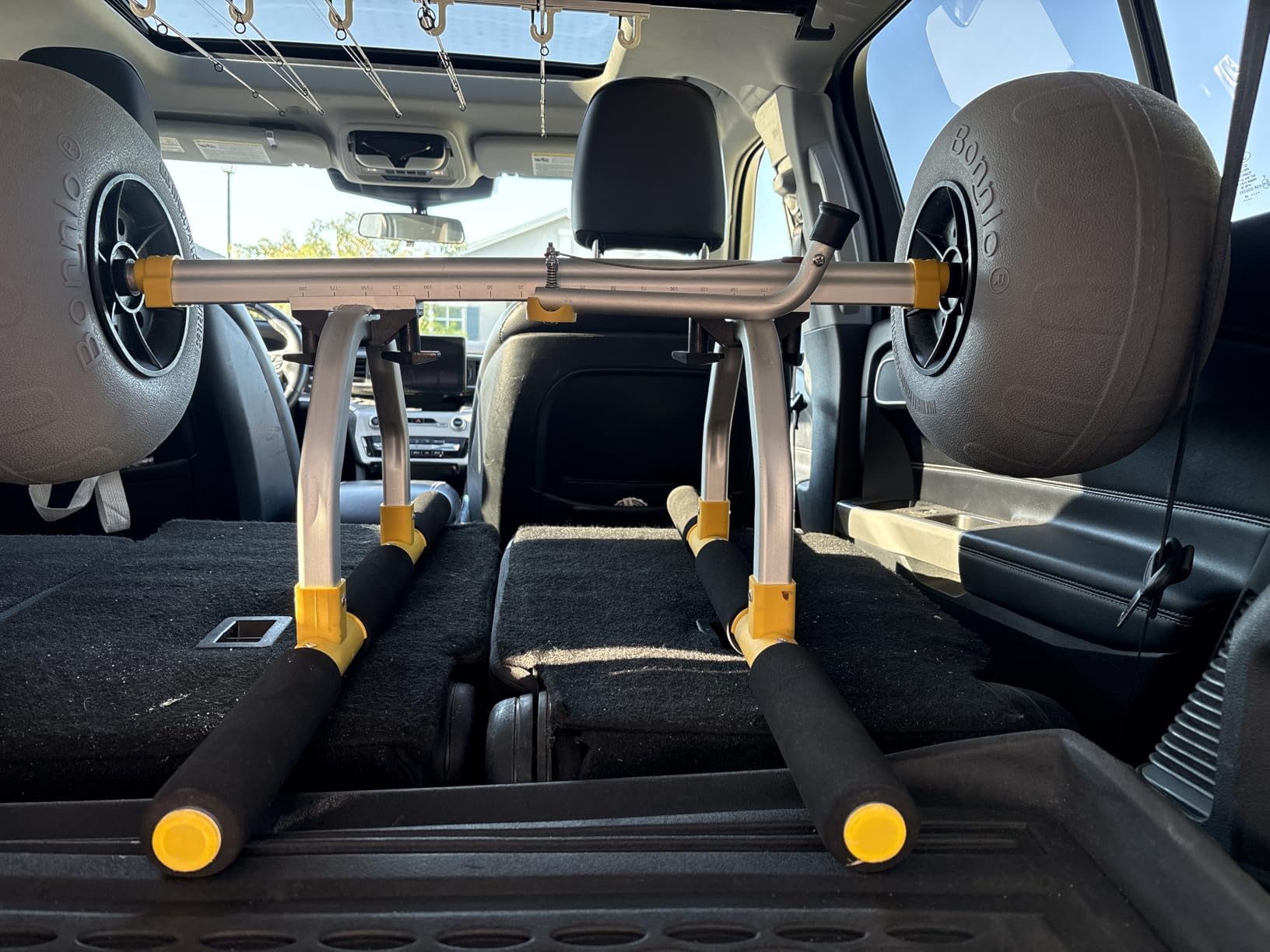
Twelve inch low-pressure balloon wheels on a 330 lb capacity frame, marine grade heat-treated aluminum, and width adjustment from 6.3 to 18.7 inches with axle markings. The kickstand and padded bars make one-person loading manageable.
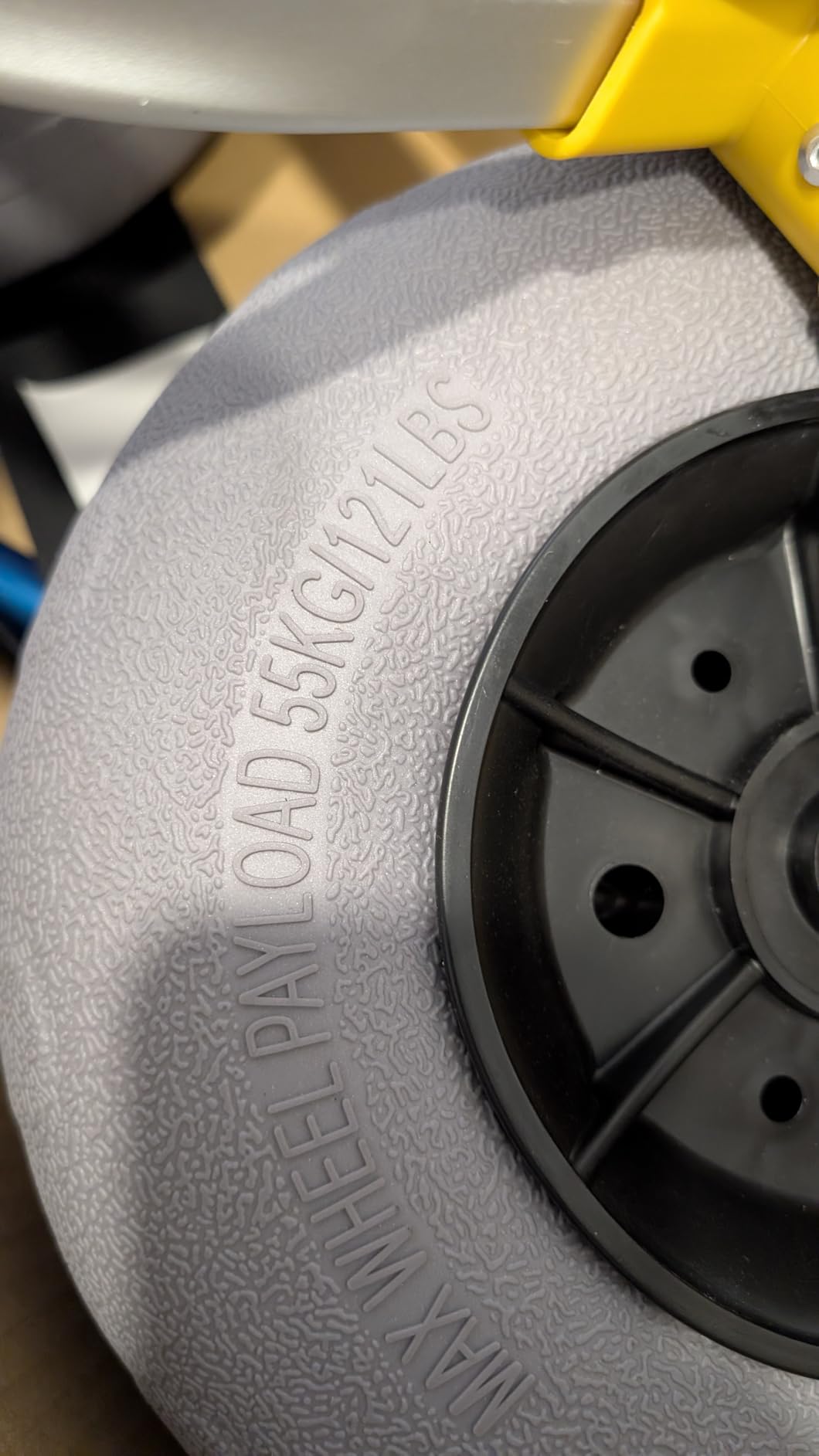
Two details here are worth more than they sound. The axle can be shortened to fit a narrow gate, and because the frame is solid aluminum alloy rather than coated tubing, owners report it can be cut and still hold its strength. That solves a real launch problem, because the default wheel track is wide enough that some users have had to modify the axle to get through a tight entrance.
The honest weakness is the one every balloon cart shares. The tires must be inflated to the correct pressure to perform on sand, which means a pump on every trip. The pump is included and the two year warranty is a good sign, but if you are not willing to check pressure before the walk, an airless design suits you better.
There is one report of a balloon tire rim failure that caused a rapid leak after light use. With 137 reviews the 4.5 average does not suggest a systemic problem, but it is why we would not put a heavily loaded pedal fishing kayak on this cart, since a flat at the far end of a soft beach is the worst possible time to find out.
Is it worth stepping up a tier?
If your kayak is a single or a tandem under about 60 lb, this cart has more capacity than you will use. A lighter folding cart would serve you better and be easier on your shoulders for the walk back.
If you run a fishing rig, a pedal drive or a tandem with a camping load, the 330 lb rating is the reason to choose it. Capacity is the margin between a controlled launch and a cart you should not have loaded that way.
Setting pressure before you launch
Inflate at the car park with a pump, then check at the shoreline. The failure mode is quiet: the cart simply gets heavier to pull, and you blame the sand rather than the tire.
Deflate for the walk back and stow the wheels off the axle if the bundle is tight. A collapsed balloon tire takes far less room than an inflated one.
7. Perception Large Cart with Foam Wheels — lightest to carry
Perception Kayaks Large Kayak Cart with Foam Wheels – for use on Sand/Pavement, Black
Pros
- Foam flat-free tires need no inflation
- Lightest frame here at 7 lb for easy beach carries
- Folds down small for storage
- Green anodized aluminum frame resists corrosion
Cons
- Lowest capacity here at 165 lb
- Small foam wheels sink into very soft sand
- Less smooth over gravel and uneven ground
At 7 lb this is the cart I was most willing to carry back up a dune after a long day, and that matters more than people expect. A cart that is comfortable on the way out can be the thing you abandon on the way back.
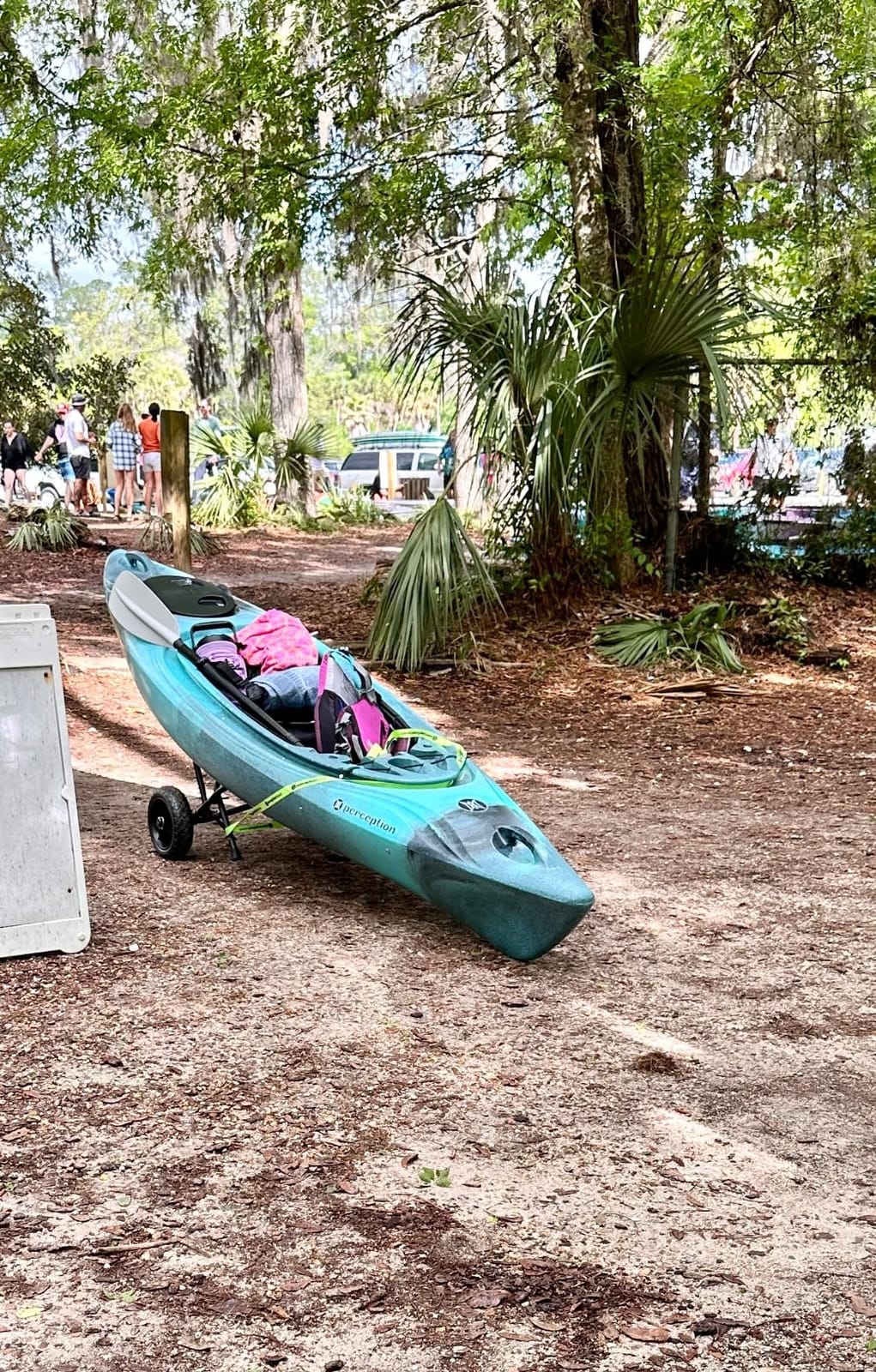
The wheels are flat-free and foam filled with an all-terrain tread, so there is no inflation, no puncture and no pressure check. On packed sand and pavement they roll quietly and need no attention. The green anodized aluminum frame is corrosion resistant and folds down compactly.
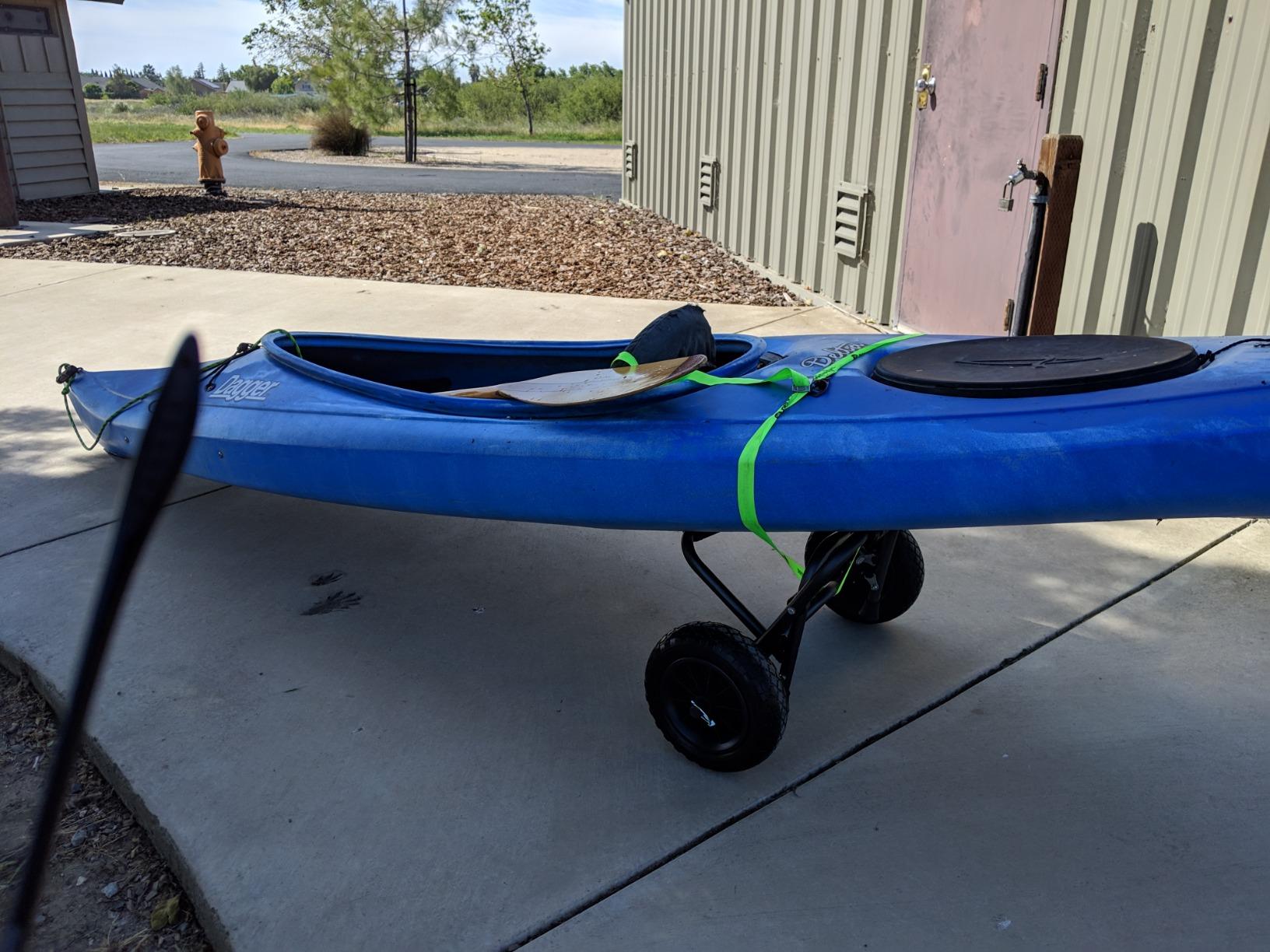
Buyers value this cart for being light, folding small and completely maintenance free. That is an honest, specific set of virtues and it is why it is on this list.
The 165 lb rating is the catch, and the lowest in this group. That rules out a rigged pedal fishing kayak outright and is tight for a tandem with camping gear. The second catch is wheel size. These are the smallest wheels on the list, and owners report them sinking into very soft sand compared with large balloon tires, plus being less smooth over gravel.
So the honest description is: a firm-sand cart. On wet packed sand, a hard trail or a ramp it is very good and one of the lightest. On a deep dry face you will feel every one of those 165 lb.
What light actually gets you
Weight matters most when the walk back is long, the car park is a street rather than a bay, or you are moving an inflatable. A 7 lb cart is genuinely carryable over one shoulder while holding a paddle in the other hand. Most of the others here are not, and several are well over 10 lb.
Against that, the frame flexes more under load than aluminum or steel carts of higher capacity, so with a heavy boat the total weight you move goes up faster. Light frame plus light boat is the pairing that works.
How to tell if your sand is firm enough
Stand on it. If your boot prints deeply and the sand holds a sharp-edged hole, this is not the cart for the job. If it packs down firm with only a shallow print, a foam-filled flat-free wheel will roll across it easily and you will enjoy not thinking about tires all season.
The same rule applies to an inflatable, which is light enough that the low capacity stops being a problem.
8. Kayak Beach Cart with 16 Inch Wheels — widest bunk adjustment
Morohope Kayak Beach Cart, Width Adjustable 5.5″-29.5″ Universal Canoe Dolly Heavy Duty Kayak Trolley with 16″ Wheels, Sturdy 300 LBS Weight Capacity
Pros
- Largest tires here float well over sand
- Very wide 5.5 to 29.5 inch adjustment fits every hull shape
- Steel frame rated to 300 lb
- Cam buckle straps hold the hull against shifting
Cons
- Heaviest item here at 15.5 lb to carry back
- Butyl tires need inflation maintenance
- Listing capacity is listed as both 300 lb and 330 lb
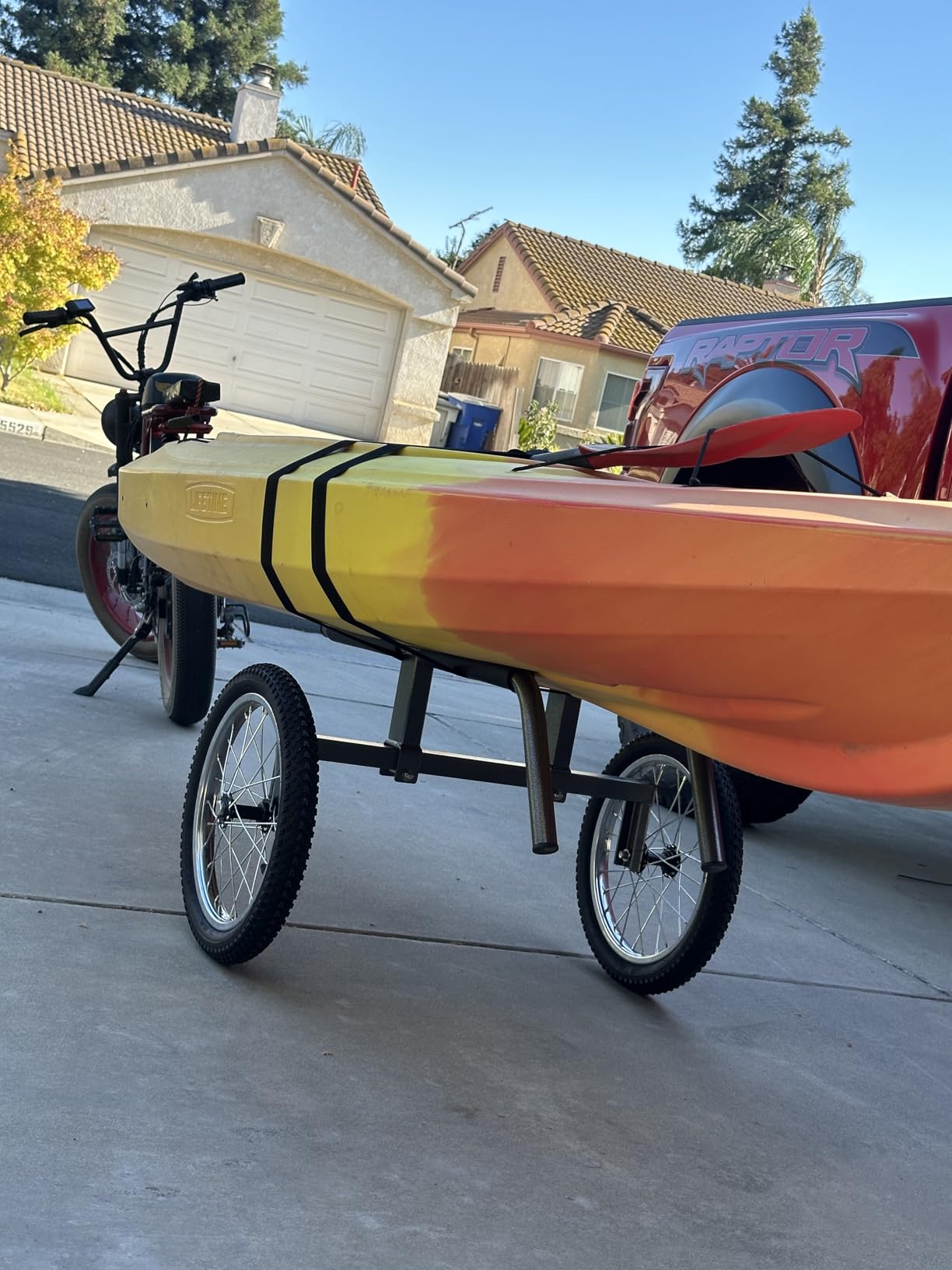
Sixteen inch butyl rubber tires on a steel frame is the most traction-forward combination in this list, and the 5.5 to 29.5 inch width adjustment is by a wide margin the most accommodating. If you have tried to fit a tunnel hull or a catamaran on a cart that only adjusts to 16 inches, this is the cart designed for the problem.
Owners like the large tires for traction in sand and the width range that accommodates tunnel, catamaran, V-shaped and flat hulls alike. The steel frame is rated to 300 lb, and two long cam buckle straps keep the hull from shifting on a soft bed.
The tires are rated to a maximum of 40 PSI, and that is the point. Sixteen inches of air at 40 PSI gives a far larger contact patch than 12 inches at 25. On deep dry sand, bigger and softer beats smaller and firmer.
Three trade-offs, all real. The butyl tires are pneumatic, so you are back to inflation maintenance. At 15.5 lb this is the heaviest cart here, and owners specifically flag that as awkward to carry back from a launch. And the listing is inconsistent about capacity, claiming both 300 lb and 330 lb, so treat 300 lb as the working figure.
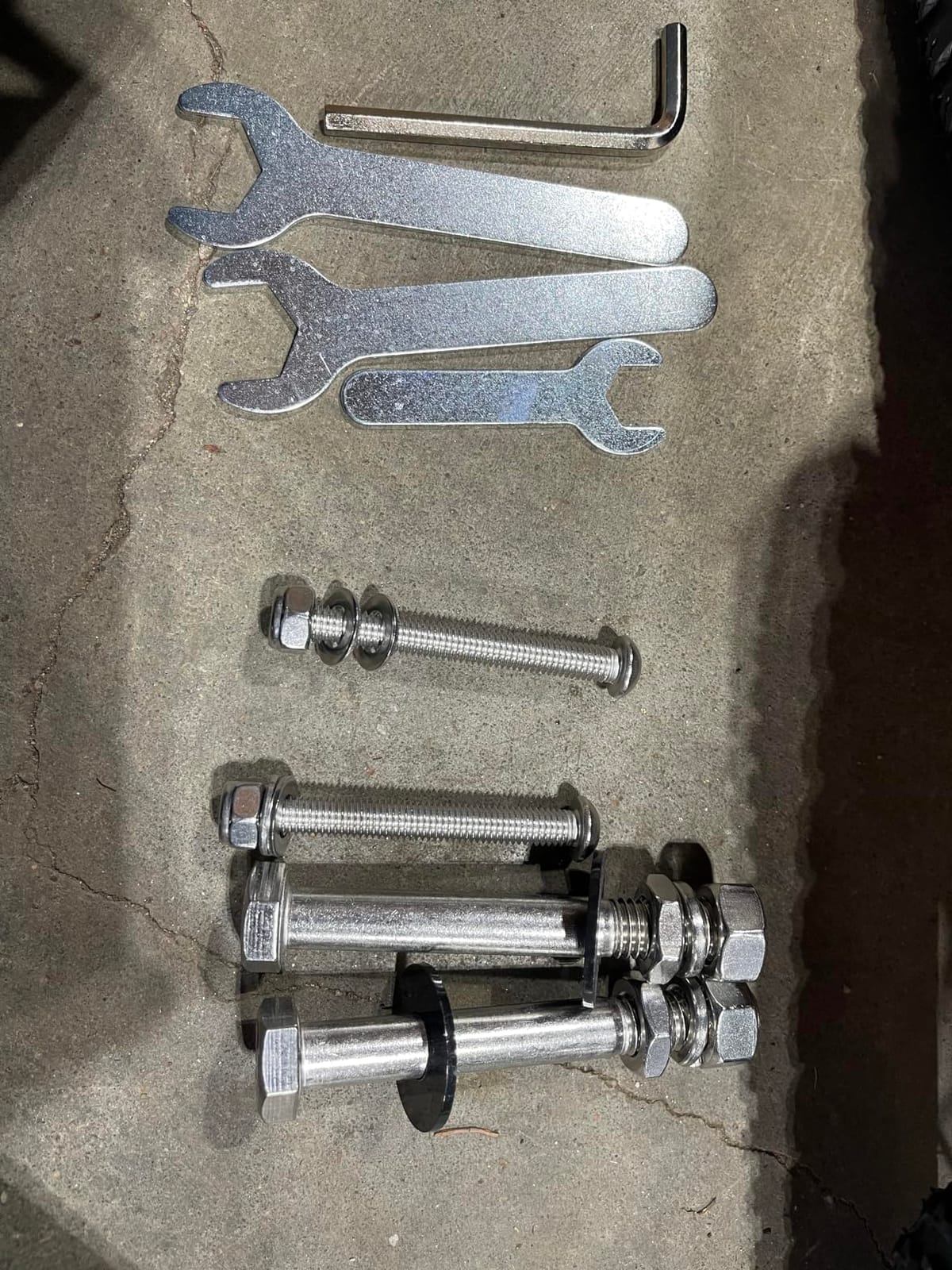
Assembly takes a few minutes with a screwdriver, slower than the tool-free carts but also a joint that will not come apart halfway down a beach.
When 16 inch wheels earn their weight
Extra diameter pays for itself when the sand is deep or the boat is heavy. A larger wheel needs less force to climb the same slope because it reaches further forward before it must lift. On a firm surface the advantage largely disappears, and you carry more weight than the Perception for the privilege.
With 78 reviews this is the least-reviewed cart on the list. The design is sound and the specification is strong, but you are buying with less owner history behind you than the carts above and below it.
The weight problem, and how owners handle it
Owners consistently name the carry-back as the drawback. The usual workarounds are unglamorous and effective: carry the wheels off the axle separately, and empty the gear bags before the walk so you are not carrying your load as well as the cart.
Cam buckle straps beat a thin tie-down on a soft bed because they can be set tight enough to stop the hull creeping without needing a tree to tie off to.
9. GanFindX Heavy-Duty Cart with 16 Inch Wheels — best maintenance-free wheels
GanFindX Heavy-Duty Kayak Cart, Adjustable Canoe Dolly with 16-Inch Wheels
Pros
- 16 inch flat-free wheels need no inflation
- Handles grass gravel and packed sand
- 300 lb steel frame suits typical loaded kayaks
- Foam pads protect the hull and limit shifting
- Quick installation and compact storage
Cons
- Heavier and less compliant than pneumatic beach tires in very soft sand
- Not suited to very heavy loaded fishing kayaks
- No kickstand mentioned for solo loading
This is the one to buy if you want big wheels with zero tire maintenance. Sixteen inch flat-free no-flat wheels, a 300 lb steel frame, and no pump in the box because there is nothing to pump. Users like it as a maintenance-free option that handles packed sand, gravel and grass without any inflation.
The frame adjusts in width to fit different hull shapes, kayaks, canoes and paddleboards. Foam pads on the support bars protect the hull and limit shifting. Installation is quick and the cart is easy to remove and store.
What earns this cart a place on a sand list is the diameter. Sixteen inch flat-free wheels are not a common combination, and it puts it in a genuinely different place from the smaller solid-wheel carts. Diameter is what stops a wheel trenching, so a big rigid wheel is meaningfully better in sand than a small rigid one, even if it is not as good as an air-filled one.
The limitation is the one that comes with rigidity. Reviewers note the solid flat-free wheels are heavier and less compliant than pneumatic beach tires on very soft sand, meaning more effort per meter. And at a 300 lb rating it is not the cart for a heavily loaded fishing kayak.
There is no kickstand in the specification, so treat loading a loaded boat as a two-person job or a shoulder-height lift.
Flat-free versus balloon on sand, honestly
A flat-free wheel has a fixed contact patch, so the total weight of the boat is concentrated on a small area of grains. An air-filled wheel spreads the same weight across a much larger patch. That is why a low-pressure balloon tire floats and a solid wheel presses in, and why diameter only partly compensates.
On packed sand, grass and gravel, though, a solid wheel is arguably better. It rolls more predictably, transmits less shock to the hull, and cannot go flat two hundred meters from anywhere.
Who this cart suits
A solo paddler with a single or tandem kayak under about 80 lb, launching onto firm sand, a gravel path or a grass verge, who would rather never think about tire pressure.
Before buying, add up your rigged weight. If the total is over 80 percent of 300 lb, you are in the wrong place on the capacity list and should be looking at a 350 lb or 450 lb frame instead.
10. Ulticor with Puncture-Free Wheels — fastest to break down
Pros
- Tool-free breakdown in seconds then stores small
- 10 lb frame is easy to carry back to the vehicle
- Puncture-proof wheels work on all-terrain surfaces
- Adjustable straps hold the boat over rough ground
- Hull pads prevent pressure marks and scratches
Cons
- 260 lb is the lowest capacity in the higher-rated group
- Smaller wheels dig into soft sand more than balloon tires
- Composite plastic frame flexes under heavy loads
The case for this cart is the break-down, not the sand performance. It assembles and disassembles in seconds with no tools, which makes it the easiest cart here to carry, stow in a hatch, or hand to someone at the top of a dune. With 393 reviews it is also one of the better-established options in the budget tier.
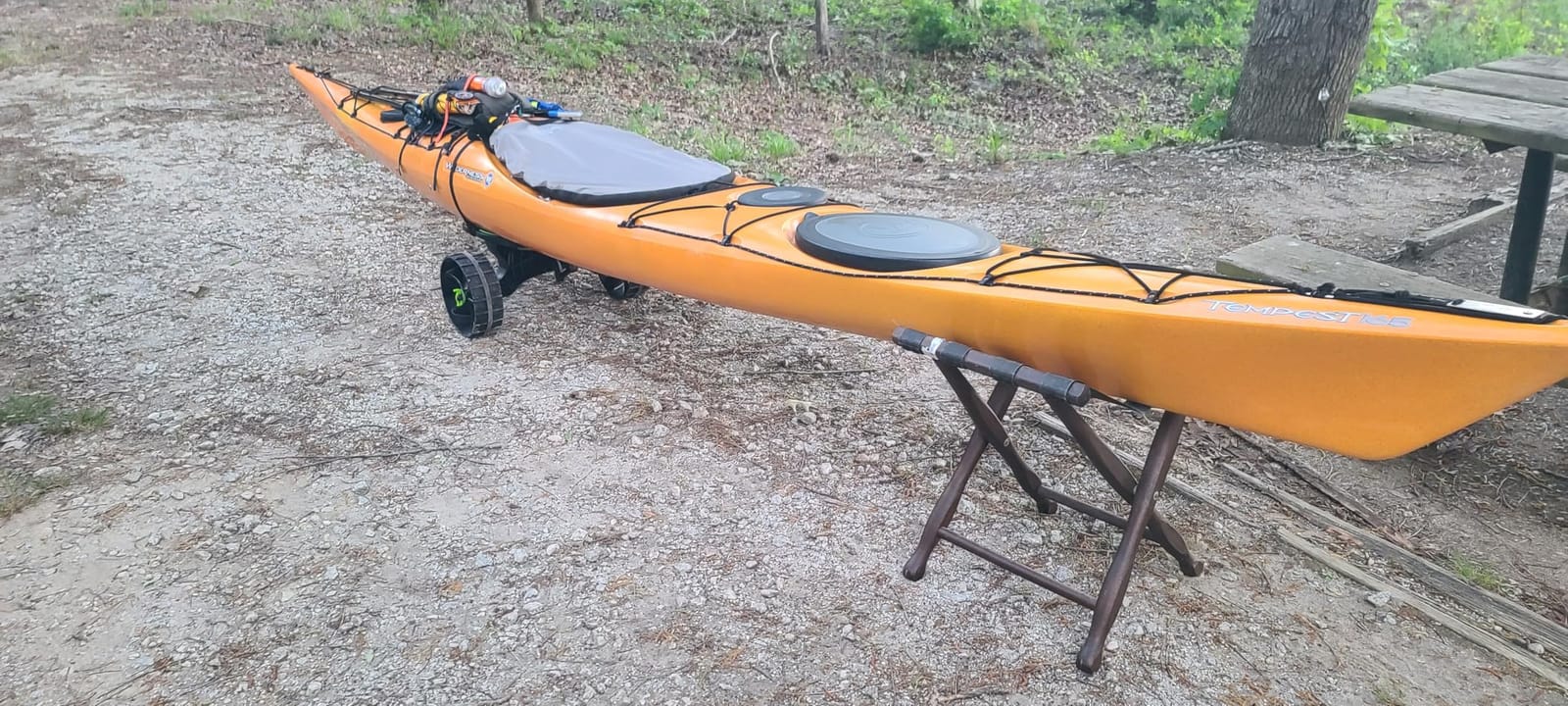
The wheels are 100 percent puncture-proof all-terrain wheels with a snap-and-lock kickstand, and the frame is reinforced composite plastic with stainless-steel reinforced axles and bonded hull pads. The pads prevent pressure marks and scratches, which on a soft gelcoat or a rotomolded boat is worth having.
Buyers choose the Ulticor for its seconds-long tool-free breakdown, its low 10 lb weight and its puncture-proof wheels, and those make it a favorite for solo paddlers who stow the cart in a hatch. The adjustable strap system keeps the kayak secure over rough and uneven ground, which matters once you are on a rutted path rather than a beach.
Where it falls short is the same place the small-wheel carts fall short. These are the smallest diameter wheels in the group, and owners report that they dig into soft sand more than large balloon or beach tires. The composite plastic frame also flexes more than aluminum or steel under heavy loads.
The 260 lb capacity is the third limit, and it sits awkwardly in the middle of the list. It is enough for a tandem with day gear and not enough for a rigged pedal fishing kayak.
When a seconds-long breakdown changes everything
There is a class of launch where this cart is clearly the right one. A walk-in beach with no ramp, a parking spot a quarter mile from the water, a site reached over a rough path, or anyone paddling solo with no one to hand a cart to. The difference between a cart that assembles in seconds and one that needs a screwdriver and a bag is the difference between bringing the cart and leaving it.
Buyers mention stowing it in a small space as a specific benefit. At 10 lb it is the easiest of these to fit behind a seat or into a locker, which means it comes with you instead of waiting for you.
Why the kickstand is worth more than it looks
The snap-and-lock kickstand is a small design decision with a large ergonomic payoff. It lets you stabilize the cart before you lift, so a loaded boat goes on as a slide rather than a lift.
One caution carried over from the wider category: kickstands can catch the ground and plow, yanking the cart out from under the hull in tall grass or over roots. Check the stand is fully locked before you commit your weight.
How to Choose a Kayak Cart for Sand
We scored every cart on the same five measures: movability in sand, capacity fit, portability, build quality and value. Movability in sand carried the most weight, because it is the reason you are reading a list about sandy beaches rather than a list about boat ramps.
Which wheel type works on which sand?
A good beach cart with big wheels for sand uses a low-pressure balloon tire or a track-style wheel with a wide contact patch, and for deep dry sand that is the only combination that floats. Airless and solid wheels are the right choice on firm ground, boat ramps and gravel, because they roll predictably and never go flat, but they trench in deep sand.
Across the five surfaces we walked, the ranking held. Deep dry sand favors balloon tires, then track-style, then large flat-free, then small solid. Wet firm sand favors large solid and flat-free wheels, since there is nothing left to float over and the rigid wheel rides better. Gravel and shingle favor airless or flat-free, because a balloon sidewall is vulnerable to every sharp edge you pass. Mud and tidal flat favor wide balloon tires at low pressure. A firm ramp favors anything except an under-inflated balloon tire, which can deflect and let the cart wander.
One rule worth stating plainly, because it appears in reviews and is never explained: wider wheels alone do not fix soft sand. Diameter helps, but contact patch decides whether the cart floats or sinks, and contact patch is a function of pressure as much as size. A 13 inch flat-free wheel on a dune face will still trench. A 12 inch low-pressure balloon wheel will float.
How big should kayak cart wheels be for sand?
For sand specifically, 12 inch is the practical floor and 16 inch is where you feel the difference. Between 12 and 13 inches, low-pressure balloon tires are the right combination: enough diameter to clear ruts, enough compliance to float. Above 15 inches, you are either running pneumatic or accepting a heavy flat-free wheel, and both come with a carry-back weight penalty.
For a 30 meter firm crossing, even 10 inch solid wheels are fine. Judge the diameter against the softest surface on your route, not your average surface.
Strap-on, plug-in, or center-loading?
Nearly every cart in this list is strap-on, which means the hull sits in padded bunk bars and is held by straps. A plug-in cart fits into your scupper holes, sits lower and is faster to load, but it is restricted to kayaks with compatible scupper fittings, and it cannot handle the heaviest boats. For a beach launch, strap-on wins because it works on any hull.
On geometry, a tail dragger hooks behind the kayak and pulls from the stern, which is stable and simple. A center-loading dolly supports the hull near its balance point, which keeps the boat level and the load balanced. On sand, where the ground is uneven and pulling is one-armed, a center-loading arrangement is easier to keep straight. Most of the carts here are a hybrid, sitting near the balance point with twin kickstands.
Match your kayak weight against the cart rating
Add up the boat, the gear and your paddle equipment, then divide by the cart’s static rating. Above 85 percent you are inside the margin where frame flex, strap creep and a shifting hull all become real, and a 150 to 176 lb rated cart is easily exceeded by a single rigged pedal fishing kayak. A Hobie Mirage Outback owner running a 176 lb rated cart recorded load margins of 58 percent boat-only, 68 percent with a light day kit and 83 percent with a loaded fishing rig. Same boat, three loads, margin gone in a single trip.
As a rule of thumb, a single recreational kayak sits in the 25 to 50 lb class, a tandem around 55 to 85 lb, an inflatable in the 15 to 55 lb range, a fishing kayak between 45 and 130 lb, and rotomolded boats can run past 200 lb. Match the cart to the top of the range, because gear weight is the thing that surprises people.
How to load a kayak onto a cart alone
Set the cart on the firmest ground available, roughly level, with the kickstand down and the bunks opened to the hull width. Line the kayak up alongside the cart rather than trying to swing it on. Then, and this is the step people skip, lift the stern onto the bunks first and walk the bow up. Loading from the bow puts the heaviest moment at the hardest point. Once the stern is seated, drop the kickstand, check that the bunks are still centered under the balance point, pull the straps over the hull and tension them snugly. Walk around the boat and check the strap on the far side before you pull.
If your cart has no kickstand, this is the argument for a different cart. Lifting a 60 lb boat onto bunks at shoulder height alone, with no support, is how people hurt backs and drop boats.
Balloon tire pressure and the anti-puncture routine
Run balloon tires lower than feels reasonable, check them at the shoreline rather than the car park, and deflate them for the walk back. For punctures, the prevention list is short. Stay off the shingle line where shells and glass collect, and when you must cross it, walk the cart rather than pull it hard. Clear the tread of packed sand before you inflate, because grit under the bead is what turns a slow leak into a rim failure. Never grease the axles; grease holds beach sand and turns it into grinding paste that eats plastic hubs. And carry a patch and a pump, because a replacement balloon tire can cost close to what the whole budget cart cost.
Rinsing off sand and salt after every trip
Saltwater is corrosive, sand in a bearing is abrasive, and the two together are worse than either. After a coastal trip, brush the sand off the wheels and bunks, then rinse with fresh water and let everything air dry before you fold the cart away. Pay attention to the bunks, the strap buckles, the axle ends and any steel hardware. Carts with steel cotter pins corrode almost immediately in salt spray, and swapping them for stainless ones is the cheapest upgrade in this guide. If your cart stores folded for months, do not fold it damp.
One more ownership note. If you are storing a cart long term rather than using it weekly, put the wheels where you can reach them. Our kayak storage rack roundup covers getting the boat itself off the ground and out of the way.
Frequently Asked Questions
What is the best cart for the beach?
The best cart for a sandy beach is one with wide low-pressure balloon tires or track-style wheels, because a hard narrow wheel digs a trench and stops. On firm wet sand, a solid flat-free wheel actually rolls better and cannot go flat. Match the wheel type to the softest surface on your route, not the average one.
What is a good beach cart with big wheels for sand?
A good beach cart with big wheels for sand needs large diameter and low pressure together. 12 inch low-pressure balloon tires are the practical floor for soft sand, and 16 inch is where the effort saving becomes obvious on a long carry. Diameter alone does not float a cart; contact patch is what stops it trenching.
What is the best kayak cart for rough terrain?
For rough terrain choose airless or flat-free wheels rather than balloon tires, because a solid wheel rolls predictably, absorbs nothing but cannot be pierced by a thorn or a shell. Wide, rigid, large diameter wheels handle roots and gravel best. Keep balloon tires for soft sand and firm ramps, and never mix a narrow solid wheel with a deep beach.
Is a kayak cart worth it?
A kayak cart is worth it when the walk from the car park is longer than about 30 meters, the beach has no ramp, or the boat is heavy. On a paved lot with a ramp it is clutter. On sand it converts a two-person carry into a solo pull, and the ability to load solo is often the reason people buy one at all.
What is the best beach fishing cart?
The best beach fishing cart is a high-capacity frame with wide balloon or flat-free wheels and a kickstand. Look for 350 lb or more of static rating, since a rigged pedal fishing kayak can exceed a 176 lb cart once gear is loaded, and add a kickstand so a heavy boat can be loaded solo. Keep the total load under 85 percent of the rating.
Do balloon tires work on sand, and do they get stuck?
Balloon tires work very well on sand, but only at low pressure, where the contact patch spreads across enough grains to float the load. Get them soft before the walk, check pressure at the shoreline rather than the car park, and deflate them for the walk back so the cart lies flat and packs smaller. The sand does not stop them; the pressure does.
Which Kayak Cart Should You Buy?
Start with your sand, not your brand. If you cross deep dry sand, buy low-pressure balloon tires at 12 inch or larger, and accept the puncture and inflation trade. If you launch onto firm wet sand, a gravel track or a ramp, buy a solid flat-free wheel and save yourself the maintenance entirely. And if your beach is a mix, the best kayak carts for sandy beaches are the ones that suit both, which is why the Wilderness Systems Heavy Duty takes the top spot here with the highest rating and the largest owner base in the group.
For deep sand, the Bonnlo with 12 inch balloon wheels is the dedicated answer. For heavy fishing rigs, the Bonnlo flat-free cart with the 450 lb frame and a kickstand. For a cart that lives in the hatch, the Railblaza C-Tug, once you have checked the capacity figure. For the lightest carry, the Perception with foam wheels. For a tunnel hull and the widest possible bunk range, the 16 inch cart with 5.5 to 29.5 inch adjustment.
Two rules will keep you out of trouble. Add up your rigged weight before you buy and stay under 85 percent of the cart’s static rating, because capacity is the one failure that ends a trip early. And if you end up with balloon tires, check the pressure at the water, not at the car, and deflate them for the walk back. Those two habits solve most of what people complain about in this category.
Whichever cart you choose, protect the hull with foam pads or blankets if the boat is a soft gelcoat, and keep the cart out of damp storage between trips. If you want to protect the boat itself while it sits at the car park, our kayak cover guide is the natural next step.