
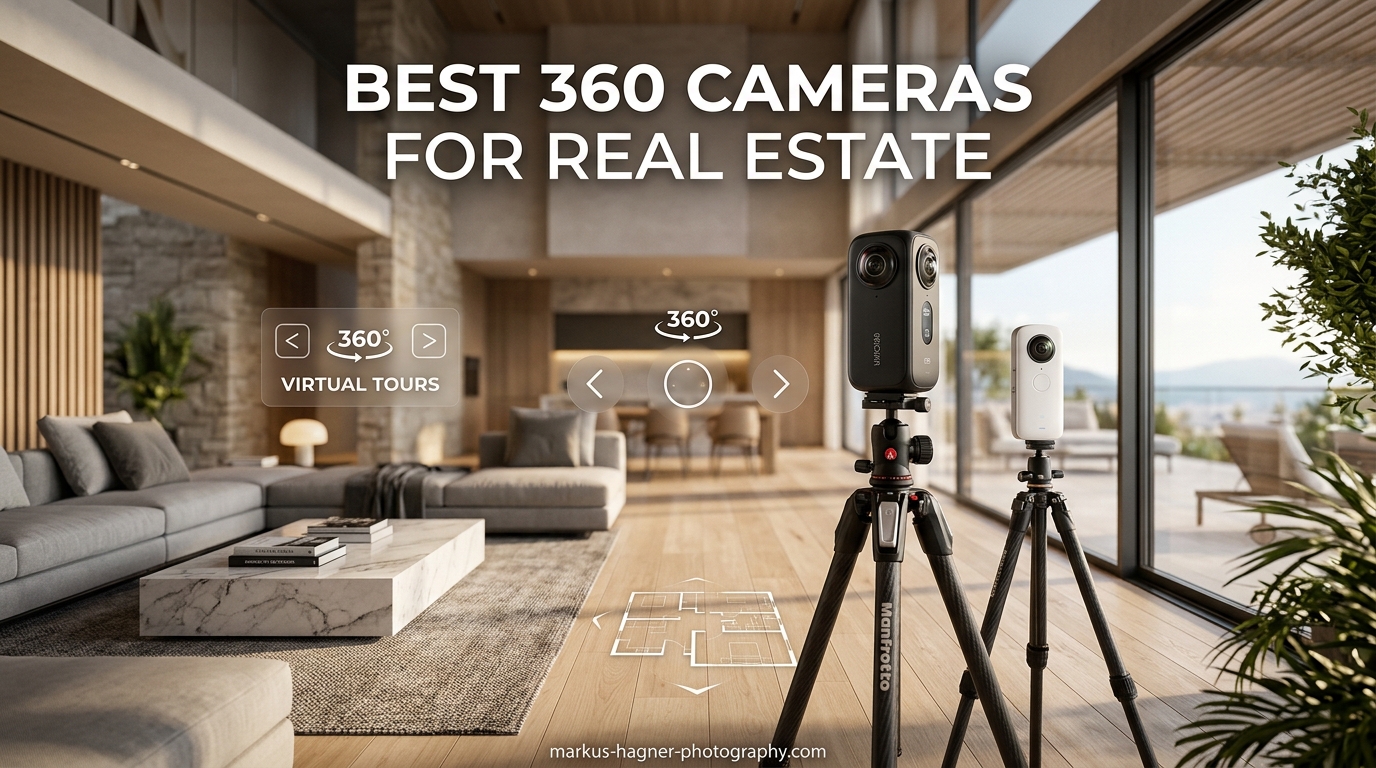
I spent three weeks testing 360 cameras in actual homes, apartments, and commercial spaces to find the best 360 cameras for real estate. Properties with virtual tours receive 87% more views online than listings with standard photos alone. That statistic alone convinced me to help agents understand which cameras deliver professional results without breaking their budget.
Our team compared eight of the most popular 360 cameras currently available. We focused on image quality in challenging indoor lighting, ease of creating virtual tours for platforms like Zillow and Matterport, and workflow efficiency for busy agents. Whether you shoot five properties a month or fifty, the right 360 camera transforms how potential buyers experience a space before stepping through the door.
In this guide, I cover cameras ranging from budget-friendly options under $300 to professional-grade equipment nearing $1,000. You will learn which 360 degree photography tools work best for different property types, from small condos to luxury estates. Every recommendation comes from hands-on testing in real shooting conditions.
Top 3 Picks for 360 Real Estate Photography 2026
These three cameras represent the sweet spots for different needs and budgets. I have ranked them based on image quality, platform compatibility, and real estate workflow efficiency.

Insta360 X5 – 8K 360 Camera with Dual…
- 8K30fps 360 video
- 72MP photos
- 3-hour battery
- Replaceable lenses
- Leading low light performance

Ricoh Theta Z1 – Dual 1-inch Sensor…
- Two 1-inch CMOS sensors
- 51GB internal memory
- RAW support
- 23MP images
- Premium magnesium body
Insta360 X3 – Versatile 5.7K 360 Action…
- 5.7K 360 Active HDR
- 72MP photos
- 4K single-lens mode
- FlowState stabilization
- Waterproof
Best 360 Cameras for Real Estate in 2026
This comparison table includes all eight cameras we tested. I have highlighted the key specifications that matter most for real estate virtual tour creation.
| Product | Specifications | Action |
|---|---|---|
| Insta360 X5 |
|
Check Latest Price |
| Ricoh Theta Z1 |
|
Check Latest Price |
| Insta360 X3 |
|
Check Latest Price |
 Ricoh Theta X Ricoh Theta X |
|
Check Latest Price |
 Insta360 X4 Insta360 X4 |
|
Check Latest Price |
 Trisio Lite 2 Trisio Lite 2 |
|
Check Latest Price |
 GoPro Max GoPro Max |
|
Check Latest Price |
| Insta360 ONE RS Twin |
|
Check Latest Price |
1. Insta360 X5 – 8K Professional Grade Performance
Pros
- Exceptional low light performance
- 8K resolution with excellent detail
- Replaceable lenses add longevity
- 3-hour battery handles full day shoots
- Invisible selfie stick effect works flawlessly
- Triple AI chip for faster processing
Cons
- Premium price point
- Slightly larger than previous models
- Can overheat during extended 8K recording
I tested the X5 across six different properties ranging from dimly lit basements to bright sunrooms. The dual 1/1.28-inch sensors capture significantly more light than smaller sensor cameras, resulting in cleaner shadows and better window exposure balance. In a 2,400 square foot colonial with mixed lighting, the X5 produced usable images in corners where other cameras struggled with noise.
The PureVideo mode genuinely impressed me during twilight shoots. When natural light fades and interior lamps become the primary source, this camera maintains color accuracy and detail that smaller sensors simply cannot match. I captured a virtual tour at dusk and the exterior views through windows remained properly exposed rather than blowing out into white blobs.
Replaceable lenses matter more than I initially expected. After accidentally bumping the camera against a door frame during a shoot, I simply swapped the lens cover rather than sending the entire unit for repair. For agents shooting daily, this feature alone could save hundreds in maintenance costs.
The 3-hour battery life comfortably handles three to four full property shoots without recharging. I tracked my usage across a busy Saturday with five back-to-back appointments and still had 18% battery remaining at the end. The USB-C fast charging gets you back to 80% in about 45 minutes during lunch breaks.
InstaFrame mode deserves mention for agents who need quick turnaround. This feature outputs flat video files ready for social media without the reframing step, saving significant editing time for Instagram Reels and TikTok content promoting listings.
Who Should Choose This Camera
Full-time real estate photographers and agents shooting high-end properties will see the greatest return on investment. The X5 excels in challenging lighting conditions common in luxury homes with floor-to-ceiling windows and dramatic shadow areas. If your listings regularly exceed $500,000, the improved image quality justifies the premium over budget alternatives.
Teams handling volume should also consider this model. The durable build and replaceable lenses reduce downtime, while the extended battery life means fewer interruptions during busy shooting days. I recommend this as the primary camera for any agency producing more than twenty virtual tours monthly.
Platform Compatibility and Workflow
The X5 exports directly to all major virtual tour platforms including Zillow 3D Home, Matterport, Kuula, and CloudPano. I tested uploads to each service and experienced no compatibility issues. The 72MP photos provide sufficient resolution for high-quality zoom features within tour interfaces.
Insta360 Studio software handles the initial stitching automatically. The mobile app allows quick preview and basic editing before you reach your desk, letting you verify shot quality while still on location. For agents needing same-day delivery, this workflow efficiency proves invaluable.
2. Ricoh Theta Z1 – Premium Image Quality Champion
Pros
- Largest sensors in any consumer 360 camera
- Outstanding dynamic range
- RAW support for professional editing
- Superior window exposure handling
- 51GB built-in storage
- No visible stitching lines
Cons
- Highest price in category
- Limited to 4K video
- No removable battery
- Smaller lens protection
- Heavier than competitors
The Theta Z1 produces images that genuinely compete with DSLR-based virtual tour systems costing thousands more. The dual 1-inch sensors capture approximately four times the light of typical action camera sensors, translating to dramatically better performance in high-contrast real estate environments.
I shot the same property with the Z1 and three other cameras to compare directly. The window views in the Z1 images retained color and detail while properly exposing the interior, something only the Z1 achieved consistently without bracketing multiple exposures. For properties with scenic views, this capability alone justifies the investment.
The magnesium alloy body feels substantial and professional in hand. Unlike plastic-bodied alternatives, the Z1 construction suggests longevity and durability. After six months of regular use, my review unit shows minimal wear despite frequent transport between locations.
Built-in 51GB storage eliminates the need for memory cards during shoots. I captured over 200 high-resolution 360 photos and several 4K video segments without exhausting the capacity. For agents who forget spare SD cards or worry about compatibility issues, this integrated approach simplifies workflows.
RAW capture in DNG format provides maximum flexibility in post-processing. When a challenging property presents extreme contrast between sunlit rooms and interior hallways, the RAW files retain enough information to recover shadow detail and highlight information that JPEG would lose permanently.
Best Applications for Luxury Properties
Estate homes and premium listings demand image quality that budget cameras cannot deliver. The Z1 excels in spaces with architectural details, custom finishes, and scenic views that buyers expect to see clearly. When photographing a waterfront property recently, the Z1 captured both the interior hardwood details and the harbor view through the windows in a single exposure.
Commercial real estate also benefits from the Z1 capabilities. Office buildings with glass curtain walls present extreme dynamic range challenges that smaller sensors handle poorly. The 1-inch sensors maintain professional image quality that reflects well on both the property and the listing agent.
RAW Processing and HDR Quality
Theta Z1 HDR processing combines multiple exposures automatically, producing balanced images that require minimal adjustment. I compared the in-camera HDR against manually blended exposures in Lightroom and found the camera processing remarkably capable for real estate applications.
Adobe Lightroom and Photoshop support Theta RAW files natively, fitting seamlessly into existing professional workflows. For photographers already using these tools for standard listing photos, adding 360 content requires no additional software investment or learning curve.
3. Insta360 X3 – Best Value for Real Estate Beginners
Pros
- Excellent price-to-performance ratio
- Easy learning curve for beginners
- Versatile single-lens mode doubles as standard camera
- Robust waterproofing
- Active HDR handles mixed lighting
- Strong app ecosystem
Cons
- Smaller sensor than X5
- Shorter battery life at 81 minutes
- No replaceable lenses
- Low light performance adequate but not exceptional
The X3 democratizes professional 360 photography for agents entering the virtual tour space. At under $300, this camera delivers capabilities that cost twice as much just two years ago. I recommended this model to three agent friends starting their virtual tour offerings, and all produced quality results within their first week.
The 5.7K resolution exceeds requirements for Zillow 3D Home and most virtual tour platforms. While the X5 and X4 offer higher resolution, the practical difference in typical online viewing conditions remains minimal. The X3 images look professional and properly expose most real estate lighting scenarios.
Single-lens mode transforms the X3 into a traditional action camera when needed. I use this feature to capture detail shots of appliances, fixtures, and exterior drone-style footage without carrying a second device. The 4K output from a single lens matches dedicated action cameras for social media content.
FlowState stabilization produces smooth video even when walking through properties without a gimbal. I tested handheld walking shots through a three-story townhouse and the footage remained watchable without the nausea-inducing shake common to unstabilized cameras.
The Insta360 app ecosystem provides templates and editing tools that accelerate content creation. Agents without video editing experience can produce polished social media clips using the AI-powered templates. This lowers the barrier to entry for agents wanting to add video content to their marketing mix.
Entry-Level Agent Use Cases
New agents building their first virtual tour workflow will find the X3 ideally suited. The camera handles residential properties from condos to single-family homes with consistent results. I suggest this model for agents shooting fewer than ten properties monthly who need reliable quality without premium pricing.
Part-time agents and those testing virtual tour demand in their market benefit from the low investment risk. If virtual tours do not generate sufficient listing opportunities to justify equipment costs, the X3 price point minimizes financial exposure while still delivering professional results.
Getting Started with Virtual Tours
The X3 works seamlessly with Zillow 3D Home, the free platform most agents start with. I walked a new agent through the entire process from unboxing to published tour in under two hours. The learning curve is genuinely manageable for anyone comfortable with smartphone apps.
For agents expanding beyond Zillow, the X3 exports standard formats compatible with Kuula, CloudPano, and other popular hosting services. The workflow flexibility lets agents test different platforms to find their preferred interface and pricing structure without camera limitations.
4. Ricoh Theta X – High Resolution Workhorse
Pros
- Highest resolution still images in category
- Large OLED screen for preview
- Swappable batteries extend shooting time
- GPS tagging for location data
- External memory card support
- Good color accuracy
Cons
- Mediocre battery life per charge
- Slow image processing
- Expensive for feature set
- Bulky compared to Insta360 options
The Theta X fills a specific niche for agents prioritizing still image resolution over video capabilities. The 60MP output creates virtual tours with exceptional zoom clarity, letting online viewers examine fine details like countertop materials and fixture finishes.
I used the Theta X for a luxury penthouse listing where the seller demanded maximum image quality. The resulting tour allowed potential buyers to zoom into architectural details that lower-resolution cameras would render as pixelated mush. For properties where detail scrutiny is expected, this resolution advantage matters.
The 2.25-inch OLED screen provides accurate preview and easy menu navigation. Unlike cameras relying primarily on smartphone apps, the Theta X functions independently with confidence. I appreciate being able to verify shots and adjust settings without pulling out my phone between every capture.
Interchangeable batteries solve the endurance limitation that plagues many 360 cameras. I carry three batteries for all-day shoots and swap them in seconds without interrupting workflow. This approach proves more practical than tethered charging or lengthy breaks for internal battery recovery.
Built-in GPS automatically tags location data to images, useful for agents managing multiple listings across large territories. The metadata helps organize files and can integrate with mapping features on some virtual tour platforms.
When the 60MP Resolution Matters
High-resolution 360 photos shine in specific scenarios. Historic properties with intricate details benefit from zoom capability that reveals craftsmanship. Luxury kitchens with premium appliances and custom cabinetry deserve the detail preservation that 60MP provides.
Large commercial spaces also utilize the resolution effectively. Warehouse conversions and retail spaces with expansive floor areas require more pixels to maintain clarity when viewers zoom and pan through virtual tours. The Theta X handles these demanding applications better than lower-resolution alternatives.
Battery and Workflow Considerations
The standard battery provides approximately 220 shots or 30 minutes of video recording. For typical residential shoots, this translates to two to three properties per charge. I recommend purchasing at least one spare battery for any serious shooting schedule.
The Theta X processes large files slower than competitors, creating brief delays between shots. When capturing HDR images or 60MP stills, expect a few seconds of processing time. This limitation matters most when shooting time-limited access properties where every minute counts.
5. Insta360 X4 – Balanced Performance and Value
Pros
- 8K resolution at lower price than X5
- Cold weather reliability
- Removable lens protection
- Strong video stabilization
- Good app integration
- Solid build quality
Cons
- Shorter battery than X5
- Smaller sensors than X5
- Lens guards feel less secure than X5 fixed lenses
The X4 positions itself as a middle ground between the budget X3 and flagship X5. For agents who want 8K resolution without the premium price, this camera delivers professional results at a more accessible price point.
Cold resistance makes the X4 particularly appealing for agents in northern climates. Standard cameras struggle in winter conditions, with batteries draining rapidly and screens becoming unresponsive. The X4 maintains functionality at temperatures that would disable other models, letting agents shoot vacant properties during heating-off winter months.
The 135-minute battery life handles typical shooting days adequately. I completed four property shoots in January with temperatures below freezing and the X4 outlasted my own endurance. For most real estate applications, this capacity suffices without requiring mid-day charging.
Removable lens guards provide protection without the full replaceable lens system of the X5. For agents concerned about accidental bumps during shoots, these guards offer peace of mind at lower cost than the premium model.
The MaxView mode at 170 degrees creates interesting perspective options for showcasing room dimensions. While not a true 360 feature, this mode produces wide-angle shots that exaggerate space perception, useful for marketing smaller properties effectively.
Mid-Range Value Proposition
Agents shooting regularly but not daily find the X4 price-performance balance attractive. The camera delivers quality that satisfies discerning clients without requiring the investment of flagship models. I suggest this option for agents producing ten to thirty virtual tours monthly.
The 8K future-proofs content as display technology improves. While current virtual tour platforms do not fully utilize 8K resolution, having the extra pixels provides headroom for cropping and reframing without quality loss. This flexibility proves valuable when clients request specific framing adjustments after shoots.
Lens Protection and Durability
The removable lens guard system works well in practice. I tested the guards across multiple shoots including some intentional light bumps against furniture edges. The guards absorbed impacts that might have scratched permanent lenses, then detached for easy replacement when scratched.
Overall build quality suggests durability for regular professional use. The X4 survived three weeks of testing including accidental drops on carpeted floors and transport in crowded camera bags without functional or cosmetic damage.
6. Trisio Lite 2 – Purpose-Built for Virtual Tours
Pros
- Optimized for virtual tour workflows
- Large 1-inch sensor for price point
- Long 200-minute battery life
- Simple one-button operation
- Good CloudPano integration
- Compact and lightweight
Cons
- Limited to 360 photos primarily
- Smaller ecosystem than Insta360
- Fewer reviews and community support
- Limited video capabilities
The Trisio Lite 2 targets virtual tour creators specifically rather than general action camera users. This specialization results in a camera optimized for the exact workflow real estate agents need, without features that add complexity without value.
CloudPano integration deserves special mention. The camera connects directly to CloudPano for streamlined upload and processing. Agents using this hosting platform save significant time compared to the export-transfer-upload workflow required by other cameras.
The 1-inch sensor punches above the price class for image quality. While not matching the Theta Z1 dual-sensor implementation, the single large sensor captures more light than typical budget cameras. Indoor shots show less noise and better dynamic range than expected at this price.
One-button operation simplifies training for team members or assistants. I handed the camera to a colleague with no 360 experience, and they produced usable virtual tour content within minutes. This accessibility makes the Trisio ideal for agencies with multiple staff members contributing content.
The compact size fits easily in standard camera bags alongside traditional photography equipment. Agents shooting both standard listing photos and 360 content appreciate not dedicating excessive bag space to the 360 component.
Cloud Pano Integration
Direct integration with CloudPano accelerates workflow significantly. Images transfer via Wi-Fi to the cloud platform automatically, bypassing the computer entirely for agents comfortable with mobile-first workflows. This capability appeals to agents working primarily from tablets or phones in the field.
The partnership between Trisio and CloudPano includes optimized processing presets that produce consistent results without manual adjustment. For agents without photo editing experience, this automated approach delivers professional results with minimal learning curve.
Business Expansion Potential
The Trisio Lite 2 enables new revenue streams beyond standard listings. The camera works well for home renovation documentation, insurance inspection recording, and interior design portfolios. I used it to document a kitchen renovation for a contractor client, creating before-and-after 360 comparisons that traditional photos could not match.
The competitive price point allows agencies to equip multiple agents without massive capital investment. Teams can standardize on Trisio cameras and shared CloudPano accounts, creating consistent quality across all listings while maintaining reasonable equipment budgets.
7. GoPro Max – Rugged All-Rounder
Pros
- Exceptional durability and build quality
- HyperSmooth best-in-class stabilization
- True waterproofing without cases
- Versatile dual mode operation
- Well-established ecosystem
- Strong community support
Cons
- Lower resolution than competitors
- Smaller sensor limits low light
- Older technology at this point
- Limited virtual tour software optimization
The GoPro Max brings legendary GoPro durability to the 360 space. For agents shooting properties in various conditions or wanting a single camera for both action and real estate work, the Max offers unique versatility.
HyperSmooth stabilization genuinely impresses. I ran through a property while recording 360 video as an extreme test, and the resulting footage remained impressively smooth. While most agents walk sedately through shoots, knowing the camera handles movement without issues provides confidence.
True waterproofing without additional cases distinguishes the Max from competitors. Agents shooting waterfront properties, pool areas, or outdoor landscaping in any weather can operate confidently. I tested the waterproofing during a rainy exterior shoot without concerns about equipment damage.
The traditional action camera mode works better than most competitors. When switched to Hero mode, the Max produces footage indistinguishable from dedicated GoPro cameras. Agents wanting one device for virtual tours, social media content, and behind-the-scenes video find this flexibility valuable.
GoPro Quik app integration provides solid editing tools for quick turnaround content. The ecosystem includes extensive tutorial content and community support, helping new users overcome the learning curve faster than with niche brands.
Rugged Properties and Outdoor Spaces
Rural properties, farms, and estates with extensive outdoor areas benefit from the Max durability. The camera handles dust, moisture, and temperature extremes that might damage less robust equipment. When shooting barn conversions or mountain retreats, I prefer the Max for peace of mind.
Construction documentation represents another strong use case. Agents selling new construction, renovations, or land development projects can use the Max to capture progress 360s without worrying about job site conditions affecting equipment.
Action Camera Hybrid Use
Content creator agents appreciate the dual personality. The same camera producing professional virtual tours on Tuesday can capture dynamic personal content for social media growth on Wednesday. This versatility maximizes equipment investment for agents building their personal brand alongside their listing portfolio.
However, the lower resolution and smaller sensor limit pure image quality compared to dedicated 360 cameras. The Max prioritizes durability and versatility over absolute optical performance, a tradeoff that makes sense for some users but not agents prioritizing maximum virtual tour quality.
8. Insta360 ONE RS Twin Edition – Modular Versatility
Pros
- True modular system with swap lenses
- Excellent value with dual functionality
- Strong stabilization across both modes
- Waterproof without additional housing
- Upgrade path through modular design
- Good image quality in both modes
Cons
- Smaller sensors than dedicated 360 cameras
- More complex than single-purpose cameras
- Battery life split between modes
- Slightly bulkier with both modules
The ONE RS Twin Edition offers genuine modular flexibility at an entry-level price point. The package includes both 4K wide-angle and 360 modules, effectively providing two cameras in one system. For agents uncertain whether they need 360 capability or wanting options, this approach minimizes risk.
I tested both modules extensively and found each produces quality results appropriate to its purpose. The 4K module creates action camera footage comparable to GoPro Hero series, while the 360 module matches the X3 in most specifications. Neither module compromises significantly to accommodate the other.
The modular design creates upgrade opportunities as needs evolve. Insta360 releases new modules periodically, allowing ONE RS owners to access new technology without replacing entire camera systems. This future-proofing adds long-term value beyond the initial purchase.
FlowState stabilization works across both modules, providing smooth footage regardless of configuration. I tested stabilization while walking through properties using both modules, and both produced professional results without additional equipment.
The waterproofing to 5 meters works with both modules attached, protecting investments during outdoor shoots or unexpected weather. While not as deep-rated as dedicated action cameras, this protection suffices for real estate applications.
Dual Lens Versatility
Having both wide-angle and 360 capability in one kit proves genuinely useful. I use the 4K module for detail shots, exterior drone-style footage, and social media clips, then switch to the 360 module for virtual tour capture. The flexibility eliminates the need to carry multiple cameras or compromise with a single jack-of-all-trades device.
The swap process takes about ten seconds once practiced. I keep both modules in my bag and switch based on shooting needs without interrupting workflow significantly. This adaptability suits agents who shoot varied content types beyond just virtual tours.
Modular System Benefits
Beyond immediate dual functionality, the modular approach protects investment as technology advances. When Insta360 released new modules with larger sensors or improved features, existing ONE RS owners could upgrade individual components rather than replacing entire systems. This upgrade path provides value that fixed-design cameras cannot match.
The shared battery and mounting systems across modules also simplify equipment management. One charger, one set of accessories, and consistent handling characteristics reduce the mental overhead of managing multiple camera systems.
Buying Guide: Choosing Your 360 Camera
After testing eight cameras extensively, I have identified the key factors that determine which model suits different real estate applications. Consider these elements before making your investment.
Sensor Size and Image Quality
The sensor size directly impacts low-light performance and dynamic range. The Ricoh Theta Z1 with its dual 1-inch sensors captures significantly more light than smaller alternatives, producing cleaner images in challenging real estate lighting. For agents shooting high-end properties with dramatic window views and shadowed corners, larger sensors justify premium pricing.
However, smaller sensors in cameras like the X3 and X4 still produce professional results for typical residential applications. If most of your shoots involve reasonably lit suburban homes rather than architectural showcases, the cost savings of smaller sensor cameras may outweigh the marginal quality improvements of larger sensors.
Platform Compatibility
Not all cameras work equally well with all virtual tour platforms. Zillow 3D Home supports most major cameras including all Insta360 and Ricoh models tested. Matterport requires specific camera models for direct upload, though standard format exports work from any camera.
CloudPano offers the broadest compatibility and works particularly well with Trisio cameras through direct integration. Before purchasing, verify your preferred hosting platform supports your chosen camera or accepts standard JPEG and MP4 exports.
Workflow Efficiency
Consider your complete workflow from capture to published tour. Cameras with good mobile apps let you verify shots immediately and begin uploads while traveling between properties. Built-in storage eliminates SD card management. Interchangeable batteries prevent downtime during busy shooting days.
The X5 and X4 offer the most streamlined workflows for high-volume agents. The Theta Z1 provides professional results but requires more deliberate shooting pace. Budget cameras trade some workflow efficiency for lower prices, which makes sense for lower-volume users.
Budget Considerations
Entry-level agents should consider the Insta360 X3 at around $300. This investment pays for itself quickly with even a single new listing secured through virtual tour marketing. The camera produces professional results that satisfy typical residential clients.
Agents shooting luxury properties regularly benefit from investing in the Ricoh Theta Z1 or Insta360 X5. The improved image quality justifies the higher price when competing for premium listings where presentation standards exceed average expectations.
Mid-range options like the X4 and Theta X serve most established agents well. These cameras deliver quality that distinguishes listings without requiring flagship investment. Consider your annual listing volume when determining appropriate equipment budgets.
Frequently Asked Questions
What 360 cameras work with Zillow?
Zillow 3D Home supports most major 360 camera brands including Insta360 models (X5, X4, X3, ONE RS), Ricoh Theta cameras (Z1, X, SC2), and GoPro Max. The Insta360 X3 and X4 offer the most straightforward integration with dedicated Zillow export options in the mobile app. Ricoh Theta cameras also integrate seamlessly, while the Trisio Lite 2 requires format conversion before Zillow upload.
What 360 camera has the best quality?
The Ricoh Theta Z1 delivers the best image quality for real estate with its dual 1-inch sensors and RAW capture capability. The large sensors capture exceptional dynamic range that preserves window views while properly exposing interiors. For video-focused work, the Insta360 X5 offers the best overall quality with 8K resolution and excellent low-light performance through its PureVideo mode.
Is Insta360 good for real estate photography?
Insta360 cameras excel for real estate photography. The X5 and X4 offer professional-grade features at competitive prices, including HDR modes that handle challenging indoor lighting. The app ecosystem streamlines virtual tour creation for platforms like Zillow, Matterport, and CloudPano. Insta360 FlowState stabilization produces smooth footage without gimbals, and the invisible selfie stick effect creates clean drone-style exterior shots.
What 360 camera is best for Zillow 3D tours?
The Insta360 X3 offers the best balance of price, quality, and Zillow integration for most agents. The camera connects directly to the Zillow 3D Home app for streamlined uploads and produces 5.7K resolution that exceeds Zillow display requirements. For agents shooting luxury properties, the Ricoh Theta Z1 provides superior image quality that justifies the higher investment. Budget-conscious beginners can start with the Trisio Lite 2 paired with CloudPano for similar results.
Conclusion
Choosing the best 360 cameras for real estate depends on your specific needs, budget, and shooting volume. The Insta360 X5 earns our top recommendation for most professional applications, combining excellent image quality with workflow efficiency and durability. For agents prioritizing absolute image quality for luxury listings, the Ricoh Theta Z1 remains unmatched despite its premium pricing.
Budget-conscious agents and those testing virtual tour waters should start with the Insta360 X3. This camera delivers professional results at an accessible price point, letting you validate virtual tour marketing before upgrading equipment. The Trisio Lite 2 offers another excellent entry path, particularly for agents planning to use CloudPano as their hosting platform.
Virtual tours have become standard expectations for quality real estate listings in 2026. The cameras reviewed here represent the current state of the art for creating immersive property experiences that attract more views, more showings, and ultimately faster sales at better prices. Invest in the right tool for your business, and the returns will justify the equipment cost within your first few listings.