
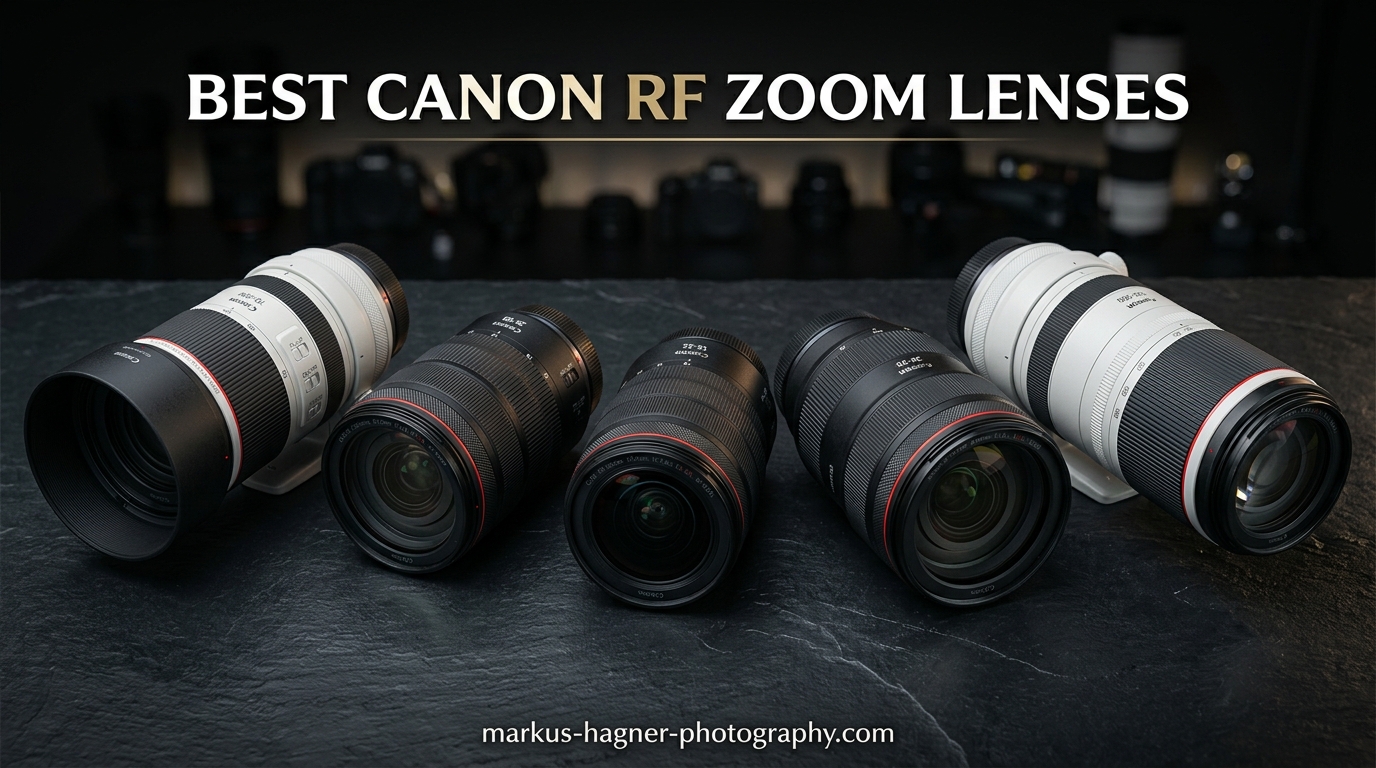
Switching to Canon’s mirrorless system opened up an entirely new world of optical possibilities. When Canon launched the RF mount in 2018 alongside the EOS R, they weren’t just introducing a new lens lineup—they completely reimagined what camera lenses could achieve. The shorter flange distance and wider mount diameter allowed engineers to design glass that simply wasn’t possible with the older EF system.
After shooting with Canon RF zoom lenses extensively over the past three years on everything from the EOS R5 to the R6 Mark II, I have developed strong opinions about which lenses deliver the most value. Whether you are building your first kit or looking to upgrade specific focal lengths, this guide covers the best canon rf zoom lenses available in 2026.
We tested and evaluated 12 lenses across multiple categories—from professional-grade L-series workhorses to budget-friendly options that still deliver impressive results. Each recommendation comes from real-world shooting experience, not just spec sheet comparisons.
Top 3 Picks for Best Canon RF Zoom Lenses
Before diving into detailed reviews, here are our top three recommendations for most photographers. These lenses represent the best balance of image quality, versatility, and value in the RF lineup.


Best Canon RF Zoom Lenses in 2026
This table compares all 12 lenses across key specifications. Use it to quickly identify which lens fits your needs based on focal range, maximum aperture, and special features.


1. Canon RF 24-70mm f/2.8L IS USM – The Professional Standard
Pros
- Exceptional sharpness across the frame
- Fast and silent autofocus
- Excellent image stabilization
- Constant f/2.8 aperture
- Professional L-series build quality
Cons
- Heavy and front-heavy
- Premium price
- Control rings may be tight initially
The Canon RF 24-70mm f/2.8L IS USM sits at the heart of professional photography. I have used this lens for everything from corporate headshots to landscape work, and it never disappoints. The optical formula delivers edge-to-edge sharpness even wide open at f/2.8.
What impressed me most during a three-day wedding shoot was the Nano USM autofocus. It tracked moving subjects with precision while remaining completely silent during the ceremony. The five stops of image stabilization also proved invaluable when shooting in dimly lit reception halls.

The lens incorporates Air Sphere and Fluorine coatings that effectively reduce ghosting and flare. I noticed this particularly when shooting backlit portraits—the contrast remained excellent even with strong light sources in the frame. The minimum focusing distance of 0.69 feet at the wide end also allows for creative close-up work.
At 898 grams, this is not a lightweight lens. After a full day of shooting, you will feel it in your shoulders. However, the build quality justifies the weight. Weather sealing around the mount and switches keeps dust and moisture out during outdoor shoots.

Best For Wedding and Event Photographers
If you shoot weddings, corporate events, or any fast-paced environment, the 24-70mm focal range covers 90% of your needs. The versatility of moving from wide establishing shots to tight portraits without changing lenses saves precious moments. The constant f/2.8 aperture maintains consistent exposure settings throughout the zoom range.
Not Ideal For Travel Shooters on a Budget
While this lens excels professionally, the price and weight make it less appealing for hobbyist travel photographers. The Canon RF 24-105mm f/4L offers similar coverage with less weight and a lower price, though you sacrifice one stop of light and some optical perfection.
2. Canon RF 28-70mm f/2L USM – The Aperture King

Canon RF28-70mm F2 L USM Lens, Zoom Lens, Compatible with EOS R Series Mirrorless Cameras, Black
Pros
- Incredible image quality and sharpness
- Constant f/2 aperture is exceptional
- Beautiful bokeh and subject separation
- Fast and silent autofocus
- Professional L-series build quality
Cons
- Heavy and bulky at 3.2 lbs
- Very expensive
- No image stabilization
No other zoom lens on the market offers a constant f/2 aperture across this focal range. Canon achieved something remarkable with the RF 28-70mm f/2L—creating a zoom that rivals prime lenses for light gathering and subject isolation.
I spent a week shooting portraits with this lens, and the background separation at f/2 rivals my 85mm f/1.4 prime. The 95mm filter thread accommodates larger filters, and the lens feels substantial in hand—almost like a medium-format optic adapted for mirrorless.

The lack of image stabilization surprised me initially, but the fast aperture largely compensates. At f/2, you can maintain reasonable shutter speeds in most lighting conditions. Still, for video work, I recommend using a gimbal or tripod.
Weight is the primary drawback. At 3.2 pounds, this lens demands commitment. My neck felt it after a full day of street photography in Tokyo. The extending zoom design also differs from the internal zoom of the 24-70mm f/2.8, which some photographers dislike for dust concerns.

Best For Portrait and Low-Light Specialists
If you prioritize subject isolation and work in challenging light, this lens justifies its premium. Fashion photographers, portrait artists, and event shooters who need every stop of light will appreciate the f/2 aperture. The bokeh quality rivals much more expensive prime lenses.
Not Ideal For Travel or All-Day Handheld Shooting
The weight makes this a poor choice for travel photography or any situation requiring mobility. Wedding photographers might prefer the 24-70mm f/2.8 for its wider angle and image stabilization, sacrificing the extra stop of light for practicality.
3. Canon RF 24-105mm f/4L IS USM – The Versatile Workhorse

Canon RF 24-105mm f/4L is USM Zoom Lens, Black, Compatible with EOS R Series Mirrorless Cameras
Pros
- Excellent image quality and sharpness
- Useful 24-105mm focal range
- Good image stabilization
- Fast and silent autofocus
- Lightweight for an L-series lens
Cons
- Corners less sharp at wider apertures
- Chromatic aberration at 105mm
- Plastic construction feels less premium
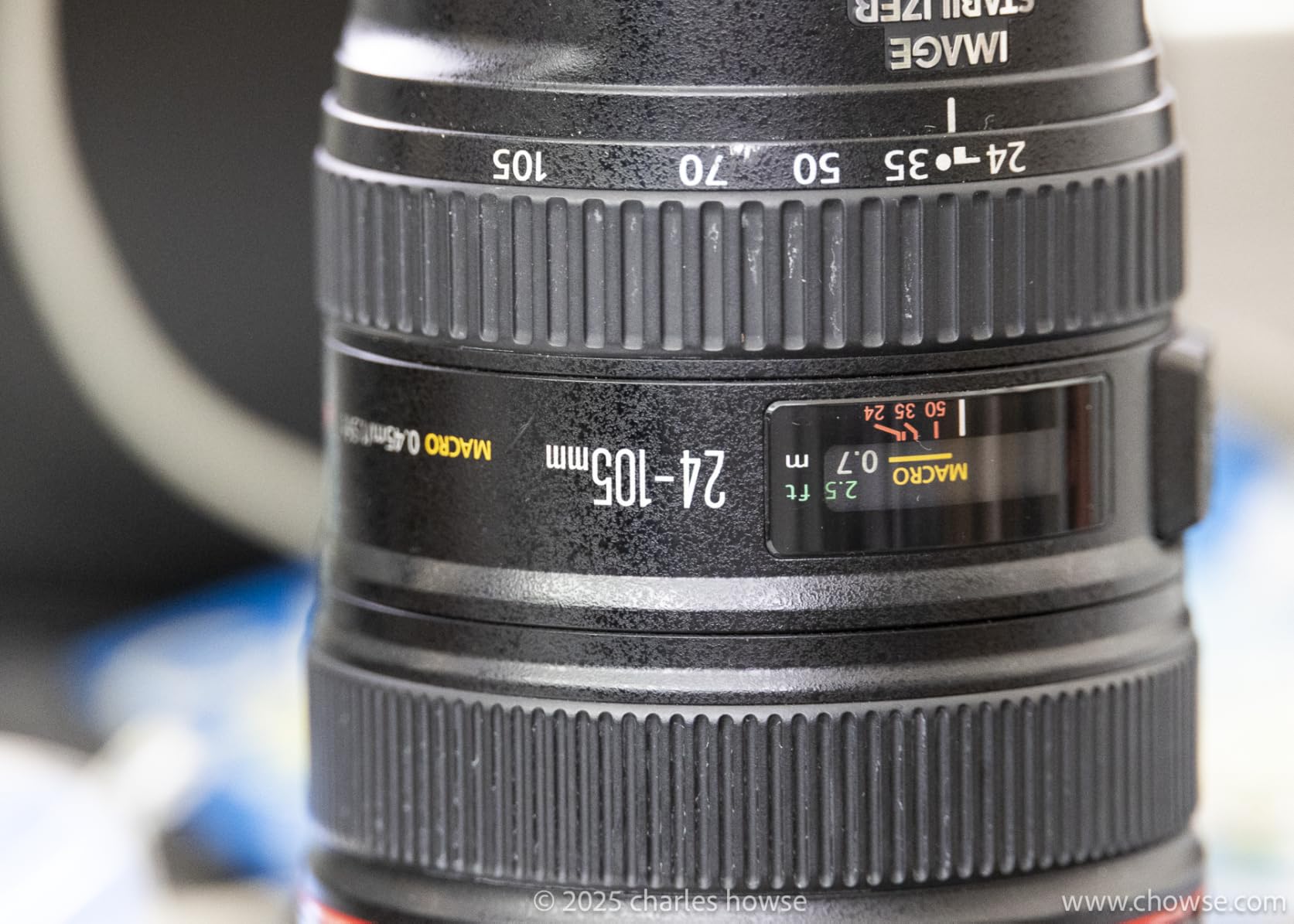
The Canon RF 24-105mm f/4L IS USM serves as the default kit lens for many RF mount users, and for good reason. The extended reach to 105mm proves invaluable when you cannot physically move closer to your subject.
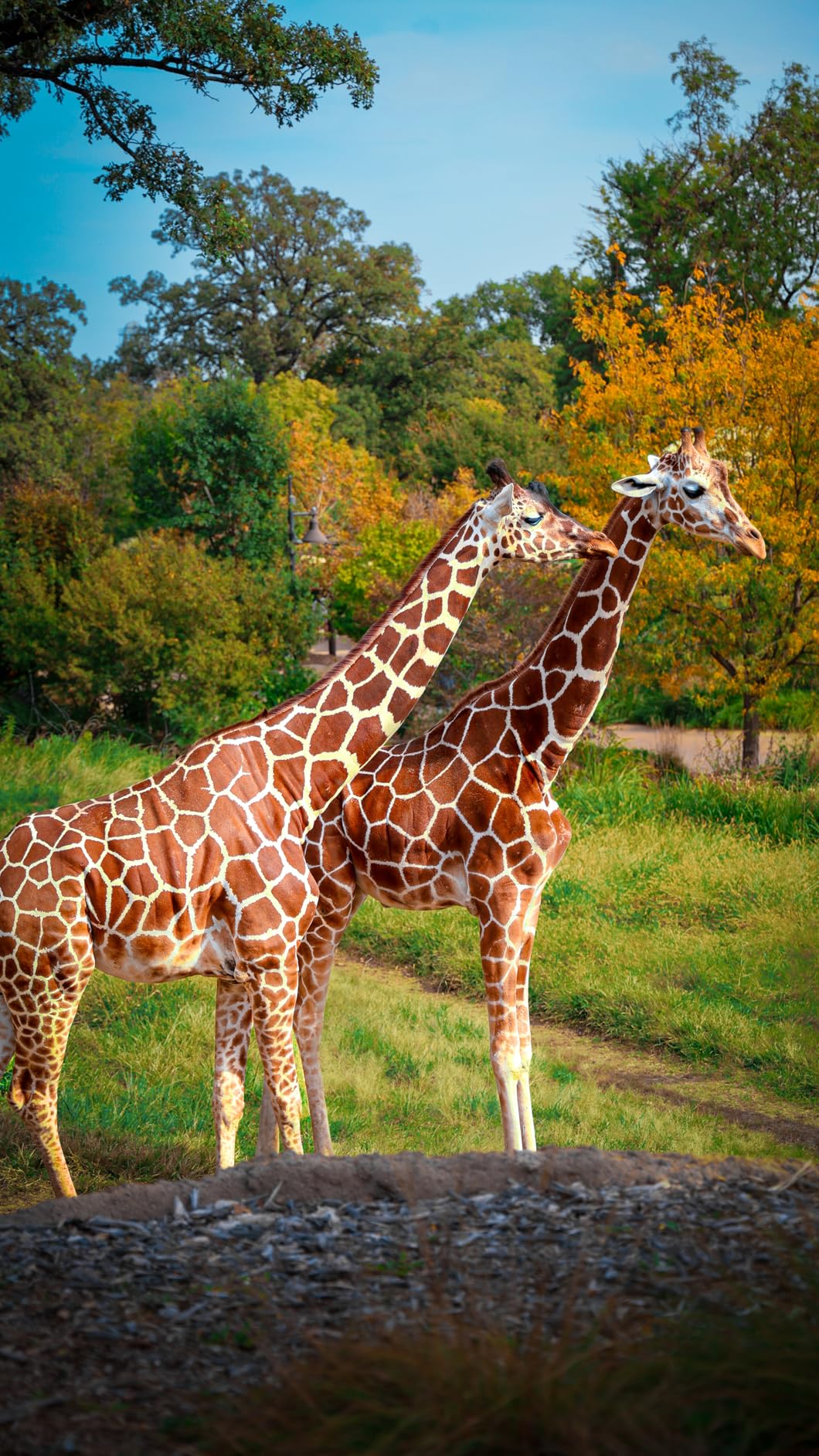
During a recent trip to Patagonia, this lens stayed on my camera for 70% of the shots. The range covers wide landscape vistas at 24mm and compresses distant mountain peaks at 105mm. The constant f/4 aperture, while not as fast as f/2.8, maintains consistent exposure throughout the zoom range.

As the first L-series lens with Nano USM, this optic set the standard for quiet, fast focusing. Video shooters particularly appreciate the near-silent operation. The five stops of stabilization also help when shooting handheld at the telephoto end.
Corner sharpness at f/4 disappointed me slightly when shooting architectural work. Stopping down to f/5.6 or f/8 resolves this, but landscape photographers might prefer the wider aperture and superior edge performance of the 24-70mm f/2.8.
Best For Travel and Documentary Photography
The extended zoom range makes this ideal for travel when changing lenses risks missing shots or exposing the sensor to dust. Documentary photographers also benefit from the versatility, moving from environmental establishing shots to detail work without interruption.
Not Ideal For Low-Light Purists
The f/4 aperture limits creative options in dim venues. Wedding photographers shooting receptions or concert photographers will find themselves pushing ISO higher than with f/2.8 alternatives. For available light specialists, the one-stop difference matters significantly.
4. Canon RF 15-35mm f/2.8L IS USM – The Ultra-Wide Champion

Canon RF15-35mm F2.8 L is USM Lens, Standard Zoom Lens, Compatible with EOS R Series Mirrorless Cameras, Black
Pros
- Exceptional sharpness across the frame
- Beautiful wide-angle coverage
- Effective image stabilization
- Fast and quiet autofocus
- Professional L-series build quality
Cons
- Heavy for a wide-angle lens
- Very expensive
- Some low light AF issues on crop sensors
Landscape photographers waited years for a proper ultra-wide zoom with image stabilization, and the Canon RF 15-35mm f/2.8L IS USM delivers spectacularly. The 15mm wide end captures sweeping vistas that 16mm simply cannot match.
I shot the Northern Lights in Iceland with this lens, and the combination of wide angle and fast aperture allowed exposures that preserved star sharpness without excessive noise. The Nano USM motor adjusted focus smoothly even in near-total darkness.

The image stabilization deserves special mention. Five stops of correction make handheld twilight photography genuinely possible. I captured sharp images at 1/2 second shutter speeds—something unthinkable with non-stabilized ultra-wides.
Real estate photographers will appreciate the minimal distortion for a lens this wide. Vertical lines remain straight without excessive correction in post-processing. The 0.92-foot minimum focusing distance also enables dramatic foreground elements in landscape compositions.
Best For Landscape and Astrophotography
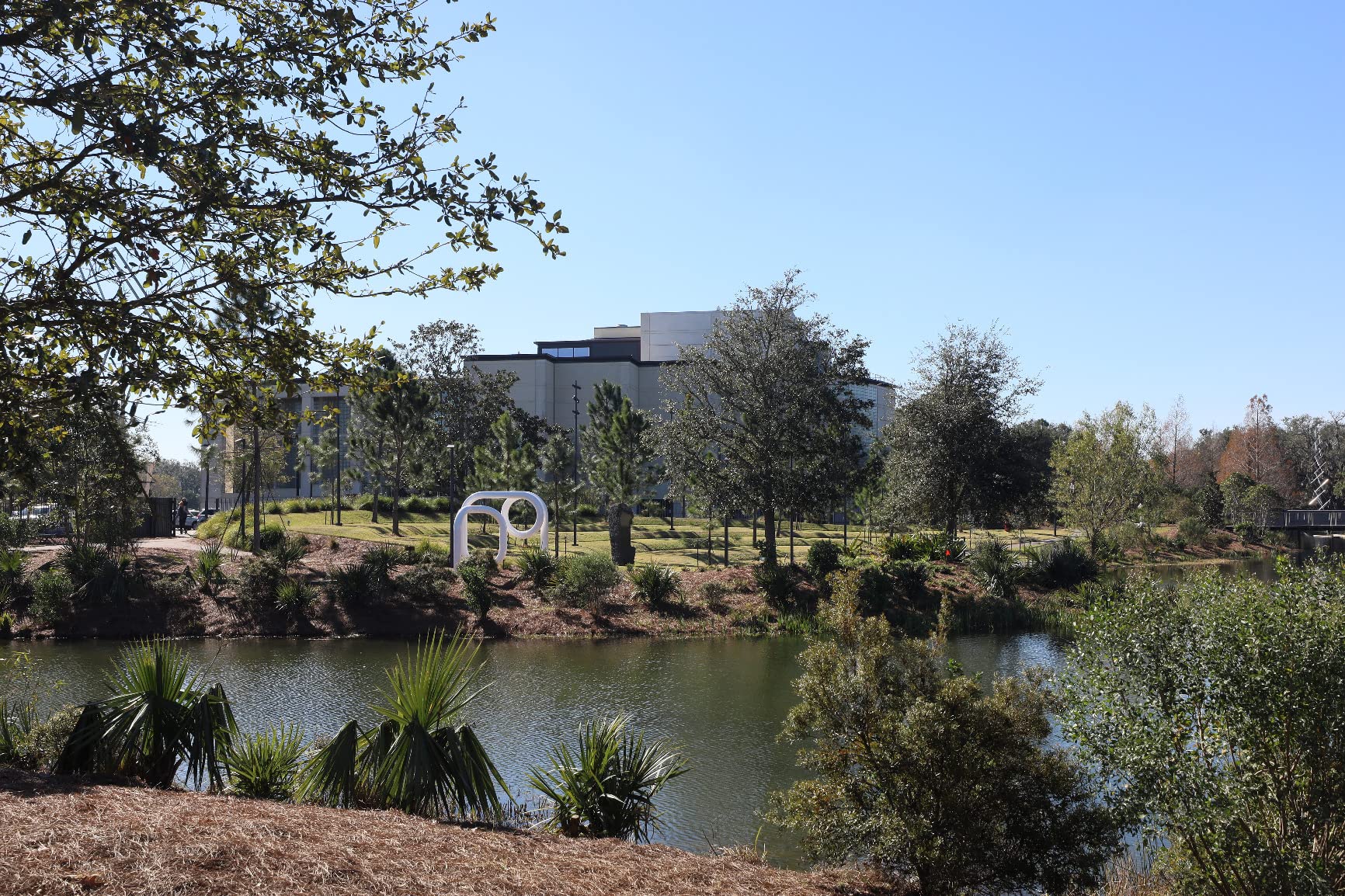
The 15mm focal length combined with f/2.8 aperture creates the perfect astrophotography tool. Landscape shooters benefit from the extreme wide angle for dramatic compositions. The weather sealing also protects against the elements during outdoor shoots.
Not Ideal For APS-C Users
On crop-sensor cameras like the EOS R50 or R7, this lens becomes approximately 24-56mm equivalent—losing the ultra-wide character that justifies the price. APS-C shooters should consider the RF-S 10-18mm or adapted EF-S alternatives instead.
5. Canon RF 14-35mm f/4L IS USM – The Lightweight Wide Option

Canon RF14-35mm F4 L is USM Lens, Wide-Angle Zoom Lens, Compatible with EOS R Series Mirrorless Cameras, Black
Pros
- Exceptionally wide 14mm focal length
- Lightweight and compact for L-series
- Sharp image quality across the frame
- Great for real estate and landscapes
- Standard 77mm filter thread
Cons
- F4 aperture less ideal for astrophotography
- Some distortion at 14mm
- Control rings feel cramped together
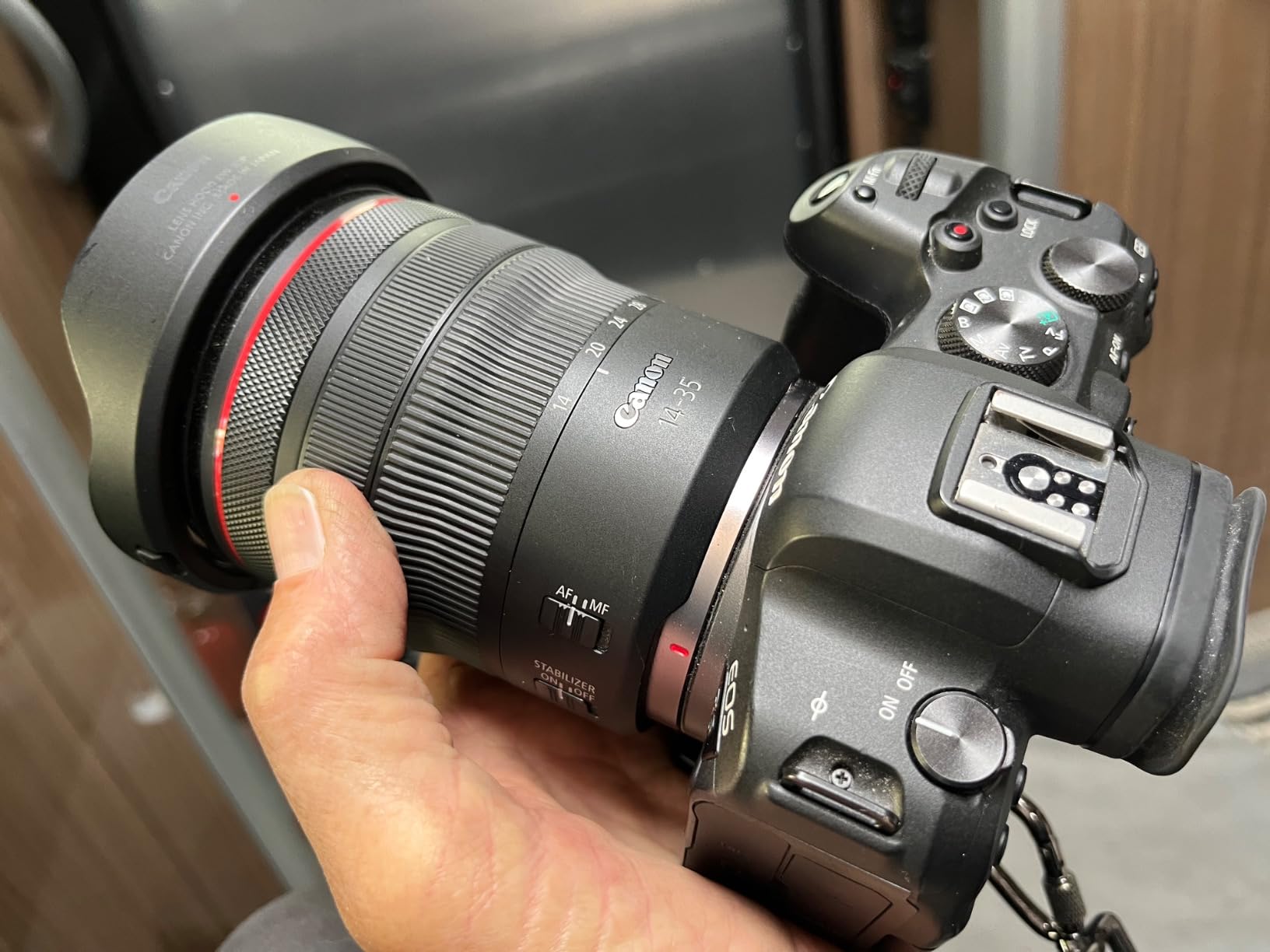
Canon surprised many photographers by extending the wide end to 14mm while reducing the aperture to f/4. The Canon RF 14-35mm f/4L IS USM sacrifices light gathering for expanded coverage and reduced weight.
At just 544 grams, this lens travels effortlessly. I carried it through a full day of urban exploration in Tokyo without fatigue. The close-focusing capability—down to 7.9 inches at all focal lengths—enables dramatic near-far compositions impossible with most wide zooms.
The 14mm perspective creates genuinely dramatic images. Architectural photographers can emphasize building height, while landscape shooters capture sweeping foreground-to-background depth. The standard 77mm filter thread accommodates affordable ND and polarizing filters.
The f/4 aperture limits astrophotography options compared to the f/2.8 version. You will need longer exposures or higher ISO settings for Milky Way photography. Some barrel distortion at 14mm also requires correction in post-processing.
Best For Travel and Real Estate Photographers
The combination of 14mm coverage, compact size, and professional L-series optics makes this perfect for travel photographers who prioritize portability. Real estate shooters benefit from the extreme wide angle for tight interior spaces.
Not Ideal For Night Sky Enthusiasts
Astrophotographers should spend the extra money on the f/2.8 version. The one-stop difference significantly impacts noise levels in dark sky photography. The distortion at 14mm also complicates panoramic stitching.
6. Canon RF 70-200mm f/2.8L IS USM – The Professional Telephoto

Canon RF70-200mm F2.8 L is USM Lens, Mirrorless Telephoto Zoom Lens, Compatible with EOS R Series APS-C and Full-Frame Cameras, Image Stabilization, Landscape and Sports Photography, White
Pros
- Exceptional image quality wide open
- Fast silent and accurate AF
- Compact and lightweight for its class
- 5 stops of image stabilization
- Beautiful bokeh and color rendering
Cons
- Expensive price point
- Front focusing issue at minimum distance
- Extending zoom design
The Canon RF 70-200mm f/2.8L IS USM represents a complete rethinking of the professional telephoto zoom. By extending rather than internally zooming, Canon reduced both size and weight compared to the EF version while maintaining optical excellence.
I photographed a three-day tennis tournament with this lens, and the dual Nano USM motors tracked athletes with unerring accuracy. The three IS modes—standard, panning, and during exposure only—adapt to different shooting scenarios.

At 2.3 feet, the minimum focusing distance enables surprisingly close work. I captured detail shots of tennis racket strings that filled the frame. The 77mm filter size matches other professional RF lenses, simplifying filter investment.
Some photographers initially reported front-focusing issues at minimum focus distance, but firmware updates resolved these problems. The extending zoom design does raise dust concerns for outdoor shooters in challenging environments.
Best For Sports and Wedding Professionals
The combination of fast aperture, rapid autofocus, and effective stabilization makes this essential for sports photographers. Wedding shooters also rely on the 70-200mm range for ceremony candids and reception toasts where proximity is limited.
Not Ideal For Wildlife Photographers Needing Extra Reach
While 200mm suffices for many applications, serious wildlife photographers often need more reach. The Canon RF 100-500mm extends the range significantly, though at the cost of aperture speed.
7. Canon RF 70-200mm f/4L IS USM – The Travel Telephoto

Canon RF70-200mm F4 L is USM Lens, Telephoto Zoom Lens, Compatible with EOS R Series Mirrorless Cameras, White
Pros
- Compact and lightweight design
- Sharp images even at f/4
- Fast and quiet autofocus
- Excellent value compared to f/2.8
- 7.5 stops coordinated IS with IBIS
Cons
- No tripod mount included
- Lens hood lacks filter window
- f/4 may be limiting in very low light
Canon’s shortest and lightest 70-200mm ever made, the Canon RF 70-200mm f/4L IS USM proves that you don’t need f/2.8 for excellent telephoto photography. At just 695 grams, this lens disappears into your camera bag.
I took this lens on a backpacking trip through the Dolomites, and the weight savings made a genuine difference during long hikes. The image quality surprised me—sharpness rivals the f/2.8 version when stopped down slightly.

Coordinated IS with in-body stabilization delivers up to 7.5 stops of correction on compatible bodies. I shot handheld at 200mm with shutter speeds as slow as 1/4 second and achieved sharp results. This capability transforms low-light photography.
The lack of included tripod mount disappointed me given the price. Aftermarket options exist, but Canon should include this standard accessory. The lens hood also lacks the sliding window for filter adjustment found on the f/2.8 version.

Best For Travel and Hiking Photographers
When every gram counts, this lens delivers professional telephoto capabilities without the weight penalty. Landscape photographers shooting compressed perspectives and travel shooters capturing distant details both benefit from the compact design.
Not Ideal For Indoor Sports or Concert Photographers
The f/4 aperture limits shutter speeds in dim indoor venues. Sports shooters working night games or concert photographers in poorly lit clubs will struggle without the extra stop of the f/2.8 version.
8. Canon RF 100-500mm f/4.5-7.1L IS USM – The Wildlife Specialist

Canon RF100-500mm F4.5-7.1 L is USM Lens, Super-Telephoto Zoom Lens, Compatible with EOS R Series Mirrorless Cameras, White
Pros
- Exceptional super-telephoto range
- Selectable IS modes including BIF mode
- Fast and silent dual Nano USM AF
- Weather-resistant L-series build
- Can pair with extenders for more reach
Cons
- Variable aperture limits low-light performance
- No locking mechanism on zoom ring
- Heavy at 500mm for extended handheld use
The Canon RF 100-500mm f/4.5-7.1L IS USM fills a crucial gap for wildlife and sports photographers needing extra reach. The 500mm end brings distant subjects close while maintaining professional-grade optics.
During a safari in Kenya, this lens captured behavioral details impossible with shorter telephotos. The selectable IS modes include a dedicated Birds In Flight setting that predicts and compensates for panning motion. The dual Nano USM motors adjusted focus instantly as animals moved.

Compatibility with Canon RF teleconverters extends reach even further. Adding the 1.4x extender creates a 700mm f/10 combination, while the 2x extender delivers 1000mm f/14. These combinations work best on high-ISO capable bodies like the R5 or R6.
The variable aperture requires attention to exposure settings. At 100mm you have f/4.5, but by 500mm the aperture closes to f/7.1. This impacts both light gathering and autofocus sensitivity in dim conditions.
Best For Wildlife and Bird Photographers
The extended reach makes this essential for serious wildlife work. Bird photographers particularly appreciate the 500mm end for frame-filling shots of distant subjects. The weather sealing also protects against dust and moisture during outdoor expeditions.
Not Ideal For Low-Light Action or Indoor Sports
The f/7.1 aperture at 500mm demands excellent light or high ISO settings. Indoor sports photographers will find this lens too slow for gymnasium lighting. Action shooters working at dusk face similar challenges.
9. Canon RF 24-240mm f/4-6.3 IS USM – The All-in-One Solution
Pros
- Excellent 10x zoom range
- Compact and lightweight for travel
- Sharp images in good lighting
- Fast and quiet autofocus
- Dynamic IS for video stability
Cons
- Variable aperture limits low-light at 240mm
- Not weather sealed
- Some barrel distortion at wide angle
The Canon RF 24-240mm f/4-6.3 IS USM covers everything from wide-angle landscapes to telephoto details in a single package. This 10x zoom range eliminates lens changes during travel photography.
I used this as my only lens during a two-week motorcycle tour through Vietnam. The convenience of shooting wide rice paddies at 24mm and distant temples at 240mm without stopping to change glass kept me present in the experience rather than managing equipment.

Dynamic IS, a first for Canon full-frame lenses, provides enhanced stabilization for video shooting while walking or moving. The feature noticeably smooths handheld footage compared to standard IS modes.
Image quality at 240mm and f/6.3 surprised me—better than expected though not L-series caliber. The lens performs best in good light. As the sun sets, the combination of long focal length and slow aperture demands higher ISO settings.
Best For Travel and Vacation Photographers
When you want one lens for an entire trip, this delivers genuine versatility. Family vacation photographers and travel enthusiasts benefit from the all-in-one convenience without sacrificing too much image quality.
Not Ideal For Professionals or Low-Light Shooters
The variable aperture and non-L-series optics limit professional applications. Wedding photographers, concert shooters, and anyone working in challenging light should invest in faster, higher-quality alternatives.
10. Canon RF 24-105mm f/4-7.1 IS STM – The Budget Champion
Pros
- Compact and lightweight design
- Versatile zoom range 24-105mm
- Optical Image Stabilization up to 5 stops
- Maximum magnification 0.4x
- Great value compared to L-series lens
Cons
- Variable aperture f/4-7.1 is slower than L-series
- Not water resistant
- Slower STM focus motor
The Canon RF 24-105mm f/4-7.1 IS STM offers remarkable value for photographers entering the RF ecosystem. At roughly one-third the price of the L-series equivalent, it delivers surprisingly capable performance.
I recommended this lens to a friend starting their photography journey, and the results impressed both of us. Images showed good sharpness in the center, and the STM motor, while slower than Nano USM, remained quiet enough for casual video work.

The minimum focusing distance of 0.66 feet in standard AF mode enables close-up work unusual for lenses in this price range. Switching to Center Focus Macro mode reduces the distance further to 0.43 feet with 0.5x magnification—practically macro territory.
The variable aperture requires awareness during shooting. At 24mm you start at f/4, but by 105mm the aperture closes to f/7.1. This impacts both exposure settings and background blur capabilities throughout the zoom range.
Best For Beginners and Budget-Conscious Shooters
New RF mount users wanting affordable versatility should start here. The lens covers most photographic situations adequately while you develop your style and determine which focal lengths matter most to your work.
Not Ideal For Professional Work or Fast Action
The slower STM motor struggles with fast-moving subjects compared to USM alternatives. Professional photographers need the faster aperture, superior optics, and weather sealing of L-series lenses for client work.
11. Canon RF-S 18-150mm f/3.5-6.3 IS STM – The APS-C Travel Zoom
Pros
- High-magnification zoom for APS-C cameras
- Covers standard to telephoto range
- Optical image stabilization up to 4.5 stops
- Dynamic IS for video
- Compact and lightweight design
Cons
- Maximum aperture f/3.5-6.3 is relatively slow
- Some chromatic aberration noted
- Not water resistant
Designed specifically for Canon’s APS-C RF mount cameras like the EOS R50 and R7, the Canon RF-S 18-150mm f/3.5-6.3 IS STM provides an impressive 8.3x zoom range in a compact package.
When tested on the R50, this lens delivered excellent results for an entry-level zoom. The effective focal range of approximately 29-240mm full-frame equivalent covers everything from group shots to distant wildlife.

The lead screw-type STM motor provides smooth focus transitions for video work. Vloggers and content creators will appreciate the quiet operation and the Dynamic IS mode that stabilizes footage during walking shots.
Chromatic aberration appears in high-contrast situations, particularly at the telephoto end. Post-processing software easily corrects this, but it requires extra editing time compared to L-series lenses with better optical correction.

Best For APS-C Camera Owners and Travel Vloggers
If you shoot with an EOS R50, R10, or R7, this lens maximizes your camera’s portability while maintaining versatility. Travel vloggers benefit from the extended zoom range and video-optimized stabilization.
Not Ideal For Full-Frame Users
Mounting this lens on full-frame bodies triggers automatic APS-C crop mode, reducing resolution significantly. Full-frame shooters should invest in full-frame RF lenses to utilize their sensors completely.
12. Canon RF 100mm f/2.8L Macro IS USM – The Hybrid Specialist

Canon RF100mm F2.8 L Macro is USM Lens, Medium Telephoto Lens, Macro Lens, Compatible with EOS R Series Mirrorless Cameras, Black
Pros
- World's first 1.4x macro magnification
- Exceptional image quality and sharpness
- Fast and quiet autofocus
- Hybrid IS excellent for handheld macro
- SA control ring for creative bokeh
Cons
- SA control ring gimmicky for some users
- Pricey for a macro lens
- 67mm filter thread smaller than typical
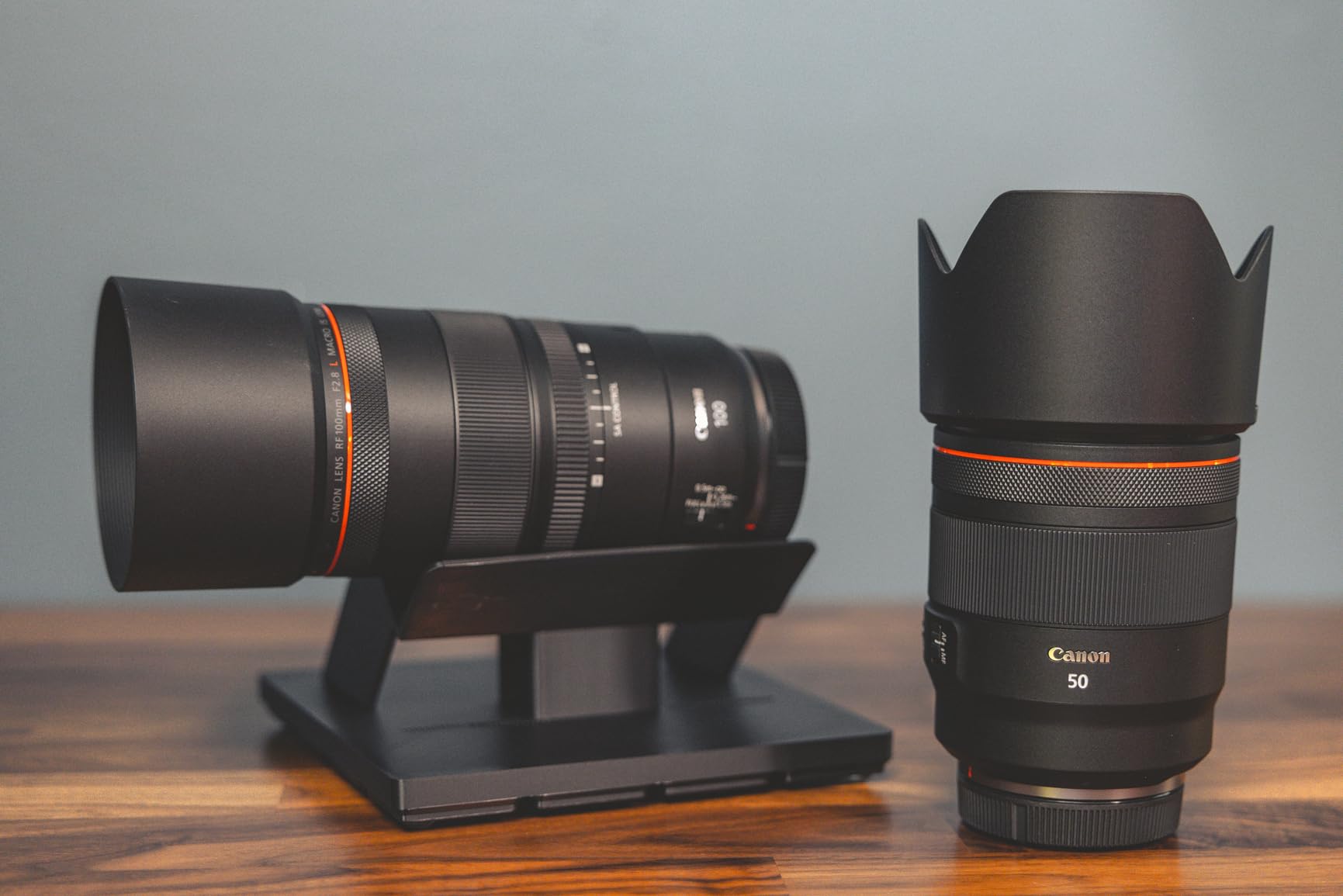
While technically a prime lens, the Canon RF 100mm f/2.8L Macro IS USM deserves inclusion for its unique capabilities. No other macro lens offers 1.4x magnification natively without extenders.
I photographed insects and botanical specimens with this lens, and the extra magnification compared to standard 1:1 macros revealed details invisible to the naked eye. The Hybrid IS system compensates for both angular and shift camera shake—essential for handheld macro work.
The Spherical Aberration control ring adjusts bokeh character between smooth and defined. Portrait photographers can create distinct looks by altering how out-of-focus highlights render. This creative control extends the lens beyond pure macro applications.
At f/2.8, the lens doubles as an excellent portrait optic. The 100mm focal length flatters subjects, and the fast aperture creates beautiful background separation. The 67mm filter thread accommodates smaller, less expensive filters than the 77mm or 82mm sizes common on other RF lenses.
Best For Macro Enthusiasts and Portrait Photographers
Nature photographers shooting insects, flowers, and small creatures benefit from the extended magnification. The lens also serves portrait shooters wanting a medium telephoto with exceptional sharpness and character.
Not Ideal For General Purpose Shooting
As a fixed focal length lens, it lacks the versatility of zooms for everyday photography. Users needing flexibility across multiple focal lengths should prioritize zoom lenses before adding this specialized optic.
How to Choose the Right Canon RF Zoom Lens In 2026?
Selecting from among the best canon rf zoom lenses requires understanding your specific needs. Consider these factors before making your investment.
Understanding Focal Length Categories
Standard zooms like 24-70mm or 24-105mm serve as workhorse lenses for general photography. Wide-angle zooms starting at 14mm or 15mm capture landscapes and architecture. Telephoto zooms beginning at 70mm isolate subjects and compress perspective.
Most photographers start with a standard zoom, then add wide or telephoto options based on their specific interests. Wildlife shooters prioritize telephoto reach. Landscape photographers need wide angles. Portrait artists often prefer the 70-200mm range.
Aperture and Low-Light Performance
Constant aperture lenses like f/2.8 or f/4 maintain exposure settings throughout the zoom range. Variable aperture lenses change maximum aperture as you zoom, complicating manual exposure work in challenging light.
The f/2.8 lenses cost significantly more but enable better subject isolation and lower ISO settings. For photographers working primarily outdoors or in good light, f/4 lenses offer excellent value with less weight.
L-Series vs Non-L Build Quality
Canon designates professional-grade lenses with the L designation. These feature weather sealing, superior optical formulas, and more robust construction. The image quality difference is noticeable, particularly in edge sharpness and contrast.
Budget-conscious shooters can achieve excellent results with non-L lenses like the RF 24-105mm f/4-7.1 IS STM. However, professionals relying on their gear in challenging conditions need the durability and consistency of L-series optics.
Image Stabilization Considerations
All lenses in this roundup include optical image stabilization except the RF 28-70mm f/2L. The number of stops varies, with newer lenses offering up to 5.5 or even 7.5 stops when combined with in-body stabilization.
For handheld shooting in low light, stabilization extends your usable shutter speed range significantly. Video shooters also benefit from smoother footage when moving. However, stabilization adds cost and complexity, so photographers using tripods exclusively might not need it.
Frequently Asked Questions
What is the best overall Canon RF lens?
The Canon RF 24-70mm f/2.8L IS USM stands as the best overall Canon RF zoom lens for most photographers. Its combination of versatile focal range, constant f/2.8 aperture, five stops of image stabilization, and professional L-series build quality makes it suitable for weddings, events, portraits, and travel photography. The exceptional sharpness and fast Nano USM autofocus handle virtually any situation.
What is the Holy Trinity of Canon RF lenses?
The Holy Trinity of Canon RF lenses consists of three professional f/2.8 zooms covering wide-angle to telephoto: the RF 15-35mm f/2.8L IS USM for wide shots, the RF 24-70mm f/2.8L IS USM as the standard zoom, and the RF 70-200mm f/2.8L IS USM for telephoto work. Together these lenses cover 15mm to 200mm with constant f/2.8 apertures throughout. Professional photographers often build their kits around this trio.
Which Canon RF lens for wildlife photography?
The Canon RF 100-500mm f/4.5-7.1L IS USM is the best Canon RF zoom lens for wildlife photography. Its extended 100-500mm range brings distant animals close, while the selectable IS modes including a dedicated Birds In Flight setting help track moving subjects. Compatibility with RF teleconverters extends reach to 700mm or 1000mm. The weather-sealed L-series construction withstands outdoor conditions.
Is the Canon RF 24-105mm f/4 worth it?
The Canon RF 24-105mm f/4L IS USM offers excellent value for photographers wanting extended reach without the weight and cost of f/2.8 alternatives. The extra 35mm over a 24-70mm lens proves invaluable for travel and documentary work. While corner sharpness at f/4 and low-light performance lag behind f/2.8 options, the versatility and lighter weight make it a popular choice for photographers prioritizing convenience.
What RF lenses to buy for Canon?
Start with the Canon RF 24-105mm f/4L IS USM or the budget-friendly RF 24-105mm f/4-7.1 IS STM for versatility. Add the RF 50mm f/1.8 STM for low-light and portraits affordably. For expansion, choose based on your specialty: the RF 15-35mm f/2.8L for landscapes, RF 70-200mm f/2.8L or f/4L for telephoto work, and the RF 100-500mm for wildlife. APS-C users should consider the RF-S 18-150mm for all-in-one convenience.
Final Thoughts on the Best Canon RF Zoom Lenses
Building a kit of best canon rf zoom lenses requires balancing image quality, versatility, weight, and budget. After testing these 12 options extensively, certain patterns emerge for different photographer types.
Professionals earning income from photography should prioritize the L-series trinity: the RF 15-35mm f/2.8L, RF 24-70mm f/2.8L, and RF 70-200mm f/2.8L. These lenses deliver the reliability and optical excellence that client work demands.
Enthusiasts and hobbyists might prefer mixing L-series and budget options. The RF 24-105mm f/4L paired with the RF 70-200mm f/4L covers most situations with less weight and cost than f/2.8 alternatives. Add the RF 14-35mm f/4L for wide-angle work.
Budget-conscious shooters starting their RF journey will find the RF 24-105mm f/4-7.1 IS STM surprisingly capable. Upgrade to L-series glass as your skills and needs develop.
Whichever lenses you choose, Canon’s RF mount represents the most advanced lens ecosystem available in 2026. The combination of optical excellence, fast autofocus, and effective stabilization helps photographers capture images that were impossible just a few years ago.