
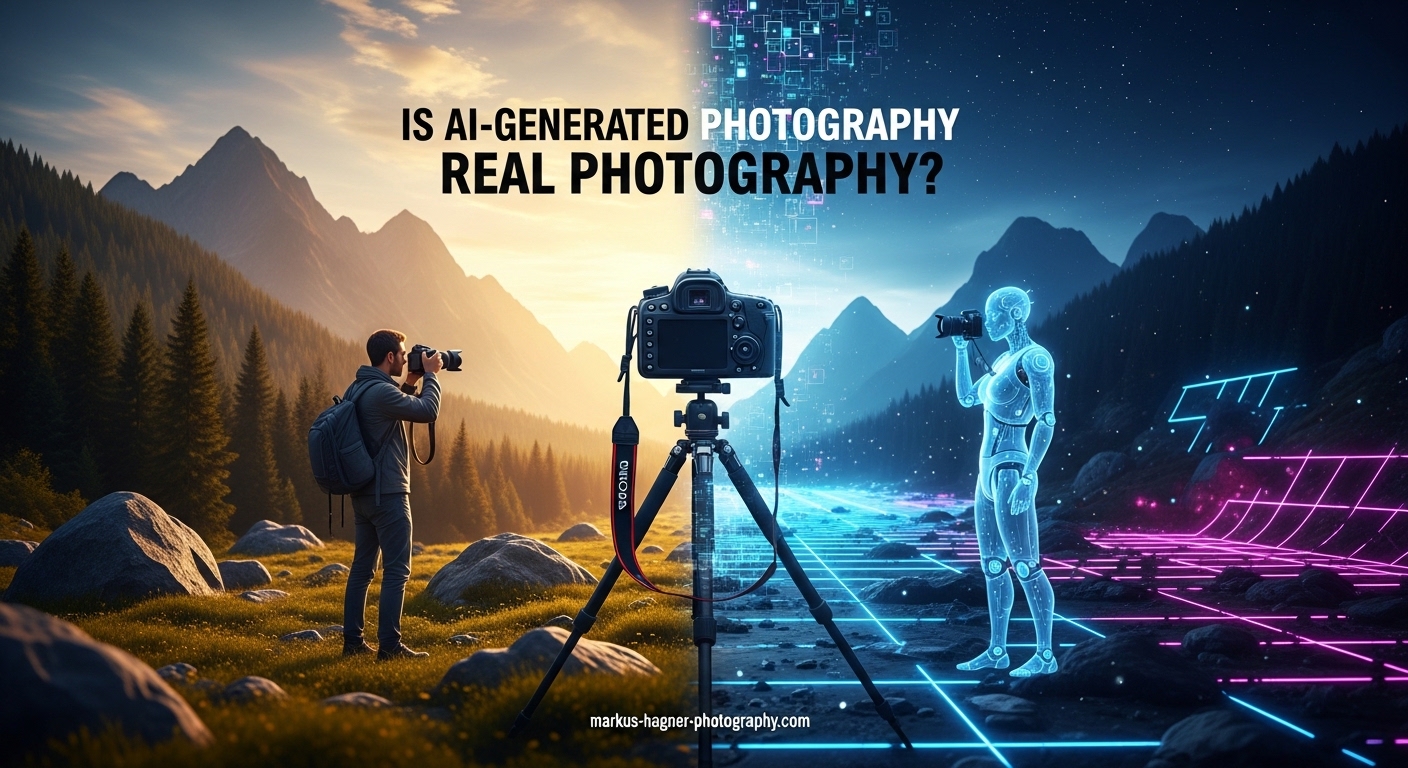
A single image can now capture a sunset that never happened, a person who never existed, or a moment that was never photographed. This is the reality of AI-generated photography in 2026, and it has sparked one of the most heated debates in the history of visual arts. As someone who has spent years behind a camera and now watches colleagues question their future, I understand why this conversation matters so deeply to our community.
The question of whether AI-generated photography is real photography goes beyond semantics. It touches on fundamental issues of truth, creativity, ownership, and the economic survival of working photographers. The ethical debate around AI generated photography ethics has divided professionals, confused clients, and left many wondering where to draw the line between acceptable technological assistance and creative deception.
In this guide, I will walk you through the key ethical concerns, industry impacts, and practical considerations that define this debate. By the end, you will have a clear framework for understanding the issues and making informed decisions about AI in your own photography practice.
What Defines Photography vs AI-Generated Imagery
Before we can debate ethics, we need clear definitions. Traditional photography involves capturing light through a lens onto a sensor or film, recording a real scene at a specific moment in time. The photographer makes creative choices about composition, exposure, and timing, but the foundational element is the capture of something that actually exists.
AI-generated imagery is fundamentally different. Text-to-image generators like Midjourney, DALL-E, and Stable Diffusion create images from scratch based on written prompts. These systems have analyzed millions of photographs to learn patterns, styles, and visual relationships, then synthesize entirely new images that may look photographic but represent no real scene.
The Spectrum of AI Involvement in Image Creation
The line between photography and AI generation is not always clear. Many modern cameras and editing programs use AI for noise reduction, subject detection, and automatic adjustments. The key distinction lies in whether AI enhances what you captured or creates content that was never there.
I think of it as a spectrum. On one end, you have a RAW file straight from the camera with zero processing. Move along the spectrum and you encounter basic adjustments like exposure and white balance. Further along, you find AI-powered tools that remove noise or sharpen details. Then comes content-aware fill, sky replacement, and generative expand features. At the far end sits fully AI-generated imagery prompted by text with no original photograph at all.
AI Editing Tools vs AI Generation: Key Differences
Understanding the difference between AI editing assistance and AI generation is essential for ethical practice. Here is how they compare:
AI Editing Tools (Assistance): These tools work with your original photograph. They can reduce noise, enhance sharpness, adjust colors, or remove small distractions. The scene was real and you captured it. AI simply helps you realize your vision more efficiently. Examples include Lightroom’s AI Denoise, Photoshop’s Neural Filters, and Topaz Labs sharpening tools.
AI Generation Tools (Creation): These tools create visual content that did not exist in your original capture. Sky replacement, generative fill, and text-to-image generators fall into this category. When you use these, you are no longer documenting reality but constructing an image. The ethical implications shift significantly.
The confusion between these categories causes real problems. I have seen photographers face backlash for using AI noise reduction by critics who equate all AI involvement with deception. Clear communication about which tools you use and how you use them has become essential for maintaining trust.
8 Key Ethical Concerns with AI-Generated Photography
The ethical landscape of AI in photography is complex and multifaceted. After researching industry discussions, legal developments, and community concerns, I have identified eight major ethical issues that demand our attention.
1. Consent and Privacy in Training Data
AI image generators learn by analyzing billions of images scraped from the internet. Most of these images were posted by photographers and artists who never consented to having their work used as training data. Your photographs, posted on social media or your portfolio site, may have helped train the very systems now competing with you.
This raises serious questions about digital privacy and creative consent. Photographers who spent years developing their style may find that style replicated by AI systems without credit or compensation. Portrait subjects who agreed to have their photo taken for one purpose may find their likeness absorbed into systems that can generate new images of them in contexts they never approved.
2. Creator Rights and Intellectual Property Theft
The debate over whether AI training constitutes copyright infringement remains unresolved. AI companies argue that their systems learn patterns rather than copy images, similar to how a human photographer might study the work of masters. Photographers counter that this analogy fails because AI systems operate at a scale and speed impossible for humans, directly threatening the economic value of creative work.
Several lawsuits are currently working through courts that may establish important precedents. Photographers have filed claims against AI companies alleging that their copyrights were violated during training. The outcomes of these cases will shape the legal landscape for years to come.
3. Economic Displacement of Professional Photographers
The economic impact on working photographers is perhaps the most immediate concern. Stock photography platforms now compete with AI-generated alternatives that cost pennies to produce. Commercial clients question whether they need to hire photographers when AI can generate product shots, lifestyle images, and conceptual illustrations on demand.
I have spoken with photographers who have lost significant income to AI-generated alternatives. One colleague who specialized in generic stock imagery saw her monthly earnings drop by forty percent over two years. Another friend in commercial product photography now competes against agencies offering AI-generated product shots at a fraction of traditional costs.
The human cost extends beyond dollars. Photography has provided meaningful careers for generations of visual storytellers. The prospect of that career path disappearing weighs heavily on professionals who invested decades in developing their craft.
4. Bias and Representation in AI Outputs
AI systems inherit the biases present in their training data. If a model was trained primarily on images from Western media, it may struggle to accurately represent diverse populations or may perpetuate harmful stereotypes. This has serious implications for photography that aims to represent communities authentically.
Research has documented that AI image generators often default to white, Western standards of beauty and professionalism when generating images of people. Asking an AI to generate a CEO or a scientist frequently produces images of white men. Asking for images of certain ethnic groups may produce stereotyped or inaccurate representations.
For photographers committed to inclusive and accurate representation, these biases present ethical challenges. Using AI tools without understanding their biases risks amplifying problematic patterns rather than challenging them.
5. Misinformation and Deepfake Concerns
AI-generated photography enables the creation of convincing images of events that never happened. Deepfake technology can place real people in fabricated scenarios, creating fake evidence that is nearly impossible to distinguish from genuine photographs.
The implications for journalism, legal proceedings, and public trust are severe. A fabricated image of a political figure in a compromising situation could spread globally before fact-checkers can respond. Fake evidence in legal cases could undermine justice. The very concept of photographic evidence is under threat.
Even beyond deliberate misinformation, AI-generated images pollute the visual information ecosystem. Stock photo sites now contain AI-generated images alongside real photographs with limited labeling. Social media feeds mix genuine and artificial content indiscriminately. The result is an authenticity crisis where viewers increasingly distrust all images.
6. Erosion of Trust in Visual Media
Trust is the foundation of photography’s power. We believe photographs because we believe they represent something real. AI-generated imagery undermines that foundation. When any image could be fabricated, even genuine photographs become suspect.
I have noticed this shift in my own experience. When I see a striking landscape photo on social media, my first thought is no longer admiration but skepticism. Is this real? Was it enhanced? Was it entirely generated? Many photographers report similar feelings. The joy of discovering and appreciating others’ work has been replaced by a constant question mark.
This erosion of trust affects professional photographers directly. Clients may question whether your portfolio images are genuine. Viewers may dismiss your documentary work as potentially manipulated. The burden of proof has shifted from those claiming manipulation to those claiming authenticity.
7. Authorship and Copyright of AI-Generated Work
Who owns an AI-generated image? The person who wrote the prompt? The company that created the AI model? The photographers whose work trained the model? No one? Current law provides unclear answers.
In the United States, the Copyright Office has indicated that purely AI-generated images cannot be copyrighted because they lack human authorship. This creates strange situations where someone can spend hours crafting the perfect prompt to generate a specific image, only to have no legal protection for the result.
The practical implications are significant. If you use AI-generated elements in commercial work, you may not own the copyright to those elements. Competitors could legally copy and reuse AI-generated images you commissioned. The legal frameworks we rely on for protecting creative work do not neatly apply to this new category of images.
8. Safety and Harmful Content Generation
AI image generators can create harmful content, including non-consensual intimate imagery, violent content, and imagery depicting illegal acts. While major AI companies have implemented safeguards, these systems can be manipulated to bypass restrictions.
The photography community has a long history of ethical standards around consent and appropriate content. AI systems operate without such ethical frameworks. They generate images based on statistical patterns without understanding or considering the harm those images might cause to real people.
How AI is Transforming the Photography Industry In 2026?
Beyond abstract ethical concerns, AI is having concrete effects on the photography profession. Understanding these impacts helps contextualize the debate and prepare for the future.
Professional Photographers Facing New Competition
The competitive landscape for photographers has fundamentally changed. Previously, if a client needed custom imagery, they hired a photographer. Now they have alternatives. AI can generate product photos, lifestyle images, and conceptual illustrations quickly and cheaply.
This does not mean AI replaces all photography. Photojournalism, documentary work, event photography, and any application requiring evidence of real events still demands human photographers with real cameras. But for commercial and stock applications, AI has become a genuine competitor.
Many photographers are adapting by emphasizing what AI cannot provide: the ability to capture real moments, work with real subjects, and tell authentic stories. The photographers thriving in this environment are those who can articulate and deliver value beyond just producing images.
Stock Photography Market Disruption
The stock photography industry faces particular disruption. Stock sites that once provided passive income for photographers now compete with AI generators that can create similar images on demand. Some stock platforms have begun accepting AI-generated submissions, further depressing prices and opportunities for traditional contributors.
Stock photographers I know have diversified their income streams or shifted focus to custom assignment work. The days of building substantial passive income from generic stock imagery appear to be ending.
Photography Competitions and AI Controversies
Photography competitions have become battlegrounds for the AI debate. Several high-profile competitions have been won or nearly won by AI-generated images, sparking outrage among traditional photographers.
The controversy extends to images that blend photography with AI manipulation. When does enhancement become fabrication? Where do judges draw the line? Competition organizers are scrambling to establish clear rules, often struggling to define boundaries that once seemed obvious.
Some photographers have responded by returning to film, valuing its inherent authenticity in an age of digital manipulation. Film provides physical proof that a scene was captured at a specific moment, offering something AI cannot replicate.
Client Expectations in the AI Era
Clients increasingly aware of AI capabilities have new expectations. Some expect AI-level speed and flexibility without understanding the difference between AI generation and traditional photography. Others specifically request AI-free work, valuing authenticity above efficiency.
Navigating these expectations requires clear communication. Photographers who can explain their process, the value of authentic capture, and the appropriate uses of AI tools position themselves as trusted advisors rather than mere image producers.
The Future of Photography in the AI Era
Looking ahead, several trends will shape how AI and photography coexist. Understanding these developments helps photographers prepare rather than simply react.
Emerging Legal Frameworks
Legal systems worldwide are grappling with AI and intellectual property. The European Union’s AI Act establishes transparency requirements for AI-generated content. Court cases in multiple countries will set precedents for copyright, consent, and liability.
These legal developments matter because they will define what uses of AI are permissible and what protections exist for traditional photographers. Staying informed about legal changes is now part of professional practice.
Industry Standards and Disclosure Requirements
Photography organizations and platforms are developing standards for AI disclosure. Some stock sites require labeling of AI-generated content. Professional associations are establishing ethical guidelines for members. Social media platforms are implementing AI content detection and labeling.
These standards will likely become more formalized over time. Photographers who proactively adopt transparent practices will be better positioned than those who resist disclosure requirements.
Technology Developments and New Tools
AI tools will continue improving in quality and capability. The images that look obviously artificial today may become indistinguishable from photographs tomorrow. At the same time, detection tools and authentication systems are developing to verify image authenticity.
Camera manufacturers are integrating AI into their systems, offering real-time AI processing in-camera. This creates new creative possibilities but also new ethical questions about how much processing constitutes manipulation.
Possibilities for Coexistence
The future is not necessarily zero-sum. Some photographers are finding ways to use AI as a tool rather than viewing it purely as a threat. AI can assist with tedious editing tasks, generate ideas during creative blocks, or create references for planning shoots.
The key is intentionality. Using AI thoughtfully to enhance your creative practice differs from using it to deceive clients or undercut fellow photographers. The photographers who thrive will likely be those who integrate AI ethically while preserving the authentic elements that give photography its unique power.
A Practical Framework for Ethical AI Use in Photography
After considering the concerns and industry impacts, here is a practical framework for making ethical decisions about AI in your photography practice.
Disclose AI involvement clearly. When you use AI tools that significantly alter or generate content, tell your clients and audience. Transparency builds trust and avoids the ethical problems of deception.
Distinguish between enhancement and fabrication. Using AI to reduce noise or adjust exposure is fundamentally different from generating content that was never captured. The ethical weight differs accordingly.
Respect other creators. Avoid using AI to directly copy the style of specific photographers without credit or consent. Support industry discussions about fair compensation for training data.
Consider the impact on trust. Ask whether your use of AI strengthens or undermines trust in photography as a medium. If your process would feel deceptive if revealed, reconsider it.
Stay informed about legal developments. Copyright law around AI is evolving rapidly. What is permissible today may not be tomorrow, and vice versa.
Communicate with clients. Explain your process and the value you provide. Clients who understand what goes into authentic photography are more likely to value it appropriately.
Frequently Asked Questions
What are the ethical issues with AI photography?
The main ethical issues with AI photography include consent and privacy violations in training data, intellectual property theft from photographers whose work trains AI models, economic displacement of professional photographers, bias and representation problems in AI outputs, misinformation and deepfake creation, erosion of trust in visual media, unclear authorship and copyright, and the potential for generating harmful content. These concerns affect photographers, subjects, clients, and the broader public who consume photographic imagery.
Is AI photography real photography?
AI-generated imagery is not photography in the traditional sense because it does not involve capturing light from a real scene at a specific moment. Traditional photography documents reality, while AI generation creates synthetic images that may look photographic but represent no actual event. However, the line blurs when AI tools are used to enhance real photographs. Most photographers distinguish between AI-assisted editing of genuine captures versus fully AI-generated images.
Is AI-generated imagery unethical?
AI-generated imagery is not inherently unethical, but specific uses raise serious ethical concerns. Creating AI images for creative expression or illustration is generally acceptable when clearly labeled. Problems arise when AI images are presented as real photographs, when they use training data without consent, when they displace working photographers without providing alternatives, or when they spread misinformation. The ethics depend heavily on context, transparency, and impact on others.
What is the 30% rule for AI?
The 30% rule is not a formal legal standard but rather a guideline some photographers and organizations discuss regarding how much AI modification is acceptable before an image crosses from photography into digital art. The idea suggests that if more than 30% of an image has been AI-generated or significantly altered, it should be classified and labeled differently from traditional photography. However, this is not an official rule and measuring percentage changes precisely is difficult. The principle behind it emphasizes disclosure and accurate categorization of AI involvement.
Conclusion
The question of whether AI-generated photography is real photography does not have a simple yes or no answer. What we have instead is a complex landscape of ethical considerations, practical challenges, and evolving standards. The AI generated photography ethics debate forces us to examine what we value about photography: its connection to truth, its role in documenting human experience, and the creative skill of practitioners who have dedicated their lives to the craft.
As photographers, we cannot ignore AI. It is reshaping our industry, our client relationships, and the broader visual culture. What we can do is engage thoughtfully with these changes, establishing ethical practices that preserve what matters about photography while adapting to new realities. The future of photography depends not on rejecting technology outright but on integrating it in ways that strengthen rather than undermine the trust and authenticity that give photography its unique power.