
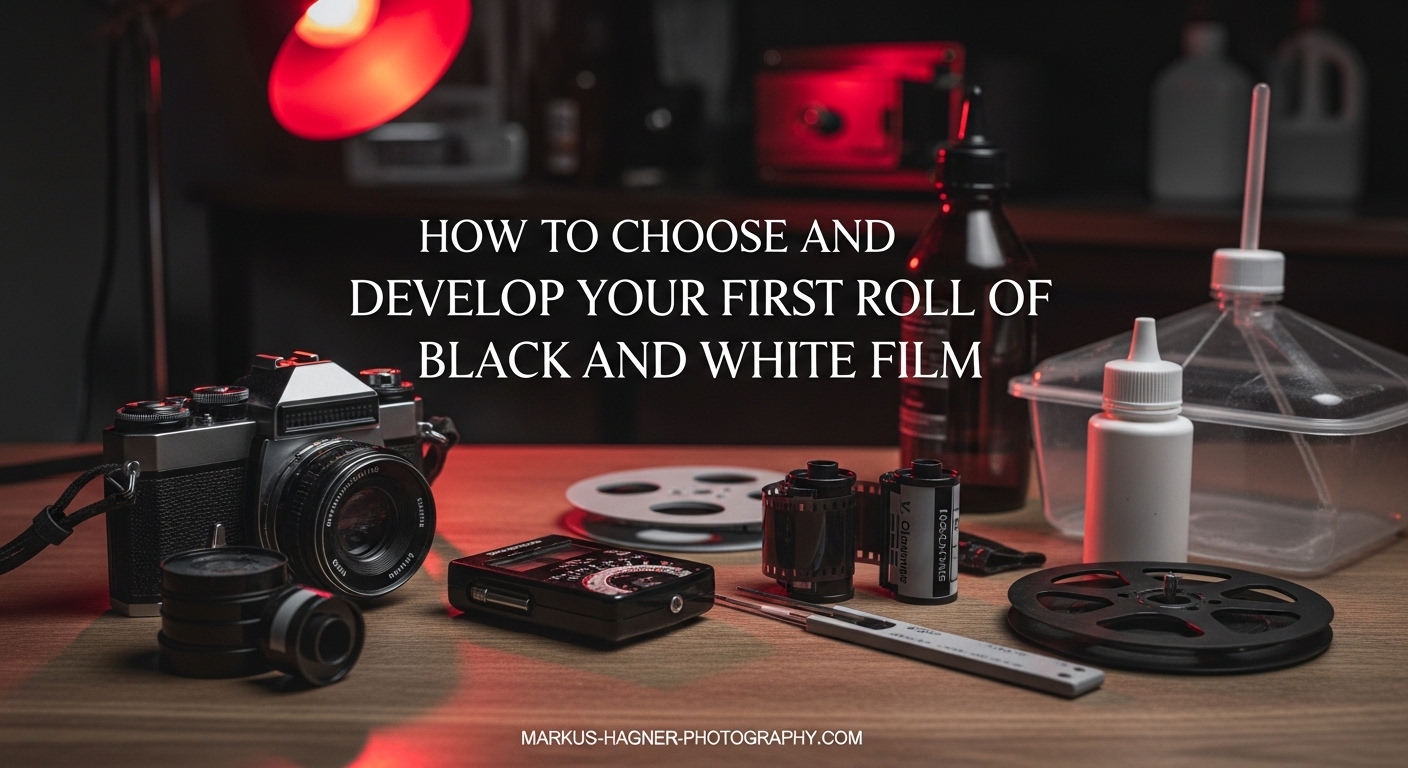
There is something deeply satisfying about holding your first developed roll of black and white film. I still remember the anticipation as I unspooled my negatives, wondering if anything would appear. The good news? B&W film developing is surprisingly forgiving, and you absolutely do not need a darkroom to do it at home. This guide will walk you through everything from picking your first film stock to loading reels, mixing chemicals, and producing beautiful negatives you can print or scan. By the end, you will have the confidence to develop black and white film at home without the learning curve that intimidated so many of us.
Developing your own film saves money too. Labs typically charge $15-20 per roll for black and white processing, while home developing costs around $3-5 per roll after your initial equipment investment. More importantly, you gain creative control over contrast, grain, and tonality that sending film to a lab simply cannot provide. The process takes about 30-45 minutes once you get comfortable, and most of that time is just waiting.
How to Choose Your First Black and White Film In 2026?
Your choice of film affects everything from grain structure to contrast to how forgiving the emulsion is when you make exposure mistakes. For your first roll, I strongly recommend starting with one of the classic 400 ISO films: Ilford HP5+, Kodak Tri-X, or Kentmere 400. These stocks have enormous exposure latitude, meaning even if your metering is off by a stop or two, you will still get usable images.
Understanding ISO for Black and White Film
ISO (or ASA on older film boxes) determines how sensitive your film is to light. Lower ISO films like 100 or 125 produce finer grain and require more light, making them ideal for bright outdoor scenes or tripod work. Higher ISO films like 400 or 800 have more visible grain but can handle lower light situations. For beginners, 400 ISO hits the sweet spot because it works in most lighting conditions without requiring a tripod.
Here is what I tell everyone starting out: shoot your first few rolls at box speed. HP5+ is rated at 400 ISO, so set your camera to 400 and meter normally. Do not try push processing (rating the film higher than box speed) or pull processing (rating it lower) until you understand how the film behaves at its native speed. Consistency matters more than experimentation when you are learning.
Recommended Beginner Films Compared
Not all black and white films are created equal. Some are more forgiving, some have finer grain, and others offer unique tonal characteristics. Here is a comparison of the best films for your first roll:
Ilford HP5 Plus (400 ISO) – The workhorse of black and white photography. HP5+ has excellent exposure latitude, moderate grain, and responds beautifully to push processing if you decide to experiment later. It is widely available and consistently manufactured, so your results will be predictable roll after roll. This is my top recommendation for first-time developers.
Kentmere 400 (400 ISO) – Kentmere is Ilford’s budget-friendly option, and it is genuinely excellent value. The grain is slightly more pronounced than HP5+, but for learning purposes, it performs admirably. Many photographers use Kentmere for testing new cameras or techniques before committing to more expensive stocks. At roughly half the price of HP5+, you can afford to make mistakes.
Kodak Tri-X 400 (400 ISO) – The legendary photojournalist film. Tri-X has a distinctive grain structure and slightly higher contrast than HP5+. It has been used to capture some of the most iconic images in history. Tri-X is slightly less forgiving than HP5+ but rewards careful exposure with beautiful tonality. If you want that classic documentary look, this is your film.
Ilford FP4 Plus (125 ISO) – If you prefer slower, finer-grained film and mostly shoot outdoors or with flash, FP4+ delivers incredibly sharp results with minimal grain. The lower ISO means you need more light, but the resolution and smoothness are worth it for landscapes and portraits. Save this for your fifth or sixth roll once you are comfortable with the developing process.
35mm vs 120 Format for Beginners
Most beginners start with 35mm film, and for good reason. The cameras are more affordable, film is cheaper, and you get 24 or 36 exposures per roll. Developing 35mm is also slightly easier because the film is narrower and loads onto reels more smoothly. If you already own a 35mm camera, start there.
120 film (also called medium format) produces larger negatives with incredible detail, but the cameras are typically more expensive and you only get 10-16 exposures per roll depending on your camera’s format. The developing process is identical, but loading 120 film onto reels can be trickier for beginners because it is wider and has a paper backing. I recommend mastering 35mm first before moving to medium format.
Essential Equipment for Developing Black and White Film at Home
You might be surprised how little equipment you actually need. The biggest misconception is that you need a dedicated darkroom. You do not. A changing bag (or a completely light-tight closet at night) handles the only step that requires total darkness: loading film onto the developing reel. Everything else happens in normal room light.
Developing Tank and Reels
The developing tank is your primary piece of equipment. It is a light-tight container that lets you pour chemicals in and out while protecting your film from light. I recommend the Paterson Universal Tank system for beginners. It is affordable, widely available, and the plastic reels are easier to load than metal ones. A two-reel Paterson tank costs around $30-40 and will last for years.
The key feature of daylight developing tanks like the Paterson is the light-trap system. Once your film is loaded inside and the lid is on, you can work in normal light. The tank has a funnel system that lets you pour chemicals through the center without exposing the film. This is what makes home developing possible without a darkroom.
Changing Bag (Your Portable Darkroom)
A changing bag is essentially a light-tight bag with two armholes. You put your film, developing tank, and reels inside, zip it shut, insert your arms through the elasticized sleeves, and load your film in complete darkness. Changing bags cost $25-50 depending on size. Get one large enough to work comfortably, because cramped conditions make loading film frustratingly difficult.
Some photographers use a closet or bathroom at night instead of a changing bag. This works, but you need to be absolutely certain no light leaks in around the door frame. Test any space by sitting inside for five minutes with your eyes adjusted to darkness. If you can see any light, even a tiny sliver, that space will fog your film. A changing bag removes this uncertainty entirely.
Chemicals: Developer, Stop Bath, Fixer, and Photo-Flo
Black and white film requires four chemicals in sequence. Here is what each one does:
Developer – This is the most important chemical. Developer converts the exposed silver halide crystals on your film into metallic silver, creating the visible image. Different developers produce different results: some emphasize fine grain, others increase contrast, and some are designed for push processing. For beginners, I recommend liquid concentrates like Ilford DDX or Kodak HC-110 because they are easy to dilute and store. Rodinal is another popular option that is incredibly affordable, but it produces more grain than modern fine-grain developers.
Stop Bath – Stop bath is a weak acid (typically acetic acid) that halts development immediately. Without it, developer continues working on your film even after you pour it out, leading to inconsistent results. You can use plain water as a stop bath for your first few rolls, but dedicated stop bath (around $10 for a bottle that lasts years) gives more consistent results and changes color when exhausted.
Fixer – Fixer removes the unexposed silver halide from your film, making the image permanent and light-safe. Without fixer, your negatives would darken completely when exposed to light. Ilford Rapid Fixer and Kodak T-Max Fixer are both excellent options. A bottle costs around $15-20 and will process dozens of rolls.
Photo-Flo (Wetting Agent) – This final step prevents water spots on your negatives as they dry. A single drop of Photo-Flo in your final rinse helps water sheet off evenly instead of beading up. A small bottle costs about $10 and will last years because you use so little per roll.
Miscellaneous Supplies
Beyond the tank and chemicals, you need a few inexpensive items:
A thermometer is essential because developer temperature affects developing time. B&W film typically develops at 68 degrees Fahrenheit (20 degrees Celsius). A simple dial thermometer works fine, or you can get a digital one for more precision.
Storage bottles for your mixed chemicals. Developer goes bad when exposed to air, so store it in full bottles with minimal headspace. One-liter brown plastic bottles work well and cost a few dollars each.
A timer for tracking development, fixing, and washing times. Your phone works fine, but a dedicated timer is nice because you can set multiple intervals.
Film clips or clothespins for hanging your negatives to dry. Special film clips have teeth that grip the film leader, but wooden clothespins work too.
Negative sleeves for storing your developed film. Plastic pages with individual slots protect your negatives from scratches and dust while keeping them organized. Look for archival-quality sleeves that will not degrade over time.
Budget Breakdown for Your Home Darkroom
Here is approximately what you can expect to spend to start developing black and white film at home:
Essential Equipment: Paterson two-reel tank ($35), changing bag ($35), thermometer ($10), storage bottles set ($12), timer ($8), film clips ($5), negative sleeves ($8). Total: approximately $113.
Chemicals (starter quantities): Developer concentrate ($18), stop bath ($10), fixer ($18), Photo-Flo ($10). Total: approximately $56.
Complete starter setup: approximately $170-180. This will process 20-30 rolls of film before you need to replace chemicals. At $3-5 per roll for chemistry versus $15-20 at a lab, you break even after developing about 12-15 rolls. Everything after that is pure savings.
Step-by-Step Guide: How to Develop Black and White Film
Now we get to the actual process. Take your time with your first few rolls. Read through all the steps before you begin, and do not worry if everything feels awkward at first. Every experienced film developer started exactly where you are now.
Before You Begin: Preparation
Gather all your materials before you start. You need: exposed film, developing tank with reels, changing bag, developer (mixed and at temperature), stop bath, fixer, Photo-Flo, thermometer, timer, and a place to hang your film to dry. Having everything ready prevents panicked searching mid-process.
Check your developer temperature. Most developers work best at 68 degrees Fahrenheit (20 degrees Celsius), but you can adjust developing time for slightly warmer or cooler temperatures using the Massive Dev Chart app or website. Temperature matters because warmer developer works faster, and if you develop for the wrong time, your negatives will be over or under-developed.
Look up your film and developer combination on the Massive Dev Chart. This free resource tells you exactly how long to develop any film in any developer. For example, HP5+ in Ilford DDX at 68 degrees requires 6.5 minutes. Write this time down or have it ready on your phone.
Step 1: Loading Film Onto the Reel
This is the only step that must happen in complete darkness. Once you start, do not open the changing bag or turn on any lights until the film is completely inside the developing tank with the lid secured.
Place your film canister, bottle opener, developing tank with reels, and scissors inside the changing bag. Zip it shut and insert your arms through the sleeves. Give your eyes a minute to adjust so you can verify there is no light inside.
Use the bottle opener to pop the end cap off your film canister. Pull the film out gently. Do not pull hard or the film will unspool quickly and become tangled. Cut the leader (the narrow tongue at the beginning of the film) off with scissors so you have a straight edge.
Feed the cut end of the film into the reel. Paterson reels have a small clip in the center that holds the film in place. Insert the film edge into the clip, then twist the reel halves back and forth to walk the film onto the reel. The film should load smoothly without resistance. If it feels stuck, back up and try again. Never force film onto a reel because it will buckle and touch itself, creating stuck-together areas that do not develop.
Once all the film is on the reel, cut it free from the spool. Place the loaded reel into the developing tank and screw the lid on tightly. Now you can remove your arms from the bag and work in normal light.
Pro tip: Practice loading a cheap sacrificial roll in daylight before attempting it in the changing bag. Once you can load smoothly with your eyes open, try with your eyes closed. This practice session prevents wasting your first real roll.
Step 2: Pre-Wash (Optional)
Some photographers pre-wash film with water before developer. The theory is that pre-washing removes the anti-halation backing (the dark coating that prevents light from bouncing through the emulsion) and brings the film to developing temperature. Others skip this step entirely.
If you choose to pre-wash, fill the tank with water at your developing temperature (68 degrees F), let it sit for one minute, then pour it out. The water will turn purple or pink from the anti-halation dye, which is normal. I pre-wash because it helps me get consistent results, but many excellent photographers skip it. Try both ways and see what works for you.
Step 3: Developer
This is where the magic happens. Developer converts the invisible latent image on your exposed film into visible metallic silver. The development time, temperature, and agitation pattern all affect your final negative.
Start your timer as you begin pouring developer into the tank. Pour steadily through the center funnel until the tank is full. Cap the tank and tap it firmly on the counter two or three times to dislodge any air bubbles clinging to the film surface. Air bubbles cause circular clear spots on your negatives called “air bells.”
Agitation schedule varies by developer, but a common pattern is: agitate for the first 30 seconds, then agitate for 10 seconds every minute thereafter. To agitate, gently invert the tank three or four times in about 10 seconds. Do not shake vigorously. The goal is to refresh the developer around the film without creating turbulence that causes uneven development.
When your timer goes off, immediately pour the developer out. Some developers can be reused (one-shot developers are discarded after use). Check your developer instructions for reuse capacity.
Step 4: Stop Bath
Pour your stop bath into the tank immediately after developer. Agitate continuously for 30 seconds to one minute. The stop bath neutralizes the alkaline developer and stops development instantly. You might notice the tank warming slightly from the chemical reaction, which is normal.
After agitation, pour the stop bath out. It can be reused many times before exhausting. If your stop bath includes an indicator dye, it will change from purple to orange when exhausted.
Beginner shortcut: Plain water works as a stop bath for your first few rolls. Fill the tank with water, agitate for 30 seconds, pour out, and repeat twice. This is less precise than chemical stop bath but perfectly adequate for learning.
Step 5: Fixer
Fixer removes the unexposed silver halide from your film, making the image permanent. Pour fixer into the tank and agitate for the first 30 seconds, then intermittently for the recommended time (typically 3-5 minutes for most fixers).
After about two minutes of fixing, you can carefully open the tank and look at your film. The milky appearance will clear as the fixer works. If the film still looks cloudy after the recommended time, fix for another minute or two. Under-fixed film will eventually darken and degrade, so err on the side of over-fixing.
Fixer can be reused many times. Keep track of how many rolls you have processed and replace the fixer when it approaches its rated capacity (typically 20-30 rolls per liter). Exhausted fixer fails to clear the film properly.
Step 6: Final Wash
With fixing complete, your film is light-safe and can be removed from the tank. However, you need to wash out residual fixer, which will eventually stain your negatives if left behind.
The most efficient washing method is the Ilford wash technique: fill the tank with water, agitate for five inversions, pour out. Repeat with 10 inversions, then 20 inversions, then 40 inversions. This uses less water than continuous washing and is actually more effective. The whole process takes about 5 minutes.
Alternatively, you can run water through the tank for 10-15 minutes. This uses more water but requires less attention. Either method works fine.
Step 7: Photo-Flo and Drying
After washing, fill the tank with water and add one or two drops of Photo-Flo wetting agent. Agitate gently for 30 seconds. This step prevents water spots by helping water sheet off the film evenly rather than beading up.
Remove your film from the reel carefully. Hold it by the ends, not the edges where fingerprints can mark the emulsion. Hang the film in a dust-free location using film clips or clothespins. Weight the bottom with another clip to keep the film from curling while it dries.
Drying takes 1-2 hours depending on humidity. Do not rush this process or use heat, which can damage the emulsion. Keep the hanging film away from dust, pets, and air currents. The bathroom after a hot shower (once the steam has dissipated) is often a good drying location because the humid air has settled dust.
Step 8: Cutting and Storing Your Negatives
Once completely dry, cut your negatives into strips of 5-6 frames for 35mm film. Use clean scissors and handle negatives only by the edges. Fingerprints on dry negatives are difficult to remove and show up clearly when scanning or printing.
Slide each strip into a negative sleeve, emulsion side (the dull side) facing the sleeve material. Label the sleeve with the date, film stock, and any notes about the shoot. Good organization pays off when you are searching for a specific image months or years later.
Store your negative sleeves in a binder or box away from direct light, heat, and humidity. Properly stored black and white negatives last for decades. Many photographers have negatives from the 1950s or earlier that still print beautifully.
Common Beginner Mistakes and Troubleshooting Tips
Even experienced film photographers make mistakes. The key is learning from them. Here are the most common problems beginners encounter and how to avoid or fix them.
Top 5 Beginner Mistakes
1. Loading film onto the reel incorrectly. This is the number one frustration for new developers. Film that touches itself during development creates areas where no chemistry reaches the emulsion, leaving blank spots on your negatives. The solution is simple: practice with a cheap roll in daylight until you can load smoothly every time. Then practice with your eyes closed before attempting it in the changing bag.
2. Incorrect developer temperature. Developer that is too warm works too fast, over-developing your negatives. Developer that is too cool works too slowly, under-developing them. Check your temperature before every session. If your developer is slightly off 68 degrees, look up the adjusted developing time on the Massive Dev Chart.
3. Inconsistent agitation. Agitation affects how evenly developer reaches your film. Too little agitation causes streaking. Too much agitation increases contrast and can cause uneven development. Find an agitation pattern and stick with it for every roll.
4. Skipping the tap after pouring chemistry. Air bubbles cling to film and create circular clear spots called air bells. Tapping the tank on the counter after pouring in each chemical dislodges these bubbles. Make it a habit.
5. Under-fixing. Rushing the fix step leaves residual silver halide on your film, which eventually darkens and stains. Fix for the full recommended time plus an extra minute for safety. Your negatives will thank you years from now.
Identifying Development Problems
Learning to read your negatives helps you diagnose problems and improve your process. Here are common issues and their causes:
Blank film (completely clear): Film was not exposed in the camera, or developer was completely exhausted. Check that your camera shutter is working and that you are using fresh developer.
Completely black film: Film was fogged by light before or during development. This usually happens during the loading step if your changing bag has a light leak or you opened the tank before fixing was complete.
Dense, dark negatives: Over-development. Your development time was too long, temperature too high, or agitation too vigorous. Check your Massive Dev Chart times and use a thermometer.
Thin, light negatives: Under-development. Development time was too short, temperature too low, or developer was exhausted. Mix fresh developer and verify your timing.
Streaks or uneven density: Insufficient agitation or uneven chemical distribution. Make sure you are agitating consistently and that chemistry covers the reels completely.
Water spots: Water dried on the emulsion before Photo-Flo was used. Always use a wetting agent in your final rinse.
Safety and Chemical Disposal
Black and white darkroom chemicals are relatively safe, but they deserve respect. Always work in a ventilated area. Avoid skin contact by wearing gloves, especially with developer, which some people are sensitive to. Keep all chemicals clearly labeled and stored away from children and pets.
Disposal regulations vary by location. In most areas, used developer can be poured down the drain with plenty of water. Fixer contains dissolved silver and should be collected for proper disposal or recycling at a photo lab or hazardous waste facility. Some photographers use silver recovery cartridges to extract the valuable silver from used fixer. Check your local regulations to be certain.
Helpful Resources
The Massive Dev Chart (available as a website and app) is indispensable. It lists developing times for virtually every film and developer combination ever made. Before developing any roll, I look up the time and temperature on Massive Dev Chart.
YouTube tutorials provide visual guidance for techniques like loading reels, which are difficult to learn from text descriptions alone. Search for “how to load film onto developing reel” and watch a few different approaches.
Film photography communities on Reddit (r/AnalogCommunity, r/Darkroom) and dedicated forums are incredibly welcoming to beginners. Post your first developed negatives and ask for feedback. Experienced photographers are happy to help you improve.
Frequently Asked Questions
How easy is it to develop black and white film?
Developing black and white film is surprisingly easy once you understand the process. The chemistry is forgiving, room temperature development works fine, and you do not need a darkroom. Most beginners produce successful negatives on their first or second attempt. The hardest part is loading film onto the reel in darkness, which improves quickly with practice.
How much does it cost to develop a roll of black and white film at home?
After the initial equipment investment of approximately $170-180, each roll costs about $3-5 in chemistry. This compares to $15-20 per roll at professional labs, meaning you break even after developing 12-15 rolls. Your equipment lasts for years, making home developing significantly cheaper in the long run.
Do I need a darkroom to develop black and white film?
No, you do not need a darkroom. A changing bag handles the only step requiring darkness: loading film onto the developing reel. Once the film is inside the light-tight developing tank, all other steps happen in normal room light. This makes home developing accessible to anyone with a small workspace.
What is the best black and white film for beginners?
Ilford HP5 Plus is the top recommendation for beginners due to its excellent exposure latitude and consistent results. Kentmere 400 offers similar characteristics at a lower price point, making it ideal for learning. Kodak Tri-X 400 is another excellent option with classic photojournalistic character. All three 400 ISO films work well in most lighting conditions.
What chemicals do I need to develop black and white film?
You need four chemicals: developer (creates the image), stop bath (halts development), fixer (makes the image permanent), and Photo-Flo wetting agent (prevents water spots). A starter set of all four chemicals costs approximately $56 and will process 20-30 rolls before needing replacement.
How long does it take to develop black and white film?
The entire developing process takes 30-45 minutes, including washing and preparation. Actual development time varies by film and developer combination, typically ranging from 5-12 minutes. Drying adds another 1-2 hours, but this is passive time when you can do other things.
Your Journey Into Film Developing Starts Here
Learning how to choose and develop your first roll of black and white film opens up a creative world that digital photography cannot replicate. The tangible process of loading film, mixing chemicals, and watching images appear on your negatives connects you to over a century of photographic tradition. It also gives you complete control over your final image, from exposure through development to printing or scanning.
My advice for beginners is simple: stick with one film stock and one developer for at least ten rolls. Learn how HP5+ responds when you expose it correctly, under-expose it, and over-expose it. Understand how development time affects contrast. Build muscle memory for loading reels. Once these fundamentals become second nature, you can experiment with different films, developers, and techniques like push processing.
Do not let fear of ruining film stop you from starting. Yes, your first roll might have problems. Your negatives might be too dense or too thin. You might struggle with reel loading. Every single experienced film photographer went through the same learning curve. The difference between those who master film developing and those who give up is simply persistence. Keep developing, keep learning, and keep enjoying the unique satisfaction of creating photographs from chemistry and light.
Your first successfully developed roll of black and white film will be a milestone you remember for years. The negatives hanging in your bathroom, slowly drying, represent not just images but a new skill and creative capability. Welcome to film developing. You are going to love it.