
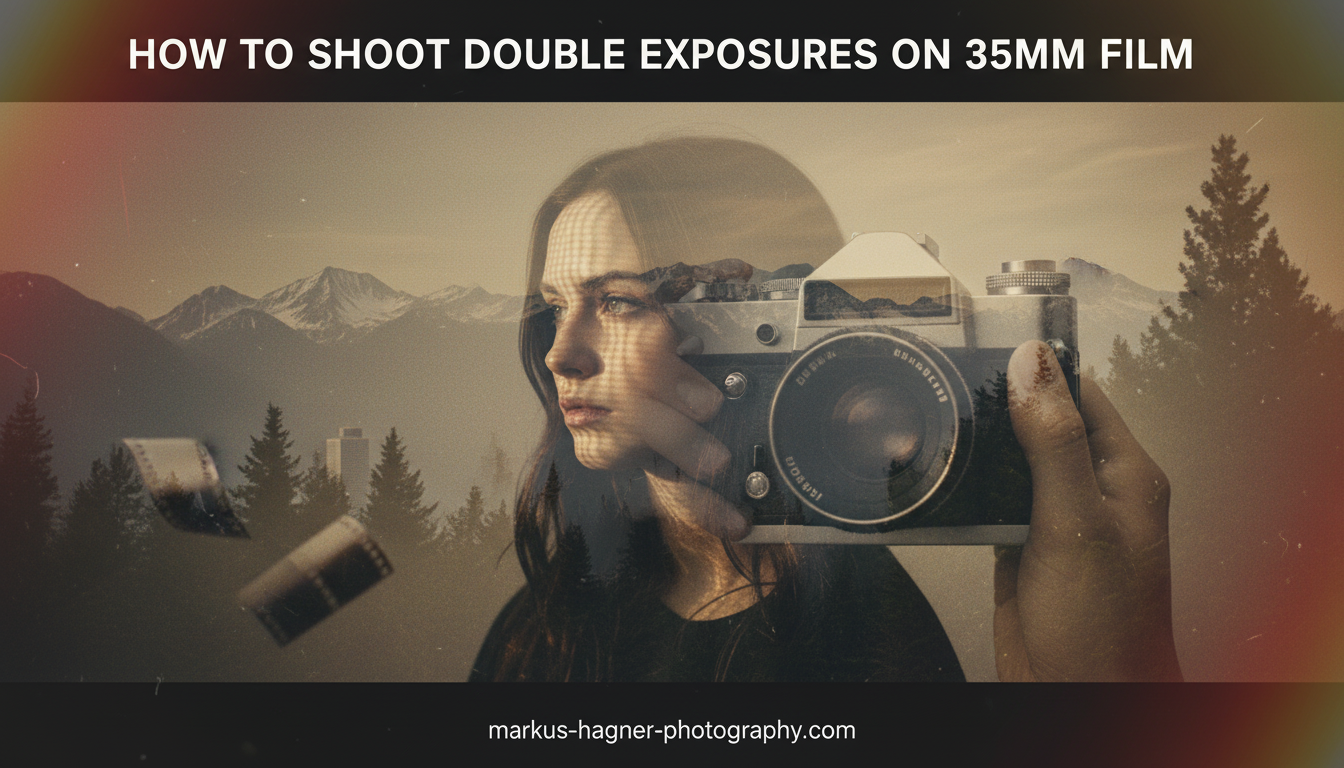
Learning how to shoot double exposures on 35mm film opens up a world of creative possibilities that digital photography simply cannot replicate. There is something magical about exposing the same frame twice, never quite knowing what you will get back from the lab. After shooting double exposures for over a decade, I can tell you that the unpredictability is part of the charm, but understanding the technique will dramatically improve your results.
In this guide, I will walk you through both main methods for creating double exposures on film: using your camera’s built-in multiple exposure function and shooting an entire roll twice (often called “blind doubles”). Each approach has distinct advantages, and by the end of this article, you will know exactly which method suits your camera and creative goals.
Whether you are working with a vintage Nikon FE2, a Canon AE-1, or even a point-and-shoot camera, you can create stunning layered images. I will cover exposure settings, composition strategies, troubleshooting common problems, and the specific steps for each technique. Let’s dive in.
What Is Double Exposure in Film Photography?
Double exposure is a technique where you expose the same frame of film to light twice, creating a single image that combines two different scenes or subjects. The result is a layered, often dreamlike photograph that shows both exposures simultaneously. Dark areas from your first shot will reveal details from your second shot, while bright areas will remain light.
The magic happens because film records light additively. When you expose a frame twice, the light from both exposures accumulates on the same piece of emulsion. This is why proper exposure becomes critical: if both shots are exposed normally, your final image will be overexposed and washed out. Understanding this fundamental principle is key to getting predictable results.
Photographers have used double exposures since the early days of film, originally by accident when they forgot to advance the film. Today, many film photographers deliberately use this technique for artistic expression, portraiture, and experimental work. The technique works particularly well for self-portraits, combining textures with subjects, and creating surreal composite images.
Equipment and Camera Requirements
Before you start shooting double exposures, you need to understand what equipment works best. The good news is that almost any 35mm film camera can create double exposures, though some make the process easier than others.
Cameras with Built-in Multiple Exposure Functions
Many SLR cameras include a dedicated multiple exposure lever or button. This feature allows you to cock the shutter without advancing the film, making it easy to expose the same frame twice in rapid succession. Popular cameras with this function include the Nikon FE2, FM3A, F100, Canon AE-1 Program, A-1, Pentax K1000 (with modification), and many others from the 1970s through 1990s.
If your camera has this feature, Method 1 (in-camera multiple exposure) will be your easiest path to double exposures. You can compose both shots immediately, see exactly what you are layering, and maintain precise control over alignment.
Any 35mm Camera for the Reload Method
Even if your camera lacks a multiple exposure function, you can still create double exposures using Method 2: shooting an entire roll, then reloading and shooting it again. This works with any 35mm camera, including point-and-shoot models, disposable cameras, and fully manual SLRs. The tradeoff is that you will not know exactly how your second exposures align with your first, which is why this technique is called “blind doubles.”
Film Recommendations
Color negative film is the most forgiving choice for learning double exposures. Stocks like Kodak Portra 400 and Fujifilm Superia offer excellent exposure latitude, meaning they can handle slight over or underexposure gracefully. This latitude gives you room for error when calculating your exposure compensation.
Black and white film is also excellent for double exposures, particularly for beginners. Ilford HP5 Plus and Kodak Tri-X 400 are popular choices that handle multiple exposures well. Black and white eliminates color compatibility concerns and often produces striking, graphic results.
Slide film (E-6 process) is the most challenging option because it has very little exposure latitude. Your exposure calculations need to be precise, and mistakes are harder to correct. I recommend saving slide film for double exposures until you have practiced with negative film first.
Helpful Tools
A few inexpensive tools can make the reload method much easier. A silver Sharpie or permanent marker lets you mark your film for better alignment when reloading. A film leader retriever is invaluable for pulling the film leader back out of the canister if it gets fully rewound. These tools cost under $15 combined and will save you significant frustration.
Two Methods for Double Exposures on 35mm Film
There are two primary approaches to creating double exposures on 35mm film, and each has distinct advantages depending on your equipment and creative goals.
Method 1: In-Camera Multiple Exposure uses your camera’s built-in function to expose the same frame twice without advancing the film. This method offers immediate control, precise alignment, and the ability to see both compositions before shooting. It requires a camera with a multiple exposure feature.
Method 2: Shoot the Entire Roll Twice involves shooting a complete roll of film, rewinding it (leaving the leader out), reloading it into your camera, and shooting every frame again. This works with any 35mm camera but offers less precise alignment. The surprise factor can lead to happy accidents.
Here is a quick comparison to help you choose:
Method 1 (In-Camera): Best for controlled compositions, works quickly, requires specific camera feature, precise alignment possible.
Method 2 (Reload): Works with any camera, includes surprise element, takes more time, alignment varies, great for self-portraits and film swaps.
Method 1: In-Camera Multiple Exposure
If your camera has a multiple exposure function, this method provides the most control and immediate results. I prefer this approach for carefully planned compositions where I want specific elements to align.
Step 1: Check Your Camera’s Multiple Exposure Function
Locate the multiple exposure lever or button on your camera. On many Nikon SLRs, it is a small lever near the film advance lever. On Canon cameras, it is often a button on the top plate. Consult your camera manual if you cannot find it. Some cameras allow you to lock the multiple exposure mode for several frames, while others require you to reset it after each double exposure.
Step 2: Set Your Exposure Compensation
Before shooting, you must adjust your exposure. Since you are exposing the same frame twice, each shot needs to be underexposed by approximately one stop to prevent the final image from being too bright. The simplest approach is to set your ISO dial to double the actual film speed. For ISO 400 film, set your camera to ISO 800. This tells your light meter to recommend settings that will underexpose by one stop.
Alternatively, if your camera has exposure compensation, dial in -1 stop. Or shoot in manual mode and adjust your aperture or shutter speed to underexpose by one stop from what your meter suggests.
Step 3: Compose and Shoot Your First Exposure
Frame your first shot carefully. Remember that the dark areas of this exposure will show through from your second shot, while bright areas will dominate the final image. Many photographers prefer shooting a high-contrast first image with strong shadows and highlights. Silhouettes against bright backgrounds work exceptionally well.
Take your first shot. Do not advance the film yet.
Step 4: Engage the Multiple Exposure Function
Activate your camera’s multiple exposure feature. On most cameras, this disengages the film advance mechanism, allowing you to cock the shutter without moving the film. You may need to hold a lever while advancing, or flip a switch before cocking the shutter.
Step 5: Compose and Shoot Your Second Exposure
Now compose your second shot. Keep in mind that this image will appear most prominently in the dark areas of your first exposure. If your first shot was a silhouette, your second shot will fill in that dark shape. If your first shot had bright highlights, those areas will remain bright regardless of your second exposure.
Take your second shot. The frame has now been exposed twice.
Step 6: Advance the Film Normally
Disengage the multiple exposure function and advance the film to the next fresh frame. You are now ready to shoot normally or create another double exposure.
Tips for In-Camera Double Exposures
Start simple. A portrait combined with a texture (like leaves, water, or architecture) is a classic combination that usually produces pleasing results. Shoot textures first, then portraits, as many photographers find this order produces better layering.
Use a tripod if possible. This keeps your camera steady and allows you to carefully plan where elements will overlap. For handheld shooting, try to keep your framing consistent between exposures.
Embrace imperfection. Some of the best double exposures happen when you least expect them. The film aesthetic thrives on happy accidents, so do not stress about perfect alignment every time.
Method 2: Shoot the Entire Roll Twice (Blind Doubles)
The reload method works with any 35mm camera and produces a different kind of double exposure. Because you shoot an entire roll before reloading, you cannot see your first exposures while composing your second. This element of surprise appeals to many film photographers and can lead to unexpectedly beautiful results.
Step 1: Load Your Film and Mark the Leader
Load your 35mm film as you normally would. Before you close the camera back, take a silver Sharpie or permanent marker and mark the film leader where it meets the take-up spool. Make a small line or arrow pointing toward the canister. This mark will help you realign the film when you reload it for the second pass.
Some photographers also mark the camera body itself where the leader exits, creating a reference point for consistent positioning.
Step 2: Shoot Your First Pass
Shoot the entire roll as you normally would, one exposure per frame. Keep track of what you shoot on each frame if possible. Many photographers keep a small notebook or use their phone to record frame numbers and subjects. This helps you plan complementary shots for the second pass.
For best results, think about what will layer well. If frame 1 is a portrait, plan to shoot a texture or landscape for frame 1 on your second pass. High-contrast images with strong silhouettes or negative space work particularly well for the first pass.
Step 3: Adjust Exposure for Each Pass
Just like with in-camera double exposures, you need to underexpose each pass. Set your ISO to double the film speed for both passes, or underexpose by one stop using exposure compensation. Some photographers prefer underexposing each pass by one and a half stops for color negative film, which has more latitude.
Step 4: Rewind the Film (Leave the Leader Out)
When you reach the end of the roll, rewind the film carefully. The critical step here is to stop rewinding before the film leader disappears completely into the canister. Listen for the sound of the film detaching from the take-up spool, then stop immediately. You should still see a small portion of the leader protruding from the canister.
If your camera has an automatic rewind function, you may need to engage it manually or use a film leader retriever if the leader gets pulled in completely. Practice this technique with a test roll before attempting important double exposures.
Step 5: Reload the Film
Open your camera back and reload the same roll of film. Align your mark on the leader with the same position you used during the first load. This alignment is critical for getting your frames to line up. The more precise your alignment, the better your double exposures will register.
Close the camera back and advance the film as you normally would. Some photographers shoot with the lens cap on for the first frame to avoid light leaks during the loading process.
Step 6: Shoot Your Second Pass
Now shoot the entire roll again, exposing each frame a second time. If you kept notes from your first pass, try to shoot complementary subjects. If frame 1 was a portrait, shoot a texture for frame 1 this time. If frame 5 was a landscape, try shooting clouds or patterns for frame 5 on this pass.
Many photographers use the second pass for textures, patterns, or abstract images that layer well over any subject. This approach works well if you did not keep detailed notes from your first pass.
Step 7: Develop Normally
After completing your second pass, rewind the film (you can let the leader go fully into the canister this time) and send it to your lab for developing. Standard processing works fine for double exposures. Some photographers mention to their lab that the roll contains double exposures, though this is not strictly necessary.
Tips for Better Blind Doubles
Consistency improves your results. Use the same camera for both passes, and try to maintain similar lighting conditions. If you shot your first pass on a sunny day, shoot your second pass in similar light for more predictable exposure.
Self-portraiture works beautifully with blind doubles. Shoot a roll of portraits or self-portraits first, then reload and shoot textures, landscapes, or patterns. The surprise element adds to the creative experience.
Expect some misalignment. Even with careful marking, frames rarely line up perfectly. This is part of the aesthetic. Embrace the slight offset as part of the film photography charm.
Exposure and Metering Guidelines for Double Exposures
Understanding exposure is the technical key to successful double exposures. Get this right, and your images will have proper density and detail. Get it wrong, and you will end up with washed-out, overexposed frames.
Why Underexpose?
Remember that film records light additively. If you expose each shot normally, you are essentially doubling the amount of light that reaches the film. The result is overexposure. To compensate, you need to cut each exposure in half, so the two halves combine to form one properly exposed image.
The standard rule is to underexpose each shot by one stop. This means each exposure receives half the light it normally would. Two halves equal one whole, giving you a properly exposed final image.
How to Underexpose by One Stop
The easiest method is to double your ISO setting. If you are shooting ISO 400 film, set your camera’s ISO dial to 800. Your light meter will now recommend settings that underexpose by one stop. This works in any exposure mode: program, aperture priority, shutter priority, or manual.
Alternatively, you can adjust your exposure manually. If your meter suggests f/8 at 1/250 second, shoot at f/11 at 1/250, or f/8 at 1/500. Either change reduces exposure by one stop.
Some cameras have exposure compensation dials. Setting this to -1 will achieve the same result without changing your ISO or manual settings.
What About More Than Two Exposures?
If you want to create triple or quadruple exposures, extend the same principle. For three exposures, underexpose each by approximately 1.5 stops (though many photographers stick with one stop and accept slightly lighter results). For four exposures, underexpose each by two stops.
In-camera multiple exposure functions often allow you to set the number of exposures in advance, and some modern cameras will automatically calculate the correct exposure compensation.
Exposure Latitude and Film Choice
Color negative film has significant exposure latitude, typically handling two to three stops of overexposure gracefully. This makes it forgiving for double exposure work. If you slightly miss your exposure calculation, the film can still produce usable images.
Black and white film also offers good latitude, particularly faster stocks like HP5 Plus and Tri-X. Slide film has the least latitude and requires the most precise exposure calculation.
Composition Tips: Highlights, Shadows, and Subject Selection
Technical skill gets you properly exposed images, but composition determines whether your double exposures are visually compelling. Understanding how highlights and shadows interact is fundamental to this technique.
The Highlights and Shadows Relationship
Here is the essential principle: your second exposure will be most visible in the dark areas (shadows) of your first exposure. Conversely, bright areas (highlights) from your first exposure will dominate and show less of your second exposure.
Think of it this way: shadows in your first shot have not received much light, so they are still receptive to light from your second shot. Highlights have already been fully exposed, so additional light has less effect.
What to Shoot First
Many experienced photographers recommend shooting dark, high-contrast images first. Silhouettes against bright backgrounds, dark subjects with bright negative space, or images with strong shadows work excellently for the first pass. The dark areas become “windows” for your second exposure.
Popular first-pass subjects include silhouettes of people, trees against sky, architecture with strong shadows, and any scene with clear dark and light areas.
What to Shoot Second
Your second exposure fills in the shadows from your first. Textures work beautifully: leaves, flowers, water, clouds, brick walls, fabric patterns. Landscapes and environmental scenes also layer well. Many photographers keep their second exposure simpler and less cluttered to avoid visual chaos.
Classic combinations include: portrait plus texture, silhouette plus landscape, architecture plus sky, and self-portrait plus nature elements.
Using Negative Space
Negative space is your friend in double exposures. Leaving large areas of your first exposure dark or simple gives your second exposure room to breathe. Avoid filling every corner of the frame with detail in both exposures. Restraint often produces more elegant results than complexity.
Troubleshooting Common Double Exposure Problems
Even with careful technique, problems arise. Here are solutions to the most common issues film photographers encounter with double exposures.
Misaligned Frames (Blind Doubles)
If your frames do not line up, you may see black bars on the edges of your scans or partial overlap. This usually results from imprecise film marking or inconsistent loading. Try marking your film more carefully, and always load in the same lighting conditions. Some offset is normal with blind doubles, so do not expect perfect alignment every time.
Overexposed Images
Washed-out, overly bright double exposures mean you did not underexpose enough. Double-check your ISO setting and ensure you are using the same compensation for both passes. Remember to reset your ISO if you change it mid-roll.
Leader Pulled into Canister
If you rewind too far and the leader disappears into the canister, use a film leader retriever tool to pull it back out. These inexpensive tools slide into the canister and grab the leader. With practice, you can retrieve a leader in under a minute.
Accidental Double Exposures
If you keep accidentally double exposing frames when you do not mean to, your multiple exposure function may be stuck or your film advance may need service. Check that the multiple exposure lever returns to its normal position after use.
Frequently Asked Questions
How to double expose 35mm film?
There are two main techniques: use your camera’s built-in multiple exposure function to expose the same frame twice without advancing the film, or shoot an entire roll, reload it, and shoot it again. For either method, underexpose each shot by approximately one stop (double your ISO setting) to prevent overexposure.
What ISO is best for double exposure?
Use ISO 200-400 film for the best balance of grain and exposure latitude. Set your camera’s ISO dial to double the actual film speed (ISO 800 for ISO 400 film) to achieve the necessary one-stop underexposure. Color negative films like Portra 400 and black and white films like Tri-X 400 are excellent choices.
What are the rules for double exposure?
The main rules are: underexpose each exposure by one stop so the combined exposures equal proper exposure, shoot dark or high-contrast subjects first so shadows can receive your second exposure, and remember that bright areas from your first shot will dominate the final image. Beyond these technical guidelines, creative experimentation is encouraged.
What should I shoot first in double exposure?
Shoot your high-contrast or darker subject first. Silhouettes, shadows, and scenes with strong negative space work excellently because the dark areas will reveal your second exposure. Many photographers prefer textures as the second exposure, filling in the shadows from the first shot with patterns like leaves, water, or clouds.
Conclusion
Learning how to shoot double exposures on 35mm film takes practice, but the creative rewards are worth the effort. Whether you choose the precision of in-camera multiple exposure or the serendipitous surprise of blind doubles, you now have the technical knowledge and compositional strategies to create compelling layered images.
Start with the method that matches your equipment, practice your exposure compensation, and do not be afraid to experiment. Some of my favorite double exposures happened when I broke my own rules or made mistakes I turned into intentional techniques. Film photography rewards experimentation, and double exposures are one of the most creative techniques available to analog photographers.
Grab a roll of film, mark your leader, and start shooting. Your first double exposures might surprise you.