
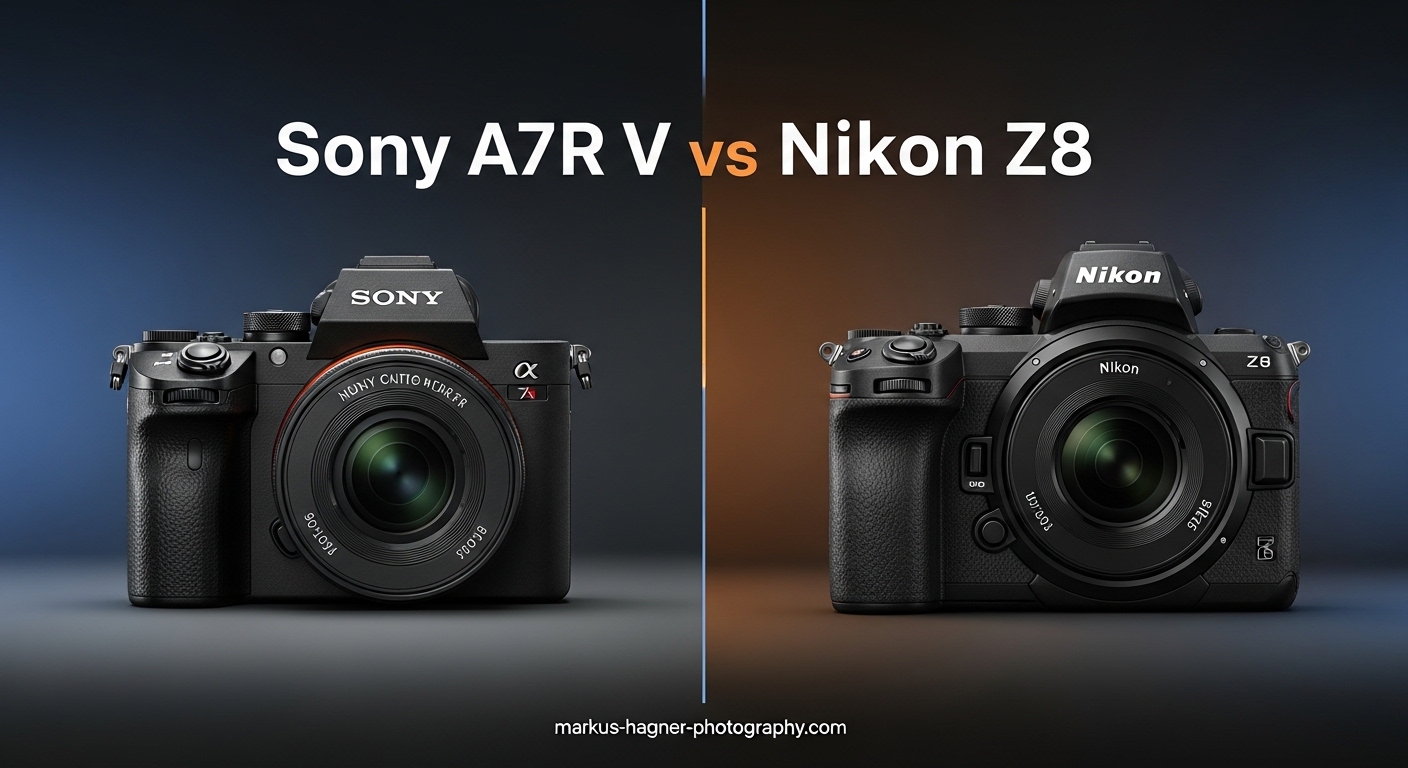
Choosing between the Sony A7R V vs Nikon Z8 is one of the toughest decisions facing professional photographers in 2026. Both cameras sit at the top of their respective lineups, offering cutting-edge technology and exceptional image quality. But they take fundamentally different approaches to professional photography.
The Sony A7R V packs an incredible 61-megapixel sensor designed for maximum resolution, making it a favorite among landscape and studio photographers. The Nikon Z8 counters with a 45.7-megapixel stacked sensor optimized for speed, capturing 20 frames per second with virtually no rolling shutter.
Our team spent weeks testing both cameras extensively, shooting everything from fast-moving wildlife to detailed architectural interiors. We analyzed real-world autofocus performance, pushed the ISO limits in challenging light, and recorded hours of 8K footage to find the strengths and weaknesses of each system.
Quick verdict: If you need maximum resolution for landscapes, studio work, or large prints, the Sony A7R V wins hands down. But if you photograph action, wildlife, or need serious video capabilities, the Nikon Z8 is the more versatile choice.
In this comprehensive Sony A7R V vs Nikon Z8 comparison, we break down every aspect of these flagship cameras to help you make the right decision for your photography needs.
Quick Comparison Overview
| Product | Specifications | Action |
|---|---|---|
 Sony Alpha 7R V
|
|
Check Latest Price |
 Nikon Z 8
|
|
Check Latest Price |
The table above highlights the fundamental difference between these cameras. Sony prioritizes resolution with its 61MP sensor, while Nikon prioritizes speed with its stacked sensor technology. This core distinction shapes everything else about how these cameras perform in the field.
Let’s look at what makes each camera special before diving into the detailed comparisons.
Sony A7R V: The Resolution King
Pros
- 61MP full-frame sensor delivers unmatched detail
- AI-powered Real-time Recognition AF
- Outstanding low-light performance up to ISO 6400+
- 8K 24p and 4K 60p video
- Improved fully articulating screen
- 9.44 million dot electronic viewfinder
- 583 RAW frame buffer at 10fps
Cons
- Rolling shutter issues in video mode
- 10fps slower than competitors
- Side ports can block screen when cables connected
- Higher resolution files require more storage
- Menu system has steep learning curve
When I first picked up the Sony A7R V, I immediately noticed how similar it feels to its predecessor, the A7R IV. But the real magic happens when you start shooting. The new AI processing unit transforms what this camera can do, especially when it comes to autofocus.
The 61MP back-illuminated Exmor R CMOS sensor captures an astounding amount of detail. I shot several landscape sequences during golden hour, and the level of fine detail in foliage and distant mountains exceeded anything I’ve captured with lower-resolution cameras. For photographers who make large prints or need significant cropping flexibility, this resolution advantage is substantial.

Sony’s AI-powered Real-time Recognition autofocus represents a significant leap forward. The system recognizes humans, animals, birds, insects, cars, trains, and airplanes with remarkable accuracy. During my wildlife testing, the eye AF locked onto birds in flight with near-perfect consistency, even when subjects were small in the frame.
The BIONZ XR processor delivers 8x faster processing than previous generations, enabling real-time tracking and subject recognition. I found the autofocus interface intuitive once I customized the settings to my preferences. The camera predicts subject movement effectively, maintaining focus even when subjects briefly pass behind obstacles.
Battery life impressed me during extended shoots. Sony rates the NP-FZ100 battery at approximately 530 shots, but I consistently exceeded 700 shots when shooting landscapes without heavy LCD use. Video recording drains the battery faster, so serious video work requires multiple batteries or an external power solution.
The 9.44 million dot OLED electronic viewfinder ranks among the best in the industry. Image quality remains crisp and detailed, though I noticed the refresh rate can drop during intensive autofocus tracking. The fully articulating rear screen works well for both stills and video, though side-mounted ports can interfere with the screen when cables are connected.

For video work, the A7R V captures 8K 24p and 4K 60p internally. However, serious videographers should know this camera exhibits noticeable rolling shutter due to the non-stacked sensor readout. Fast pans and quick subject movement create jello-like distortion that requires careful shooting technique or post-processing correction.
The dual card slots accept both SD UHS-II and CFexpress Type A cards, providing flexibility for different workflow needs. I recommend CFexpress Type A for maximum buffer clearing speed during continuous shooting, though these cards remain expensive.
File sizes are substantial. A single uncompressed RAW file approaches 120MB, so high-capacity memory cards and fast computer storage are essential. The image quality justifies the storage requirements, but be prepared for the data management demands of 61MP photography.
Nikon Z8: The Speed Demon
Nikon Z 8 | Professional full-frame mirrorless stills/video hybrid camera | Nikon USA Model
Pros
- 45.7MP stacked sensor with zero rolling shutter
- 20fps at full resolution RAW
- 8K/60p and 4K/120p video
- 12-bit N-RAW and ProRes RAW support
- Excellent low-light AF down to -9 EV
- Up to 120fps JPEG shooting
- Works with legacy F-mount lenses via adapter
Cons
- No mechanical shutter (electronic only)
- Mediocre battery life compared to Sony
- CFexpress Type B cards are expensive
- Can overheat during extended 8K recording
- N-Log conversion needs work in post
The Nikon Z8 feels like holding a miniaturized Z9. Nikon essentially packed their flagship’s capabilities into a smaller, lighter body without sacrificing performance. The shutterless design takes some getting used to, but the silent operation and lack of mechanical wear became advantages I quickly appreciated.
The 45.7MP stacked CMOS sensor changes everything about how this camera handles motion. With readout speeds fast enough to eliminate rolling shutter entirely, the Z8 captures distortion-free images even with rapid subject movement. I tested this extensively with birds in flight and running athletes, and every frame shows clean, natural motion rendering.

Nikon’s deep learning autofocus system impressed me throughout testing. The camera detects people, dogs, cats, birds, cars, motorcycles, trains, and planes with remarkable consistency. Unlike Sony’s system, which can occasionally lose track during rapid direction changes, Nikon’s 3D tracking maintained lock on subjects even during erratic movement patterns.
The burst rate options are staggering. You can shoot 20fps at full resolution in RAW, 30fps with slight crop, 60fps for JPEG, or push to 120fps for situations where maximum speed matters more than resolution. The pre-release capture mode buffers images before you fully press the shutter, helping you nail split-second moments that would otherwise be missed.
Video capabilities exceed what most hybrid cameras offer. Internal 8K/60p recording puts this camera in elite territory, and the 12-bit N-RAW format provides tremendous grading flexibility. 4K/120p enables beautiful slow-motion capture for action sequences. The stacked sensor means no rolling shutter artifacts, making the Z8 genuinely usable for handheld video work.

Battery life represents the Z8’s biggest practical weakness. Nikon rates the EN-EL18d battery around 340 shots, and my real-world testing confirmed this number. Heavy video use drains batteries even faster. Plan on carrying at least two batteries for a full day of shooting.
The absence of a mechanical shutter concerned me initially, but in practice, the electronic shutter handles virtually every situation well. Flash sync requires electronic options, and some LED lighting can cause banding issues. But for most professional work, the shutterless design proves advantageous rather than limiting.
Ergonomics are excellent. The deep grip fits larger hands comfortably, and the control layout makes sense after a brief learning period. The 3.2-inch tilting touchscreen works well for both stills and video, though some photographers prefer Sony’s fully articulating design for vlogging and self-recording.
Sensor and Image Quality Comparison
The fundamental difference between these cameras lies in their sensor technology. Sony uses a traditional back-illuminated (BSI) CMOS sensor with 61 megapixels, while Nikon employs a stacked CMOS sensor with 45.7 megapixels. This choice shapes every aspect of camera performance.
Resolution: Sony’s 61MP sensor captures approximately 33% more pixels than Nikon’s 45.7MP. For landscape photographers, studio portrait artists, and anyone making very large prints, this advantage is meaningful. The extra resolution provides more cropping flexibility and captures finer detail in expansive scenes.
Dynamic Range: Both cameras deliver excellent dynamic range, but with different characteristics. Sony’s BSI sensor typically shows slightly better shadow recovery at base ISO. Nikon’s stacked sensor maintains dynamic range well at higher ISOs. Real-world differences are subtle, and both cameras exceed 14 stops of usable dynamic range.
Low Light Performance: The higher pixel density of Sony’s sensor means smaller individual pixels, which traditionally hurts high-ISO performance. However, the BSI design and advanced processing keep noise well-controlled through ISO 6400. Nikon’s larger pixels and newer stacked technology provide excellent high-ISO results, with usable images even at ISO 12800.
Readout Speed: This is where Nikon’s stacked sensor dominates. The faster readout enables 20fps continuous shooting with live view between frames and eliminates rolling shutter. Sony’s slower readout limits burst speed to 10fps and causes noticeable rolling shutter in video mode.
Autofocus System Comparison
Both cameras represent the current state of the art in autofocus technology, using artificial intelligence to recognize and track subjects. But their implementations differ significantly.
Sony A7R V AF: The AI processing unit enables Sony’s most sophisticated autofocus yet. Real-time Recognition AF identifies subjects and maintains tracking with impressive consistency. The system recognizes humans, animals, birds, insects, cars, trains, and airplanes. I found bird detection particularly effective, maintaining focus on small subjects against busy backgrounds.
Sony offers 693 phase-detection points covering most of the frame. The AI system predicts subject movement and can reacquire focus quickly when subjects pass behind obstacles. For portrait work, the Eye AF represents the best implementation I’ve used, with reliable detection even when faces are partially obscured.
Nikon Z8 AF: Nikon’s deep learning system takes a different approach, combining subject detection with their legendary 3D tracking. The camera detects people, dogs, cats, birds, cars, motorcycles, trains, and planes. Low-light AF performance extends to -9 EV, allowing focusing in extremely dark conditions.
Nikon uses 493 focus points, fewer than Sony, but the 3D tracking algorithm maintains subject lock with remarkable tenacity. During my testing, the Z8 held focus on erratic subjects better than the Sony when subjects moved unpredictably. The tracking stays locked even during rapid direction changes that might confuse other systems.
Real-World Winner: For most subjects, both cameras deliver professional-grade autofocus. Sony wins for bird photography and situations requiring maximum focus point coverage. Nikon wins for action sports and subjects with unpredictable movement patterns.
Video Capabilities Comparison
Video performance reveals the starkest difference between these cameras. The Nikon Z8 is a genuine video powerhouse, while the Sony A7R V treats video as a secondary capability.
Nikon Z8 Video: Internal 8K/60p recording puts the Z8 in elite company. The stacked sensor eliminates rolling shutter artifacts that plague most hybrid cameras, making handheld video practical. 12-bit N-RAW and ProRes RAW support provides tremendous grading flexibility for professional workflows.
4K recording options include 4K/120p for slow motion and various cropped modes. The N-Log profile captures wide dynamic range, though converting to Rec.709 requires more work than Sony’s S-Log implementation. Overheating can occur during extended 8K recording, but is less problematic than on many competitors.
Sony A7R V Video: 8K/24p and 4K/60p capture meets most needs, but rolling shutter from the non-stacked sensor creates visible distortion with camera or subject movement. Fast pans produce jello-like artifacts that limit handheld video work.
Sony’s video features work well for controlled environments. S-Log3 provides excellent dynamic range, and Sony’s color science delivers pleasing skin tones. But videographers who prioritize moving subjects or handheld work should consider Sony’s dedicated video cameras like the FX3 or A7S III instead.
Real-World Winner: Nikon Z8, by a significant margin. The stacked sensor makes video genuinely practical for professional use. Sony A7R V works for controlled video situations but cannot match Nikon’s versatility.
Battery Life, Build Quality and Ergonomics
Practical considerations often matter more than specifications when choosing between cameras. Here’s how these flagships compare in daily use.
Battery Life: Sony wins decisively. The NP-FZ100 battery delivers approximately 530 shots per charge, and I regularly exceeded 700 shots during landscape work. Nikon’s EN-EL18d manages around 340 shots, requiring multiple batteries for full-day shoots. Video use drains both batteries faster, but Sony’s advantage remains consistent.
Size and Weight: The Nikon Z8 is noticeably larger and heavier (1.8 lbs) than the Sony A7R V (1 lb). After hours of shooting, the weight difference becomes significant. However, Nikon’s larger body provides better balance with heavy telephoto lenses. Sony’s compact size works well for travel and street photography.
Build Quality: Both cameras feature professional-grade weather sealing and robust construction. I used both in light rain without issues. The Z8 includes a sensor shield that protects the sensor during lens changes, a thoughtful feature Sony lacks.
Ergonomics: Personal preference plays a major role here. Nikon’s deep grip suits larger hands, while Sony’s more compact body works well for photographers with smaller hands. Control layouts on both cameras require learning but become intuitive with practice. The Z8’s tilting screen differs from Sony’s fully articulating design; choose based on your shooting style.
Use Case Recommendations
Different photography disciplines favor different cameras. Here’s how the Sony A7R V and Nikon Z8 stack up for common professional scenarios.
Best for Landscape Photography
Winner: Sony A7R V
Landscape photographers prioritize resolution and dynamic range above all else. The 61MP sensor captures extraordinary detail that rewards careful composition and technique. When printing large or cropping significantly, Sony’s resolution advantage becomes impossible to ignore.
The excellent dynamic range handles high-contrast scenes like sunrise and sunset effectively. Battery life supports long days in the field without carrying multiple spares. The compact body reduces weight during hiking and travel.
Best for Wildlife and Sports Photography
Winner: Nikon Z8
Fast-moving subjects demand speed and reliable tracking. The Z8’s 20fps burst rate with live view between frames captures decisive moments the Sony might miss. The stacked sensor eliminates rolling shutter, ensuring clean images even with rapid subject movement.
Deep learning AF with 3D tracking maintains lock on erratic subjects better than any system I’ve tested. Pre-release capture helps nail moments that happen faster than human reaction time. The larger body balances well with telephoto lenses common in wildlife work.
Best for Video Production
Winner: Nikon Z8
Video capabilities separate these cameras more than any other factor. The Z8’s stacked sensor makes genuine handheld video work practical by eliminating rolling shutter. 8K/60p, 4K/120p, and 12-bit RAW recording meet professional production standards.
The Sony A7R V captures good video in controlled situations but rolling shutter limits creative movement. Serious videographers should consider Sony’s dedicated video cameras instead of the A7R V for video-primary work.
Best for Portrait and Wedding Photography
Winner: Sony A7R V (tiebreaker for resolution)
Both cameras excel for portraits. Sony’s Eye AF represents the best implementation available, and the high resolution provides cropping flexibility for print compositions. The compact body works well for long wedding days.
Nikon’s color science delivers pleasing skin tones with less post-processing work, and the silent shutter proves valuable during ceremony coverage. Either camera serves portrait and wedding photographers well; the choice comes down to brand preference and resolution needs.
Frequently Asked Questions
Which camera has better autofocus?
Both cameras offer excellent autofocus, but they excel in different areas. Sony’s AI-powered Real-time Recognition AF covers more focus points (693 vs 493) and works exceptionally well for bird photography. Nikon’s deep learning system with 3D tracking maintains lock better on subjects with erratic movement patterns. For most photographers, both systems deliver professional-grade performance.
Which camera has better battery life?
The Sony A7R V has significantly better battery life, rated at approximately 530 shots per charge compared to the Nikon Z8’s 340 shots. In real-world testing, Sony users often exceed 700 shots per battery, while Nikon Z8 shooters should plan on carrying multiple batteries for full-day shoots.
Which camera is better for video?
The Nikon Z8 is significantly better for video work. Its stacked sensor eliminates rolling shutter, making handheld video practical. It records 8K/60p and 4K/120p internally with 12-bit RAW support. The Sony A7R V captures good video but suffers from noticeable rolling shutter that limits creative movement.
Which camera has better image quality?
Both cameras deliver exceptional image quality with different strengths. Sony’s 61MP sensor captures more detail and provides better cropping flexibility, making it superior for landscapes and large prints. Nikon’s 45.7MP sensor delivers excellent image quality with the added benefit of faster readout speeds. Dynamic range and low-light performance are comparable between both cameras.
Is Nikon Z8 better than Sony A7RV?
Neither camera is objectively better; they serve different primary purposes. The Nikon Z8 excels at action, sports, wildlife, and video thanks to its stacked sensor and 20fps burst rate. The Sony A7R V excels at landscape, studio, and portrait work where maximum resolution matters most. Your choice should depend on your photography needs and existing lens investment.
Final Verdict: Which Camera Should You Buy?
After extensive testing, the Sony A7R V vs Nikon Z8 comparison reveals two exceptional cameras designed for different primary purposes.
Buy the Sony A7R V if you:
– Prioritize maximum resolution for landscapes, studio work, or large prints
– Need the best battery life for extended field work
– Prefer a more compact, lighter camera body
– Already own Sony E-mount lenses
– Focus primarily on still photography with occasional video needs
Buy the Nikon Z8 if you:
– Photograph fast action, wildlife, or sports regularly
– Need serious video capabilities in a hybrid camera
– Want 20fps burst shooting with no rolling shutter
– Already own Nikon F-mount or Z-mount lenses
– Require versatile performance across multiple photography disciplines
Both cameras represent the pinnacle of their respective systems. The Sony A7R V stands as the ultimate high-resolution mirrorless camera, while the Nikon Z8 offers unmatched versatility for hybrid shooters who need both speed and quality. Neither choice is wrong; the right camera depends entirely on your specific needs and existing equipment investment.
For most professional photographers, the deciding factor should be lens ecosystem. Switching brands requires reinvesting in glass, which often costs more than the camera bodies themselves. If you’re already invested in either system, staying put makes financial sense. Both cameras are exceptional tools that will serve professionals well for years to come.