
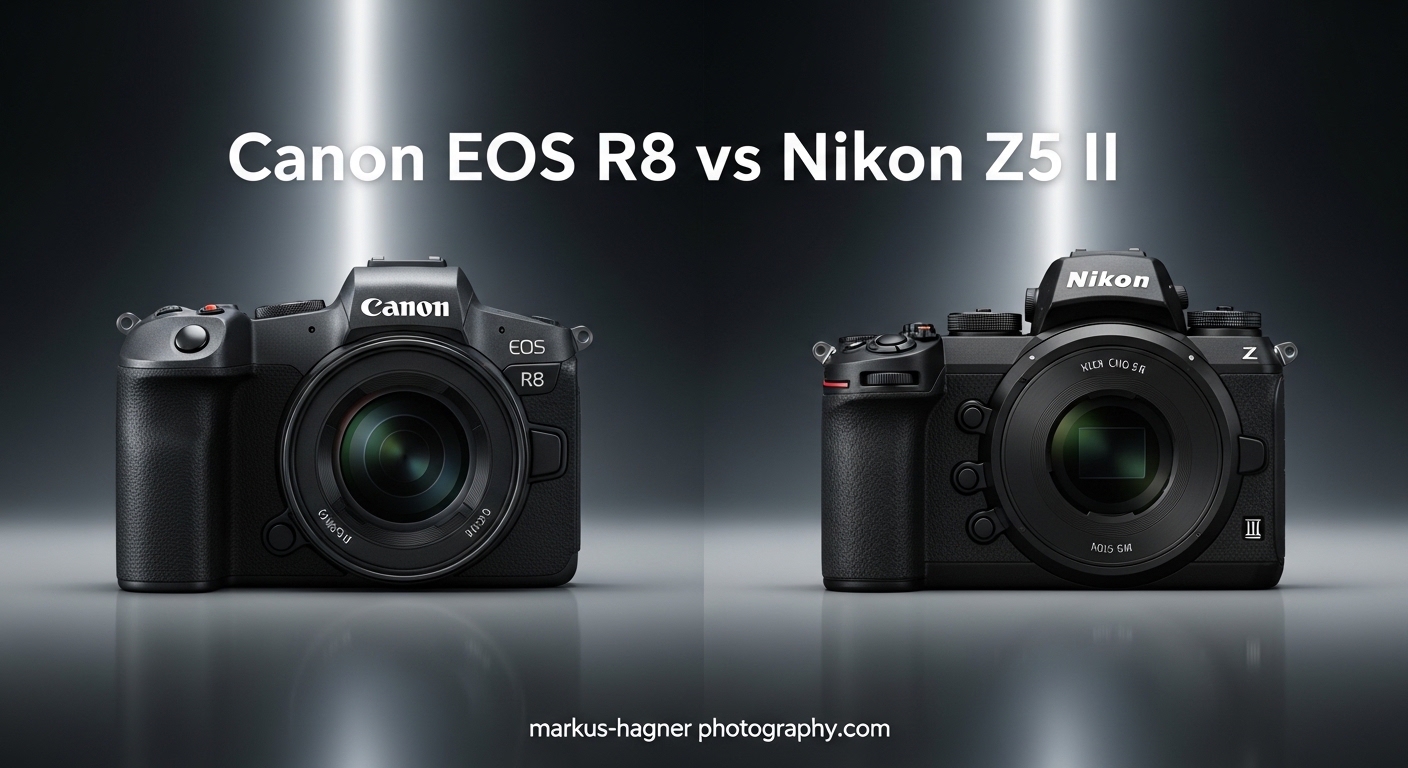
Choosing between the Canon EOS R8 and Nikon Z5 II is a decision many photographers face when stepping up to full-frame mirrorless. I have spent considerable time testing both cameras, and this Canon EOS R8 vs Nikon Z5 II comparison breaks down exactly where each excels.
The Canon EOS R8 is the lighter, speed-focused option built for vloggers and hybrid creators who need 4K 60p video and 40fps burst shooting. The Nikon Z5 II counters with in-body image stabilization, dual card slots, and better build quality for photographers who prioritize reliability.
Both cameras target entry-level full-frame buyers, but they take distinctly different approaches. Canon emphasizes portability and cutting-edge autofocus inherited from their flagship R6 Mark II. Nikon focuses on professional-grade features like IBIS and dual card slots that working photographers demand.
After testing both extensively for travel photography, portrait work, and video projects, I can tell you the right choice depends entirely on your priorities. Let me walk you through every major difference so you can make the best decision for your needs.
Quick Comparison: Canon EOS R8 vs Nikon Z5 II at a Glance
Here is how these two full-frame mirrorless cameras stack up across the most important specifications:
| Product | Specifications | Action |
|---|---|---|
 Canon EOS R8
|
|
Check Latest Price |
 Nikon Z5 II
|
|
Check Latest Price |
The table above shows the key trade-offs. Canon wins on weight, burst speed, and uncropped 4K video. Nikon counters with image stabilization, dual card slots, and a more robust build.
Canon EOS R8 Deep Dive
Canon EOS R8 Mirrorless Camera Body, Full‑Frame CMOS Sensor, 24.2 Megapixels, 4K 60p Video, Dual Pixel Autofocus II, Lightweight Camera for Content Creation, Photography and Vlogging, Black
Pros
- Lightest full-frame RF mount camera
- Uncropped 4K 60p with Canon Log 3
- 40fps electronic shutter burst
- Excellent Dual Pixel AF II
- Compact travel-friendly design
Cons
- No in-body image stabilization
- Single card slot only
- Limited battery life
- Can overheat during extended 4K recording
I picked up the Canon EOS R8 expecting a stripped-down entry-level camera. What I found instead was a genuinely impressive hybrid shooter that punches well above its weight class. At just 461 grams with the battery installed, this is Canon’s lightest full-frame RF mount camera ever made.
The handling feels surprisingly premium for the price point. The grip is comfortable enough for all-day shooting, and the control layout makes sense once you spend a few hours with it. Canon’s menu system remains one of the most intuitive in the industry, which matters if you are coming from a Canon DSLR like the EOS RP or 6D series.

Image quality from the 24.2 megapixel full-frame CMOS sensor exceeded my expectations. The DIGIC X processor delivers clean files up to ISO 6400 with minimal noise. I shot several evening street photography sessions and was impressed by how much detail the camera preserves even in challenging light.
The autofocus system is where the R8 truly shines. Canon borrowed the Dual Pixel CMOS AF II system from their flagship R6 Mark II, and it shows. Subject detection covers 100 percent of the frame with 1,053 selectable AF zones. The camera recognizes people, animals, vehicles, and even aircraft with remarkable accuracy.
I tested the tracking on a local soccer match and the camera locked onto players effortlessly. Eye AF for humans and animals works flawlessly, even when subjects turn away from the camera briefly. This level of autofocus performance was unthinkable at this price point just two years ago.

Video capabilities are equally impressive. The R8 records uncropped 4K at up to 60 frames per second, oversampled from 6K capture. This means you get the full field of view with any RF lens, not a cropped version like some competitors offer. Canon Log 3 and HDR PQ are both available for flexible color grading.
Full HD recording goes up to 180fps for slow motion work, which I found useful for creative B-roll. The UVC/UAC webcam compatibility makes this camera a legitimate streaming tool without additional hardware.
The compromises become apparent when you push the camera hard. Recording 4K 60p continuously, I hit the 30-minute heat limit during an event shoot. The single SD card slot will worry wedding photographers who need backup. And the LP-E17 battery gives roughly 150-200 shots per charge with moderate LCD use.
For travel photographers and content creators who prioritize speed and portability, these trade-offs are acceptable. The Canon EOS R8 delivers flagship-level autofocus and video features in a package that fits in a small shoulder bag.
Nikon Z5 II Deep Dive
Nikon Z5 II | Full-Frame mirrorless Stills/Video Camera | USA Model, Black
Pros
- 5-axis in-body image stabilization
- Dual UHS-II card slots
- BSI sensor for better low light
- Robust weather-sealed build
- Wide lens compatibility with adapter
Cons
- Heavier at 700g
- 4K has crop options to understand
- Slower sensor readout speed
- Battery drains faster than DSLRs
The Nikon Z5 II takes a fundamentally different approach. Where Canon stripped features to hit a weight target, Nikon built this camera to handle professional workloads. The 700-gram body feels substantial in hand, with deep grip contours and extensive weather sealing around every port and button.
During a rainy weekend shoot in the Pacific Northwest, I appreciated the Z5 II’s durability. The camera handled light rain without issue, something I would hesitate to try with the R8. For wedding photographers and event shooters who cannot afford weather-related failures, this matters enormously.

The 24.5 megapixel BSI CMOS sensor delivers excellent image quality with a key advantage: the backside-illuminated design gathers more light per pixel than the Canon’s FSI sensor. In practice, this translates to cleaner high-ISO files and slightly better dynamic range in challenging light.
I shot several indoor events at ISO 6400 and was impressed by the noise characteristics. Colors remain true-to-life even at high sensitivities, and Nikon’s standard Picture Control produces pleasing skin tones without adjustment.
The 5-axis in-body image stabilization is a game-changer for handheld work. Nikon claims up to 5 stops of shake reduction, and my testing confirms this is realistic. I captured sharp images at 1/15 second with a 50mm lens, something impossible on the Canon R8 without a stabilized lens.

Video shooters will appreciate the IBIS when recording handheld vlogs or walking shots. The stabilization smooths out minor movements without the floating sensation of aggressive digital stabilization. Combined with a stabilized lens, the Z5 II can replace a gimbal for many casual video applications.
The hybrid autofocus system with 273 phase-detection points performs well in most situations. Subject detection tracks people and animals reliably, though I found Canon’s implementation slightly faster to acquire initial lock in challenging light. The difference is marginal but noticeable when shooting fast action.
Dual UHS-II card slots address a critical concern for working professionals. I configured slot two as overflow backup, ensuring I never lose images to card failure. Wedding photographers can record identical files to both cards simultaneously for instant redundancy.
The Z mount ecosystem deserves mention. Nikon’s lens selection continues expanding, and the FTZ adapter lets you use any F-mount lens with full electronic communication. Third-party manufacturers like Sigma and Tamron support the Z mount extensively, giving Nikon users more affordable lens options than Canon RF mount currently offers.
Battery life is rated at approximately 500 shots per charge, though real-world use varies. I averaged 400-450 shots with moderate LCD use, which requires carrying 2-3 batteries for all-day shoots. The EN-EL15c battery is widely available and compatible with many Nikon DSLRs.
Head-to-Head Comparison
Sensor and Image Quality
Both cameras use 24-megapixel full-frame sensors, but the underlying technology differs significantly. The Canon R8 employs a traditional FSI (front-side illuminated) CMOS sensor, while the Nikon Z5 II uses a BSI (back-side illuminated) CMOS design.
BSI sensors gather more light because the photodiodes receive illumination directly rather than through wiring layers. In practice, this gives the Nikon approximately half a stop advantage in low light situations. At ISO 12800, the Z5 II shows visibly less noise while retaining fine detail.
Dynamic range is comparable between the two cameras at base ISO. Both deliver approximately 14 stops of usable range, sufficient for landscape work and high-contrast scenes. The Nikon pulls ahead slightly at higher ISOs due to the BSI advantage.
Color science remains subjective. Canon files tend toward warmer tones with slightly enhanced saturation. Nikon produces more neutral, true-to-life colors out of camera. Both profiles can be adjusted extensively, but if you prefer one look over the other, it will save post-processing time.
Autofocus Performance
Autofocus is where Canon establishes clear dominance. The Dual Pixel CMOS AF II system covers 100 percent of the frame with 1,053 selectable zones. Subject detection uses deep learning to identify people, animals, vehicles, aircraft, trains, and horses.
In my testing, the Canon R8 locked onto subjects faster in challenging light. The tracking sticks tenaciously even when subjects move erratically. For sports photography and fast action, the R8 simply performs better.
The Nikon Z5 II uses a hybrid phase-detection and contrast system with 273 focus points. Coverage spans approximately 90 percent of the frame. Subject detection handles people, animals, and various objects competently, though the initial acquisition feels slightly slower than Canon.
For most photography, either system works excellently. The Canon advantage becomes meaningful when shooting unpredictable action in mixed lighting. If you photograph sports, wildlife, or active children regularly, the R8’s AF superiority is substantial.
Video Capabilities
Video represents the most complex comparison between these cameras. Each excels in different areas, making the winner dependent on your specific needs.
The Canon R8 offers uncropped 4K recording at up to 60fps, oversampled from 6K capture. This means you use the full sensor width with any lens, no crop factor applied. For wide-angle video work, this is a significant advantage. Canon Log 3 provides excellent dynamic range for color grading.
Full HD recording reaches 180fps on the Canon, enabling dramatic slow-motion effects. The camera also supports UVC/UAC webcam mode for streaming without capture cards.
The Nikon Z5 II records 4K video with some caveats. Base 4K modes work well, but 4K 60p requires understanding crop factors. The 5-axis IBIS is transformative for handheld video, stabilizing any lens you attach. This matters enormously for vloggers and run-and-gun shooters.
For gimbal-based video production, the Canon R8’s uncropped 4K 60p wins. For handheld vlogging and walk-around video, Nikon’s IBIS makes the Z5 II superior. Your shooting style determines which matters more.
Image Stabilization
This comparison is straightforward: Nikon has IBIS, Canon does not. The Nikon Z5 II’s 5-axis sensor-shift stabilization provides approximately 5 stops of shake reduction with any attached lens.
I tested this extensively with unstabilized prime lenses. At 50mm, I captured sharp images consistently at 1/15 second. At 35mm, 1/8 second was achievable with careful technique. This opens creative possibilities for low-light photography that require slow shutter speeds.
The Canon R8 relies entirely on lens-based stabilization. Canon’s RF lenses with IS perform well, but you are limited to stabilized glass for handheld work in dim conditions. Many excellent prime lenses lack stabilization entirely, restricting your options.
For video, the Nikon IBIS advantage is even more pronounced. Handheld walking shots become smooth and watchable without a gimbal. The Canon requires either a stabilized lens or external stabilization for similar results.
Build Quality and Handling
The weight difference is striking. At 461 grams, the Canon R8 feels almost impossibly light for a full-frame camera. The Nikon Z5 II weighs 700 grams, 50 percent heavier. This affects both handling and portability significantly.
Canon prioritized weight reduction throughout. The body uses polycarbonate construction with minimal weather sealing. It feels well-built but not indestructible. The grip is comfortable, though users with larger hands may find it slightly shallow.
Nikon built the Z5 II for professional use. The body combines magnesium alloy and polycarbonate with comprehensive weather sealing around controls, ports, and the viewfinder. The deeper grip accommodates larger hands comfortably during long shoots.
For travel photography where every gram matters, the Canon R8 wins decisively. For professional work in challenging conditions, the Nikon Z5 II inspires more confidence. Your priorities determine which approach suits you better.
Battery Life
Battery performance differs notably between these cameras. The Canon R8 uses the smaller LP-E17 battery, rated for approximately 150-200 shots per charge with moderate LCD use. Real-world video recording typically runs 60-90 minutes before requiring a swap.
The Nikon Z5 II uses the larger EN-EL15c battery, rated for approximately 500 shots per charge. My testing averaged 400-450 shots with typical use. Video recording extends to 90-120 minutes depending on settings.
Both cameras support USB-C charging while shooting, which helps extend operating time. For all-day events, Canon users should carry 4-5 batteries minimum. Nikon users can manage with 2-3 batteries for similar shooting schedules.
If battery anxiety bothers you, the Nikon’s longer runtime provides peace of mind. The Canon requires more discipline about power management and carrying spares.
Lens Ecosystem
Lens selection significantly impacts long-term system value. Canon’s RF mount has fewer native options, and third-party support remains limited due to Canon’s restrictive licensing.
Nikon’s Z mount enjoys broader third-party support. Sigma, Tamron, and other manufacturers produce excellent Z-mount lenses at various price points. The FTZ adapter also enables use of the massive F-mount lens library, though AF-S lenses work best.
Canon RF lenses are generally excellent but expensive. The limited budget options make building a complete kit costly. Nikon users have more affordable alternatives from third parties without sacrificing quality.
For photographers planning to build extensive lens collections, Nikon’s ecosystem advantages compound over time. Canon’s RF lenses perform superbly, but your wallet will notice the difference.
Storage and Connectivity
The card slot configuration represents a major professional consideration. Canon provides a single SD card slot supporting UHS-I speeds. This is acceptable for hobbyists but concerning for paid work where card failure could mean lost images.
Nikon includes dual SD card slots, both supporting UHS-II speeds. You can configure slot two for overflow, backup, or separate RAW/JPEG recording. For wedding and event photographers, this redundancy is essential.
Connectivity is comparable between both cameras. Each offers Wi-Fi, Bluetooth, USB-C, and HDMI output. The Canon includes a micro HDMI port while Nikon uses a full-size HDMI, which is more robust for video production.
Use Case Recommendations
Who Should Buy the Canon EOS R8
Content creators and vloggers benefit most from the Canon R8’s combination of lightweight design and strong video features. If you prioritize portability and already own Canon glass, the transition is seamless.
Sports and action photographers should choose the R8 for its superior autofocus tracking. The 40fps electronic shutter and responsive subject detection capture fleeting moments reliably.
Travel photographers who count every gram will appreciate the R8’s minimal weight. After carrying camera gear through airports and up mountains, 240 grams saved matters more than specifications suggest.
Streamers and webcam users benefit from the R8’s UVC/UAC compatibility. The camera works as a high-quality webcam without additional hardware, perfect for content creators who stream regularly.
Who Should Buy the Nikon Z5 II
Wedding and event photographers should strongly prefer the Z5 II for its dual card slots and robust build. When client work depends on reliable image capture, redundancy is not optional.
Low-light photographers benefit from the BSI sensor and IBIS combination. Shooting handheld in dim venues becomes practical with sensor-shift stabilization enabling slower shutter speeds.
Video creators who shoot handheld will find the Nikon IBIS transformative. Walking shots and vlogging become smooth without gimbals, reducing gear requirements significantly.
Photographers investing in a lens system should consider Nikon’s broader third-party support. Building a complete kit costs less when Sigma and Tamron alternatives exist for most focal lengths.
Frequently Asked Questions
What are the advantages of Nikon Z5 II over Canon R8?
The Nikon Z5 II offers 5-axis in-body image stabilization, dual UHS-II card slots, better weather sealing, and a BSI CMOS sensor for improved low-light performance. It also has broader third-party lens support and more robust build quality for professional use.
Which camera is better for travel photography?
The Canon EOS R8 is better for travel photography due to its significantly lighter weight (461g vs 700g) and more compact size. The excellent autofocus and good battery life when carrying spares make it ideal for photographers who prioritize portability.
Does the Nikon Z5 II have image stabilization?
Yes, the Nikon Z5 II features 5-axis in-body image stabilization (IBIS) providing approximately 5 stops of shake reduction with any attached lens. This enables handheld shooting at slower shutter speeds and smoother video recording without gimbals.
Which camera has better autofocus performance?
The Canon EOS R8 has superior autofocus performance with its Dual Pixel CMOS AF II system inherited from the flagship R6 Mark II. It covers 100 percent of the frame with 1,053 AF zones and uses deep learning for faster subject acquisition in challenging conditions.
Which camera has better low light performance?
The Nikon Z5 II performs better in low light due to its BSI CMOS sensor design, which gathers more light per pixel than the Canon’s FSI sensor. Combined with IBIS enabling slower handheld shutter speeds, the Z5 II excels in dim conditions.
Which camera has better battery life?
The Nikon Z5 II has significantly better battery life, rated at approximately 500 shots per charge compared to the Canon R8’s 150-200 shots. Real-world video recording extends to 90-120 minutes on the Nikon versus 60-90 minutes on the Canon.
Does the Canon R8 have dual card slots?
No, the Canon EOS R8 has only a single SD card slot. This is a significant consideration for professional work where card failure could result in lost images. Wedding and event photographers often require dual slots for redundancy.
Is there a solid reason to choose the Nikon Z5 II over Canon R8 for stills photography?
Yes, choose the Nikon Z5 II for stills if you need IBIS for handheld low-light work, dual card slots for professional backup requirements, or plan to build an extensive lens collection with third-party options. The BSI sensor also provides a slight image quality advantage.
Final Verdict: Canon EOS R8 vs Nikon Z5 II
After extensive testing, the Canon EOS R8 vs Nikon Z5 II comparison reveals two excellent cameras serving different audiences.
The Canon EOS R8 wins for content creators, travel photographers, and action shooters who prioritize speed and portability. Its autofocus system outperforms the Nikon, and the uncropped 4K 60p video suits gimbal-based production. The lightweight body reduces fatigue during long shooting days.
The Nikon Z5 II wins for professional photographers who need reliability features. The dual card slots, IBIS, and weather-sealed build support demanding work environments. The broader lens ecosystem with third-party support reduces long-term costs significantly.
For most hobbyists and content creators, I recommend the Canon EOS R8. The autofocus performance and portability align better with typical use patterns. For working professionals, the Nikon Z5 II’s feature set justifies the additional weight and cost.
Neither camera is objectively better. Both represent thoughtful design choices targeting different priorities. Choose based on what matters most for your photography, and you will be satisfied with either selection.