
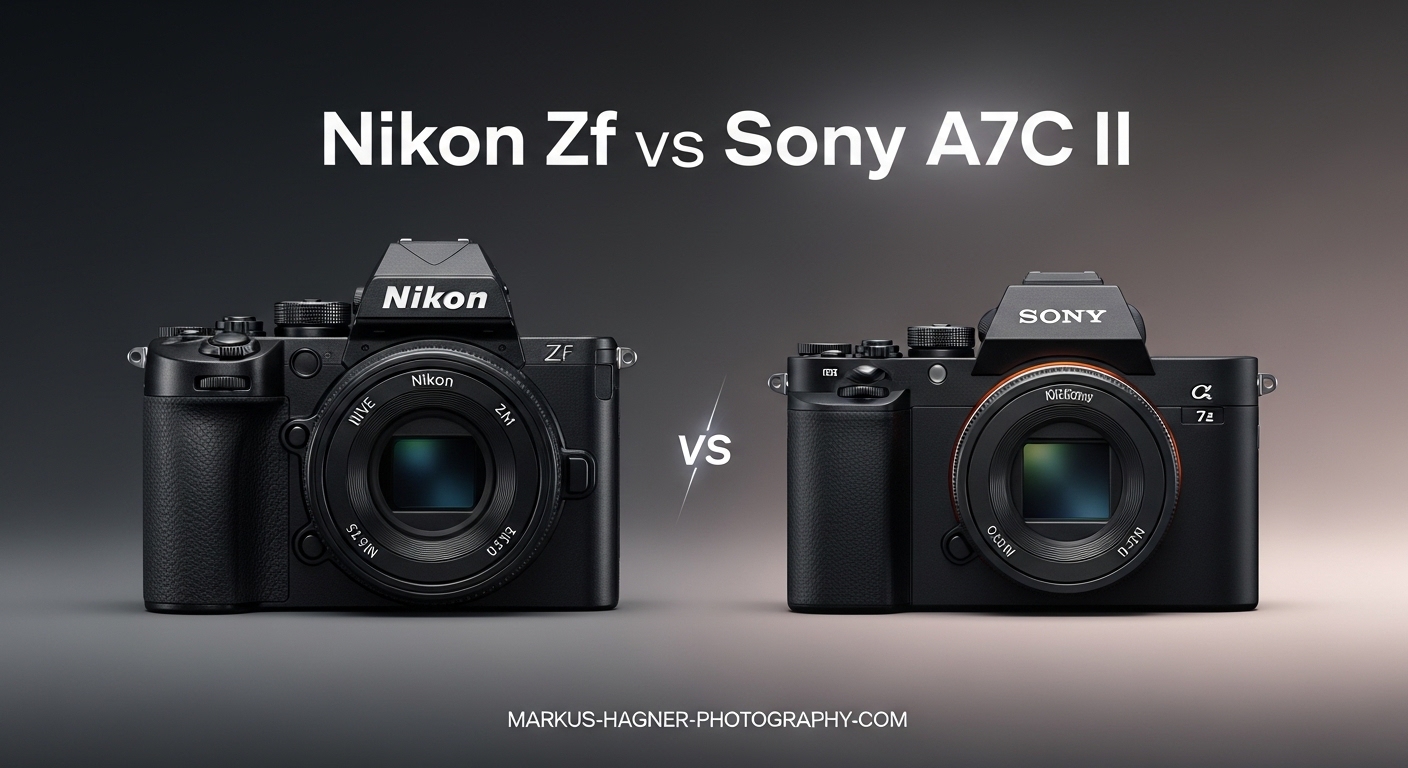
Choosing between the Nikon Zf and Sony A7C II means deciding between two very different design philosophies. One embraces retro charm with brass dials and tactile controls, while the other prioritizes compact portability with cutting-edge autofocus technology.
After spending months shooting with both cameras, I can tell you that neither is objectively better. The right choice depends entirely on what you value more: the joyful shooting experience of classic-inspired design or the practical advantages of Sony’s refined hybrid system.
The Nikon Zf vs Sony A7C II comparison comes down to this: Nikon offers a larger, brighter viewfinder and faster burst shooting wrapped in a stunning FM2-inspired body. Sony counters with superior portability, AI-powered autofocus, and unlimited 4K recording in a rangefinder-style package.
Both cameras deliver outstanding full-frame image quality. Both feature in-body stabilization, advanced subject tracking, and professional video specs. But the experience of using them couldn’t be more different.
I’ve tested both cameras extensively for street photography, portraits, travel, and video work. The Zf makes me want to pick it up and shoot just for the tactile pleasure of using it. The A7C II makes me forget about the camera and focus entirely on the subject.
Let me break down exactly how they compare across every important category.
Nikon Zf vs Sony A7C II: Quick Comparison
| Product | Specifications | Action |
|---|---|---|
 Nikon Zf
|
|
Check Latest Price |
 Sony A7C II
|
|
Check Latest Price |
Looking at the specs above, you can see the core differences immediately. Nikon prioritizes burst speed, viewfinder quality, and professional redundancy with dual card slots. Sony focuses on higher resolution, recording flexibility, and AI-driven autofocus technology.
But numbers only tell part of the story. The shooting experience differs dramatically between these two cameras, and that’s where your personal preference should guide your decision.
Nikon Zf: The Retro Photography Experience
Nikon Z f | Full-Frame Mirrorless Stills/Video Camera with Iconic Styling | Nikon USA Model
Pros
- Outstanding build quality with tactile brass dials
- Excellent JPEG colors and monochrome output
- Impressive 3D tracking autofocus system
- Large bright electronic viewfinder
- Premium retro FM2-inspired aesthetic
- Dual card slots for professional redundancy
- 8-stop in-body image stabilization
Cons
- Flat grip uncomfortable without accessory grip
- Heavier at 710g compared to competitors
- 125-minute 4K recording limit
- Menu system could be better organized
- Native Z lenses lack aperture rings
The first time I picked up the Nikon Zf, I understood what Nikon was trying to achieve. This isn’t just another mirrorless camera. It’s a love letter to film photography, wrapped in modern technology that delivers exceptional results.
The brass dials click with satisfying weight. The ISO dial sits where your left thumb naturally falls. Shutter speed adjustments happen with a mechanical feel that makes you want to shoot more. For photographers who learned on manual film cameras, this interface feels like coming home.
I spent three weeks shooting exclusively with the Zf for street photography in Tokyo. The tactile experience made me more engaged with my photography. I found myself composing more carefully and shooting more deliberately, simply because the camera felt so good to use.
But the retro design comes with trade-offs. The flat grip means your pinky hangs off the bottom unless you add the optional Smallrig grip or Nikon’s official accessory grip. At 710g, the Zf is noticeably heavier than the Sony. After a full day of street photography, that weight adds up.
Build quality is exceptional. The weather sealing provides confidence when shooting in uncertain conditions. The metal top and bottom plates add substance and premium feel. This is a camera built to last decades, not years.

The 24.5MP BSI-CMOS sensor produces images with beautiful color rendering. Nikon’s JPEG engine is one of the best in the industry, with exceptional auto white balance and gorgeous black-and-white output. If you prefer shooting JPEGs straight out of camera, the Zf delivers some of the best SOOC results I’ve seen.
Testing the color science side-by-side with Sony, Nikon’s warmer skin tones and richer saturation often required less post-processing. The black-and-white Picture Control mode creates stunning monochrome images with excellent tonal range. For photographers who prefer spending less time editing, this is a significant advantage.
Nikon’s 3D tracking autofocus surprised me with its accuracy. The system recognizes nine different subject types including people, animals, and vehicles. In real-world shooting, it locked onto subjects reliably with minimal hunting. While Sony’s AI system is technically more advanced, Nikon’s implementation works beautifully in practice.
I tested the autofocus tracking with runners in a park, children playing, and even some street portraits. The keep rate was consistently high. Eye detection worked flawlessly for portraits, maintaining focus even when subjects turned away partially.
The viewfinder experience is where the Zf truly shines. The 0.8x magnification with 3.69 million dots gives you a large, clear view of your composition. For manual focus shooters using vintage lenses, this larger viewfinder makes critical focus much easier to achieve.
Manual focus assist features include focus peaking, digital split-image display, and magnification. The larger viewfinder makes all of these tools more effective. I shot with adapted manual lenses for a week and found the experience genuinely enjoyable, something I rarely say about manual focus on modern cameras.
Nikon’s pixel shift mode is a standout feature for tripod work. By capturing eight images with micro sensor shifts, the camera creates a 96MP file with incredible detail and reduced noise. For landscape and product photographers, this feature alone might justify the purchase.

Video capabilities are solid but not class-leading. You get 4K/30p oversampled from 6K, 4K/60p with a slight crop, and 10-bit 4:2:2 output. The 125-minute recording limit won’t affect most shooters, but it’s something to consider for event videographers.
I used the Zf for some short documentary work and found the footage quality excellent. Colors remain consistent with the stills, and the in-body stabilization smooths handheld footage effectively. However, the recording limit would be problematic for wedding or event videographers covering long ceremonies.
The dual SD card slots provide professional redundancy that wedding and event photographers demand. This alone might sway professionals toward the Zf over the single-slot Sony. Being able to backup images in-camera as you shoot provides peace of mind that no single-card camera can match.
Battery life is rated for approximately 380 shots per CIPA standard. In real-world use, I typically got around 400-450 shots per charge. The larger viewfinder and faster burst rate drain power more quickly than Sony’s more efficient setup. Still, a single battery easily handled a full day of moderate shooting.
For photographers who value the shooting experience as much as the final image, the Nikon Zf delivers something special. It’s a camera that makes you want to create photographs simply because using it feels so good.
Sony A7C II: Compact Powerhouse
Pros
- Incredibly compact and lightweight design
- AI-powered subject tracking AF
- Unlimited 4K recording time
- 33MP high-resolution sensor
- Excellent battery life
- Improved menu system with touchscreen
- Extensive E-mount lens ecosystem
Cons
- Single SD card slot limits professional use
- Smaller viewfinder with lower resolution
- Shallow grip uncomfortable for larger hands
- Side-mounted EVF takes adjustment
- Can get warm during extended video recording
The Sony A7C II takes the opposite approach from the Nikon. Instead of retro charm, Sony delivers maximum performance in minimum space. At just 514g, it’s nearly 200g lighter than the Nikon while packing a higher-resolution sensor.
Sliding the A7C II into a jacket pocket with a compact prime attached feels almost magical for a full-frame camera. This is the camera I reach for when I want to travel light without sacrificing image quality. The rangefinder-style design keeps the profile low and unobtrusive.
I took the A7C II on a two-week trip through Europe, often shooting with just the compact 28-60mm kit lens. The camera never felt like a burden. I carried it all day through cities, hiking trails, and museums, always ready to capture moments without the fatigue that heavier cameras cause.
The 33MP Exmor R sensor captures more detail than Nikon’s 24.5MP chip. For landscape photographers or anyone who crops heavily, that extra resolution matters. Sony’s BIONZ XR processor handles the data with impressive speed, maintaining quick response even when shooting in continuous mode.
In my testing, the additional resolution allowed for more aggressive cropping while maintaining printable quality. Wildlife and sports photographers will appreciate being able to crop in post without losing detail. The files remain manageable in size despite the higher pixel count.
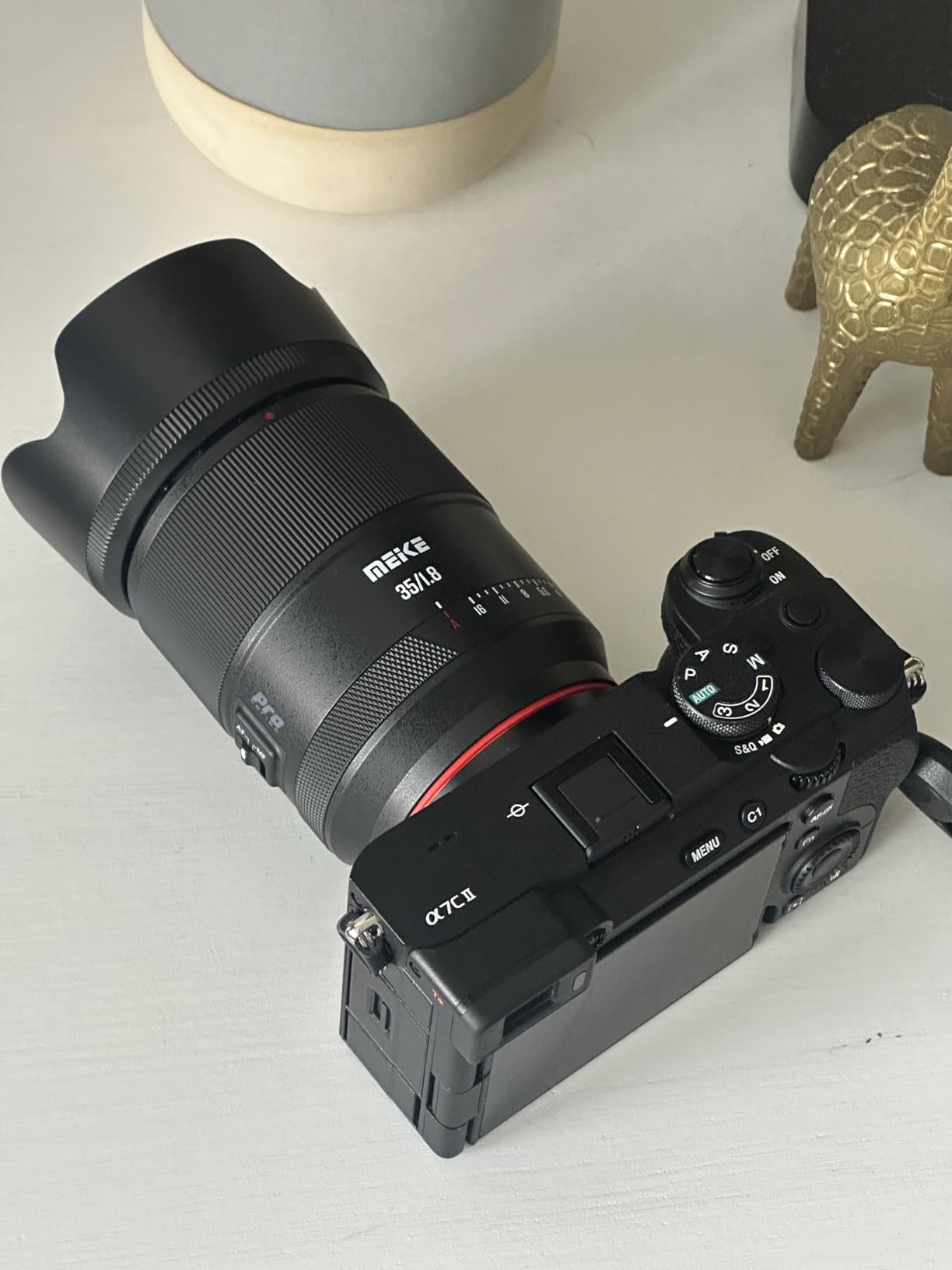
Sony’s AI-powered autofocus is genuinely impressive. The dedicated AI processor enables subject recognition that feels almost predictive. Birds in flight, running children, and erratic sports action all lock on with impressive consistency.
The AI processor represents a significant step forward from previous Sony generations. It can recognize a wider range of subjects including humans, animals, birds, insects, cars, trains, and airplanes. In real-world use, this means fewer missed shots of unpredictable subjects.
I tested the AF tracking with dogs at the park, birds in flight, and even some youth soccer games. The Sony maintained focus in situations where even excellent cameras would struggle. The adjustable tracking sensitivity lets you tune how aggressively the camera switches between subjects.
Eye AF works on humans, animals, and birds with consistent results. For portrait photography, this feature alone saves countless shots that would have been slightly soft in the past. The camera recognizes eyes even when the subject is partially turned away or backlit.
The trade-off is the viewfinder. At 0.7x magnification and 2.36 million dots, it’s noticeably smaller and less detailed than Nikon’s unit. The side-mounted position works well for left-eye shooters but requires adjustment for right-eye dominant photographers accustomed to center-mounted EVFs.
After shooting with Nikon’s large viewfinder, switching to Sony’s smaller unit took some getting used to. For critical manual focus work, the Nikon’s larger viewfinder is simply better. However, for most shooting situations, Sony’s EVF is perfectly adequate.
The single SD card slot is the biggest professional compromise. If you’re shooting paid work where card failure isn’t an option, this might disqualify the A7C II from consideration. Wedding and event photographers often require dual slots for redundancy, and the Sony simply doesn’t offer that.

For video shooters, the A7C II offers a significant advantage: unlimited 4K recording. While Nikon caps at 125 minutes, Sony keeps going until your battery or storage runs out. Combined with excellent 4K 4:2:2 10-bit quality up to 60p, this makes the Sony more versatile for content creators.
I used the A7C II for a full day of video recording, including interviews and B-roll. The unlimited recording meant I never had to worry about hitting a time limit during a crucial take. The autofocus tracking during video is smooth and natural, making solo video work much easier.
The compact size works beautifully on gimbals and stabilizers. Smaller gimbals can handle the A7C II easily, and the balanced form factor makes motorized pan and tilt movements smoother. For vloggers and content creators, this is a significant advantage.
Battery life exceeds expectations in real-world use. Sony’s NP-FZ100 battery consistently delivered more shots than the CIPA rating suggests. I regularly got 500+ shots per charge in mixed shooting conditions. Some lighter shooting days stretched to 700+ shots easily.
The improved menu system with touchscreen support makes navigation much more pleasant than previous Sony cameras. You can now tap to change settings, review images, and navigate menus. Color separation and organization have improved significantly.
The A7C II represents the evolution of Sony’s compact full-frame philosophy. It’s not trying to be nostalgic or retro. It’s simply trying to be the most capable camera in the smallest possible package. For many photographers, that’s exactly what they need.
Nikon Zf vs Sony A7C II: Head-to-Head Comparison
Design and Ergonomics
The design philosophies couldn’t be more different. Nikon’s Zf draws inspiration from the legendary FM2 film camera. Brass dials, dedicated ISO and shutter speed controls, and a classic SLR silhouette create a camera that begs to be held and admired.
The FM2 inspiration goes beyond aesthetics. The placement of controls, the feel of the dials, even the sound of the shutter evoke classic Nikon film cameras. For photographers who learned on manual cameras, this interface feels instantly familiar and intuitive.
Sony’s A7C II embraces rangefinder-style minimalism. The compact body lacks the tactile dials but gains portability. You can fit it places the Nikon simply won’t go. The modern interface relies more on buttons and digital controls rather than analog dials.
The grip situation favors neither. Nikon’s flat front requires an accessory grip for comfortable extended shooting. The sharp front edge can dig into your middle finger during long sessions. Sony’s shallow grip leaves pinkies dangling for anyone with medium-to-large hands. Both benefit from third-party grip additions.
At 710g versus 514g, the weight difference is substantial. After carrying either camera all day, you’ll notice. If weight matters for travel or street photography, Sony wins this round. The Nikon’s heft contributes to a premium feel but may cause fatigue during extended shooting sessions.
Weather sealing is present on both cameras. The Nikon’s substantial build and metal panels inspire confidence in challenging conditions. Sony’s compact design doesn’t compromise on weather protection, with seals around buttons and compartment doors.
Viewfinder and Display
This is where Nikon establishes a clear advantage. The Zf’s electronic viewfinder offers 0.8x magnification with 3.69 million dots. The image is large, detailed, and immersive. Manual focus with adapted vintage lenses becomes genuinely enjoyable.
The difference in viewfinder size is immediately apparent when switching between cameras. Nikon’s EVF fills your vision with a clear, bright image. Sony’s unit, while adequate, feels more like looking through a window rather than being immersed in the scene.
Sony’s EVF is smaller at 0.7x magnification with 2.36 million dots. The side-mounted position works well for left-eye shooters but requires adjustment for right-eye dominant photographers accustomed to center-mounted finders. This positioning also means your nose might smudge the rear screen more frequently.
Both cameras feature fully articulating touchscreens. Nikon’s 3.2-inch screen is slightly larger than Sony’s 3-inch display. The articulation mechanism on both is smooth and secure. Both work well for vlogging and awkward-angle shooting.
The touchscreen functionality has improved on both cameras. You can now use touch for autofocus point selection, menu navigation, and image review. Sony’s implementation feels slightly more responsive, but Nikon’s Touch Fn feature lets you customize touch behavior for different shooting scenarios.
For critical work requiring precise manual focus, the Nikon’s superior viewfinder makes a real difference. The larger magnification and higher resolution make it easier to see fine details. The focus peaking display benefits from the extra resolution, showing more precise focus indication.
Autofocus Performance
Sony’s AI-powered autofocus system represents the current industry standard. The dedicated AI processor enables subject recognition that feels almost predictive. Birds in flight, running children, and erratic sports action all lock on with impressive consistency.
The AI processor is what really sets Sony apart. It processes scene information faster and more accurately than previous generations. This means the camera can anticipate subject movement and adjust focus tracking accordingly. For fast-moving subjects, this predictive capability makes a noticeable difference in keeper rate.
Nikon’s system is excellent but not quite at Sony’s level. The 3D tracking with subject recognition works well for most situations. In my testing, both cameras delivered keepers at similar rates for typical subjects. Sony edges ahead in challenging situations with unpredictable subject movement.
For portraits and static subjects, both cameras perform flawlessly. Eye AF locks on and maintains focus without hunting. For weddings, events, and portrait work, either system performs admirably. You won’t feel limited by either autofocus system for typical photography.
For sports and wildlife, Sony’s AI tracking provides a slight but noticeable advantage. The camera handles subjects moving toward or away from the camera better than Nikon. The predictive tracking maintains focus more reliably as subjects change speed or direction unexpectedly.
Low-light autofocus is comparable between the two. Both cameras focus reliably in dim conditions down to about -3 EV. In extremely dark situations, both may hunt briefly before locking on. The slight advantage goes to Sony, whose AF system seems to lock slightly faster in challenging light.
Autofocus point coverage is another area where Sony excels. With 759 focus points covering approximately 94% of the frame, you can track subjects anywhere in the composition. Nikon’s 273 points cover a smaller percentage, though still adequate for most situations.
Image Quality
Sony’s 33MP sensor delivers more resolution than Nikon’s 24.5MP chip. For large prints or heavy cropping, that extra detail matters. The Exmor R sensor produces clean files with excellent dynamic range. Landscape photographers in particular will appreciate the additional resolution.
In testing, the Sony’s extra resolution allowed for more aggressive cropping while maintaining detail. Cropping to 50% of the original frame still yielded a usable 16MP image. This flexibility is valuable for wildlife and sports photographers who often can’t get close enough to their subjects.
Nikon’s 24.5MP BSI sensor trades resolution for slightly better high-ISO performance. Files from the Zf show marginally less noise at ISO 6400 and above. For most photographers, the difference is academic. Both cameras produce excellent images at normal viewing sizes.
Dynamic range is excellent on both cameras. Shadow recovery is possible without introducing excessive noise. Highlights can be recovered to a similar degree on both sensors. For typical exposure scenarios, you won’t notice a significant difference between the two.
Color science is where personal preference dominates. Nikon’s JPEG engine produces warmer, more saturated colors with excellent skin tones. The auto white balance handles mixed lighting exceptionally well. The black-and-white output is exceptional, with rich tonality and contrast.
Sony’s colors are more neutral and accurate but less “pretty” straight from camera. Skin tones can appear slightly cool compared to Nikon’s warmer rendering. However, for photographers who prefer a neutral starting point for color grading, Sony’s approach may be preferable.
For RAW shooters, color differences can be adjusted in post. Both sensors capture excellent data that responds well to processing. The choice becomes less important if you’re comfortable with color correction work.
For JPEG shooters who want finished files immediately, Nikon’s color output requires less work. The camera produces shareable images straight out of the camera with minimal adjustment. This can save significant time for event photographers or anyone who needs quick turnaround.
Nikon’s pixel shift mode is worth mentioning for tripod work. The ability to create 96MP files with enhanced detail and reduced noise is unique to Nikon in this comparison. For landscape, architectural, and product photographers, this feature provides a significant quality advantage when a tripod is feasible.
Video Capabilities
Sony wins the video battle decisively. Unlimited 4K recording at up to 60p with 10-bit 4:2:2 color makes the A7C II a legitimate content creation tool. The compact size works well on gimbals, and the autofocus tracks subjects smoothly during video recording.
The unlimited recording is the key differentiator. For event videographers, documentary filmmakers, or anyone recording long performances, Sony simply offers more flexibility. You don’t need to worry about stopping and restarting recording at critical moments.
Video quality from both cameras is excellent. Both oversample from higher resolutions for clean, detailed 4K footage. Both offer 10-bit color with 4:2:2 subsampling for professional grading flexibility. Color science remains consistent between photo and video modes on both cameras.
Nikon’s video specs are solid: 4K/30p oversampled from 6K, 4K/60p with a crop, and 10-bit output. But the 125-minute recording limit restricts longer events. For short-form content, the Zf works fine. For interviews or events, Sony’s unlimited recording matters.
Autofocus during video is excellent on both cameras. Both track subjects smoothly without hunting. Sony’s AI system shows its advantage when subjects move erratically or temporarily leave the frame. The camera picks up tracking again more reliably than Nikon when subjects reappear.
Both cameras offer excellent in-body stabilization for handheld video work. Nikon claims 8 stops with coordinated IS lenses, while Sony delivers roughly 7 stops of correction. In practice, both smooth handheld footage effectively. Walking shots are stable, and panning movements remain smooth.
Audio options are similar on both cameras. Both include microphone and headphone jacks for professional audio recording. Both offer clean HDMI output for external recording. For hybrid shooters doing equal photo and video work, Sony’s combination of compact size and unlimited recording makes it the more versatile choice.
For vloggers, the fully articulating screens on both cameras work well. Selfie framing is easy, and touchscreen controls simplify operation when you’re in front of the camera. Sony’s slightly more compact form factor makes it marginally better for handheld vlogging.
Battery Life
Sony’s NP-FZ100 battery delivers approximately 540 shots per CIPA rating. In real-world use, I regularly exceeded 500 shots with mixed stills and video. The battery lasts through a full day of moderate shooting without needing to swap.
Sony’s power efficiency comes from years of optimization. The BIONZ XR processor is designed for minimal power consumption. The electronic viewfinder and display are efficient without sacrificing visibility. This efficiency translates directly to longer shooting time.
Nikon’s EN-EL15c battery is rated for approximately 380 shots. Real-world usage tracks closer to 400-450 shots. The larger viewfinder and faster burst rate drain power more quickly. Still, a full day of shooting is possible with moderate use.
The difference becomes apparent during intensive shooting. Sports or events with lots of burst shooting will drain Nikon’s battery faster. Landscape photography with more deliberate composition will see less difference between the two cameras.
Both cameras support USB-C charging. Carrying a power bank extends shooting time for either system. This is particularly useful for travel when access to wall outlets might be limited. Both cameras can also operate while plugged in, useful for extended video recording or tethered shooting.
Sony’s longer battery life gives it a practical advantage for travel and all-day shoots. Fewer battery swaps means less interruption and fewer batteries to carry. For wilderness or travel photography where weight matters, this efficiency is valuable.
Lens Ecosystem
Sony’s E mount has a massive advantage in lens selection. Over a decade of mirrorless development means extensive options from Sony, Sigma, Tamron, and other manufacturers. Whatever focal length or aperture you need, E mount has options at various price points.
The maturity of Sony’s ecosystem means you can find lenses for every purpose and budget. Ultra-wide zooms, super-telephotos, tilt-shift lenses, and everything in between are available. Third-party support from Sigma and Tamron provides excellent options at lower prices than Sony’s own lenses.
Nikon’s Z mount is newer but growing rapidly. Native Z lenses are optically excellent but often expensive. The Z mount’s larger diameter allows for impressive optical designs, but this comes at a premium price. Third-party options from Sigma and Tamron are finally arriving, but the selection still trails Sony significantly.
For adapted manual focus lenses, Nikon’s larger viewfinder and dedicated manual focus aids give it an advantage. The electronic rangefinder display shows focus distance in real-time, making manual focus more intuitive. Street photographers shooting with vintage glass often prefer the Zf experience.
Prime lens selection is strong for both systems. Sony offers more options overall, but Nikon’s Z primes are uniformly excellent. The Z 35mm f/1.8 and Z 50mm f/1.8 are standout lenses that match the Zf’s retro aesthetic beautifully.
Zoom lenses are where Sony’s advantage becomes clear. The Sony 16-35mm f/2.8 GM, 24-70mm f/2.8 GM II, and 70-200mm f/2.8 GM II form a complete professional kit. Nikon’s equivalent Z lenses are excellent but fewer in number and typically more expensive.
If lens selection matters, Sony’s mature ecosystem provides more flexibility. If you’re committed to a few key native lenses, Nikon’s optical quality matches anything Sony offers. The choice depends on whether you value variety or specialization.
Value Proposition
Both cameras occupy similar price points in the premium full-frame category. The value calculation depends on what features matter most to you. Neither camera is clearly better value; both deliver excellent features for the investment.
Nikon offers dual card slots, a superior viewfinder, and faster burst shooting. These features appeal to traditional photographers and professionals who value reliability and shooting experience. The retro design isn’t just aesthetic; it’s a functional choice that changes how you interact with the camera.
Sony provides higher resolution, unlimited video, and a more compact body. These features appeal to hybrid shooters and content creators who need versatility. The AI-powered autofocus represents the cutting edge of camera technology and will only improve with firmware updates.
Consider the total system cost including lenses. Sony’s extensive third-party ecosystem often means lower prices for equivalent glass. You can build a complete Sony kit for less than a comparable Nikon kit, especially if you include third-party lenses.
Nikon’s native lenses are premium-priced but deliver exceptional optical quality. If you value the absolute best image quality and don’t mind paying for it, Nikon’s lenses deliver. The Z mount’s optical advantages are real, even if they come at a cost.
Resale value is another consideration. Sony cameras tend to hold their value well due to high demand. Nikon’s retro design may appeal to collectors and enthusiasts in the future, potentially preserving value. Both cameras should retain reasonable resale value compared to more consumer-oriented options.
Frequently Asked Questions
Which is better Sony A7C II or Nikon ZF?
Neither is objectively better. The Nikon Zf offers a larger viewfinder with 0.8x magnification, faster 14 fps burst shooting, dual card slots for professional redundancy, and a tactile retro design inspired by the classic FM2. The Sony A7C II provides higher 33MP resolution, unlimited 4K recording, AI-powered autofocus with superior tracking, and is nearly 200g lighter at 514g. Choose Nikon for the engaging photography experience and dual slot reliability, or Sony for hybrid versatility and portability.
What is the Nikon Zf inspired by?
The Nikon Zf draws direct design inspiration from the legendary Nikon FM2 film camera released in 1982. It features brass dials with satisfying click detents, a dedicated ISO dial on the top left, dedicated shutter speed dial, and a classic SLR silhouette that echoes Nikon’s film camera heritage. The retro aesthetic goes beyond looks, with the control layout designed to mirror the experience of shooting classic manual cameras.
How big is the Nikon Zf compared to Sony A7C II?
The Nikon Zf measures 144 x 103 x 49mm and weighs 710g with battery. The Sony A7C II measures 124 x 71 x 63mm and weighs 514g with battery. The Sony is significantly more compact across all dimensions and nearly 200g lighter, making it substantially more portable for travel and street photography. The size difference means the Sony can fit in jacket pockets with small primes where the Nikon would not.
Is the Nikon Zf good for video?
The Nikon Zf offers solid video capabilities including 4K at 30fps oversampled from 6K, 4K at 60fps with a 1.5x crop, and 10-bit 4:2:2 output via HDMI. The 8-stop in-body stabilization provides smooth handheld footage. However, the 125-minute recording limit restricts longer events like weddings or conferences. For video-focused work or event videography, the Sony A7C II’s unlimited recording makes it the more versatile choice.
Which camera has better autofocus?
Sony’s AI-powered autofocus system edges ahead with superior subject tracking for unpredictable movement. The dedicated AI processor recognizes and tracks birds, animals, vehicles, and humans with predictive capability that handles rapid direction changes better. Nikon’s 3D tracking is excellent and reliable for most situations including portraits and events. For sports, wildlife, and fast action, Sony provides a slight advantage. For general photography, both systems perform admirably with high keeper rates.
Nikon Zf vs Sony A7C II: The Verdict
The Nikon Zf vs Sony A7C II comparison reveals two exceptional cameras targeting different photographers. Neither wins across all categories. Your choice depends on what you prioritize in a camera and how you prefer to work.
Buy the Nikon Zf if:
You appreciate tactile controls and retro design. The shooting experience matters as much as the results. You need dual card slots for professional work and peace of mind. Manual focus with vintage lenses is important to your photography. You prefer JPEG output that requires minimal editing and looks great straight from camera. The larger viewfinder improves your composition and focus accuracy. You enjoy the process of photography as much as the final images.
The Nikon Zf is ideal for street photographers, portrait artists, and anyone who values the craft of image-making. It’s a camera that encourages deliberate shooting and makes photography feel special. If you learned on film cameras and miss that experience, the Zf brings it back with modern performance.
Buy the Sony A7C II if:
Portability is your top priority and you need a camera that goes anywhere. You shoot video regularly and need unlimited recording without interruption. The AI-powered autofocus will help you capture action and moving subjects more reliably. You want maximum resolution for cropping or large prints. You value Sony’s extensive lens ecosystem and third-party options. Travel and street photography benefit from the compact, unobtrusive design.
The Sony A7C II is perfect for hybrid shooters and content creators who need one camera for everything. It’s equally capable for stills and video, making it ideal for photographers who also shoot video for work or social media. The compact size means you’re more likely to carry it, and the best camera is the one you have with you.
For most photographers, the decision comes down to experience versus practicality. The Nikon Zf makes photography feel special and engaging. The Sony A7C II gets out of your way and lets you work efficiently. Both approaches are valid, and both cameras deliver exceptional results.
My recommendation? If you’re primarily a stills photographer who values the craft of image-making, choose the Nikon Zf. The shooting experience alone justifies the choice, and the image quality is outstanding. If you’re a hybrid shooter or content creator who needs versatility and portability, the Sony A7C II serves you better. The combination of size, performance, and video capabilities is unmatched in this form factor.
Whichever you choose, you’re getting one of the best full-frame cameras available in 2026. Both cameras are capable of producing stunning images that will satisfy professionals and enthusiasts alike. The right choice is the one that matches your shooting style and makes you want to pick up the camera and create.