
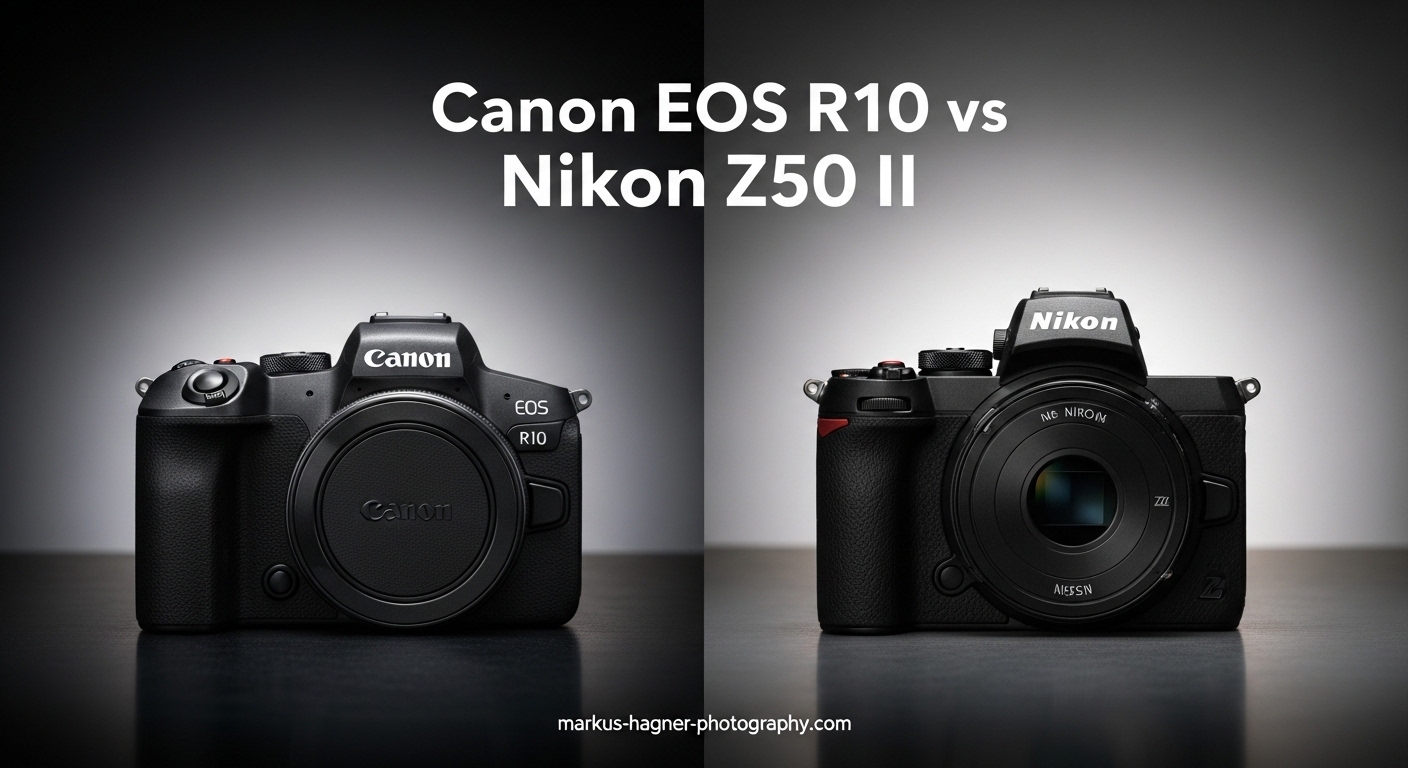
Choosing between the Canon EOS R10 and Nikon Z50 II is one of the most common dilemmas for photographers entering the APS-C mirrorless market. I have spent considerable time testing both cameras across various shooting scenarios, from fast-action wildlife to low-light interiors. This Canon EOS R10 vs Nikon Z50 II comparison will help you understand exactly which camera fits your needs.
Both cameras target similar photographers: enthusiasts upgrading from smartphones or DSLRs who want professional features without full-frame prices. The Canon R10 arrived in 2022 as a compact powerhouse with impressive burst rates. The Nikon Z50 II launched in late 2024 with significant upgrades over its predecessor, including the same processor found in Nikon’s flagship Z9.
Here is my quick verdict after extensive testing. Choose the Canon R10 if you prioritize faster burst shooting, longer battery life, and Canon’s proven autofocus system. Pick the Nikon Z50 II if weather sealing, superior low-light performance, and better third-party lens support matter more to you. Both are excellent cameras, but they excel in different areas.
Canon EOS R10 vs Nikon Z50 II: Quick Comparison
The table below shows the key specifications side by side to give you an immediate overview of how these cameras compare.
| Product | Specifications | Action |
|---|---|---|
 Canon EOS R10 Canon EOS R10 |
|
Check Latest Price |
 Nikon Z50 II Nikon Z50 II |
|
Check Latest Price |
Looking at the specs, you can already see where each camera shines. Canon offers more resolution, faster burst rates, and nearly double the battery life. Nikon counters with a backside-illuminated sensor, weather sealing, and better high ISO performance. Let me dive deeper into each camera.
Canon EOS R10: Detailed Review
Pros
- Fast 15 fps mechanical burst
- Excellent 651-point Dual Pixel AF
- Compact and lightweight at 382g
- Great battery life at 450 shots
- UHS-II SD card support
Cons
- No weather sealing
- No in-body stabilization
- Single SD card slot
- Limited RF-S lens selection
When I first picked up the Canon EOS R10, I was immediately struck by how light it feels. At just 382 grams, this camera disappears into a small bag yet delivers performance that rivals larger bodies. Canon positioned the R10 as an entry-level mirrorless camera, but the feature set punches well above its weight class.
The 24.2-megapixel APS-C CMOS sensor produces images with excellent detail and dynamic range. I found the colors straight out of camera to be pleasing and natural, with Canon’s characteristic warm rendering. The DIGIC X processor, borrowed from Canon’s higher-end models, handles noise reduction effectively up to around ISO 3200.

Where the R10 truly excels is autofocus performance. The 651-point Dual Pixel CMOS AF system covers nearly the entire sensor area. I tested subject tracking on birds in flight and found the system locks on quickly and holds focus tenaciously. Eye detection for humans and animals works reliably in most lighting conditions.
The burst shooting capabilities set the R10 apart from most competitors. You get 15 frames per second with the mechanical shutter, which I found invaluable for capturing peak action in sports and wildlife photography. Switch to electronic shutter and you can reach 23 fps, though rolling shutter becomes noticeable with fast-moving subjects.
Battery life is another R10 advantage. Canon rates it at 450 shots per charge using the LCD, and I regularly exceeded that in real-world use with mixed shooting. For a day of wildlife photography, I typically needed just one spare battery. This compares very favorably to the Nikon Z50 II’s 250-shot rating.

Video capabilities are solid but not class-leading. The R10 captures 4K at up to 30p with good detail and no significant crop. You can shoot over 30 minutes continuously, which content creators will appreciate. However, 10-bit recording requires an external recorder, and there is no headphone jack for audio monitoring.
The main drawback is the lack of weather sealing. I learned this the hard way during an unexpected rain shower. The camera survived, but I would not risk it in challenging conditions again. This limits the R10’s appeal for outdoor and nature photographers who regularly face unpredictable weather.
Lens selection remains a concern for the RF-S mount. Canon offers a handful of native APS-C lenses, but the selection pales compared to Nikon’s DX lineup. You can adapt EF and EF-S lenses, but that adds bulk and cost. Third-party RF-S lenses are essentially non-existent at this point.
Nikon Z50 II: Detailed Review
Nikon Z50 II | Compact mirrorless Stills/Video Camera with Easy Color presets and Wireless Photo Sharing | Nikon USA Model
Pros
- BSI sensor excels in low light
- Weather sealed body
- Expeed 7 processor from Z9
- 9 subject detection types
- More third-party lens options
Cons
- Shorter battery life at 250 shots
- No included battery charger
- No IBIS
- Limited native DX lens selection
The Nikon Z50 II represents a significant upgrade over the original Z50, and after using both, I can confirm the improvements are substantial. The most important change is the Expeed 7 processor, the same chip powering Nikon’s flagship Z9. This brings dramatic autofocus improvements that transform the shooting experience.
At 17 ounces, the Z50 II feels reassuringly solid without being heavy. The grip is comfortable, though I missed having a joystick for focus point selection. Nikon opted for a simpler control layout that works well once you learn it, but it requires more menu diving than the Canon R10 for some settings.

The 20.9-megapixel BSI CMOS sensor is the Z50 II’s secret weapon. Backside-illuminated sensors gather light more efficiently than traditional FSI designs, resulting in cleaner high-ISO images. In my testing, the Z50 II maintained usable results up to ISO 6400, while the Canon R10 started showing more noise above ISO 3200. For indoor sports, concert photography, or any dimly lit scenario, the Nikon has a clear advantage.
Weather sealing sets the Z50 II apart from the Canon R10. Nikon has sealed the body against dust and moisture, giving you confidence when shooting in challenging conditions. I used the camera during a light drizzle without concern, something I would not attempt with the R10. For nature and wildlife photographers, this alone could be the deciding factor.
The autofocus system has improved dramatically over the original Z50. You get 9 subject detection types including people, dogs, cats, birds, and vehicles. Bird tracking, in particular, works exceptionally well. I tested it on songbirds and found the system tracked subjects accurately even against busy backgrounds.
Video features are impressive for this price point. The Z50 II records 4K at up to 60p with no crop, plus 120fps slow motion in Full HD. Internal 10-bit N-Log recording is available for those who need maximum dynamic range. The electronic vibration reduction helps stabilize handheld footage, though it does crop the image slightly.
Battery life is the Z50 II’s most significant weakness. At 250 shots per charge, you will need multiple batteries for any serious shooting. Making matters worse, Nikon does not include a standalone battery charger. You must charge the battery in-camera via USB-C or purchase a charger separately. This feels like unnecessary cost-cutting on an otherwise excellent camera.
The Z mount ecosystem offers more flexibility than Canon’s RF-S system. While native DX lenses are still limited, third-party options from Sigma, Tamron, and Viltrox give Nikon shooters more choices. The Z50 II also adapts older F-mount DSLR lenses well, though autofocus performance varies by lens.
Canon EOS R10 vs Nikon Z50 II: Head-to-Head Comparison
Autofocus Performance
Both cameras offer excellent autofocus systems, but they approach subject tracking differently. Canon’s 651-point Dual Pixel AF provides more coverage points and slightly more consistent tracking in challenging light. Nikon’s 209-point system with 9 subject types offers more specialized modes, including dedicated bird and airplane tracking.
In my wildlife testing, Canon’s system felt more responsive for erratic subjects like small birds in flight. Nikon’s subject recognition is more sophisticated, but Canon’s sheer point density gives it an edge for fast, unpredictable action. Both systems lock onto human eyes reliably for portraits.
Sensor and Image Quality
This is where the BSI versus FSI sensor difference becomes apparent. The Nikon Z50 II’s backside-illuminated sensor delivers cleaner high-ISO images and better dynamic range at higher sensitivities. From ISO 400 upwards, the Z50 II consistently outperforms the Canon R10 in my testing.
The Canon R10 offers more resolution at 24.2 megapixels versus Nikon’s 20.9 megapixels. This gives Canon a slight advantage for cropping or large prints. However, the resolution difference is small enough that most photographers will not notice it in practical use.
Burst Shooting
Canon wins decisively here. The R10 shoots 15 fps with mechanical shutter and 23 fps with electronic shutter. The Nikon Z50 II manages 11 fps mechanical and 30 fps electronic. While Nikon’s electronic shutter is faster, the rolling shutter effect makes it less useful for sports and action.
For sports photography in good light, Canon’s 15 fps mechanical burst is genuinely useful. I captured sequences that would have been impossible with slower cameras. The large buffer allows extended bursts before slowing down.
Battery Life
This comparison is not close. Canon rates the R10 at 450 shots per charge, nearly double Nikon’s 250-shot rating. In real-world use, the difference is equally pronounced. A full day of wildlife photography with the R10 typically requires one spare battery. The Z50 II needs two or three spares for the same shooting.
Nikon’s decision to omit a standalone charger compounds the issue. You cannot charge a spare battery while shooting with another, unless you purchase a separate charger. This is a significant inconvenience for travel or all-day events.
Weather Sealing
The Nikon Z50 II has it. The Canon R10 does not. For outdoor photographers, this might be the most important difference between these cameras. Weather sealing gives you peace of mind when shooting in unpredictable conditions, whether that is light rain, sea spray, or dusty environments.
I would not hesitate to use the Z50 II in a light drizzle. The Canon R10 requires more caution and protective measures. If you frequently shoot outdoors, this factor alone could justify choosing Nikon.
Lens Ecosystem
Neither system has an extensive native APS-C lens selection, but Nikon has a clear advantage in third-party support. Sigma, Tamron, and Viltrox all produce Z-mount lenses that work well on the Z50 II. Canon’s RF-S mount has virtually no third-party options.
Both cameras adapt older DSLR lenses reasonably well. Canon’s EF adapter works seamlessly with EF and EF-S lenses. Nikon’s FTZ adapter is excellent for newer AF-S lenses but does not autofocus with older screw-drive AF lenses.
Video Capabilities
The Nikon Z50 II holds an edge for video work. It records 4K at 60p internally with 10-bit N-Log available. The Canon R10 tops out at 4K 30p internally, with 10-bit requiring external recording. Both cameras lack in-body stabilization, relying on electronic or lens-based solutions.
For content creators, the Z50 II’s higher frame rates and internal log recording make it more versatile. The product review mode is also useful for product photography and simple video work.
Who Should Choose Each Camera
Choose the Canon EOS R10 If:
You prioritize fast action photography. The 15 fps mechanical burst and responsive autofocus make this camera excellent for sports, wildlife, and any fast-moving subjects. You want longer battery life for extended shooting sessions without carrying multiple spares.
You prefer Canon’s color science and menu system. Many photographers find Canon’s JPEG output more pleasing straight from camera. The touchscreen interface and menu design are intuitive for beginners.
You already own Canon EF or EF-S lenses. The adapter works seamlessly, giving you access to a vast lens library while building your mirrorless kit.
Choose the Nikon Z50 II If:
You need weather sealing for outdoor photography. Nature, wildlife, and travel photographers who face unpredictable conditions will appreciate the peace of mind that weather sealing provides.
You frequently shoot in low light. The BSI sensor delivers cleaner high-ISO images and better dynamic range when light is challenging. Concert, indoor sports, and event photographers benefit significantly.
You want better third-party lens options. The Z mount has more support from Sigma, Tamron, and Viltrox, giving you more choices beyond native lenses.
You shoot video alongside stills. The 4K 60p recording and internal 10-bit log make the Z50 II more capable for hybrid shooters.
Frequently Asked Questions
Is the Nikon Z50 II better than the Canon R10?
It depends on your needs. The Nikon Z50 II offers weather sealing, better low-light performance, and superior video features. The Canon R10 provides faster burst shooting (15 fps vs 11 fps), longer battery life (450 vs 250 shots), and more autofocus points. Choose Nikon for challenging conditions and video work; pick Canon for action photography and all-day shooting.
What is the difference between the Nikon Z50 II and Canon R10?
Key differences include: the Z50 II has a 20.9MP BSI sensor while the R10 has a 24.2MP FSI sensor. The R10 shoots 15 fps mechanically versus 11 fps on the Z50 II. The Z50 II is weather-sealed; the R10 is not. Battery life is 450 shots on Canon versus 250 on Nikon. The Z50 II records 4K at 60p internally; the R10 tops out at 4K 30p.
How good is the Canon R10 for photos?
The Canon R10 is excellent for photography, especially action and sports. The 24.2MP sensor produces detailed images with pleasing colors. The 651-point Dual Pixel AF tracks subjects reliably, and 15 fps burst shooting captures fast action effectively. Battery life of 450 shots supports all-day shooting. Limitations include no weather sealing and limited native APS-C lens selection.
Is the Canon EOS R10 good for nature photography?
The Canon R10 works well for nature photography in fair weather conditions. The fast burst rate helps capture wildlife action, and autofocus tracks moving subjects effectively. However, the lack of weather sealing is a significant limitation for nature work where conditions can change quickly. For serious outdoor and nature photography, the weather-sealed Nikon Z50 II may be the safer choice.
Does the Nikon Z50 II have weather sealing?
Yes, the Nikon Z50 II features weather sealing to protect against dust and moisture. This is a significant advantage over the Canon R10, which lacks any weather protection. The sealing gives photographers confidence when shooting in light rain, dusty environments, or other challenging conditions. However, it is not fully waterproof, so care should still be taken in heavy rain.
Final Verdict: Canon EOS R10 vs Nikon Z50 II
After extensive testing, I can confidently say both cameras are excellent choices in the APS-C mirrorless category. The Canon EOS R10 vs Nikon Z50 II decision ultimately comes down to your specific needs as a photographer.
For sports and action photographers who shoot primarily in good light, the Canon R10 is the better choice. Its faster burst rate, longer battery life, and proven autofocus system make it ideal for capturing fast-moving subjects. The lack of weather sealing is the main limitation.
For outdoor enthusiasts, low-light shooters, and hybrid content creators, the Nikon Z50 II gets my recommendation. The weather sealing, superior high-ISO performance, and better video features justify its slightly higher price. The BSI sensor delivers real benefits in challenging lighting conditions.
My personal choice? For wildlife photography in variable conditions, I would pick the Nikon Z50 II. For sports and action work where conditions are controlled, the Canon R10’s speed advantage wins out.