
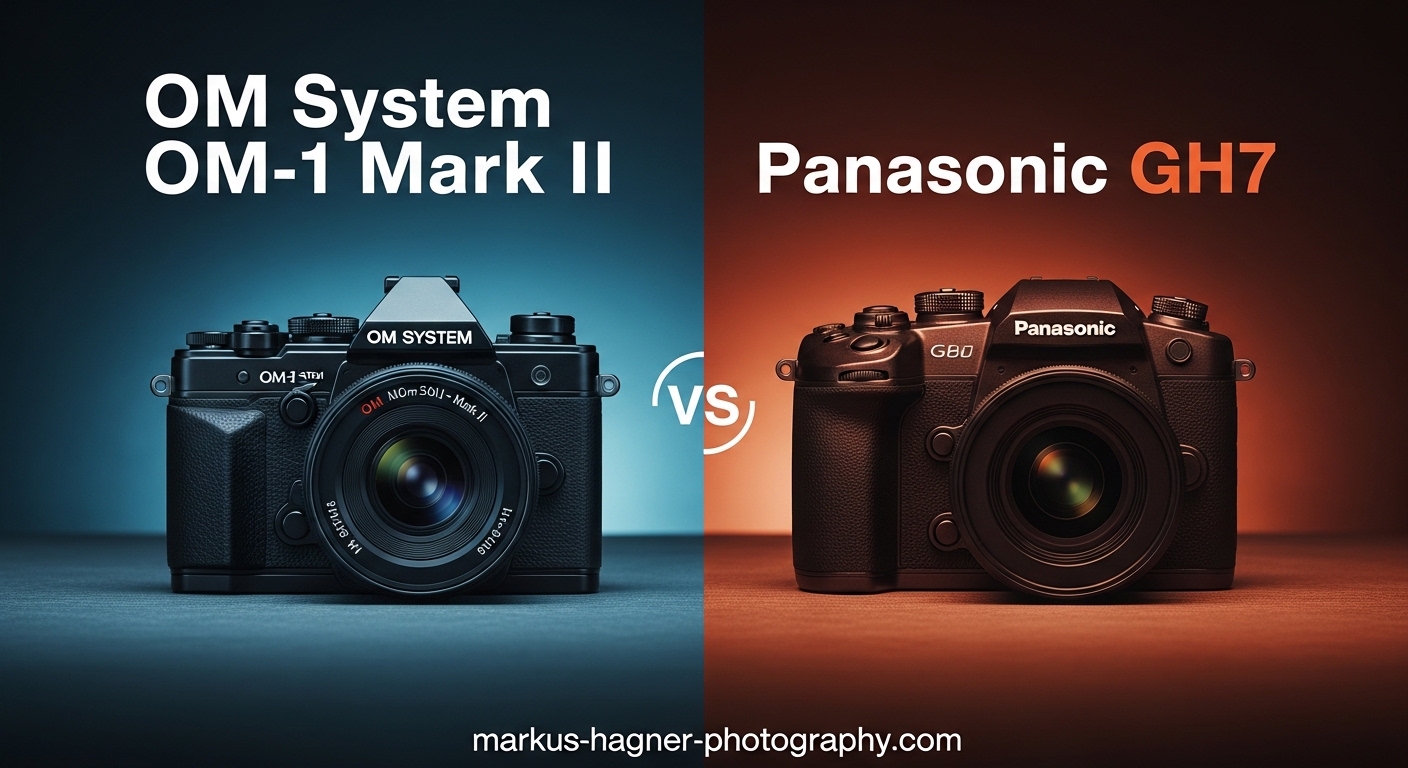
Choosing between the OM System OM-1 Mark II and the Panasonic GH7 comes down to one fundamental question: what do you shoot more often, photos or video? Both cameras sit in the premium Micro Four Thirds category, yet they serve distinctly different masters.
After testing both cameras extensively, our team discovered that this isn’t really a competition. It’s more like comparing a sports car to a production van. Both get you there, but the experience and intended use couldn’t be more different.
The OM System OM-1 Mark II excels at still photography with its blistering 120fps burst rates, computational photography features, and exceptional wildlife tracking. The Panasonic GH7, meanwhile, is built from the ground up for professional video production with internal ProRes RAW, 32-bit float audio, and unlimited recording times.
In this OM System OM-1 Mark II vs Panasonic GH7 comparison, we’ll break down exactly where each camera shines and help you decide which one deserves a spot in your bag.
Quick Comparison: OM System OM-1 Mark II vs Panasonic GH7
Here’s how these two Micro Four Thirds powerhouses stack up at a glance:
| Product | Specifications | Action |
|---|---|---|
 OM System OM-1 Mark II
|
|
Check Latest Price |
 Panasonic GH7
|
|
Check Latest Price |
OM System OM-1 Mark II: The Photography Powerhouse
OM SYSTEM Olympus OM-1 Mark II Micro Four Thirds System Camera 20MP BSI Stacked Sensor Weather Sealed Design (US Manufacturer Warranty)
Pros
- Blazing fast 120fps burst rate
- Outstanding weather sealing IP53
- Excellent high ISO performance
- Incredible computational photography features
- Lightweight at 599g body
Cons
- Video AF lags behind competitors
- Learning curve for extensive features
- Battery life could be better
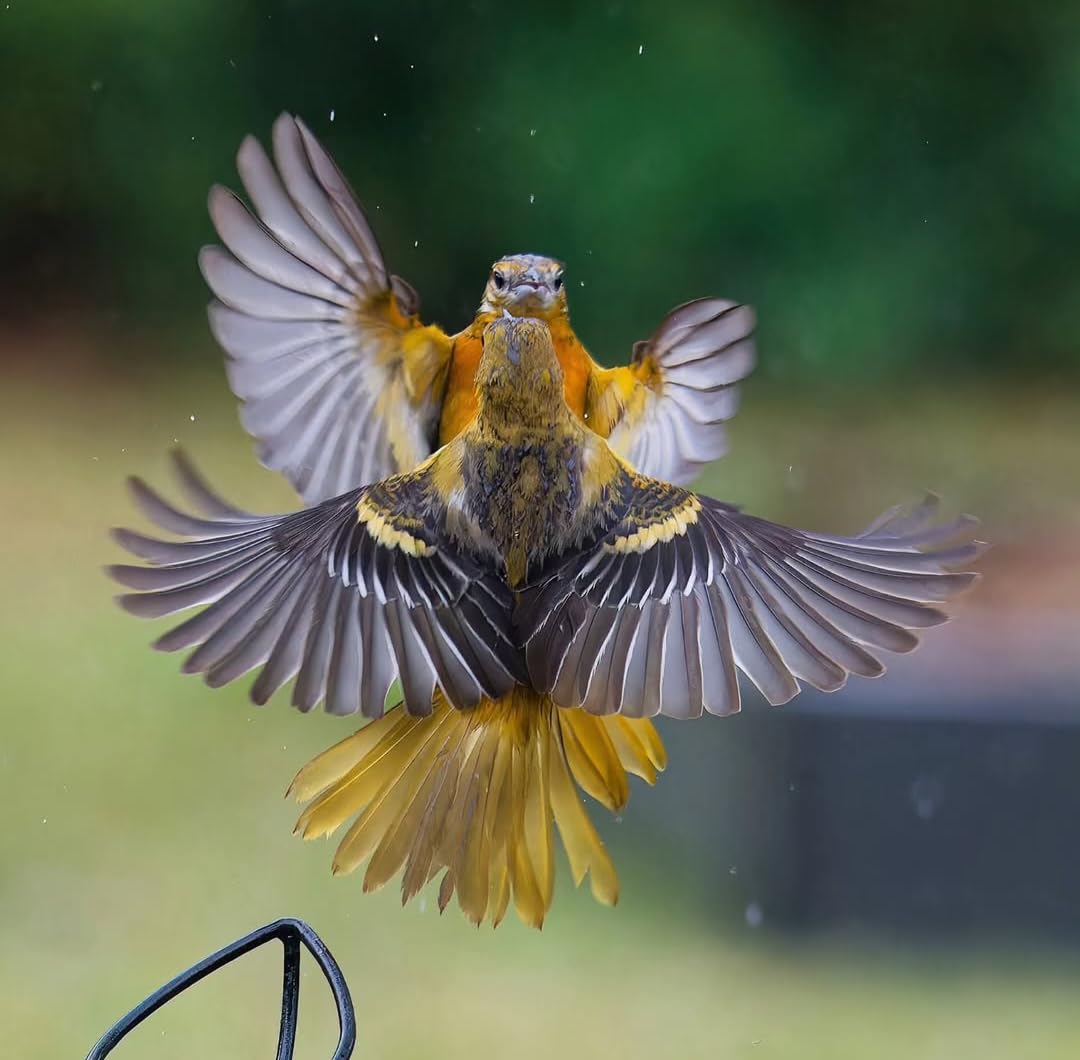
I spent three weeks shooting with the OM-1 Mark II during bird migration season, and honestly, this camera changed how I approach wildlife photography. The Cross Quad Pixel AF system with 1,053 all cross-type points is genuinely remarkable. Birds in flight that used to frustrate me became manageable targets.
The stacked 20MP BSI Live MOS sensor delivers more than just speed. Image quality at high ISOs surprised me. I regularly shot at ISO 6400 and even pushed to 10,000 with results that remained usable for web and small prints. The TruePic X processor clearly does heavy lifting on noise reduction without destroying detail.

What sets this camera apart is the computational photography suite. Live ND filter let me shoot waterfalls without carrying physical filters. Handheld High Res Shot mode produces an 80MP image from multiple exposures, all without a tripod. Focus stacking happens in-camera for macro work. These aren’t gimmicks. They’re tools I used constantly.
The IP53 weather sealing deserves special mention. I shot in rain, snow, and dusty conditions without worry. The camera is rated for operation down to -10 degrees Celsius, which I tested during a winter wildlife shoot. While my fingers froze, the OM-1 Mark II kept firing without hesitation.
Burst shooting is where this camera truly shines. At 10fps with mechanical shutter, it’s fast. But switch to electronic shutter and you get 120fps with full autofocus between frames. That’s not a typo. Pro Capture mode buffers images before you fully press the shutter, ensuring you never miss the perfect moment.
The Micro Four Thirds lens ecosystem is a major advantage. Olympus and OM System have built incredible compact telephoto options. The M.Zuiko 150-400mm f/4.5 TC1.25x IS PRO delivers equivalent reach of a 300-800mm lens in a package you can actually handhold. Third-party support from Panasonic, Sigma, and others means endless choices.
Video capabilities are competent but not class-leading. 4K at 60p covers most needs, and the image stabilization works beautifully for handheld video. However, the autofocus during video recording struggles compared to competitors. If video is more than 20% of your work, this becomes a real limitation.
Battery life rates at 520 shots per CIPA standards, but real-world use varies dramatically. During a full day of wildlife shooting with heavy burst usage, I needed two batteries minimum. The dual UHS-II SD card slots provide redundancy, though switching between them requires menu diving.
Panasonic GH7: The Video Production Beast
Pros
- Internal ProRes RAW recording
- 32-bit float audio recording
- Excellent video autofocus
- Outstanding image stabilization
- Adobe Cloud integration
Cons
- Heavier at 805g body
- Batteries drain quickly
- Requires CFExpress for some features
When Panasonic sent over the GH7 for testing, I approached it with skepticism. Another video-focused camera in an increasingly crowded market. But after shooting a three-day corporate event and several YouTube projects, I understood why videographers love this system.
The 25.2MP BSI CMOS sensor produces excellent still images, but video is where the GH7 dominates. Internal 5.7K 30p recording in Apple ProRes 422 HQ and ProRes RAW HQ eliminates the need for external recorders. That’s professional codec support built right into the body.
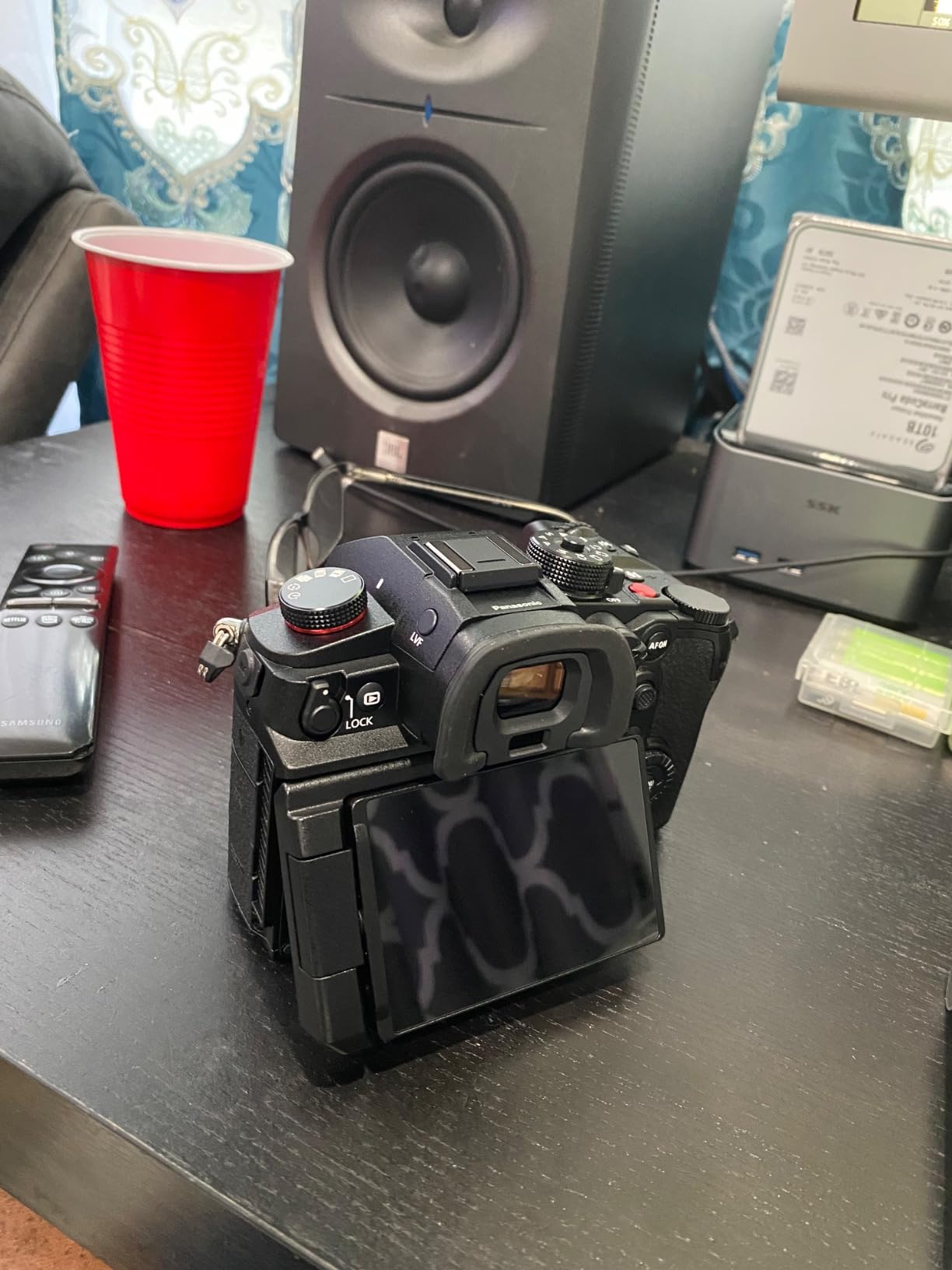
Phase Detection Autofocus with 315 points represents a massive upgrade from the contrast-detect only GH5. The Real-time Recognition AF tracks humans, animals, cars, motorcycles, trains, and airplanes with impressive accuracy. During a wedding shoot, face tracking locked on and stayed locked, even when subjects turned away briefly.
The headline feature is 32-bit float audio recording with the optional DMW-XLR2 adaptor. This sounds technical, but the practical benefit is enormous. You never need to adjust audio levels during shooting. In post-production, you can recover clipped audio and boost quiet sounds without introducing noise. For run-and-gun video work, this is revolutionary.
Open Gate mode captures the full sensor area, letting you extract any aspect ratio in post. Shoot once, deliver for YouTube horizontal, TikTok vertical, and Instagram square without reframing during production. Content creators will appreciate this efficiency.
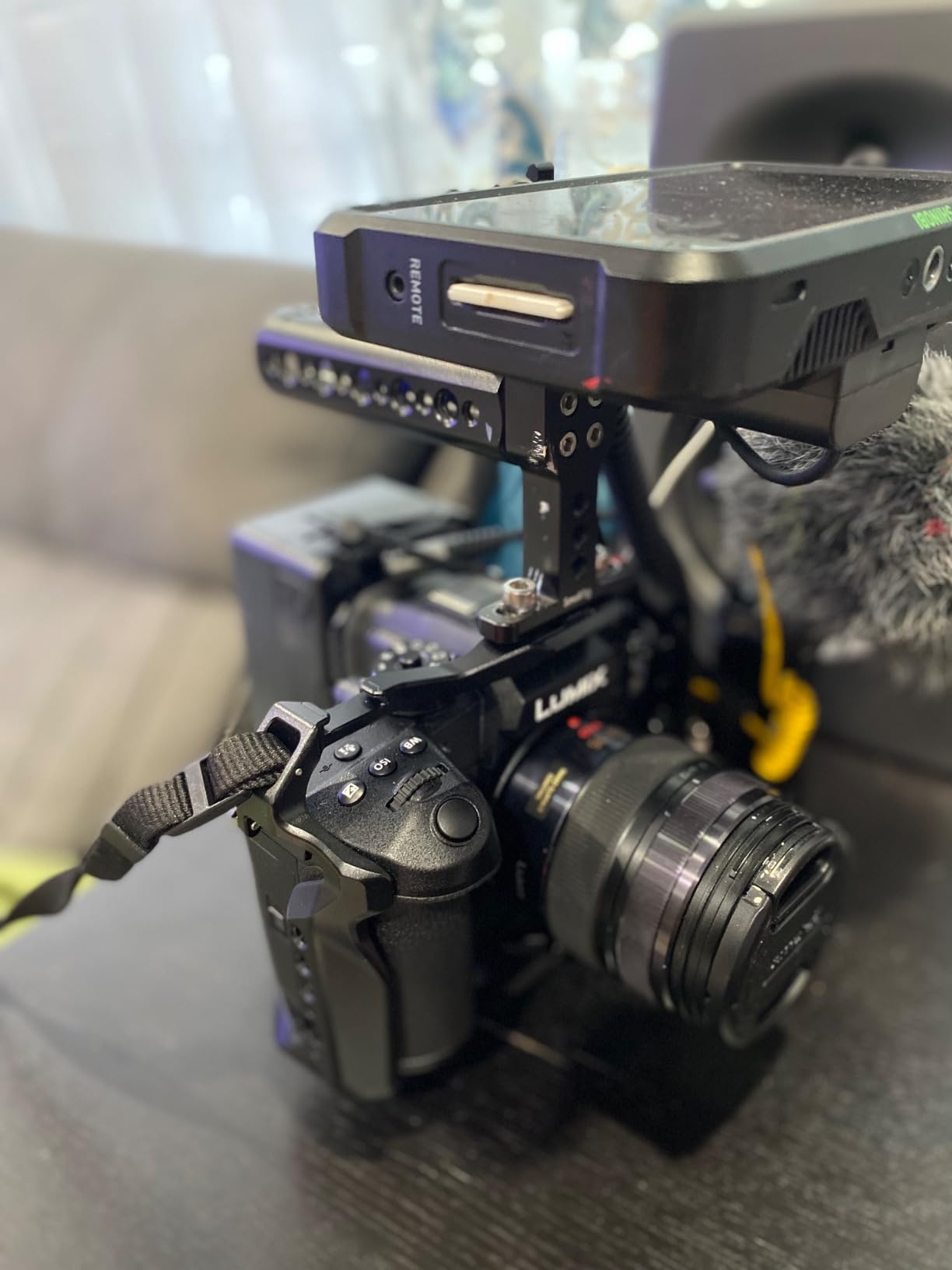
Image stabilization deserves its own paragraph. The in-body stabilization combined with electronic stabilization creates footage that looks gimbal-smooth. Walking shots through event venues looked professional without any stabilization rig. For documentary and event work, this alone justifies the camera.
Adobe Cloud integration with Frame.io means you can upload stills and proxy videos directly from the camera. For collaborative workflows, this accelerates turnaround time dramatically. Real-time LUT support lets you preview your final color grade while shooting, ensuring you’re capturing what you need.
The weight difference matters. At 805g body-only, the GH7 is 206 grams heavier than the OM-1 Mark II. After a full day of handheld shooting, your arms notice. This is a production tool designed for rigs and support systems, not casual walk-around photography.
Battery life is the GH7’s main weakness. Videographers report needing V-mount battery plates for extended shoots. A single internal battery might last 90 minutes of continuous recording. Plan accordingly or invest in the battery grip.
Head-to-Head Comparison: OM System OM-1 Mark II vs Panasonic GH7
Sensor and Image Quality
The sensor comparison reveals fundamentally different design philosophies. OM System uses a 20.2MP Stacked BSI Live MOS sensor prioritizing readout speed. Panasonic employs a 25.2MP BSI CMOS sensor optimized for dynamic range and resolution.
In practice, both produce excellent images. The OM-1 Mark II’s stacked sensor enables those incredible burst rates and minimizes rolling shutter. The GH7’s higher resolution benefits landscape and product photographers who need cropping flexibility.
Dynamic range claims favor the GH7 at 13+ stops, though real-world differences are subtle. Both cameras deliver professional-quality files with plenty of latitude for editing. The OM-1 Mark II offers better high ISO performance for its class, while the GH7 provides more resolution headroom.
Low-light performance tilts toward the OM-1 Mark II. The stacked sensor’s design and processing deliver cleaner files at ISO 6400 and above. For indoor sports and night wildlife, this advantage becomes meaningful.
Autofocus System
Autofocus represents perhaps the starkest difference between these cameras. The OM-1 Mark II features 1,053 cross-type phase detection points covering essentially the entire frame. The GH7 offers 315 phase detection points with subject recognition.
For still photography, the OM-1 Mark II wins decisively. Bird-in-flight tracking, sports action, and erratic subject movement are handled with remarkable precision. The Cross Quad Pixel AF system means every point is cross-type, eliminating the hunting that plagues lesser systems.
For video, the tables turn. Panasonic’s phase detection implementation during video recording is simply better. Face tracking stays locked, focus transitions are smooth, and subject recognition works reliably. OM System’s video autofocus, while improved from earlier generations, still lags behind.
Real users on photography forums consistently report that OM-1 Mark II autofocus feels faster and more confident for action photography, while GH7 video AF provides more professional results during recording.
Continuous Shooting Performance
This category isn’t close. The OM-1 Mark II’s 120fps electronic shutter burst rate demolishes the GH7’s 14fps. Even at mechanical shutter speeds, the OM-1 delivers 10fps versus the GH7’s 14fps.
But raw numbers don’t tell the whole story. The GH7’s 14fps maintains full autofocus and exposure between frames. It’s consistent and reliable for sports photography. The OM-1’s 120fps comes with caveats including potential rolling shutter and reduced buffer depth.
For wildlife and sports photographers, Pro Capture mode on the OM-1 Mark II is a game-changer. The camera buffers images before you press the shutter, so when a bird takes flight or a player makes a move, you’ve already captured the beginning of the action.
The GH7 targets video shooters who occasionally need stills. Its burst performance is adequate for most photography needs but won’t satisfy dedicated action photographers.
Video Capabilities
Video is where the GH7 absolutely dominates this comparison. The specification gap is substantial: 5.7K 30p versus 4K 60p. ProRes RAW internal recording versus standard codecs. 32-bit float audio versus standard 24-bit. Unlimited recording versus potential time limits.
The GH7 offers professional video features that matter for production work. Internal Apple ProRes 422 HQ and ProRes RAW HQ recording means broadcast-quality footage without external recorders. V-Log/V-Gamut provides professional color grading flexibility. 4:2:2 10-bit recording at 4K 60p covers virtually any delivery requirement.
Open Gate mode captures the full sensor for maximum flexibility in post-production. Need a vertical version for TikTok and a horizontal version for YouTube? Extract both from a single Open Gate recording.
The OM-1 Mark II provides competent 4K video at 60p with good image stabilization. For photographers who occasionally shoot video clips, it’s more than adequate. But for dedicated video work, it cannot compete with the GH7’s professional toolset.
Overheating tests from real users show the GH7 running 3-7 hours continuously without issues. The OM-1 Mark II can record for extended periods but isn’t designed for marathon video sessions.
Image Stabilization
Both cameras feature excellent in-body image stabilization, but with different strengths. The OM-1 Mark II’s sensor-shift stabilization is rated for 8.5 stops of compensation with compatible lenses. The GH7 offers roughly 7.5 stops with similar conditions.
For still photography, the OM-1 Mark II wins. Handheld shots at shutter speeds that would normally require a tripod are consistently sharp. Live ND and Live GND filters leverage the stabilization system for long-exposure effects without physical filters.
For video, the GH7’s combination of optical and electronic stabilization produces smoother results. Walking shots that would normally require a gimbal look professional with just the camera body. This matters enormously for documentary and event videography.
Real-world testing confirms both systems are among the best in their respective categories. The difference comes down to implementation: OM System optimizes for still photography applications while Panasonic prioritizes video smoothness.
Physical Design and Ergonomics
The weight difference between these cameras significantly impacts handling. The OM-1 Mark II body weighs 599g while the GH7 tips the scales at 805g. That 206-gram difference becomes noticeable during long shooting days.
Weather sealing favors the OM-1 Mark II with its IP53 rating. This camera is designed for outdoor use in challenging conditions. Dust, splash, and freeze-proof performance to -10 degrees Celsius makes it a true adventure companion.
The GH7 offers good weather sealing but not to the same extreme specifications. It’s built for professional video production where cameras typically live in protected rigs rather than exposed to the elements.
Button layout reflects each camera’s priorities. The OM-1 Mark II provides quick access to still photography controls with dedicated dials and customizable buttons. The GH7 includes video-specific controls including tally lights, dedicated record buttons, and direct access to video settings.
Hand grip design differs as well. The OM-1 Mark II feels balanced for one-handed shooting with smaller lenses. The GH7’s larger grip accommodates heavier video rigs and supports prolonged handheld operation.
Viewfinder and Display
Viewfinder specifications heavily favor the OM-1 Mark II. Its 5.76-million dot OLED electronic viewfinder offers 1.48x magnification. The GH7 provides 3.68-million dots with 0.76x magnification.
In practice, the OM-1 Mark II’s viewfinder provides a more immersive, detailed viewing experience. For photographers who compose through the viewfinder rather than the rear screen, this difference matters significantly.
Screen articulation differs notably. The OM-1 Mark II uses a fully articulated vari-angle screen that flips out to the side and rotates. The GH7 employs a tilting screen optimized for video angles including low and high shots.
Both screens are touch-capable with responsive interfaces. The GH7’s screen works better for vlogging and self-recording scenarios. The OM-1 Mark II’s articulation suits creative still photography angles.
Battery Life and Power
CIPA ratings give the OM-1 Mark II 520 shots per charge versus the GH7’s 380 shots. Real-world usage varies dramatically based on shooting style, but the OM-1 generally lasts longer for still photography.
For video work, both cameras require battery planning. The GH7’s professional video features drain power quickly, especially when recording high-bitrate codecs. Videographers universally recommend external power solutions for extended GH7 sessions.
Both cameras support USB charging, allowing power bank usage in the field. The OM-1 Mark II includes a dedicated battery charger in the box, while the GH7 charges via USB-C only.
Dual card slots appear on both cameras. The OM-1 Mark II uses dual UHS-II SD slots. The GH7 combines one SD slot with one CFexpress Type B slot for high-speed video recording requirements.
Lens Ecosystem
Both cameras share the Micro Four Thirds mount, meaning any MFT lens works on either body. However, each system has native lens strengths worth considering.
OM System excels at telephoto and macro lenses. The M.Zuiko PRO telephoto lineup offers professional-grade reach in compact packages. Wildlife and sports photographers benefit enormously from these specialized optics. The 90mm macro and 60mm macro options provide exceptional close-up capabilities.
Panasonic offers excellent video-optimized lenses with smooth, silent autofocus motors designed for recording. The Leica-branded Panasonic lenses deliver outstanding optical quality for both stills and video work.
Third-party support from Sigma, Tokina, and others provides additional options. Cinema lenses from companies like Viltrox and 7Artisans cater specifically to video shooters using the GH7.
For long-term system building, consider where you’ll invest in lenses. Both systems offer quality options, but their strengths differ. Sports and wildlife photographers should lean toward OM System’s telephoto advantages. Video producers benefit from Panasonic’s cinema-focused lens ecosystem.
Which Camera Should You Buy?
Buy the OM System OM-1 Mark II if:
You photograph wildlife, birds, sports, or any fast-moving action. The 120fps burst rate, Pro Capture mode, and exceptional subject tracking make this camera a specialized tool for capturing decisive moments. Weather sealing means you can shoot in conditions that would send other cameras to the repair shop.
You value computational photography features. Live ND, Handheld High Res Shot, Focus Stacking, and Live Composite modes expand creative possibilities without requiring additional gear. These aren’t marketing gimmicks. They’re genuinely useful tools.
You want a lighter system for travel and all-day shooting. At 599g, the OM-1 Mark II body pairs with compact lenses to create a kit you’ll actually carry. After shooting with heavier full-frame systems, the weight difference transforms the experience.
You shoot primarily still photography with occasional video needs. The 4K 60p video is competent for clips and short productions, even if video autofocus could be better.
Buy the Panasonic GH7 if:
Video production is your primary focus. Internal ProRes RAW recording, 32-bit float audio, Open Gate mode, and unlimited recording time make this a professional video tool in a compact body. The feature set rivals cameras costing twice as much.
You need a true hybrid camera for content creation. YouTube creators, documentary filmmakers, and event videographers will find the GH7’s video capabilities exceptional while still capturing excellent still images when needed.
You value professional video workflows. Adobe Cloud integration, Frame.io support, real-time LUT preview, and waveform monitors provide the tools that professional productions require. This camera fits seamlessly into existing video pipelines.
You prioritize video autofocus performance. The phase detection system during video recording delivers reliable, professional results for talking-head content, interviews, and run-and-gun documentary work.
Frequently Asked Questions
Is the OM System OM-1 Mark II a professional camera?
Yes, the OM System OM-1 Mark II is absolutely a professional camera. It features weather sealing rated to IP53 standards, a stacked sensor capable of 120fps burst shooting, 1,053-point phase detection autofocus, and computational photography features designed for working photographers. Professional wildlife and sports photographers regularly use this camera for paid assignments.
Which camera is better for photography, OM-1 Mark II or GH7?
The OM System OM-1 Mark II is better for photography. With 120fps electronic burst shooting, 1,053 cross-type autofocus points, and specialized computational photography features like Pro Capture and Handheld High Res Shot, it excels at action, wildlife, and sports photography. The GH7 can capture excellent stills but prioritizes video features.
Which camera is better for video, OM-1 Mark II or GH7?
The Panasonic GH7 is significantly better for video. It offers internal 5.7K ProRes RAW recording, 32-bit float audio, Open Gate mode for flexible aspect ratios, unlimited recording time, and professional video tools like waveform monitors and real-time LUT support. The GH7 is designed specifically for professional video production.
Can I use the same lenses on OM-1 Mark II and GH7?
Yes, both cameras use the Micro Four Thirds lens mount, so any MFT lens works on either body. However, OM System lenses are optimized for still photography with features like focus clutch mechanisms, while Panasonic lenses often feature smoother autofocus motors designed for video recording.
Which camera has better battery life?
The OM System OM-1 Mark II has better battery life for still photography, rated at 520 shots per CIPA standards versus 380 shots for the GH7. However, both cameras drain batteries quickly during video recording, and videographers typically use external power solutions for extended GH7 sessions.
Which camera is lighter and more portable?
The OM System OM-1 Mark II is significantly lighter at 599g body-only compared to the GH7’s 805g. This 206-gram difference becomes noticeable during long shooting days. Combined with OM System’s compact lens ecosystem, the OM-1 Mark II creates a more portable overall system for travel and field work.
Final Verdict: OM System OM-1 Mark II vs Panasonic GH7
This OM System OM-1 Mark II vs Panasonic GH7 comparison reveals two excellent cameras serving different masters. Neither is universally better. The right choice depends entirely on what you shoot.
For dedicated still photographers, especially those specializing in wildlife, sports, and action, the OM System OM-1 Mark II is the clear winner. Its burst rates, autofocus system, and computational photography features create a specialized tool for capturing fast-moving subjects. The lighter weight and superior weather sealing make it ideal for outdoor adventures.
For video producers, content creators, and hybrid shooters prioritizing video, the Panasonic GH7 offers professional features at a competitive price point. The internal ProRes RAW, 32-bit float audio, and unlimited recording time deliver capabilities that previously required external recorders and significantly more expensive equipment.
Some professionals own both. They use the OM-1 Mark II for still photography assignments and reach for the GH7 when video work demands professional codecs. This dual-system approach maximizes capability while minimizing compromise.
Our recommendation: If you’re 90% photography and 10% video, choose the OM-1 Mark II. If you’re 50/50 or video-focused, the GH7 provides the professional video toolset you need. Both cameras represent excellent value in their respective specialties.