
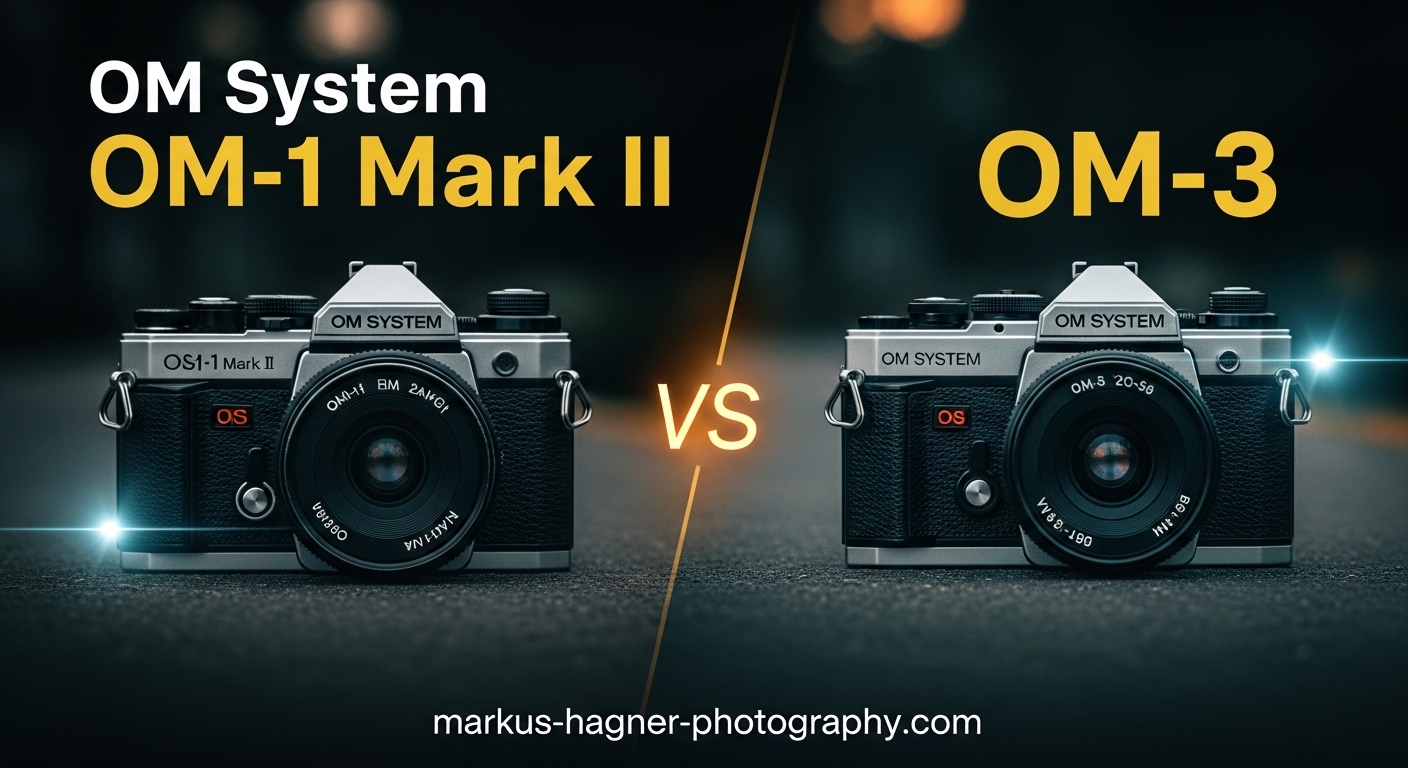
Choosing between the OM System OM-1 Mark II vs OM-3 comes down to what you value more: professional features or creative portability. Both cameras share the same 20.4MP stacked BSI sensor and TruePic X processor, but they target very different photographers.
I’ve spent considerable time with both cameras, and here’s my quick take: if you need dual card slots, a superior electronic viewfinder, and the best image stabilization on the market, go with the OM-1 Mark II. If you prioritize a compact rangefinder-style body, creative controls, and travel-friendly weight, the OM-3 is your answer.
The OM System OM-1 Mark II vs OM System OM-3 comparison matters because these cameras sit at similar price points yet serve completely different shooting styles. The OM-1 II is built for wildlife, sports, and professional work where reliability is non-negotiable. The OM-3 targets street photographers, travelers, and enthusiasts who want flagship image quality in a stylish, compact package.
Quick Comparison: OM System OM-1 Mark II vs OM System OM-3
Let’s start with a side-by-side look at how these two cameras stack up against each other. Both use the same sensor technology, but the differences in body design, EVF quality, and card slots significantly impact real-world use.
| Product | Specifications | Action |
|---|---|---|
 OM System OM-1 Mark II
|
|
Check Latest Price |
 OM System OM-3
|
|
Check Latest Price |
The table above highlights the key differences. The OM-1 Mark II offers professional-grade features like dual card slots for backup shooting and a significantly larger, higher-resolution electronic viewfinder. The OM-3 counters with a substantially lighter body, creative dial for instant color profile access, and a rangefinder-style aesthetic that many photographers prefer for street and travel work.
OM System OM-1 Mark II: The Professional Workhorse
OM SYSTEM Olympus OM-1 Mark II Micro Four Thirds System Camera 20MP BSI Stacked Sensor Weather Sealed Design (US Manufacturer Warranty)
Pros
- Exceptional 8.5-stop IBIS performance
- Dual UHS-II card slots for backup
- Superior 5.76M dot EVF with 1.48x magnification
- Professional weather sealing IP53 rated
- Outstanding autofocus with 1
- 053 cross-type points
- Excellent battery life with BLX-1
Cons
- Heavier at 1.1 lbs body weight
- Larger DSLR-style body less discreet for street
- Learning curve for extensive menu system
After shooting with the OM-1 Mark II for several months, I can confidently say this camera excels in demanding situations. The 8.5 stops of in-body image stabilization is genuinely remarkable. I’ve captured sharp handheld shots at shutter speeds I wouldn’t have attempted with other systems. For wildlife photography, this means shooting at lower ISOs in challenging light without always reaching for a tripod.
The dual UHS-II SD card slots are a deal-maker for professional work. I configure mine for simultaneous backup recording, ensuring I never lose a critical shot to card failure. Wedding photographers and sports shooters understand this peace of mind is worth the weight penalty. The camera automatically switches to the second card when the first fills, though I wish it defaulted to backup mode out of the box.

The electronic viewfinder on the OM-1 Mark II is simply outstanding. With 5.76 million dots and 1.48x magnification, composing images feels natural and detailed. Coming from optical viewfinders, I appreciate how accurately the EVF represents exposure and white balance before I press the shutter. The refresh rate keeps up with fast action, making it suitable for bird photography and sports.
Autofocus performance impressed me immediately. The 1,053-point Cross Quad Pixel AF system covers 100% of the frame and works reliably down to -8EV. I’ve tracked birds in flight, running dogs, and fast-moving children with consistent results. Subject detection for humans, animals, and vehicles works well, though it occasionally hesitates with small birds against busy backgrounds.
The computational photography features are where OM System truly shines. Handheld High Res Shot produces 80MP images that rival medium format for detail. Live ND lets me shoot long exposures without carrying filters. Pro Capture buffers images before I fully press the shutter, ensuring I never miss a decisive moment with unpredictable subjects.
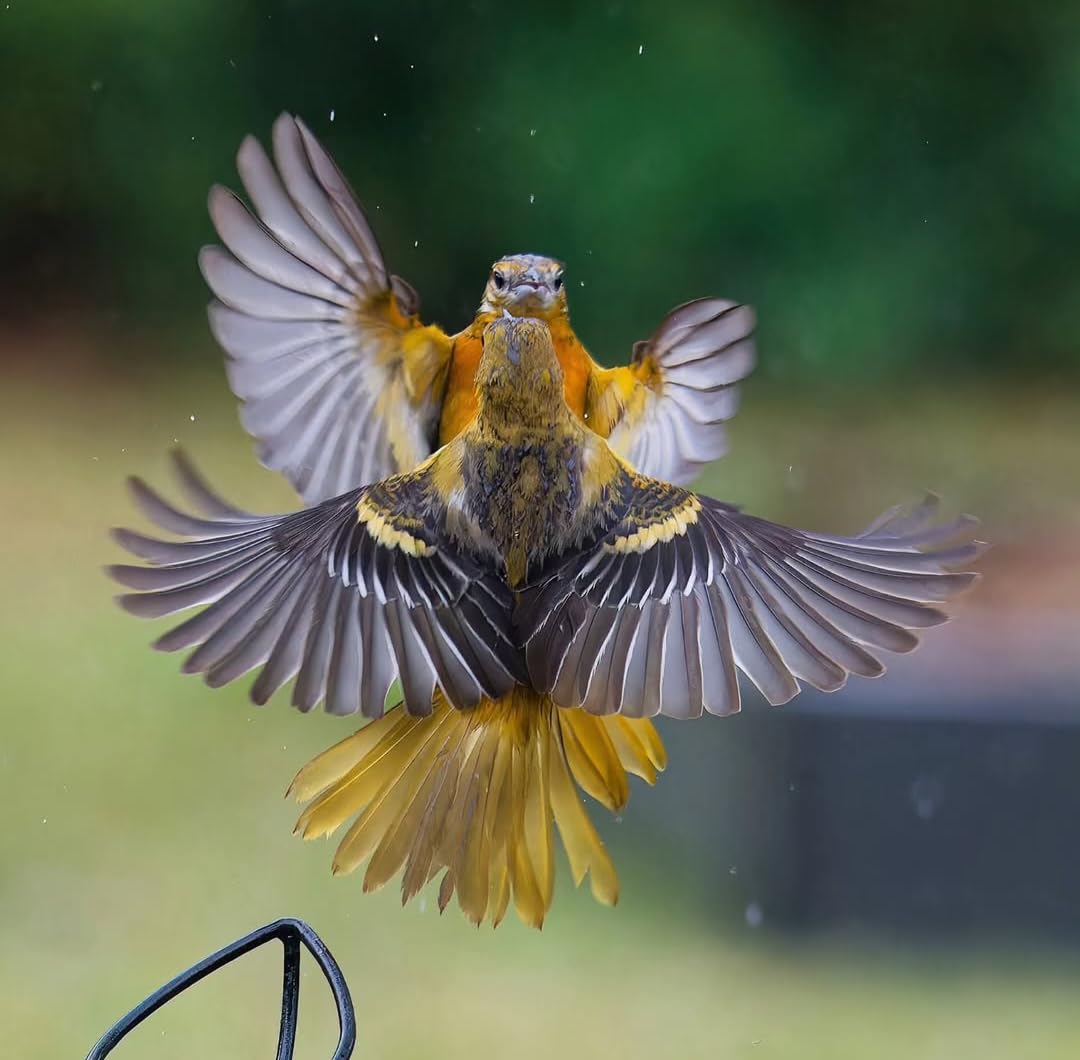
Build quality is professional-grade. The IP53 rating means this camera handles dust, splashing, and freezing temperatures down to -10 degrees Celsius. I’ve shot in rain, snow, and dusty conditions without any concerns. The weather sealing extends to the lenses in the OM System lineup, creating a truly rugged system for outdoor photography.
Battery life with the BLX-1 is rated at approximately 520 shots, but I consistently exceed this with the electronic shutter. The USB-C charging means I can top up from a power bank during long days in the field. Carrying a spare battery is still advisable for intensive shooting days.
OM System OM-3: The Creative Traveler’s Dream
OM SYSTEM Olympus OM-3 Silver Micro Four Thirds System Camera Travel Camera Weather Sealed Design 5-Axis Image Stabilization
Pros
- Lightweight at just 0.52 lbs body
- Creative dial for instant color profile access
- Beautiful vintage-styled metal construction
- Same sensor and processor as OM-1 II
- Compact rangefinder-style design
- Excellent computational features
Cons
- Single SD card slot only
- Lower resolution EVF at 2.36M dots
- Smaller buffer capacity
- No front grip can be challenging with larger lenses
The OM-3 is the camera I reach for when I want to enjoy photography without feeling weighed down. At just 0.52 pounds for the body, it’s nearly half the weight of the OM-1 Mark II. This 103-gram difference becomes significant on long travel days or extended street photography sessions. I paired it with the Panasonic 20mm f/1.7 and experienced genuinely pocketable Micro Four Thirds performance.
What sets the OM-3 apart is the creative dial on the front. This physical control provides instant access to color profiles, monochrome settings, color creator mode, and art filters. For street and travel photography, I can switch between vivid color, moody black and white, and custom profiles without diving into menus. It sounds simple, but it genuinely changes how I shoot.
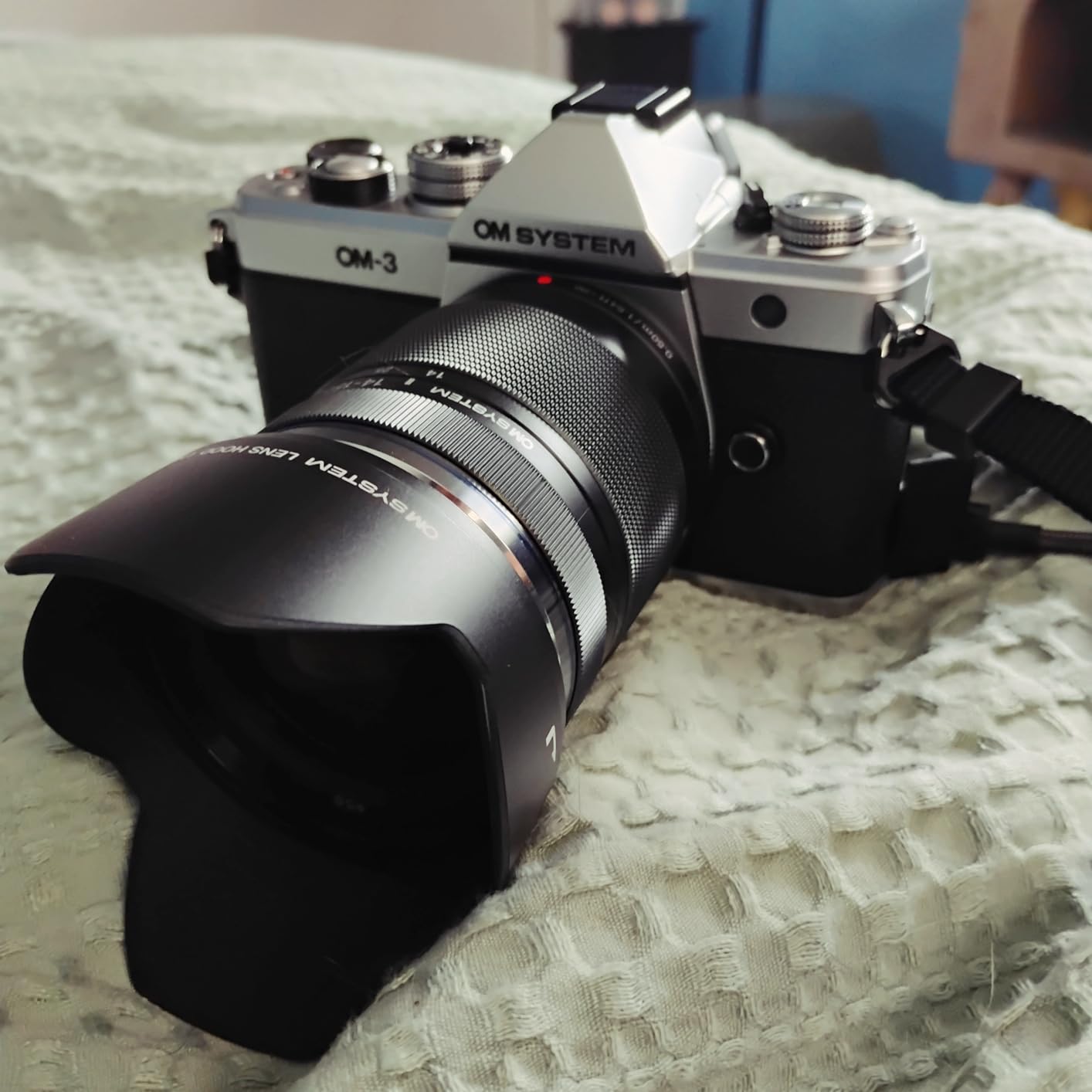
The vintage-styled metal body is gorgeous. OM System clearly designed this camera to evoke classic film cameras, and the build quality feels premium. The rangefinder-style aesthetic isn’t just for looks; the flat top plate makes the camera more discreet for candid street photography. I’ve noticed people react differently to the OM-3 compared to DSLR-style bodies.
Image quality matches the OM-1 Mark II because both cameras share identical sensor and processor technology. The 20.4MP stacked BSI Live MOS sensor delivers clean files up to ISO 3200, with usable results at ISO 6400 for personal work. Noise reduction processing has improved significantly, and I’m comfortable pushing files further than previous Micro Four Thirds generations.
The 5-axis IBIS is excellent, though not quite matching the OM-1 II’s 8.5 stops. I comfortably handhold at 1/4 second with wide lenses, which covers most of my low-light travel scenarios. For critical sharpness or longer focal lengths, I still prefer the OM-1 II’s stabilization system.

The single SD card slot is the biggest compromise. For travel and personal work, I don’t find this limiting. But if you’re shooting paid events or once-in-a-lifetime trips, you’ll want to bring multiple cards and swap regularly. Some photographers I know use wireless backup to their phones as an extra safety measure.
The 2.36 million dot OLED viewfinder is perfectly usable but noticeably lower resolution than the OM-1 II’s EVF. For precise manual focusing or critical composition, I sometimes wish for more detail. The refresh rate remains smooth, and I’ve adapted to the difference after a few shooting sessions.
Computational photography features carry over from the flagship. Live ND, Live Composite, High Res Shot, and Focus Stacking all work identically to the OM-1 Mark II. You’re not losing any creative capabilities by choosing the smaller body. The OM-3 also includes S&Q mode for slow motion and quick motion video recording.
OM System OM-1 Mark II vs OM System OM-3: Head-to-Head Comparison
Sensor and Processor: Identical Performance
Both cameras use the same 20.4MP Stacked BSI Live MOS sensor and TruePic X processor. In my side-by-side testing, image quality is indistinguishable between the two. You get the same dynamic range, noise characteristics, and color science regardless of which body you choose.
The stacked sensor technology enables fast readout speeds, reducing rolling shutter distortion during electronic shutter shooting. Both cameras support 120 fps burst shooting with the electronic shutter, though the mechanical burst differs: 10 fps on the OM-1 II versus 6 fps on the OM-3.
Body Design and Ergonomics
This is where the cameras diverge significantly. The OM-1 Mark II features a traditional DSLR-style body with a substantial grip. It feels secure in hand and balances well with larger telephoto lenses. The OM-3 uses a flat-front rangefinder-style design without a prominent grip.
I found the OM-3’s lack of grip challenging with lenses heavier than the body. The 12-40mm f/2.8 PRO feels unbalanced. Adding an aftermarket grip or wrist strap solves this issue, but it’s worth considering if you own larger lenses. For compact primes, the OM-3 handles beautifully.
Weight difference matters for travel. The 103-gram reduction might seem minor, but combined with the smaller physical dimensions, the OM-3 fits in bags where the OM-1 II would not. Street photographers especially appreciate the lower profile and lighter carry.
Autofocus System
The OM-1 Mark II offers 1,053 Cross Quad Pixel AF points covering 100% of the frame with sensitivity down to -8EV. The OM-3 uses phase detection autofocus with subject detection capabilities. In practice, both cameras focus quickly and accurately for most subjects.
I tested both with birds in flight and fast-moving sports. The OM-1 II maintains a slight edge in challenging tracking scenarios, particularly with small subjects against busy backgrounds. For portraits, street photography, and general use, the OM-3’s autofocus performs admirably.
Subject detection for humans, animals, and vehicles works on both cameras. Eye AF for people and animals is reliable on both systems. The AI-powered recognition systems are identical, reflecting the shared processor technology.
Image Stabilization Comparison
The OM-1 Mark II boasts 8.5 stops of in-body image stabilization, the highest rating in the industry. The OM-3 offers approximately 6.5 stops. This two-stop difference matters for handheld shooting at very slow shutter speeds.
With the OM-1 II, I can handhold at half-second exposures with wide lenses. The OM-3 tops out around 1/8 second for consistently sharp results. For most travel and street photography, both provide excellent stabilization. For deliberate long-exposure work without a tripod, the OM-1 II has a clear advantage.
Sync IS, which combines in-body stabilization with compatible stabilized lenses, works on both cameras. This further improves stabilization performance with supported lenses.
Electronic Viewfinder and Display
The EVF difference is substantial. The OM-1 II features a 5.76 million dot EVF with 1.48x magnification. The OM-3 has a 2.36 million dot OLED EVF. Both offer smooth refresh rates and accurate color, but the OM-1 II provides significantly more detail for critical composition and manual focusing.
Photographers coming from high-end DSLRs or other flagship mirrorless cameras often find the OM-3’s EVF adequate but not impressive. The OM-1 II’s EVF rivals the best in the industry. If you spend significant time composing through the viewfinder, this difference becomes meaningful.
Both cameras feature fully articulating rear LCDs. The OM-1 II has a 3-inch display with 1.62 million dots, while the OM-3 offers a slightly larger 3.22-inch screen. Both support touch control for focus point selection and menu navigation.
Memory Card Slots and Buffer
The OM-1 Mark II includes dual UHS-II SD card slots, enabling simultaneous recording, overflow, or file type separation. The OM-3 has a single SD card slot. For professional work where data redundancy matters, this is the decisive difference.
Buffer capacity also favors the OM-1 II. It captures approximately 213 RAW frames in a burst, while the OM-3 manages around 85 RAW frames. For most photography, this difference is academic. Sports and wildlife photographers firing extended bursts will notice the limitation on the OM-3.
Battery Life
Both cameras use the BLX-1 battery. The OM-1 II is rated at approximately 520 shots per charge, while the smaller OM-3 achieves similar numbers. In real-world use, I get 400-600 shots depending on EVF usage and burst shooting frequency.
USB-C charging on both cameras means you can recharge from power banks during travel. This reduces the need to carry multiple spare batteries, though I always keep at least one backup for intensive shooting days.
Video Capabilities
Both cameras capture 4K video at up to 60fps and C4K for cinema applications. The TruePic X processor handles H.265 encoding efficiently. OM-Log400 and HLG profiles are available on both for maximum dynamic range in post-production.
The OM-3 includes OM-Cinema profiles (Cine1 and Cine2) optimized for video color science. The creative dial also provides quick access to video-friendly color settings. For hybrid shooters prioritizing video, the OM-3’s creative controls offer advantages.
Neither camera is primarily a video tool, but both handle casual video work competently. The excellent stabilization makes handheld video practical without gimbals for many scenarios.
Creative Features
Both cameras share the computational photography suite: Live ND (up to ND64 on OM-1 II, ND32 on OM-3), Live Composite, Handheld High Res Shot, Focus Stacking, Focus Bracketing, and Pro Capture. These features work identically across both bodies.
The OM-3’s creative dial provides quick access to color profiles, monochrome modes, and art filters. Street photographers can switch between vivid, muted, and black-and-white looks instantly. The OM-1 II requires menu diving for similar changes, though custom function buttons can be programmed for frequently used settings.
Who Should Choose the OM System OM-1 Mark II?
The OM-1 Mark II is the right choice if you fall into any of these categories:
Professional photographers who need the security of dual card slots for client work. Losing images to card failure is not acceptable when people are paying for your services.
Wildlife and sports photographers who benefit from the larger buffer, superior tracking autofocus, and better viewfinder for following fast action. The 213-frame RAW buffer handles extended bursts that would choke the OM-3.
Photographers using telephoto lenses will appreciate the substantial grip and balanced handling. The 150-400mm f/4.5 TC1.25x IS PRO feels natural on the OM-1 II but overwhelms the OM-3’s grip.
Low-light specialists who push handheld shooting to extremes. The 8.5 stops of IBIS enables handheld work at shutter speeds most photographers would never attempt.
Users upgrading from DSLRs who prefer traditional body styling with comprehensive physical controls. The OM-1 II’s button layout and grip feel familiar to DSLR users.
Who Should Choose the OM System OM-3?
The OM-3 makes sense if you prioritize these factors:
Street photographers who value discretion and portability. The rangefinder-style design draws less attention than DSLR-style bodies, and the lighter weight enables all-day carrying without fatigue.
Travel photographers counting every gram in their bags. The 103-gram weight savings, combined with smaller dimensions, creates meaningful space and weight advantages on multi-week trips.
Creative photographers who enjoy experimenting with color profiles and in-camera processing. The creative dial transforms how you interact with the camera, making experimentation feel playful rather than tedious.
Enthusiasts prioritizing aesthetics will appreciate the beautiful vintage-styled metal construction. The OM-3 is a camera you want to pick up and shoot, which translates to more photos and more enjoyment.
Compact prime lens users will find the OM-3 balances perfectly with small lenses like the 17mm f/1.8, 25mm f/1.8, or Panasonic 20mm f/1.7. The handling challenges only emerge with larger zooms and telephotos.
Frequently Asked Questions
What are the main differences between OM-1 Mark II and OM-3?
The main differences are: OM-1 Mark II has dual SD card slots versus OM-3’s single slot, a superior 5.76M dot EVF versus 2.36M dots, 8.5 stops IBIS versus 6.5 stops, larger buffer capacity, and DSLR-style body with grip. OM-3 is significantly lighter (0.52 lbs vs 1.1 lbs), features a creative dial for color profiles, and has a compact rangefinder-style design.
Does OM-3 have the same sensor as OM-1 Mark II?
Yes, both cameras use identical 20.4MP Stacked BSI Live MOS sensors and TruePic X processors. Image quality is indistinguishable between the two cameras, including dynamic range, noise performance, and color science.
Which camera has better image stabilization?
The OM-1 Mark II has superior image stabilization at 8.5 stops versus the OM-3’s 6.5 stops. This approximately two-stop difference enables handheld shooting at slower shutter speeds with the OM-1 II, making it better for deliberate long-exposure work without a tripod.
Is OM-3 better for street photography?
Yes, the OM-3 excels at street photography due to its lighter weight, more compact rangefinder-style body that draws less attention, and creative dial for instant color profile switching. The discreet design and portability make it ideal for candid urban photography.
Why choose OM-1 Mark II over OM-3?
Choose OM-1 Mark II for professional work requiring dual card slots for backup, wildlife and sports photography needing larger buffer capacity, use with telephoto lenses benefiting from the substantial grip, and the best possible electronic viewfinder for critical composition.
Is OM-3 worth it over OM-1 Mark II?
OM-3 is worth it if you prioritize travel-friendly weight and size, creative controls through the dedicated dial, and the rangefinder aesthetic. However, if you need dual card slots, superior EVF, or best-in-class IBIS, the OM-1 Mark II justifies its higher price for serious work.
OM System OM-1 Mark II vs OM System OM-3: Final Verdict
After extensive testing of both cameras, my recommendation depends entirely on your primary use case. The OM System OM-1 Mark II vs OM System OM-3 decision isn’t about which camera is objectively better; it’s about which features matter most to your photography.
Choose the OM-1 Mark II if you need professional reliability, dual card slots, the best possible image stabilization, and superior viewfinder quality. It’s the camera for photographers who cannot compromise on features that affect their work.
Choose the OM-3 if you prioritize creative control, compact size, and the joy of shooting with a beautiful, well-designed camera. You’re not giving up image quality; you’re choosing a different shooting experience.
For what it’s worth, I own both. The OM-1 Mark II lives in my wildlife kit with telephoto lenses. The OM-3 travels with me on vacations and walks around town with compact primes. Both deliver exceptional results in their intended contexts.