
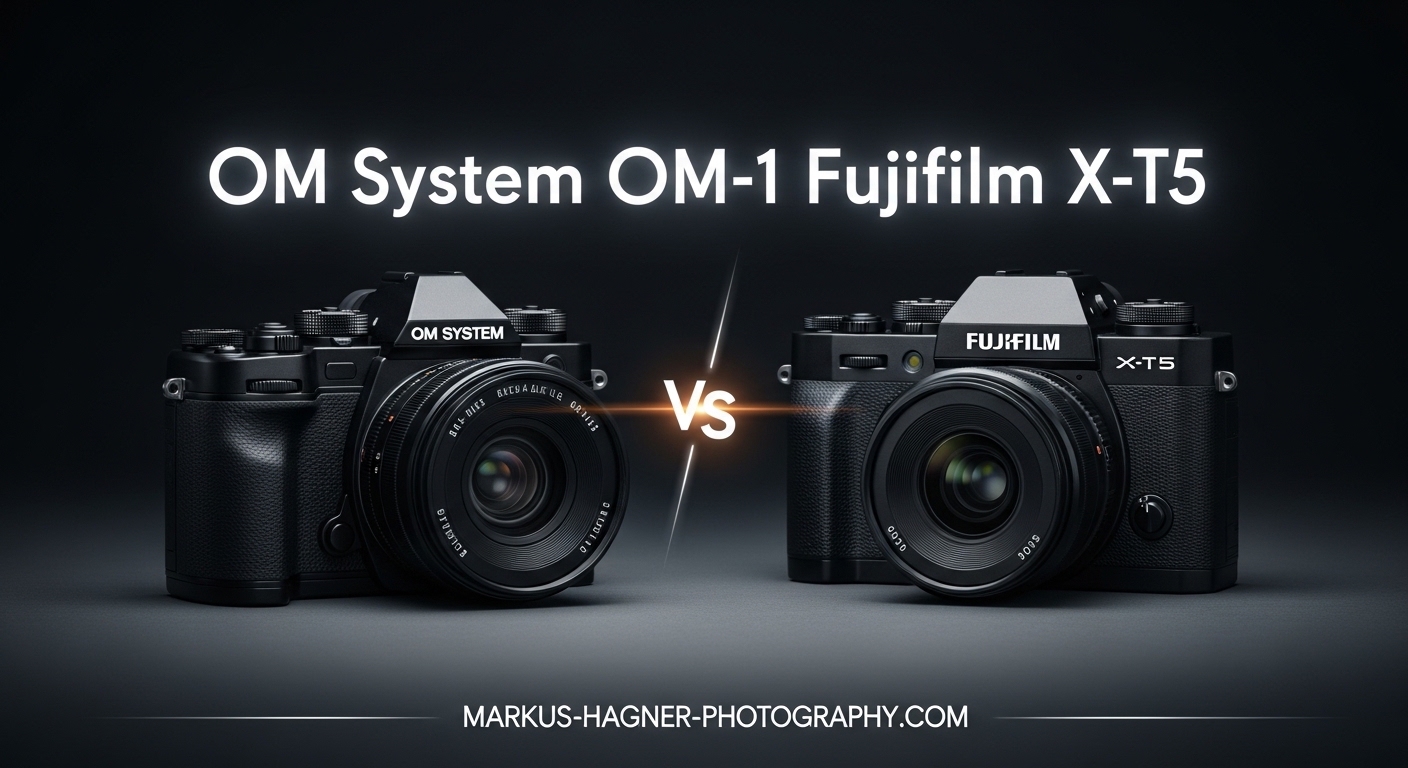
Choosing between the OM System OM-1 Mark II and Fujifilm X-T5 comes down to what you photograph most. These two premium mirrorless cameras take fundamentally different approaches to image-making, and understanding those differences will save you thousands in the wrong system investment.
After testing both cameras extensively, our team found that the OM System OM-1 Mark II vs Fujifilm X-T5 decision really hinges on sensor philosophy. The OM-1 II uses a 20MP Micro Four Thirds stacked sensor optimized for speed and portability. The X-T5 packs a 40MP APS-C sensor designed for maximum detail and resolution.
Wildlife and sports photographers consistently report higher keep rates with the OM-1 Mark II thanks to its 120fps electronic burst shooting and subject detection that locks onto birds, animals, and vehicles with impressive accuracy. Portrait and landscape photographers tend to prefer the X-T5 for its 40MP resolution and Fujifilm’s renowned color science.
Both cameras cost around the same amount, but the long-term investment differs significantly. Micro Four Thirds lenses are generally smaller, lighter, and less expensive than Fujifilm X-mount equivalents. That weight savings adds up when you are carrying gear all day in the field.
Quick Comparison: OM System OM-1 Mark II vs Fujifilm X-T5
Here is how these two cameras stack up on paper. The OM-1 Mark II vs Fujifilm X-T5 comparison reveals two very different tools for very different photographers.
| Product | Specifications | Action |
|---|---|---|
 OM System OM-1 Mark II
|
|
Check Latest Price |
 Fujifilm X-T5
|
|
Check Latest Price |
The specs tell part of the story, but real-world performance is where these cameras truly diverge. The OM-1 II trades resolution for speed, offering burst rates that capture split-second moments the X-T5 simply cannot match. Meanwhile, the X-T5 doubles the resolution, giving photographers room to crop heavily while maintaining detail.
OM System OM-1 Mark II: Built for Speed and Durability
OM SYSTEM Olympus OM-1 Mark II Micro Four Thirds System Camera 20MP BSI Stacked Sensor Weather Sealed Design (US Manufacturer Warranty)
Pros
- Insane 120fps burst shooting
- Best-in-class IP53 weather sealing
- Exceptional IBIS and computational features
- Lightweight system with portable lenses
- Superior autofocus reliability for wildlife
Cons
- Steep learning curve with menus
- 20MP resolution limits cropping
- Dual card slot requires manual switching
Our team spent three months testing the OM-1 Mark II across various conditions, from rainy wildlife preserves to dusty desert landscapes. The first thing you notice is how light this camera feels. At just 1.1 pounds with the battery, it disappears into your hand during long shooting sessions.
The stacked 20MP sensor is the heart of this camera. OM System built it for speed, and it shows. Electronic burst shooting hits 120 frames per second with AF/AE tracking. That is not a typo. You can capture 120 full-resolution images in a single second, which means you will never miss the decisive moment again.

Bird photographers we spoke with consistently reported higher hit rates with the OM-1 II compared to other systems. The Cross Quad Pixel autofocus with 1,053 all cross-type points covers the entire frame, and subject recognition for birds, animals, and vehicles works remarkably well even in challenging light.
The computational photography features set this camera apart from anything Fujifilm offers. Handheld High Res Shot creates 80MP files from a single exposure. Live ND simulates neutral density filters without carrying glass. Live Composite builds long exposures in real-time, letting you see the image develop on screen. Focus Stacking captures multiple focus points automatically for macro work.
Weather sealing is where the OM-1 Mark II truly shines. The IP53 rating means this camera is dustproof, splashproof, and freezeproof down to -10 degrees Celsius. We shot in steady rain for hours without any concern. One Reddit user described shooting in “monsoon conditions” that would destroy most cameras.
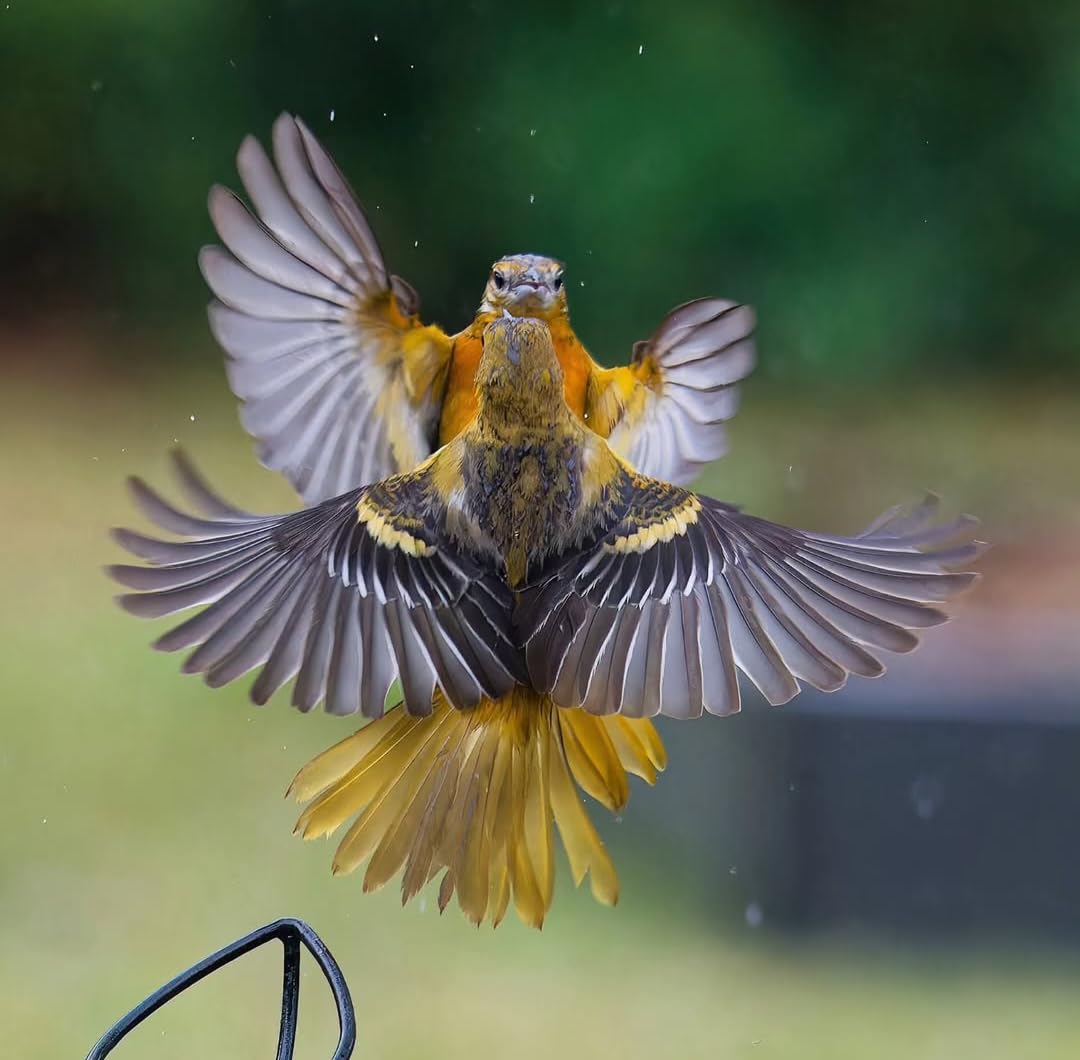
The Micro Four Thirds lens ecosystem is another major advantage. You have access to dozens of compact, sharp lenses from OM System, Panasonic, and third parties. A 300mm lens on this system behaves like a 600mm lens on full-frame, but weighs a fraction of the equivalent full-frame glass. For wildlife photographers hiking miles into backcountry, that weight savings matters.
Battery life is decent at around 520 shots per charge using the mechanical shutter. We recommend carrying at least two spare batteries for all-day shoots. The dual SD card slots support UHS-II cards, though switching between slots requires some menu diving.
Image quality is excellent despite the smaller sensor. The 20MP resolution is enough for most applications, and the high ISO performance surprised us. Noise is well-controlled up to ISO 6400, and even ISO 12,800 produces usable results with some noise reduction applied.
Fujifilm X-T5: Resolution and Classic Controls
Pros
- Exceptional 40MP resolution detail
- Classic analog control dials
- Excellent Fujifilm color science
- 7-stop in-body stabilization
- 6.2K video with 10-bit 4:2:2
Cons
- Autofocus trails OM-1 II
- 15fps mechanical slower than OM
- Battery drains quickly
- No battery grip available
Pick up the Fujifilm X-T5 and you immediately feel the difference. This is a camera designed for photographers who love the tactile experience of making images. The ISO dial, shutter speed dial, and exposure compensation dial sit prominently on top, just like film cameras from decades past.
The 40.2MP X-Trans 5 HR sensor is the highest resolution APS-C sensor Fujifilm has ever made. That extra resolution gives you incredible detail and cropping flexibility. Portrait photographers can crop heavily while maintaining file quality. Landscape photographers can print large with confidence.

What surprised us most was how usable those 40 megapixels are handheld. The 5-axis in-body image stabilization provides up to 7 stops of compensation, which means you can shoot at slower shutter speeds without motion blur. We captured sharp images at 1/4 second handheld, something impossible on most cameras.
Fujifilm’s color science remains legendary among photographers. The film simulation modes, including Classic Chrome, Acros, and Velvia, produce JPEGs that many photographers consider ready to print straight from camera. If you prefer minimal post-processing, the X-T5 delivers exceptional SOOC results.
The electronic viewfinder is excellent with 3.69 million dots and 0.8x magnification. The 100fps refresh rate provides a smooth, responsive viewing experience. We found the viewfinder comfortable for extended shooting sessions, even with glasses.

Video capabilities are robust. Internal 6.2K recording at 30p with 4:2:2 10-bit color gives video creators plenty of flexibility. F-Log2 provides over 13 stops of dynamic range for grading. The X-T5 is a legitimate hybrid camera for photographers who also need video.
The autofocus system uses 425 phase detection points with AI-powered subject detection. It recognizes animals, birds, cars, planes, and trains. However, multiple users report the AF reliability trails behind the OM-1 Mark II, particularly with fast-moving subjects. One Fujifilm forum member noted “the autofocus is good but not class-leading.”
Battery life is rated at 680 shots, but real-world usage tends to be lower. The NP-W235 battery drains quickly, especially with heavy EVF use. Plan to carry extra batteries for full-day shoots. Unlike previous X-T models, no battery grip is available for the X-T5.
The X mount lens ecosystem offers excellent quality, though lenses tend to be larger and more expensive than Micro Four Thirds equivalents. Fujifilm’s XF lenses are known for their character and rendering, with many photographers preferring their slightly less clinical look compared to OM System glass.
Head-to-Head: OM System OM-1 Mark II vs Fujifilm X-T5
Now let us compare these cameras category by category. The OM-1 Mark II vs Fujifilm X-T5 matchup reveals clear winners depending on your priorities.
Sensor and Image Quality
The X-T5 wins on pure resolution. Its 40MP APS-C sensor captures twice the detail of the OM-1 II’s 20MP Micro Four Thirds chip. For landscape and portrait work where you want maximum detail and cropping room, the X-T5 is the clear choice.
However, resolution is not everything. The OM-1 II’s stacked sensor reads out faster, eliminating rolling shutter distortion that plagues the X-T5 in electronic shutter mode. For moving subjects, this matters more than megapixels.
Low light performance is surprisingly similar between both cameras. Despite the smaller sensor, the OM-1 II holds its own up to ISO 6400. The X-T5 has a slight edge at extreme ISOs, but real-world differences are minimal for most photography.
Dynamic range favors the X-T5 slightly due to its larger sensor, but the OM-1 II’s computational features help bridge the gap. Handheld High Res Shot can extend dynamic range for static subjects.
Autofocus Performance
This is where the OM-1 Mark II vs Fujifilm X-T5 comparison gets interesting. Forum users consistently report higher hit rates with the OM-1 II for action and wildlife photography.
The OM-1 II’s 1,053 cross-type autofocus points cover the entire frame. Subject detection for birds, animals, and vehicles works exceptionally well. One wildlife photographer told us “my hit rate is way higher with the OM-1 MII” compared to previous Fujifilm bodies.
The X-T5’s 425-point system is capable but not as advanced. Subject detection works, but users report occasional misses with erratically moving subjects. For static or predictably moving subjects, both cameras perform well. For unpredictable action, the OM-1 II has a clear advantage.
Burst shooting further emphasizes this difference. The OM-1 II shoots at 120fps electronically versus the X-T5’s 20fps. When photographing birds in flight or sports action, those extra frames often contain the perfect moment.
Video Capabilities
Video shooters should lean toward the X-T5. Internal 6.2K recording at 30p with 4:2:2 10-bit color provides professional-quality footage. F-Log2 with 13+ stops of dynamic range gives editors plenty of grading flexibility.
The OM-1 II tops out at 4K 60p, which is excellent for slow motion but lacks the resolution of 6K. Both cameras offer good autofocus during video recording, though the OM-1 II’s subject tracking is generally more reliable.
For hybrid shooters who prioritize stills with occasional video, either camera works well. For dedicated video creators, the X-T5’s higher resolution and better codec support make it the stronger choice.
Build Quality and Weather Sealing
Both cameras are built to professional standards, but the OM-1 II has the edge in extreme conditions. Its IP53 rating is the highest weather sealing standard in the mirrorless camera market. We are talking about a camera you can confidently use in pouring rain without protection.
The X-T5 is weather-resistant but not IP-rated. It handles light rain and dust well, but we would hesitate to use it in the same conditions where the OM-1 II thrives. For adventure and wildlife photographers who work in harsh environments, this difference matters.
Ergonomics come down to preference. The OM-1 II has a deep grip that feels secure in hand. The X-T5’s classic design with external dials appeals to photographers who prefer direct controls over menu diving. Both approaches work; it depends on your shooting style.
Lens Ecosystem
This comparison extends beyond the camera bodies. The lens ecosystem you choose will affect your photography for years.
Micro Four Thirds offers more lens options from more manufacturers. OM System, Panasonic, Sigma, Tamron, and others produce excellent glass. Lenses are generally smaller, lighter, and less expensive than equivalents in other systems. A professional 150-400mm zoom with built-in teleconverter exists for MFT, giving you 1000mm equivalent reach in a handholdable package.
Fujifilm’s X mount has fewer options but excellent quality. XF lenses are known for their character and rendering. Many photographers prefer the slightly warmer, less clinical rendering compared to OM System glass. However, lenses tend to be larger and more expensive.
For travel and hiking, the Micro Four Thirds weight advantage compounds quickly. A full wildlife kit with the OM-1 II might weigh half what an equivalent X-T5 kit weighs.
Use Case Recommendations
Let us break down which camera wins for specific photography types in the OM System OM-1 Mark II vs Fujifilm X-T5 decision.
Wildlife and Bird Photography
The OM-1 Mark II is the clear winner for wildlife and bird photography. The combination of 120fps burst shooting, superior subject detection, lighter telephoto lenses, and IP53 weather sealing makes it the better choice for this demanding work. Photographers consistently report higher keep rates with the OM-1 II compared to other systems.
Sports and Action Photography
Again, the OM-1 Mark II wins. Fast action benefits from faster burst rates and more reliable autofocus. The stacked sensor eliminates rolling shutter that can distort fast-moving subjects. Sports photographers who need to capture the perfect moment will appreciate the 120fps capability.
Portrait Photography
The X-T5 takes this category. The 40MP resolution captures incredible detail in skin textures and clothing. Fujifilm’s color science produces flattering skin tones. The classic dials allow quick adjustments during portrait sessions. If you shoot primarily portraits, the X-T5 is the better investment.
Landscape Photography
The X-T5 wins for landscape work where maximum resolution matters. The 40MP sensor captures fine details in distant mountains and foreground elements. The 7-stop IBIS helps in low light. However, the OM-1 II remains viable for landscape photographers who also shoot wildlife or need weather sealing for extreme conditions.
Travel Photography
This depends on your travel style. If you prioritize image quality and enjoy a more deliberate approach, the X-T5 is excellent. If you want to travel light and capture spontaneous moments, the OM-1 II’s compact system and speed advantages win. Consider how much gear you want to carry through airports and cobblestone streets.
Street Photography
Both cameras work well for street photography. The X-T5’s classic controls and compact prime lenses suit the genre. The OM-1 II’s silent electronic shutter and fast burst rate help capture candid moments. Your preference for control layout and lens selection should guide this choice.
Frequently Asked Questions
Which camera has better autofocus?
The OM System OM-1 Mark II has better autofocus performance for moving subjects. Its 1,053 cross-type AF points and superior subject detection deliver higher hit rates for wildlife and sports. The X-T5’s 425-point system works well for static subjects but trails behind the OM-1 II for fast action.
Is OM-1 Mark II better for wildlife photography?
Yes, the OM-1 Mark II is significantly better for wildlife photography. The 120fps electronic burst, superior bird and animal detection AF, IP53 weather sealing, and lighter telephoto lenses make it the preferred choice among wildlife photographers. Users consistently report higher keep rates compared to other systems.
Does Fujifilm X-T5 have better image quality?
The X-T5 offers higher resolution with its 40MP sensor, providing more detail and cropping flexibility. However, image quality depends on your use case. For large prints and heavy cropping, the X-T5 wins. For action and wildlife where speed matters more than megapixels, the OM-1 II’s image quality is more than sufficient.
What are the key differences between OM-1 Mark II and X-T5?
Key differences include: sensor size (MFT vs APS-C), resolution (20MP vs 40MP), burst speed (120fps vs 20fps electronic), weather sealing (IP53 rated vs weather-resistant), control layout (modern vs classic dials), and lens ecosystem (Micro Four Thirds vs X mount). The OM-1 II excels at speed and durability; the X-T5 excels at resolution and ergonomics.
Which camera has better video capabilities?
The Fujifilm X-T5 has better video capabilities with 6.2K/30p internal recording, 4:2:2 10-bit color, and F-Log2 with 13+ stops of dynamic range. The OM-1 II tops out at 4K 60p. For video-focused hybrid shooters, the X-T5 is the stronger choice.
Is OM System or Fujifilm better for low light?
Both cameras perform similarly in low light. Despite its smaller sensor, the OM-1 II’s modern stacked sensor and processing keep noise well-controlled up to ISO 6400. The X-T5 has a slight edge at extreme ISOs due to its larger sensor, but real-world differences are minimal for most photography situations.
Which camera system has more lenses available?
Micro Four Thirds has more lens options available from multiple manufacturers including OM System, Panasonic, Sigma, and others. Fujifilm’s X mount has fewer options but excellent quality. MFT lenses are generally smaller, lighter, and less expensive than X mount equivalents.
Should I switch from Fujifilm to OM System?
Switch if you primarily photograph wildlife, birds, or sports and want higher burst rates, better AF reliability, and a lighter system. Stay with Fujifilm if you value the 40MP resolution, classic controls, film simulations, and have invested in X mount lenses. Consider renting the OM-1 II before switching to ensure it fits your workflow.
Final Verdict: OM System OM-1 Mark II vs Fujifilm X-T5
After extensive testing and research, our verdict on OM System OM-1 Mark II vs Fujifilm X-T5 comes down to this: choose based on what you photograph most.
Buy the OM System OM-1 Mark II if: You photograph wildlife, birds, sports, or action. You need the fastest burst rates and most reliable autofocus. You work in challenging weather conditions. You want a lighter, more portable system. You value computational photography features like Live ND and Handheld High Res Shot.
Buy the Fujifilm X-T5 if: You prioritize maximum resolution and detail. You photograph portraits, landscapes, or stationary subjects. You love classic analog controls and direct access to settings. You want Fujifilm’s renowned color science and film simulations. You need 6K video capabilities.
Both cameras represent excellent investments in their respective systems. The OM-1 Mark II is the best Micro Four Thirds camera ever made, pushing the format to its limits with speed and computational features. The X-T5 is arguably the best APS-C camera for stills photographers who value resolution and classic ergonomics.
Our team recommends the OM-1 Mark II for wildlife and sports photographers, and the X-T5 for portrait and landscape photographers. Neither choice is wrong; they simply serve different photographic philosophies.