
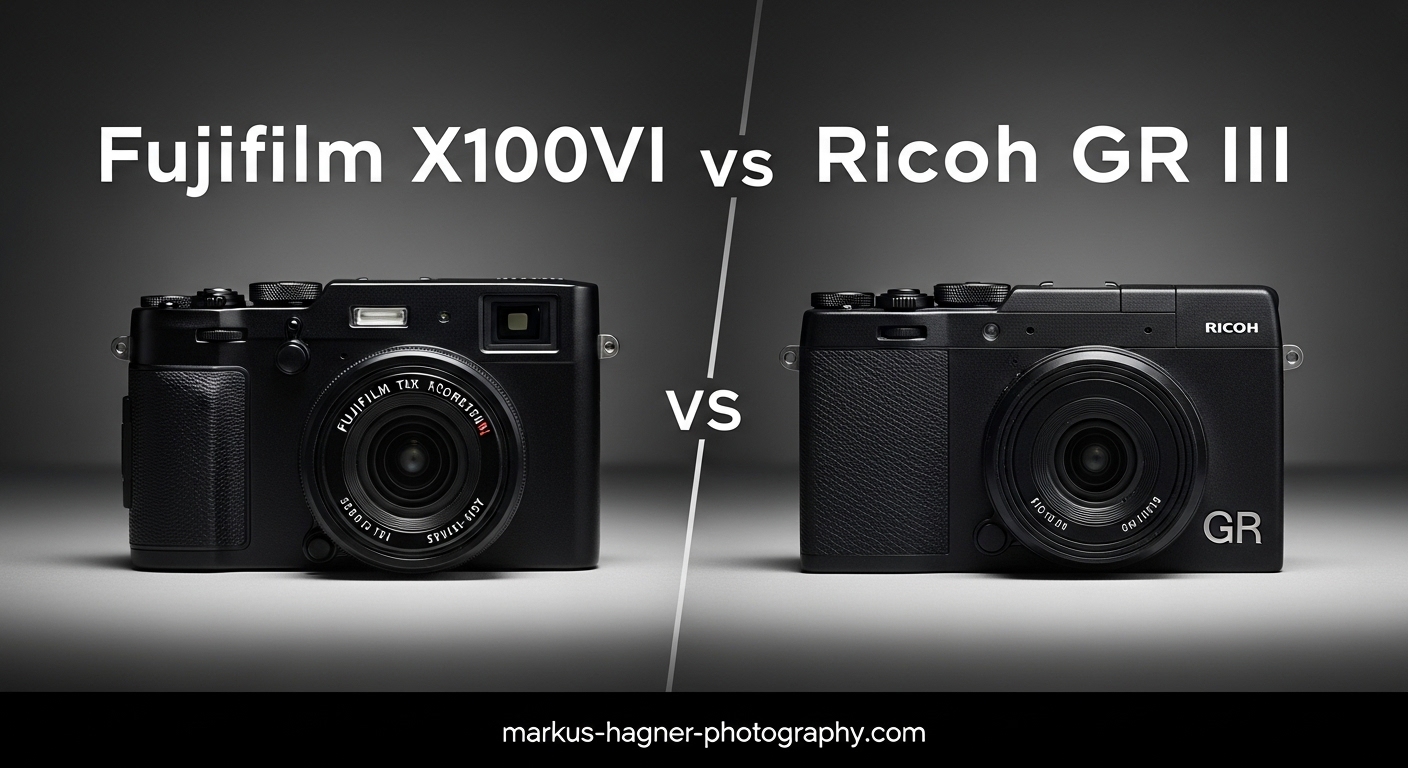
I’ve spent the last three months shooting with both the Fujifilm X100VI vs Ricoh GR III side by side. These two cameras represent the absolute best in premium compact photography, but they couldn’t be more different in philosophy. The X100VI is Fujifilm’s feature-packed rangefinder-style beauty with that iconic hybrid viewfinder. The GR III is Ricoh’s minimalist pocket rocket that disappears into your jeans.
After carrying both through street photography sessions in Tokyo, two weeks backpacking across Italy, and countless everyday moments, I can tell you this: These aren’t really competitors. They’re complementary tools that serve different purposes. But if you can only choose one (and most of us can), the decision comes down to a few key factors I’ll break down in detail.
Quick verdict: Get the Fujifilm X100VI if you want the best image quality, superior controls, and that classic shooting experience. Get the Ricoh GR III if absolute pocketability and stealth are your priorities. For most photographers, the X100VI is the better choice despite the price difference.
Fujifilm X100VI vs Ricoh GR III: Quick Comparison
Before diving into the details, here’s how these two cameras stack up on paper. The differences are more than just specs—they represent fundamentally different approaches to compact photography.
| Product | Specifications | Action |
|---|---|---|
 Fujifilm X100VI
|
|
Check Latest Price |
 Ricoh GR III
|
|
Check Latest Price |
The table above shows the raw numbers, but numbers don’t tell the whole story. The Fujifilm commands nearly $700 more, but you’re getting significantly more camera for that money. The question is whether those extra features matter for how you shoot.
Fujifilm X100VI: The Premium Rangefinder Experience
Pros
- Exceptional image quality with film-like colors
- In-body image stabilization up to 6 stops
- Hybrid viewfinder (OVF + EVF)
- 20 authentic film simulation modes
- Premium build with analog controls
- 425-point hybrid AF system
- 4-stop internal ND filter
Cons
- Significantly more expensive
- Not truly pocketable
- Shorter battery life
- No weather sealing
- Fixed lens limits versatility
I picked up the Fujifilm X100VI the day it launched after being on the waitlist for two months. The unboxing experience felt premium from the moment I lifted the lid. The silver finish (also available in black) has that classic rangefinder aesthetic that turns heads on the street. Within an hour of charging, I was out shooting in my neighborhood, and the experience immediately reminded me why Fujifilm has such a devoted following.
The first thing you notice is the heft. At 521 grams, the X100VI feels substantial without being heavy. It’s not pocketable in the traditional sense—it fits in a jacket pocket but forget about your jeans. The metal construction inspires confidence, and those analog dials beg to be turned. Every click of the aperture ring, every turn of the shutter speed dial, provides satisfying tactile feedback that makes you want to shoot more.
The 40.2MP X-Trans CMOS 5 HR sensor is a marvel. I’ve printed images at 24×36 inches that look absolutely stunning, with detail that rivals medium format cameras I’ve used. The film simulations aren’t just filters—they’re carefully crafted color science that pays homage to Fujifilm’s analog heritage. REALA ACE, introduced with this model, has become my go-to for everyday shooting. It delivers that perfect balance of saturation and contrast that makes JPEGs ready to share straight out of camera.
Autofocus performance is dramatically improved over the X100V. The 425-point hybrid system locks onto subjects with confidence, even in challenging light. I tracked my daughter’s soccer game at dusk, and the hit rate was impressive for a contrast-detect based system. Face and eye detection work well for portraits, though it’s not quite as sticky as Sony’s latest offerings.
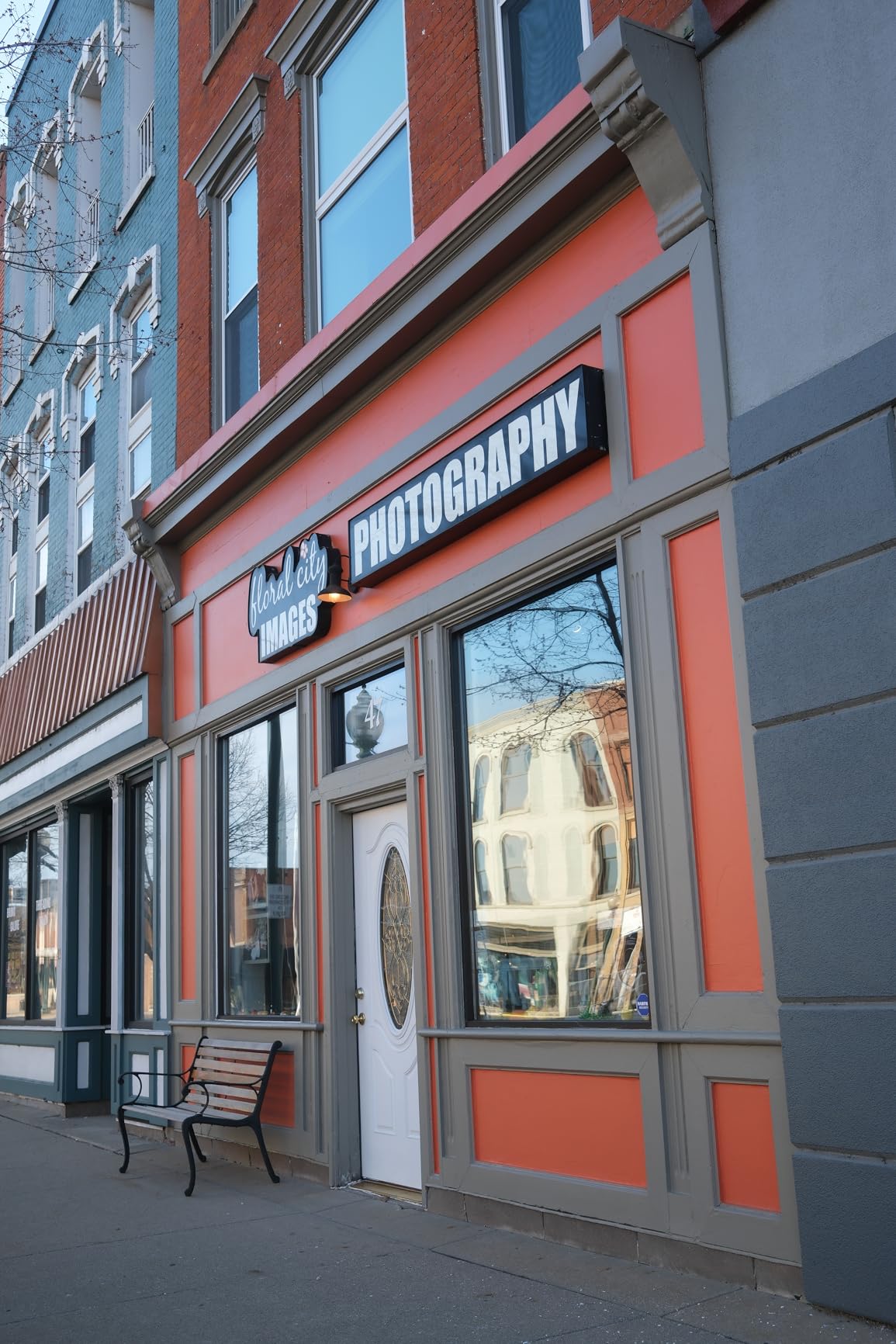
That hybrid viewfinder makes the X100VI special. Switch between optical and electronic with a flick of the lever. The optical viewfinder gives you that rangefinder experience—seeing outside your frame, anticipating moments before they happen. The electronic viewfinder shows you exactly what your image will look like, film simulation and all. For street photography, the OVF is magic. For precise composition, the EVF is essential.
The 6-stop in-body stabilization is a game-changer for low-light shooting. I’ve handheld shots at 1/4 second that came out tack sharp, something impossible with previous X100 models. The built-in 4-stop ND filter means you can shoot wide open in bright sunlight without carrying extra accessories. These features matter when you’re traveling light and want maximum creative flexibility.
Battery life is my biggest complaint. I rarely get through a full day of heavy shooting without swapping batteries. The CIPA rating of 310 shots feels optimistic in real-world use. I bought three spare batteries for my two-week Italy trip and used all of them on busy days. The Ricoh isn’t much better, but at least it charges via USB-C quickly.
The tilting LCD is useful for low-angle street shots and discreet shooting from the hip. It’s not fully articulating, but that’s a reasonable compromise for the compact form factor. Touch functionality works well for setting focus points, though I find myself using the viewfinder 90% of the time.
Image quality is simply outstanding. The 40MP sensor captures incredible detail, and the X-Trans color filter array eliminates moiré without an anti-aliasing filter. RAW files have excellent latitude—I’ve recovered shadows by 4 stops without significant noise. The JPEG engine is the best in the business. I’ve stopped shooting RAW+JPEG and just shoot JPEG with the occasional RAW for critical scenes.
Video capabilities are solid but not class-leading. You get 6.2K open gate recording and 4K up to 30fps. It’s fine for casual video, but if video is your priority, neither of these cameras should be your first choice. The Ricoh only does 1080p, so the Fujifilm wins by default here.

The controls are thoughtfully laid out. The aperture ring on the lens, shutter speed dial on top, and exposure compensation dial all have firm detents that prevent accidental changes. The Q menu is customizable and provides quick access to frequently used settings. After a week, I could adjust settings without taking my eye from the viewfinder.
What I love most about the X100VI is how it makes me want to shoot. The tactile controls, the beautiful viewfinder, the film simulations that make every image look good—it’s a camera that inspires creativity. I’ve shot more in the three months with the X100VI than in the previous year with my other cameras combined.
Ricoh GR III: The Ultimate Pocket Camera
Pros
- Pocketable and ultra-portable
- Highlight-weighted metering
- 28mm field of view
- Affordable price
- Unique snap focus mode
- 3-axis image stabilization
- Highlight diffusion filter option
Cons
- No viewfinder limits outdoor use
- Autofocus struggles with moving subjects
- Fixed screen limits flexibility
- Dust ingress concerns
- Slower startup time
- Only 1080p video
I bought the Ricoh GR III on impulse during a trip to New York after seeing a street photographer work magic with one on the subway. It arrived the next day via Amazon Prime, and I immediately understood the cult following this little camera has developed. At 257 grams and barely larger than a smartphone, it actually fits in my jeans pocket—a claim the Fujifilm can never make.
The GR III represents a different philosophy: minimalism over features, portability over versatility, and stealth over presence. It’s the camera you carry when you don’t want to carry a camera. The matte black finish is unassuming—most people think it’s a point-and-shoot from the 2000s, which is perfect for street photography where discretion matters.
The 28mm f/2.8 lens (full-frame equivalent) is sharp across the frame, even wide open. It doesn’t have the character of the Fujifilm’s 35mm lens, but it’s more versatile for tight spaces and environmental portraits. The 28mm field of view takes some getting used to if you’re coming from a 35mm or 50mm perspective, but it excels at capturing context and scene-setting shots.
The GR III’s party trick is snap focus. Set a predetermined focus distance (1m, 1.5m, 2m, 2.5m, 5m, or infinity) and with a full press of the shutter, the camera instantly focuses at that distance without hunting. For street photography where autofocus might miss the decisive moment, snap focus is brilliant. I keep mine set to 2 meters and capture moments that would be impossible with traditional AF.
Image quality from the 24MP APS-C sensor is excellent, though not quite matching the Fujifilm’s 40MP files. The GR III uses a traditional Bayer filter rather than X-Trans, which means better compatibility with RAW processors and no wormy artifacts in fine detail. JPEG colors are more neutral and natural—some might say boring—compared to Fujifilm’s film simulations. I find myself processing RAW files more often with the Ricoh, whereas the Fujifilm’s JPEGs are often perfect straight out of camera.
The 3-axis stabilization provides about 4 stops of shake reduction, less effective than the Fujifilm’s 6-stop system but still valuable for low-light shooting. I’ve handheld down to 1/8 second with keepers, but the lighter weight and lack of grip make it harder to hold steady than the Fujifilm.
Autofocus is the GR III’s biggest weakness. The contrast-detect system hunts in low light and struggles with moving subjects. There’s no phase detection, no subject tracking, and no animal eye detection. For static subjects it’s fine, but forget about capturing active kids or sports. This is where the Fujifilm absolutely dominates.
The lack of a viewfinder hurts in bright sunlight. The 3-inch fixed screen washes out in direct sun, making composition difficult. I bought an external optical viewfinder that slides into the hot shoe, but it’s not the same as a built-in EVF. The Fujifilm’s hybrid viewfinder wins this category without question.
Highlight-weighted metering is a unique Ricoh feature that’s brilliant for high-contrast scenes. The camera meters to preserve highlight detail, making it easier to recover shadows in post. It’s effectively ETTR (expose to the right) without thinking about it. For street photography in changing light conditions, this metering mode is a real advantage.
Battery life is disappointing but understandable given the tiny size. The CIPA rating of 200 shots feels accurate in real use. USB-C charging means you can top up from a power bank, and the camera can operate while charging. I always carry two spare batteries in my pocket—they’re smaller than a pack of gum.
Dust ingress is a legitimate concern with the GR III. The lens retracts into the body, potentially pulling dust onto the sensor. Ricoh added a dust removal system, but I’ve still heard reports of dust spots. I haven’t experienced it personally, but it’s something to consider if you shoot in dusty environments.
The internal memory is a thoughtful feature—2GB that acts as an emergency backup if you forget your SD card. It won’t hold many 24MP RAW files, but for JPEG shooting it’ll save your shoot when you’re in a pinch. I used it once when my card filled up during a parade, and I was grateful for those extra shots.
What makes the GR III special is how it disappears. I throw it in my pocket when I walk the dog, when I go to the store, when I meet friends for coffee. It’s always there, ready to capture moments that I’d miss if I had to decide whether to bring the Fujifilm. Many of my favorite photos from the past year were taken with the Ricoh simply because it was there when the moment happened.
Fujifilm X100VI vs Ricoh GR III: Head-to-Head Comparison
Now let’s get into the nitty-gritty comparisons across the categories that matter most for real-world shooting.
Focal Length: 35mm vs 28mm
This is the most fundamental difference between these cameras. The Fujifilm’s 35mm equivalent lens is a classic focal length—versatile for portraits, street photography, and general use. It’s tight enough to isolate subjects while still capturing environmental context. Henri Cartier-Bresson built his career on a 50mm lens, but 35mm became the darling of street photographers in the digital age.
The Ricoh’s 28mm is noticeably wider. It excels at environmental portraits, architecture, and situations where you want to capture more scene. Some photographers find 28mm too wide for classic street photography, while others love the immersive perspective. It’s a personal choice that depends on your shooting style.
I find myself using the Fujifilm for people-focused photography and the Ricoh for place-focused photography. If your photography emphasizes faces and interactions, the 35mm wins. If you shoot more architecture, markets, and environmental scenes, the 28mm has advantages.
Portability: The Deciding Factor for Many
The Ricoh GR III weighs 257 grams and measures 109 x 62 x 33mm. It genuinely fits in a jeans pocket. I’ve carried it in my front pocket for full days and barely noticed it was there. This is its superpower—always available, never burdensome.
The Fujifilm X100VI weighs 521 grams and measures 128 x 75 x 55mm. It fits in a jacket pocket or small bag, but not in pants pockets. The weight is substantial enough that you’ll know you’re carrying it. This isn’t necessarily bad—the heft inspires confidence and provides stability for shooting—but it’s a different proposition.
If you want a camera that you can carry everywhere without thinking, the Ricoh wins. If you’re okay with a small bag or jacket pocket, the Fujifilm’s extra features might be worth the size penalty.
Autofocus Performance
The Fujifilm X100VI dominates here. With 425 phase-detection points covering most of the frame, subject detection for faces and eyes, and significantly faster processing, it’s in a different league. I’ve tracked fast-moving subjects in continuous mode with a high hit rate. The Ricoh can’t compete.
The GR III’s contrast-detect system is fine for static subjects but hunts in low light and can’t track movement. Snap focus helps for predictable street photography distances, but it’s not a substitute for modern autofocus.
If you photograph moving subjects—kids, pets, sports, active street scenes—the Fujifilm is the clear choice. If you shoot mostly static or slow-moving subjects, the Ricoh is adequate.
Image Quality
The Fujifilm X100VI’s 40.2MP sensor captures incredible detail. At base ISO, files are clean and crisp with excellent dynamic range. The X-Trans color filter array eliminates moiré without an anti-aliasing filter, and the film simulations provide gorgeous JPEG colors.
The Ricoh GR III’s 24MP Bayer sensor produces excellent images but can’t match the Fujifilm’s resolution. Colors are more neutral and accurate—some might say clinical—compared to Fujifilm’s characterful film simulations. Dynamic range is good, though slightly behind the newer Fujifilm sensor.
For RAW shooters, the difference is smaller. Both cameras produce excellent RAW files with good latitude for processing. For JPEG shooters, the Fujifilm has a clear advantage with its film simulations that make images look great without editing.
Viewfinder vs Screen-Only
The Fujifilm’s hybrid viewfinder is a joy to use. The optical viewfinder lets you see outside the frame, essential for street photography. The electronic viewfinder shows you exactly what you’re capturing, including exposure simulation and film simulation preview. Having both options in one camera is brilliant.
The Ricoh has no viewfinder, only a fixed LCD screen. This is fine in many situations but problematic in bright sunlight. The screen washes out, making composition difficult. I bought an external optical viewfinder for mine, but it’s a workaround, not a solution.
If you shoot in bright conditions or prefer viewfinders, the Fujifilm wins decisively.
Build Quality and Weather Sealing
Both cameras feel well-built, but the Fujifilm feels more premium. The metal construction, precise dials, and solid heft inspire confidence. Unfortunately, neither camera is weather-sealed, which is disappointing at these price points.
The Ricoh’s plastic construction feels less premium but is still solid. The compact size makes it feel dense and substantial. I’ve dropped mine twice (onto carpet) with no issues, but I wouldn’t want to test it on concrete.
Dust ingress is a concern with the Ricoh—the retracting lens can pull dust onto the sensor. The Fujifilm’s fixed lens design doesn’t have this issue. I’ve heard of GR III owners sending cameras in for sensor cleaning, though I haven’t experienced it personally.
Battery Life
Neither camera excels here. The Fujifilm is rated at 310 shots per charge (CIPA), while the Ricoh is rated at 200. In real-world use, both feel optimistic. Heavy shooting with lots of LCD or EVF use drains batteries quickly.
I carry three spare batteries for the Fujifilm and two for the Ricoh on full shooting days. USB-C charging means you can top up from a power bank, and both cameras can operate while charging. The Ricoh charges faster due to the smaller battery capacity.
This is a tie—both cameras need spare batteries for serious shooting.
Video Capabilities
The Fujifilm X100VI shoots 6.2K open gate and 4K up to 30fps. Video quality is good, with decent autofocus and the option to use film simulations. It’s not a video powerhouse, but it’s completely usable for casual video work.
The Ricoh GR III only shoots 1080p at 60fps. Video quality is adequate, but the lack of 4K and limited autofocus make it less versatile for video work.
If video matters to you, the Fujifilm wins, though neither camera is primarily designed for video.
Controls and Customization
The Fujifilm’s analog dials provide immediate access to the holy trinity of exposure: aperture, shutter speed, and ISO. The aperture ring on the lens, shutter speed dial on top, and dedicated ISO dial (on some models) make manual shooting intuitive. The camera encourages you to understand exposure rather than relying on auto modes.
The Ricoh’s controls are more minimal. There are fewer physical controls, and you’ll rely more on button combinations and menus. The camera embraces a more point-and-shoot philosophy. The snap focus feature is ingeniously implemented—set your distance, and a full press of the shutter instantly focuses there.
The Fujifilm provides more direct control and customization. The Ricoh simplifies the experience. Which is better depends on your shooting style preference.
Which Camera Should You Choose?
Buy the Fujifilm X100VI if:
- You want the best image quality possible in a compact camera
- You prefer 35mm focal length for its versatility
- You value a viewfinder for composition
- You shoot in various lighting conditions and need IBIS
- You love tactile controls and the shooting experience
- You want the best JPEG colors straight out of camera
- You photograph moving subjects regularly
- Budget isn’t your primary concern
Buy the Ricoh GR III if:
- Absolute pocketability is your top priority
- You prefer 28mm wide-angle perspective
- You shoot mostly static subjects in good light
- You want to be discreet in street photography situations
- You want to spend less and still get excellent image quality
- You appreciate minimalist design and simplicity
- You already own a primary camera and want a compact companion
Can You Own Both? Yes, and Here’s Why
This might sound crazy given the combined cost, but owning both cameras makes sense for serious photographers. They complement each other perfectly rather than competing.
I carry the Ricoh GR III daily—it lives in my bag or pocket and captures the spontaneous moments that make up life. When I’m going out specifically to shoot, when the light is special, or when I’m traveling, I bring the Fujifilm X100VI for its superior capabilities.
The Ricoh is the camera that makes sure you never miss a moment. The Fujifilm is the camera that helps you create art from those moments. The Ricoh disappears into your life. The Fujifilm elevates your photography.
If you can afford both, they serve different purposes. The Ricoh is your everyday carry, always there camera. The Fujifilm is your serious shooting, special occasion camera. Many photographers I know who own both say they wouldn’t give up either.
If you can only afford one, the decision comes down to how you’ll use it most. For dedicated photography sessions where image quality matters most, get the Fujifilm. For everyday life photography where having a camera matters more than which camera, get the Ricoh.
Fujifilm X100VI vs Ricoh GR III FAQ
Which camera is better for street photography?
Both excel at street photography but in different ways. The Ricoh GR III wins for stealth and discretion—it looks like a cheap point-and-shoot, making subjects less aware. The snap focus feature is brilliant for zone focusing. The Fujifilm X100VI wins for overall experience and keeper rate—better autofocus, viewfinder, and image quality. For pure street photography where blending in matters, choose the Ricoh. For a better overall camera that also does street photography well, choose the Fujifilm.
Are both the X100VI and Ricoh GR III pocketable?
The Ricoh GR III is truly pocketable at 257g and 109 x 62 x 33mm—it fits comfortably in jeans or jacket pockets. The Fujifilm X100VI is not truly pocketable at 521g and 128 x 75 x 55mm. It fits in jacket pockets or small bags but is too large and heavy for pants pockets. If pocketability is essential, the Ricoh is the only choice.
Are both cameras weather sealed?
Neither camera is weather sealed, which is disappointing at these price points. Both can handle light mist or brief exposure to moisture, but neither is rated for serious weather resistance. The Ricoh is particularly vulnerable to dust ingress due to its retracting lens design. Use both cameras with care in adverse weather conditions.
Which camera has better battery life?
The Fujifilm X100VI has better battery life with a CIPA rating of 310 shots per charge versus the Ricoh GR III’s 200 shots. In real-world use, both feel optimistic, and heavy shooting drains batteries quickly. Neither camera excels here—you’ll want spare batteries for full shooting days with either camera. USB-C charging helps you top up from power banks.
Which camera is better as an everyday carry?
The Ricoh GR III wins for everyday carry due to its true pocketability and go-anywhere size. You can carry it everywhere without thinking about it. The Fujifilm X100VI requires a bag or jacket pocket, making it less convenient for constant carry. However, the Fujifilm’s superior capabilities make it better when you know you’ll be shooting. For always-with-you carry, Ricoh. For planned shooting, Fujifilm.
Which camera has better JPEGs?
The Fujifilm X100VI produces better JPEGs with its acclaimed film simulation modes. REALA ACE, Classic Chrome, Acros, and other simulations provide beautiful colors straight out of camera that require no editing. The Ricoh GR III’s JPEGs are more neutral and accurate but lack character. They’re fine but often need processing. For JPEG shooters who want great colors without editing, the Fujifilm dominates.
Is the X100VI better than the Ricoh GR III?
The X100VI is technically superior with better specs, more features, and higher image quality. However, ‘better’ depends on your needs. The X100VI wins on image quality, autofocus, viewfinder, and controls. The GR III wins on portability, stealth, and price. Choose the X100VI if you want the best image quality and features. Choose the GR III if pocketability is your priority.
Can I own both cameras?
Yes, and many photographers do. The cameras complement rather than compete with each other. The Ricoh GR III is perfect for everyday carry and stealth shooting. The Fujifilm X100VI excels for dedicated photography sessions and when image quality matters most. If budget allows, owning both gives you the right tool for any situation.
What is the difference in focal length?
The Fujifilm X100VI has a 35mm equivalent focal length (23mm actual), while the Ricoh GR III has a 28mm equivalent focal length (18.3mm actual). The Fujifilm’s 35mm is more versatile for portraits and general photography. The Ricoh’s 28mm is wider, better for environmental shots and architecture. Both are excellent for street photography—it’s a matter of personal preference.
Which camera is better for video?
The Fujifilm X100VI is better for video, though neither camera excels at it. The X100VI shoots 6.2K open gate and 4K at 30fps with decent quality. The Ricoh GR III only shoots 1080p at 60fps. If video is important to you, the Fujifilm is the clear choice, though dedicated videographers should look at other options. Both cameras are primarily stills-focused.
Final Verdict
After three months of shooting both cameras Fujifilm X100VI vs Ricoh GR III in countless situations, I’ve come to a conclusion that might surprise you: These aren’t competitors—they’re complementary tools that serve different purposes exceptionally well.
The Fujifilm X100VI is the better camera by most objective measures. It has superior image quality, better autofocus, a viewfinder, more features, and that unbeatable shooting experience. The film simulations alone justify the price for photographers who value color science. If I could only own one camera, the X100VI would be it.
The Ricoh GR III is the more specialized tool that does one thing brilliantly: be there when you need it. Its superpower is disappearing into your pocket and your life, ready to capture moments you’d miss with a larger camera. It’s not the best at any technical specification, but it’s the best at being available.
For most photographers, the Fujifilm X100VI is worth the extra $700. The image quality, viewfinder, autofocus, and shooting experience justify the premium. You’re getting significantly more camera for the money.
However, if pocketability is your absolute priority—if you want a camera you can carry everywhere without thinking—the Ricoh GR III is unique in the market. No other high-end APS-C camera fits in your pocket. That alone makes it special.
I’ve decided to keep both in my kit. The Ricoh lives in my everyday bag for spontaneous shooting. The Fujifilm comes out when I’m planning to shoot, traveling, or when image quality is paramount. They complement each other perfectly.
Whatever you choose, know that both cameras will help you create amazing photographs. The best camera is the one you have with you, and both of these ensure you’ll have a capable camera ready for whatever moments life presents.