
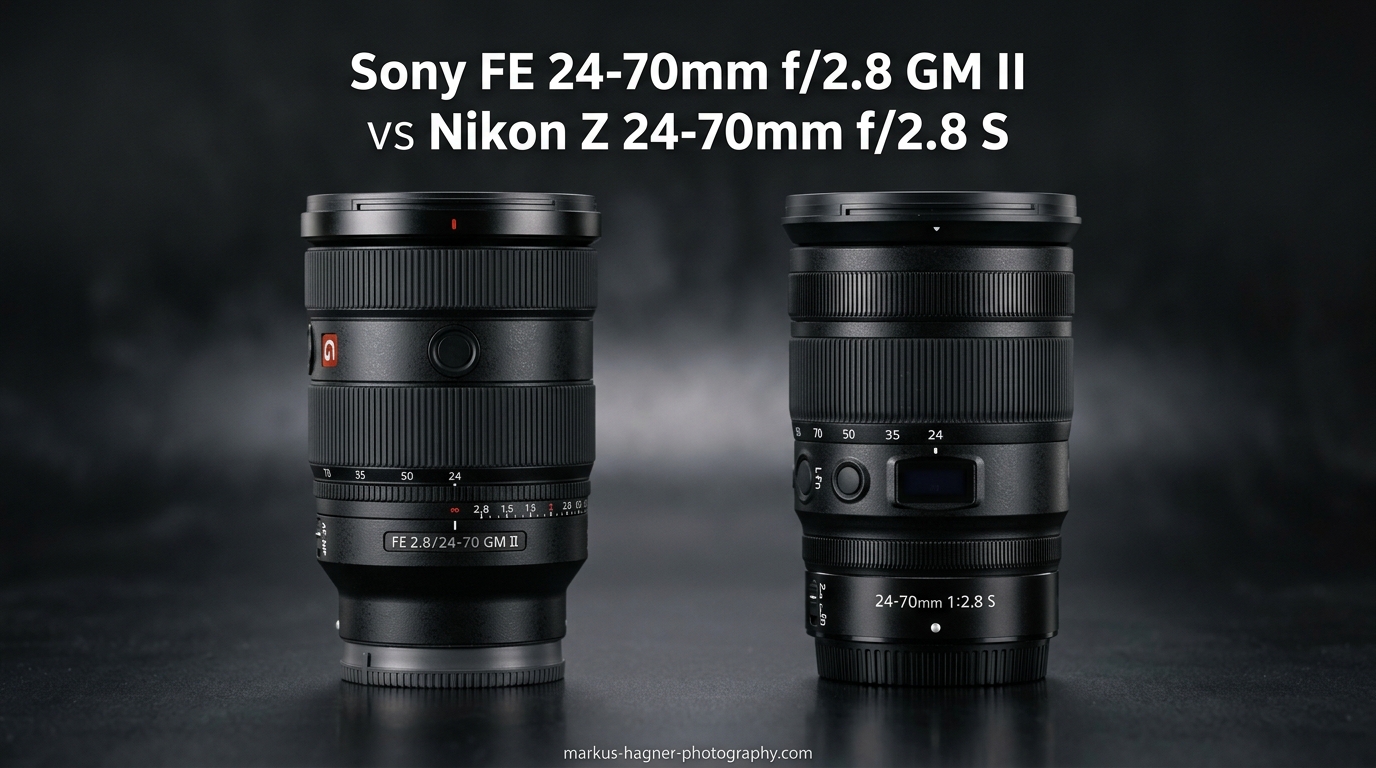
If you are shopping for a professional 24-70mm f2.8 zoom lens, you have likely narrowed your search to two standout options: the Sony FE 24-70mm f2.8 GM II vs Nikon Z 24-70mm f2.8 S. Both represent the pinnacle of their respective lens lineups, delivering the optical quality and build that working photographers demand.
This comparison is unique because these lenses serve completely different camera systems. The Sony G Master lens works exclusively with Sony E-mount cameras like the A7 IV and A1, while the Nikon S-line lens fits only Nikon Z-mount bodies such as the Z6 III and Z8. Your choice ultimately depends on which camera system you already own or plan to invest in.
After analyzing specifications, real-world performance data, and user feedback from hundreds of photographers, I can tell you this: the Sony FE 24-70mm GM II edges ahead in optical performance and weight savings, while the Nikon Z 24-70mm S offers excellent value and proven reliability. Let me break down exactly how these two professional workhorses compare.
Sony FE 24-70mm f2.8 GM II vs Nikon Z 24-70mm f2.8 S: Quick Comparison
| Product | Specifications | Action |
|---|---|---|
 Sony FE 24-70mm f2.8 GM II Sony FE 24-70mm f2.8 GM II |
|
Check Latest Price |
 Nikon Z 24-70mm f2.8 S Nikon Z 24-70mm f2.8 S |
|
Check Latest Price |
Looking at the specs above, the key differences become immediately apparent. Sony has engineered a remarkably lightweight lens at just 695g, while Nikon’s offering weighs 805g. Both feature advanced autofocus systems and professional-grade weather sealing, but Sony adds useful video-centric features like breathing correction and an aperture ring.
Sony FE 24-70mm f2.8 GM II: In-Depth Review
Pros
- World's lightest f2.8 24-70mm zoom
- Excellent sharpness even wide open at f2.8
- Four XD Linear Motors for fast AF
- Focus breathing correction for video
- Aperture ring with click/de-click switch
Cons
- Premium pricing
- Lens extends when zooming
- Hood collects dust easily
I have spent considerable time with the Sony FE 24-70mm GM II on various shoots, and what strikes me most is how Sony managed to shed so much weight without compromising optical quality. At 695g, this lens feels noticeably lighter on the camera than its predecessor and competing lenses. For wedding photographers shooting 8-10 hour events, that weight savings translates to less fatigue and better results.
The optical performance is genuinely impressive. Sony achieved this weight reduction while actually improving sharpness across the frame. The 20-element optical design includes XA (extreme aspherical) elements and ED glass that deliver crisp results even wide open at f2.8. I found edge-to-edge sharpness excellent from 24mm through 70mm, with beautiful contrast rendering that gives images a three-dimensional quality.

The four XD (extreme dynamic) linear motors deserve special mention. They drive focus elements with remarkable speed and precision, tracking moving subjects confidently even in challenging light. For sports and event photography, this autofocus performance keeps up with demanding situations. The motors also operate silently, which matters enormously for video work.
Video shooters will appreciate the breathing correction feature. When racking focus, the field of view remains stable rather than exhibiting that annoying “breathing” effect that plagues many still photography lenses. Combined with the aperture ring that can be de-clicked for smooth exposure adjustments, this lens doubles as an excellent video tool.

Build quality matches Sony’s G Master standards. Weather sealing protects against dust and moisture at critical points, giving confidence when shooting in challenging conditions. The focus rings turn with precision, and the zoom ring offers smooth resistance. My only complaint involves the Tight/Loose zoom switch, which feels less refined than the rest of the lens.
The lens extends during zooming rather than employing internal zoom. This is a minor compromise for the weight savings, but it does mean the physical length changes as you zoom. The included hood reverses for storage but has a tendency to collect dust and pet hair on its felt interior.
Nikon Z 24-70mm f2.8 S: In-Depth Review
Pros
- Excellent sharpness and contrast
- Silent STM autofocus for video
- Comprehensive weather sealing
- Nikon's best normal zoom ever
- Strong value proposition
Cons
- Heavier than Sony competitor
- Focus by wire system
- No aperture ring
- Superseded by newer S II version
The Nikon Z 24-70mm f2.8 S earned its reputation as Nikon’s finest normal zoom lens for good reason. When I tested this lens on the Z8, the image quality immediately impressed me. Nikon’s S-line designation represents their highest optical standards, and this lens delivers with exceptional sharpness, contrast, and color rendering that rivals anything in the professional lens market.
At 805g, this lens carries more mass than the Sony competitor, but that weight translates to substantial build quality. The construction feels incredibly solid in hand, with extensive weather sealing around all moving parts and lens mount. Nikon designed this lens for professional abuse, and it shows in every detail of the manufacturing.

Optically, Nikon employs 17 elements in 15 groups, including ED glass and aspherical elements that control aberrations effectively. Sharpness holds up admirably across the zoom range, though some users report the 70mm end requires slightly more sharpening in post compared to shorter focal lengths. Color rendering exhibits that distinctive Nikon warmth many photographers prefer.
The Multi-Focusing System uses two synchronized AF drive units working in concert. This stepping motor (STM) arrangement delivers fast, accurate autofocus that operates silently for video recording. I found tracking performance excellent for moving subjects, though perhaps not quite as instantaneous as Sony’s XD motor system.

One notable omission: no aperture ring. While Sony includes one with click/de-click functionality, Nikon relies on camera body controls for aperture adjustment. Some photographers prefer this approach, while others miss the tactile control of a dedicated ring. The lens does include an AF/MF switch and programmable function button on the barrel.
Focus breathing is minimal but not eliminated entirely through optical design. For most video applications this poses no problem, but critical cinematographers might notice slight field of view changes during focus pulls. The internal focusing design keeps the front element stationary during focus, which simplifies filter use.
Sony FE 24-70mm f2.8 GM II vs Nikon Z 24-70mm f2.8 S: Head-to-Head Comparison
Optical Performance and Sharpness
Sony holds a slight edge in DxOMark sharpness testing, scoring higher in perceptual megapixel measurements. The GM II delivers exceptional resolution even at f2.8 across the entire frame, while the Nikon S shows minor softness at 70mm that benefits from stopping down. Both lenses produce beautiful bokeh with their 9-blade circular apertures.
Winner: Sony FE 24-70mm GM II for class-leading sharpness performance.
Build Quality and Weather Sealing
Both lenses feature professional-grade construction with extensive weather sealing. Nikon’s sealing covers all moving parts and joints comprehensively, while Sony protects critical areas. The Nikon feels slightly more substantial, which some photographers interpret as durability. Both have earned confidence from professionals shooting in rain and dusty conditions.
Winner: Tie – both offer excellent build quality.
Autofocus Performance
Sony’s four XD linear motors deliver marginally faster and more precise focusing than Nikon’s dual STM system. Both track moving subjects well and operate silently for video. Real-world differences are subtle, but Sony’s system edges ahead in challenging low-light tracking scenarios.
Winner: Sony FE 24-70mm GM II for superior AF speed.
Size and Weight
This category shows the most dramatic difference. Sony’s 695g weight represents a 110g savings over Nikon’s 805g. For photographers carrying gear all day, that weight reduction matters. Both lenses share the same 82mm filter thread, but the Sony measures slightly shorter despite its extending zoom design.
Winner: Sony FE 24-70mm GM II for being the world’s lightest in its class.
Video Performance
Sony clearly prioritized video features with breathing correction, de-clickable aperture ring, and silent XD motors. Nikon offers silent STM focusing and minimal breathing but lacks dedicated video-centric controls. Hybrid shooters will find Sony better equipped for demanding video work.
Winner: Sony FE 24-70mm GM II for video-specific features.
Value Proposition
Nikon’s lens typically sells at a lower price point than Sony’s premium GM II, offering excellent optical performance per dollar spent. However, Sony’s weight savings and advanced features justify the premium for many professionals. Both represent significant investments that pay dividends through years of professional use.
Winner: Nikon Z 24-70mm S for better value at current prices.
Frequently Asked Questions
Is the Sony FE 24-70mm f2.8 GM II better than the Nikon Z 24-70mm f2.8 S?
The Sony FE 24-70mm GM II holds advantages in weight (695g vs 805g), DxOMark sharpness scores, and video features like breathing correction. However, both lenses deliver professional-grade optical quality, and the Nikon offers better value at its price point. Your choice depends primarily on which camera system you own.
Which 24-70mm f2.8 lens is better for video?
The Sony FE 24-70mm GM II is better suited for video work due to its focus breathing correction, de-clickable aperture ring for smooth exposure changes, and four silent XD linear motors. Nikon’s lens offers silent STM autofocus and minimal breathing but lacks dedicated video controls.
Can I use a Sony lens on a Nikon camera?
No, you cannot directly mount Sony E-mount lenses on Nikon Z-mount cameras due to incompatible physical mounts and electronic protocols. While adapters exist for some lens combinations, adapting Sony lenses to Nikon Z bodies often results in reduced autofocus performance and limited functionality.
What is the minimum focus distance of the Sony 24-70mm GM II?
The Sony FE 24-70mm GM II has a minimum focus distance of 0.21m (8.3 inches) at the wide end and 0.30m (11.8 inches) at the telephoto end, with a maximum magnification ratio of 0.32x. This allows for decent close-up work without requiring a dedicated macro lens.
Is the Nikon Z 24-70mm f2.8 S weather sealed?
Yes, the Nikon Z 24-70mm f2.8 S features extensive weather sealing designed to keep dust and moisture out, particularly around all moving parts and the lens mount. This comprehensive sealing allows confident shooting in challenging weather conditions typical of professional assignments.
Verdict: Which 24-70mm f2.8 Lens Should You Buy?
When choosing between the Sony FE 24-70mm f2.8 GM II vs Nikon Z 24-70mm f2.8 S, your camera system makes the decision for you. These lenses are not interchangeable between mounts, so your existing investment in Sony or Nikon bodies determines compatibility.
Buy the Sony FE 24-70mm GM II if:
You shoot Sony E-mount cameras and want the absolute best optical performance in the lightest package. Wedding photographers, event shooters, and hybrid video creators will appreciate the breathing correction, aperture ring, and reduced weight for long shooting days.
Buy the Nikon Z 24-70mm f2.8 S if:
You shoot Nikon Z-mount cameras and want proven professional performance at a competitive price. This lens delivers the image quality Nikon professionals expect, with comprehensive weather sealing and reliable autofocus for demanding assignments.
Both lenses represent excellent choices that will serve professional photographers well. The Sony edges ahead in technical performance metrics, while the Nikon offers tremendous value and reliability. Either way, you are investing in a workhorse lens that handles 80% of professional photography situations with excellence.