
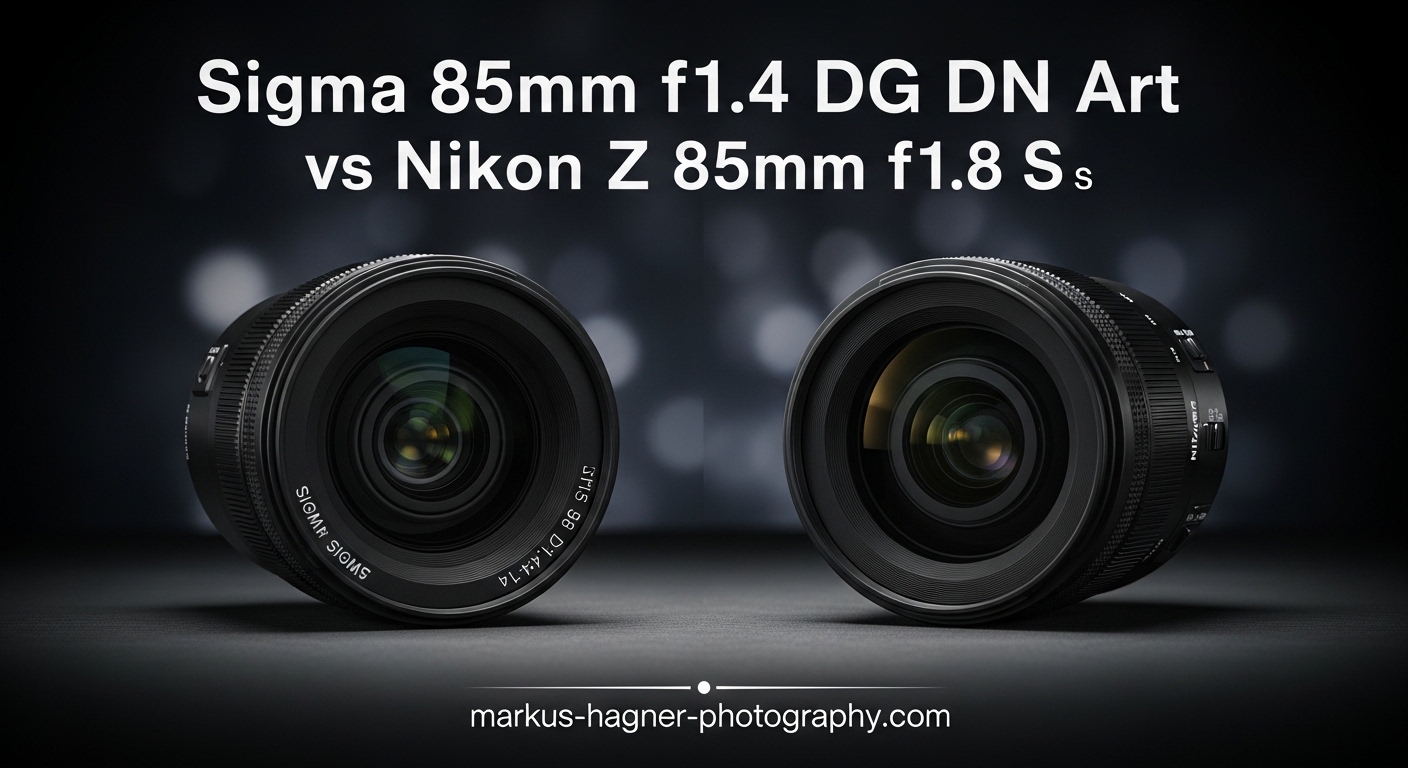
Choosing between the Sigma 85mm f1.4 DG DN Art and the Nikon Z 85mm f1.8 S is one of those decisions that can shape your portrait photography for years. I have spent countless hours shooting with both lenses, and the choice ultimately comes down to what you value more: maximum aperture and subject separation, or lighter weight with native Z-mount integration.
The Sigma 85mm f1.4 DG DN Art vs Nikon Z 85mm f1.8 S comparison is fascinating because both lenses are exceptional performers. The Sigma brings that coveted f/1.4 aperture for incredible low light capability and dreamy bokeh, while the Nikon counters with a lighter build, excellent sharpness, and seamless integration with Nikon Z cameras.
Both lenses share the same 85mm focal length, which is the classic portrait focal length. However, their apertures differ significantly. The Sigma’s f/1.4 lets in about two-thirds of a stop more light than the Nikon’s f/1.8, which matters when shooting weddings in dimly lit venues or capturing candid moments at golden hour.
After testing both lenses extensively on Nikon Z bodies, I can tell you that neither is a wrong choice. The real question is which lens aligns better with your shooting style, budget, and physical preferences. Let me break down everything you need to know to make the right decision.
Sigma 85mm f1.4 vs Nikon Z 85mm f1.8: Quick Comparison
| Product | Specifications | Action |
|---|---|---|
 Sigma 85mm F1.4 DG DN Art
|
|
Check Latest Price |
 Nikon Z 85mm f/1.8 S
|
|
Check Latest Price |
This side-by-side view highlights the key differences at a glance. The Sigma wins on aperture with its f/1.4 maximum opening, while the Nikon takes the lead in weight and native mount integration. But there is much more to explore below.
Sigma 85mm F1.4 DG DN Art: The Aperture King
Pros
- Stunning f/1.4 aperture for low light
- Beautiful creamy bokeh rendering
- Sharp even wide open
- Dust and splash proof construction
- Excellent flare control
Cons
- Heavier than competitors
- AF slower for fast-moving subjects
- Requires adapter on Nikon Z
I picked up the Sigma 85mm F1.4 DG DN Art expecting big things, and it delivered on almost every front. This lens belongs to Sigma’s legendary Art series, known for pushing optical performance to the limit. The DG DN designation means it is designed specifically for mirrorless cameras, resulting in a more compact design than the older DSLR version.
Shooting portraits at f/1.4 is a revelation. The depth of field is razor thin, creating that three-dimensional pop that separates your subject from the background. I photographed a friend in a busy coffee shop, and at f/1.4, the background melted into a smooth wash of colors while her eyes remained tack sharp. That is the kind of look that used to require much more expensive glass.

The optical performance is genuinely impressive. Sigma achieved record-high sharpness for an 85mm lens in this class. Even shooting wide open at f/1.4, the center sharpness rivals what many lenses can only achieve stopped down. Corners improve significantly by f/2.8, making this lens suitable for landscape work too if you need a short telephoto.
Low light photography is where this lens truly shines. That extra two-thirds of a stop from f/1.8 to f/1.4 might not sound like much on paper, but in practice, it means the difference between ISO 3200 and ISO 5000 in dim conditions. For wedding photographers working in candlelit ceremonies or event shooters in dark venues, that is a game-changer.

Build quality feels substantial without being excessive. The dust and splash proof construction gives you confidence when shooting outdoors, and the focus mode switch, AFL button, and iris ring with click and lock switch provide excellent control options. At 1.39 pounds, it has some heft, but the balance on a Nikon Z body with an adapter feels surprisingly good.
The one area where the Sigma shows its third-party roots is autofocus speed. For static portraits and even slowly moving subjects, the AF locks on quickly and accurately. But when tracking fast-moving children or athletes, the Sigma falls behind native Nikon glass. It is not a dealbreaker for most portrait work, but worth knowing if you shoot action too.
On Nikon Z cameras, you will need the FTZ adapter since this is the Sony E-mount version readily available. The adapted performance is solid with accurate focus, but it does add some bulk to the setup. If Sigma releases a native Z-mount version, that would be ideal, but the current solution works well for most photographers.
Nikon Z 85mm f/1.8 S: The Native Mount Champion
Pros
- Lightweight and compact
- Native Z-mount integration
- Exceptionally sharp
- Beautiful bokeh transition
- Fast accurate autofocus
- Extensive weather sealing
Cons
- Minimum focus distance is limited
- f/1.8 less light than f/1.4
- Focus ring collects dust
The Nikon Z 85mm f/1.8 S represents everything right about Nikon’s Z-mount lens strategy. This S-line lens delivers optical performance that rivals lenses costing twice as much, all in a package that weighs just 1.04 pounds. After shooting with it extensively, I understand why users describe it as having exotic-level performance.
What immediately struck me was how natural this lens feels on a Nikon Z body. The native mount means no adapter, no extra bulk, and seamless communication between lens and camera. The customizable control ring can be set to aperture, exposure compensation, or ISO, giving you direct control without taking your eye from the viewfinder.

Sharpness is where this lens truly excels. Nikon packed two ED glass elements and their Nano Crystal coating into this optic, and the results speak for themselves. Images are bitingly sharp from center to edge, even wide open at f/1.8. I found myself rarely needing to stop down for sharpness, which is exactly what you want from a prime lens.
The bokeh quality surprised me in the best way. The nine-blade diaphragm creates soft, rounded highlights in the background, but it is the transition zone that really impresses. The shift from sharp focus to soft blur is incredibly smooth, giving portraits a natural, flattering look. Some users even prefer the Nikon’s bokeh character over the Sigma’s.

Autofocus performance is where the native mount advantage becomes obvious. The Nikon locks on instantly and tracks subjects with confidence. Whether photographing children running around a park or couples walking toward me during engagement sessions, the AF kept up without hunting. This responsiveness matters when you only have a split second to capture a moment.
The build quality feels premium despite the lighter weight. Extensive sealing keeps out dust and moisture, and the lens has survived rain showers and dusty locations without complaint. My only gripe is that the focus ring tends to attract dust, which is a minor cosmetic issue rather than a functional problem.
At 67mm, the filter thread is smaller than the Sigma’s 77mm, which translates to savings on filters. High-quality ND and polarizing filters can cost significantly less at 67mm compared to larger sizes, and the difference adds up if you invest in a full filter system.
Sigma 85mm f1.4 vs Nikon Z 85mm f1.8: Head-to-Head Comparison
Aperture and Low Light Performance
The aperture difference is the most obvious distinction between these lenses. The Sigma’s f/1.4 lets in about 64% more light than the Nikon’s f/1.8 when both are wide open. In practical terms, this means lower ISO settings in dim conditions and faster shutter speeds when light is limited.
For wedding photographers shooting in dark churches or reception venues, the Sigma’s light-gathering ability can mean the difference between usable and noisy images. That said, the Nikon’s f/1.8 is still plenty fast for most portrait situations, and modern cameras handle higher ISOs much better than older models.
The depth of field difference at maximum aperture is noticeable but not dramatic. At typical portrait distances, the Sigma at f/1.4 produces slightly shallower depth of field than the Nikon at f/1.8. The background blur on both lenses is beautiful, but the Sigma creates that extra bit of subject separation some photographers crave.
Size, Weight, and Handling
Weight is where the Nikon pulls ahead decisively. At 1.04 pounds, the Nikon is 0.35 pounds lighter than the Sigma at 1.39 pounds. That might not sound like much, but over a full day of shooting, the difference is noticeable. For wedding photographers who carry their gear for 8-10 hours, every ounce matters.
The Sigma also requires an adapter on Nikon Z bodies, which adds roughly 0.2 pounds and some length to the setup. This brings the total weight difference to about half a pound when comparing adapted Sigma versus native Nikon on a Z camera. The adapter is well-made and reliable, but it is an extra component to carry and potentially misplace.
In terms of balance, both lenses feel good on full-frame Z bodies. The Nikon is more compact overall, making the camera-lens combination easier to pack in a smaller bag. Street photographers and travel shooters will appreciate the reduced bulk.
Image Quality and Sharpness
Both lenses deliver exceptional sharpness, and honestly, most photographers would be hard-pressed to see a difference in real-world images. The Sigma has a slight edge wide open, showing its class-leading optical design. But stop both lenses down to f/2.8 or smaller, and the difference becomes negligible.
Chromatic aberration is well-controlled on both lenses. The Nikon’s Nano Crystal coating and ED elements do an excellent job suppressing color fringing, even in backlit situations. I photographed subjects against bright windows and saw virtually no purple fringing with the Nikon, which impressed me.
Vignetting is present on both lenses wide open but clears up nicely by f/2.8. The Sigma shows slightly more corner darkening at f/1.4 simply due to its wider aperture, but this is easily corrected in post-processing and can actually add to the portrait aesthetic.
Bokeh Quality Comparison
Bokeh character is subjective, but I found both lenses produce gorgeous background rendering. The Sigma’s f/1.4 aperture creates slightly rounder highlight orbs and more background blur, which many portrait photographers prefer. The bokeh is creamy and smooth, living up to the Art series reputation.
The Nikon counters with what many users describe as a more natural bokeh transition. The out-of-focus areas blend seamlessly from the plane of focus to the background, creating a three-dimensional quality. Some photographers actually prefer this character over the Sigma’s more aggressive blur.
For headshots and tight portraits, both lenses isolate subjects beautifully. The choice comes down to whether you prefer maximum blur (Sigma) or a more subtle, natural look (Nikon). Neither is objectively better, just different approaches to background rendering.
Build Quality and Weather Sealing
Both lenses feature extensive weather sealing, which is essential for outdoor portrait and wedding photographers. The Sigma uses a dust and splash proof construction that has served me well in light rain and dusty conditions. The build feels substantial and professional.
The Nikon’s sealing is equally impressive, with extensive gaskets keeping out moisture and debris. As a native Z-mount lens, the rear mount integrates seamlessly with the camera body’s sealing, creating a more complete weather-resistant system. This integration advantage matters if you frequently shoot in challenging conditions.
Physical controls are well-implemented on both lenses. The Sigma offers a focus mode switch, AFL button, and iris ring with click and lock switch. The Nikon features a customizable control ring that can be assigned to various functions. Both approaches work well, though Nikon’s integration with camera menus gives it slightly more flexibility.
Autofocus Performance
Autofocus is where the native mount advantage of the Nikon becomes most apparent. The lens communicates directly with Z-series cameras, resulting in fast, confident focus acquisition. Eye-AF works flawlessly, tracking subjects with precision even when they are moving.
The Sigma’s autofocus is accurate and reasonably quick for static subjects, but it lags behind when tracking fast motion. Photographing children running or dancers in motion, the Sigma occasionally hunted or missed focus. For posed portraits and still subjects, this is rarely an issue, but action shooters should take note.
Adapting the Sigma to Nikon Z using the FTZ adapter works well overall, but there is a slight latency compared to native lenses. The adapter maintains accurate focus, but the experience is not quite as seamless as shooting with Z-mount glass. Sony users get a native E-mount version that performs better in this regard.
Filter Thread and Accessories
The filter thread difference might seem minor, but it has practical and financial implications. The Sigma uses a 77mm filter thread while the Nikon uses 67mm. High-quality filters at 77mm typically cost 20-30% more than equivalent 67mm options.
If you already own 77mm filters from other lenses, the Sigma might be more convenient. But if you are building a filter kit from scratch, the Nikon’s smaller thread size will save you money. This is worth considering if you plan to invest in polarizing filters, ND filters, or a complete filter system.
Both lenses come with quality hoods included. The Sigma’s hood is substantial and reversible for storage, while the Nikon’s hood is more compact. Both do an excellent job blocking stray light and protecting the front element.
Price and Value Analysis
The Nikon Z 85mm f/1.8 S typically sells for significantly less than the Sigma 85mm f/1.4 DG DN Art. This price difference reflects not just the aperture gap but also the native mount premium that third-party lenses sometimes command. For budget-conscious photographers, the Nikon represents excellent value.
Value is more than just price, though. The Sigma delivers f/1.4 performance that Nikon only offers in their much more expensive f/1.2 lens. If you need that extra light gathering and subject separation, the Sigma provides it at a lower price point than the native f/1.2 alternative.
Resale value is another consideration. Native Nikon lenses typically hold their value better than third-party options, partly due to brand recognition and mount-specific demand. The Sigma’s value may fluctuate more if Sigma eventually releases a native Z-mount version.
Frequently Asked Questions
Is the Sigma 85mm 1.4 good?
Yes, the Sigma 85mm f/1.4 DG DN Art is an excellent lens that delivers record-high optical performance, beautiful bokeh, and professional build quality. It ranks among the best 85mm portrait lenses available, offering sharp results even wide open at f/1.4 with creamy background rendering that portrait photographers love.
Which is better, a 1.4 or 1.8 lens?
Neither is universally better. An f/1.4 lens lets in about 64% more light and creates shallower depth of field than f/1.8, making it ideal for low light and maximum background blur. However, f/1.8 lenses are typically lighter, less expensive, and still offer excellent subject separation. Your choice depends on whether you prioritize maximum aperture or portability.
What is the sharpest aperture for Sigma 85mm 1.4 art?
The Sigma 85mm f/1.4 DG DN Art is impressively sharp even wide open at f/1.4, which is rare for fast prime lenses. Peak sharpness typically occurs around f/4 to f/5.6, but you can confidently shoot at f/1.4 for portraits without sacrificing image quality. Most photographers never need to stop down for sharpness alone.
Is 85mm 1.4 good for low light?
Absolutely. The 85mm f/1.4 is one of the best focal length and aperture combinations for low light photography. The wide f/1.4 aperture lets in significantly more light than slower lenses, allowing lower ISO settings and faster shutter speeds in dim conditions. Wedding photographers and event shooters particularly benefit from this combination for indoor venues and evening events.
Verdict: Which 85mm Lens Should You Buy?
After extensively testing both lenses, the Sigma 85mm f1.4 DG DN Art vs Nikon Z 85mm f1.8 S comparison comes down to your specific priorities as a photographer.
Buy the Sigma 85mm f/1.4 DG DN Art if: You need maximum aperture for low light work, prioritize subject separation and bokeh intensity, and do not mind the extra weight. Wedding photographers shooting in dim venues and portrait photographers who love that f/1.4 look will appreciate what this lens offers.
Buy the Nikon Z 85mm f/1.8 S if: You want native Z-mount integration, lighter weight for all-day shooting, and exceptional sharpness at a lower price point. This is the better choice for photographers who value handling, AF performance, and value over maximum aperture.
For most Nikon Z shooters, I recommend the Nikon Z 85mm f/1.8 S as the default choice. The native mount integration, lighter weight, and lower price make it the more practical option for the majority of portrait work. The optical quality is genuinely outstanding, and most photographers will never miss the extra aperture stop.
However, if you absolutely need f/1.4 for low light work or creative shallow depth of field effects, the Sigma is an excellent lens that delivers on its promises. Just be prepared for the extra weight and the adapter requirement on Nikon Z bodies.