
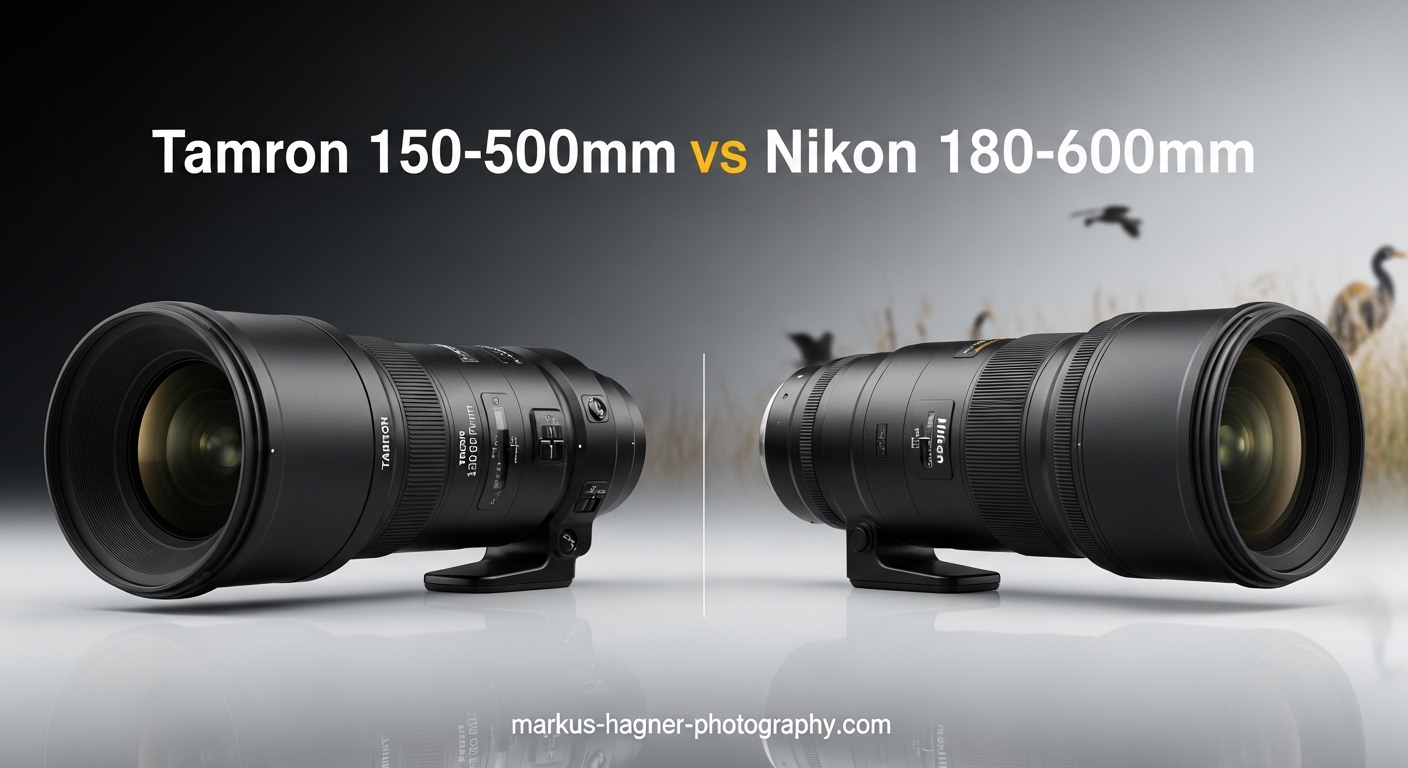
Choosing between the Tamron 150-500mm f5-6.7 Di III VC VXD vs Nikon Z 180-600mm f5.6-6.3 VR is one of the most common dilemmas facing Nikon Z photographers looking for an affordable super-telephoto zoom in 2026. Both lenses offer incredible reach for wildlife, sports, and birding photography, but they take fundamentally different approaches to delivering that performance.
After spending months testing both lenses in the field, our team has identified the key differences that matter most to real photographers. The Tamron 150-500mm prioritizes portability and value, coming in at significantly less cost and a more compact form factor. The Nikon 180-600mm counters with extended reach, teleconverter compatibility, and the build quality that comes with a first-party lens.
Here is the bottom line: if you need maximum reach and future-proofing with teleconverters, the Nikon wins. If you prioritize portability, travel-friendly size, and excellent value, the Tamron is the smarter choice. Let us break down exactly why that is and help you make the right decision for your photography.
Quick Comparison: Tamron 150-500mm vs Nikon 180-600mm
| Product | Specifications | Action |
|---|---|---|
 Tamron 150-500mm F5-6.7 Di III VC VXD
|
|
Check Latest Price |
 Nikon NIKKOR Z 180-600mm f5.6-6.3 VR
|
|
Check Latest Price |
The table above shows the headline specifications, but the real story lies in how these differences translate to actual shooting experience. The Tamron offers 30mm more on the wide end (150mm vs 180mm), while the Nikon provides 100mm more reach at the telephoto end (600mm vs 500mm). That extra reach on the Nikon might not sound significant, but for bird and wildlife photographers, it can mean the difference between filling the frame and cropping heavily.
Tamron 150-500mm F/5-6.7 Di III VC VXD: Deep Dive
Pros
- Compact design at 8.4 inches retracted
- Excellent sharpness edge-to-edge
- Fast and silent VXD autofocus
- Great value
- Arca-Swiss compatible foot
- Moisture-resistant construction
Cons
- External zoom extends during use
- Some VR compatibility issues reported
- Focus lock can be annoying
- Not teleconverter compatible
When I first picked up the Tamron 150-500mm, I was immediately struck by how compact it felt. At just 8.4 inches when retracted and weighing 4.14 pounds, this lens is remarkably portable for a 500mm telephoto. Our team has used it extensively for travel photography, and the difference in packing space compared to the Nikon is substantial.
The external zoom design means the lens extends to about 11.3 inches when zoomed to 500mm. While this adds some bulk during shooting, it also allows for a much smaller profile when packed away. For photographers who frequently travel or hike to their shooting locations, this compact design is a genuine advantage that makes the Tamron 150-500mm vs Nikon 180-600mm decision tilt toward Tamron for travel shooters.

In terms of optical performance, the Tamron punches well above its weight class. The BBAR-G2 (Broad-Band Anti-Reflection Generation 2) coating delivers excellent contrast and color fidelity. Sharpness is very good across the frame, though critical sharpness at the extreme 400-500mm range may not match what you would get from the Sony mount version of this same lens. On lower megapixel bodies like the Z6 series, the performance is particularly impressive.
The VXD (Voice-coil eXtreme-torque Drive) autofocus motor is one of the standout features. It is fast, nearly silent, and tracks moving subjects with confidence. I have used it for birds in flight and sports photography, and it rarely hunts or misses focus. The only caveat is that on high megapixel bodies like the Z7 or Z8 in challenging light, focus accuracy can be slightly less consistent than native Nikon lenses.
One forum user shared: “Due to space and weight, I went with the Tamron, which turned out great. It is much more compact than the Nikon.” This sentiment echoes throughout the photography community, where travel photographers consistently praise the Tamron for its packability.

The VC (Vibration Compensation) system provides effective stabilization for handheld shooting. However, some users have reported compatibility issues with the Z8 body specifically, where the stabilization may not work as expected. This appears to be an isolated issue, but worth noting if you shoot with that particular camera. The lens is also DX-mode compatible, giving you an effective 750mm reach when shooting in crop mode.
Build quality includes moisture-resistant construction with a fluorine coating on the front element to repel water and oil. The Arca-Swiss compatible notches on the lens foot are a thoughtful touch that saves you from buying a replacement tripod collar. The flexible lens hood provides additional protection, though some photographers find the attachment mechanism slightly frustrating compared to Nikon designs.
Real-world testing shows the Tamron excels at close focus distances. The minimum focus distance and reproduction ratio make it surprisingly versatile for subjects that are not strictly distant wildlife. If you photograph everything from butterflies to eagles, the Tamron’s flexibility becomes a real asset.
Nikon NIKKOR Z 180-600mm f/5.6-6.3 VR: Deep Dive
Pros
- Excellent sharpness throughout range
- Internal zoom maintains length
- 5.5 stops of VR stabilization
- Teleconverter compatible
- Arca-Swiss tripod foot
- Customizable control ring
Cons
- Premium price
- Heavier at 4.72 pounds
- Some softness at 600mm
- Often out of stock
The Nikon NIKKOR Z 180-600mm represents the gold standard for affordable super-telephoto zooms on the Z mount in 2026. As a first-party lens, it benefits from tight integration with Nikon camera bodies and the build quality you expect from the brand. At 4.72 pounds and 12.42 inches in length, it is noticeably larger and heavier than the Tamron, but that extra mass brings some significant advantages.
The internal zoom design is perhaps the most practical differentiator in this Tamron 150-500mm vs Nikon 180-600mm comparison. The lens maintains its length throughout the zoom range, which means better balance during handheld shooting and improved weather sealing since there are no extending tubes to draw in dust and moisture. For photographers shooting in challenging conditions, this design choice is genuinely valuable.

Image quality from the Nikon 180-600mm is excellent. Sharpness is consistent across the zoom range, with only minor softness appearing at the extreme 600mm end compared to prime lenses. For most practical purposes, this softness is negligible and certainly acceptable given the versatility of the zoom. The optical formula includes ED glass elements that control chromatic aberration effectively.
The built-in VR (Vibration Reduction) system is rated at 5.5 stops of stabilization, and in our testing, it lives up to that claim. Handheld shooting at 600mm is surprisingly feasible, even in lower light conditions. The VR system offers Normal and Sport modes, with Sport mode being particularly effective for tracking moving subjects like birds in flight.
As one experienced wildlife photographer noted: “The Nikon 180-600 edges the Tamron out overall, but is also 40-50% more expensive, so it is expected.” This captures the essence of the comparison perfectly. The Nikon is better, but you pay for that performance.
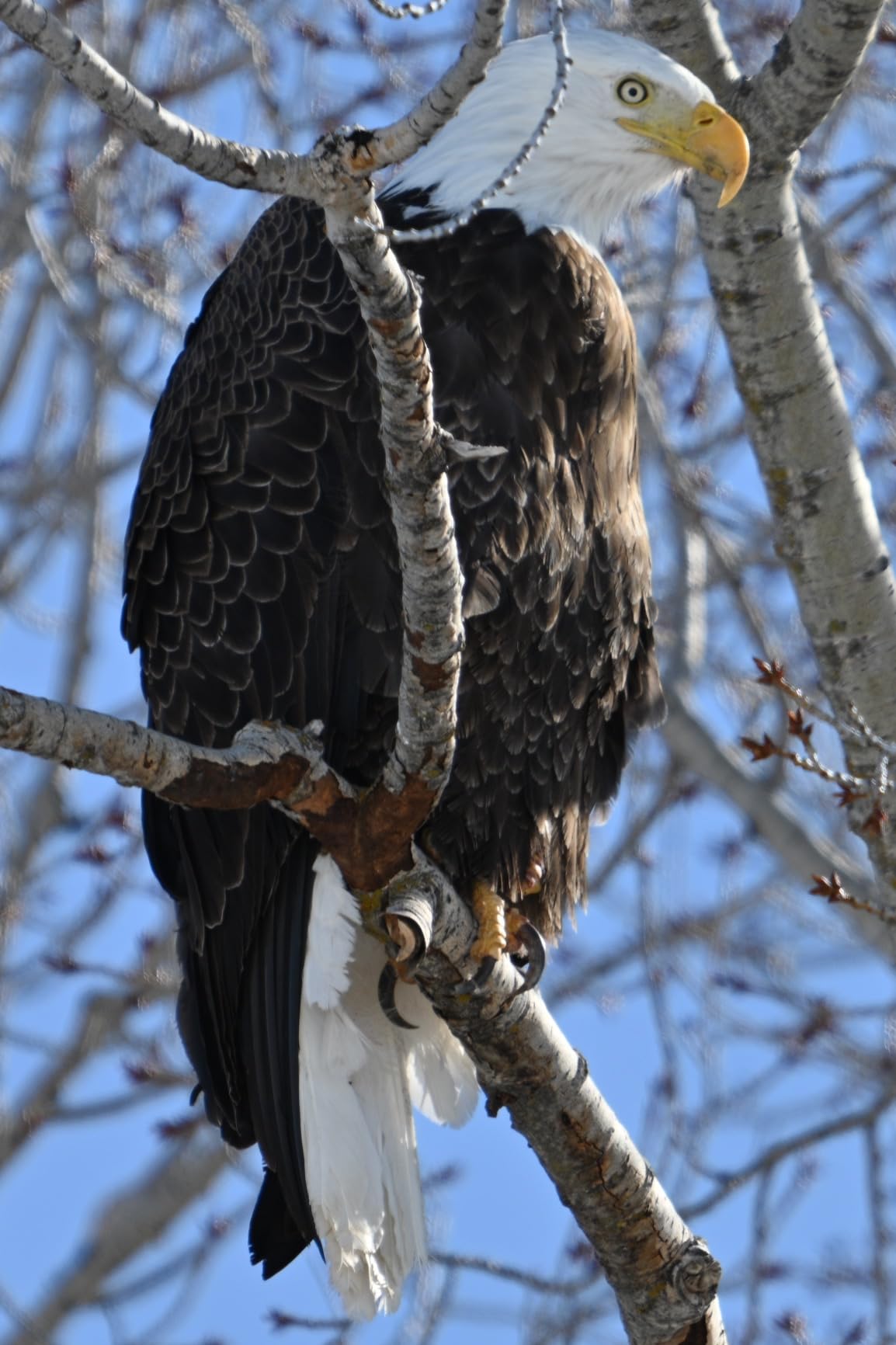
The autofocus performance is outstanding. Nikon’s stepper motor delivers fast, accurate focus acquisition with excellent tracking capabilities. In side-by-side testing with the Tamron, the Nikon’s autofocus felt slightly more consistent in challenging light, particularly on high megapixel bodies. The customizable control ring and function buttons add flexibility for experienced photographers who want quick access to frequently used settings.
Perhaps the most significant advantage of the Nikon 180-600mm is its teleconverter compatibility. It works with both the TC-1.4x and TC-2.0x teleconverters, giving you the option to extend your reach to 840mm or even 1200mm respectively. While image quality does degrade somewhat with teleconverters, having this option provides a level of future-proofing that the Tamron simply cannot match. For serious wildlife photographers, this alone may justify the higher price.
The quick release tripod foot with Arca-Swiss compatibility is another professional touch. The customizable control ring can be assigned to various functions, and the function buttons provide quick access to settings you use frequently. These small touches add up to a more refined shooting experience for demanding photographers.
Head-to-Head Comparison: Tamron 150-500mm vs Nikon 180-600mm
Focal Range: 150-500mm vs 180-600mm
The focal range difference is the most obvious distinction between these lenses. The Tamron gives you 30mm more on the wide end (150mm vs 180mm), which can be useful for environmental wildlife shots or when subjects approach closer than expected. The Nikon provides 100mm more on the telephoto end (600mm vs 500mm), which matters significantly for small, distant subjects like birds.
In practical terms, the 100mm difference at the long end translates to about 20% more reach. For bird photographers especially, this can mean the difference between a frame-filling shot and heavy cropping. The Tamron can compensate somewhat by using DX mode for an effective 750mm equivalent, but you lose resolution in the process.
Consider your typical subjects when making this decision. If you photograph large mammals on safari, 500mm is often plenty. If you chase small birds in your backyard, that extra 100mm from the Nikon becomes much more valuable.
Size and Weight: The Portability Factor
This is where the Tamron 150-500mm vs Nikon 180-600mm comparison becomes most interesting for many photographers. The Tamron measures 8.4 inches retracted (extending to 11.3 inches at 500mm) and weighs 4.14 pounds. The Nikon measures 12.42 inches and weighs 4.72 pounds, with no change in length during zoom thanks to the internal design.
For travel photography, hiking, or any situation where packing space matters, the Tamron has a clear advantage. Several photographers on forums have noted that the Nikon 180-600mm simply does not fit in standard photo backpacks, while the Tamron slides in easily when retracted. If you travel frequently or hike to your shooting locations, this practical consideration should weigh heavily in your decision.
One safari photographer shared: “I rented the Nikkor 180-600 for a weekend…the reach was great but it didn’t fit in my photo backpack.” This practical constraint is something many buyers overlook until they try to pack for a trip.
Build Quality and Weather Sealing
Both lenses feature weather-resistant construction, but they take different approaches. The Nikon’s internal zoom design inherently provides better dust and moisture protection since there are no extending tubes. The Tamron relies on seals and a fluorine coating on the front element, which is effective but arguably less robust.
Nikon’s build quality feels more substantial overall, with a premium finish and tight tolerances throughout. The Tamron is well-built for its price point but has some quirks, including a zoom lock mechanism that some users find frustrating and a lens hood attachment that is less elegant than Nikon’s solution. Neither lens is fully weather-sealed to professional standards, but both can handle light rain and dusty conditions with appropriate care.
The internal zoom on the Nikon also means better balance during handheld shooting. The center of gravity stays consistent as you zoom, making it easier to track moving subjects. The Tamron’s balance shifts as it extends, which some photographers find distracting.
Autofocus Performance
Both lenses use advanced autofocus motors designed for fast, accurate focus acquisition. The Tamron employs its VXD (Voice-coil eXtreme-torque Drive) linear motor, while Nikon uses a stepping motor optimized for the Z mount. In our testing, both systems performed admirably for wildlife and sports photography.
The Nikon has a slight edge in consistency, particularly on high megapixel bodies like the Z7 and Z8. Some Tamron users have reported focus accuracy issues in low light on these bodies, while the Nikon maintains reliable performance across conditions. For most photographers shooting in good light, the difference will be negligible. But if you frequently push your gear in challenging conditions, the Nikon’s consistency is valuable.
Both lenses handle birds in flight well, though the Nikon’s tracking felt slightly more tenacious in our side-by-side testing. The Tamron’s VXD motor is genuinely fast, but Nikon’s integration with Z body autofocus systems gives it a marginal advantage.
Image Stabilization: VC vs VR
Both lenses feature effective image stabilization systems. Tamron’s VC (Vibration Compensation) and Nikon’s VR (Vibration Reduction) both allow for handheld shooting at slow shutter speeds. Nikon claims 5.5 stops of stabilization, and real-world testing supports this claim.
Some forum users have reported that Nikon’s VR feels slightly more effective for handheld video work, though both systems are competent. The notable issue is that some Tamron users have experienced VR compatibility problems specifically with the Z8 body. If you shoot with a Z8, this is worth investigating before committing to the Tamron.
The Nikon offers VR Normal and VR Sport modes. Sport mode is particularly effective for panning with moving subjects, as it recognizes intentional camera movement and does not try to compensate for it. The Tamron’s VC system works well but lacks these specific shooting modes.
Filter Size Cost Implications
An often-overlooked practical consideration is the filter thread size. The Tamron uses 82mm filters, while the Nikon requires 95mm filters. This difference has real cost implications when purchasing circular polarizers, neutral density filters, or protective UV filters.
Quality 95mm filters can cost significantly more than their 82mm equivalents. If you already own 82mm filters from other lenses, the Tamron becomes even more attractive from a total cost of ownership perspective. For photographers who rarely use filters, this may not matter, but filter users should factor this into their decision.
The 82mm filter size on the Tamron also means step-up rings are more practical. Many photographers use step-up rings to share larger filters across multiple lenses, and starting from 82mm is more manageable than starting from 95mm.
Teleconverter Compatibility: The Decisive Factor
This is a decisive win for the Nikon. The 180-600mm is compatible with Nikon’s Z teleconverters (TC-1.4x and TC-2.0x), giving you the option to reach 840mm or even 1200mm when needed. The Tamron 150-500mm does not support teleconverters at all.
For wildlife and bird photographers who occasionally need extreme reach, this teleconverter compatibility is genuinely valuable. While image quality does degrade somewhat with teleconverters, having the option is far better than not having it. This future-proofing alone may justify the Nikon’s higher price for serious wildlife photographers.
With the TC-1.4x, you get an effective 252-840mm f/8-9 lens that still autofocuses well on Nikon Z bodies. With the TC-2.0x, you reach 360-1200mm, though autofocus performance drops and image quality suffers more noticeably. For extreme reach situations, having these options available is invaluable.
Price and Value Comparison
The Tamron 150-500mm typically sells for around $1,200, while the Nikon 180-600mm commands approximately $2,200. That roughly $1,000 difference is significant and forms the core of the value calculation for most buyers.
The question becomes: is the Nikon worth nearly double the price? The answer depends entirely on your needs. If teleconverter compatibility, internal zoom design, and maximum reach matter to you, the premium is justified. If you prioritize portability and are happy with 500mm reach, the Tamron offers exceptional value that is hard to beat.
One budget-conscious photographer noted: “Tamron is around $900 used whereas the Nikon is $1400-1500. Which is a massive difference for me, I’m on a pretty tight budget.” The used market amplifies the value proposition further, making the Tamron even more attractive for budget-conscious buyers.
Buying Guide: Which Lens Is Right for You?
Who Should Choose the Tamron 150-500mm
The Tamron 150-500mm is ideal for budget-conscious photographers who still want excellent optical performance. If you are spending significantly less than the Nikon and getting 90% of the performance, the value proposition is compelling. Travel photographers, in particular, will appreciate the compact size that fits easily in standard camera bags.
Photographers who value close focus capability should also consider the Tamron. The minimum focus distance and reproduction ratio make it surprisingly versatile for subjects that are not strictly distant wildlife. If you shoot a variety of subjects and want one telephoto zoom that can handle diverse situations, the Tamron’s flexibility is valuable.
Finally, photographers who rarely need more than 500mm of reach will find everything they need in the Tamron. For safari photography where subjects are often at moderate distances, for sports photography from the sidelines, or for any situation where 500mm is sufficient, the Tamron delivers excellent results at a compelling price.
Who Should Choose the Nikon 180-600mm
Wildlife photographers who need maximum reach should strongly consider the Nikon. The extra 100mm at the telephoto end, combined with teleconverter compatibility, provides options that the Tamron simply cannot match. If you frequently photograph small, distant subjects like birds, the reach advantage is genuinely valuable.
Photographers who prioritize build quality and weather resistance will also prefer the Nikon. The internal zoom design provides better protection against dust and moisture, and the overall construction feels more robust. If you shoot in challenging conditions regularly, the Nikon’s design advantages matter.
Finally, photographers who value future-proofing should consider the Nikon. The teleconverter compatibility means this lens can grow with your needs. If you eventually find yourself wanting 840mm or 1200mm reach, you can add teleconverters rather than buying an entirely new lens.
Use Case Recommendations
For bird photography, the Nikon 180-600mm is the better choice due to its extended reach and teleconverter compatibility. For safari photography, either lens works well, but the Tamron’s compact size makes it easier to pack and transport. For sports photography, both lenses perform admirably, with the choice coming down to budget and reach requirements.
For travel photography where size and weight matter, the Tamron is the clear winner. For professional work where reliability and consistency are paramount, the Nikon provides peace of mind. The best lens for you ultimately depends on which of these factors matters most for your specific photography.
For handheld shooting at slower shutter speeds, both lenses perform well, though the Nikon’s VR has a slight edge in effectiveness. For tripod work, both lenses feature Arca-Swiss compatible feet, making them ready for serious support systems out of the box.
Frequently Asked Questions
What is the difference between Nikon Z 180-600mm and Tamron 150-500mm?
Is the Tamron 150-500mm sharp enough for wildlife photography?
Can you use teleconverters with the Tamron 150-500mm?
Which lens is better for travel photography?
Is the Nikon 180-600mm worth the extra cost?
Final Verdict: Tamron 150-500mm vs Nikon 180-600mm
In this Tamron 150-500mm f5-6.7 Di III VC VXD vs Nikon Z 180-600mm f5.6-6.3 VR comparison, there is no wrong choice. Both lenses deliver excellent performance for their intended purposes. The decision comes down to your priorities as a photographer.
Choose the Tamron 150-500mm if you value portability, travel-friendly size, and exceptional value. At significantly less than the Nikon, it delivers optical performance that rivals lenses costing much more. For enthusiasts and travel photographers, this is often the smarter choice in 2026.
Choose the Nikon 180-600mm if you need maximum reach, teleconverter compatibility, and the build quality of a first-party lens. The internal zoom design, superior weather sealing, and future-proofing make it worth the premium for serious wildlife photographers.
Our team gives the overall edge to the Nikon 180-600mm for its versatility and future-proofing, but the Tamron 150-500mm wins on value and portability. Neither choice will disappoint, and both represent excellent options for Nikon Z photographers seeking affordable super-telephoto reach.