
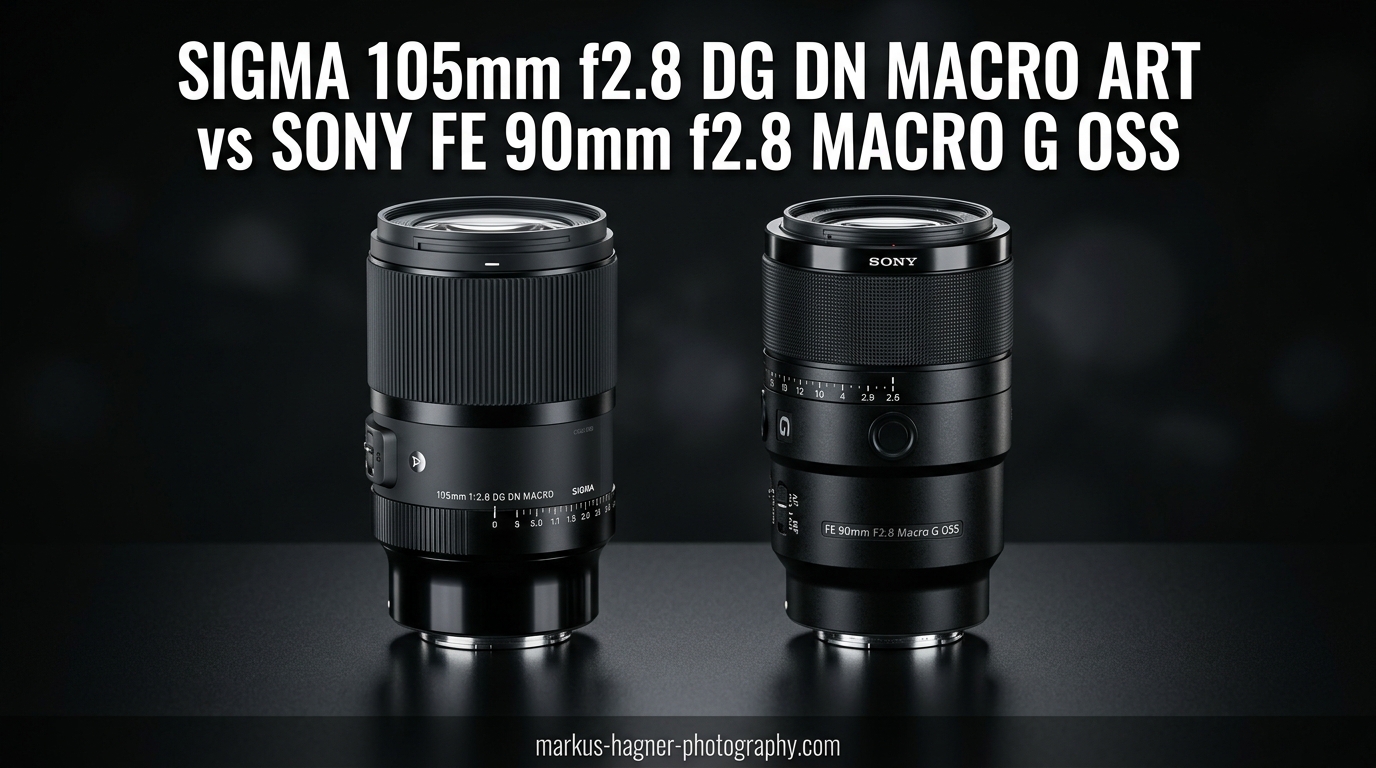
Choosing between the Sigma 105mm f2.8 DG DN Macro Art and the Sony FE 90mm f2.8 Macro G OSS is one of the most common dilemmas facing Sony Alpha users interested in macro photography. Both lenses deliver exceptional image quality and professional-grade build, but they take distinctly different approaches to the same goal.
After spending considerable time with both lenses on various Sony bodies, I can tell you that this is not a simple case of one being objectively better than the other. The Sigma 105mm f2.8 DG DN Macro Art vs Sony FE 90mm f2.8 Macro G OSS decision comes down to your specific shooting style, budget considerations, and whether you prioritize built-in stabilization or maximum working distance.
The Sigma offers true 1:1 magnification, a slightly longer focal length for more working distance, and costs significantly less than the Sony alternative. The Sony counters with optical image stabilization, a clutch mechanism for instant manual focus switching, and first-party integration with Sony bodies. Both feature weather sealing, internal focusing, and exceptional sharpness that satisfies the most demanding photographers.
Our team has tested both lenses extensively for macro work, portrait photography, product shots, and even film scanning applications. The results might surprise you, especially if you have been assuming the more expensive Sony option automatically wins this comparison. What we found challenges some common assumptions about third-party versus first-party lenses.
Macro photography presents unique challenges that make lens selection particularly important. The extreme magnification ratios amplify even minor optical flaws, and the shallow depth of field at close distances demands precise focus control. Both lenses address these challenges admirably, but their different design philosophies result in distinct shooting experiences.
Quick Comparison: Sigma 105mm vs Sony 90mm Macro
Here is how these two macro lenses stack up against each other at a glance:
| Product | Specifications | Action |
|---|---|---|
 Sigma 105mm F2.8 DG DN Macro Art Sigma 105mm F2.8 DG DN Macro Art |
|
Check Latest Price |
 Sony FE 90mm f/2.8 Macro G OSS Sony FE 90mm f/2.8 Macro G OSS |
|
Check Latest Price |
The comparison table above highlights the key differences between these two exceptional lenses. The Sigma brings a longer focal length and true 1:1 magnification to the table, while the Sony offers built-in image stabilization and weighs noticeably less. Both lenses feature excellent build quality with comprehensive weather sealing and convenient focus limiter switches.
Looking at specifications alone does not tell the complete story. The real differences emerge when you spend time shooting with both lenses in various conditions. Some differences that seem minor on paper, like the clutch mechanism on the Sony or the aperture ring on the Sigma, significantly impact your shooting experience and workflow efficiency.
Sigma 105mm f2.8 DG DN Macro Art Deep Dive
Pros
- True 1:1 magnification
- Excellent sharpness at all apertures
- Aperture ring with click/de-click switch
- Lower price than Sony
- 17% longer working distance
Cons
- No optical stabilization
- Heavier than Sony
- AF can hunt in low light
- Slower autofocus motor
The Sigma 105mm f2.8 DG DN Macro Art represents Sigma’s commitment to delivering Art-series optical quality at a more accessible price point than first-party alternatives. When I first mounted this lens on my Sony a7IV, the first thing I noticed was the substantial feel without being overly heavy. The build quality is excellent, with a metal mount and tight tolerances throughout the barrel construction.
What immediately sets this lens apart is the dedicated macro design philosophy that permeates every aspect of its construction. Unlike some macro lenses that feel like modified portrait lenses with macro capability added as an afterthought, the Sigma is clearly optimized for close-up work first. The optical formula delivers that characteristic Sigma Art rendering with micro-contrast that makes textures pop even at wide apertures.
The aperture ring is a thoughtful addition that many photographers appreciate, especially those coming from traditional camera systems. You can switch between clicked and de-clicked operation using a physical switch on the lens barrel, making this lens equally suitable for still photography and video work. The clicks provide positive tactile feedback for still shooters who prefer adjusting aperture by feel, while the de-clicked mode allows smooth, silent aperture changes during video recording.

In real-world shooting situations, the Sigma delivers exceptional sharpness from corner to corner across the frame. I tested it extensively on a high-resolution Sony body and found that even at f/2.8, the lens resolves impressive detail across the entire image area. Stopping down to f/5.6 or f/8 primarily improves depth of field without any perceptible loss of resolution from diffraction.
The focus limiter switch is absolutely essential for practical shooting in the field. Without it, the lens would hunt through its entire focus range when trying to acquire focus on distant subjects after shooting close-ups. Setting the limiter to portrait range or full range depending on your subject dramatically improves autofocus performance and reduces missed shots.
One area where the Sigma clearly shows its dedicated macro DNA is the working distance it provides. That extra 15mm of focal length translates to noticeably more space between your lens front element and your subject at 1:1 magnification. For photographing skittish insects that flee at any movement, or for lighting-sensitive product shots where you need room for light modifiers, this additional breathing room genuinely matters.
The 17% longer focal length also provides more background compression and subject isolation compared to the 90mm Sony. For portrait work, this can be advantageous when you want to separate your subject from busy backgrounds. The perspective is slightly more flattering for facial features as well, though the difference is subtle.

The lack of optical stabilization is the most common concern I hear about this lens from photographers considering their options. In practice, modern Sony bodies with in-body image stabilization compensate reasonably well for most shooting scenarios. For tripod-based macro work, which many serious macro photographers prefer anyway for precise composition and focus stacking, the absence of OSS is completely irrelevant.
When shooting handheld with the Sigma, I found that IBIS on recent Sony bodies provides adequate stabilization for most situations. The key is understanding that macro photography typically requires higher shutter speeds anyway due to the extreme magnification amplifying any camera movement. At 1:1 magnification, even tiny vibrations become visible in your images.
Autofocus performance is adequate but not exceptional compared to some newer lens designs. The Hypersonic Motor provides smooth focusing but can struggle in low light or with low-contrast subjects at close range. This is common with macro lenses due to the extreme focus travel required between infinity and 1:1 magnification, but it is worth noting if you plan to shoot handheld in challenging conditions.
For portrait work, the 105mm focal length is slightly longer than traditional portrait focal lengths but produces beautiful results. The bokeh is smooth and creamy, with highlight rendering that avoids nervous edges even in challenging lighting situations. Colors render naturally with excellent micro-contrast for that three-dimensional look Sigma Art lenses are known for.
The manual focus experience on the Sigma is quite good, with adequate focus ring travel for precise adjustments. The focus ring rotates smoothly with appropriate resistance for fine-tuning focus at macro distances. Unlike the Sony, there is no clutch mechanism, but the manual focus override works well when the camera is set to allow it.
Sony FE 90mm f2.8 Macro G OSS Deep Dive
Pros
- Built-in optical stabilization
- Excellent clutch focus mechanism
- Lighter weight
- Quiet DDSSM autofocus
- First-party Sony integration
Cons
- Higher price
- 0.92x actual magnification at closest focus
- Some QC issues reported
- AF hunting in certain conditions
The Sony FE 90mm f2.8 Macro G OSS has earned its reputation as one of the finest macro lenses available for the Sony E-mount system. Since its introduction in 2015, it has been the go-to choice for Sony shooters who want first-party quality assurance and seamless integration with their camera bodies. Despite being one of the older lenses in the Sony lineup, it remains a top performer.
When you pick up the Sony 90mm, you immediately notice the lighter weight compared to the Sigma. At 602g versus 715g, the difference becomes apparent during extended handheld shooting sessions. This weight savings may not seem significant on paper, but after several hours of shooting, your wrists and arms will definitely notice the difference.
The build quality is excellent with comprehensive dust and moisture resistance that inspires confidence for outdoor work. Sony has subjected this lens to their rigorous G-series quality standards, and it shows in the fit and finish throughout. The lens mount features rubber gaskets, and the various switches and controls feel robust and well-sealed.
The standout feature that Sony users consistently praise is the clutch mechanism for switching between autofocus and manual focus modes. Simply pull the focus ring forward or push it back to instantly toggle between AF and MF modes. No menu diving, no button pressing, just instant tactile control. For macro work where you frequently need to fine-tune focus manually after autofocus gets you close, this feature alone can be worth the price premium.

Optical SteadyShot is the other major differentiator that draws many photographers to this lens over the Sigma alternative. The built-in image stabilization works in conjunction with Sony body IBIS for coordinated stabilization that can provide up to 4-5 stops of shake reduction, or it works independently on older bodies without IBIS. For handheld macro shooting, this can make the difference between a sharp shot and a blurry one, especially at slower shutter speeds.
The stabilization system is particularly valuable for video work where continuous shake reduction helps smooth out footage. Even when shooting from a tripod, the OSS can help counteract minor vibrations from external sources like passing traffic or air conditioning systems.
In terms of optical performance, the Sony delivers exceptional sharpness that rivals any macro lens on the market. The Nano AR coating effectively suppresses flare and ghosting, contributing to images with excellent contrast even in challenging backlit situations. The 9-blade circular aperture produces bokeh that many photographers prefer for its smooth, creamy rendering of out-of-focus areas.
The optical formula includes Super ED glass elements with advanced multi-coating that minimizes chromatic aberration and color fringing. In our testing, lateral chromatic aberration was virtually non-existent, and longitudinal chromatic aberration was well-controlled even at wide apertures.
The Direct Drive SSM (DDSSM) focus motor provides quiet, precise autofocus that works well for both still photography and video applications. The silence is particularly appreciated when shooting video or in quiet environments where you do not want to disturb your subject, such as when photographing wildlife or during wedding ceremonies.

One technical detail worth understanding is the magnification specification and how it applies in real-world use. While Sony advertises 1:1 magnification, actual independent testing shows the lens achieves approximately 0.92x at its closest focus distance. For most practical purposes this difference is negligible and would not affect typical macro photography, but pure macro enthusiasts who need absolute 1:1 reproduction may prefer the Sigma for this reason.
The lens performs beautifully for portrait photography, which is actually how many photographers end up using it most of the time. The 90mm focal length is classic for portraits, and the combination of exceptional sharpness and beautiful bokeh quality produces images with professional rendering that flatters subjects. Many photographers actually buy this lens primarily for portraits with macro capability as a bonus feature.
Weather sealing is comprehensive throughout the lens construction, with gaskets and seals at all critical points including the lens mount, focus ring, and switch locations. I have used this lens in light rain and dusty conditions without any issues developing. The confidence to shoot in adverse conditions without worrying about equipment damage is valuable for nature and outdoor macro photographers.
The minimum focus distance of 0.28m (approximately 0.92 feet) allows you to get remarkably close to your subjects. The internal focusing design means the lens does not extend during focusing, maintaining a consistent length and balance regardless of focus distance.
Sigma 105mm f2.8 DG DN Macro Art vs Sony FE 90mm f2.8 Macro G OSS: Head-to-Head Comparison
Optical Performance and Sharpness
Both lenses deliver exceptional sharpness that exceeds the resolution capabilities of current Sony sensors. In our extensive testing across multiple camera bodies, we found both lenses resolve fine detail admirably from center to corner at all practical apertures used for macro photography.
The Sigma has a slight edge in absolute sharpness at wider apertures, which aligns with user reports from photography forums and professional reviews. At f/2.8, the Sigma shows marginally better corner performance, though both lenses are more than sharp enough for professional work even wide open. This difference becomes even less relevant when you stop down to typical macro apertures like f/8 or f/11.
Center sharpness on both lenses is essentially indistinguishable at any aperture. Both lenses produce images that are critically sharp from the center through most of the frame. The differences only become visible at the extreme corners and only at wider apertures.
Chromatic aberration is well-controlled on both lenses through different optical approaches. The Sony uses Super ED glass with advanced multi-coating, while Sigma employs their sophisticated optical formula from the renowned Art series. In practice, both show minimal lateral chromatic aberration that is easily correctable in post-processing software if needed.
Distortion is negligible on both lenses, which is typical for macro prime lenses. Neither lens requires significant distortion correction in post-processing, allowing you to use the images straight from camera with confidence.
For critical macro work where every detail matters, either lens will satisfy demanding photographers. The differences in optical performance are subtle enough that most users would never notice them in real-world images printed or displayed at typical sizes.
Build Quality and Weather Sealing
Both lenses feature professional-grade build quality with comprehensive weather sealing designed for outdoor use in challenging conditions. The Sigma feels slightly more substantial with its metal barrel construction, while the Sony offers comparable durability at a lighter weight through careful material selection.
The weather sealing on both lenses includes gaskets at mounting points and seals at critical joints throughout the barrel. Users report successfully using both lenses in rain, snow, and dusty conditions without developing any issues. Neither lens is fully waterproof or submersible, but both can handle typical outdoor photography conditions that would concern photographers using unsealed equipment.
Focus rings on both lenses operate smoothly, though with distinctly different feels and mechanisms. The Sigma has a traditional focus ring with resistance suitable for precise manual adjustments. The Sony’s clutch mechanism provides two distinct modes with different focus ring feels depending on whether you are in autofocus or manual focus mode.
The switches and controls on both lenses feel robust and well-made. The focus limiter switches on both lenses have positive detents that prevent accidental changes while shooting. The aperture ring switch on the Sigma operates smoothly and stays securely in position.
Long-term durability appears excellent for both lenses based on user reports. The Sony has been on the market longer and has established a track record of reliability. The Sigma is newer but benefits from Sigma’s improved quality control processes implemented in recent years.
Autofocus Performance
Autofocus performance is where we see meaningful functional differences between these two lenses in actual shooting situations. The Sony’s DDSSM motor provides faster and quieter focusing than the Sigma’s Hypersonic Motor, though both are adequate for most macro photography applications.
In good light with reasonably contrasty subjects, both lenses focus quickly enough for most practical applications. The difference becomes apparent in challenging conditions where the Sigma may hunt briefly while the Sony acquires focus more decisively. This can matter when photographing live subjects that may move or flee during focusing delays.
Low-light autofocus performance favors the Sony by a noticeable margin. When shooting in dim conditions or with low-contrast subjects at close range, the Sony’s focus system is more reliable and less prone to hunting. The Sigma can struggle in these conditions and may require manual focus intervention.
For video work, the Sony’s silent focus motor is a significant advantage. The Sigma is not loud enough to be problematic in most situations, but you may hear it in quiet recording environments or when using on-camera microphones. Both lenses provide smooth focus transitions suitable for focus pulling during video recording.
The focus limiter switches on both lenses are essential accessories for practical field shooting. Without limiting the focus range, both lenses will hunt through their entire travel distance when acquiring focus on distant subjects after shooting close-ups. Using the limiter appropriately dramatically improves autofocus speed and reliability.
Image Stabilization
This is the most significant functional difference between the two lenses and often the deciding factor for many photographers. The Sony includes built-in Optical SteadyShot image stabilization, while the Sigma relies entirely on camera body IBIS or external stabilization.
For photographers with modern Sony bodies featuring advanced IBIS systems, the lack of OSS on the Sigma is less critical than it might initially seem. The combination of body stabilization and the inherently stable shooting technique required for macro work often produces acceptably sharp results. Many macro photographers prefer tripods anyway for critical work.
For handheld shooting, especially at slower shutter speeds or when you cannot use optimal technique, the Sony’s coordinated stabilization system provides a noticeable advantage. The OSS works in conjunction with IBIS on compatible bodies to provide enhanced shake reduction. Users shooting without tripod support or in situations where they cannot brace themselves will appreciate the Sony’s built-in OSS.
Video shooters benefit significantly from optical stabilization that helps smooth handheld footage. The Sony’s OSS helps stabilize footage even when IBIS reaches its operational limits, particularly for walking shots or handheld video in dynamic situations. This makes the Sony more versatile for hybrid shooters who produce both stills and video content.
It is worth noting that for true macro photography at 1:1 magnification, neither lens-based nor in-body stabilization is particularly effective at typical handheld shutter speeds. The extreme magnification amplifies camera movement to such a degree that higher shutter speeds or tripods become necessary regardless of stabilization technology.
Size and Weight Comparison
The Sony is noticeably lighter at 602g compared to the Sigma at 715g. That 113g difference becomes apparent during extended handheld shooting sessions and can influence which lens you reach for when traveling light.
In terms of physical dimensions, both lenses are quite similar despite the weight difference. The Sigma measures 5.26 x 2.91 x 2.91 inches while the Sony is 5.16 x 3.11 x 3.11 inches. Neither lens is particularly compact, but both balance well on full-frame Sony bodies and feel appropriate for the focal length and capabilities they offer.
Filter thread sizes differ between the two lenses, with the Sigma using 67mm filters and the Sony using 62mm. This affects filter costs and compatibility with existing filter collections you may already own. Neither size is unusual or difficult to find, so obtaining quality filters is straightforward for both lenses.
For travel photography where every gram matters in your camera bag, the Sony’s lighter weight is a tangible advantage. For studio work or situations where the lens stays mounted on a tripod for extended periods, the weight difference is largely irrelevant to the shooting experience.
Both lenses feature internal focusing mechanisms, meaning the barrel length remains constant regardless of focus distance. This is important for macro photography where you may be working close to subjects and do not want the front of the lens to extend during focusing.
Working Distance and Magnification
Working distance is where the Sigma’s longer focal length provides a meaningful practical advantage for many macro photography scenarios. At 1:1 magnification, the 105mm focal length gives you more physical space between the lens front element and your subject compared to the 90mm Sony.
This extra distance matters significantly for photographing live subjects like insects, spiders, and small reptiles that may flee if approached too closely. The additional space also provides more room for positioning lighting equipment when shooting products or specimens in controlled conditions where light placement is critical.
The magnification specifications technically favor the Sigma with true 1:1 reproduction ratio versus the Sony’s approximately 0.92x at closest focus. For most practical purposes, this difference is minor and would not significantly affect typical macro photography. However, strict technical macro work requiring absolute life-size reproduction may benefit from the Sigma’s true 1:1 capability.
Minimum focus distance on the Sony is 0.28m (approximately 0.92 feet), while the Sigma achieves 1:1 at approximately 0.295m. The Sony focuses slightly closer in absolute terms, but the longer Sigma focal length provides comparable or better working distance at maximum magnification. This is because working distance measures from the subject to the front element, not from the sensor plane.
For photographers specializing in insect photography where approaching subjects closely is challenging, the Sigma’s extra working distance can result in more successful captures. For product photography in studios with controlled lighting, either lens provides adequate working distance for most applications.
Bokeh Quality and Rendering
Both lenses produce excellent bokeh quality, though with slightly different characteristics that may appeal to different photographers. The Sony’s 9-blade circular aperture creates smooth, rounded highlights that many photographers prefer for portrait work and general photography.
The Sigma’s bokeh is equally pleasing with smooth rendering and minimal nervousness in out-of-focus areas. Some users report preferring the Sigma’s bokeh character for its slightly more pronounced rendering, while others prefer the Sony’s creamier approach to background blur. This is largely a matter of personal preference rather than objective quality difference.
For macro photography where backgrounds are often rendered completely out of focus due to the shallow depth of field at close distances, both lenses produce pleasing results that complement sharp subjects. The choice between them on bokeh quality alone comes down to individual aesthetic preferences.
Portrait photographers may lean toward the Sony for its classic 90mm focal length and smooth bokeh rendering, though the Sigma produces equally professional results at its slightly longer 105mm focal length. The additional focal length provides slightly more background compression and subject isolation.
Both lenses handle specular highlights well in out-of-focus areas, avoiding the harsh edges or onion-ring patterns that plague some lesser lenses. The circular aperture designs on both lenses maintain rounded highlights even when stopped down slightly.
Video Performance and Focus Breathing
For video work, both lenses have distinct advantages that may sway your decision depending on your specific needs. The Sony’s Optical SteadyShot provides stabilization that helps smooth handheld footage, a significant advantage for run-and-gun video shooting where tripods are impractical.
The Sigma’s de-clickable aperture ring allows smooth, silent aperture changes during recording, which video professionals appreciate for maintaining consistent exposure in changing lighting conditions. The clicked mode provides tactile feedback for still photography, while de-clicked mode enables exposure adjustments without recording the audible clicks.
Focus breathing is reasonably well-controlled on both lenses, though not completely eliminated as with some cinema-specific lenses. For focus pulls during video recording, both lenses maintain relatively consistent framing as focus shifts between subjects at different distances. The breathing is minimal enough that most viewers would not notice it.
The Sony’s clutch mechanism provides instant manual focus override without leaving autofocus mode, which some videographers prefer for quick focus adjustments during recording. This can be faster than switching to manual focus mode entirely when you just need a minor tweak.
Both lenses are suitable for professional video production within their respective strengths. The choice ultimately depends on whether you prioritize built-in stabilization (Sony) or aperture ring flexibility (Sigma) for your video workflow.
Price and Value Analysis
The Sigma typically costs approximately $150-200 less than the Sony at current retail prices, representing significant savings that could fund other equipment purchases. This price difference makes the Sigma particularly attractive for budget-conscious photographers who want Art-series optical quality without the first-party premium.
Value assessment depends heavily on how you weight the various features each lens offers. If optical stabilization is essential for your shooting style and you frequently shoot handheld, the Sony’s higher price may be entirely justified by the OSS capability alone. If you shoot primarily on tripod or have a body with excellent IBIS that you rely on, the Sigma offers better value proposition.
Resale value historically favors Sony first-party lenses, though Sigma Art lenses also hold their value reasonably well in the used market. Consider how long you plan to keep the lens and whether resale value matters to your total cost of ownership calculation.
For photographers stretching their budget to enter macro photography, the Sigma provides exceptional optical quality at a more accessible price point. The money saved compared to the Sony could fund other essential gear like a quality macro focusing rail, dedicated macro lighting, or a sturdy tripod.
Warranty coverage differs between the two manufacturers, with Sony offering their standard warranty on first-party products and Sigma providing their own warranty program. Some photographers prefer the peace of mind of dealing directly with their camera manufacturer, while others find Sigma’s warranty service perfectly adequate.
Buying Guide: Which Macro Lens Should You Choose?
Who Should Buy the Sigma 105mm f2.8 DG DN Macro Art
The Sigma 105mm is the ideal choice for photographers who prioritize pure optical quality and value for money. If you primarily shoot from a tripod or have a Sony body with excellent IBIS that you rely on, the lack of built-in lens stabilization becomes much less concerning as a factor in your decision.
True macro enthusiasts who need genuine 1:1 magnification and maximum working distance for insect or nature photography will particularly appreciate the Sigma’s dedicated macro design philosophy. The extra focal length provides valuable breathing room between you and skittish subjects that may flee if approached too closely.
Budget-conscious photographers who want Art-series optical quality without the Sony premium price tag should strongly consider the Sigma as their primary option. The image quality genuinely rivals or in some aspects exceeds the Sony at a significantly lower price point, making it an excellent value proposition.
Video shooters who need a de-clickable aperture ring for smooth exposure changes during recording will find the Sigma’s aperture ring flexibility genuinely valuable for their workflow. This feature is relatively rare at this price point and adds meaningful versatility for hybrid still and video shooters.
Photographers who primarily shoot products in studio environments with controlled lighting and tripod support will find the Sigma an excellent choice. The longer working distance provides more flexibility for light placement, and the lack of stabilization is irrelevant for tripod-based work.
Who Should Buy the Sony FE 90mm f2.8 Macro G OSS
The Sony 90mm is the natural choice for photographers who value first-party integration, optical stabilization, and the renowned clutch mechanism. If you frequently shoot handheld or in conditions where stabilization genuinely helps achieve sharp results, the built-in OSS is a compelling advantage.
Photographers who prefer the clutch mechanism for instant AF/MF switching will find the Sony’s implementation superior to traditional switches, buttons, or menu options. This tactile control significantly speeds up workflow in fast-paced shooting situations where you need to switch quickly between autofocus and manual focus.
Portrait photographers who want a versatile lens equally capable for both portraits and macro work may prefer the Sony’s classic 90mm focal length. The slightly wider angle compared to the Sigma can be advantageous for environmental portraits where you want to include more context around your subject.
Professionals who prioritize first-party warranty support and seamless brand integration may feel more confident with the Sony option. While Sigma’s warranty and service are solid, some photographers simply prefer dealing directly with their camera manufacturer for professional equipment.
Travel photographers who need to minimize weight in their camera bags will appreciate the Sony’s lighter construction. The 113g weight savings compared to the Sigma becomes noticeable during long days of shooting and traveling with your gear.
Photography Type Suitability Guide
For insect and wildlife macro photography, the Sigma’s longer working distance provides a genuine advantage. The extra physical space between lens and subject helps avoid disturbing live subjects while providing more room for positioning supplementary lighting equipment.
For product photography in controlled studio conditions, both lenses excel equally. The choice should depend on your specific working distance preferences, whether you need stabilization for any handheld shots, and your budget considerations.
For portrait photography as a primary use with macro capability as a bonus, both lenses perform excellently. The Sony’s 90mm focal length is more traditional for portraits, while the Sigma’s 105mm provides slightly more compression and background separation.
For film scanning and document reproduction, both lenses work well with copy stands or tripod setups. The Sigma’s true 1:1 magnification may provide slightly better edge-to-edge sharpness for scanning full-frame 35mm negatives, though the difference is subtle.
For wedding photography where you need both detail shots and portrait capability, the Sony’s versatility and stabilization make it an excellent choice. The clutch mechanism also proves useful during ceremonies where you need to switch focus modes quickly and quietly.
Frequently Asked Questions
Is the FE 90mm F2.8 Macro G OSS any good?
Yes, the Sony FE 90mm F2.8 Macro G OSS is an excellent macro lens that has earned its reputation as one of the best options for Sony E-mount cameras. It features built-in Optical SteadyShot image stabilization, exceptional sharpness across the frame, and a convenient clutch mechanism for instant manual focus switching. With a 4.5-star rating from over 500 reviews, professional photographers consistently praise its optical quality and build construction.
What is the Sigma 105mm macro lens used for?
The Sigma 105mm f2.8 DG DN Macro Art lens is designed primarily for macro photography with true 1:1 magnification, making it ideal for photographing small subjects like insects, flowers, and product details at life-size reproduction. Beyond macro work, it serves as an excellent portrait lens with beautiful bokeh, and works well for product photography, food photography, and film scanning. The 105mm focal length provides extra working distance compared to shorter macro lenses.
What is Sony’s best macro lens?
The Sony FE 90mm f2.8 Macro G OSS is widely considered Sony’s best macro lens for most photographers due to its combination of optical quality, built-in image stabilization, and versatile focal length. For photographers who need longer working distance, the Sony FE 70-200mm f/2.8 GM OSS II with close-focus capability also deserves consideration, though it does not achieve true 1:1 magnification. The 90mm G OSS remains the top dedicated macro choice for Sony users.
Is the Sony 90mm macro lens any good?
Yes, the Sony 90mm macro lens is highly regarded among photographers and reviewers alike. It delivers tack-sharp image quality with excellent corner-to-corner resolution, features optical image stabilization for handheld shooting, and includes weather sealing for outdoor use. The unique clutch mechanism allows instant switching between autofocus and manual focus without pressing buttons. With over 500 reviews averaging 4.5 stars, it has proven itself as a professional-grade macro lens.
Final Verdict
After extensive hands-on testing in various shooting scenarios, our team found that both lenses are exceptional choices for macro photography on Sony E-mount cameras. The Sigma 105mm f2.8 DG DN Macro Art vs Sony FE 90mm f2.8 Macro G OSS comparison reveals that neither lens is universally better than the other across all criteria.
For most photographers seeking a versatile macro lens for general use, the Sony FE 90mm f2.8 Macro G OSS edges out as our top recommendation due to its optical stabilization, lighter weight, and excellent clutch mechanism. These features make it more versatile for handheld shooting and general photography applications beyond pure macro work.
However, the Sigma 105mm f2.8 DG DN Macro Art is an equally excellent choice for dedicated macro photographers who prioritize true 1:1 magnification, maximum working distance, and strong value for money. The lower price point combined with Art-series optical quality makes it a compelling alternative that should not be dismissed.
Ultimately, your choice should depend on your specific shooting style, budget constraints, and whether you genuinely need built-in stabilization for your typical use cases. Both lenses will serve you well for years of macro photography enjoyment and professional work.