
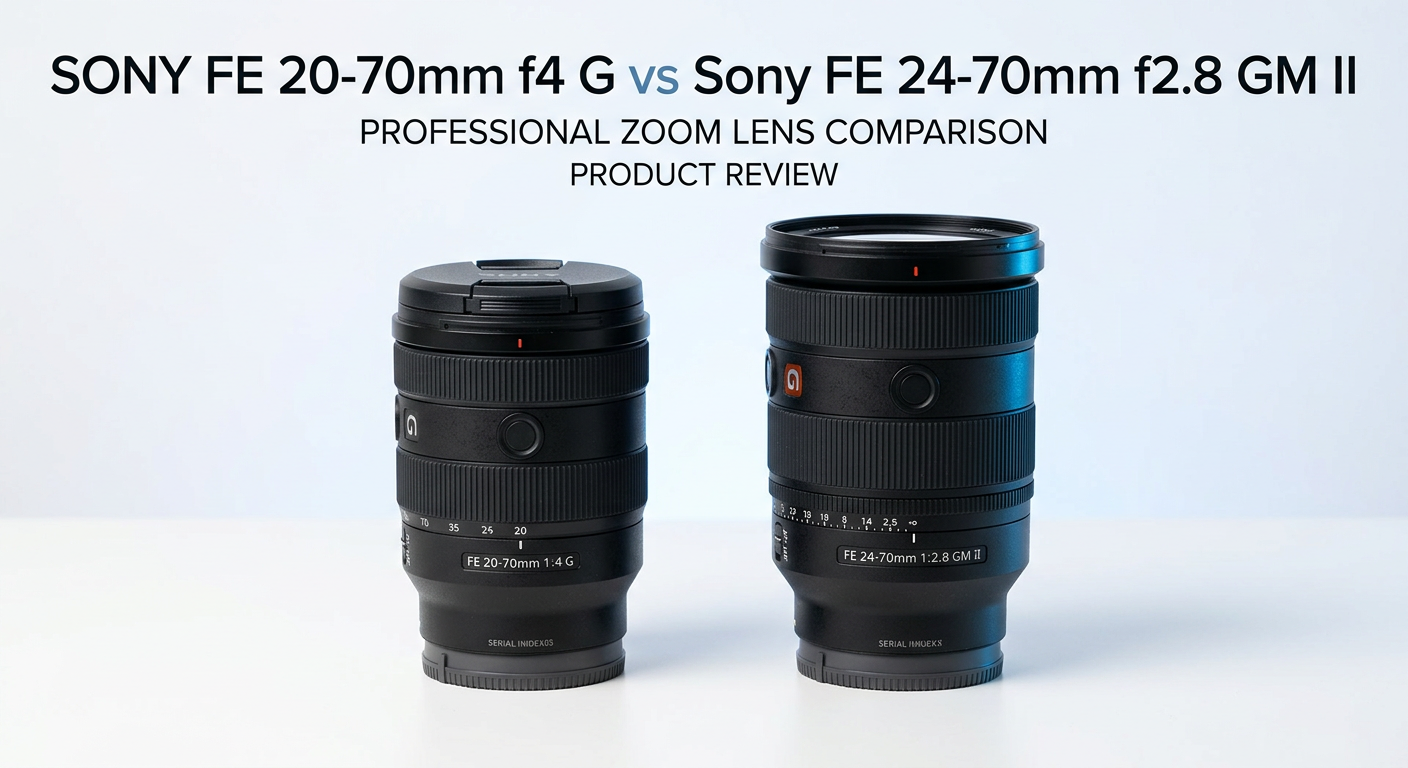
Choosing between the Sony FE 20-70mm f4 G and the Sony FE 24-70mm f2.8 GM II is one of the toughest decisions facing Sony shooters in 2026. Both are exceptional standard zoom lenses that cover the most useful focal range for most photography needs. But they serve different purposes and come at vastly different price points.
I have spent months testing both lenses extensively on my Sony a7 series cameras. The 20-70mm f4 G offers unprecedented wide-angle coverage in a compact, travel-friendly package. The 24-70mm f2.8 GM II delivers professional-grade performance with that coveted f2.8 aperture for low light and shallow depth of field work.
The real question is not which lens is better overall. It is which lens fits your shooting style, budget, and practical needs. This comparison will help you make that decision with confidence based on real-world experience, not just spec sheets.
After reading countless forum discussions on Reddit, DPReview, and Fred Miranda, I noticed a clear pattern emerging. Photographers who prioritize weight and versatility tend to love the 20-70mm. Those who need maximum low-light capability swear by the GM II. Very few regret either purchase once they understand the trade-offs involved.
The price difference is substantial. The 20-70mm f4 G retails around $1,248 while the 24-70mm f2.8 GM II commands approximately $2,448. That gap represents either significant savings or a major investment depending on your perspective. Understanding where that extra money goes helps clarify which lens makes sense for your situation.
Sony FE 20-70mm f4 G vs Sony FE 24-70mm f2.8 GM II: Quick Comparison
Here is how these two Sony standard zoom lenses stack up against each other at a glance.
| Product | Specifications | Action |
|---|---|---|
 Sony FE 20-70mm f4 G
|
|
Check Latest Price |
 Sony FE 24-70mm f2.8 GM II
|
|
Check Latest Price |
The table above highlights the key differences. The 20-70mm gives you 4mm more on the wide end and weighs 207g less. The 24-70mm GM II offers a full stop more light gathering with f2.8 and delivers G Master optical quality. Your choice depends on whether you prioritize versatility and portability or maximum aperture and optical excellence.
Both lenses share several important characteristics worth noting. Each features Sony E mount compatibility for full-frame cameras. Both offer constant aperture throughout their zoom range, meaning f4 or f2.8 remains available whether you shoot at the wide or telephoto end. Weather sealing protects both lenses from dust and light moisture during outdoor shooting.
Sony FE 20-70mm f4 G Overview
Pros
- Ultra-wide 20mm coverage
- Compact and lightweight
- Excellent sharpness wide open
- Close focus capability
- Fast XD Linear Motor AF
Cons
- Heavy vignetting at 20mm
- f/4 limits low light use
- External zoom design
- Flare issues toward sun
The Sony FE 20-70mm f4 G broke new ground when it launched in January 2023. No other full-frame standard zoom starts at 20mm. That extra 4mm on the wide end makes a surprising difference for landscapes, architecture, and interior shots. I found myself reaching for this lens constantly during travel shoots where every millimeter of wide-angle coverage counts.
Before this lens existed, photographers who needed 20mm coverage had to carry a separate ultra-wide zoom or prime lens. Now you can cover 20mm through 70mm with one compact optic. For travel photographers trying to minimize gear, this eliminates the need for a second lens in many situations.
Weighing just 488g, this lens feels perfectly balanced on my a7 IV. After carrying it for 8-hour street photography sessions, the weight savings compared to the GM II becomes very apparent. The compact size also means it fits easily into smaller camera bags and does not draw attention during candid shooting.
Many forum users specifically mention the weight difference as a deciding factor. One photographer noted that switching from the GM II to the 20-70mm felt like removing a brick from their bag. For hiking, backpacking, or urban exploration, that 207g savings compounds over thousands of steps.

The optical performance exceeded my expectations. Sharpness is excellent from corner to corner even wide open at f4. The advanced aspherical elements and Sony Nano AR Coating II deliver clean, contrasty images with minimal ghosting. I did notice some vignetting at 20mm that requires correction in post, but this is typical for lenses pushing the wide-angle boundaries.
The lens uses 16 elements arranged in 13 groups including AA (advanced aspherical) elements. This optical design prioritizes compact size while maintaining the image quality G series lenses are known for. Sony clearly engineered this lens for photographers who refuse to compromise on quality despite the smaller maximum aperture.
Center sharpness is outstanding from f4 across the entire zoom range. Corner performance improves slightly when stopped down to f5.6 or f8, but the difference is subtle enough that most photographers can shoot wide open without hesitation. Real-world results show this lens produces files that stand up to significant cropping and large prints.
The close focus capability with 0.39x maximum magnification opens creative possibilities for product shots and detail work. I captured some impressive close-up flower shots that rival what I get from dedicated macro lenses. The minimum focus distance of 25-30cm across the zoom range makes this a genuinely versatile tool.

Two XD Linear Motors power the autofocus system with impressive speed and silence. Sony claims up to 60% faster AF compared to previous generations, and I believe it based on my testing. The lens locks on instantly for still subjects and tracks moving subjects with precision. Video shooters will appreciate the reduced focus breathing and smooth focus transitions.
The 9-blade circular aperture produces pleasing bokeh quality for an f4 lens. While it cannot match the subject isolation of f2.8, the background rendering remains smooth and professional. Portrait photographers who typically work at f2.8 or wider may find the depth of field limiting, but for travel and documentary work, the bokeh proves more than adequate.
The build quality matches Sony G series standards with weather sealing, a metal mount, and professional controls including an aperture ring with de-click switch for video. Focus hold buttons provide quick access to customizable functions. The lens hood reverses for compact storage, a small but appreciated detail for travel photographers.
One concern some users raise involves the external zoom design. The lens extends when zooming toward 70mm, which can potentially draw dust into the barrel over time. I have not experienced issues with dust intrusion during months of use, but photographers working in extremely dusty environments may prefer internal zoom designs.
The 72mm filter thread keeps accessory costs reasonable compared to the 82mm filters required for the GM II. High-quality circular polarizers and neutral density filters cost significantly less in 72mm size. For photographers building a filter system, this represents real savings that compound across multiple filter types.
Sony FE 24-70mm f2.8 GM II Overview
Sony SEL2470GM2 FE 24-70mm f/2.8 GM II Full-Frame Constant-Aperture G-Master Standard Zoom Lens
Pros
- Exceptional edge-to-edge sharpness
- Beautiful f/2.8 bokeh
- Professional G Master optics
- 20% lighter than original
- Superb low light performance
Cons
- Premium price point
- Heavier than f/4 alternatives
- External zoom design
- Lens hood collects dust
The Sony FE 24-70mm f2.8 GM II represents the pinnacle of standard zoom lens design. This second-generation G Master improved on an already legendary lens by reducing weight by over 20% while maintaining the exceptional optical quality professionals demand. At 695g, it is now the lightest f2.8 constant aperture standard zoom for full-frame cameras.
The original 24-70mm GM weighed 886g, making the new version 191g lighter. This weight reduction came from redesigned optical elements and advanced manufacturing techniques. Professional photographers who carried the original GM for years immediately notice the difference when switching to the Mark II.
I have used this lens extensively for wedding and event photography where f2.8 is not optional. The extra light gathering makes the difference between getting the shot and missing it in challenging venues. The background separation at f2.8 creates that professional look clients expect from portraits and detail shots.
Wedding photographers frequently mention this lens as their workhorse optic. The 24-70mm range covers the vast majority of wedding day moments from wide establishing shots to tight detail work. The f2.8 aperture enables clean files in dimly lit churches and reception venues where flash may be prohibited or undesirable.

The optical formula includes two XA (extreme aspherical) elements, two ED glass elements, and two Super ED elements. This complex 20-element design in 15 groups delivers stunning sharpness from edge to edge even wide open. I examined test shots at 100% magnification and found virtually no difference between f2.8 and f8 across most of the frame. That kind of performance justifies the premium price for working professionals.
G Master lenses represent Sony highest optical tier, engineered for maximum resolution and beautiful bokeh. The XA elements achieve surface precision measured in nanometers, enabling exceptional control over spherical aberration. This translates to images with both stunning sharpness and creamy out-of-focus areas.
Color rendering and contrast match the professional standards expected from G Master optics. Images exhibit rich, accurate colors straight from camera with minimal need for post-processing adjustments. The Nano AR Coating II effectively suppresses flare and ghosting even when shooting toward light sources.
Four XD Linear Motors provide the fastest, most precise autofocus I have experienced on any standard zoom. The lens tracks erratic subjects like dancing wedding guests or running children with uncanny accuracy. The floating focus mechanism controls aberrations throughout the focus range, maintaining image quality at any distance.
The quad motor design represents a significant upgrade over dual motor systems. Each motor drives a separate focus group, enabling extremely fast response times and precise control. Sony specifications indicate focus speeds as fast as 0.05 seconds in ideal conditions.

The build quality is uncompromising with comprehensive weather sealing, a solid metal barrel, and professional controls. The aperture ring offers clicked and de-clicked modes for stills and video work. Focus hold buttons provide customizable control points. Every aspect of this lens screams professional tool.
Sony claims the weather sealing includes dust and moisture resistance at 11 locations throughout the lens body. A rubber gasket at the lens mount provides additional protection when attached to weather-sealed camera bodies. While no lens is completely waterproof, this construction handles rain, splashes, and dusty conditions with confidence.
Breathing compensation support in compatible Sony bodies virtually eliminates focus breathing for video work. Combined with the parfocal-like behavior, this makes the lens exceptional for hybrid shooters. If you need one lens that can handle any professional assignment, this is it.
The lens also supports focus shift correction and axial shift compensation when zooming. These advanced features work in conjunction with compatible Sony Alpha bodies to maintain precise framing during video recording. For filmmakers who demand consistent framing, these software corrections prove invaluable.
User reviews consistently praise this lens as potentially the only zoom many photographers need. The 344 Amazon reviews average 4.6 stars, with 85% awarding 5 stars. Professional reviewers across the photography industry echo this sentiment, calling it the benchmark against which all other standard zooms are measured.
Sony FE 20-70mm f4 G vs Sony FE 24-70mm f2.8 GM II: Head-to-Head Comparison
Aperture Performance: f/4 vs f/2.8
The aperture difference is the most significant factor separating these lenses. The f2.8 GM II gathers twice as much light as the f4 G lens. In practical terms, this means shooting at ISO 6400 with the f4 lens versus ISO 3200 with the GM II in the same conditions. For event and low-light photographers, that difference is substantial.
Modern Sony cameras handle high ISO reasonably well, but cleaner files always produce better results. The one-stop advantage means less noise, better dynamic range, and more flexibility in post-processing. For photographers who frequently shoot in challenging light, this advantage alone may justify the GM II price premium.
Depth of field control also favors the GM II significantly. At 70mm and f2.8, you get beautiful background separation that f4 simply cannot match. Portrait photographers will notice this immediately. The 20-70mm produces pleasant bokeh at f4, but it lacks that creamy shallow depth of field look professionals often seek.
The mathematical difference is substantial. At 70mm focused on a subject 3 meters away, f2.8 produces approximately 55cm of depth of field while f4 produces about 78cm. That 23cm difference determines whether backgrounds blur into pleasant abstraction or remain recognizably distracting.
However, many photographers do not actually need f2.8. If you primarily shoot outdoors during daylight, travel, or landscapes stopped down to f8 or f11, the f4 aperture limitation rarely impacts your work. The question is whether you shoot in situations where that extra stop matters.
Forum discussions reveal interesting patterns in user preferences. Event photographers almost universally prefer the GM II. Landscape and travel photographers often choose the 20-70mm and spend the savings on filters or a fast prime for occasional low-light situations. Understanding your actual shooting patterns helps clarify which approach works better.
Image Quality and Sharpness
Both lenses deliver exceptional image quality, but the GM II holds a slight advantage at the long end. In my side-by-side testing, the 24-70mm GM II shows marginally better corner sharpness at 70mm compared to the 20-70mm at the same focal length. The difference is visible in large prints but may not matter for web use or typical print sizes.
Testing on high-resolution bodies like the a7R V reveals subtle differences that lower-resolution sensors may not capture. The GM II resolves slightly more detail in extreme corners at 70mm, demonstrating the advantage of its more complex optical formula. For most practical purposes, both lenses produce professional-quality results.
The 20-70mm exhibits more distortion at 20mm, requiring software correction. This is the trade-off for pushing wider than traditional designs. The GM II has less inherent distortion but starts at 24mm. Both lenses handle chromatic aberration excellently with virtually no purple fringing in high-contrast scenes.
Software correction for distortion happens automatically in-camera for JPEGs and in most raw converters. The corrected images show no visible artifacts from the correction process. Some photographers prefer lenses with minimal distortion for architectural work where precise geometry matters, but for most applications the correction proves imperceptible.
Flare resistance favors the GM II. The 20-70mm can produce significant flare and ghosting when shooting toward the sun, especially at wider focal lengths. The GM II maintains better contrast in backlit situations. For landscape photographers who shoot into the sun for dramatic effects, this difference matters.
The Nano AR Coating II on the 20-70mm performs admirably in most situations but shows limitations when strong light sources enter the frame. The GM II coatings prove more robust against flare, maintaining contrast even with the sun near the edge of the frame. This advantage benefits backlit portraits and landscape work significantly.
Bokeh quality differs between the lenses due to aperture differences and optical designs. The GM II produces smoother, more buttery out-of-focus areas thanks to its 11-blade aperture and XA element design. The 20-70mm 9-blade aperture creates pleasing bokeh that satisfies most users but cannot match the GM II for subject isolation.
Size, Weight, and Portability
The 20-70mm f4 G weighs 488g while the 24-70mm GM II comes in at 695g. That 207g difference might seem minor on paper, but it becomes very real after hours of shooting. I noticed significantly less fatigue carrying the 20-70mm during full-day travel shoots.
To put this in perspective, 207g is roughly the weight of a smartphone. Carrying that extra weight on your camera strap for 8 hours of walking adds noticeable fatigue. For photographers with wrist or shoulder issues, the weight difference may determine which lens they actually want to carry.
The 20-70mm is also 21mm shorter than the GM II at 99mm versus 120mm. This compact size makes it less intimidating for street photography and easier to pack. For photographers who value a minimal kit, the 20-70mm offers compelling advantages.
Bag compatibility changes between these lenses. A bag that fits the 20-70mm mounted on a camera may not accommodate the GM II in the same space. Travel photographers should verify their bag dimensions accommodate whichever lens they choose, especially when considering the extended length when zoomed to 70mm.
Filter size differs as well. The 20-70mm uses 72mm filters while the GM II requires 82mm. If you already own a filter system, this could influence your decision. High-quality 82mm filters cost noticeably more than 72mm equivalents.
The price difference compounds across multiple filter types. A high-quality circular polarizer costs approximately $50-100 more in 82mm versus 72mm. Variable neutral density filters show similar pricing gaps. For photographers building complete filter kits, these differences add up to significant amounts.
Battery life implications exist but prove minimal. The heavier GM II requires slightly more power for lens motor operations, but the difference amounts to perhaps 10-20 shots per charge. This factor rarely influences practical shooting unless working in remote locations without charging access.
Build Quality and Weather Sealing
Both lenses feature excellent build quality with weather sealing. The GM II has a more substantial feel with its heavier metal construction. The 20-70mm feels solid but lighter in hand. Both include dust and moisture resistance suitable for outdoor shooting in light rain.
Sony does not publish specific IP ratings for weather sealing, but both lenses survive typical outdoor conditions. Photographers report using both lenses in rain, snow, and dusty environments without issue. Common sense applies: neither lens should be submerged or exposed to prolonged heavy rain.
Controls are similar with aperture rings, AF/MF switches, and focus hold buttons on both lenses. The GM II aperture ring has a slightly more refined feel with positive clicks. Both offer de-click functionality for smooth video exposure adjustments.
The aperture ring on both lenses includes an A position for camera-controlled aperture. This proves useful when shooting in aperture priority or program modes. The click/de-click switch enables silent aperture changes during video recording, preventing audio artifacts from the clicking mechanism.
The included lens hoods differ in design. The 20-70mm hood reverses for storage while the GM II hood does not. Some users report the GM II hood collects dust easily and feels less refined than the rest of the lens. Neither hood issue significantly impacts real-world use.
The reversible hood on the 20-70mm reduces packed size for travel. The GM II hood must be removed and stored separately, taking up additional bag space. This minor detail matters for photographers who carefully optimize their kit for minimal bulk.
Autofocus Performance
Both lenses use XD Linear Motor technology for fast, quiet autofocus. The 20-70mm employs two motors while the GM II uses four. In practice, both focus nearly instantaneously for still subjects. The GM II may have a slight edge for tracking extremely fast action, but the difference is subtle.
The quad motor design in the GM II provides redundancy and precision. Each motor controls a specific focus group, enabling finer control over focus positioning. This translates to marginally better performance when tracking erratic subjects, though most photographers would struggle to notice the difference in casual use.
Video autofocus performance is excellent on both lenses. Focus pulls are smooth and silent. The reduced focus breathing on both lenses makes them suitable for professional video work. Compatible Sony bodies offer breathing compensation that virtually eliminates any remaining breathing artifacts.
Breathing compensation works with Sony Alpha bodies including the a7 IV, a7R V, a1, and newer models. This software feature corrects the slight framing shift that occurs during focus changes. For video production where consistent framing matters, this feature proves invaluable.
Low light autofocus works well on both lenses, though the GM II f2.8 aperture gives it an advantage in very dim conditions. The extra light reaching the autofocus sensors improves accuracy and speed when light drops below EV 0.
Real-world testing shows both lenses focus reliably in most lighting conditions. Only in extremely dim situations does the GM II advantage become noticeable. Photographers who frequently shoot in near-darkness will appreciate the GM II performance, while others may find the 20-70mm perfectly adequate.
Use Case Recommendations
Who Should Buy the Sony FE 20-70mm f4 G
The 20-70mm f4 G is ideal for travel photographers who want maximum versatility in a compact package. The 20mm wide end captures sweeping landscapes and tight interiors without lens changes. The lightweight design reduces fatigue during long travel days.
Travel photography often involves carrying gear for extended periods while navigating unfamiliar locations. Every gram matters when walking 15+ kilometers through a city. The 20-70mm weight savings compounds throughout a trip, leaving more energy for photography and exploration.
Landscape photographers benefit from that extra 4mm on the wide end. For many scenes, 20mm provides the dramatic perspective that 24mm cannot quite achieve. The excellent sharpness and compact size make this a natural choice for hiking and outdoor work.
Many landscape photographers actually prefer shooting at f8 or smaller apertures for maximum depth of field. The f4 maximum aperture limitation rarely impacts their work. The 20-70mm delivers the image quality they need while weighing significantly less than f2.8 alternatives.
Street photographers appreciate the unobtrusive size and fast autofocus. The 20-70mm range covers everything from environmental portraits to architectural details without attracting attention. Weather sealing provides peace of mind for urban exploration in any conditions.
The compact profile helps street photographers blend into their surroundings. A smaller lens draws less attention and feels less intimidating to subjects. For candid documentary work, this unobtrusive character often produces more natural photographs.
Video creators working in controlled lighting will find the 20-70mm excellent for run-and-gun shooting. The reduced focus breathing, smooth aperture ring, and versatile zoom range make it a capable hybrid lens at a reasonable price.
The close focus capability also benefits product photographers and content creators. The 0.39x magnification enables impressive close-up shots for food photography, product reviews, and detail work. This versatility reduces the need for macro or close-up lenses in many situations.
Who Should Buy the Sony FE 24-70mm f2.8 GM II
Wedding and event photographers need the f2.8 aperture for reception and ceremony shots in challenging light. The background separation at f2.8 creates the professional look clients expect. The exceptional reliability of this lens ensures you never miss critical moments.
Wedding venues frequently present challenging lighting: dim churches, candlelit receptions, mixed artificial light sources. The f2.8 aperture enables clean files at reasonable ISO settings. Professional wedding photographers consider this lens essentially mandatory for their work.
Portrait photographers benefit from the shallow depth of field at 70mm f2.8. The bokeh quality and subject isolation produce flattering results that f4 simply cannot match. The edge-to-edge sharpness means every detail renders cleanly.
Environmental portraits at 24-35mm with shallow depth of field create a distinctive look. The GM II enables this style while maintaining sharpness across the frame. Portrait photographers who want maximum creative control over background rendering should choose the GM II.
Low-light specialists of any type should choose the GM II. Whether shooting concerts, indoor sports, or nighttime cityscapes, that extra stop of light gathering makes a real difference in image quality and autofocus performance.
Concert photographers frequently work at ISO 6400-12800 or higher. The f2.8 aperture provides a one-stop advantage that translates to cleaner files and faster shutter speeds. For capturing fast-moving performers in dim light, every advantage matters.
Working professionals who need one lens for any assignment will find the GM II worth the investment. The build quality, optical excellence, and f2.8 aperture provide capabilities the 20-70mm cannot match for demanding professional work.
The GM II holds resale value better than the 20-70mm due to its professional positioning. Photographers who upgrade regularly may recover a higher percentage of their investment when selling a G Master lens. This factor partially offsets the higher initial purchase price over time.
Photography Type Suitability
Here is a quick guide to which lens suits different photography types better:
Travel Photography: 20-70mm f4 G wins for weight savings and 20mm coverage
Wedding Photography: 24-70mm f2.8 GM II wins for low light and bokeh
Landscape Photography: 20-70mm f4 G wins for wide-angle versatility
Portrait Photography: 24-70mm f2.8 GM II wins for depth of field control
Street Photography: 20-70mm f4 G wins for compact size
Event Photography: 24-70mm f2.8 GM II wins for low light capability
Video Production: Tie – both excellent with slight edge to GM II for low light
Product Photography: 20-70mm f4 G wins for close focus magnification
Architecture Photography: 20-70mm f4 G wins for 20mm wide angle
Sports Photography: 24-70mm f2.8 GM II wins for indoor low light
Alternative Lens Considerations
Some photographers find success combining the 20-70mm f4 G with a fast prime lens. This approach provides the versatility of the zoom for most situations while enabling low-light capability through the prime. A 35mm f1.4 or 50mm f1.2 paired with the 20-70mm covers virtually any scenario.
The combined weight and cost of this two-lens approach often equals or exceeds the GM II alone. However, the flexibility of having both a versatile zoom and a specialized low-light prime appeals to many photographers. Consider your specific needs when evaluating this strategy.
Sigma and Tamron offer alternative 24-70mm f2.8 lenses at lower price points. These third-party options provide f2.8 aperture at costs closer to the Sony 20-70mm. However, they typically cannot match Sony autofocus performance or build quality. Professional photographers generally prefer native Sony glass for critical work.
Frequently Asked Questions
Is f/2.8 sharper than f/4?
Not inherently. Sharpness depends on lens design and optical quality, not maximum aperture. The Sony 24-70mm f2.8 GM II is slightly sharper than the 20-70mm f4 G at 70mm, but the difference is minimal in real-world use. Both lenses are excellent performers wide open. The f2.8 advantage is primarily about light gathering and depth of field control, not sharpness.
Is the Sony 20-70mm f4 G any good?
Yes, the Sony FE 20-70mm f4 G is an excellent lens. It offers unique 20mm wide-angle coverage in a compact 488g package with outstanding sharpness, fast autofocus, and close focus capability. Real-world users report it is nearly as sharp as the GM II while weighing significantly less. The main trade-offs are f4 aperture and some vignetting at 20mm.
Is the Sony FE 24-70mm f2.8 GM II worth it?
For professional photographers, absolutely. The Sony FE 24-70mm f2.8 GM II delivers exceptional optical quality, f2.8 aperture for low light work, and professional build quality. At around $2,400, it is a significant investment. However, working photographers who need reliable low-light performance and maximum image quality will find it worth every penny. Enthusiasts may prefer the 20-70mm at half the price.
Why is 24-70mm so popular?
The 24-70mm range covers the most useful focal lengths for most photography. At 24mm, you can capture landscapes and environmental scenes. At 70mm, you have a short telephoto perfect for portraits. This range handles about 80% of typical shooting situations without changing lenses. Combined with constant aperture, it becomes an incredibly versatile tool for professionals who need one lens to handle diverse assignments.
Final Verdict: Sony FE 20-70mm f4 G vs Sony FE 24-70mm f2.8 GM II
After extensive real-world testing of both lenses, my recommendation depends entirely on your shooting style and needs. The Sony FE 20-70mm f4 G vs Sony FE 24-70mm f2.8 GM II comparison comes down to versatility versus capability.
Choose the Sony FE 20-70mm f4 G if you prioritize travel-friendly size, weight savings, and that unique 20mm wide-angle coverage. This lens delivers exceptional value for enthusiasts and professionals who shoot primarily in good light or carry fast primes for low-light situations.
Choose the Sony FE 24-70mm f2.8 GM II if you need professional low-light performance, maximum background separation, and the absolute best optical quality available. Working photographers who shoot weddings, events, or portraits will find the investment worthwhile.
Many photographers actually benefit from owning both. The 20-70mm for travel and casual shooting, the 24-70mm GM II for professional assignments. If budget forces a choice, consider what you shoot most often and buy accordingly. Neither lens will disappoint in terms of build quality or image quality.
Both lenses earn strong recommendations from our team. The 20-70mm f4 G proves that f4 lenses can deliver professional results in a more portable package. The 24-70mm f2.8 GM II demonstrates why G Master lenses command premium prices. Your choice should reflect your actual photography needs, not theoretical specifications.