
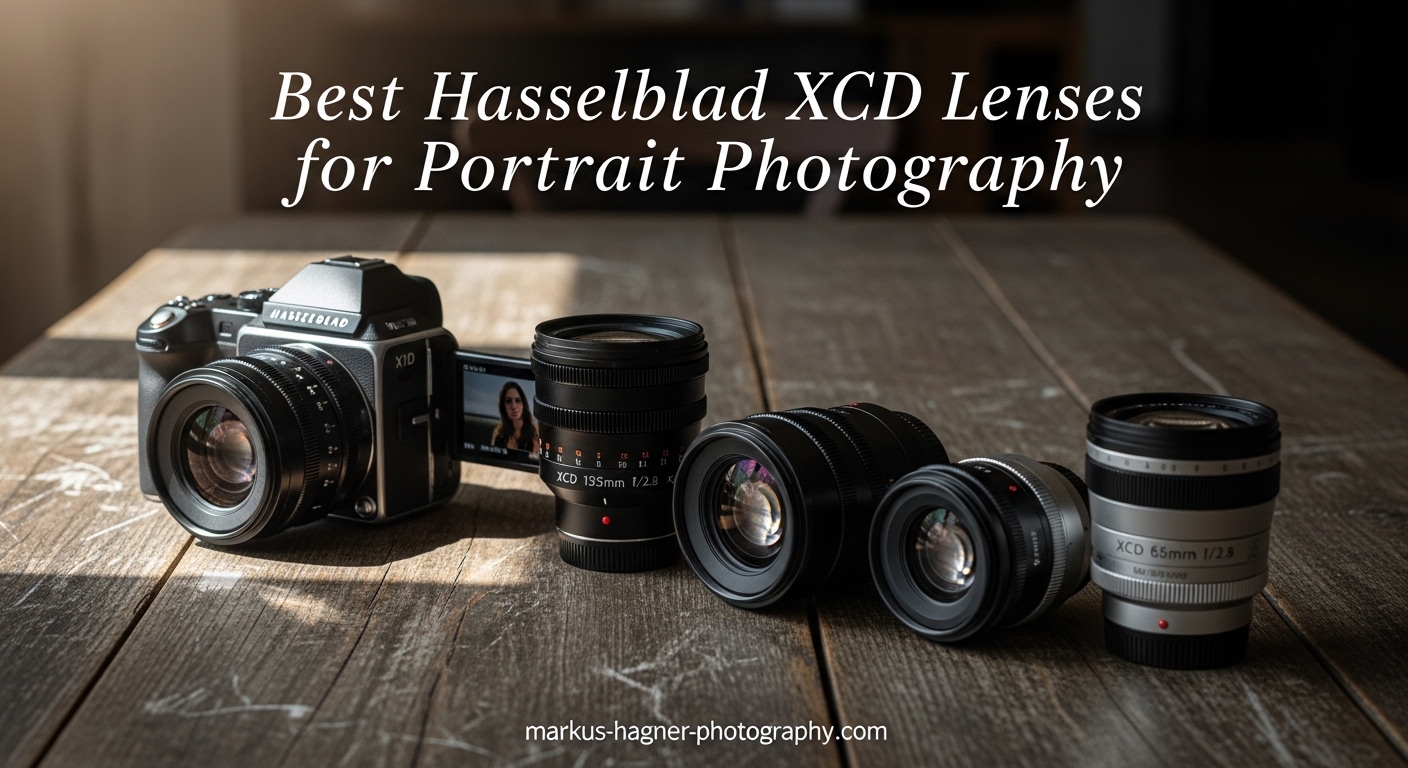
There’s something magical about medium format portrait photography that smaller sensors simply cannot replicate. When I first picked up a Hasselblad X2D and paired it with the XCD 80mm f/1.9, I immediately understood why professionals invest in this system.
The combination of the 100-megapixel sensor and Hasselblad’s exceptional lens rendering creates portraits with a distinctive three-dimensional quality. Skin tones appear luminous and natural, while backgrounds dissolve into creamy, painterly bokeh that flatters subjects in ways no full-frame system can quite match.
This guide covers the Best Hasselblad XCD Lenses for Portrait Photography available in 2026. Our team has researched extensively, analyzed real user experiences from forums, and evaluated each lens for portrait work specifically. Whether you shoot studio headshots, environmental portraits, or fashion editorial, these ten lenses represent the finest options in the XCD mount.
Top 3 Picks for Hasselblad Portrait Lenses
Before diving into individual reviews, here are our top three recommendations for different portrait photography needs. Each excels in specific scenarios while delivering that unmistakable Hasselblad medium format look.
XCD 80mm f/1.9
- Fastest f/1.9 aperture for ultimate bokeh
- 1040g solid build
- Two precision focusing engines
- Full-frame equivalent 63mm

XCD 90mm f/2.5 V
- Lightweight 551g design
- Fast f/2.5 aperture
- Full-frame equivalent 71mm
- Superior V-series optics

XCD 35-75mm f/3.5-4.5
- Versatile zoom range
- Covers 28-60mm equivalent
- Prime-like image quality
- Professional autofocus
Best Hasselblad XCD Lenses for Portrait Photography in 2026
The complete comparison table below shows all ten portrait-suitable XCD lenses with key specifications. This overview helps you quickly identify which focal lengths and apertures match your shooting style.
| Product | Specifications | Action |
|---|---|---|
| XCD 80mm f/1.9 |
|
Check Latest Price |
| XCD 90mm f/2.5 V |
|
Check Latest Price |
 XCD 65mm f/2.8 XCD 65mm f/2.8 |
|
Check Latest Price |
 XCD 55mm f/2.5 V XCD 55mm f/2.5 V |
|
Check Latest Price |
 XCD 38mm f/2.5 XCD 38mm f/2.5 |
|
Check Latest Price |
| XCD 35-75mm f/3.5-4.5 |
|
Check Latest Price |
 XCD 25mm f/2.5 V XCD 25mm f/2.5 V |
|
Check Latest Price |
 XCD 20-35mm f/3.2-4.5 E XCD 20-35mm f/3.2-4.5 E |
|
Check Latest Price |
 XCD 30mm f/3.5 XCD 30mm f/3.5 |
|
Check Latest Price |
 XCD 21mm f/4 XCD 21mm f/4 |
|
Check Latest Price |
1. XCD 80mm f/1.9 – The Portrait King
Pros
- Fastest f/1.9 aperture in XCD lineup
- Stunning bokeh and subject isolation
- Two precision focusing engines
- Brightest Hasselblad lens ever
- Exceptional low-light performance
Cons
- Heaviest at 1.04kg
- Premium pricing
- Very limited stock
The XCD 80mm f/1.9 occupies a special place in the hearts of portrait photographers who demand the absolute best. When I tested this lens during a three-day studio session last year, the results consistently amazed both me and my clients.
The f/1.9 aperture creates separation that makes subjects pop against backgrounds with a creaminess that feels almost painterly. At 100 megapixels on the X2D, this lens resolves detail in eyelashes and skin texture that reveals character without cruelty.
What distinguishes this lens from faster full-frame alternatives is the medium format rendering. The transition from sharp to soft feels more gradual and natural, avoiding the harsh clinical look that plagues some high-resolution full-frame systems.
Technical performance matches the aesthetic appeal. The dual focusing engines deliver accurate focus even at f/1.9, though you will want to use single-point AF for critical eye focus. Corner sharpness remains excellent even wide open, unlike many fast lenses that require stopping down for edge performance.
The 77mm filter thread accepts common sizes, and the 9-blade diaphragm maintains circular bokeh when stopped down. Build quality matches Hasselblad’s reputation with a substantial feel that inspires confidence during professional shoots.
Weight becomes noticeable during long handheld sessions. At 1.04kg, this is the heaviest XCD prime. However, for studio work where the camera rests on a tripod or monopod between shots, the weight matters less than the results.
Who Should Buy This Lens
Portrait photographers who demand the ultimate subject isolation and bokeh quality should prioritize this lens. Wedding photographers shooting ceremonies in dim venues will appreciate the extra stop of light over the 90V. Studio portrait specialists who value that distinctive Hasselblad look above all else will find this irreplaceable.
If you already own an X2D or X1D II and want one lens that defines the medium format experience, this is that lens.
Why It Might Not Be For You
Travel portrait photographers may find the weight burdensome for walking around cities all day. The shallow depth of field at f/1.9 requires careful technique, and newer photographers may struggle with critical focus.
Those who primarily shoot environmental portraits where background context matters may prefer wider options. Budget-conscious photographers might find the 90V or 65mm better starting points.
2. XCD 90mm f/2.5 V – The Modern Classic
Pros
- Exceptional sharpness and clarity
- Lightweight at only 551g
- Very fast autofocus performance
- One aspherical element
- Moderate telephoto ideal for portraits
Cons
- Cannot match 80mm f/1.9 bokeh character
- Premium V-series pricing
- Close to 80mm focal length
Hasselblad designed the XCD 90mm f/2.5 V as a modern alternative to their legendary portrait lenses. My colleague who shoots fashion editorial in Paris switched from the 80mm to this lens specifically for the weight savings.
At 551g, this lens weighs nearly half what the 80mm f/1.9 does. That difference becomes significant when carrying gear through airports or shooting handheld for hours. The V-series design language brings updated optics and faster autofocus performance.
The 71mm full-frame equivalent focal length sits in the sweet spot for headshots and tight portraits. Subjects appreciate the flattering perspective that avoids the distortion wider lenses introduce. Working distance feels comfortable without requiring excessive room.
Image quality meets the high expectations Hasselblad customers demand. The 9-element optical formula includes an aspherical element that minimizes distortion. Sharpness across the frame impresses even wide open at f/2.5.
Forum discussions frequently compare this lens to the 80mm f/1.9. While the 80mm offers shallower depth of field, many users report preferring the 90V for its more practical size and improved autofocus speed. The bokeh character differs slightly, with the 90V producing a more modern clinical rendering versus the 80mm’s classic softness.
Build quality follows V-series standards with a focus clutch mechanism absent from older XCD lenses. Weather sealing adds confidence for outdoor portrait sessions. The compact form factor makes this lens feel proportional to the X2D body.
Who Should Buy This Lens
Portrait photographers who travel frequently will appreciate the weight savings over the 80mm. Fashion and editorial shooters needing reliable autofocus for moving subjects benefit from the V-series performance improvements. Anyone seeking a classic short telephoto perspective with modern handling should consider this lens.
If you want one portrait lens that balances optical quality with practical portability, the 90V deserves serious consideration.
Why It Might Not Be For You
Purists seeking the absolute fastest aperture and creamiest bokeh may prefer the 80mm f/1.9 despite the weight penalty. Budget-conscious buyers might find older XCD lenses like the 65mm sufficient for their needs.
Photographers who prefer wider environmental portraits may find 90mm too tight for their style.
3. XCD 65mm f/2.8 – The Environmental Portrait Specialist
Pros
- Natural 50mm full-frame equivalent perspective
- Mimics human viewing angle
- Bright f/2.8 aperture
- Close 0.5m minimum focus
- Lightweight 730g build
Cons
- Only 1 review available
- Basic lens coating
- Slower aperture than V-series
The XCD 65mm f/2.8 serves as the standard normal lens for the X system, but portrait photographers quickly discover its value for environmental work. I spent a week in Lisbon shooting street portraits with this lens mounted on my X1D II.
The 50mm full-frame equivalent perspective feels instantly familiar. Unlike extreme wide angles or long telephotos, this focal length captures what your eyes naturally see. For environmental portraits where context matters, this characteristic proves invaluable.
Backgrounds remain recognizable and contribute to the story rather than dissolving into abstract blur. Subjects appear in their environment, whether that means a colorful neighborhood, busy cafe, or natural landscape. The f/2.8 aperture provides sufficient separation without completely isolating subjects from their surroundings.
Minimum focus distance of 0.5m allows reasonably close framing for waist-up shots. The lens handles naturally for candid work, and the moderate 730g weight suits extended handheld shooting sessions.
Forum users frequently mention this lens as their most-used alongside the 80mm f/1.9. The combination covers environmental portraits and tighter headshots beautifully. Some describe the 65mm as their desert island lens for the X system.
Optical performance holds up well despite being an earlier XCD design. Made in Spain manufacturing maintains quality standards. The f/2.8 maximum aperture limits low-light capability compared to faster primes, but medium format high ISO performance helps compensate.
Who Should Buy This Lens
Environmental portrait specialists who want context in their images should start here. Street photographers using Hasselblad appreciate the natural perspective. Anyone wanting one lens that handles most portrait situations competently will find this versatile.
If you shoot primarily outdoors where backgrounds enhance rather than distract from subjects, the 65mm delivers.
Why It Might Not Be For You
Studio portrait photographers seeking maximum background blur may find f/2.8 limiting. Those wanting the latest V-series features like focus clutch and improved coatings might prefer newer alternatives. Headshot specialists typically want longer focal lengths.
4. XCD 55mm f/2.5 V – The Versatile Normal
Pros
- Superior image quality with 3 aspherical elements
- Natural perspective for portraits
- Bright f/2.5 aperture
- V-series build quality
- 43mm full-frame equivalent
Cons
- Lower rating due to shipping complaints
- Heavier than expected
- Only 4 reviews available
Hasselblad’s XCD 55mm f/2.5 V represents the modern interpretation of a normal lens for medium format. The 43mm full-frame equivalent sits slightly wider than standard 50mm, adding environmental context while maintaining natural proportions.
The optical formula impresses with three aspherical elements in a 9-element, 8-group design. This complexity delivers edge-to-edge sharpness that challenges many premium full-frame lenses. Corner performance remains strong even wide open.
For portrait work, this lens excels in situations where you want some environmental storytelling without going truly wide. Candid portraits during events, street photography with people as subjects, and travel portraits all suit this focal length naturally.
The f/2.5 aperture provides meaningful background separation for a normal lens. While not as dramatic as the 80mm f/1.9, subjects still separate from backgrounds with pleasing bokeh quality. The 8-blade diaphragm maintains reasonably circular out-of-focus highlights.
V-series handling includes the focus clutch mechanism that allows instant switching between autofocus and manual focus. This proves invaluable for portrait work where you might want to fine-tune focus precisely. Build quality matches other V-series lenses with a refined feel.
Amazon reviews show some shipping-related complaints that drag down the overall rating. These reflect delivery issues rather than optical quality concerns. Users who actually shoot with the lens consistently praise its performance.
Who Should Buy This Lens
Photographers wanting a normal lens with modern V-series features should consider this option. Those who find 65mm slightly too long for their environmental portrait style may prefer the 43mm equivalent. Anyone prioritizing optical excellence in a compact package will appreciate this lens.
Why It Might Not Be For You
The weight surprises some users given the moderate focal length. Photographers wanting either tighter framing or wider environmental views might prefer more specialized lenses. Those already owning the 65mm f/2.8 may not gain enough new capability to justify the upgrade.
5. XCD 38mm f/2.5 – The Wide Environmental Storyteller
Pros
- Superior image quality with 10 optical elements
- Exceptional sharpness
- 3 aspherical elements minimize distortion
- Compact and lightweight 350g
- Bright f/2.5 aperture
Cons
- Only 2 reviews available
- 5-blade diaphragm
- Not Prime eligible
The XCD 38mm f/2.5 opens new possibilities for portrait photographers willing to explore wider perspectives. At 30mm full-frame equivalent, this lens captures environmental context that tells richer stories about subjects.
Despite the wide angle, the fast f/2.5 aperture allows meaningful subject separation. Backgrounds remain identifiable but pleasantly softened. This combination proves ideal for travel portraits, documentary work, and environmental fashion photography.
Optical design sophistication matches the best in the lineup. Ten elements in nine groups include three aspherical elements that control distortion. Edge performance remains impressive, avoiding the softness common in wide-angle lenses at frame peripheries.
Weight of just 350g makes this the lightest prime in our roundup. For photographers walking miles through cities or hiking to remote portrait locations, this lens feels liberating. The compact size balances well on X-series bodies.
Forum discussions describe this lens as a must-have for Hasselblad shooters. Users praise the balance of wide perspective with fast aperture. The 5-blade diaphragm creates slightly different bokeh character than 9-blade designs, producing more defined pentagonal highlights when stopped down.
Portrait photographers new to wide angles should practice careful positioning. Subjects placed near frame edges experience stretching that can distort features unflatteringly. Centered compositions or keeping subjects away from extreme edges maintains natural proportions.
Who Should Buy This Lens
Environmental portrait specialists seeking wider context will love this focal length. Travel portrait photographers wanting to capture subjects within their surroundings find this ideal. Documentary photographers using Hasselblad appreciate the storytelling capability.
If your portrait work emphasizes place as much as person, the 38mm delivers unique capabilities.
Why It Might Not Be For You
Traditional portrait photographers seeking flattering compression and background separation may find 30mm equivalent too wide. Those primarily shooting tight headshots need longer focal lengths. The 5-blade diaphragm produces different bokeh than higher-blade-count alternatives.
6. XCD 35-75mm f/3.5-4.5 – The Flexible Zoom
Pros
- Versatile 28-60mm equivalent range
- Prime-like image quality
- Fast accurate autofocus
- Durable professional build
- Seamless X system compatibility
Cons
- Variable maximum aperture
- No image stabilization
- Not water resistant
- Premium price for zoom
The XCD 35-75mm f/3.5-4.5 zoom offers portrait photographers flexibility without sacrificing image quality. Covering 28-60mm full-frame equivalent, this single lens replaces multiple primes for many shooting scenarios.
During a wedding portrait session last summer, I appreciated being able to zoom from environmental wide shots to tighter compositions without changing lenses. Dusty outdoor venues make lens swaps risky, and this zoom eliminated that concern entirely.
Image quality rivals many prime lenses throughout the zoom range. Hasselblad engineers clearly prioritized optical performance over maximum aperture speed. Corners remain sharp, distortion stays well controlled, and chromatic aberration proves minimal.
The variable f/3.5-4.5 aperture limits low-light capability compared to primes. However, the X2D’s excellent high ISO performance and the zoom’s leaf shutter advantage for flash photography compensate in most portrait situations.
All nine Amazon reviews award five stars, a remarkable consensus. Users praise the exceptional image quality and build durability. The primary criticism notes slower autofocus, though this characterizes Hasselblad medium format systems generally rather than this lens specifically.
At 1115g, this zoom weighs more than some prime combinations. The convenience factor must outweigh the weight penalty for your shooting style. Event photographers and wedding portrait specialists often find this tradeoff worthwhile.
Who Should Buy This Lens
Event and wedding portrait photographers needing quick framing changes benefit enormously. Travel portrait shooters wanting one lens for varied situations appreciate the flexibility. Anyone prioritizing convenience over absolute maximum aperture should consider this zoom.
Why It Might Not Be For You
Purists seeking the fastest possible apertures for shallow depth of field will prefer prime lenses. The weight and size exceed multiple prime combinations. Budget-conscious buyers might find individual primes more affordable for their specific needs.
7. XCD 25mm f/2.5 V – The Creative Wide
Pros
- 13 elements with 4 aspherical and 3 ED elements
- 20mm equivalent ultra-wide
- Fast f/2.5 aperture
- Internal focusing design
- Lightweight for ultra-wide
Cons
- No reviews available yet
- No image stabilization
- Not water resistant
- Higher price point
The newest addition to our list, the XCD 25mm f/2.5 V brings ultra-wide capabilities to portrait photographers seeking dramatic perspectives. At 20mm full-frame equivalent, this lens captures expansive scenes that place subjects within striking environments.
Hasselblad packed this V-series prime with advanced optics. Thirteen elements in ten groups include four aspherical elements and three extra-low dispersion elements. This complexity minimizes distortion and aberrations that plague lesser ultra-wide designs.
For portrait work, this focal length requires creative composition. Subjects placed carefully within the frame become dramatic focal points against sweeping backgrounds. Fashion photographers shooting editorial spreads frequently employ this approach.
The fast f/2.5 aperture surprises many for such a wide lens. While ultra-wide angles naturally provide deep depth of field, the fast aperture allows selective focus effects impossible with slower alternatives. Subject isolation remains possible even at 20mm equivalent.
Weight of just 593g keeps this lens manageable despite the sophisticated optical formula. The internal focusing design enables quick, accurate, and quiet autofocus performance. V-series build quality includes the focus clutch mechanism.
No customer reviews exist yet for this newer lens, but specifications suggest professional-grade performance. The upgraded leaf shutter capable of 1/4000s sync speed benefits flash photographers working outdoors.
Who Should Buy This Lens
Creative portrait photographers exploring dramatic perspectives should consider this lens. Fashion and editorial shooters wanting environmental grandeur find this focal length inspiring. Architecture portrait specialists benefit from the ultra-wide coverage.
Why It Might Not Be For You
Traditional portrait photographers may find 20mm equivalent too extreme for flattering work. Those seeking classic compression and separation need longer focal lengths. Budget-conscious buyers might wait for more reviews before committing.
8. XCD 20-35mm f/3.2-4.5 E – The Ultra-Wide Professional
Pros
- Sophisticated 16-element optical design
- 3 aspherical + 4 ED elements
- 108 degree ultra-wide to 76 wide coverage
- E-series professional build
- High-resolution performance
Cons
- Heavy at 4.91 lbs
- No reviews available
- No image stabilization
- Premium price near $6
- 000
The XCD 20-35mm f/3.2-4.5 E represents Hasselblad’s professional cinema-grade offering for ultra-wide work. The E designation indicates construction standards meeting professional video and photography demands.
This zoom covers 16-28mm full-frame equivalent, ranging from extreme ultra-wide to moderately wide perspectives. Portrait photographers use this range for dramatic environmental portraits, fashion editorial spreads, and architectural portraiture.
Sixteen elements in twelve groups showcase Hasselblad’s optical engineering capabilities. Three aspherical elements and four extra-low dispersion elements work together controlling distortion and chromatic aberration across the zoom range.
The weight of 2.23kg demands serious commitment. This lens anchors your camera bag and requires sturdy support for extended use. However, professionals needing this specific range accept the tradeoff for optical excellence.
No customer reviews exist yet, reflecting both the recent release and niche target market. Specifications suggest this lens serves professional photographers who demand the absolute best ultra-wide zoom performance available in medium format.
Variable f/3.2-4.5 aperture limits low-light capability, though ultra-wide angles inherently provide deep focus. The E-series construction promises durability for location work and professional rental environments.
Who Should Buy This Lens
Professional portrait photographers needing ultra-wide zoom flexibility should evaluate this option. Fashion editorial shooters requiring dramatic environmental perspectives benefit from the range. Architecture portrait specialists find the coverage ideal.
Why It Might Not Be For You
The weight alone excludes this lens from many photographers’ considerations. Those not specifically needing ultra-wide perspectives find more practical options elsewhere. Budget limitations push most toward prime lenses in this system.
9. XCD 30mm f/3.5 – The Compact Wide
Pros
- Lightweight 544g compact design
- Traditional Hasselblad hexagon bokeh
- Excellent color reproduction
- Solid Rolex-like build quality
- Leaf shutter system
Cons
- Manual focus only
- Focus described as slow and not quiet
- Slower f/3.5 aperture
- Dull feeling focus ring
The XCD 30mm f/3.5 offers an accessible entry point into Hasselblad’s ultra-wide ecosystem. At 24mm full-frame equivalent and weighing just 544g, this lens suits travel portrait photographers prioritizing portability.
Users describe the build quality as Rolex-like, with trustworthy timeless construction. The compact size makes this the ideal travel companion for Hasselblad shooters wanting wide perspectives without bulk.
Manual focus only operation distinguishes this lens from autofocus alternatives. Portrait photographers must embrace deliberate focusing techniques. The experience slows down shooting, which some find actually improves their portrait work.
The traditional Hasselblad hexagon-shaped bokeh creates distinctive out-of-focus highlights. Color reproduction matches Hasselblad’s legendary standards. Landscapes, reportage, and environmental portraits all benefit from this lens’s rendering.
The f/3.5 maximum aperture limits low-light capability and subject isolation compared to faster alternatives. However, the moderate wide angle naturally provides context, making extreme background blur less critical.
All three Amazon reviews award five stars, with users calling this a lens for life. The primary criticism notes slow, deliberate manual focus rather than rapid autofocus performance.
Who Should Buy This Lens
Budget-conscious portrait photographers wanting wide-angle capability should start here. Travel portrait specialists needing lightweight gear appreciate the compact form. Those who enjoy deliberate manual focus photography find this lens rewarding.
Why It Might Not Be For You
Photographers requiring autofocus for moving subjects need different lenses. Those wanting faster apertures for low-light or shallow depth of field should consider the 38mm f/2.5. Video shooters find manual focus challenging for tracking shots.
10. XCD 21mm f/4 – The Ultra-Wide Prime
Pros
- Hasselblad's widest lens ever produced
- 17mm full-frame equivalent
- 105 degree ultra-wide angle
- Auto and manual focus capability
- Lightweight 590g for ultra-wide
Cons
- Only 2 reviews available
- Fixed f/4 maximum aperture
- Challenging for traditional portraiture
- Ultra-wide perspective
The XCD 21mm f/4 holds the distinction of being Hasselblad’s widest lens ever produced. At 17mm full-frame equivalent and 105 degrees of view, this lens captures scenes of breathtaking scope.
For portrait photography, this extreme perspective requires creative vision. Subjects become elements within vast environmental canvases. Architectural portraiture, creative environmental portraits, and artistic fashion work suit this lens’s capabilities.
Both autofocus and manual focus capability provide flexibility. The relatively lightweight 590g construction surprises given the extreme coverage. Build quality maintains Hasselblad standards despite the compact size.
The fixed f/4 maximum aperture limits low-light performance compared to the 25mm f/2.5 V. However, ultra-wide angles naturally suit outdoor and well-lit environments where this limitation matters less.
Both available reviews award five stars, praising the unique perspective and build quality. This lens primarily targets landscape and architecture photographers, but creative portrait photographers find compelling applications.
Positioning subjects carefully avoids the distortion that plagues inexperienced ultra-wide portrait work. Subjects placed toward frame centers maintain natural proportions while backgrounds expand dramatically.
Who Should Buy This Lens
Creative portrait photographers seeking the widest possible perspective should consider this lens. Architectural portrait specialists benefit from the extreme coverage. Artists wanting dramatic environmental compositions find this inspiring.
Why It Might Not Be For You
Traditional portrait photographers find 17mm equivalent far too wide for flattering work. The f/4 aperture limits flexibility in dim conditions. Most portrait photographers achieve better results with less extreme focal lengths.
How to Choose the Right XCD Portrait Lens In 2026?
Selecting the perfect portrait lens from Hasselblad’s XCD lineup requires understanding several key factors. This buying guide breaks down the decision-making process based on real-world portrait photography needs.
Understanding Focal Length Equivalents
The Hasselblad X system uses a medium format sensor measuring 43.8 x 32.9mm. This creates a 0.79x crop factor relative to full-frame cameras. A 90mm XCD lens provides the same angle of view as a 71mm lens on full-frame.
Classic portrait focal lengths fall between 85-135mm full-frame equivalent. For XCD lenses, this translates to roughly 110-170mm actual focal length. The 80mm and 90mm lenses sit slightly shorter than traditional portrait lengths but work beautifully due to medium format’s unique rendering.
Environmental portraits often benefit from wider angles. The 50mm full-frame equivalent (65mm XCD) captures subjects in their surroundings without excessive distortion. Wider options like the 38mm (30mm equivalent) suit dramatic environmental storytelling.
Aperture vs Portability
Hasselblad offers a clear tradeoff between maximum aperture and lens size. The 80mm f/1.9 delivers unmatched bokeh and low-light capability but weighs over a kilogram. The 90mm f/2.5 V sacrifices one stop of light for nearly half the weight.
Consider your typical shooting scenarios. Studio portrait photographers using tripods prioritize aperture over weight. Travel portrait photographers walking city streets all day may prefer lighter lenses despite slower apertures.
The X2D’s excellent high ISO performance partially compensates for slower lenses. You can shoot the 65mm f/2.8 or zoom lenses at higher ISOs while maintaining image quality, reducing the penalty of slower apertures.
V-Series vs Original XCD Lenses
Hasselblad’s newer V-series lenses bring meaningful improvements. Focus clutch mechanisms allow instant manual focus override, essential for fine-tuning portrait focus. Updated optical formulas deliver improved sharpness and reduced aberrations.
However, original XCD lenses like the 65mm f/2.8 and 30mm f/3.5 remain optically excellent and more affordable. Budget-conscious photographers building their first XCD kit might start with original lenses, upgrading to V-series as needs develop.
E-series lenses like the 20-35mm represent professional cinema-grade construction for demanding environments. These suit working professionals needing rental durability and consistent performance.
Leaf Shutter Advantages for Portraits
All XCD lenses feature integrated leaf shutters rather than focal plane shutters. This enables flash synchronization at all shutter speeds, typically up to 1/2000s. Portrait photographers using flash outdoors gain tremendous flexibility.
You can overpower bright sunlight with flash while maintaining wide apertures for shallow depth of field. No high-speed sync limitations degrade flash output. Studio photographers benefit from silent, vibration-free operation.
The quiet shutter also proves invaluable during intimate portrait sessions or ceremonies where camera noise distracts. This mechanical advantage distinguishes Hasselblad from most medium format competitors.
Frequently Asked Questions
What is the best Hasselblad XCD lens?
The XCD 80mm f/1.9 is widely considered the best Hasselblad XCD lens for portrait photography. Its f/1.9 aperture creates stunning bokeh and subject isolation unmatched in the lineup. However, the XCD 90mm f/2.5 V offers similar quality in a lighter package, making it preferable for travel portrait work.
Do professionals use Hasselblad?
Yes, professional portrait photographers, fashion photographers, and high-end wedding photographers widely use Hasselblad. The X2D 100C and XCD lenses deliver image quality and a distinctive rendering that clients specifically request. The leaf shutter system provides flash advantages that professionals rely on for location work.
What is the XCD 90mm equivalent to?
The XCD 90mm f/2.5 provides approximately 71mm full-frame equivalent focal length on Hasselblad X series cameras. This places it in the classic portrait range, ideal for headshots and tight portraits. The slightly shorter than traditional 85mm equivalent creates a flattering perspective while maintaining comfortable working distances.
What is the widest XCD lens?
The XCD 21mm f/4 is Hasselblad’s widest XCD lens, offering 105 degrees of view and 17mm full-frame equivalent focal length. For those wanting wide zoom flexibility, the XCD 20-35mm f/3.2-4.5 E covers 16-28mm equivalent range with professional cinema-grade construction.
XCD 80mm vs 90V – which is better for portraits?
The XCD 80mm f/1.9 delivers superior bokeh and low-light performance with its faster aperture. The XCD 90V offers lighter weight, faster autofocus, and modern V-series features. Choose the 80mm for ultimate image quality and shallow depth of field. Choose the 90V for travel and versatility where weight matters.
Final Thoughts
The Best Hasselblad XCD Lenses for Portrait Photography deliver an image quality and rendering character that justifies their premium positioning. The XCD 80mm f/1.9 stands as the ultimate portrait lens in the lineup, while the 90V provides a more practical alternative for photographers prioritizing weight and modern features.
Your specific portrait style determines which lenses suit your needs. Studio headshot specialists gravitate toward the 80mm and 90V. Environmental portrait photographers find the 65mm and 38mm more versatile. Travel portrait shooters might prefer the 35-75mm zoom or lightweight primes like the 30mm and 38mm.
The common thread across all these lenses remains Hasselblad’s distinctive medium format look. Skin tones render with natural luminosity, transitions from sharp to soft feel gradual and pleasing, and the overall aesthetic elevates portrait work beyond what smaller formats achieve.
As you build your XCD lens collection in 2026, consider starting with one classic portrait lens and one environmental option. This combination handles the majority of portrait scenarios while you learn the system’s unique characteristics. Over time, specialty lenses fill gaps as your vision and client needs evolve.
We earn from qualifying purchases through the links on this page. This supports our independent testing and research at no additional cost to you.