
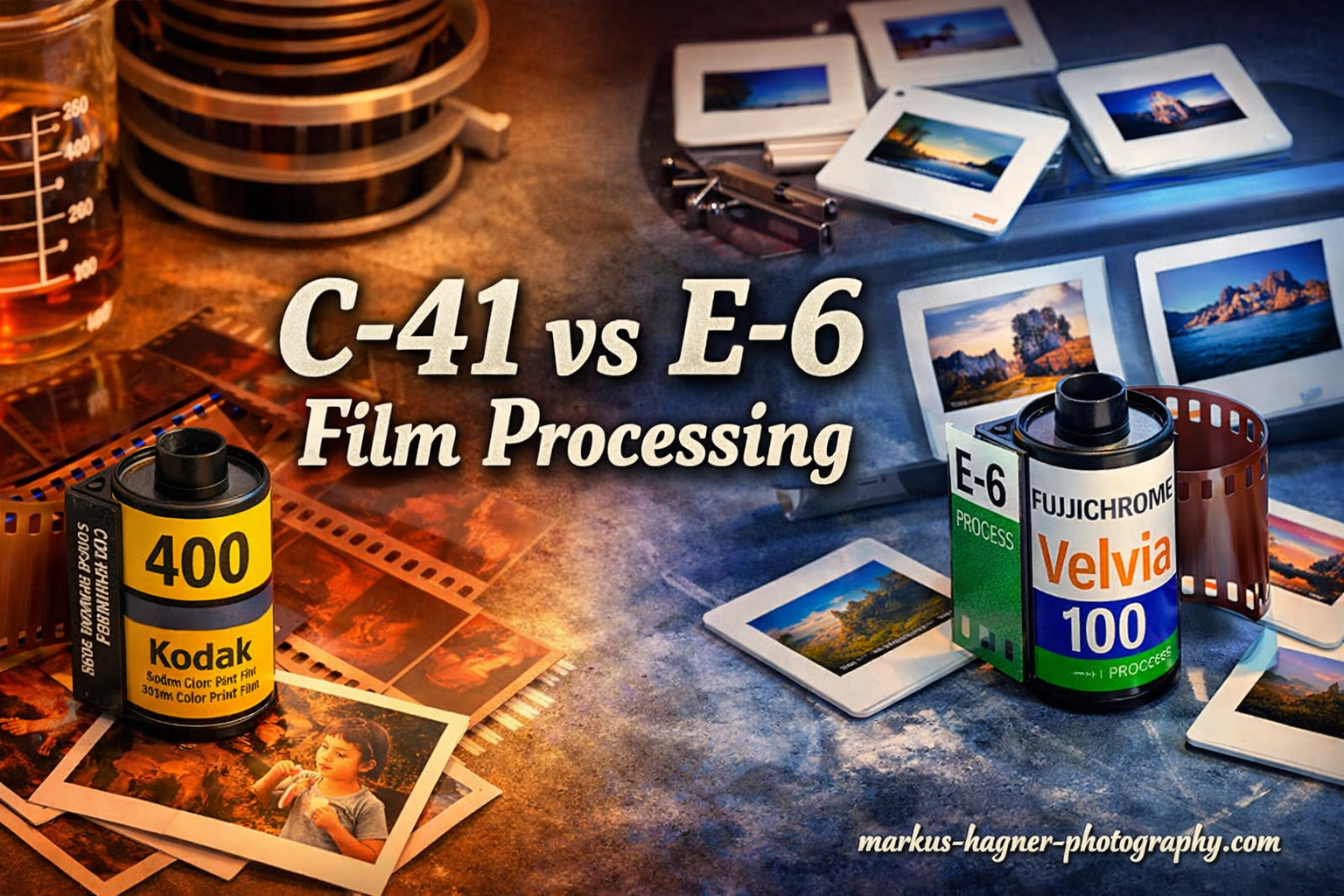
If you’re diving into film photography, understanding the difference between C-41 vs E-6 film processing is essential for choosing the right materials and getting the results you want. These two processes define how your color film comes to life, each producing distinctly different final images.
C-41 processing creates color negatives with an orange mask and broad exposure latitude, making it forgiving for beginners. E-6 processing produces positive transparencies (slides) with vibrant colors and high contrast, but demands precise exposure.
After processing hundreds of rolls in both formats over the past decade, I can tell you that neither is universally “better.” The right choice depends entirely on your creative goals, technical comfort level, and how you plan to use your images.
C-41 vs E-6 Film Processing: Quick Comparison
| Product | Specifications | Action |
|---|---|---|
 CineStill CS41 C-41 Developing Kit CineStill CS41 C-41 Developing Kit |
|
Check Latest Price |
 Unicolor E-6 Film Developing Kit Unicolor E-6 Film Developing Kit |
|
Check Latest Price |
This side-by-side comparison shows the key differences between representative chemistry kits for each process. The C-41 kit from CineStill offers more reusability and longer shelf life, while the E-6 kit from Unicolor provides everything needed for slide development in one package.
C-41 Color Negative Processing
Pros
- Easy to use with clear instructions
- Cost-effective compared to lab processing
- Color-coded chemicals prevent mix-ups
- Reusable for multiple rolls
- Extended shelf life
- Produces clean crisp negatives
- Good for beginners transitioning from B and W
Cons
- Requires temperature control
- Some users received powder instead of liquid
- Potential for expired chemicals affecting results
C-41 is the standard processing method for color negative film. Developed by Kodak in 1972, it produces the familiar orange-masked negatives that most photographers associate with color film. The orange mask helps correct color balance during printing or scanning.
The chemistry involves four main baths: developer, bleach, fixer, and stabilizer. The developer creates the latent image by reducing exposed silver halide crystals to metallic silver while simultaneously forming dye clouds in each color layer. The bleach converts the metallic silver back to silver halide, and the fixer removes it entirely, leaving only the dye image.
Temperature control is critical but forgiving. The standard temperature is 102°F (38.9°C), but many home processors successfully work within a few degrees either way. This tolerance is why many film enthusiasts find C-41 easier to process at home than E-6.
Popular C-41 film stocks include Kodak Portra, Kodak Gold, Kodak Ultramax, and Fujicolor. These films offer excellent exposure latitude, typically handling 2-3 stops of overexposure gracefully. This forgiving nature makes them ideal for beginners and situations with challenging or unpredictable lighting.
The wide dynamic range of C-41 negatives means you can recover details from shadows and highlights during scanning or printing. I’ve salvaged shots that looked completely lost, pulling details from underexposed shadows that would be gone forever on slide film.
E-6 Slide Film Processing
Pros
- Produces great results for E-6 slide film
- Complete kit with all necessary chemicals
- Reliable color slide development
- Perfect 5-star rating from users
Cons
- Limited stock availability
- Higher price point
- Small review count due to niche product
E-6 processing creates positive transparencies, commonly called slides or chromes. These are the films you can hold up to light and see a correctly colored, positive image. The process was introduced by Kodak in 1976 and produces some of the most vibrant, saturated images in film photography.
The chemistry is more complex than C-41, involving seven distinct baths: first developer, reversal bath, color developer, pre-bleach, bleach, fixer, and final rinse. The first developer creates a negative silver image, then the reversal bath exposes the remaining silver halide. The color developer then forms the positive dye image.
Temperature control is far more demanding. E-6 requires precise 100°F (38°C) with minimal tolerance. Even small variations can cause color shifts that affect the entire roll. Most home processors use sous vide immersion circulators to maintain exact temperatures.
Popular E-6 films include Kodak Ektachrome and Fujifilm Velvia. These films offer incredible color saturation and sharpness but have very narrow exposure latitude, typically only about half a stop of forgiveness. You need to nail your exposure or accept lost highlights and blocked shadows.

Despite the technical challenges, many photographers (myself included) find E-6 more satisfying to process at home. The chemistry is more stable than C-41, meaning less worry about exhausted developers causing color casts. When you pull a perfectly developed slide from the tank, the immediate positive feedback is incredibly rewarding.
C-41 vs E-6: Head-to-Head Comparison
Processing Difficulty
C-41 wins on simplicity. With fewer steps and more temperature tolerance, it’s the easier process to learn. However, the chemistry exhausts faster and can produce color casts if not fresh. Many Reddit users report that E-6 is actually easier to get right consistently because the chemistry is more stable.
From the r/Darkroom community: “IMO E6 is easier to get right at home versus C41. Even with extreme attention to detail and a sous vide I still got minor color casts with C41.” This is a common sentiment among experienced home processors.
Exposure Latitude and Dynamic Range
C-41 color negative film offers significantly more exposure latitude, typically 2-3 stops of overexposure tolerance. This makes it ideal for situations where lighting is unpredictable or when you’re learning film photography.
E-6 slide film demands precision. With only about half a stop of latitude, you need accurate metering and consistent technique. The reward is incredibly detailed highlights and rich, saturated colors that negatives simply cannot match.
Color Characteristics
C-41 negatives produce natural, pleasing colors with excellent skin tone rendering. The orange mask can make color grading more complex during scanning, but modern software handles this well. Colors tend to be more muted and naturalistic.
E-6 slides offer vivid, saturated colors that pop off the light table. Velvia is famous for its deep greens and blues, making it a favorite for landscape photography. Ektachrome provides more natural color rendition while still offering that distinctive slide film punch.
Home Processing Considerations
For home processing, your choice depends on your priorities. If you want simplicity and forgiveness, C-41 is the way to go. The CineStill CS41 kit is widely available and produces excellent results with minimal equipment.
If you’re willing to invest in temperature control equipment and want more consistent results over time, E-6 might actually be easier. The chemistry holds up better between uses, and you’ll see your results immediately as positives.
Cross Processing: E-6 in C-41 and Vice Versa
Cross processing means developing film in the wrong chemistry, creating unpredictable but often artistic results. Processing E-6 slide film in C-41 chemicals produces color negative film with wild color shifts, increased contrast, and saturated, unusual hues.
The reverse (C-41 film in E-6 chemicals) is less common and produces muted, low-contrast positives with strange color casts. Cross processing E-6 in C-41 is popular for experimental photography, but be aware it exhausts your C-41 chemistry faster than normal processing.
What is the difference between C-41 and E6 film processing?
Can you develop C-41 film in E-6 chemicals?
Can you develop slide film in C-41 chemicals?
Which is easier for home processing: C-41 or E-6?
Verdict: Which Process Should You Choose?
For the C-41 vs E-6 film processing decision, your choice depends on your priorities and shooting style.
Choose C-41 if: You’re new to film photography, want forgiveness for exposure errors, shoot in variable lighting conditions, or need to scan and print your work digitally. The wide exposure latitude and simpler processing make it the practical choice for most photographers.
Choose E-6 if: You want the distinctive look of slide film, enjoy precise technical work, plan to project your images, or want immediate positive feedback from your processing. The vibrant colors and sharpness are unmatched, but you need solid technique.
My recommendation: Start with C-41 to build confidence, then try E-6 once you’re comfortable with film. Both processes reward careful attention and offer creative possibilities that digital simply cannot replicate.