
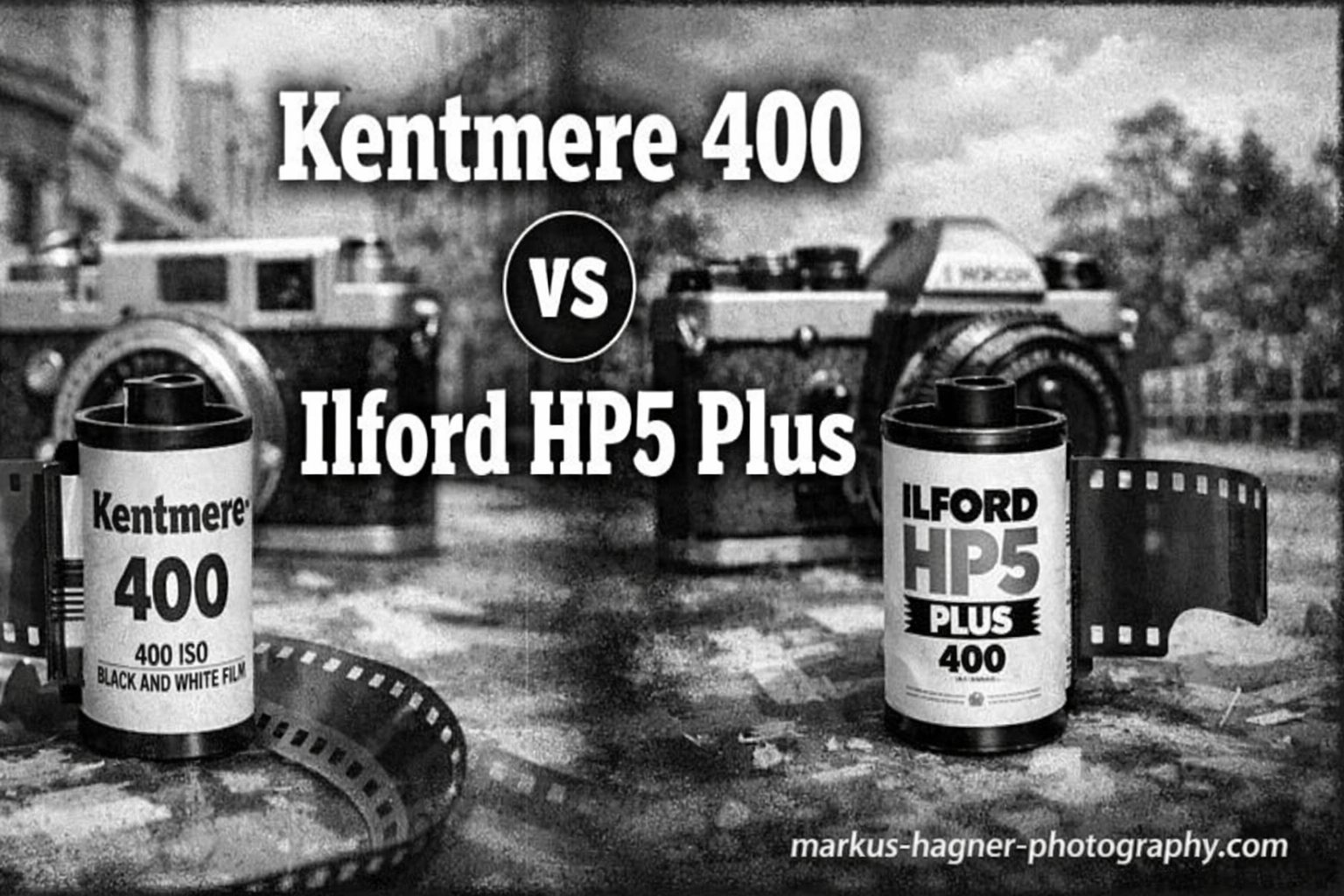
Choosing between Kentmere 400 vs Ilford HP5 Plus is one of the most common dilemmas facing film photographers today. Both are ISO 400 black and white negative films made by the same manufacturer, yet they serve distinctly different purposes and budgets.
After shooting dozens of rolls of each film over the past few years, I have developed a clear understanding of when each stock shines and where they fall short. This comprehensive comparison will help you decide which film deserves a spot in your camera bag.
Here is the quick verdict: Ilford HP5 Plus is the superior technical performer with finer grain, better dynamic range, and more pushability. However, Kentmere 400 offers incredible value and is more than capable for most photography situations. The 25-40% price difference makes Kentmere an excellent choice for high-volume shooters and students.
Both films are manufactured by Harman Technology in the United Kingdom. Despite sharing the same production facility, they use completely different emulsion formulations. HP5 Plus contains more silver and uses a more sophisticated grain structure, which explains both its superior performance and higher price point.
Kentmere 400 vs Ilford HP5 Plus: Quick Comparison
| Product | Specifications | Action |
|---|---|---|
 Kentmere 400 (35mm 36 exp) Kentmere 400 (35mm 36 exp) |
|
Check Latest Price |
 Ilford HP5 Plus (35mm 36 exp, 3-pack) Ilford HP5 Plus (35mm 36 exp, 3-pack) |
|
Check Latest Price |
This side-by-side comparison highlights the key differences between these two popular black and white films. While both share the same ISO 400 speed rating, the underlying characteristics differ significantly in ways that will impact your final images.
The most obvious difference is price. Kentmere 400 typically costs 25-40% less per roll than HP5 Plus. For photographers shooting high volumes or students learning the craft, this price gap adds up quickly over time.
Kentmere 400: Deep Dive Review
Pros
- Excellent value for money
- Good sharpness for the price
- Classic grain aesthetic
- Ideal for students and beginners
- Wide exposure latitude
Cons
- More grain than HP5 Plus
- Less dynamic range
- Negatives can scratch more easily
- Lower contrast out of the box
Kentmere 400 has become my go-to film for casual shooting and camera testing. At roughly $8-9 per roll, it offers an affordable entry point into black and white photography without sacrificing too much image quality.
The film produces a classic grainy look that many photographers actually prefer for street photography and documentary work. The grain is more pronounced than HP5 Plus, especially in highlights and smooth tones like skies. This gives images a vintage, textured feel that works beautifully for certain subjects.
What surprised me most about Kentmere 400 is its exposure latitude. The film handles overexposure particularly well, giving beginners room to make mistakes without ruining shots. I have accidentally overexposed by 2 stops and still recovered usable images with good shadow detail.
The contrast is notably lower than HP5 Plus right out of the camera. Some photographers describe Kentmere as coming out flat, lacking true black and white points. This actually works in your favor if you prefer to control contrast during development or scanning. The lower native contrast gives you more flexibility in post-processing.
One genuine downside I have experienced is scratch resistance. Kentmere negatives seem more prone to scratching during development and handling compared to HP5 Plus. This is a common complaint in the film community and something to be aware of if you process your own film. Careful handling and proper technique minimize this issue.
For street photography, camera testing, and learning film photography, Kentmere 400 is hard to beat at its price point. I regularly recommend it to students and photographers just starting their black and white journey.
Ilford HP5 Plus: Deep Dive Review
Ilford 1574577 HP5 Plus, Black and White Print Film, 35 mm, ISO 400, 36 Exposures (Pack of 3)
Pros
- Professional-grade quality
- Excellent dynamic range
- Fine grain for ISO 400
- Superior highlight retention
- Pushes exceptionally well
- Trusted consistent results
Cons
- Higher price point
- Grain still visible at 400
- Film prices have increased
- Some packaging issues reported
Ilford HP5 Plus has earned its reputation as one of the most versatile and reliable black and white films ever made. With over 3,000 reviews on Amazon and a 4.8-star rating, it is the gold standard that other films are measured against.

What immediately stands out when shooting HP5 Plus is the tonal range. The film captures a broader range of tones from deep shadows to bright highlights, giving images a richness and depth that budget films struggle to match. This expanded dynamic range means you can capture more detail in challenging lighting situations.
The grain structure is noticeably finer than Kentmere 400. While both films are ISO 400 and will show grain, HP5 Plus renders it more smoothly and organically. Skies and smooth surfaces look cleaner, and fine details hold up better in enlargements.
Where HP5 Plus truly excels is push processing. I have pushed this film to EI 1600 with excellent results, and many photographers regularly push it to 3200 for low-light work. The film maintains shadow detail and highlight retention even when pushed hard. Kentmere can be pushed too, but the results are not as clean.

The higher silver content in HP5 Plus contributes to both its superior image quality and higher price. Silver halide crystals are the light-sensitive component of film, and more silver generally means better sharpness, tonal range, and overall image quality.
Professional photographers overwhelmingly choose HP5 Plus for critical work. The consistency from batch to batch, combined with its forgiving nature and excellent results, makes it a reliable workhorse. When you cannot afford to miss the shot, HP5 Plus delivers.
For portraits, landscapes, documentary work, and any situation where image quality matters, HP5 Plus is worth the premium. The results speak for themselves.
Kentmere 400 vs Ilford HP5 Plus: Head-to-Head Comparison
Grain Structure and Sharpness
Grain is where the difference between these films becomes immediately visible. HP5 Plus uses a more refined emulsion with smaller, more uniform silver halide crystals. This translates to finer apparent grain and better sharpness, especially in mid-tones and highlights.
Kentmere 400 has a coarser grain structure that is visible even at smaller print sizes. The grain is not necessarily bad, it has a classic, organic quality that many photographers appreciate. For street photography and documentary work, this grainy aesthetic can add character and mood to images.
In terms of acutance, the apparent sharpness at edges, HP5 Plus scores higher. Fine details like hair, fabric texture, and distant foliage render more clearly. Kentmere is sharp enough for most purposes but shows slightly lower acutance under close examination.
Dynamic Range and Exposure Latitude
Dynamic range is one of the most significant technical differences between these films. HP5 Plus captures approximately 11-12 stops of dynamic range, while Kentmere 400 manages around 9-10 stops. This 1-2 stop difference matters in high-contrast scenes.
HP5 Plus excels at highlight retention. Bright areas like clouds, white clothing, and backlit subjects hold detail longer before blowing out. Kentmere tends to block up in highlights faster, creating a bloom effect around bright areas.
Shadow detail is also superior on HP5 Plus. Deep shadows retain more information and can be lifted during scanning or printing without turning to mud. Kentmere shadows go black more quickly, limiting your options in post-processing.
Both films offer good exposure latitude, meaning they tolerate over and underexposure reasonably well. However, HP5 Plus is more forgiving of exposure errors due to its broader dynamic range.
Contrast and Tonal Range
Out of the box, HP5 Plus has higher native contrast than Kentmere 400. This means HP5 images tend to have richer blacks and brighter whites without adjustment. Kentmere can appear flat by comparison, lacking strong black and white points.
The lower contrast of Kentmere is not necessarily a disadvantage. Many photographers prefer a flatter negative because it provides more flexibility for controlling contrast during development or scanning. You can always add contrast in post, but removing it from a high-contrast negative is harder.
Tonal gradation is smoother on HP5 Plus. The transitions between tones flow more naturally, especially in skin tones and gradual sky gradients. Kentmere can show slightly more abrupt tonal transitions, though this is subtle and only noticeable in direct comparison.
Pushing and Pulling Capabilities
Pushing film means shooting at a higher ISO than the box speed and developing longer to compensate. This is essential for low-light photography when you need faster shutter speeds.
HP5 Plus is legendary for its pushability. Here is how it performs at different speeds:
Box Speed (EI 400): Excellent results with fine grain and full tonal range. This is where the film shines.
+1 Stop (EI 800): Very good results with slightly increased grain and minimal loss of shadow detail. Most photographers cannot tell the difference from box speed.
+2 Stops (EI 1600): Good results with visible grain increase and some shadow compression. Still very usable for most applications.
+3 Stops (EI 3200): Acceptable results with pronounced grain and significant shadow loss. Works for artistic low-light work where grain adds to the mood.
Kentmere 400 can also be pushed, but with more limitations:
Box Speed (EI 400): Good results with characteristic grain.
+1 Stop (EI 800): Good results, similar to HP5 at this level.
+2 Stops (EI 1600): Acceptable but grainy. Shadow detail suffers more than HP5. Some photographers report good results, others find it too grainy.
+3 Stops (EI 3200): Not recommended. The grain becomes overwhelming and shadow detail is largely lost.
For pushing beyond EI 800, HP5 Plus is the clear winner. Its higher silver content and better dynamic range allow it to maintain image quality when pushed hard.
Developer Recommendations
Both films work well with a wide range of developers. Here are the most popular combinations:
Ilford DD-X: An excellent all-around developer for both films. DD-X produces fine grain and good sharpness while maintaining full speed. Development times are similar for both films, making it easy to process them together.
Kodak Xtol: Known for producing extremely fine grain and full film speed. Xtol works beautifully with HP5 Plus, maximizing its sharpness potential. For Kentmere, it helps tame the grain while maintaining good tonality.
Rodinal (R09 One Shot): A classic developer that produces sharp, grainy results. Rodinal enhances the inherent characteristics of each film, making HP5 even sharper and Kentmere even grainier. Great for photographers who embrace grain as an aesthetic choice.
Stand Development: Both films respond well to stand development using highly diluted Rodinal or similar developers. This technique involves minimal agitation over long development times (45-60 minutes). It produces even development and can help manage high-contrast scenes.
Pyro Developers: For advanced darkroom workers, pyro developers like PMK or 510-Pyro produce beautiful results with both films. The staining action helps control highlights and can produce a unique tonal quality.
Scratch Resistance and Handling
One consistent complaint about Kentmere 400 is that the emulsion scratches more easily than HP5 Plus. Multiple forum users and reviewers have noted this issue, which appears to be related to the emulsion formulation and possibly the anti-halation layer.
In my experience, careful handling during development minimizes scratching. Use soft squeegees or skip the squeegee entirely, and make sure your development tanks and reels are clean. The scratches, when they occur, tend to be fine and may not show in scans.
HP5 Plus has a more robust emulsion that resists scratching better. This is one reason professional labs often prefer it, as it handles the rigors of commercial processing more reliably.
Anti-Halation Layer Differences
The anti-halation layer prevents light from bouncing off the film base and creating halos around bright objects. Both films have effective anti-halation layers, but there are subtle differences.
Kentmere 400 has a slightly weaker anti-halation effect, which can result in a subtle bloom around strong highlights. Some photographers actually like this effect for its dreamy quality, but it is technically a limitation.
HP5 Plus has a more effective anti-halation layer that produces cleaner highlights without the bloom effect. For technical and commercial work where clean highlights matter, this is an advantage.
Silver Content and Emulsion Structure
The silver content difference between these films is real and measurable. HP5 Plus contains more silver halide per square inch than Kentmere 400. This is one of the main reasons for the price difference, as silver is a significant cost component in film manufacturing.
More silver means more light-sensitive material to capture image information. This translates to better sharpness, finer grain, improved tonal range, and better push performance. The emulsion structure of HP5 Plus is also more sophisticated, with a blend of different crystal sizes optimized for various aspects of image quality.
Kentmere uses a simpler emulsion design with less silver. This keeps costs down but results in the performance differences we have discussed. It is still a capable film, just not at the same technical level as HP5 Plus.
Format Availability
Both films are available in multiple formats:
Kentmere 400: 35mm cassettes (24 and 36 exposure), 120 roll film, 100ft bulk rolls for home loading
Ilford HP5 Plus: 35mm cassettes (24 and 36 exposure), 120 roll film, 4×5 sheet film, 5×7 sheet film, 8×10 sheet film, 100ft bulk rolls
HP5 Plus has broader format availability, including large format sheet films that Kentmere does not offer. For large format photographers, HP5 Plus is the only choice between these two.
In 35mm and 120 formats, both films are readily available. Bulk rolls offer significant savings for high-volume shooters, with both films available in 100ft lengths.
Price and Value Analysis
The price difference between these films is substantial and meaningful. Let us break down the actual costs:
Kentmere 400: Approximately $8-9 per 36-exposure roll in 35mm. Bulk rolls bring the per-roll cost down to around $5-6 when home-loaded.
Ilford HP5 Plus: Approximately $12-15 per 36-exposure roll in 35mm, or about $4-5 per roll when purchased in multi-packs. Bulk rolls reduce the cost to around $8-9 per roll.
This means HP5 Plus costs roughly 25-45% more than Kentmere depending on how you buy it. Over the course of shooting 100 rolls per year, that difference adds up to $300-600.
Is HP5 Plus worth the extra cost? It depends on your needs:
Choose Kentmere 400 if: You shoot high volumes, are learning film photography, want to test cameras or lenses, shoot street photography where grain is acceptable, or are budget-conscious.
Choose HP5 Plus if: Image quality is critical, you need to push film regularly, you shoot portraits or fine art work, you make large prints, or you want consistent professional results.
Many photographers use both: Kentmere for everyday shooting and experimentation, HP5 Plus for important projects and client work. This hybrid approach maximizes value while ensuring quality when it matters most.
Frequently Asked Questions
Is Kentmere made by Ilford?
Yes, Kentmere film is manufactured by Harman Technology, the same company that owns Ilford Photo. Both films are produced in the same UK facility using similar quality control processes. However, Kentmere is positioned as a budget-friendly alternative with a different emulsion formulation and less silver content than Ilford Plus films.
Is Kentmere 400 the same as HP5 Plus?
No, Kentmere 400 is not the same emulsion as HP5 Plus. While both are ISO 400 black and white films made by Harman Technology, they use completely different formulations. HP5 Plus contains more silver, has finer grain, better dynamic range, and superior pushability. Kentmere 400 is a simpler, budget-oriented emulsion designed to offer good performance at a lower price point.
Is Kentmere 400 good for beginners?
Kentmere 400 is an excellent choice for beginners. The affordable price allows new photographers to shoot more and learn faster without worrying about wasting expensive film. The wide exposure latitude forgives common metering mistakes, and the classic grain aesthetic is forgiving of imperfect technique. Many photography instructors specifically recommend Kentmere for students learning black and white photography.
Can Kentmere 400 be pushed to 1600?
Yes, Kentmere 400 can be pushed to EI 1600 (+2 stops), though results are mixed. Some photographers report good quality at this speed, while others find the grain becomes too pronounced and shadow detail suffers significantly. For pushing beyond EI 800, Ilford HP5 Plus generally produces cleaner results due to its higher silver content and better dynamic range.
Does Kentmere 400 scratch easily?
Yes, Kentmere 400 negatives are more prone to scratching than Ilford HP5 Plus, according to numerous user reports. The emulsion appears to be less robust during development and handling. Careful technique including gentle washing, avoiding squeegees, and using clean equipment minimizes this issue. If scratch resistance is a major concern, HP5 Plus offers better durability.
Which film has better dynamic range?
Ilford HP5 Plus has significantly better dynamic range than Kentmere 400. HP5 Plus captures approximately 11-12 stops compared to Kentmere’s 9-10 stops. This difference shows in highlight retention and shadow detail. HP5 Plus holds bright highlights longer without blowing out and retains more information in deep shadows that can be lifted during scanning or printing.
Is HP5 Plus worth the extra cost over Kentmere?
HP5 Plus is worth the extra cost if image quality is your priority. The finer grain, better dynamic range, superior pushability, and more robust emulsion justify the 25-45% price premium for professional or critical work. However, for learning, camera testing, or high-volume shooting where ultimate quality is less important, Kentmere 400 offers excellent value and may be the smarter choice.
Verdict: Which Film Should You Choose?
After extensive testing with both Kentmere 400 vs Ilford HP5 Plus, my recommendation depends entirely on your priorities and budget.
Choose Kentmere 400 if you are:
A student or beginner learning black and white photography. The lower price lets you shoot more and learn faster without breaking the bank. The wide exposure latitude forgives mistakes.
A high-volume shooter who goes through film quickly. Street photographers, documentary photographers, and anyone who shoots dozens of rolls monthly will appreciate the cost savings.
Testing cameras or lenses. Kentmere is perfect for checking if a camera works properly or comparing lens characteristics without wasting expensive film.
Choose Ilford HP5 Plus if you are:
A professional or serious enthusiast where image quality matters. The finer grain, better dynamic range, and superior pushability justify the premium for critical work.
Shooting portraits, fine art, or any subject where tonal richness is important. The expanded tonal range and smoother gradations elevate your images.
Working in low light and need to push film. HP5 Plus pushes cleaner to higher speeds, maintaining image quality when light is scarce.
My overall verdict: Ilford HP5 Plus is the technically superior film and wins this comparison. However, Kentmere 400 is an excellent value that delivers good results at a lower price point. The best choice depends on whether you prioritize maximum image quality or cost efficiency.