
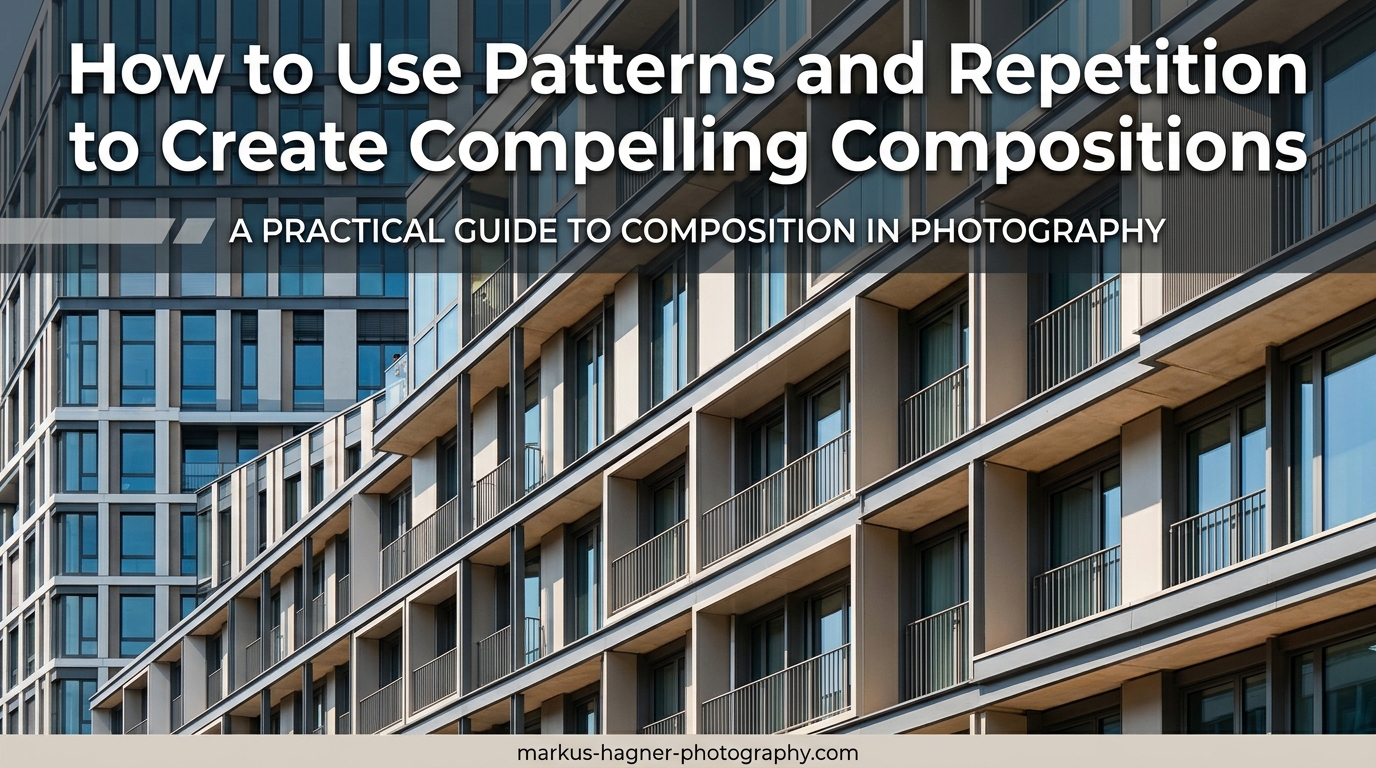
Patterns and repetition are among the most powerful tools in a photographer’s composition toolkit. When used effectively, they can transform ordinary scenes into visually striking images that hold the viewer’s attention. In this guide, I will show you exactly how to use patterns and repetition to create compelling compositions in your photography.
Whether you are photographing architecture, nature, or everyday objects, understanding how to work with repetitive elements will add depth and visual interest to your work. By the end of this article, you will know how to find patterns, emphasize them, break them for impact, and even enhance them during post-processing.
What Are Patterns and Repetition in Photography?
Patterns and repetition in photography refer to the use of recurring visual elements such as shapes, colors, lines, or textures to create rhythm, unity, and visual interest in a composition. While these terms are often used interchangeably, they each have distinct meanings that are worth understanding.
Repetition occurs when a single element appears multiple times throughout your frame. This could be a row of streetlights, a series of windows, or repeating shadows cast by a fence. Repetition creates consistency and can establish a strong visual foundation for your image.
Pattern involves a more organized grouping of repeated elements. A pattern typically follows a predictable structure or arrangement. Think of brick walls, tiled floors, or the natural spirals found in sunflowers. Patterns often feel more structured and intentional than simple repetition.
Rhythm emerges when repetition and pattern work together to create a sense of movement or flow through your image. Like a musical beat, visual rhythm guides the viewer’s eye from one element to the next, creating a dynamic viewing experience.
Understanding the distinction between these concepts helps you make intentional choices about how to use them. A photograph might feature repetition without a clear pattern, or it might combine multiple patterns to create complex visual rhythm. Each approach produces different emotional effects in the viewer.
Why Patterns and Repetition Create Compelling Compositions
Our brains are naturally drawn to order and repetition. From an early age, we learn to recognize patterns as a way of making sense of the world. This inherent attraction is what makes patterns and repetition so effective in photography composition.
When you fill your frame with repeating elements, you create visual harmony. The viewer’s eye finds comfort in the predictable structure, and the image feels unified and cohesive. This sense of order can evoke feelings of calm and satisfaction.
Patterns also create rhythm and movement within a static image. As the eye travels across repeating elements, it experiences a visual journey. This sense of motion keeps the viewer engaged longer and adds energy to what might otherwise be a flat composition.
Perhaps most importantly, patterns help direct the viewer’s attention. Repetitive elements naturally guide the eye toward focal points, especially when combined with techniques like leading lines or the rule of thirds. You can use patterns to control exactly how someone experiences your photograph.
The emotional impact of patterns depends largely on how you use them. Complete, unbroken patterns create harmony and calm. Interrupted patterns create tension and curiosity. Understanding this relationship gives you powerful creative control over your images.
How to Emphasize Patterns in Your Photography
The most effective way to emphasize patterns is to fill the frame with repetitive elements. When patterns extend to the edges of your image, they create a sense of infinite continuation that draws the viewer in. This technique works especially well for geometric patterns in architecture or natural textures.
Getting closer to your subject is often the simplest way to fill the frame. Use your feet before you use your zoom. Walking closer often reveals details and patterns that would be lost at a distance. Macro photography takes this approach even further, revealing intricate patterns invisible to the naked eye.
Your camera angle significantly affects how patterns appear. Shooting straight-on tends to flatten patterns and emphasize their graphic qualities. Angled shots add depth and can reveal the three-dimensional nature of repetitive elements. Experiment with both approaches to see which serves your vision.
Consider your distance from the subject carefully. Too far, and patterns lose their impact. Too close, and you might miss the bigger structure. The sweet spot often comes when individual elements are clearly visible but the overall pattern remains the dominant visual feature.
The Art of Breaking Patterns for Visual Impact
While filling the frame with patterns creates harmony, breaking patterns creates visual tension and interest. A pattern interruption works like a plot twist in a story. It surprises the viewer and creates a focal point that demands attention.
The key to effective pattern breaking is contrast. Look for elements that stand out from the repetitive structure through color, shape, size, or orientation. A single red umbrella in a sea of black umbrellas. One crooked window in a row of perfectly aligned ones. These interruptions create powerful focal points.
Color contrasts are particularly effective for breaking patterns. The human eye is naturally drawn to color differences, so even subtle variations can create strong visual impact. A warm-toned element in a cool-toned pattern, or vice versa, will immediately capture attention.
Shape contrasts work similarly. A circular object in a pattern of squares, or an organic shape among geometric forms, creates visual interest through its very presence. The contrast between order and chaos becomes the subject of your photograph.
Where you place the break matters too. Positioning your interrupted element according to the rule of thirds often creates a more dynamic composition than centering it. This follows the same principles as placing any focal point in your frame.
Types of Patterns You Can Use in Photography
Geometric Patterns
Geometric patterns are among the most common and visually striking types you will encounter. They include repeating squares, triangles, circles, and other regular shapes. Architecture offers endless geometric patterns, from the grid of windows on a skyscraper to the repeating arches of a bridge.
These patterns create a sense of order and precision. They work well for minimalist compositions and can make powerful graphic statements. When photographing geometric patterns, pay attention to alignment and symmetry for the cleanest results.
Organic and Natural Patterns
Nature provides abundant organic patterns that feel more fluid and less rigid than their geometric counterparts. Tree bark textures, flower petal arrangements, leaf venation, and wave patterns all offer rich photographic opportunities.
These patterns often have a calming, soothing quality. They connect viewers to the natural world and work beautifully in landscape and nature photography. The key is to look for the underlying structure within apparent chaos.
Color Repetition
Color patterns can exist independently of shape patterns. A field of wildflowers with repeating colors, or a row of buildings painted in alternating hues, creates rhythm through chromatic repetition rather than structural repetition.
Color patterns work particularly well for creating mood. Warm color repetitions feel energetic and inviting. Cool repetitions feel calm and serene. Consider how color temperature affects the emotional quality of your pattern photography.
Shape Repetition
When the same shape repeats throughout your frame, shape repetition becomes your primary compositional element. This differs from geometric patterns in that the shapes themselves might not form a larger geometric structure.
A collection of circular plates, a row of arched doorways, or repeated triangular rooflines all demonstrate shape repetition. The consistency of form creates visual unity even when other elements vary.
Texture Patterns
Textures create patterns through surface quality rather than through distinct shapes or colors. Sand dunes, fabric weaves, weathered wood, and stone surfaces all offer textural patterns that add tactile quality to your images.
Side lighting often enhances texture patterns by creating shadows that emphasize surface variations. The interplay of light and texture can transform an apparently flat surface into a rich, dimensional composition.
Abstract Patterns
Abstract patterns emerge when you isolate elements from their context. Close-up photography of everyday objects often reveals abstract patterns that viewers might not immediately recognize. This creates mystery and invites closer inspection.
Abstract pattern photography encourages creative seeing. By removing familiar context, you challenge viewers to engage with pure visual elements of shape, color, and texture without preconceptions about what they represent.
How to Find Patterns in Everyday Scenes?
Training your eye to see patterns takes practice, but once you develop this skill, you will find patterns everywhere. The key is to shift from looking at objects to looking at relationships between elements.
Architecture offers the most obvious starting point. Buildings are designed with repetition in mind. Windows, columns, bricks, and decorative elements all repeat in predictable ways. Urban environments are treasure troves of geometric patterns waiting to be discovered.
Nature provides patterns at every scale, from the microscopic to the astronomical. Look for spirals in shells and flowers, branching patterns in trees and rivers, and wave patterns in sand and water. Nature’s patterns often have a mathematical precision that is deeply satisfying.
Everyday objects reveal patterns when photographed thoughtfully. A drawer full of kitchen utensils, books on a shelf, or products on store shelves all contain repetitive elements. The ordinary becomes extraordinary when you recognize and emphasize its pattern qualities.
Light and shadow create patterns of their own. Shadows cast by window blinds, light filtering through leaves, or the geometric shadows of architectural elements all create ephemeral patterns that change throughout the day.
Reflections can double or multiply patterns in interesting ways. Water surfaces, windows, and mirrors create symmetrical or distorted repetitions that add complexity to your compositions.
Camera Settings for Pattern Photography
Choosing the right camera settings helps you capture patterns effectively. While specific settings depend on your subject and creative intent, certain principles apply broadly to pattern photography.
Aperture significantly affects how patterns render. A small aperture (high f-number like f/11 or f/16) creates deep depth of field, keeping the entire pattern sharp from foreground to background. This works well for architectural patterns where you want consistent detail throughout.
Alternatively, a wide aperture (low f-number like f/2.8 or f/4) creates shallow depth of field, isolating a portion of the pattern. This selective focus approach can emphasize texture or create abstract effects by blurring parts of the repetitive structure.
Focus modes matter more than you might expect. For flat, two-dimensional patterns, single-point autofocus often works best. For patterns with depth, consider using zone focusing or manual focus to ensure the critical parts of your pattern are sharp.
Shutter speed becomes important when photographing patterns that move, such as waves, clouds, or crowds of people. Fast shutter speeds freeze motion, preserving the pattern’s structure. Slower shutter speeds blur motion, creating new patterns from movement itself.
Lens choice affects your perspective. Wide-angle lenses exaggerate the scale of nearby repetitive elements. Telephoto lenses compress perspective, making distant patterns appear denser. Macro lenses reveal patterns invisible to casual observation.
Enhancing Patterns in Post-Processing
Post-processing offers powerful tools for emphasizing patterns after you have captured them. These techniques can strengthen the visual impact of repetitive elements and correct minor issues with your original composition.
Clarity and texture adjustments directly enhance pattern visibility. Increasing clarity adds midtone contrast that emphasizes edges and details within patterns. Texture adjustments specifically target fine details, making surface patterns more pronounced.
Be careful not to overdo these adjustments. Too much clarity can create artificial-looking halos around pattern elements. Subtle increases usually produce the most natural and effective results.
Contrast enhancements help patterns stand out. Increasing overall contrast emphasizes the difference between light and dark elements within a pattern. This is particularly effective for geometric patterns where strong contrast reinforces graphic impact.
Cropping can transform a mediocre pattern photo into a strong one. Tight cropping removes distracting elements and allows you to fill the frame more effectively with your pattern. Consider cropping to non-standard aspect ratios if it serves your composition.
Black and white conversion often strengthens pattern photography. Removing color eliminates a potential distraction and focuses attention on shape, texture, and tonal relationships. Patterns that seem busy in color often become elegantly simple in black and white.
Pattern Photography Exercises to Practice
Developing your pattern-seeing skills requires deliberate practice. These exercises will help train your eye and build your pattern photography portfolio.
Exercise 1: The Home Pattern Hunt. Without leaving your house, find and photograph five different patterns. Look at furniture, textiles, food, household objects, and architectural details. This exercise proves that patterns exist everywhere once you learn to see them.
Exercise 2: Fill the Frame Challenge. Choose one pattern and photograph it three different ways, each time filling the frame more completely. Notice how increasing pattern dominance changes the image’s impact and emotional quality.
Exercise 3: Pattern Interruption Scavenger Hunt. Spend an hour looking specifically for broken patterns. Find at least three examples where something disrupts an otherwise repetitive structure. Consider how each interruption creates a focal point.
Exercise 4: Color Pattern Exploration. Focus entirely on color repetition for one photography session. Ignore shapes and textures. Find patterns created solely through color relationships, whether complementary, analogous, or monochromatic.
Frequently Asked Questions About Patterns and Repetition
How can repetition and pattern be used to create a sense of motion?
Repetition and pattern create motion through visual rhythm. When repeating elements progress across the frame, the viewer’s eye naturally follows this progression, creating a sense of movement. Varying the size, spacing, or angle of repetitive elements enhances this effect, making static images feel dynamic and alive.
What are the 7 rules of composition?
The seven fundamental rules of composition include the rule of thirds, leading lines, framing, symmetry and patterns, depth and layers, viewpoint and perspective, and background consideration. Patterns and repetition fit within the symmetry and patterns category but can be combined with any of the other rules for more sophisticated compositions.
What do pattern and repetition create in art?
Pattern and repetition in art create visual rhythm, unity, and harmony. They organize visual elements into cohesive structures that guide the viewer’s eye and evoke emotional responses. Complete patterns create calm and order, while interrupted patterns create tension and interest.
What can be created by using patterns and repetition in a film?
In film, patterns and repetition create visual continuity, establish mood, and guide narrative rhythm. Directors use recurring visual motifs to connect scenes, build tension through escalating patterns, or create emotional impact by breaking established patterns at key dramatic moments.
Conclusion: Mastering Patterns in Your Photography
Patterns and repetition offer endless creative possibilities for photographers at every skill level. By learning to see the repetitive structures that surround us, you can transform ordinary scenes into compelling compositions that captivate viewers.
Remember that the most interesting pattern photography often combines multiple techniques. Emphasize patterns by filling the frame, then consider breaking them for visual tension. Use camera settings intentionally, and do not hesitate to enhance patterns further in post-processing.
The true power of patterns and repetition lies in their versatility. They work across every genre of photography, from architecture to nature to street photography. As you practice the exercises in this guide and develop your eye for patterns, you will discover that compelling compositions are everywhere waiting to be found.