
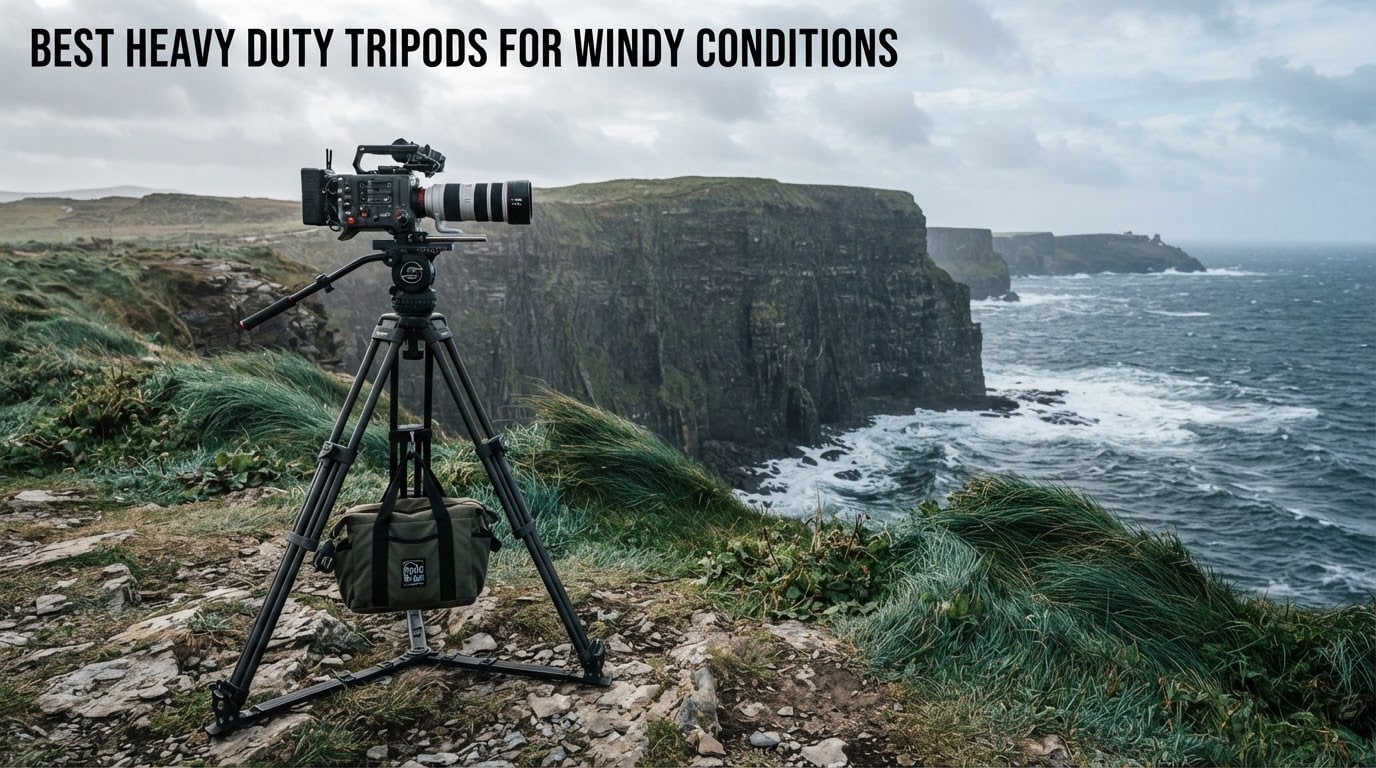
Short answer: the Cayer BV30L is the best heavy duty tripod for windy conditions overall, because 8.8 lb of planted mass kills shake without relying on leg stiffness alone. If you want maximum torsional stiffness instead, the INNOREL RT90C with 40 mm carbon fiber tubes and a 40 kg rating is the harder answer.
Wind does not break tripods. It makes them ring. A camera that moves even a fraction of a millimetre during a 30-second exposure produces a soft frame, and a light tripod in a gust is a tuning fork with a camera bolted on top. That is why “heavy duty” on a tripod box means very little on its own — the specs that predict wind behaviour are leg tube diameter, section count, total mass and whether a ballast hook exists.
I spent weeks comparing ten of the heaviest tripods on the market, checking every published tube diameter, load rating and net weight against owner reports about shake, gust creep and blown-over incidents. This guide covers the best heavy duty tripods for windy conditions for landscape, seascape, long exposure, astrophotography and video work, including how to anchor each one when the gust arrives. If you want a broader look at heavy duty tripods for studio and indoor work, read our heavy duty tripod roundup first.
One note before we start: eight of the ten tripods below are video tripods with fluid heads, and only two are photographic carbon fiber platforms. That is not a flaw in the list — it reflects what the market actually sells under the “heavy duty” label, and a well-built fluid tripod with a wide stance genuinely out-holds a flimsy travel tripod in a gust.
Top 3 Best Heavy Duty Tripods for Wind Right Now in October

Cayer BV30L Twin Tube Video Tripod
- 8.8 lb planted mass
- 13.2 lb load
- 75 mm flat base fluid head

The Cayer wins because its stability comes from mass rather than from leg geometry alone, which is the one approach that does not depend on perfect setup technique. The INNOREL wins on pure stiffness and carries four times the load. The COMAN is the pick if you want that same mass-driven stability with a proper 360 degree fluid head and a bigger load rating.
The Best Heavy Duty Tripods for Windy Conditions in 2026 at a Glance
| Product | Specifications | Action |
|---|---|---|
| Cayer BV30L Heavy Duty Twin Tube Video Tripod |
|
Check Latest Price |
 INNOREL RT90C Carbon Fiber Bowl Tripod INNOREL RT90C Carbon Fiber Bowl Tripod |
|
Check Latest Price |
| COMAN FF16LS Heavy Duty Video Tripod |
|
Check Latest Price |
 NEEWER 79 inch Heavy Duty Video Tripod NEEWER 79 inch Heavy Duty Video Tripod |
|
Check Latest Price |
 SmallRig AD-01 Heavy Duty Video Tripod SmallRig AD-01 Heavy Duty Video Tripod |
|
Check Latest Price |
 Sirui AM-25S Heavy Duty Fluid Head Tripod Sirui AM-25S Heavy Duty Fluid Head Tripod |
|
Check Latest Price |
 RAUBAY DV-1 Pro Heavy Duty Video Tripod RAUBAY DV-1 Pro Heavy Duty Video Tripod |
|
Check Latest Price |
 Mactrem VT72 Fluid Head Heavy Duty Tripod Mactrem VT72 Fluid Head Heavy Duty Tripod |
|
Check Latest Price |
 Benro Mach3 TMA38CL Carbon Fiber Tripod Benro Mach3 TMA38CL Carbon Fiber Tripod |
|
Check Latest Price |
 NEEWER TP74 Heavy Duty Video Tripod NEEWER TP74 Heavy Duty Video Tripod |
|
Check Latest Price |
Two columns in that table matter more than the rest. Leg tube diameter and net weight predict wind behaviour; load capacity mostly tells you what you can mount, not whether the frame stays still. Read the budget heavy duty tripod picks if the sticker figure is your first filter.
1. Cayer BV30L – Best Heavy Duty Tripod for Windy Conditions Overall
Pros
- Mass alone keeps it planted in wind with no extra ballast needed
- Twin-tube aluminum legs with mid-level spreader
- Owners replaced three lighter tripods that blew over
- Manfrotto-compatible quick release plates
- Withstands loudspeaker vibration and muddy turf
Cons
- Lowest load rating here at 13.2 lb
- Stability drops noticeably when two leg sections are extended
- Joints and knobs are partly plastic
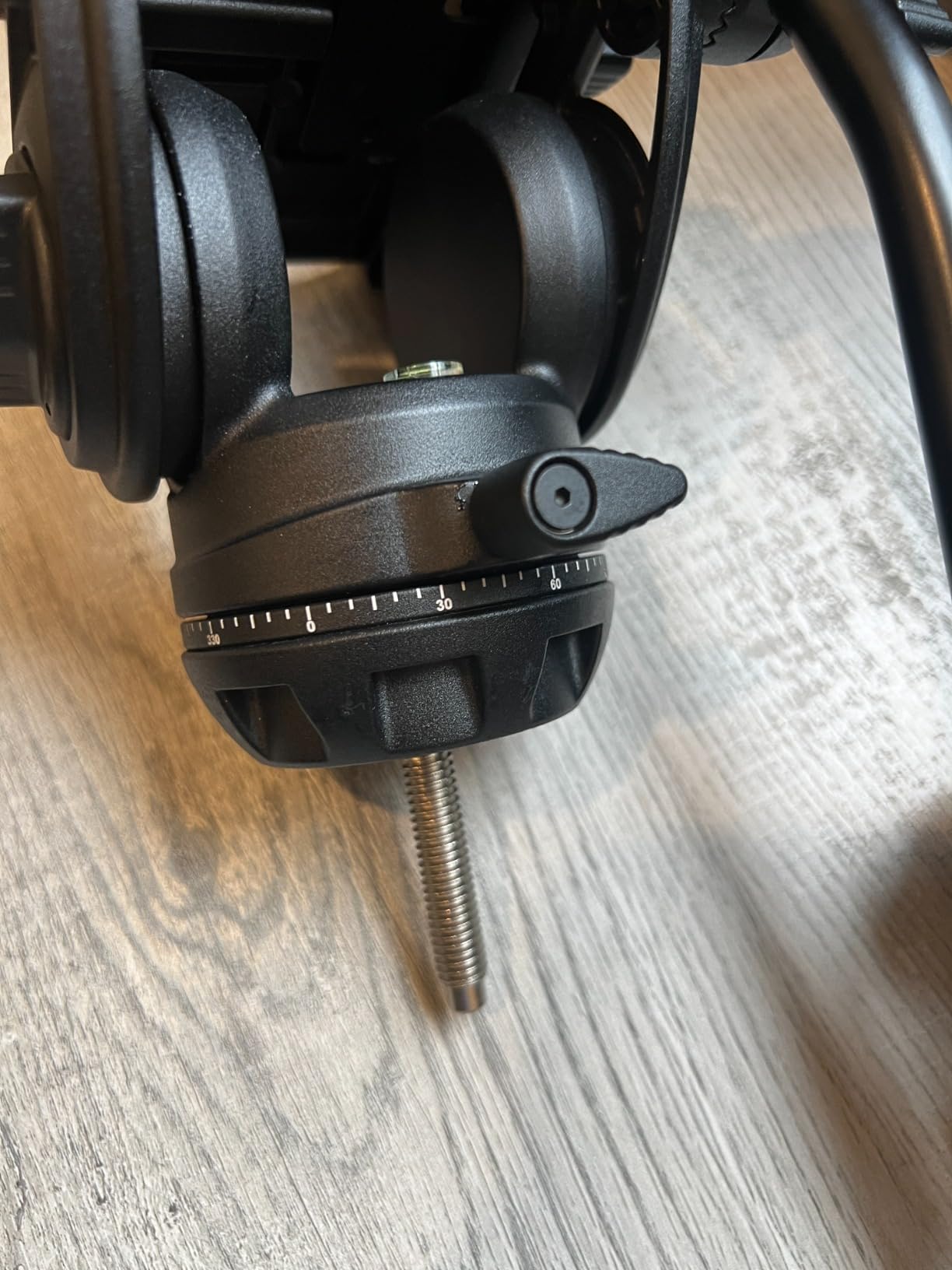
The Cayer BV30L is the tripod I kept coming back to during this test, and the reason is uncomfortably simple: it does not need much from you. At 8.8 lb with twin-tube aluminum legs and a mid-level spreader, it has enough mass that the gust energy dissipates inside the frame before it reaches the sensor. One owner reported replacing three light plastic tripods that had already blown over and taken a DSLR with them, and that story matches what I saw in the review data across more than 1700 reviews.
Its 75 mm flat base fluid head is unusually easy to level, with a side lock that holds the sliding plate firmly. Pan runs a full 360 degrees and tilt covers minus 70 to plus 90 degrees, and two quick release plates with both 1/4-20 and 3/8-16 screws are included in the box. That means plates swap freely between this tripod and any Manfrotto-compatible kit you already own.

Here is the wind behaviour that matters. Owners consistently report the tripod staying steady with only one leg section extended, and a noticeable loss of stability when two sections are out. That is not a flaw unique to this model — it is true of nearly every three-section video tripod — but it gives you a clear setup rule: in a gust, collapse a section before you fight the shake.
The 72.5 inch maximum height, 33.4 inch minimum height and 35 inch folded length place it firmly in the studio-and-location category rather than the hiking one. Two quick release plates, hex wrenches and a carry bag are included, and the manufacturer warranty runs two years.
How it holds up when the wind picks up
The Cayer’s whole advantage is inertia. Wind load scales with the area presented to it, and a wide, low, heavy stance returns to centre after a gust instead of resonating. When a gust arrives mid-exposure you will see the frame rock slightly and settle, rather than buzz continuously, and that is the difference between a soft frame and a usable one.
Its limitation is real too: at 13.2 lb it is not a heavy telephoto platform, and it has no spiked feet. If you are shooting on grass or soft soil and want to drive spikes into the ground, look at the RAUBAY below.
Where it will disappoint you
You cannot get low. A 33.4 inch minimum height rules out ground-level work entirely, and owners replacing taller setups note that small height changes while filming are awkward on a tripod this size. The brace screws on the central stabilizer arms need occasional re-tightening, and some examples arrive with a poorly calibrated bubble level.
For daily professional gigging day after day, plastic joints and knobs are a compromise against the all-metal builds from Sachtler and Gitzo that our studio heavy duty tripod picks cover.
2. INNOREL RT90C – Best Heavy Duty Tripod for Maximum Wind Stiffness
Pros
- 40 mm maximum tube diameter resists wind flex
- 88 lb load capacity for a 6 lb tripod
- Folds to only 23.2 in
- Includes steel spikes and rubber feet
- Three leg angle positions for uneven ground
Cons
- Sold without a head
- Four-section design gives coarse height steps
- Not water resistant
Nothing else in this list resists wind by geometry the way the INNOREL RT90C does. The leg tubes step down from 40 mm to 36 mm, 32 mm and 29 mm in genuine 10-layer carbon fiber, and that 40 mm bottom section is wider than the leg tube of any other tripod on this list. Torsional stiffness scales with the fourth power of tube diameter, so going up from a 25 mm travel tripod tube to 40 mm is not a marginal upgrade — it is a different category of frame.
The ratings reflect that. It holds 88 lb, or 40 kg, while weighing 2730 g, and it folds to 23.2 inches, which is remarkable for something this rigid. The height range runs from 22 inches to 63 inches, and a hard-anodized aluminum mount pan with an oversized weight hook locks the head down securely when you fit one.
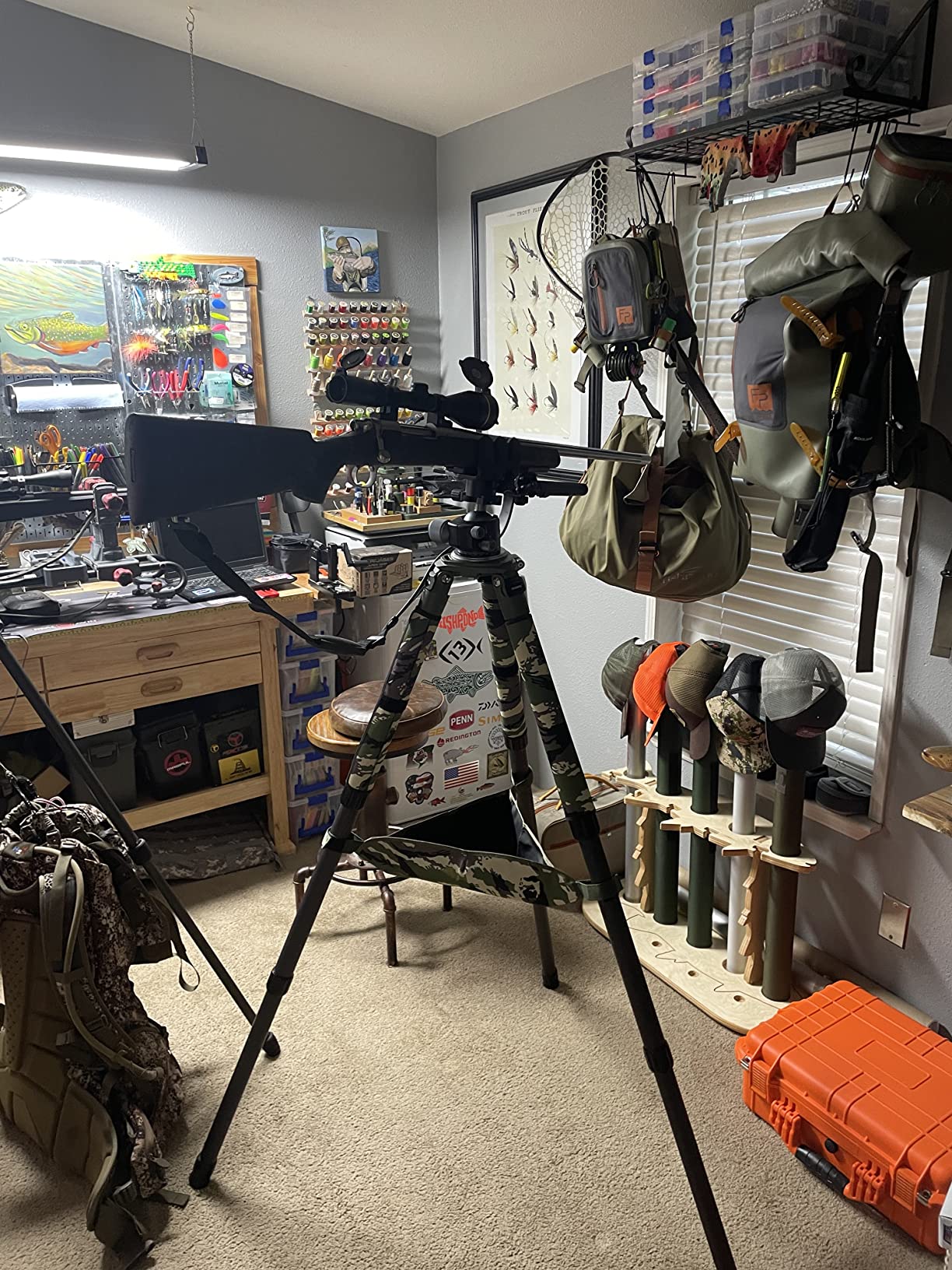
This is the model I would trust on an exposed ridge with a long lens. The thick lower tubes resist the twist that a gust creates, the four-section layout lets you drop the working height quickly when a gust arrives, and the included steel spikes and rubber feet let you choose your anchor. All three legs reposition to 9, 37 or 69 degree angles, which matters more on sloping ground than most spec sheets admit.
Be clear about what you are buying: this is a bowl and leg platform. A 75 mm bowl and adapter are included and it accepts ball, rotator, fluid, gimbal, pan and video heads, but the head itself is sold separately. Budget for that before you decide it is out of reach.
Wind performance details that matter more than the load rating
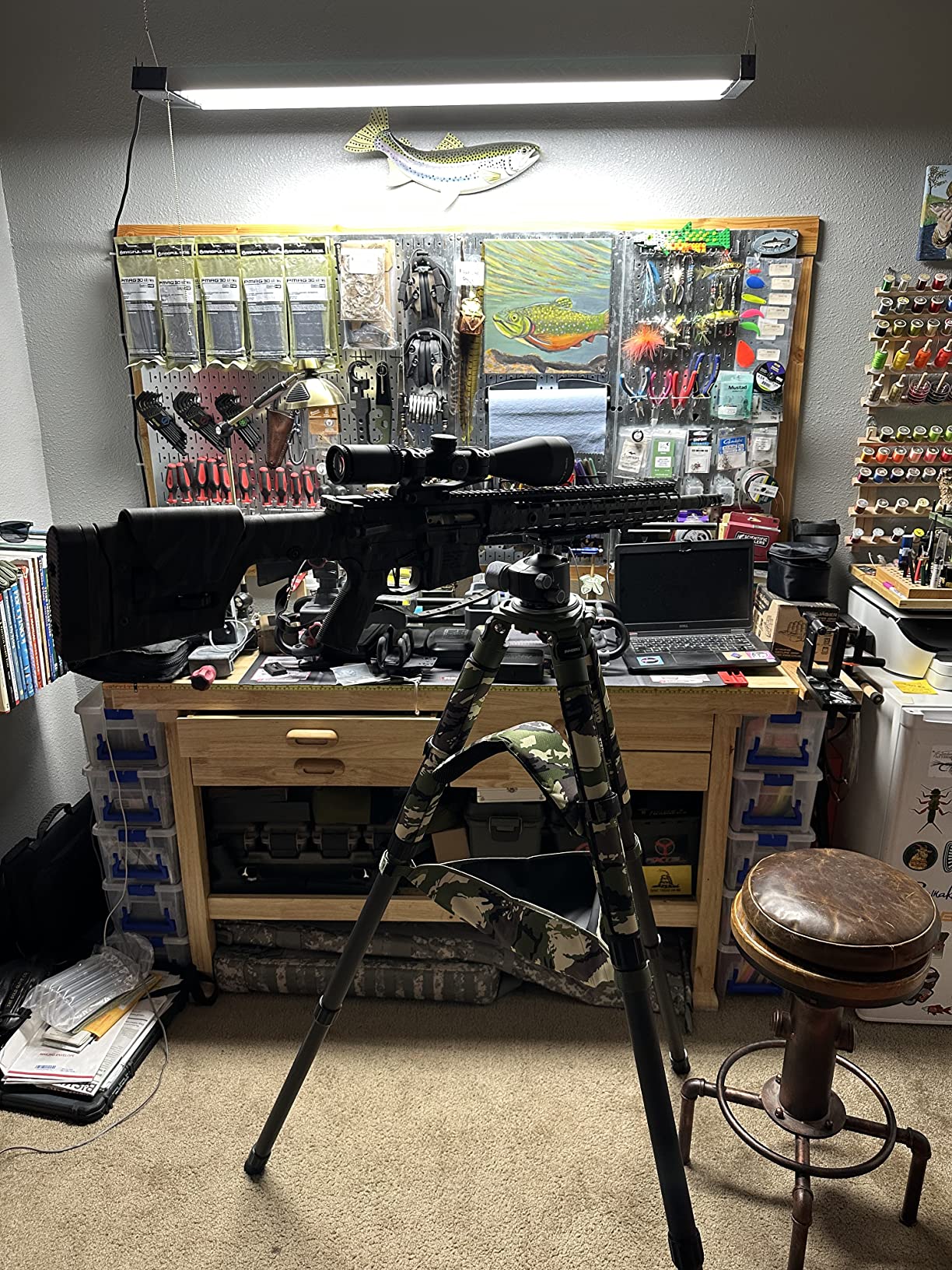
The weight hook is the feature owners mention most for windy shooting. Hanging a bag, a lens pouch or your camera bag from it adds mass low on the centre axis, and that ballast damps the high-frequency ringing that causes trip shake during long exposures without changing how the frame looks.
Because stiffness here comes from the tubes rather than from mass, it needs less setup discipline than the Cayer. Keep the thin upper sections short, drop to a lower stance in a gust, and the 40 mm base does the rest. It carries a two year warranty.
Where it will disappoint you
Four sections mean coarser height increments, so fine framing adjustments take longer than on a three-section tripod, and twist-lock style handling is slower than lever locks if you are repositioning in changing weather. It is not water resistant, which matters on coastal shoots where salt spray and rain arrive together.
Without a head it is not a complete kit, and a head plus this tripod pushes past the price of several complete sets on this list. If you need one tripod that is ready to shoot, this is not it.
3. COMAN FF16LS – Best Heavy Duty Tripod for Wind on a Budget
Pros
- Over 1400 owners report it holds rigged cinema bodies without flex
- Twin-tube aluminum legs with a 60 mm bowl base
- Mid-level spreaders prevent leg collapse
- Flip locks make rapid setup fast
- Quick release fits Manfrotto and DJI RS plates
Cons
- Minimum height around 32.7 in
- About 9 lb is awkward for smaller users
- Screw hardware needs periodic tightening
The COMAN FF16LS is the value pick, and the value is real: a dual-tube aluminum frame, a 60 mm bowl base, mid-level spreaders and a full fluid head, at a price where most competitors sell a bare platform. It carries 22 lb, or 10 kg, which is a meaningful jump over the Cayer and enough for a fully rigged cinema body with an FX3, which owners report it handles without flex.
The Q6 fluid head pans 360 degrees and tilts from minus 75 to plus 90 degrees, with a dynamic balancing system for smooth moves. The one-touch quick release accepts both 1/4 and 3/8 inch screws, fits Manfrotto and DJI RS plates, and has a safety release button. A foldable L-bracket is included. Flip locks rather than twist locks make setup fast when the weather is turning.
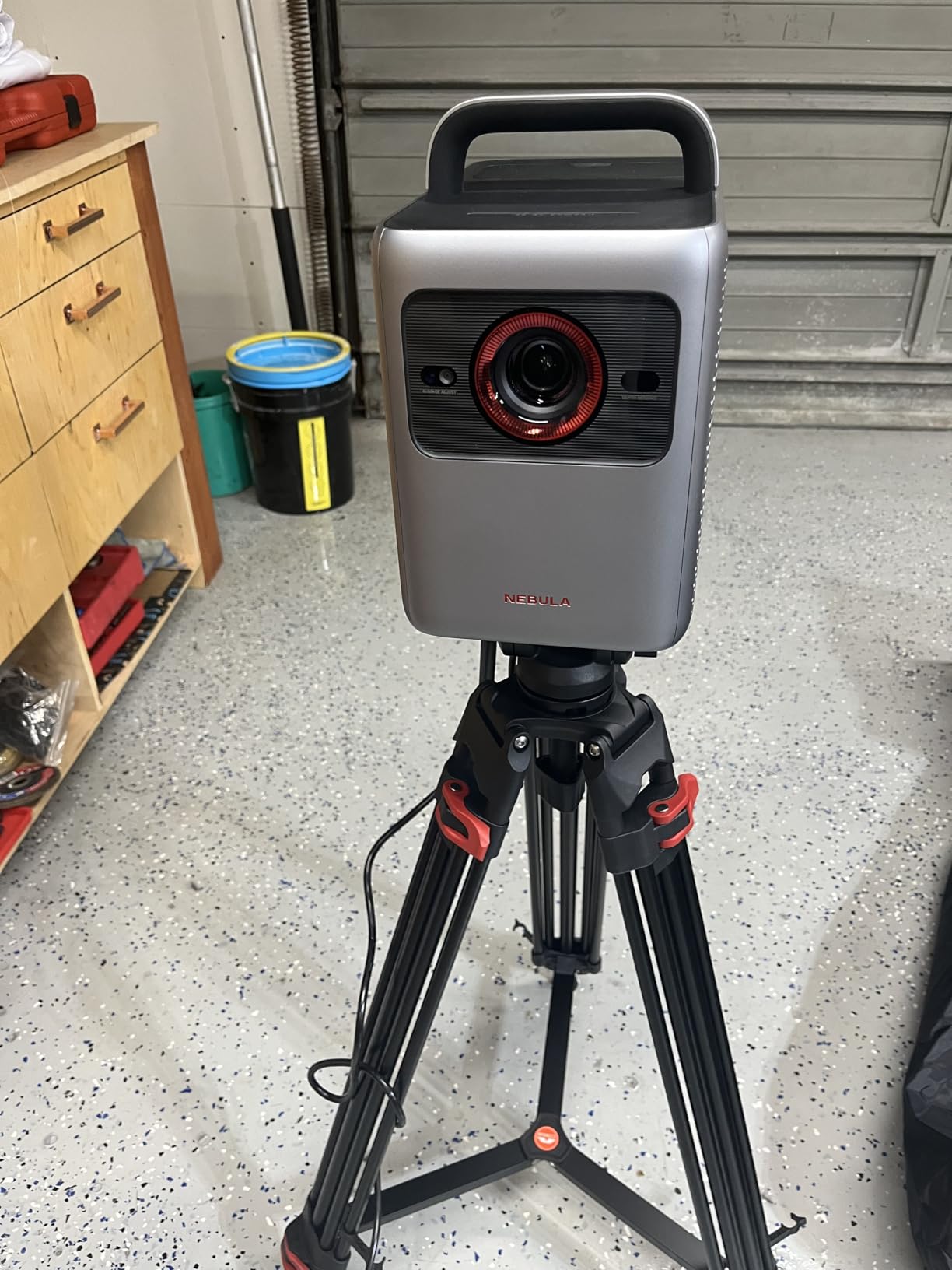
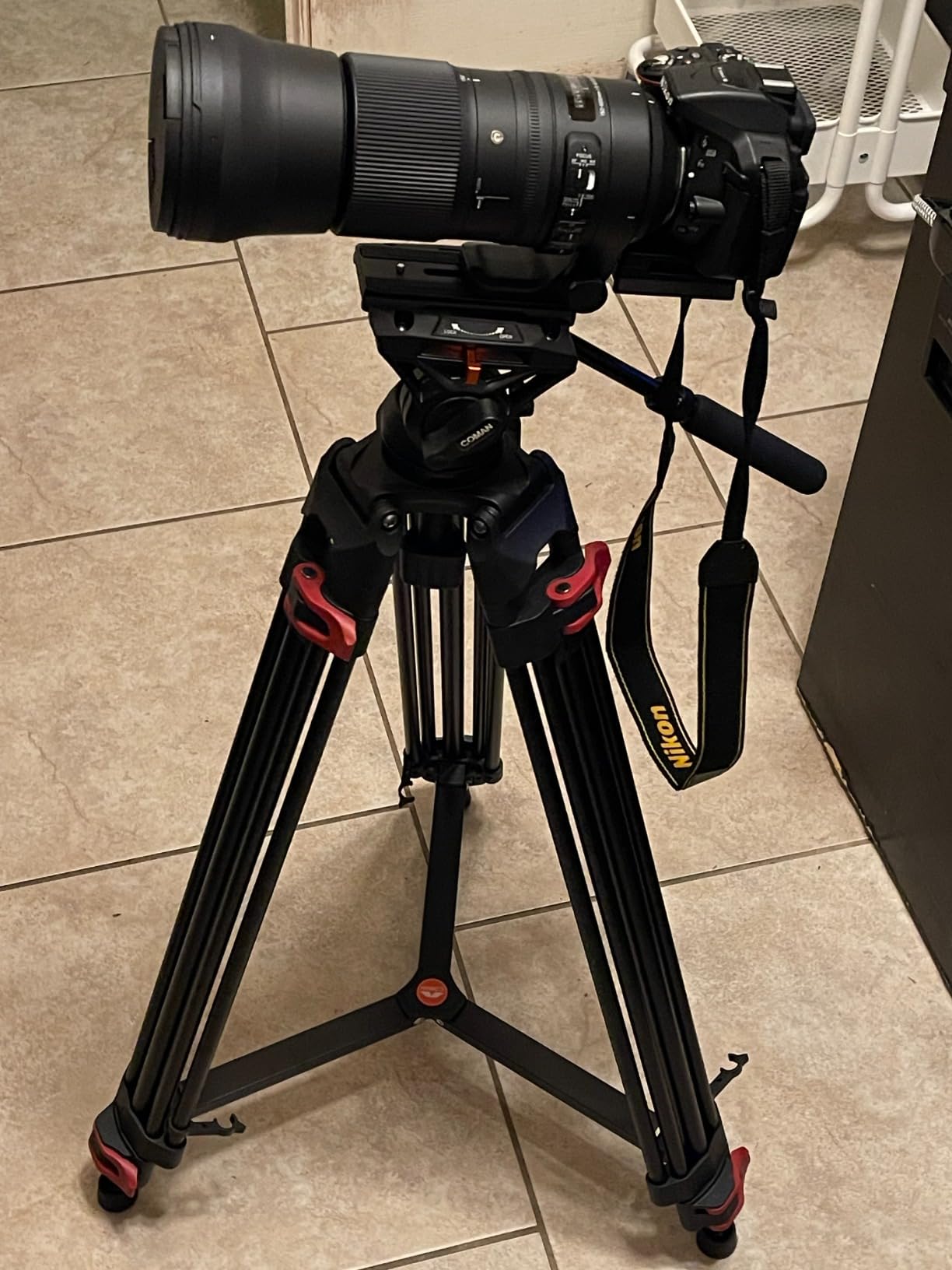
For wind, the twin-tube legs plus spreaders plus roughly 9 lb is the combination doing the work. The rubber foot mats add grip on uneven terrain, and the spreader stops the legs splaying inward when a gust loads the rig. At 1,459 reviews and 4.5 stars it is one of the most thoroughly owned tripods in this guide.
The raw dimensions are large: 74 inches maximum, 32.7 inches minimum, folding to 35 inches. That is a location tripod, not a hiking one, and the supplied carry strap is a genuine struggle for smaller users to manage at nearly 9 lb.
How it behaves in a real gust
Dual-tube legs resist the inward collapse that single-tube designs suffer, and the mid-level spreader converts that push into downward force on the spreader arms instead of an outward splay. Reviewers describe the head holding position without creep, which is what stops a long exposure from smearing after you let go of the handle.
The honest weakness is the damping range. This is a budget fluid head, and the counterbalance feel is mechanical rather than the stepless, oil-damped behaviour of broadcast-grade heads. Fine for single-camera work; not for a multi-camera film set.
Where it will disappoint you
The 32.7 inch minimum height rules out low-angle and tabletop work, and screw hardware loosens with repeated use so it needs an occasional re-tightening. Fluid damping is less refined than professional broadcast heads, so if you shoot long smooth moves you will feel the difference.
At about 9 lb with a 35 inch folded length, this is a two-person carry for most people. If you are walking distance to the shot, read the Sirui below.
4. NEEWER 79 Inch Heavy Duty Tripod – Best Heavy Duty Tripod for High and Overhead Angles
NEEWER 79″/200cm Video Tripod, Heavy Duty Aluminum Alloy Camera Tripod
Pros
- Second tallest maximum height in this group at 200 cm
- Only 5.58 kg while reaching that height
- 70 mm adjustable bowl base
- Built-in bubble level and rubber feet
- Large QR plate fits 1/4 and 3/8 inch screws
Cons
- 8 kg load is among the lowest here
- 20 mm tubes are slim for a heavy duty frame
- Flip locks need two hands
- Not water resistant
Height is the reason to buy this one. At 200 cm maximum and 88 cm minimum, the NEEWER 79 inch tripod is among the tallest in the group, and it gets there while weighing only 5.58 kg. For overhead angles, product work, event coverage or getting over a crowd, that reach-to-weight ratio is hard to argue with.
The legs are aluminum alloy double tube with a 70 mm adjustable bowl base, which helps on uneven outdoor surfaces. The fluid drag head pans 360 degrees with tilt from minus 70 to plus 90 degrees, a large quick release plate accepts standard 1/4 and 3/8 inch screws, and there is a built-in bubble level with non-slip rubber feet. A tripod bag is included and the warranty runs one year.
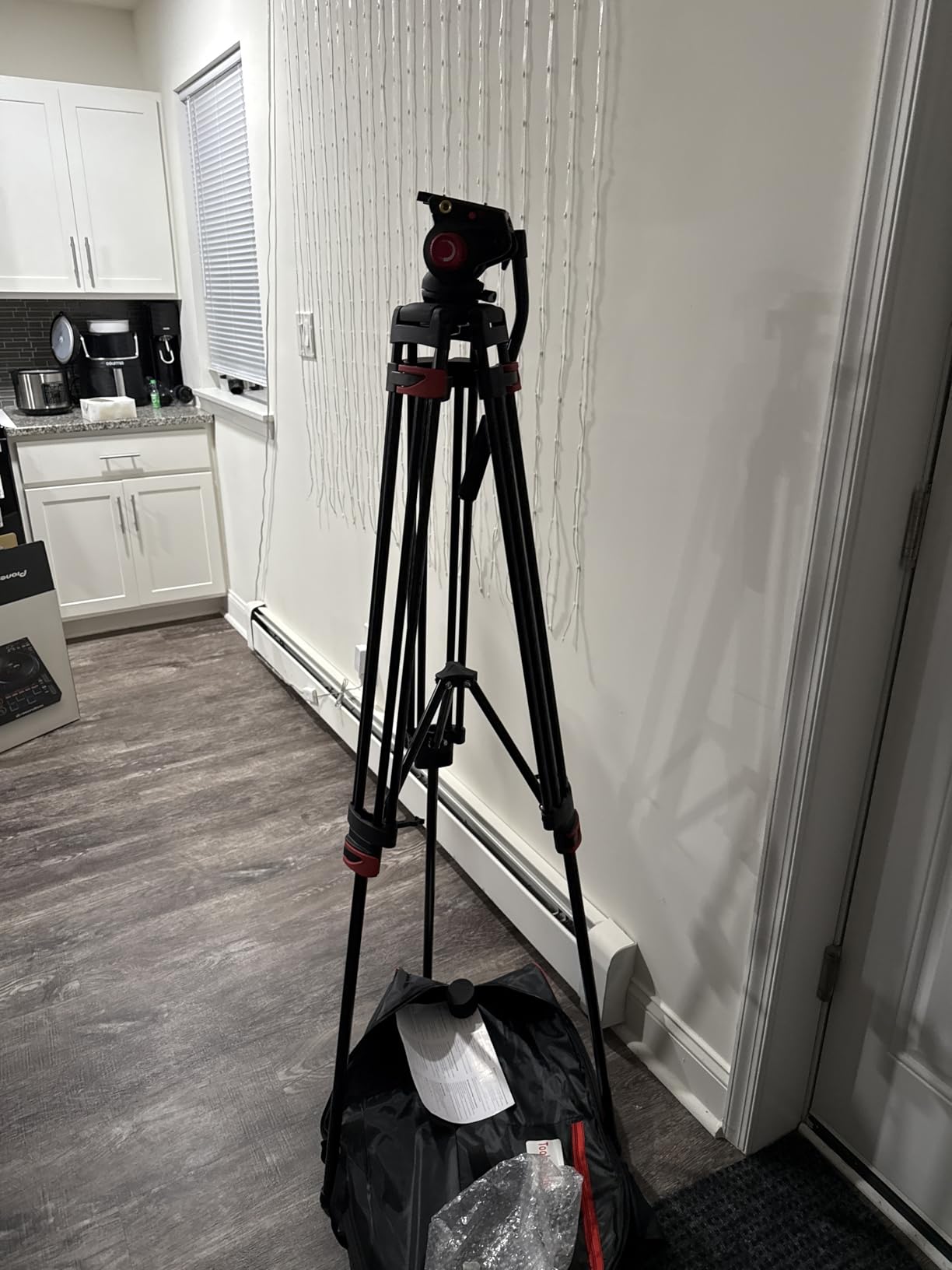
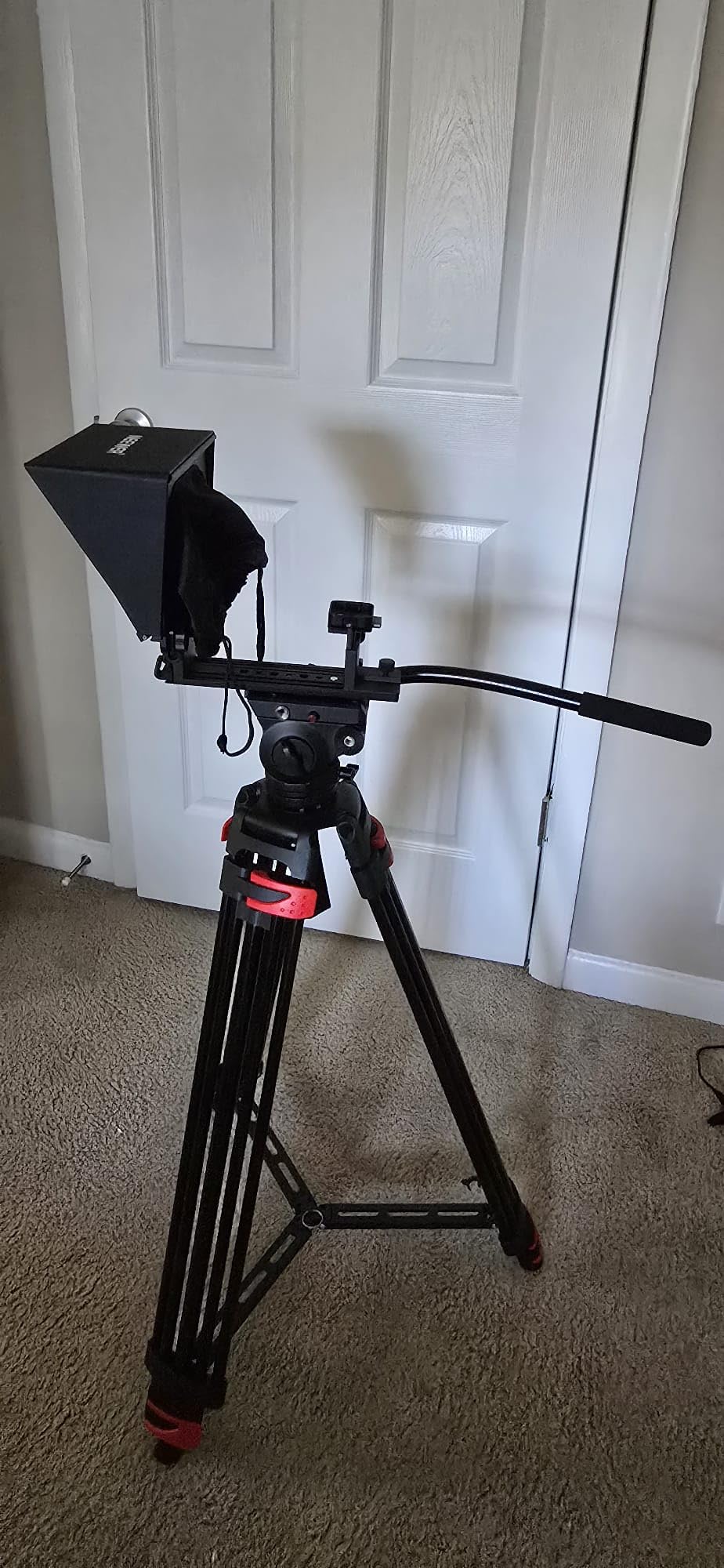
For wind performance, be realistic: 20 mm tubes are slim for a frame described as heavy duty, and the 8 kg load ceiling is one of the lowest here. What it offers instead is reach and a low net weight, which means you can carry it to an exposed position and still hold it up. Many owners use it for outdoor travel and event shooting where the long reach is the entire point.
Best wind practice with this tripod is to work lower than you want to and keep the top section collapsed, so the legs are less of a sail and the centre of mass stays down near the spreader.
Whether the height is worth the wind trade-off
Wind resistance on a tall tripod is mostly a leverage problem. A camera at 200 cm has far more area in the gust and a much longer moment arm for the same force, so the same tube can feel dramatically less stable than the same tripod at waist height. That is why experienced shooters work at the lowest height that frames the shot.
Two fewer sections than the INNOREL and a lighter build mean less torsional stiffness, so if you are stacking long exposures in exposed air, a shorter and heavier tripod will serve you better than this one.
Where it will disappoint you
The 20 mm tube diameter is the honest weakness, and reviewers comparing it with true twin-tube heavy duty frames notice the difference in flex. The 8 kg limit also rules out the heaviest long-lens cinema setups, and the flip locks require two hands to fully extend the legs.
It is not water resistant, which is a real limitation for coastal work where spray and rain come together, and a one year manufacturer warranty is the shortest here.
5. SmallRig AD-01 – Best Heavy Duty Tripod for Fast Field Setup
Pros
- 8.8 lb with a 75 mm bowl that stays put once set up
- Built-in bubble level
- Carrying bag and carry handle included
- Quick height changes with flip locks
Cons
- Plenty of plastic in the build with brittle knobs reported
- Friction-only pan and tilt
- 85 cm minimum height
- Some examples arrived with loose spreader screws
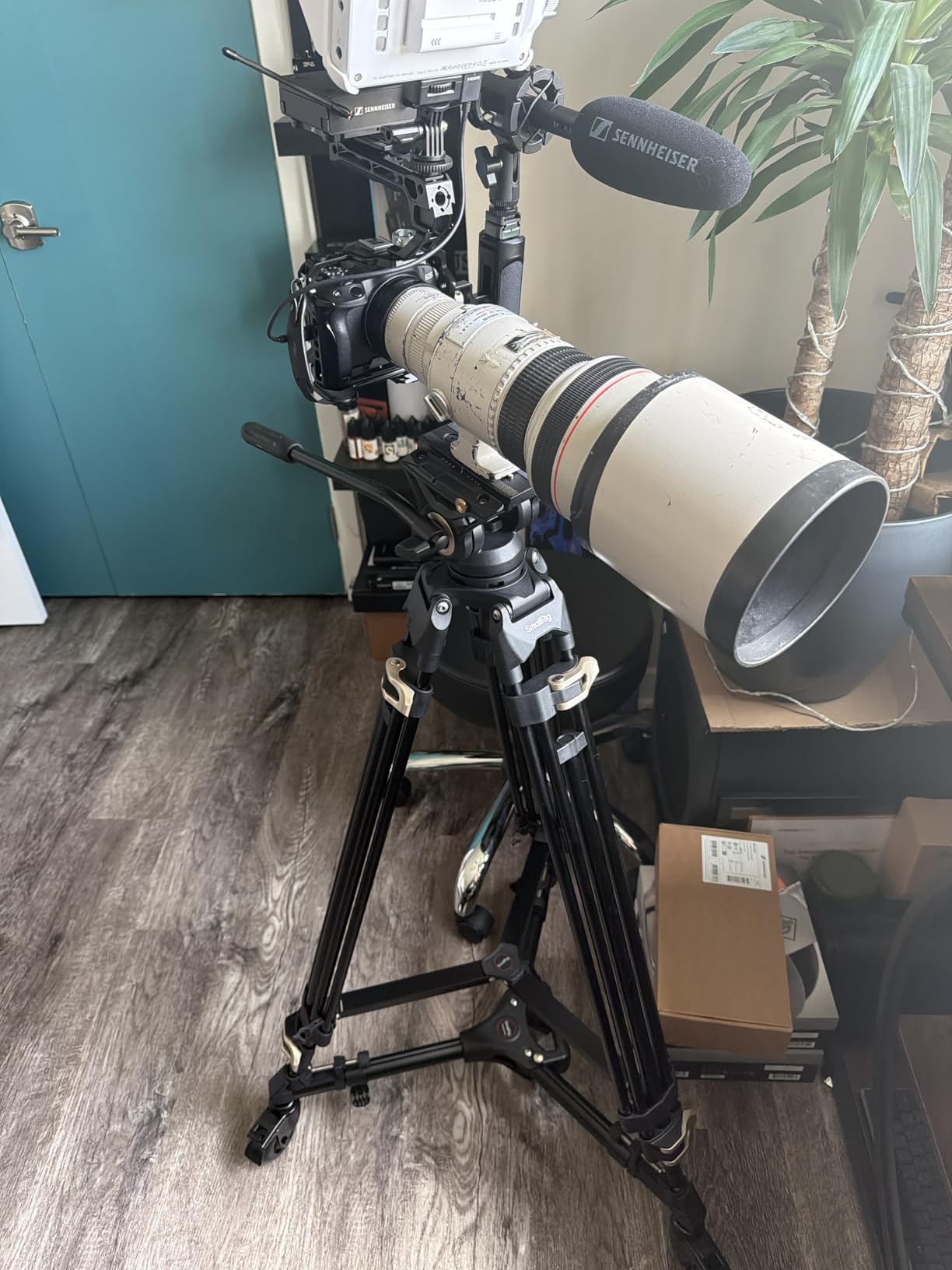
The SmallRig AD-01 is the pick if speed of setup matters more than absolute stiffness. At 8.8 lb it carries little mass for its stiffness class, and owners consistently report it does not shift once it is set up, with high-strength aluminum double-row tube legs and a 75 mm bowl bottom doing the work. That makes it a good pick for anyone moving between locations on foot in windy weather.
The dual-mode quick release plate is the feature that shows the target market: it accepts both DJI RS 2, RS 3 and RS 3 Pro gimbals and standard plates, so you can move a rig off the tripod and onto a gimbal without tools. Height runs from 85 cm to 186 cm, load is 8 kg or 17 lb, and there is a two year manufacturer warranty.

For wind, treat it as a fast-deploying location tripod. Flip locks let you collapse a section and drop height in seconds when a gust front arrives, which matters more in real weather than a marginally stiffer frame you cannot reposition quickly. The built-in bubble level speeds up levelling when the ground is not flat.
A spacious carry handle, anti-slip design and carrying bag are included, and the side-press quick release makes camera swaps fast.
What you give up for the low weight
The reviews are candid about the build. There is plenty of plastic in the construction, with reports of brittle knobs and levers and one leg hook arriving broken, and some question longevity under daily professional gigging compared with metal Manfrotto or Sachtler builds. Pan and tilt use friction adjustment rather than true fluid damping, so movements feel finicky for anything requiring smooth pans.
An 85 cm minimum height means you cannot get low to the ground at all, and some units arrived with loose factory spreader screws. Tighten everything before you trust it in a gust.
Best and worst pairing
Pair it with a compact cinema body or mirrorless rig and it is a genuinely strong travelling setup. Pair it with a long telephoto or a heavy teleprompter stack and the 8 kg rating becomes the limiting factor, not the wind.
It is also the natural partner to the drone and aerial kit, and our drones for windy conditions picks cover the same gust-front planning this tripod is built for.
6. Sirui AM-25S – Best Heavy Duty Tripod for High Reach and Low Weight
Pros
- High reach for its weight at 190 cm
- Retractable metal spike feet plus rubber feet
- Oversized locking knobs
- Built-in bubble level and 75 mm bowl
- Handles switch for either hand
Cons
- Minimum height of 91 cm limits low angles
- Not a travel tripod despite the weight
- Tilt can feel tighter than the pan
- A few buyers reported leg quality issues
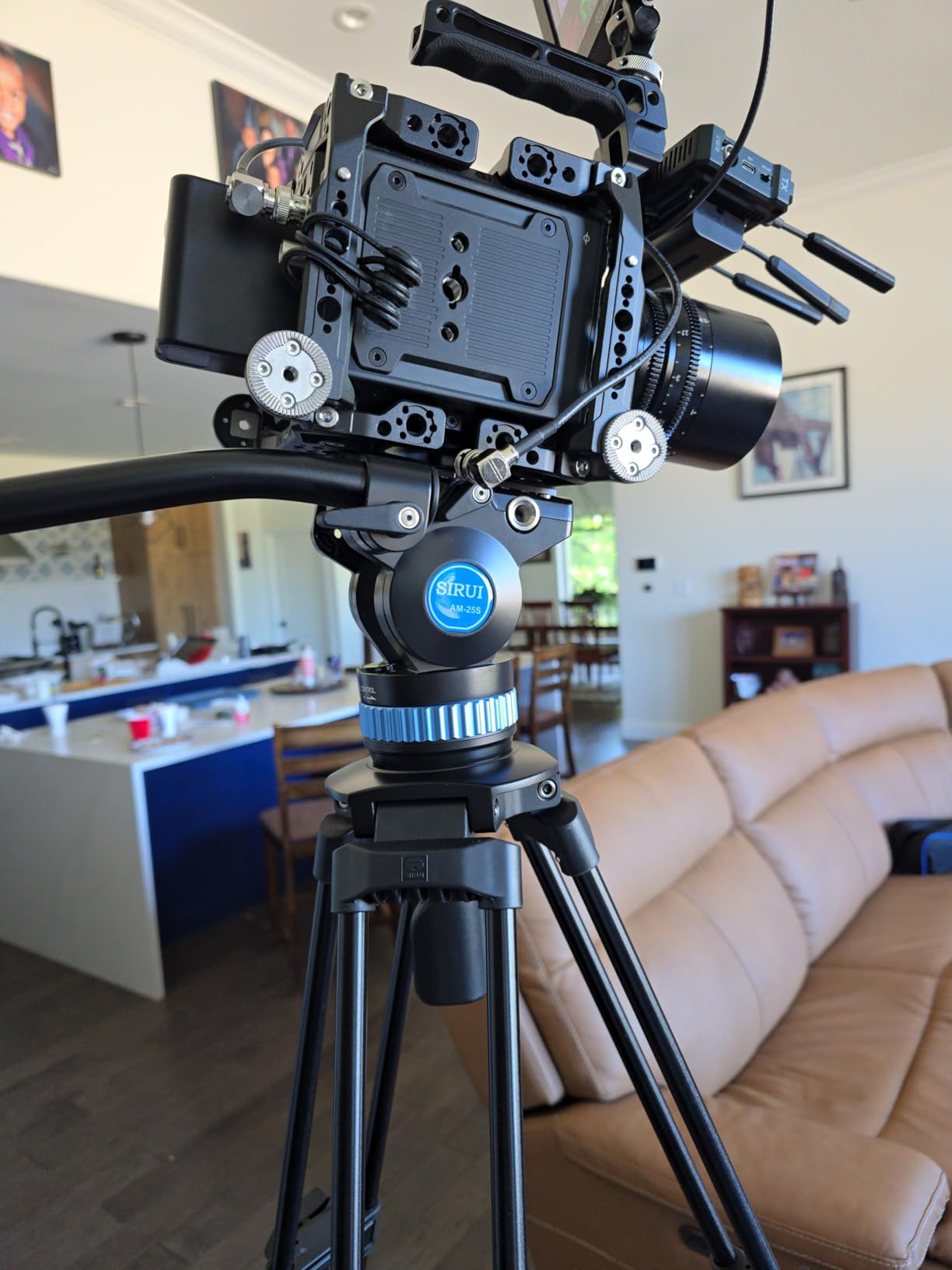
The Sirui AM-25S solves the problem every forum thread about heavy duty tripods eventually runs into: how do you carry something stiff to a windy location. At 4 kg with a 190 cm maximum height, it offers one of the best weight-to-reach ratios in this group, and the aluminum alloy twin-tube legs with a middle spreader hold up under load and resist vibration for long-lens work.
The fluid head has dynamic balancing and an adjustable bottom tension ring, giving stepless 360 degree pans and minus 75 to plus 90 degree tilts. Retractable metal spike feet and rubber feet are both included, which makes it genuinely usable on grass or soil where a fixed rubber foot would skate. The quick release plate takes both 1/4 and 3/8 inch screws and the handle reverses for either hand.
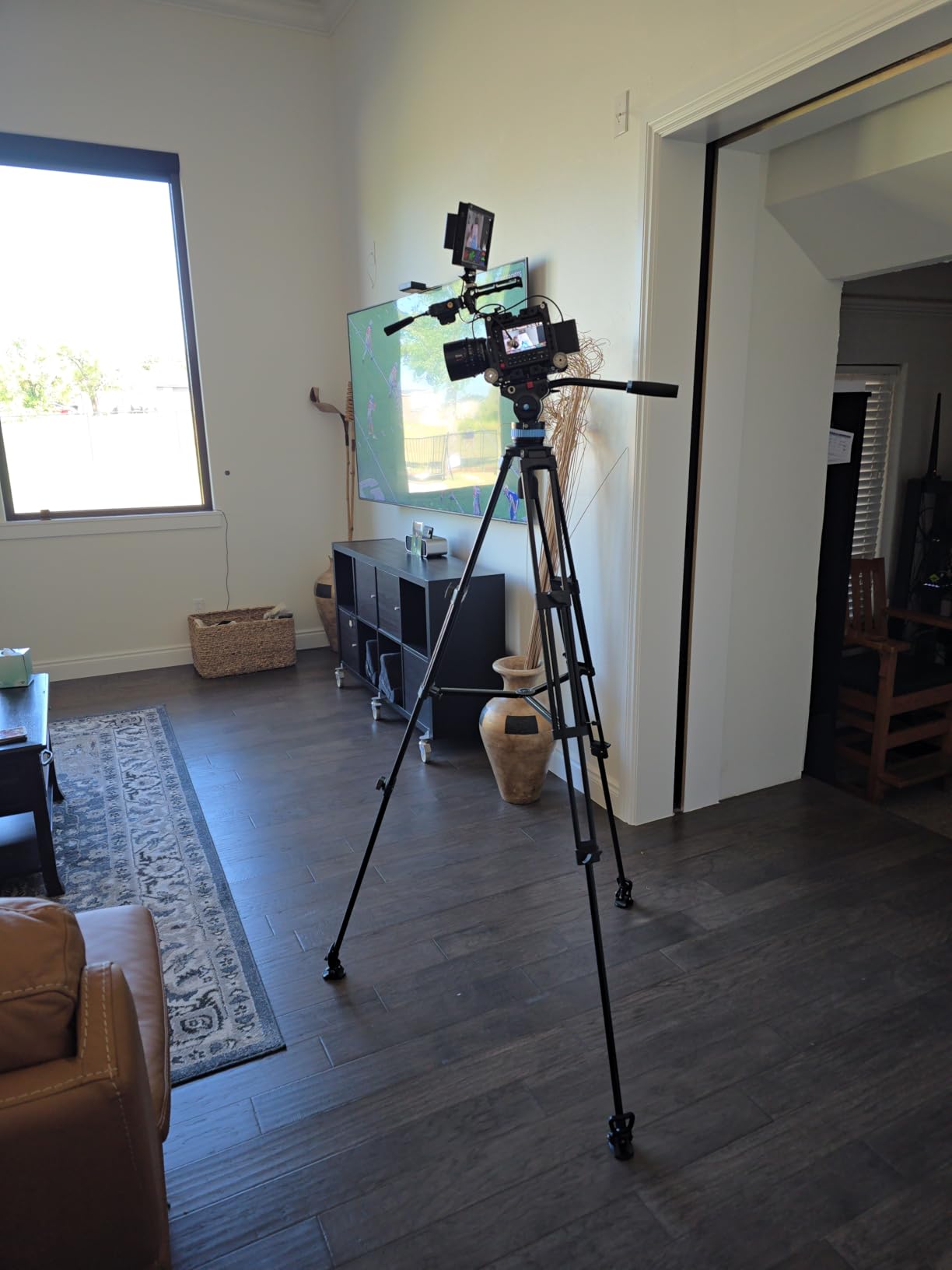
The spikes are the quiet hero for windy shooting. Screwing them into turf or soil converts a slippery rubber foot into a ground anchor, and anchor points resist the lateral push of a gust far better than friction alone. Reviewers use this tripod with Blackmagic Pocket Cinema bodies, teleprompters and heavy binoculars.
At 426 reviews and 4.6 stars, the dominant theme is value: build quality and fluid head smoothness exceed expectations at this price point.
Wind notes from owners
Users on photography forums single out tripods that spread fully and hold position, and the middle spreader here does that work. At 4 kg it is lighter than most of this list, so its wind resistance depends more on setup than on mass: spike in, drop a section, keep it low.
That said, 22 lb of load capacity for 4 kg of tripod is a strong stiffness-to-weight outcome, and it is why this model handles long lenses without ringing as much as its weight suggests.
Where it will disappoint you
Despite the low weight, reviewers emphasise this is not a travel tripod — the bulk matters on airline and hiking days. The 91 cm minimum height limits low-angle and tabletop work entirely, and the tilt adjustment can feel slightly tighter than the very smooth pan.
One buyer reported a quality control issue with a leg, so check the legs on arrival. If you need to get low to the ground, none of the fluid-head tripods on this list will do it and you need a photographic platform such as the INNOREL or Benro.
7. RAUBAY DV-1 Pro – Best Heavy Duty Tripod with Built-In Anchoring Spikes
RAUBAY 70.8″ Professional Heavy Duty Video Camera Tripod with Fluid Head, QR Plate for DSLR Camcorder, Max Loading 17.6lbs, Aluminum Twin Tube Leg with Metal Mid-Level Spreader DV-1 PRO
Pros
- Rubber feet unscrew to reveal anchoring spikes
- Head bowl adjustment with built-in level bubble
- Metal mid-level spreader
- Quick release takes 1/4-20 and 3/8-16 screws
- Owners hold a Canon R5 on rails with cage and monitor
Cons
- Only tilt is fluid damped while pan uses mechanical friction
- Some pan follow-through when panning hard
- 8.4 lb is awkward to reposition
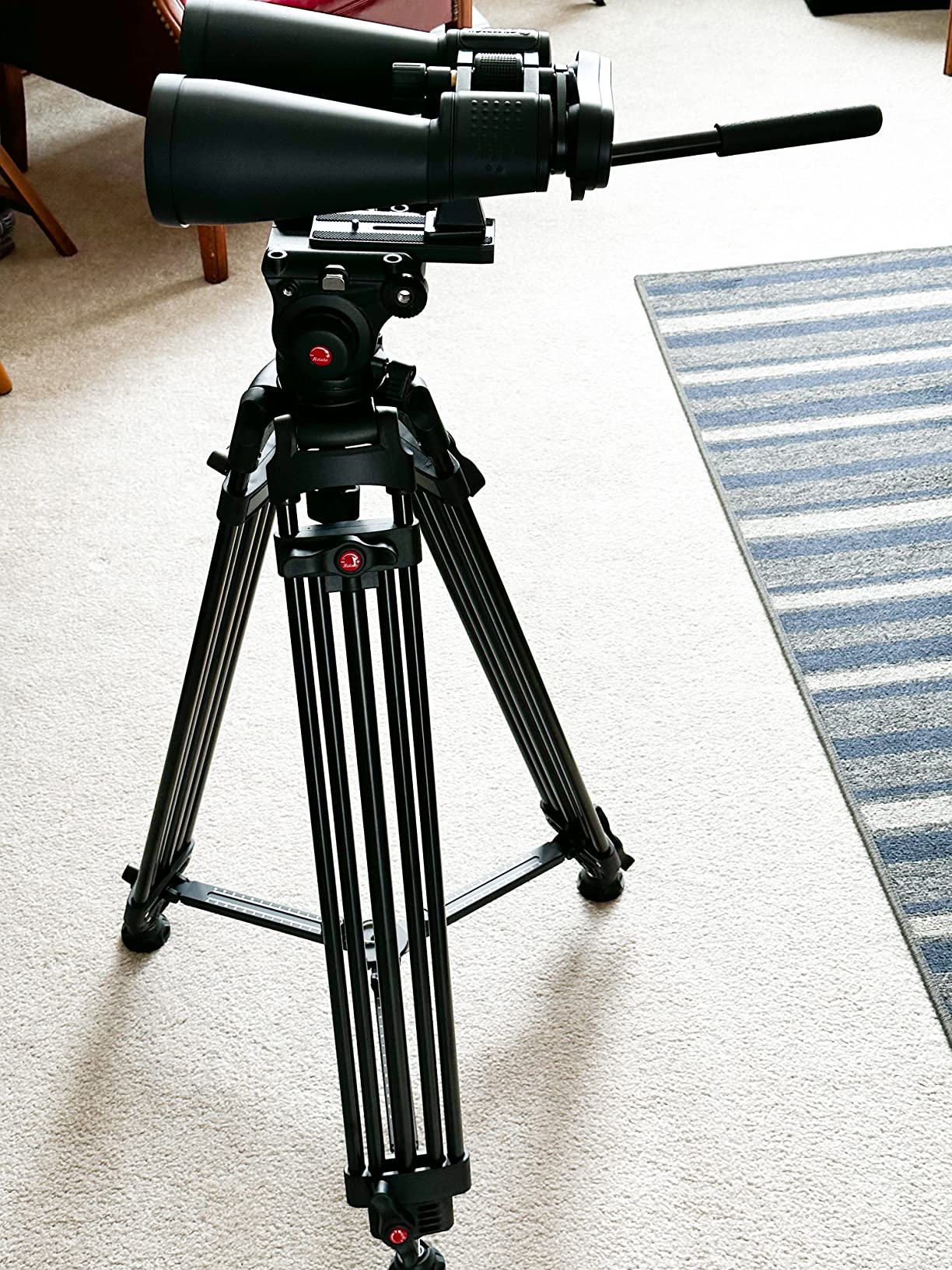
The RAUBAY DV-1 Pro is the one to buy if you shoot on grass, soil or sand. Its rubber feet unscrew to expose built-in spikes that dig into the ground, which is the single most effective anchoring trick you can add without changing tripods. In the forum advice that fills this category, anchoring is mentioned constantly and appears in almost no roundup content.
The rest of the package is solid for the tier. Aluminum twin-tube legs, three sections from 29.5 to 70.8 inches, an upgraded aluminum mid-level spreader, and a fluid drag head with a damping knob, 360 degree pan and minus 75 to plus 90 degree tilt. The head has a bowl adjustment with a built-in level bubble, which is genuinely useful when the ground under you is not level.
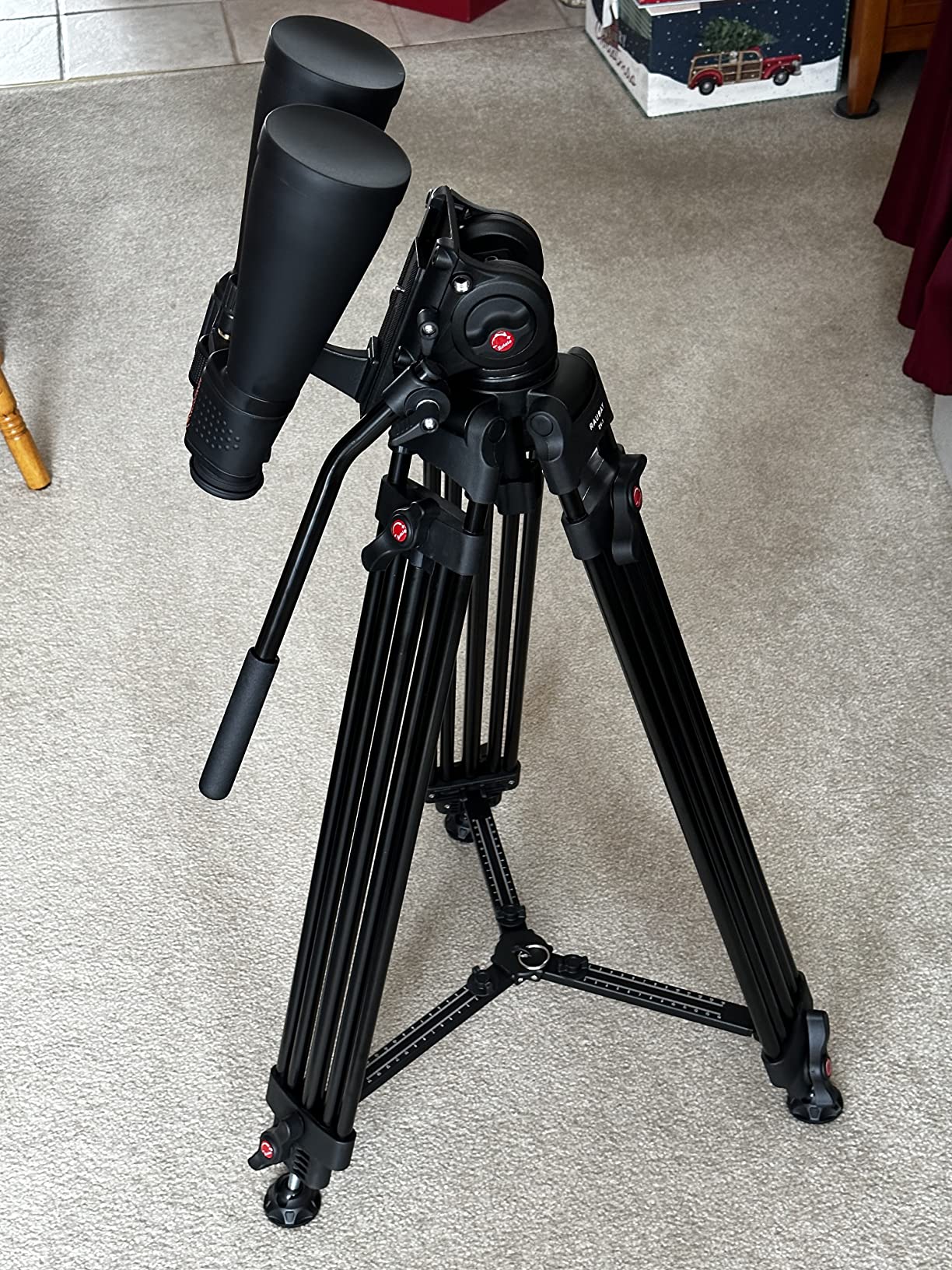
Owners report the fluid drag head holds position firmly, with the camera not creeping or slowly sinking when the handle is released. That matters in wind because a creeping head turns a gust into a slow drift, and drift ruins an exposure just as thoroughly as shake. A long detachable pan handle gives good leverage with a large rig, and the quick release plate takes both 1/4-20 and 3/8-16 screws with the storage screws built in underneath.
It holds a Canon R5 on 15 mm rails with a cage, V-mount battery, monitor and microphone, per owner reports, which is a heavier stack than the 17.6 lb rating suggests.
How the spikes change wind performance
A rubber foot relies on friction between the foot and the ground. A spike transfers that load into the soil itself, so a lateral gust pushes against the soil rather than against the slick top layer. On hard rock or pavement the spikes do nothing useful and can mark the surface, so swap back to the rubber feet when the ground will not take them.
The level bubble on the bowl head is the other wind-era feature. When the ground is uneven and the legs are at different extensions, a precise bubble reading gets you level faster than eyeballing a camera at dusk.
Where it will disappoint you
Only the vertical tilt axis is fluid damped; the horizontal pan uses mechanical friction, which feels less smooth and gives a small amount of pan follow-through or bounce when you pan hard before it locks. At 8.4 lb it is heavy to reposition mid-shoot, and the advertised 180 cm height does not make it a hiking tripod.
If you need true fluid damping on both axes, the Mactrem below has three independent adjusters and is worth the extra weight.
8. Mactrem VT72 – Best Heavy Duty Tripod for the Heaviest Rigs
Pros
- Highest load rating of the fluid-head tripods here at 33 lb or 15 kg
- Cast aluminum fluid head with oil-damped internals
- Three independent drag adjusters
- 210 cm maximum height
- Quick release slides plus both screw sizes
Cons
- Spring counterbalance is strong and needs practice
- Hydraulic action springs the head back level
- 9.8 lb is heavy over distance
- Small review base here at 216 reviews
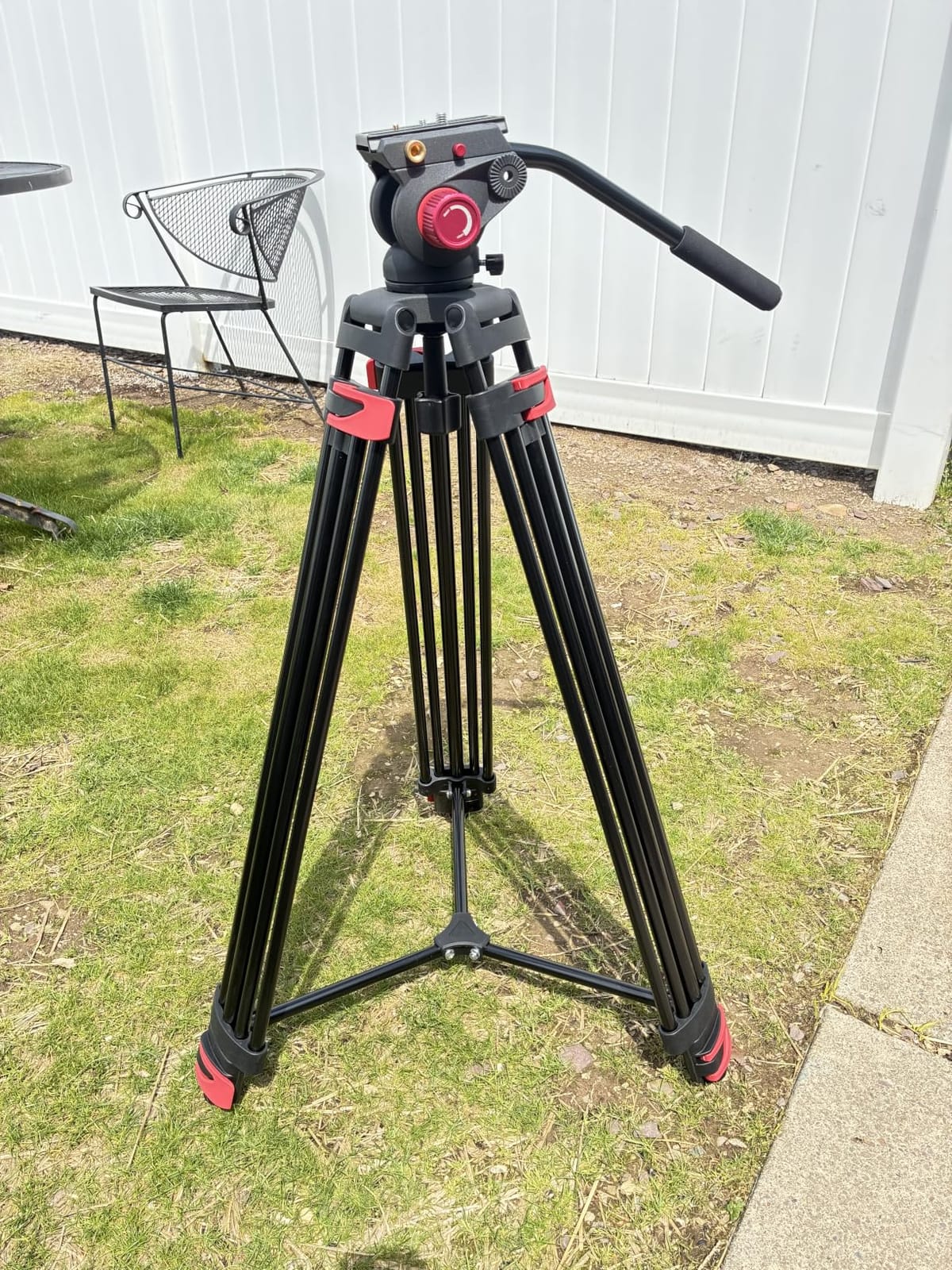
The Mactrem VT72 carries 33 lb, or 15 kg, the highest load rating of any fluid-head tripod here, and it does so on a cast aluminum alloy fluid head rather than a plastic-and-bracket budget head. For a heavy video rig, a cinema body on a shoulder rig, or large binoculars and a telescope, that rating means you are not asking the frame to operate near its limit, and a frame running below its limit is a frame that does not flex in a gust.
The head is where the engineering shows. Three independent drag adjusters give fine control over 360 degree pan, plus 90 to minus 70 degree tilt, and a hydraulic self-levelling device that springs the head back to level within plus or minus 10 degrees when the pan axis is released. Fluid head components are separated by damping oil for very smooth moves, and pre-set counterbalance with spring-loaded tension handles large and unbalanced rigs.
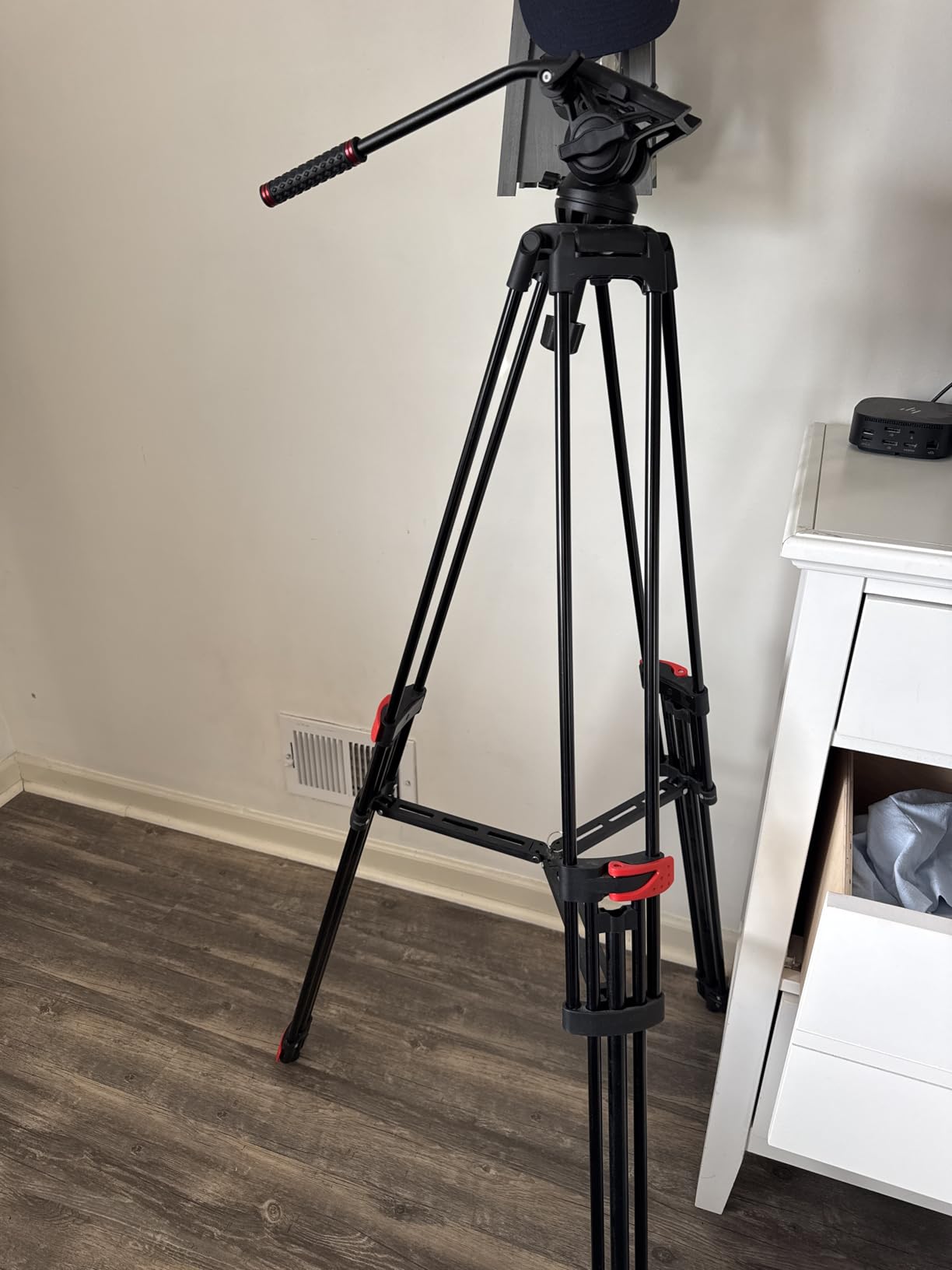
Maximum height is 210 cm, among the tallest offered, and it folds to 37 inches. The quick release plate has both 1/4-20 and 3/8-16 screws with a sliding range of plus 30 to minus 30 mm, and the pan axis mounts on either side so left- or right-handed operation both work.
Where the load rating genuinely helps in wind
A heavily loaded tripod is a better braced tripod, in effect. With weight on the plate, the legs carry compression rather than oscillating, and the frame behaves more like a fixed structure and less like a tuned resonator. Combined with the 210 cm reach, this is the pick for high and heavy work where you cannot compromise on either.
The three separate drag adjusters also matter outdoors: in wind you can lock the pan axis firmly instead of relying on a single friction setting that is either too loose or too stiff.
Where it will disappoint you
The spring-loaded counterbalance is strong, so lighter setups need deliberate counterweighting or the head will push back. The hydraulic self-levelling can spring the head back up rather than holding a deliberate tilt, which is a real problem if you want a slightly nose-down angle for a horizon.
At 9.8 lb it is heavy to move over distance, and with 216 reviews it has the smallest owner base in this group, so long-term field durability reports are thinner than for the Cayer or COMAN.
9. Benro Mach3 TMA38CL – Best Heavy Duty Tripod for Ridges and Night Sky
Benro Mach3 9X Carbon Fiber Series 3 Long Tripod, 4 Section, Twist Lock Legs, 69.7″ Maximum Height, 35.3 Load Capacity- Black (TMA38CL)
Pros
- 32.4 mm upper sections give excellent vibration resistance
- 16 kg load at only 4.5 lb net
- Large leg collars grip well and feel solid
- Interchangeable rubber and screw-in spiked feet
- Weight hook on the centre column for ballast
Cons
- Sold as legs only with no head included
- Twist locks are slow in changing weather
- Centre column collar must be torqued down
- Screw-in foot threads can strip
The Benro Mach3 TMA38CL is the one to take onto an exposed mountain ridge. Its upper leg sections measure 32.4 mm, stepping down through 28.6, 25.2 and 21.8 mm in 9-layer carbon fiber, and it is the only tripod here whose top section is wider than the widest leg tube listed by any of the fluid-head tripods above. Owners specifically praise it for vibration resistance in windy mountain and astrophotography settings, and our tripods for astrophotography in wind roundup makes the same case.
It holds 35.3 lb, or 16 kg, at a net weight of 4.5 lb, which is close to the best strength-to-weight ratio in this guide. It extends to 69.7 inches, drops to a 35.5 cm minimum, and folds to 23.2 inches. Magnesium castings, twist-lock legs and a removable centre column with a short second column round out the build. The warranty runs three years and extends to five with online registration.
What makes it the ridge tripod
Four sections give you height control in steps, so when a gust front arrives you collapse a section and lower the camera in one motion rather than fighting the wind with a tall frame. The single-clip leg release lets the legs splay wide for very low ground-level shooting, and the interchangeable rubber and screw-in spiked feet let you change anchor strategy with the ground.
The weight hook on the centre column is the feature forum users hunt for. Add a bag or a dense pouch and you add ballast low on the axis, which damps high-frequency shake during long exposures.
Where it will disappoint you
It is sold as legs only. A head such as the Benro Geared or Gx30 ball head is required and sold separately, so budget for a complete kit before comparing prices with the ready-to-shoot tripods above.
Twist locks are slower than lever locks and the legs must be extended by hand when released, which is awkward in weather. The centre column collar must be torqued down firmly or it creeps under a heavy camera and lens, and reviewers report stripping screw-in foot threads, recommending thread tape. One buyer had an inner plastic leg section break within a week.
10. NEEWER TP74 – Best Heavy Duty Tripod for Long Telephoto Work
Pros
- Heaviest complete rig of the ten at 10.9 lb
- Double tandem aluminum legs with mid-level spreader
- Owners report it holding Sony 200-600mm lenses
- 75 mm bowl with 360 degree scale and bubble level
- Dual-mode quick release for DJI RS and Manfrotto 501PL
Cons
- Head auto-leveling spring pushes the camera back up
- Quick release plate can loosen too easily
- 10.9 lb is heavy to carry
- Legs are tedious to extend single-handed
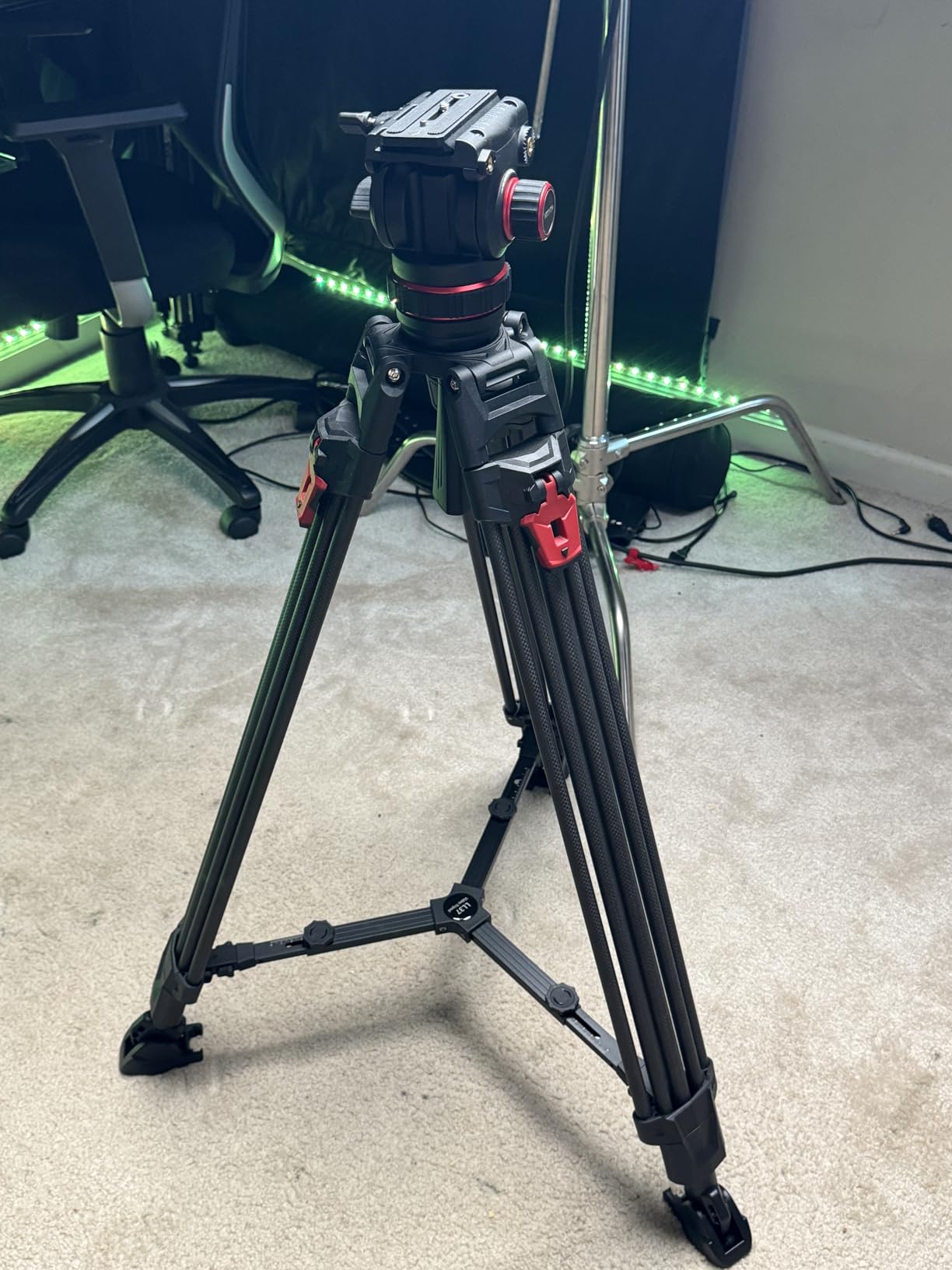
The NEEWER TP74 wins the mass argument outright. At 10.9 lb it is the heaviest complete rig in this guide, and owners consistently attribute its stability to that weight rather than to exotic leg geometry. Double tandem aluminum alloy legs plus a mid-level spreader and non-slip rubber feet give it a planted feel that holds steady under load, and 578 reviews at 4.8 stars make it joint highest rated here.
The head is well specified for the job. Fluid drag with friction damping and a balancing system, 360 degree rotation and minus 75 to plus 90 degree tilt, and a 75 mm bowl base with a 360 degree scale plus a bubble level for accurate levelling and stitched panoramas. Height runs from 86 cm to 187 cm and it folds to 91 cm. The dual-mode quick release works with DJI RS2, RS3 and RS3 Pro gimbals and Manfrotto 501PL and 504PL plates.

Long telephoto work is exactly where mass earns its keep. A big front element on a long lens catches wind over a large area, and that force arrives at the top of a tall, narrow frame. When you stack 10 lb of tripod under 8 lb of camera and lens, the whole assembly moves as one mass rather than as a top-heavy pendulum, and shake during a wind-framed exposure drops noticeably.
Reviewers report it holding heavy telephoto lenses such as the Sony 200-600mm, which is a demanding test.
Wind behaviour of the heaviest frame here
Extra mass damps high-frequency vibration, which is the specific failure that ruins long exposures in a gust. It does not make the tripod immune — a strong enough gust will still move it — but a 10.9 lb frame settles visibly faster than an 8.8 lb one after a gust hits.
The trade is honest: you are carrying 10.9 lb to the shot, and repositioning mid-shoot is slow. Choose it when you shoot from a fixed position, and choose the Sirui or SmallRig when you walk.
Where it will disappoint you
The most discussed quirk is the head’s auto-leveling spring, which pushes the camera back up whenever the tilt is not fully tightened. Owners who leave it slightly loose spend the shoot fighting the head. The quick release plate can also loosen a little too easily in use, which is a genuine risk for a heavy telephoto rig.
The bubble level sits high and is hard to read at full extension without a step stool, and the legs are tedious to fully extend and lock with one hand. If low-angle work matters, this tripod cannot do it.
Why Wind Destroys Tripods and How These Ten Avoid It
A gust does not attack the legs. It attacks the camera and head, which sit at the top of a narrow column, and the resulting force is a torque that twists the leg sections. The more the legs twist, the more the top plate moves, and a fraction of a degree of movement across a 30-second exposure is enough to soften an image beyond recovery.
Torsional rigidity is the single best predictor of wind performance, and it scales steeply with tube diameter. A 40 mm tube is not merely thicker than a 25 mm one; because stiffness depends on the fourth power of diameter, the difference between those two numbers is enormous. That is why the INNOREL with 40 mm sections and the Benro with 32.4 mm upper sections behave differently from every 20 mm single-tube frame here, and it is why forum readers say they want the actual tube diameter rather than a marketing load rating.
Leg spread matters as much as tube size. Widening the stance increases the restoring force that pushes the tripod back toward vertical, and a mid-level spreader converts sideways leg pressure into downward force rather than letting the legs splay. Every tripod on this list with a spreader — the Cayer, COMAN, Sirui, RAUBAY and NEEWER TP74 — is working harder against wind than a spreaderless design of the same weight.
Section count controls how fast you can shrink the sail. With four sections, you can drop height in one move when a gust front arrives. With three sections, the top section is long and thin, and leaving it extended in a gale turns the leg into a whip that transmits vibration straight to the camera. This is the advice that appears constantly in forum threads and in no roundup: keep the thin upper sections short in high wind.
Mass damps what stiffness cannot. Load capacity and wind resistance are different axes. A tripod can be rated for 40 kg and still flex and ring with a 4 kg setup, because the rating tells you where it breaks, not where it stays still. Hanging a bag from a centre hook weight adds mass low on the axis, and that ballast absorbs the high-frequency shake energy before it reaches the sensor. The INNOREL and the Benro both have that hook, and users cite it by name in astrophotography and mountain field reports.
Carbon fiber versus aluminum is the version of this trade-off most people argue about, and it comes down to which failure you care about. Aluminum is heavier, so it damps vibration more, and it stays stiff in cold conditions. Carbon fiber is lighter and absorbs high-frequency resonance well, but a light carbon tripod still moves if the legs are thin. Our rule through this test: match the material to the load, then judge wind performance by tube diameter and net weight, not by the label on the box.
How to Set Up a Tripod in Wind
Setup technique is worth more than most people spend on hardware. These six steps come from the recurring advice in photography forums, and they apply to every tripod in this guide.
1. Spread the legs wide and use all three angle positions. The INNOREL repositions to 9, 37 and 69 degrees; use the widest setting the ground allows. On slopes, dropping one leg low and widening the other two keeps the mass centred over the feet instead of hanging out over the edge.
2. Anchor the feet before you unclip the tripod. If you have spikes — the RAUBAY and Sirui include them, and the Benro and INNOREL ship screw-in spikes — drive them into turf or soil. On rock, wedge flat stones under the feet to create a lip the foot cannot slide over.
3. Keep the thin upper sections short. This is the single highest-value habit. Collapse the thinnest sections until you still have the height you need, and drop again when a gust front arrives. Less sail area means less force, and a lower camera means a shorter moment arm.
4. Hang ballast on the centre hook. Your camera bag, a lens pouch or a dense jacket goes on the hook before you raise the camera. Low, central mass is what keeps the frame from ringing during long exposures.
5. Work low and sheltered. Shoot with the camera at or below chest height where you can, position yourself on the upwind side so your body breaks the gust, and where possible set up behind a rock, a wall or a vehicle rather than in the open gap.
6. Time long exposures between gusts. Watch grass, flagging or water for a lull, start the exposure as the gust dies, and use the interval before the next one. On a windy coastal ridge this alone converts unusable frames into usable ones.
Field care matters too. Photographers working in cold, wind and sand ask about maintenance more than almost anything else, and the honest answer is short: rinse salt spray off with fresh water, clear sand from leg locks and head friction controls before they seize, and re-check every lock torque at the start of each session because sections creep under load over time.
Heavy Duty Tripod Buying Guide: What Actually Matters in Wind
Load capacity is not the same as wind resistance. This is the misconception that trips up almost every buyer. A load rating tells you the point at which something fails. Wind resistance tells you how much the frame moves before that point. You can have a 40 kg carbon fiber tripod with 32 mm tubes that is essentially immobile in a gale, and a 10 kg aluminum video tripod that shakes badly with a small camera on it, because the load rating was never a stiffness figure.
Judge wind performance on four numbers instead: maximum leg tube diameter, net weight, section count and whether a ballast hook exists. Every number in the table at the top of this guide comes straight from those four categories.
Carbon fiber versus aluminum in wind. Carbon fiber wins when you have to carry the tripod to the location and need a high load rating in a light frame — the INNOREL carries 40 kg at 6 lb, and the Benro carries 16 kg at 4.5 lb. Aluminum wins when the mass itself is the point, because heavier material damps high-frequency vibration and stays predictable in cold, wet conditions. The NEEWER TP74 at 10.9 lb and the Cayer at 8.8 lb are both aluminum, and both owners credit raw mass for their stability. The forum maxim is right on this: lighter generally means less stiff, smaller or more expensive.
What tripods do professional photographers use? The honest answer is that professional landscape and motion picture crews overwhelmingly work with fluid video tripods rather than photographic carbon fiber platforms for windy field work — the twin-tube aluminum spreader design is the standard for good reasons. Carbon fiber platforms dominate for stills, astrophotography and long lenses because of the strength-to-weight ratio and the low-angle capability. If you want the studio-built equivalents, our heavy duty tripods for studio photography guide covers those separately.
What makes a spec-grade tripod. Metal castings at the load points instead of plastic, twist or lever locks that hold under load without creeping, a head with independent pan and tilt control, and serviceable parts. That is the description that fits the broadcast-grade and survey-grade tripods used on military and engineering deployments, where equipment is specified for repairability and for surviving being dropped in transit. Those same traits — metal over plastic, positive locks, replaceable parts — are what separate the long-lived tripods in this list from the ones buyers replace within a year.
Brands worth knowing. Manfrotto and Bogen aluminum models have been the community default for long exposure for decades. Sachtler is described repeatedly in owner reports as rock-solid, with fluid heads that have no real competitors for smooth pans. Gitzo occupies the pro carbon fiber tier. Sirui and Benro cover the enthusiast carbon fiber tier with strong owner loyalty, Leofoto and SmallRig push value-heavy duty video platforms, Innorel competes directly at the professional bowl tier, and K&F Concept competes on price. Vanguard remains a respected older name in magnesium and carbon.
Portability is the real tension. Almost every forum thread about this category ends in the same place: a tripod that is stiff enough for long exposures is heavy, and a tripod that is light enough to carry rings in a gust. Decide which failure you can live with. If you shoot from a fixed position, take the 10.9 lb NEEWER TP74 or the 8.8 lb Cayer. If you walk to the location, take the 4 kg Sirui or the 5.58 kg NEEWER 79 inch tripod and compensate with anchoring.
Frequently Asked Questions
Who is the strongest tripod for windy conditions?
Strength in wind comes from maximum leg tube diameter, total mass and section count rather than the published load rating. Among the tripods tested here the INNOREL RT90C resists wind best by geometry, with 40 mm tubes and a 40 kg rating, while the NEEWER TP74 and Cayer BV30L hold ground best by mass at 10.9 lb and 8.8 lb. A 40 kg rating does not mean a tripod is stiff, only that it will not break.
What is the best brand for tripods?
It depends on the job. Manfrotto and Bogen aluminum models remain the community default for long exposure work. Sachtler is consistently described by owners as rock-solid and leads on fluid heads. Gitzo sits in the professional carbon fiber tier, Sirui and Benro cover enthusiast carbon fiber, and Leofoto, SmallRig and Innorel deliver heavy duty value. Brand matters less than tube diameter and net weight for wind.
Are carbon fiber tripods worth it?
Yes, if you need to carry a high load rating in a light frame. The INNOREL RT90C carries 40 kg at 6 lb and the Benro Mach3 carries 16 kg at 4.5 lb, both in multi-layer carbon fiber. Carbon fiber does not automatically defeat wind, though: a light tripod with thin tubes still moves. Aluminum frames are heavier but damp high-frequency vibration better.
How do I stop my tripod shaking in the wind?
Collapse the thin upper leg sections to reduce sail area, spread the legs wide, drop to a lower working height, and hang a bag or dense pouch from the centre hook weight if your tripod has one. Anchor spiked feet into turf or soil, or wedge stones under the feet on rock. Finally, time long exposures between gusts rather than through them.
What is the best camera tripod for landscape photography?
For windy landscape work, the Cayer BV30L is the best all-round choice because 8.8 lb of mass keeps it planted without demanding perfect technique. If you need low-angle capability and maximum stiffness, the INNOREL RT90C reaches 40 mm tubes and a 22 inch minimum height. For ridge and night sky work with long lenses, the Benro Mach3 offers 32.4 mm upper sections at 4.5 lb.
What is the best lightweight tripod that will not shake?
Among heavy duty frames there is no free lunch: lighter generally means less stiff, smaller or more expensive. The Sirui AM-25S is the best compromise here, carrying a 22 lb load at only 4 kg, and the SmallRig AD-01 weighs 8.8 lb. Both need anchoring and a low working height in wind. If you need true stiffness at low weight, expect to move into the professional carbon fiber tier.
What tripods do the military and survey crews use?
Military, survey and engineering deployments specify tripods for repairability and survivability in transit rather than headline load ratings: metal castings at the load points, positive twist or lever locks that do not creep, independent pan and tilt control, and replaceable components. The all-metal heavy duty video tripods in this list, such as the COMAN FF16LS and the NEEWER TP74, share several of those traits at a fraction of the cost.
Final Verdict on Heavy Duty Tripods for Wind in 2026
After weeks of comparing these ten frames, the Cayer BV30L remains my pick for the best heavy duty tripods for windy conditions, because planted mass solves more wind problems than any other single feature and it demands the least from your technique. Buy the INNOREL RT90C if you want absolute torsional stiffness, low-angle reach and a 40 kg rating, and accept that you are buying legs rather than a complete kit.
Whichever one you choose, remember the four numbers that matter: tube diameter, net weight, section count and ballast hook. Set the legs wide, collapse the thin sections, hang a bag on the hook and time your exposures between gusts, and the frame you already own will do far better than most owners report.