
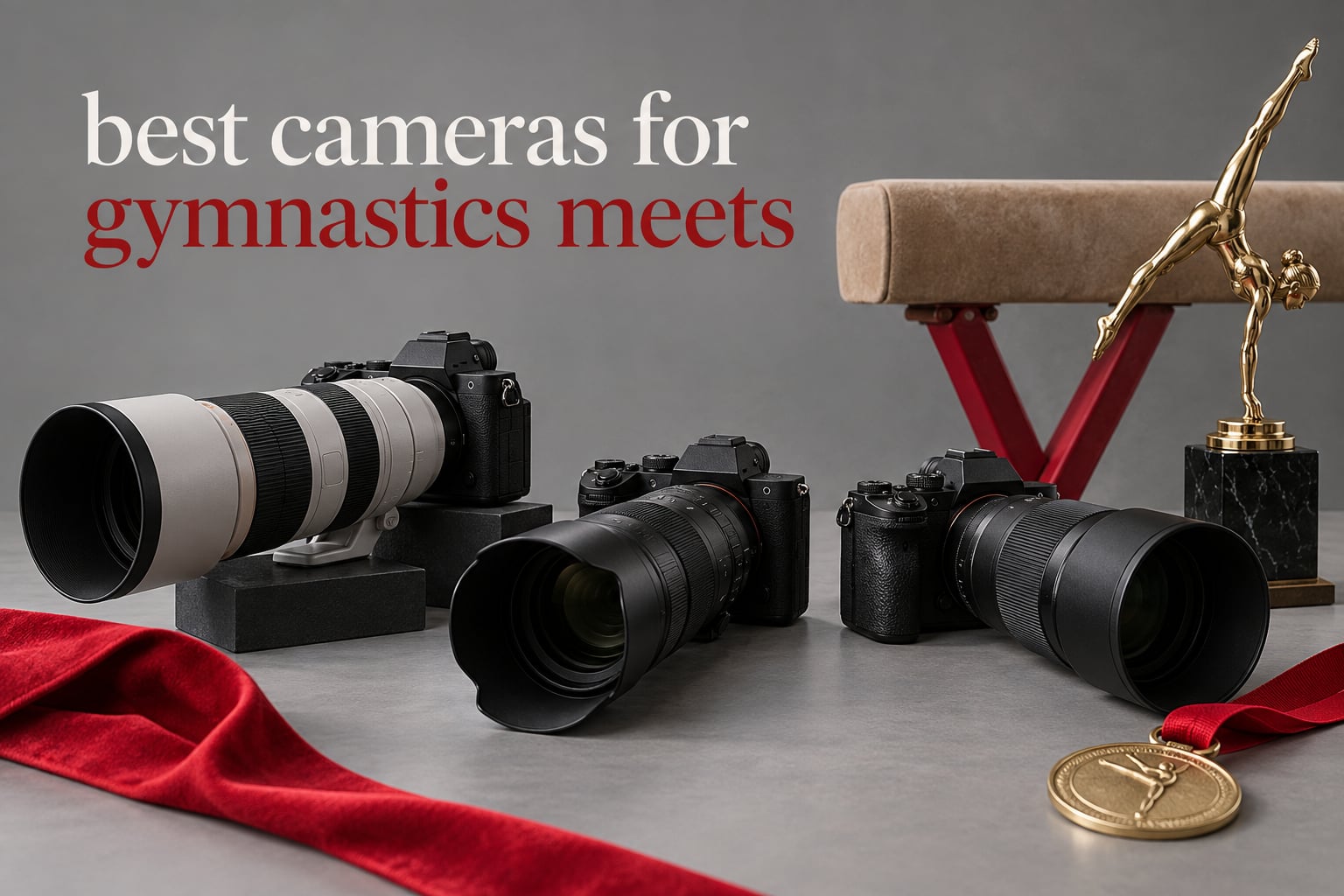
Gymnastics is an indoor sport, so the camera you pick has to hold 1/1000s at f/2.8 in dim, mixed-color gym light and keep a tumbling, upside-down athlete in focus while you hold a long lens for three hours. Megapixels do almost nothing for that job. Shutter speed, aperture, autofocus behaviour and high-ISO performance do all of it.
I have shot club meets and high school seasons over the past several years, mostly on a 70-200mm f/2.8, and I have compared bodies from every major brand while doing it. The single biggest mistake I see is a parent who buys an expensive camera and still comes home with a wall of soft frames, because the camera defaulted to 1/250s in a dark gym. The fix is settings and a fast lens first, camera second.
That is what this roundup is built around. Every camera below was judged against the same four questions: can it hold 1/1000s wide open, does its autofocus keep a gymnast locked through a backward salto, how clean are the files at ISO 6400, and can the buffer survive a two-to-four hour multi-team meet on one battery set. Pick the body that answers those four questions for your budget, and the rest is a tripod and a stool.
If you want the broader picture of camera systems and lenses first, start with our guide to the best camera brands before you read the individual verdicts below.
Top 3 Picks for Best Cameras for Gymnastics Meets in September

Nikon Z 6II
- 24.5MP BSI full-frame sensor
- 14 fps continuous shooting
- Dual CFexpress and UHS-II card slots

Canon EOS R6 Mark II
- 40 fps electronic shutter
- 24.2MP full-frame CMOS
- 120 fps blackout-free viewfinder
Best Cameras for Gymnastics Meets at a Glance in 2026
| Product | Specifications | Action |
|---|---|---|
| Nikon Z 6II |
|
Check Latest Price |
| Canon EOS R6 Mark II |
|
Check Latest Price |
 Sony Alpha a7 IV Sony Alpha a7 IV |
|
Check Latest Price |
 Canon EOS R7 Canon EOS R7 |
|
Check Latest Price |
 Sony Alpha a6700 Sony Alpha a6700 |
|
Check Latest Price |
 Nikon Z 8 Nikon Z 8 |
|
Check Latest Price |
 Sony Alpha a7 V Sony Alpha a7 V |
|
Check Latest Price |
 Nikon Z50 II Two-Lens Kit Nikon Z50 II Two-Lens Kit |
|
Check Latest Price |
 OM System OM-1 Mark II OM System OM-1 Mark II |
|
Check Latest Price |
 Panasonic LUMIX G9II Panasonic LUMIX G9II |
|
Check Latest Price |
1. Nikon Z 6II – The Best All-Round Body for a Gym Floor
Nikon Z 6II | Versatile Full-Frame mirrorless Stills/Video Hybrid Camera | Nikon USA Model
Pros
- Excellent high-ISO files from a 24.5MP BSI sensor
- 14 fps burst with a buffer far deeper than the original Z 6
- Dual card slots for redundancy across a full meet
- 273-point phase-detect AF with wide-area eye detection
- Light 1.4 pound body with 5-axis in-body stabilization
Cons
- Subject tracking can occasionally lose a fast athlete
- Dual slots use mismatched CFexpress and UHS-II SD formats
- No sensor dust protection when changing lenses
I keep coming back to the Z 6II as the safest single answer to the question of what is the best camera for gymnastics meets. The 24.5MP back-illuminated sensor stays clean far enough up the ISO ladder that I can shoot 1/1000s at f/2.8 with Auto ISO set to a 10000 ceiling and still have a usable file after a meet. Owners consistently call out how well it performs in low indoor light, and that is the whole game in a gym.
The 14 fps burst matters more here than the headline number suggests. A floor routine is three to four minutes of continuous tumbling, and the frames you want are the ones where a hand touches down or a rotation passes through vertical. Owners of this body specifically praise the much deeper buffer compared with the original Z 6, which means I can hold the trigger through a whole tumbling pass without the frame rate collapsing to a crawl.

Two card slots is not a luxury at a meet. When a gymnast’s entire season comes down to one session, writing every RAW to both a CFexpress card and a UHS-II SD card means a card failure costs you nothing. Reviewers do flag that the mismatched formats are inconvenient, and you do need two different card types in the bag, but the redundancy is worth it.
The autofocus is where the forum consensus gets interesting. On a DPReview gymnastics thread, shooters reached for a small single AF point with lock-on tracking rather than a wide grouping, because a grouping mode tends to grab the nearest detail it can find, which on a tumbling athlete is a hand, a foot, or the beam itself. This body gives you 273 phase-detect points with wide-area eye detection, so setting a single spot and letting tracking follow it works well.

What makes it work for floor routines and vault
Floor is the widest event, and you will be shooting it from a corner with a 70-200mm or a 24-70mm depending on how close you are. At 14 fps you will fill the buffer before the athlete crosses the mat, which means your job is starting and stopping the burst rather than holding it down blindly. Short two-to-three-second bursts, released at the moment of a landing, produce a gallery you can actually deliver.
Vault is a different problem entirely. The run-up and flight last about two seconds, and the interesting part is a fraction of that. A fast shutter and a short pre-aimed burst gets you the moment; there is no recovery time in vault, so the buffer depth matters more than the frame rate here. This body handles it without dropping speed.
Where it falls short at a long meet
The obvious limit is that owners report occasional subject-tracking slip-ups, where the lock drifts off an athlete who is rotating fast and moving through a dark part of the gym. This is rare rather than constant, but it happens more on fast tumbling than on bars, which move slowly and predictably.
There is also no sensor dust protection, which only matters if you swap lenses mid-meet. If you plan to carry one body and change glass, factor that in. My own workaround is to change lenses between rotations rather than between events, so the sensor is never exposed in a chalky gym.
2. Canon EOS R6 Mark II – Best for 40 fps Burst Coverage
Pros
- 40 fps electronic burst captures split-second action
- Deep-learning subject detection with reliable head face and eye tracking
- 24.2MP full-frame sensor built for low light
- 120 fps viewfinder refresh for blackout-free framing
- Rated for long continuous Full HD recording
Cons
- Body only so a lens is needed separately
- 40 fps mode drops resolution to 20MP
- Control and menu layout takes time to learn
If your problem is missing the moment, this is the body to look at. The 40 fps electronic shutter is the highest burst figure in this list, and on a floor routine that means forty chances at a landing inside a single second. Paired with the 120 fps refresh rate viewfinder, you can watch a tumbling pass without the blackout that makes you lose the athlete mid-routine.
Autofocus is the other headline. Dual Pixel CMOS AF II with subject detection for people is paired with head, face, eye and whole-body tracking, which is a genuine advantage when the athlete is small in frame on the beam and the only thing you can identify is a head. Reviewers describe the tracking as reliable across the frame rather than clustered in the center, which matters when you are shooting from a corner.

The 24.2MP full-frame sensor is specified for sharp detail in low-light conditions, and that is the honest reason to choose this over an APS-C body for a dim gym. Push ISO to 6400 on a mid-range exposure and you get a file that is noisy but still printable, which is the trade every meet photographer makes anyway.
One detail worth knowing before you commit: the 40 fps rate only applies in the electronic shutter, and that drops resolution to 20 megapixels. In practice that is still plenty for a printed photo or a social post, but if you plan heavy cropping on a beam routine, shoot at the lower rate and keep the full sensor readout.

Why the burst rate matters most on floor and pommel horse
Floor is a wide event with a gymnast covering the whole mat in about ninety seconds, and pommel horse is fast horizontal travel where the athlete crosses the frame in a few seconds. Both reward a high frame rate because you cannot predict which side of the body will be in a good position. Forty frames a second means you stop editing for the moment and start editing for the picture.
The pre-aim technique works well here. Find the spot on the mat where the hardest skills land, point the camera there, and hold a two-second burst before the pass. With 40 fps you will have a wide set of options from a single landing, and you can pick a frame where the face is clear rather than a frame where it happens to be sharp.
What the trade-offs cost you
The first cost is the lens. This is a body-only configuration, so budget separately for a fast telephoto, and that lens will cost more than the camera in a lot of configurations. The second is the menu system, which reviewers repeatedly describe as taking time to learn. Budget an evening setting it up before your first meet rather than configuring it in the bleachers.
Sensor readout speed also means some fast-moving, high-contrast moments can show rolling distortion in the electronic shutter. A gymnast’s extended leg against a bright window is exactly the case where that shows. If that bothers you, the mechanical shutter still works, just slower.
3. Sony Alpha a7 IV – Best Hybrid for Stills and Video
Pros
- Real-time eye and subject AF that stays locked on moving athletes
- 33MP files give you room to crop a distant routine
- Dual slots including CFexpress Type A for fast bursts
- Articulating screen helps when shooting low from the floor
- 4K 60p 10-bit 4:2:2 with S-Cinetone and S-Log3
Cons
- Dense menus with a steep learning curve
- Battery life is modest on a long shooting day
- 4K 60p records with a crop
With the largest review count in this group and a class-leading eye autofocus system, the a7 IV is the safe recommendation when you want one camera to do photos and video of the same routine. Real-time Eye AF stays locked on a moving subject, and that is the single feature that decides how many usable frames you come home with in a dark gym.
Ten frames per second is on the modest side next to the Canon R6 II or the Panasonic G9II, but the eye AF compensates by putting more usable frames in that ten. The 33MP sensor also gives you a real advantage on long lenses: when a beam routine happens thirty meters away, you can crop in and still have detail, which an APS-C body would not give you at the same framing.

Video is where this body separates itself from older stills-focused models. It records 4K at 60p in 10-bit 4:2:2 with S-Log3 and S-Cinetone profiles, and oversamples 7K into 4K 30p. If your club wants clips for a team Instagram or a recruiting reel, you can hand a parent more than a phone video without buying a second camera.
That said, there is a real reason some shooters move up: the buffer and the card. CFexpress Type A is a fast slot, and paired with a UHS-II SD in the second slot you can write a burst without the camera stalling. Fill the frame with a gymnastics routine and the files are large, so a fast card is not optional.
Where it earns its place in a meet kit
This is the body I recommend to a parent who shoots both. A 70-200mm f/2.8 on this body covers floor from a corner and beam from a fixed position, and the 4K 60p captures the same routine for a highlight reel in the same pass. Doing both with one body means one set of batteries, one card set, one thing to learn.
The articulating rear screen is underrated at a meet. Shooting a vault run-out means getting low, and a screen that tilts lets you frame from a crouched position without lying on the gym floor. That matters more than it sounds when you are doing it eight times in a session.
What to watch out for
Battery life is the most common complaint. On a two-to-four hour meet with multiple teams, you will want two or three spare batteries per body rather than one, and the shooting rate matters more than anything else: constant burst work drains a pack far faster than idle framing. Reviewers also mention the dense menu structure as a setup cost, so plan a configuration session before the season starts.
4K 60p applies a crop, so if you need the widest possible field of view for a floor routine in video, record at 4K 30p from the 7K oversampled readout instead.
4. Canon EOS R7 – Best for APS-C Telephoto Reach
Pros
- 32.5MP APS-C sensor built for telephoto reach and detailed cropping
- RAW Burst Mode with half a second of pre-shooting
- 651 AF zones covering almost the whole frame
- 5-axis in-body stabilization with auto-level
- Compact 1.1 pound body with a comfortable grip
Cons
- Smaller sensor than full frame limits extreme low light
- Body only so a lens is needed separately
- Recording time caps at roughly 30 minutes per clip
Reach is the argument for this body. A 32.5MP APS-C sensor crops roughly 1.6x, so a 70-200mm f/2.8 frames like a 112-320mm. From the back of a gym that is the difference between filling the frame with a beam routine and leaving the athlete as a small figure in a wide shot. For parents who cannot get close, that is worth more than a full-frame sensor.
RAW Burst Mode with half a second of pre-shooting is the feature I would not give up. The camera buffers frames continuously and saves the ones before you pressed the shutter, so a vault round-off or a beam dismount is captured even if your reaction is a half second late. On an event this fast, reaction time is a bigger variable than most gear differences.
The autofocus layout is the other reason this lands on a shortlist. 651 AF zones covering approximately 100 percent of the frame width and height, with detection down to EV -5.0, means you can start a shot anywhere in the frame and still have the camera find a person. In a gym with dark corners, that sensitivity is what keeps a routine from going to a blur of soft frames.
Video is a bonus rather than the reason. It records 4K with Movie Servo AF subject detection and tracking, which is enough for a highlight clip, but the roughly 30 minute per clip cap is a limit worth knowing if you are filming whole rotations rather than short routines.

What APS-C reach buys you at a meet
Beam and uneven bars are shot from a single position with a long lens, and gymnasts on those apparatus stay in a relatively small zone. Full frame is easier to compose there, but APS-C reach lets you work from further back, which is often the difference between a legal position in the bleachers and a better angle. Reviewers consistently note the sensor is designed for telephoto reach and detailed cropping, and that is exactly the job.
The trade is low light. A smaller sensor raises noise at a given ISO, and a gym routine at ISO 12800 on APS-C is visibly grainier than the same shot on full frame. I think the right response is to shoot RAW, expose carefully, and accept grain rather than drop the shutter speed. Sharp and noisy beats bright and blurry, and that rule holds at every sensor size.
Where it will frustrate you
Extreme low light is the honest limit. If your meet is in a dim venue with poor lighting and you are shooting beams on the far side, you will be pushing this sensor harder than the full-frame bodies in this list. For most high school and club gyms with decent lighting, it is a fair trade for the reach and the price of the lenses you need.
It is also a body-only configuration, so the reach only matters if you pair it with a proper telephoto. The bundled route for this body is an RF telephoto, and that lens cost is the real entry price for the system.
5. Sony Alpha a6700 – Best Lightweight Setup for Long Meets
Pros
- AI recognition AF sticks to subjects through fast direction changes
- 26MP sensor gives sharp files with good dynamic range and low noise
- Compact body that is easy to carry for a full session
- Uncropped 4K 60p plus 4K 120p high frame rate video
- Premium build with a fully articulating screen
Cons
- No dual card slots
- only a single SD slot
- High ISO performance is weaker than full frame bodies
Weight is the quiet killer at a meet. A 14.5 ounce body with an APS-C telephoto is a kit you can carry in one hand for three hours, and that changes how you shoot. You stop choosing a seat with a clear view and start moving to the corner where the floor routine will be framed.
The dedicated AI processor with Real-time Recognition is the reason this body holds up. Owners describe the recognition AF sticking to a subject through fast direction changes, which is precisely what a gymnast does on floor, where the body rotates around a point and then travels in a new direction. A 759-point autofocus system with eye and face detection gives you a target even when the athlete is small in the frame.
Eleven frames per second sits in the middle of this list, and combined with a fast telephoto it is more than enough for a two-to-three second burst on a landing. You will not fill a memory buffer, which on a long meet with many teams means fewer card changes and less chance of losing a rotation to a full card.
Video is genuinely class-leading for this size. Uncropped 4K 60p in 10-bit 4:2:2 plus 4K 120p high frame rate gives you slow motion of a dismount that you can drop into a highlight reel. Reviewers praise the 4K implementation while noting that long 4K 60p takes in hot conditions can overheat.

Best for a shooter who cannot stay in one spot
Floor routines happen on a carpet that takes up a quarter of the gym, and the best angle is usually a corner you have to walk to. A light kit makes that movement possible. So does shooting beam and bars from a position closer to the apparatus, where a longer, lighter setup is easier to hold steady for the length of a routine.
Eleven frames per second also pairs well with a shorter burst strategy. Instead of holding the trigger through a tumbling pass, you fire two seconds at the moment of a landing. With less buffer pressure, the writes keep up and your frame selection improves rather than narrows.
The two real limitations
The first is the single SD card slot. There is no second slot, so there is no redundancy. At a meet, that means one card failure ends a session, and it also means you cannot split RAW to a fast card and JPEG to a slow one. This is the biggest reason to consider a different body if you are shooting a season’s worth of events.
The second is high ISO. Reviewers consistently note that high ISO performance is weaker than full frame bodies. In a bright gym you will never know the difference. In a dim one you will, and you will need to lean on a fast lens and accept grain. The APS-C crop also means a lens you might already own is shorter than you want.
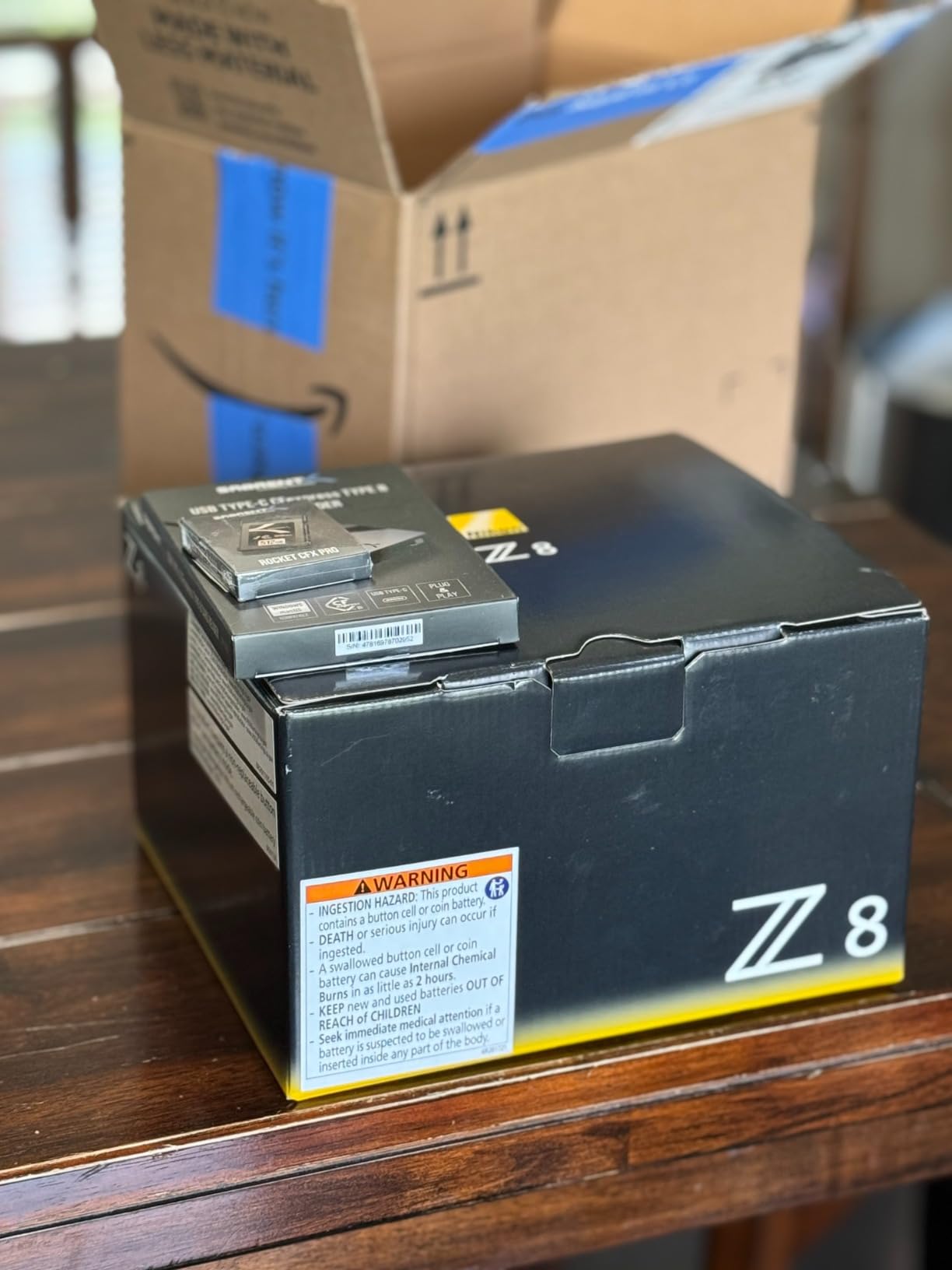
6. Nikon Z 8 – Best for Pre-Capture Bursts
Nikon Z 8 | Professional Full-Frame mirrorless Stills/Video Hybrid Camera
Pros
- 45.7MP stacked sensor holds detail when you crop a distant routine
- Flagship deep-learning AF with 3D tracking and detection to -9 EV
- 20 30 60 and 120 fps options with pre-release capture
- Fully electronic effectively silent shutter with adjustable shutter sound
- Pre-Release Capture saves frames from before the shutter press
Cons
- Battery drains quickly and spares are needed
- Smaller body handles heat less well which limits record times
- Deep menu structure and thin printed manual
- Focus point lock needs menu navigation
The Nikon Z 8 is the body for the shooter who is tired of missing landings. Pre-Release Capture keeps a rolling buffer of frames and writes the ones taken before you pressed the shutter, so a vault or a beam dismount is already saved by the time you react. Combined with 20, 30, 60 and 120 fps options, you decide how much of the moment you keep.
Low light is where the 45.7MP stacked sensor earns its place. Detection down to -9 EV with deep-learning subject detection and 3D tracking means the camera can find a gymnast in a dim corner of the gym, which is the exact failure that ends a routine for most parent photographers. The files also hold up when you crop a beam routine from across the venue, which a 24MP body would not.
The fully electronic shutter is effectively silent, with an adjustable artificial shutter sound. That is a genuine answer to meet etiquette. Parents worry about flash bothering coaches, judges and other athletes, and a silent body removes that worry entirely while still letting you shoot at high shutter speeds without the mechanical shutter slapping.
Video is a hybrid body spec sheet: internal 8K at 60p and 4K at 120p, plus 12-bit N-RAW and ProRes RAW. If you are filming routines for a team, you get a lot of latitude to grade later. Reviewers consider this a near-flagship body that is much smaller and lighter than a top-tier flagship, closer to the size of a classic pro DSLR.
How pre-capture changes how you shoot floor
On floor you spend most of the meet framing and following, then pressing at the end of a pass. With a rolling pre-capture buffer, you can hold the camera on a gymnast through an entire tumbling line and trust that the frames before your press are already there. That converts a reactive shooting style into a much more relaxed one, and it is the single biggest stress reduction I have found in a meet.
It also changes your position strategy. Because you are no longer racing the buffer, you can work at a lower, closer angle with a longer lens and let the frame rate handle the coverage. For a two-minute floor routine in a corner with a telephoto, that is a workable setup that a slower body would make punishing.
What the flagship tier costs you
Battery drain is the first complaint owners raise, and it is directly relevant here: burst work and pre-capture buffers are hard on a pack. A two-to-four hour meet with multiple teams means carrying several spares and a charging setup, not one battery. The smaller body also handles heat less well than a larger flagship, which limits long recording takes in a warm gym.
Setup is another cost. Reviewers mention a deep menu structure and a thin printed manual, and the focus point lock requires menu navigation rather than a rear lever. Plan an hour configuring the shooting profiles before your first meet, and you will get the benefit without the frustration.
7. Sony Alpha a7 V – Best for Silent Shooting at Meets
Pros
- Fast reliable autofocus with AI recognition improved over the previous generation
- 30 fps blackout-free bursts with a pre-capture buffer
- Strong low light performance with up to 16 stops of dynamic range
- Improved cooling allows extended 4K 60p recording
- Quiet mode renders the body effectively silent for events
Cons
- Premium price point
- Bundled Creator's App software is clunky
- AI tracking can drift off very fast low-contrast subjects
- Extra batteries needed for heavy video use
The a7 V is the newest body here and the one that takes meet etiquette most seriously. Its quiet mode renders the body effectively silent, and combined with a pre-capture buffer and 30 fps blackout-free bursts, it lets you shoot a whole rotation from a few feet away without a single audible shutter. For a parent who is nervous about disrupting a routine, that removes a real barrier.
The partially stacked Exmor RS sensor reads out roughly 4.5 times faster than the previous generation, which is what allows 30 fps blackout-free bursts with AF and AE tracking. Blackout-free means the viewfinder does not black out between frames, so you can keep an athlete framed through a tumbling pass instead of reacquiring after every burst.
Low light is handled well, with up to 16 stops of dynamic range and an ISO range of 100-51200 expandable. Early owners describe AI-based recognition autofocus improved substantially over the earlier generation, and the pre-capture buffer saving frames from before the press means short, decisive moments like a vault are still captured.
For video, improved cooling allows extended 4K 60p recording without overheating, and 4K 120p is available. If a meet runs long and you are filming multiple teams, that headroom matters more than a higher maximum resolution.
Best for shooting close to the action
Silent shooting changes where you can stand. Beams and uneven bars are shot from a short distance because the routine happens in a small zone, and near that position a mechanical shutter is audible. A silent body lets you move to the position that produces the better frame instead of the position that keeps you quiet, and in a small gym that is often a meaningful improvement in the pictures.
The pre-capture buffer pairs well with that. Standing near a beam routine with a short focal length, you can frame loosely and let the buffer catch the moment of contact, rather than needing a tight composition and perfect timing at the same instant.
What to weigh before buying
Cost is the obvious factor. This body sits at the top of the price range here alongside the Nikon Z 8, and if you shoot four meets a year that outlay is hard to justify against a mid-range body and money spent on a better lens. Lens quality changes the outcome of a meet shot more than body tier does.
Two smaller issues come up in reviews. The bundled Creator’s App software is described as clunky, which matters if you plan to send photos to a phone rather than to a gallery. And some owners report AI tracking drifting off very fast, low-contrast subjects, which in a gym is exactly a tumbling athlete against a bright window. Set a single tracking point rather than relying fully on recognition and you will avoid the edge case.
8. Nikon Z50 II Two-Lens Kit – Best Budget Starting Point
Pros
- Two lenses included covering wide angle through telephoto
- Lightweight compact body that is easy to carry all day
- Subject detection for nine types with dedicated bird and airplane modes
- Articulating rear screen and 31 Picture Control presets for quick looks
Cons
- 5 fps continuous shooting is modest for fast action
- 1/4000s maximum shutter limits fast wide-open work
- Only one battery is included in the kit
- Kit lenses are basic compared with upgraded optics
This is the honest answer if you are starting from nothing, and the honest answer for most parents is that the camera you already own is fine. What the Z50 II kit does is remove the excuse. A 16-50mm and a 50-250mm in the box means you can shoot a floor routine wide and a beam routine tight on day one, without buying a lens first.
The catch is speed. Five frames per second is modest for tumbling, and a 1/4000s maximum shutter is the real limitation, because it caps how far you can open up in bright light before you hit the ceiling. Reviewers list both among the main complaints. In a dim gym, neither matters much, because you will be at 1/1000s and climbing the ISO instead.
Subject detection for nine types, including dedicated bird and airplane modes, is more than a first camera needs, but the people detection is usable. Nikon has also added 31 built-in Picture Control presets, which is genuinely useful at a meet: a flat neutral profile leaves more latitude for editing the mixed gym light than a punchy preset that bakes in a color cast.
There is a well-worn piece of advice floating around meet photography circles that the best camera is the one in your hand, whether that is a mirrorless body or a phone. A commenter on a DPReview thread put it plainly, saying a Nikon D5100 was amazing for how well it worked for gymnastics and cheer. The camera is rarely the failure point. Settings are.

Best for a first season and a first meet
If you shoot one or two meets a year and want frames you can put in a gallery without thinking, this kit is enough. Shoot 4K at 60p or stills, set the profile for floor before the session starts, and swap to the 50-250mm for beam and bars. The 50-250mm is not a fast lens, so you will be pushing ISO, but a stacked 20.9MP DX sensor gives you usable files in a normal gym.
Its other value is that it lets you learn the position problem. Which event you stand at, when to zoom, when to stop shooting and move, is the skill that separates a wall of soft frames from a usable gallery. Buying the body first is the right order only if you already know you will keep shooting.
Where you will notice the limits
Five frames per second is the biggest one. On a floor routine you will get a handful of frames per pass rather than a sequence, which means more misses and more work in the edit. The 1/4000s ceiling is the second, and it shows on floor where you may want 1/1600s at f/2.8 in a brightly lit gym.
Only one battery is included, and one battery is not enough for a two-to-four hour meet. The bundled glass is entry-level, so a 20.9MP sensor paired with a slow kit lens will produce good files in good light and soft, noisy ones in a dim gym. Plan to replace one lens within a year, and the first one should be a fast short telephoto.
9. OM System OM-1 Mark II – Best Long-Lens Value with Sealing
OM SYSTEM Olympus OM-1 Mark II Micro Four Thirds System Camera 20MP BSI Stacked Sensor Weather Sealed Design (US Manufacturer Warranty)
Pros
- 1053 all cross-type phase detection points covering 100 percent of the frame
- Stacked sensor with high resolution and low noise
- TruePic X engine processes up to three times faster for responsive bursts
- IP53 rated dustproof splashproof and freeze proof to -10 C
- Computational modes like Handheld High Res Shot and Live GND
Cons
- Micro Four Thirds sensor is smaller and limits high ISO
- Body only so a lens is needed separately
- US warranty requires purchase from an authorized dealer
The argument for this body is reach per dollar combined with sealing. Micro Four Thirds gives you roughly a 2x crop compared to full frame, so a 300mm lens behaves like a 600mm on a larger sensor. When a beam routine happens at the far end of a large gym, that is the difference between a usable frame and a speck, and it is why long Micro Four Thirds glass is a common choice in indoor sport shooting.
Autofocus is the other strength. 1,053 all cross-type phase detection points covering 100 percent of the frame means there is no dead zone, and cross-type points detect contrast in both axes, which helps in a low-contrast gym where an athlete is lit from behind by windows. The stacked BSI Live MOS sensor keeps readout fast enough for up to 10 fps stills and up to 120 fps with the electronic shutter.
IP53 sealing rated dustproof, splashproof and freeze proof to -10 C is unusual at this level and matters if you are shooting in a school gym in winter with a cold floor and chalk dust in the air. The computational modes are a bonus rather than a meet feature, though Live GND and Handheld High Res Shot are pleasant when shooting a posed team photo at the end.
Stabilization is 8.5 stops of five-axis in-body stabilization, which is far more than you need at 1/1000s. The place it earns its keep is handheld video during a routine, where a gym is never as steady as a tripod.

Best for long meets and travel between them
Multiple meets in one season means gear in a car, in a bag, in weather that is not cooperating. A sealed body that handles dust and cold removes a category of worry, and the small sensor plus compact long lenses mean the whole kit fits in a small bag. For a photographer covering a whole season, that is a real advantage over a full-frame kit.
The 100 percent frame coverage also helps with a specific gymnastics problem. Because the athlete can be anywhere in the frame, and because a beam routine happens in a zone you framed wide to keep in the shot, a wide AF net means you are not constantly repositioning a single point to where the gymnast happens to be.
Where the format works against you
High ISO is the honest limit. A smaller sensor is noisier at a given sensitivity, and a dim gym pushes you there. Shoot RAW, keep the shutter at 1/1000s, and accept grain. The community line holds: better to be sharp and noisy than bright and blurry.
It is also a body-only configuration, and the long lenses that make this system shine are a separate purchase. The US warranty requires buying from an authorized dealer, which is worth checking before you order, and the format is less flexible if you later want to shoot something other than indoor sport.
10. Panasonic LUMIX G9II – Best for 60 fps Bursts and Steadier Video
Panasonic LUMIX G9II Micro Four Thirds Camera, 25.2MP Sensor with Phase Hybrid AF, Powerful Image Stabilization, High-Speed Perfomance and Mobility, Flagship Model of G Series – DC-G9M2BODY
Pros
- Phase detection autofocus is fast and dependable for action shooting
- 60 fps bursts with AFC plus pre-burst recording
- 8.0-stop in-body stabilization with 7.5-stop Dual I.S. 2
- Blackout-free electronic viewfinder during continuous shooting
- C4K and 4K 10-bit 120p and 100p slow motion
- Lighter and smaller than earlier flagship bodies
Cons
- Micro Four Thirds sensor limits high ISO performance
- Deep complex menu system that takes time to navigate
- Battery life is slightly below average
- Some users report inconsistent focus and lock-on in lower light
Sixty frames per second with continuous autofocus is the biggest burst number in this roundup, and it comes with pre-burst shooting that records frames before the shutter press and rolls back to them. For an event that lasts under two seconds, like a vault, that combination means you do not need to predict the moment. You press when it happens and choose from what you already captured.
Phase detection autofocus is a first for the Lumix G series, with 779 phase detection points, and reviewers describe it as fast and dependable for action and sport work. The blackout-free electronic viewfinder means you can follow a routine at 60 fps without the image disappearing, which is the single most important viewfinder feature in this whole list.

Video is where this body separates itself from the stills-focused entries above. C4K and 4K 10-bit at 120p and 100p give you genuine slow motion of a dismount or a release, and 8.0-stop in-body stabilization combined with 7.5-stop Dual I.S. 2 keeps handheld footage steady. Reviewers note it is lighter and smaller than earlier flagship bodies while matching their video features.
If your club wants replay footage on a screen at the meet, slow motion of a beam or bars routine is the kind of clip that gets played back. A body that records it natively saves you from a phone and a transfer.

Best for capturing a single decisive moment
Vault, and the finish of a floor routine, are the two moments where a long lead time is impossible. Sixty frames per second means the entire two seconds of a vault is 120 frames, which is far more than you need, and pre-burst captures the frames before you realized the athlete was launching. You edit down to a clean landing instead of hunting for one.
That advantage shrinks on slower events. Beam and bars are drawn out, with holds and pauses, and 60 fps on a long routine generates a lot of files without generating many distinct moments. Setting the burst rate per event is a small habit that pays off over a season.
What to know before you commit
High ISO is the format’s limit again, and this body is the weakest on the review count and the high ISO front of the ten listed here. If your meet venue is dim, expect grain at the settings you need for 1/1000s. Shoot RAW and keep the aperture wide open.
Reviewers also mention a deep, complex menu system, slightly below average battery life, and a few reports of inconsistent focus and lock-on in lower light. The last one matters most in a gym, so if this is your pick, set a single tracking point in good light and confirm it holds before the session starts.
How to Choose a Camera for Gymnastics: Seven Specs That Matter
Gymnastics is an indoor, four-apparatus sport shot from the floor, so a good meet photographer moves between positions rather than standing in one place. Floor routines are shot from a corner, beam and uneven bars are shot from a single position with a long lens, and vault is a short burst at the run-out. The camera has to work in all three, which is why I weight the specs below the way I do.
Start with shutter speed, because it is the one setting that decides whether a frame is usable. Then look at autofocus, because a sharp frame of the wrong part of the apparatus is worthless. Everything else is a refinement on those two.
Shutter speed floor: 1/500 minimum and 1/1000 preferred
What should your shutter speed be for sports photography? For indoor gymnastics, 1/500 second is the absolute floor and 1/1000 is where you want to be. A tumbling athlete rotates through roughly 360 degrees in well under a second, so anything slower than 1/500 turns a handspring into a grey streak. The community default in meet photography circles has been 1/800 to 1/1000 for years for exactly this reason.
The one thing worth repeating is the trade. In a dim gym you cannot have a fast shutter, a wide aperture and a low ISO at the same time. You have to give up one, and the right one to give up is ISO. Sharp and noisy beats bright and blurry, every time. A grainy 1/1000s frame of a landing is a photograph; a clean 1/250s frame is not.
Autofocus: one point with tracking beats a group on tumbling bodies
Which autofocus mode actually works for gymnastics? The consistent answer from shooters who have done it is a small single point with subject tracking, and an explicit warning against group or wide-area modes. On a DPReview gymnastics thread, one photographer put the reason plainly: group autofocus focuses on the closest detail it finds within the group, which will be hands, arms or feet, and seldom the face.
That gets worse when the athlete is inverted. A gymnast going through a back handspring is upside down, and face-first detection has nothing to lock onto. Set one AF point, assign it to a button on the back of the camera, and let tracking follow. If your body offers 3D tracking or a similar mode, treat it as a starting position rather than a finished answer.
Lens stabilization is the other setting people get wrong. A veteran shooter who covers dance and ballet recommends carrying stabilization off when shooting faster than about 1/250, because at 1/1000 the lens is already past the range where stabilization helps and can be a source of blur. Follow that advice at meet shutter speeds.
Gym lighting: set the ISO ceiling and the white balance before you shoot
What are the best ISO settings for indoor sports photography? Use Auto ISO with a ceiling between 10000 and 12800, and set a minimum shutter speed of 1/800 or 1/1000 in the camera’s auto ISO menu. That way the camera raises ISO to hold the speed and never lets it fall below what motion demands. A Pentax forum user shooting indoor sports works the same way, choosing a sports mode at 1/500s, f/5.6 and ISO 8000 to 10000.
Auto white balance drifts in a gym because the sources are not the same. Older gyms mix metal halide fixtures, newer ones run LED, and windows along one wall add daylight. Lock white balance to a preset for the zone you are shooting rather than letting it wander mid-routine. One photographer shooting gymnastics on a Canon R6 Mark II with a 200mm f/2 found white balance priority helped, and setting a fixed value is the version of that idea you can apply to any camera.
Shoot RAW. A mixed-source gym will never sit perfectly on a single white balance, and a RAW file lets you correct color in editing without throwing away the highlight detail you worked for with a fast shutter.
The lens matters more than the body
What lens is best for gymnastics? A 70-200mm f/2.8 is the default answer, and it is the lens that appears in most meet photography kits. On full frame it frames like a short telephoto from the floor and like a 160-320mm from the back of the gym. Shoot RAW, focus at 2.8, and let Auto ISO hold the shutter speed.
Here is the event-by-event version. Floor routine: a 24-70mm f/2.8 from a corner if you can get close, or the 70-200 at its short end from further back. Beam and uneven bars: a 70-200mm or a 100-400mm from one position, since the apparatus work happens in a small zone. Vault: the 70-200 from the run-out, focused in advance. Pommel horse: the 70-200 at the short end, because travel is fast and horizontal.
Beyond 200mm you enter 300mm f/4 territory, which is lighter and easier to hold but gathers less light. In a bright gym that is a fair trade for a reach that a 70-200 cannot give you. If you shoot a lot of floor from the back corner, a 100-400mm at f/4.5-5.6 is more usable than a 600mm you cannot keep up with. Our speedlight buying guide covers lighting for those venues that are genuinely too dark, though meets generally disallow flash during routines.
Supporting a long lens for three hours also means a monopod. Shooters on forums consistently use one, and a stool goes with it. A monopod turns a heavy telephoto into something you can hold level for a whole rotation, which is the difference between covering beam and bars and giving up on them.
Where to stand for each apparatus event
Floor routine: the two corners of the mat, and pick one before the rotation starts. Zoom to frame as the gymnast moves so the composition stays consistent, and do not chase lateral moves. Vault: the run-out end, focused in advance, shooting a short burst. Balance beam and uneven bars: one position at roughly mid-apparatus distance, ideally square to the beam, where a 70-200 or 100-400 keeps the athlete the same size all routine. Pommel horse: from the side, at the short end of your zoom, because travel is fast.
The practical rule most meet photographers converge on: pick a spot before the rotation and stay in it. Moving mid-routine produces soft, off-center frames and lost time, and the position you can hold still produces better pictures than the position you think would be better.
Cards, batteries and a two-to-four hour meet
What specs matter for a multi-hour event? Three things: card speed, buffer depth and battery count. For cards, UHS-II or better in every body that offers it, since a burst rate is worthless if the camera waits on the write. A meet produces thousands of RAW files across several teams, so bring more cards than you think you need and format them in the camera between rotations.
For batteries, do the math before the season. Continuous burst work drains a pack far faster than idle framing, and flagship-class bodies drain faster still. A shooting parent on a 30 fps body reports wishing for longer battery life on a body they otherwise like. Two or three spares per body, plus a way to charge between rotations, is the working answer.
Dual card slots are worth using when the body has them. Write every frame to both a fast card and a second card so a card failure does not end a session. This is the argument I make for the Nikon Z 6II and the Canon R6 Mark II over lighter single-slot alternatives.
Clear the buffer between team rotations, not during them. It takes thirty seconds and it stops a long session from degrading into a stuttering write speed right when the level team is warming up.
Filming vs shooting: pocket and AI auto-tracking cameras
What is the best device to record kids’ sports? If the goal is video and you want it to follow your child without an operator, a compact AI auto-tracking camera is genuinely good at that job, and that is what dominates the shopping results for this query. For video of a meet, though, none of these replace an interchangeable-lens body, because the reason to film a routine is a smooth, zoomable, well-exposed take of the whole floor.
Our advice is to treat them as a second camera rather than a first one. A pocket-style auto-tracking camera is a good way to capture a memory video of your child without holding a telephoto at the same time, and it is a good backup at a meet where you are already shooting stills. If you want to stream a meet or produce highlight reels for a club, the hybrid video features on the bodies above, particularly 4K 60p 10-bit recording and high frame rate slow motion, will serve you better. Our broadcast camera guide covers multi-camera setups if you go that route.
Frequently Asked Questions
What is the best camera for taking gym photos?
A full-frame mirrorless body with reliable subject-detection autofocus, a burst rate of at least 10 fps, and a fast 70-200mm f/2.8 is the best setup for a gymnastics meet. The Nikon Z 6II is our top pick because its 24.5MP BSI sensor stays clean at high ISO, it shoots 14 fps, and it has dual card slots. A Canon R6 Mark II leads on burst rate at 40 fps.
What should my shutter speed be for sports photography?
For indoor gymnastics, 1/500 second is the absolute minimum and 1/1000 is preferred. A tumbling athlete rotates through 360 degrees in under a second, so anything slower turns a handspring into a streak. In a dim gym you cannot hold a fast shutter, a wide aperture and a low ISO at once, so give up ISO and keep the shutter speed.
What are the best ISO settings for indoor sports photography?
Use Auto ISO with a ceiling of 10000 to 12800 and a minimum shutter speed of 1/800 or 1/1000. That lets the camera raise ISO to hold the speed without ever dropping below what motion requires. Shoot RAW so you can correct the mixed gym color temperature in editing without losing highlight detail.
Which camera has the highest burst rate?
The Panasonic LUMIX G9II in this roundup shoots 60 fps with continuous AF and pre-burst capture, the highest figure here. The Canon EOS R6 Mark II follows at 40 fps in the electronic shutter, the Canon EOS R7 at 30 fps, and the Sony Alpha a7 V at 30 fps blackout-free.
Can I use flash at a gymnastics meet?
Do not use flash during routines. It distracts the gymnast at the exact moment focus matters most, and meets generally prohibit it. A body with a fully electronic silent shutter, such as the Sony Alpha a7 V or the Nikon Z 8, lets you shoot in silence instead. If a venue is too dark, check with the coach before adding any lighting.
Do I need full frame for indoor sports?
Not strictly. An APS-C body gives you roughly 1.6x telephoto reach, which helps a lot when a beam routine happens at the far end of a large gym, and Micro Four Thirds gives about 2x. Full frame wins at high ISO in a dim gym, so match the sensor to your venue lighting and your shooting distance rather than to the spec sheet.
The Final Word on the Best Cameras for Gymnastics Meets in 2026
The best cameras for gymnastics meets in 2026 are not the most expensive ones. They are the bodies that hold 1/1000s at f/2.8, keep a tumbling athlete locked in a single tracking point, and survive three hours of burst shooting on spare batteries and fast cards. The Nikon Z 6II is the best all-round pick for most people, the Canon EOS R6 Mark II is the one to buy if missing a landing hurts, and the Nikon Z50 II kit is the honest answer if you are just starting out and would rather spend next year on a lens.
Whatever you choose, set it up before you walk in. Arrive early, stand where you will stand for the whole rotation, find the backlit windows, lock white balance for that zone, put 1/1000s on the dial, and let Auto ISO rise. The parents who come home with a gallery are rarely the ones with the best camera. They are the ones who picked a position and held a shutter speed.