
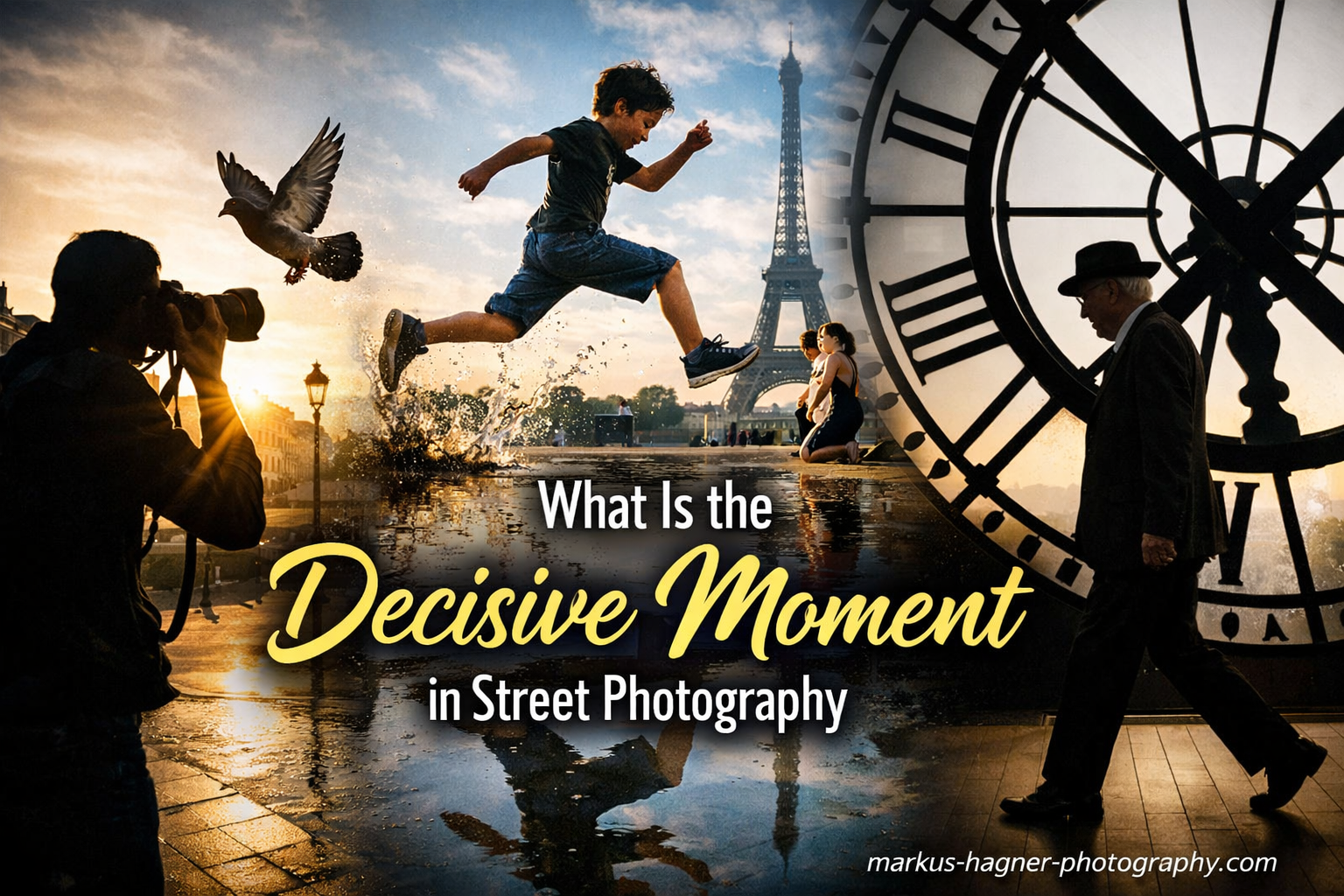
You know that feeling when something incredible happens right in front of you, and by the time you raise your camera, it’s already gone? Every street photographer has been there. The person leaping over a puddle, the perfect shadow falling across a stranger’s face, the split-second when three people’s gestures align into something magical.
These fleeting instants are what separate memorable street photographs from forgettable snapshots. They’re what Henri Cartier-Bresson called “the decisive moment” – and learning to recognize and capture them is the most rewarding challenge a street photographer can undertake.
In this guide, I’ll explain exactly what the decisive moment means, share its fascinating origins, and give you structured exercises to train your eye. After 15 years of shooting streets from Tokyo to Buenos Aires, I’ve learned that capturing decisive moments isn’t about luck. It’s about preparation, observation, and developing a particular way of seeing the world.
What Is the Decisive Moment in Street Photography?
The decisive moment is the fleeting instant when visual and psychological elements in a scene spontaneously come together in perfect harmony. It’s that split second when geometry, gesture, emotion, and light align to create an image that reveals something deeper about the human experience.
This concept goes far beyond capturing “something happening.” A decisive moment isn’t just action or movement. It’s the marriage of form and content – when the visual structure of your frame (lines, shapes, shadows, layers) combines with human meaning (gesture, expression, interaction) to create a photograph that transcends mere documentation.
Think of it this way: a man jumping over a puddle is just an action. But when that leap happens at the exact moment when his reflection in the water mirrors his movement perfectly, when the geometry of buildings behind him frames his gesture, when the light catches his expression – that’s a decisive moment. Every element serves the photograph.
Street photographers often misunderstand this concept. Many think it means “capturing action” or “getting lucky with timing.” But the decisive moment is really about recognizing when there’s a photograph worth taking – that instant when the chaos of street life briefly organizes itself into visual poetry.
The Origins: Henri Cartier-Bresson’s Vision
Henri Cartier-Bresson coined the term “the decisive moment” in 1952, though the original French title “Images à la Sauvette” translates more literally to “images on the run” or “stolen images.” His American publisher chose the more philosophical English title, and the phrase has shaped street photography ever since.
Cartier-Bresson was a French humanist photographer who believed deeply in intuition and spontaneity. He carried a small Leica camera and traveled the world for decades, seeking those rare instants when life revealed its essential truths. His most famous photograph – a man jumping over a puddle behind the Gare Saint-Lazare in Paris – remains the quintessential example of the decisive moment.
What many photographers don’t realize is that Cartier-Bresson didn’t actually like the term “decisive moment” later in his life. He felt it had become misunderstood and overused. His original concept was more nuanced: it wasn’t about decisive action, but about the photographer’s decisive recognition that a photograph existed in that scene at that moment.
The philosophy behind the decisive moment rests on several key principles. First, photography captures time in a way no other medium can – freezing a moment that will never exist again. Second, the photographer must be ready, both technically and mentally, to respond instantly. Third, the best photographs happen when form (visual structure) and content (meaning) marry perfectly.
In 2026, some argue that the concept feels outdated. After all, modern cameras can shoot 20 frames per second, and AI can help identify interesting moments. But I believe the core idea matters more than ever. Technology can capture images, but only a trained eye can recognize which moments are worth capturing.
How to Train Your Eye for the Decisive Moment In 2026?
Here’s the truth that took me years to learn: you can train yourself to see decisive moments. It’s not some mystical talent you’re born with. It’s a skill developed through deliberate practice, careful observation, and thousands of hours behind the camera.
The exercises below will help you develop what photographers call “visual literacy” – the ability to quickly recognize potential photographs in the chaos of street life. I recommend practicing each exercise for at least a week before moving to the next one.
Exercise 1: The Observation Walk
Leave your camera at home. Walk through a busy area for 30 minutes with only one goal: observe. Watch how people move. Notice where shadows fall. Pay attention to gestures, expressions, interactions. Don’t photograph anything – just train your eye to see.
This exercise eliminates the pressure to capture, allowing you to focus purely on observation. Many photographers are so busy looking for shots that they never truly learn to see. Do this exercise daily for one week, and you’ll start noticing things you never saw before.
Exercise 2: Pre-Visualization Practice
Find a location with interesting light and geometry – an intersection, a market entrance, a building with strong shadows. Stand there for 20 minutes and mentally compose photographs before they happen. Ask yourself: “If someone walked through that patch of light right now, where would I frame them?”
This trains your brain to anticipate rather than react. Decisive moment photography is largely predictive. You see the potential for a photograph before it exists, position yourself correctly, and wait for the elements to align.
Exercise 3: Geometry Hunting
Spend one week photographing only geometric elements – lines, shapes, patterns, shadows, reflections. Ignore people entirely. Train yourself to see the structural bones of street scenes.
Decisive moments require strong visual foundations. If you can’t see geometry in a scene, you won’t recognize when human elements align with it. This exercise builds the compositional awareness that makes decisive moments possible.
Exercise 4: Gesture Recognition
Now reverse the previous exercise. For one week, focus exclusively on human gestures – a hand raised, a head turned, a step mid-stride. Photograph nothing else. Learn to anticipate when gestures will peak.
Every gesture has a natural climax. A raised hand reaches its apex. A running figure reaches maximum extension. Training yourself to recognize these peaks is essential for timing decisive moments.
Exercise 5: The Waiting Game
Find a visually interesting spot – a doorway with dramatic light, a wall with strong texture, a corner where paths intersect. Stand there for 45 minutes. Wait. Don’t chase moments; let them come to you.
This teaches patience, which most street photographers lack. We’re conditioned to keep moving, to hunt for photographs. But some of the best decisive moments happen when you let the street come to you.
Exercise 6: Shadow and Light Tracking
On a sunny day, find a location where shadows create interesting patterns. Watch how those shadows move and change over 30 minutes. Photograph how people interact with the light and shadow.
Light is the raw material of photography. Understanding how it moves and transforms a scene helps you predict when conditions will be optimal for decisive moments.
Exercise 7: Layered Scene Analysis
Find a scene with depth – foreground, middle ground, background all containing potential subjects. Watch how elements in different planes move and interact. Try to capture moments when something interesting happens in multiple layers simultaneously.
The most sophisticated decisive moments often involve layering – when foreground, middle, and background elements all contribute to the photograph. This exercise trains you to see depth and complexity.
Practical Techniques to Capture Decisive Moments
Training your eye is essential, but you also need technical preparation. The most perfectly observed decisive moment means nothing if your camera isn’t ready to capture it. Here are the practical techniques I use.
Master Zone Focusing
Zone focusing is the single most important technical skill for decisive moment photography. Instead of relying on autofocus, you pre-set your focus distance and aperture to create a “zone” of acceptable sharpness.
Here’s how I set up my camera: I use a 35mm lens at f/8 or f/11, pre-focused to about 8 feet. This gives me a zone of acceptable focus from roughly 5 to 15 feet. Anything within that range will be acceptably sharp. This eliminates focus lag entirely.
The beauty of zone focusing is that it removes a variable. When a decisive moment appears, I don’t need to think about focus. I just frame and shoot. In street photography, fractions of seconds matter.
Eliminate Shutter Lag
Nothing kills decisive moments faster than shutter lag – the delay between pressing the button and the camera actually capturing the image. Every camera has some lag, but you can minimize it.
Turn off any unnecessary processing. Shoot in RAW to avoid in-camera JPEG processing delays. Pre-focus whenever possible. Use mechanical shutter rather than electronic if your camera is faster that way. Know your equipment’s response time intimately.
Burst Mode: Use Wisely
There’s a philosophical debate in street photography about burst mode. Some argue it’s cheating – that a “true” decisive moment is captured in a single frame. Others embrace it as a practical tool.
My approach: use burst mode as insurance, not as a replacement for timing. I still try to capture the decisive moment in a single frame. But I’ll shoot a short burst of 3-5 frames when timing is critical. The key is not to spray and pray – that leads to thousands of mediocre images.
Work the Scene
When you find a promising location, don’t take one shot and leave. Work the scene. Stay there. Watch how it evolves. Try different angles. Wait for different people to pass through.
Some of my best decisive moments came after 20 minutes of standing in one spot. The scene keeps changing, and eventually, the elements align. Patience and persistence often matter more than speed.
Anticipation vs. Reaction
Capturing decisive moments involves two different skills: anticipation and reaction. Anticipation means predicting what will happen and positioning yourself before it occurs. Reaction means responding instantly to unexpected moments.
The best street photographers excel at both, but I’d argue anticipation is more important. You can’t react to what you don’t see coming. Train yourself to read situations – to notice when two people’s paths will intersect, when someone is about to gesture, when light is about to hit a particular spot.
Composition in a Split Second
Decisive moments happen fast, but composition still matters. The challenge is developing compositional instincts that work automatically. You don’t have time to consciously apply rules – they need to be second nature.
Focus on these essentials: leading lines that draw the eye, layers that create depth, negative space that gives subjects room to breathe, and frame edges that don’t cut through important elements. Practice these until they’re automatic.
Overcoming Fear and Self-Consciousness
Many photographers struggle with the psychological aspect of street photography – the fear of photographing strangers, the self-consciousness of standing in public with a camera. This fear causes hesitation, and hesitation kills decisive moments.
The truth is, most people don’t care. They’re absorbed in their own lives. If you’re respectful and unobtrusive, you can photograph almost anything in public spaces. The fear is mostly in your head.
Start by photographing scenes rather than individuals. As your confidence grows, gradually include people more prominently. Remember: a decisive moment isn’t about confrontation. It’s about observation and timing.
Common Mistakes When Seeking the Decisive Moment
After years of teaching street photography workshops, I see the same mistakes over and over. Here are the most common ones – and how to avoid them.
Mistake 1: Chimping After Every Shot
“Chimping” – constantly checking your LCD after each shot – is the enemy of decisive moments. While you’re looking at your screen, life continues unfolding around you. You’ll miss five potential photographs while reviewing one.
Train yourself to shoot without checking. Review your images later, when you’re not on the street. Trust your instincts in the moment.
Mistake 2: Over-Relying on Burst Mode
Burst mode has its place, but it shouldn’t be your default. When you spray frames indiscriminately, you stop thinking about timing. You become reactive rather than intentional.
Use burst mode sparingly. Focus on developing your timing and anticipation. One perfectly timed frame is worth twenty almost-right ones.
Mistake 3: Ignoring the Background
In the rush to capture a gesture or expression, it’s easy to forget about the background. But backgrounds make or break decisive moments. A distracting element behind your subject can ruin an otherwise perfect photograph.
Train yourself to see the entire frame, not just your subject. The best decisive moments work because every element – foreground, subject, background – contributes.
Mistake 4: Moving Too Fast
Street photography isn’t a race. Many photographers walk too fast, barely pausing to observe. They cover lots of ground but see little.
Slow down. Spend more time in fewer locations. Let scenes develop. The decisive moment is rarely found by rushing past it.
Mistake 5: Waiting for Action Instead of Form
Remember: the decisive moment is about form and content coming together. Many photographers wait for dramatic action while ignoring beautiful geometry. They miss quieter moments that might be more powerful.
Train yourself to see both – the visual structure of a scene and the human elements within it. The magic happens when they align.
Frequently Asked Questions
What is the decisive moment in street photography?
The decisive moment is the split second when visual and psychological elements in a scene spontaneously align to create a meaningful photograph. Coined by Henri Cartier-Bresson in 1952, it represents the marriage of form (composition, geometry, light) and content (gesture, emotion, human meaning) in a single frame.
Who coined the term ‘decisive moment’?
French photographer Henri Cartier-Bresson coined the term in his 1952 book ‘Images à la Sauvette’ (published in English as ‘The Decisive Moment’). He developed the concept throughout his decades-long career documenting human life around the world with his Leica camera.
Is the decisive moment just luck?
No. While luck plays a role in what unfolds on the street, capturing the decisive moment requires preparation, anticipation, and trained observation. Experienced photographers increase their ‘luck’ through technical readiness, understanding of light and composition, and the ability to predict when elements will align.
How long does it take to develop an eye for decisive moments?
Developing this skill takes months to years of consistent practice. Most photographers report significant improvement after 1-2 years of dedicated street photography, with continued refinement over a lifetime. Regular practice with specific training exercises accelerates the learning process.
Can you capture decisive moments with a smartphone?
Yes. While traditional street photographers prefer dedicated cameras with manual controls, the concept of the decisive moment applies regardless of equipment. Smartphone cameras have improved dramatically and can capture decisive moments effectively, especially with techniques like burst mode and pre-focusing.
Final Thoughts on the Decisive Moment
The decisive moment remains the holy grail of street photography – that instant when preparation meets opportunity, when your trained eye recognizes what others miss. It takes patience, practice, and countless hours of observation. But when you finally capture one, when all the elements align and you press the shutter at exactly the right moment, there’s nothing else like it.