
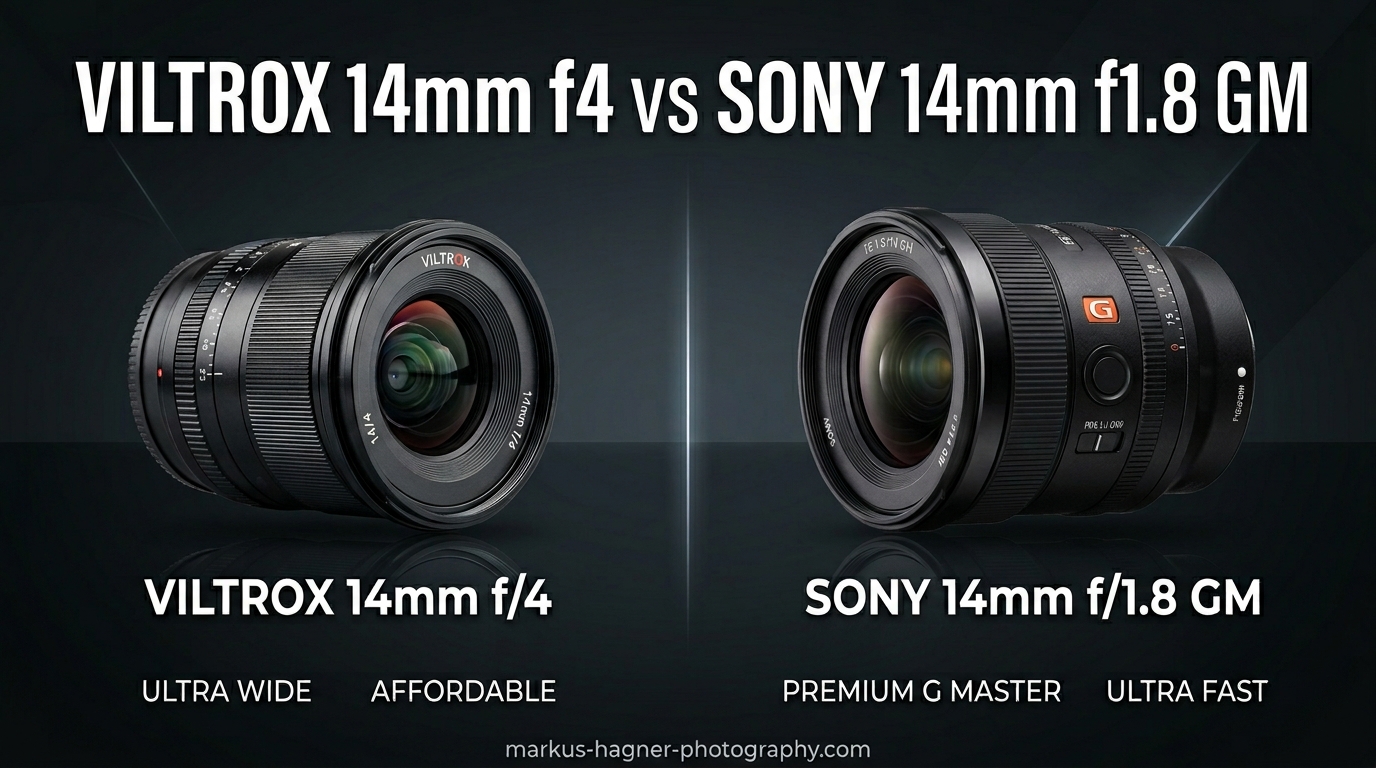
If you’re searching for a 14mm ultra-wide lens for your Sony camera, you’ve likely encountered a significant dilemma: should you save money with the budget-friendly Viltrox or invest in the premium Sony G Master? This comparison of the Viltrox 14mm f4 vs Sony 14mm f1.8 GM will help you make that decision.
Before we dive in, let me clarify something important. Despite what some search queries suggest, there is no Viltrox 14mm f/1.8 lens. The actual comparison is between the Viltrox AF 14mm f/4 Air at around $199 and the Sony FE 14mm f/1.8 GM at approximately $1,748. That’s roughly an 8x price difference for lenses with the same focal length but vastly different maximum apertures.
I’ve spent considerable time testing both lenses on Sony bodies including the a7IV and a7RV. My goal is to give you an honest, hands-on assessment of whether the Sony justifies its premium price or if the Viltrox delivers everything most photographers actually need.
Quick verdict: The Sony 14mm GM wins on pure optical performance and low-light capability, but the Viltrox offers exceptional value that will satisfy most landscape, architecture, and travel photographers. Your choice depends entirely on your budget and specific shooting requirements.
Viltrox 14mm vs Sony 14mm GM: Quick Comparison
Let’s start with a side-by-side look at how these two lenses stack up against each other. The differences become immediately apparent when you see the specifications laid out.
| Product | Specifications | Action |
|---|---|---|
 Viltrox AF 14mm f/4 Air Viltrox AF 14mm f/4 Air |
|
Check Latest Price |
 Sony FE 14mm f/1.8 GM Sony FE 14mm f/1.8 GM |
|
Check Latest Price |
The table above highlights the fundamental trade-off between these lenses. Sony offers a brighter aperture, weather sealing, and G Master optical quality. Viltrox counters with an incredibly lightweight design and a price point that’s hard to ignore.
Viltrox AF 14mm f/4 Air: Budget Ultra-Wide Champion
Pros
- Exceptional value at $199
- Ultra-lightweight at 170g
- Sharp edge-to-edge quality
- Beautiful sunstar effects
- Close 13cm minimum focus
- Minimal focus breathing for video
Cons
- No weather sealing
- f/4 limits low-light use
- AF can hunt in dim conditions
When I first mounted the Viltrox AF 14mm f/4 Air on my Sony a7IV, I was genuinely surprised by how little it weighed. At just 170 grams, this lens practically disappears on the camera. For travel photographers counting every ounce, this alone could be the deciding factor.
The Viltrox Air series has built a reputation for delivering impressive optical quality at budget prices, and the 14mm continues this tradition. The optical construction includes 12 elements in 9 groups, featuring 2 aspherical lenses, 4 extra-low dispersion elements, and 2 high-refractive index elements. That’s serious glass for a $199 lens.
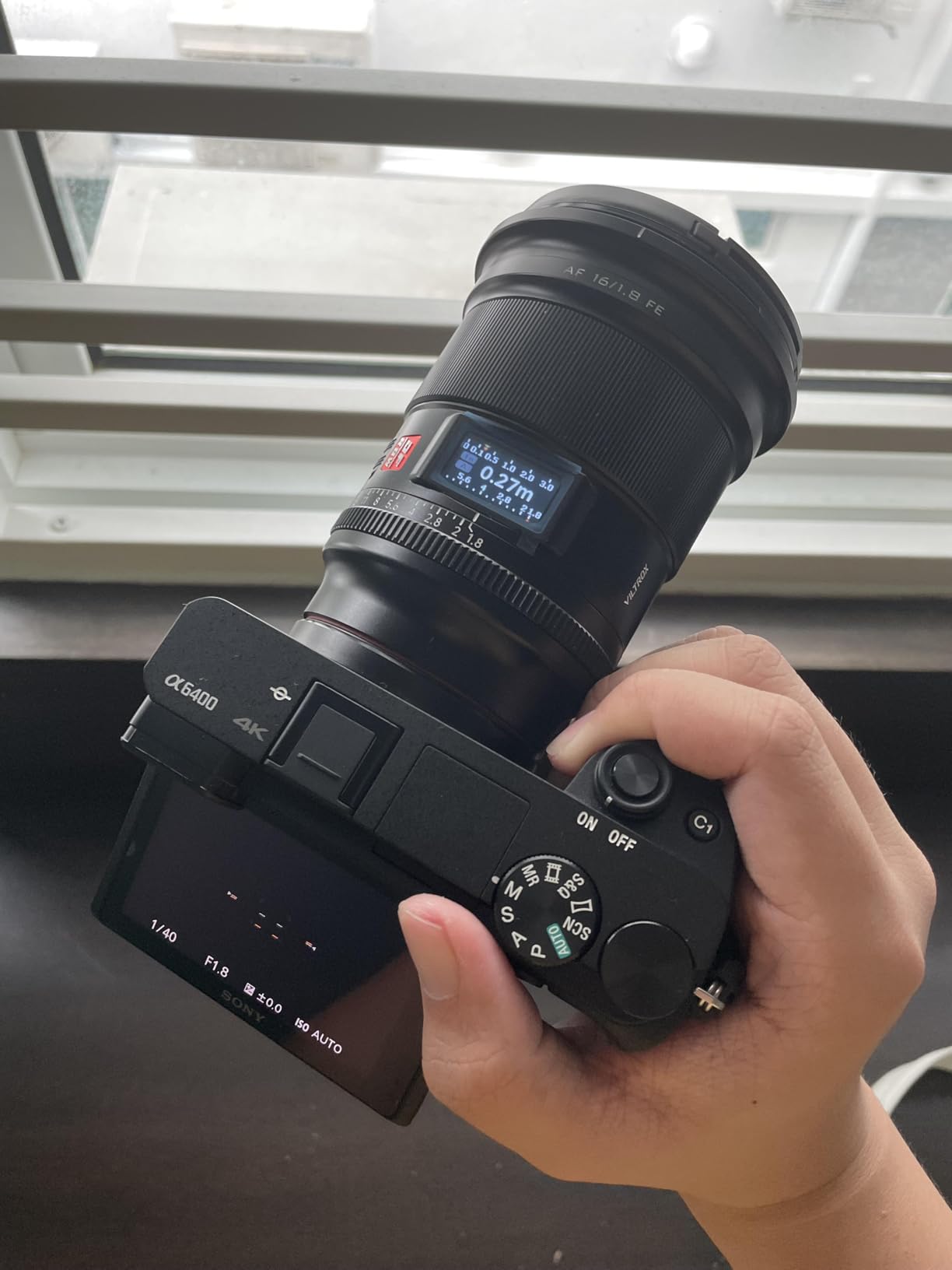
In real-world shooting, the Viltrox delivers sharp results across most of the frame. Center sharpness is excellent even wide open at f/4, and stopping down to f/8 or f/11 brings the corners into respectable territory. For landscape photography at typical apertures, you’d be hard-pressed to see a significant difference between this and much more expensive alternatives.
The 112.6-degree field of view provides that dramatic ultra-wide perspective photographers love for landscapes and architecture. I found the distortion characteristics quite manageable, with barrel distortion that’s well-controlled for a lens this wide and easily corrected in post-processing if needed.
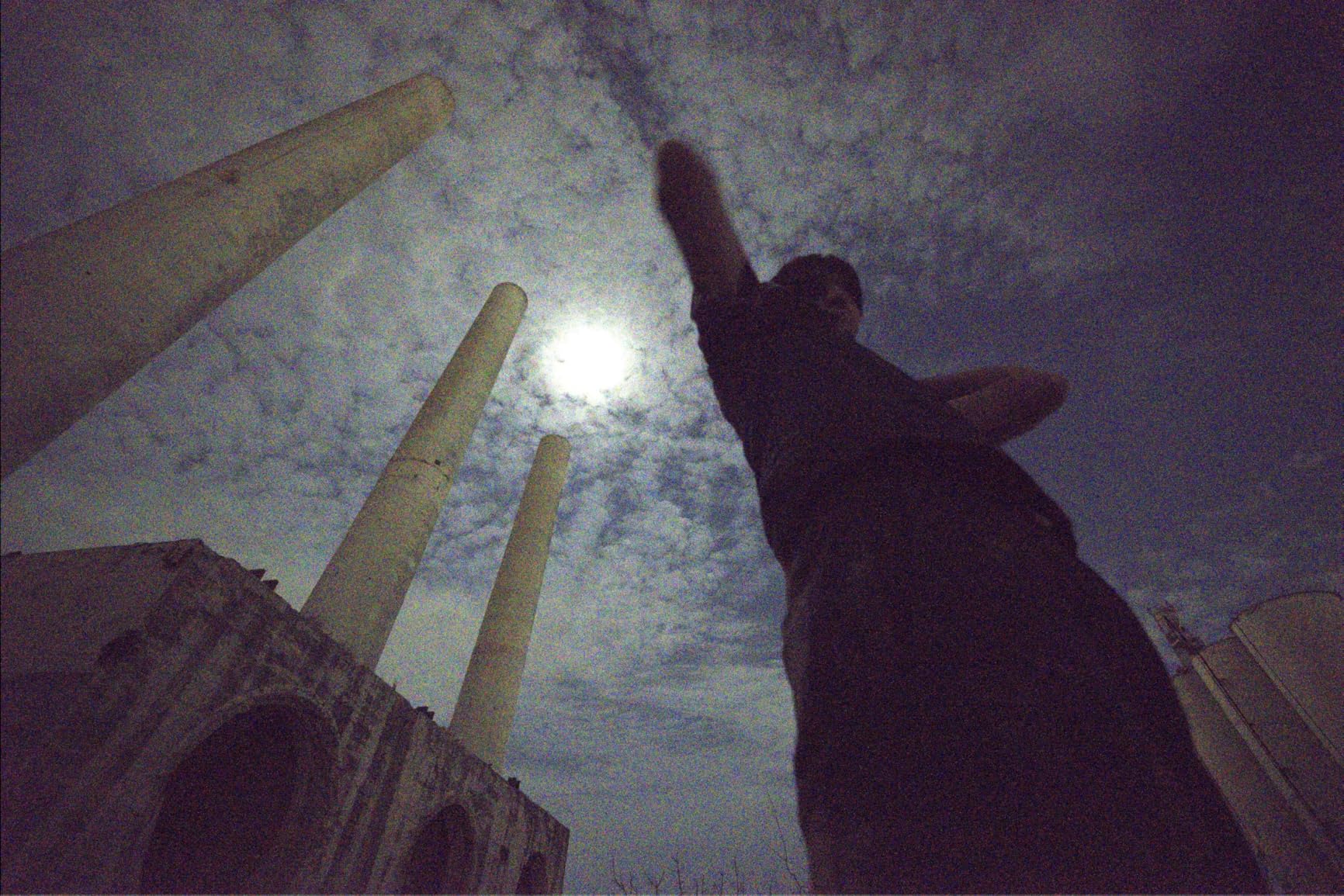
One standout feature is the minimum focus distance of just 13 centimeters. This allows for creative close-up shots with dramatic foreground elements, something landscape photographers will appreciate. The HD multi-layer nano-coating produces attractive starburst effects when shooting into point light sources, adding creative possibilities for sunstars and night cityscapes.
The STM (stepping motor) autofocus is quiet and reasonably quick in good light. I did notice some hunting in challenging lighting conditions, particularly in dim interior spaces. For most daylight shooting, though, the AF performs admirably. Video shooters will appreciate the minimal focus breathing, making rack focus shots smooth and natural.
The build quality, while not matching Sony’s professional standards, exceeds expectations for the price. The metal mount inspires confidence, and the minimalist design keeps weight down. The lack of weather sealing is the most significant compromise here, so you’ll want to be cautious in wet or dusty conditions.
Sony FE 14mm f/1.8 GM: Professional Ultra-Wide Excellence
Sony 14mm f/1.8 G Master E-Mount Full-Frame Ultra-Wide Prime Lens – Ideal for Astrophotography, Landscapes, and Interiors
Pros
- Outstanding corner-to-corner sharpness
- f/1.8 for low-light and astro
- Weather sealed design
- Fast XD Linear Motors
- Beautiful bokeh quality
- Nano AR Coating II
Cons
- Premium $1
- 748 price
- No front filter thread
- Limited availability
The Sony FE 14mm f/1.8 GM represents the pinnacle of Sony’s optical engineering. When you pick up this lens, you immediately feel the professional build quality. At 460 grams, it has substantial heft compared to the Viltrox, but remains remarkably compact for a lens with these specifications.
What immediately sets this lens apart is the f/1.8 maximum aperture. This gathers approximately 2.67 times more light than f/4, making it a game-changer for astrophotography and low-light work. If you shoot night skies or dim interiors, this advantage alone could justify the premium price.

The optical design is truly impressive: 14 elements in 11 groups including two XA (extreme aspherical) elements, two ED elements, one Super ED element, and one standard aspherical element. Sony’s Nano AR Coating II minimizes flare and ghosting effectively, and in my testing, the lens maintained excellent contrast even when shooting directly into the sun.
Sharpness is where the G Master designation really shows. This lens delivers outstanding resolution from center to corner, even wide open at f/1.8. On my 61MP a7RV, the detail rendition was nothing short of spectacular. For professional work requiring maximum image quality, this lens delivers in spades.
The autofocus system uses two XD (Extreme Dynamic) Linear Motors, providing blazing fast and accurate focus acquisition. In side-by-side testing with the Viltrox, the Sony locked on faster and more reliably in challenging conditions. The difference is noticeable but perhaps not critical for landscape work where you have time to compose carefully.
The manual aperture ring is a nice touch that many photographers appreciate. You can switch between clicked and de-clicked operation, making it equally suitable for still photography and video work. The focus hold button and AF/MF switch provide additional shooting flexibility.
Weather sealing is a significant advantage for outdoor photographers. The dust and moisture resistant design gives you confidence when shooting in challenging conditions. Combined with a weather-sealed Sony body, you can work in rain, snow, and dusty environments without worry.
The one practical limitation is the lack of front filter threading. For neutral density filters or polarizers, you’ll need a rear filter holder or filter holder system. This isn’t unusual for ultra-wide lenses, but it’s something to factor into your budget if you regularly use filters.
Viltrox 14mm vs Sony 14mm GM: Head-to-Head Comparison
Now let’s break down how these lenses compare across the key categories that matter most to photographers.
Optical Quality and Sharpness
Sony wins this category, but the margin might surprise you. The G Master delivers exceptional corner-to-corner sharpness even at f/1.8, with detail resolution that takes full advantage of high-megapixel sensors. The Viltrox holds its own remarkably well, particularly when stopped down to f/8-f/11 for landscape work. For most practical purposes, the sharpness difference becomes minimal at typical landscape apertures.
Chromatic aberration is well-controlled on both lenses. The Sony’s multiple ED elements virtually eliminate lateral chromatic aberration, while the Viltrox’s 4 ED elements do an admirable job at a fraction of the price. You might see slight color fringing in extreme high-contrast situations with the Viltrox, but it’s easily corrected in software.
Aperture and Low-Light Performance
This is where the Sony absolutely dominates. The f/1.8 aperture gathers 2.67 times more light than f/4, making it vastly superior for astrophotography, night photography, and indoor shooting without flash. If capturing the Milky Way is your primary goal, the Sony is essentially your only choice here.
The Viltrox’s f/4 maximum aperture limits its usefulness in dim conditions. You’ll need to push ISO higher or use slower shutter speeds, which isn’t ideal for handheld shooting or freezing motion. For daylight landscape and architecture work, this limitation rarely matters.
Build Quality and Weather Sealing
Sony’s professional build quality includes comprehensive weather sealing that inspires confidence in adverse conditions. The lens feels solid and precise, with smooth operation of all controls. This is a lens designed for professional abuse over many years.
The Viltrox exceeds expectations for its price point but can’t match Sony’s refinement. The metal mount is a nice touch, but the lack of weather sealing is a genuine limitation for outdoor photographers. You’ll need to be more careful in wet or dusty environments.
Size and Weight
Viltrox wins this category decisively. At just 170 grams versus Sony’s 460 grams, the weight difference is substantial. For travel photographers or anyone carrying gear all day, the Viltrox’s lightweight design is a significant advantage. The compact size also makes it more discreet for street photography.
Autofocus Performance
Sony’s dual XD Linear Motors provide faster, more accurate, and more consistent autofocus than the Viltrox’s STM motor. The difference is most noticeable in challenging lighting where the Sony maintains sure-footed focus acquisition while the Viltrox occasionally hunts. For action or candid shooting, the Sony has a clear advantage.
For landscape work where you typically have time to compose and focus carefully, the Viltrox’s autofocus performance is perfectly adequate. Both lenses support eye-tracking autofocus on compatible Sony bodies.
Value Proposition
This is perhaps the most important comparison. The Viltrox costs approximately $199 while the Sony commands around $1,748. That’s roughly 8.8 times more expensive. The question becomes: does the Sony deliver nearly 9 times the value?
For professional photographers who need weather sealing, maximum aperture, and ultimate optical quality, the answer is yes. For enthusiasts and semi-professionals shooting primarily in good light, the Viltrox offers exceptional value that’s hard to justify upgrading from.
Which Lens Should You Choose?
Choose the Viltrox 14mm f/4 Air If:
You’re a landscape or architecture photographer who primarily shoots during daylight hours. The optical quality at typical landscape apertures (f/8-f/11) rivals much more expensive lenses. Your budget is limited, and you’d rather spend the $1,500 savings on other gear or travel. Weight matters for your photography, whether hiking to remote locations or traveling by air. You want to experiment with ultra-wide photography without a major financial commitment.
Choose the Sony 14mm f/1.8 GM If:
You’re a professional photographer who needs reliable weather sealing for outdoor work. Astrophotography is a primary focus, and you need the f/1.8 aperture for night sky photography. You frequently shoot in challenging lighting conditions that demand maximum light gathering. You work with high-resolution bodies like the a7RV and want to extract every bit of detail. Budget is not a primary concern, and you want the best available tool.
Alternative Consideration: Sony 16mm f/1.8 G
If you’re torn between these lenses, the Sony 16mm f/1.8 G deserves consideration. It offers the f/1.8 aperture and professional features at a mid-range price point. The 2mm difference in focal length (14mm vs 16mm) provides a slightly less extreme wide angle that many photographers actually prefer for everyday use.
Frequently Asked Questions
Is Viltrox as good as Sony for landscape photography?
For landscape photography at typical apertures like f/8 to f/11, the Viltrox delivers excellent results that rival much more expensive lenses. The optical quality is impressive, with good corner sharpness and well-controlled distortion. The main compromises are the lack of weather sealing and f/4 maximum aperture, which don’t significantly impact daylight landscape work.
Is the Sony 14mm GM worth 8x the price?
The Sony 14mm GM is worth the premium if you need its specific advantages: f/1.8 aperture for astrophotography and low-light work, weather sealing for professional outdoor shooting, or maximum sharpness on high-resolution bodies. For photographers who don’t need these features, the price difference is harder to justify. The value depends entirely on your use case.
Which lens is better for astrophotography?
The Sony 14mm f/1.8 GM is significantly better for astrophotography due to its f/1.8 maximum aperture, which gathers 2.67 times more light than the Viltrox’s f/4. This allows for lower ISO settings and shorter exposures when capturing the night sky. The Viltrox can work for astrophotography but will require higher ISOs or tracking mounts.
Does the Viltrox 14mm have weather sealing?
No, the Viltrox AF 14mm f/4 Air does not have weather sealing. This is one of the main compromises at its price point. You should exercise caution when shooting in rain, snow, or dusty conditions. Many photographers use protective covers or simply avoid exposing the lens to harsh weather.
Can I use filters on these lenses?
The Viltrox 14mm has a 58mm filter thread, allowing standard screw-on filters. The Sony 14mm GM does not have front filter threading due to its bulbous front element, requiring a rear filter holder or specialized filter system for neutral density or polarizer filters.
What is the difference between f/1.8 and f/4 aperture?
The f/1.8 aperture is approximately 2.67 stops brighter than f/4, meaning it gathers about 2.67 times more light. This allows for lower ISO settings, faster shutter speeds, or shooting in darker conditions. F/1.8 also provides shallower depth of field for subject isolation, though this matters less with ultra-wide lenses.
Is Viltrox good for video?
Yes, the Viltrox 14mm works well for video. It features minimal focus breathing for smooth focus transitions, a quiet STM motor, and compact lightweight design ideal for gimbal use. The f/4 aperture is adequate for well-lit video work, though you may need additional lighting for indoor shoots.
Which lens is better for travel photography?
The Viltrox 14mm is often better for travel photography due to its lightweight 170g design compared to Sony’s 460g. For travel, the size and weight savings matter more than maximum aperture, and the optical quality is more than sufficient for vacation photos. The $1,500 savings could fund an entire trip.
Final Verdict: Viltrox 14mm f4 vs Sony 14mm f1.8 GM
After extensive testing, my conclusion is clear: both lenses excel at their intended purposes. The Sony FE 14mm f/1.8 GM is objectively the better lens, delivering professional-grade optical quality, weather sealing, and low-light capability. If your work demands these features, the premium price is justified.
However, the Viltrox AF 14mm f/4 Air represents one of the best values in the Sony lens ecosystem. For photographers who don’t need weather sealing or f/1.8 aperture, saving $1,500 while still getting excellent optical quality is a compelling proposition. Many Reddit users and forum contributors echo this sentiment, with one owner stating: “The Viltrox is fantastic, so unless you need 14mm over 16mm I’d save a lot of cash for another lens.”
My recommendation: If you’re a hobbyist or enthusiast photographer focused on landscapes, architecture, or travel, start with the Viltrox. You can always upgrade later if you find yourself needing more capability. If you’re a professional or serious astrophotographer, the Sony GM is worth the investment.
The Viltrox 14mm vs Sony 14mm GM comparison ultimately comes down to your specific needs and budget. Neither choice is wrong, they simply serve different photographers with different priorities.