
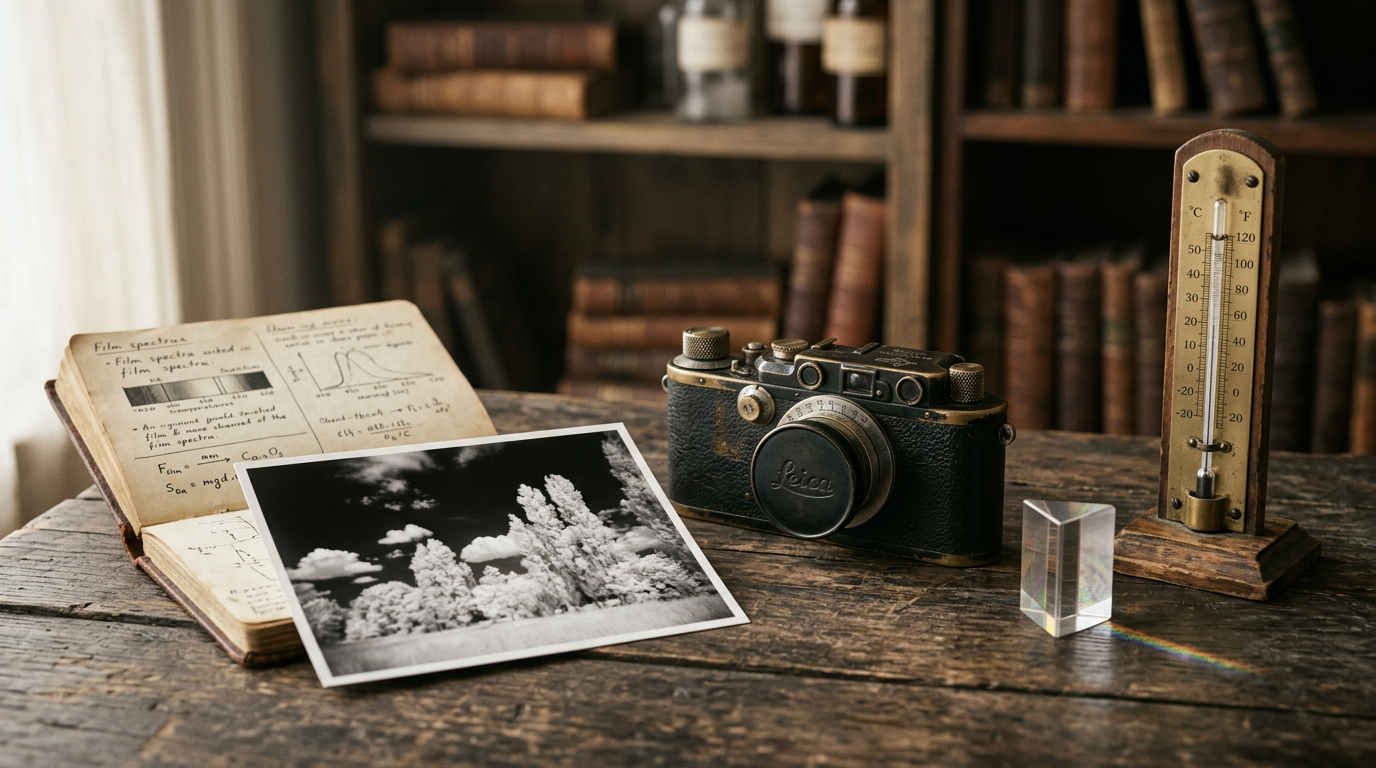
There is something magical about infrared photography. It reveals a world our eyes cannot see, transforming ordinary landscapes into ethereal scenes where green foliage glows white and blue skies turn dramatically dark. The history of infrared photography spans over two centuries, from a serendipitous discovery in a British observatory to sophisticated digital sensors capturing distant galaxies. This journey involves brilliant scientists, wartime innovation, artistic rebellion, and technological revolution that continues to this day.
Infrared photography captures light in wavelengths between 700nm and 1200nm, beyond what the human eye can perceive. Unlike thermal imaging, which captures heat signatures from warm objects, photographic infrared works with near-infrared light reflected from surfaces. The distinctive look comes from how chlorophyll in plants reflects infrared light, creating the characteristic white vegetation effect that defines the infrared aesthetic and has captivated photographers for over a century.
Understanding this history helps readers appreciate how scientific discovery, military necessity, and artistic vision combined to create one of photography’s most distinctive techniques. From battlefields to art galleries, from satellite imagery to album covers, infrared photography has shaped how the world sees the invisible spectrum.
The Discovery of Infrared Light (1800)
The story begins with astronomer William Herschel in 1800. While studying the temperature of different colors in the light spectrum using a prism and thermometers, Herschel noticed something unexpected. The temperature increased as he moved from violet toward red, but it continued rising beyond the visible red light into an area that appeared completely dark to his eyes.
Herschel had discovered infrared radiation, though he called it “calorific rays.” He realized that invisible light existed beyond the red end of the spectrum, carrying heat energy that could warm his thermometer even though no visible light was present. This discovery fundamentally changed our understanding of light and the electromagnetic spectrum, opening doors to technologies we still use today in everything from television remotes to space telescopes.
The scientific community initially struggled to accept Herschel’s findings. Many believed light and heat were entirely separate phenomena that could not exist together. However, further experiments confirmed that infrared radiation behaved like visible light in many ways. It could be reflected, refracted, and absorbed, following similar optical principles. This laid the groundwork for eventually capturing infrared light photographically.
Early photographic pioneers in the Victorian era experimented with various light wavelengths, but the technology to capture infrared remained elusive for decades. Photographic emulsions of the time responded primarily to blue and ultraviolet light, making them insensitive to the longer infrared wavelengths that Herschel had discovered. Scientists understood the theoretical possibilities, but practical infrared photography would have to wait for advances in emulsion chemistry.
William de Wiveleslie Abney, a British scientist and photographer, made important contributions in the 1870s and 1880s. He developed techniques for photographing the infrared spectrum and created some of the earliest spectroscopic photographs. Abney’s work demonstrated that photographic emulsions could be sensitized to longer wavelengths, though the process remained difficult and impractical for most applications.
The First Infrared Photographs (1910)
Professor Robert Williams Wood at Johns Hopkins University created the first practical infrared photographs in 1910. Wood was a brilliant experimental physicist known for his playful approach to science and his willingness to challenge conventional wisdom. He developed special photographic plates sensitized to infrared wavelengths, allowing him to capture images using light invisible to the human eye.
Wood’s infrared photographs showed a transformed world that seemed almost alien. Green trees and grass appeared startlingly white, while skies darkened to near black. Water took on inky blackness, and human skin developed an ethereal, porcelain quality. This phenomenon became known as the Wood Effect, named after its discoverer, and remains one of the most distinctive characteristics of infrared photography today.
The Wood Effect occurs because chlorophyll in healthy plant tissue reflects infrared light rather than absorbing it. This biological adaptation creates the ghostly white appearance that defines infrared landscapes. Plant leaves have evolved to reflect near-infrared light to prevent overheating from solar radiation, a survival mechanism that creates the surreal aesthetic artists and scientists have found compelling for over a century.
Wood published his findings in the Royal Photographic Society journal, demonstrating both the scientific potential and artistic possibilities of infrared photography. His images of landscapes and architecture revealed hidden details invisible in conventional photographs, sparking interest among scientists and photographers alike. The publication marked a turning point, transforming infrared photography from theoretical curiosity to practical reality.
The technical challenges remained significant. Early infrared plates required extremely long exposures, often several minutes even in bright sunlight. Photographers had to work with fragile glass plates and specialized processing techniques. Despite these obstacles, Wood’s breakthrough proved that capturing the invisible spectrum was possible, inspiring further development.
World War I Aerial Photography Applications
World War I brought infrared photography into military service with remarkable speed. Military planners quickly recognized that infrared-sensitive plates could penetrate atmospheric haze that obscured conventional aerial reconnaissance photographs. This capability proved invaluable for photographing enemy positions from high altitudes where haze was most problematic.
Standard photographic emulsions scattered blue light in the atmosphere, reducing contrast and detail in distant subjects. Blue light waves scatter easily when they encounter dust and water particles in the air, creating the milky appearance that plagues distant views. Infrared wavelengths passed through haze more effectively because their longer waves scattered less when encountering atmospheric particles.
This meant reconnaissance aircraft could capture clearer images of distant targets, providing crucial intelligence about enemy fortifications and troop movements. Commanders gained unprecedented visibility into enemy territory, changing how wars were planned and fought. The strategic advantages of infrared aerial photography justified significant investment in the technology.
The military applications drove substantial investment in infrared-sensitive emulsion development. Companies like Wratten and Wainwright in Britain worked to improve the sensitivity and consistency of infrared plates for military use. Scientists experimented with different sensitizing dyes and emulsion formulations to achieve better results. While the technology remained challenging to work with, requiring long exposures and careful handling, the intelligence advantages justified the effort.
Pilots and reconnaissance photographers developed specialized techniques for infrared aerial work. They learned to compensate for the different focusing characteristics of infrared light and to interpret the unusual tonal values in their images. These wartime developments established infrared photography as a serious scientific and military tool, laying groundwork for even more ambitious projects to come.
The knowledge gained during World War I would prove essential for the even more sophisticated infrared projects of World War II. Military interest in infrared photography continued between the wars, with research programs in multiple countries working to improve sensitivity and ease of use.
Commercial Film Development in the 1930s
The 1930s marked what historians call the golden age of infrared photography. Kodak introduced commercial infrared film, making the technology accessible to photographers beyond military and scientific institutions for the first time. Ilford and Agfa developed their own infrared emulsions, creating competition that accelerated innovation and improved quality.
Dr. Kenneth Mees at Kodak Research Laboratories led much of this development work. His team created emulsions sensitized to various infrared wavelengths, giving photographers choices in how they captured the invisible spectrum. The improved sensitivity allowed shorter exposure times, making infrared photography more practical for handheld cameras and moving subjects.
The availability of commercial infrared film sparked experimentation across many fields. Astronomers used infrared plates to study planets and stars, penetrating atmospheric interference that limited visible-light observations. The ability to see through atmospheric haze proved as valuable for studying the cosmos as it had been for military reconnaissance.
Botanists discovered that infrared photographs could reveal plant health in ways visible photography could not. Stressed vegetation reflected infrared differently than healthy plants, allowing researchers to identify diseased or drought-affected crops before damage became visible to the naked eye. This early application of infrared photography to agriculture anticipated modern satellite-based crop monitoring by decades.
The popular press discovered infrared photography as well during this period. The London Times published striking infrared images showing London landmarks in the distinctive infrared style. Public fascination with these otherworldly photographs helped establish infrared photography as both a scientific tool and an artistic medium. Museums and galleries began exhibiting infrared work, recognizing its unique aesthetic qualities.
Long-distance photography benefited enormously from infrared techniques. The Lick Observatory in California used infrared photography to capture detailed images of distant mountains and landscapes through atmospheric haze that would have rendered conventional photographs nearly useless. These demonstrations of infrared capability attracted attention from scientists and photographers around the world.
World War II and Aerochrome Development
World War II pushed infrared photography to new heights of sophistication. The most significant development was false-color infrared film, later known as Aerochrome. This revolutionary film rendered infrared-reflecting vegetation in vivid pink or red while showing other elements in contrasting colors, creating an almost psychedelic palette that made camouflaged objects immediately obvious.
The military developed false-color infrared specifically for camouflage detection. Enemy forces would paint vehicles and structures green to blend with vegetation, attempting to hide from aerial observation. However, painted surfaces reflected infrared light differently than living plants. No paint could duplicate the complex cellular structure that caused vegetation to reflect near-infrared wavelengths.
In Aerochrome images, real vegetation appeared pink or red while painted camouflage showed as green or brown, making hidden positions obvious to trained photo interpreters. The technology proved devastatingly effective. Camouflage that fooled visual observers and conventional photography became useless against infrared imaging.
Aerial reconnaissance using infrared film provided intelligence that saved countless lives. Pilots and photo interpreters could identify camouflaged airfields, troop concentrations, and supply depots that would have remained hidden from conventional photography. The distinctive pink coloring of healthy vegetation in Aerochrome images became iconic among military intelligence personnel, a clear indicator that what they were seeing was genuine landscape rather than enemy deception.
The development of false-color infrared film represented a major technical achievement. Creating color film that could render infrared information required complex dye chemistry and precise manufacturing processes. The film needed to respond to both visible and infrared wavelengths while producing distinguishable colors in the final image. Kodak and other manufacturers rose to the challenge, producing films that remained in production for decades.
After the war, false-color infrared film found numerous civilian applications. Geologists used it to identify mineral deposits and rock formations that reflected infrared in distinctive ways. Agricultural researchers mapped crop health across vast areas, identifying stressed vegetation before problems became visible. Medical researchers explored its potential for diagnostic imaging, examining circulation and tissue health through infrared-sensitive photography.
The military technology developed for war became a versatile tool for peacetime science and industry. Government agencies, universities, and private companies all found applications for infrared photography that its wartime developers had never imagined.
Artistic Adoption: The 1950s and 1960s
As infrared film became more accessible and easier to use, artists began exploring its creative potential with growing enthusiasm. The 1950s saw serious photographers embrace infrared photography as a legitimate artistic medium rather than merely a scientific curiosity. Major photographers experimented with the technique, creating bodies of work that demonstrated its expressive possibilities.
Minor White, one of the most influential photographers and educators of his generation, created haunting infrared landscapes that explored spiritual and metaphysical themes. His infrared work emphasized the otherworldly quality of the medium, using the transformed tonal values to suggest hidden realities beyond ordinary perception. White taught at the California School of Fine Arts and later at MIT, spreading his appreciation for infrared photography to generations of students.
Ansel Adams experimented with infrared film, though he used it less extensively than some of his contemporaries. Adams appreciated how infrared film could render foliage with dramatic brightness while darkening skies, creating the high-contrast aesthetic he favored in his landscape work. His infrared photographs of Yosemite demonstrate the unique possibilities of the medium when applied by a master of exposure and composition.
Edward Steichen, director of photography at the Museum of Modern Art in New York, included infrared photographs in major exhibitions, legitimizing the technique as fine art. His influential “Family of Man” exhibition and other shows featured infrared work alongside conventional photography, signaling institutional acceptance of the medium.
Weegee, the famous crime scene photographer known for his gritty flash photography, used infrared flash for candid nightclub photography. His infrared images captured unguarded moments in total darkness, revealing the secret lives of New York nightlife. Weegee demonstrated that infrared photography could serve documentary and journalistic purposes as well as artistic ones.
The 1960s brought infrared photography into popular culture through the psychedelic movement. Musicians embraced the otherworldly infrared aesthetic for album covers, creating visual identities that matched the experimental sounds of the era. Jimi Hendrix, Bob Dylan, Frank Zappa, and the Doors all used infrared photography on iconic album covers that defined the visual language of rock music.
Photographers like Elliott Landy and Karl Ferris specialized in infrared music photography, creating visual identities for rock stars that remain influential today. Landy’s photographs of Bob Dylan and The Band used infrared film to create dreamlike portraits that captured the countercultural spirit. Ferris developed a distinctive style combining infrared photography with psychedelic manipulation, pioneering what he called “sound photography” that attempted to visualize music.
Their work demonstrated that infrared photography could be commercially viable as well as artistically significant. Record labels and magazines commissioned infrared work, and the distinctive look became associated with the creative freedom and experimental spirit of the 1960s.
The Digital Transition
The 1990s transformed photography fundamentally, and infrared photography changed with it. Digital camera sensors proved naturally sensitive to infrared light, an unintended side effect of how silicon-based sensors work. Silicon responds to wavelengths well into the near-infrared range, meaning digital cameras could theoretically capture infrared images without special film.
This sensitivity was initially considered a problem by camera manufacturers. Infrared light reaching the sensor caused color casts and inaccurate white balance in normal photographs. The solution was to install internal infrared-blocking filters, called hot mirrors, in front of the sensors. These filters blocked most infrared light while allowing visible light to pass through, ensuring accurate color reproduction.
Photographers discovered that removing this filter allowed digital cameras to capture infrared images directly. This birthed the infrared conversion industry, where companies modify cameras by replacing the hot mirror with infrared-passing filters. These converted cameras can see only infrared light, producing the characteristic infrared look without the need for external filters or long exposures.
Kodak discontinued its 35mm High Speed Infrared film in 2007, marking the end of an era. The discontinuation reflected both declining film sales as photographers moved to digital and the environmental challenges of manufacturing infrared-sensitive emulsions. Photographers who loved film infrared faced a difficult choice: stockpile remaining supplies or embrace digital alternatives.
Digital infrared photography offered advantages that film could not match. Instant feedback allowed photographers to check exposure and composition immediately, eliminating the uncertainty that made film infrared so challenging. Variable white balance settings enabled creative color effects that required complex darkroom techniques with film. The cost per image dropped dramatically, encouraging experimentation and learning.
Today, photographers can choose between converted cameras and external infrared filters. Converted cameras offer convenience and shorter exposure times, allowing handheld photography in most conditions. Filter systems work on unmodified cameras but require tripod-mounted long exposures because the filter blocks visible light from reaching the sensor. Full-spectrum conversions allow photographers to switch between infrared and normal photography by changing external filters, offering maximum flexibility.
Contemporary Applications and Future
Infrared photography continues evolving in the digital age, finding new applications and artistic expressions. Contemporary artists like Richard Mosse use infrared film to document conflict zones, creating surreal pink landscapes that draw attention to humanitarian crises. Mosse’s work in the Congo, using obsolete Aerochrome film that remained available through specialty suppliers, brought infrared photography into fine art galleries and museums worldwide. His large-format infrared images transformed the brutal realities of war into disturbingly beautiful visions that commanded attention.
Claudia Andujar used infrared photography to document indigenous Yanomami people in the Amazon rainforest, creating intimate portraits that bridge documentary and artistic photography. Her infrared images capture both the physical presence and spiritual dimension of her subjects, demonstrating how infrared photography can reveal hidden aspects of both landscape and human identity.
Scientific applications have expanded dramatically with digital technology. Infrared satellite imagery monitors deforestation, crop health, and urban development across the globe. NASA and other space agencies use infrared imaging to study Earth’s climate and surface changes. Forensic investigators use infrared photography to reveal hidden writing, analyze document alterations, and detect evidence invisible to the naked eye. Medical applications include diagnostic imaging and research into circulation and tissue health.
The James Webb Space Telescope represents perhaps the most ambitious infrared photography project ever undertaken. Orbiting far from Earth at the L2 Lagrange point, it captures infrared images of distant galaxies, nebulae, and exoplanets that formed billions of years ago. Webb’s stunning images continue the tradition that began with Herschel in 1800, revealing invisible aspects of our universe through infrared light. The telescope’s infrared capabilities allow it to see through cosmic dust that obscures visible-light observations, opening new windows into the cosmos.
Other contemporary photographers pushing infrared boundaries include Kate Ballis, whose infrared landscapes transform familiar Australian scenery into alien worlds, and Edward Thompson, who documented environmental issues using infrared photography. Zak Van Biljon creates large-format infrared landscapes that challenge our perception of natural environments. These artists demonstrate that infrared photography remains a vital creative medium in the digital age.
Conclusion
The history of infrared photography spans over two centuries of scientific discovery, military necessity, artistic exploration, and technological innovation. From William Herschel’s thermometer experiments in a British observatory to the James Webb Space Telescope’s deep space observations, infrared photography has consistently revealed what human eyes cannot see.
What began as scientific curiosity became a military advantage, then an artistic movement, and finally an accessible creative tool for photographers worldwide. Each era added new applications and new practitioners, building on discoveries that came before. The distinctive infrared aesthetic continues to captivate viewers and inspire photographers to explore beyond visible light.
Whether you appreciate infrared photography for its scientific applications, its artistic possibilities, or simply its surreal beauty, the technique represents one of photography’s most fascinating developments. As digital technology advances and new sensors become more capable, the future of infrared photography promises even more remarkable discoveries waiting in the invisible spectrum.
What is infrared photography?
Infrared photography captures light in wavelengths between 700nm and 1200nm, which is invisible to the human eye. This creates distinctive images where green foliage appears white and blue skies turn dark, producing the characteristic ethereal infrared aesthetic that has captivated photographers for over a century.
Who discovered infrared light?
Astronomer William Herschel discovered infrared light in 1800 while studying the temperature of different colors in the light spectrum using a prism and thermometers. He noticed that temperature continued rising beyond visible red light into an apparently dark area, revealing invisible radiation he called calorific rays.
What is the history of infrared imaging?
Infrared imaging began with Herschel’s 1800 discovery, followed by Robert Williams Wood’s first infrared photographs in 1910. World War I brought military aerial reconnaissance applications, the 1930s saw commercial film development by Kodak and others, World War II introduced false-color Aerochrome film for camouflage detection, the 1950s-60s brought artistic adoption, and the digital era transformed infrared photography from film to sensor-based capture.
Did Ansel Adams use infrared film?
Yes, Ansel Adams experimented with infrared film, though he used it less extensively than some contemporaries like Minor White. He appreciated how infrared rendered foliage with dramatic brightness while darkening skies, creating the high-contrast aesthetic he favored in landscape photography. His infrared photographs of Yosemite demonstrate the unique possibilities of the medium when applied by a master photographer.
Who are the famous infrared photographers?
Famous infrared photographers include Robert Williams Wood who created the first infrared photographs in 1910, Minor White known for spiritual infrared landscapes, Ansel Adams who experimented with infrared film, Weegee who used infrared flash for nightlife photography, Elliott Landy and Karl Ferris who defined 1960s album cover photography, Simon Marsden known for gothic infrared imagery, Richard Mosse who uses Aerochrome for conflict photography, and Claudia Andujar who documented indigenous peoples in the Amazon.