
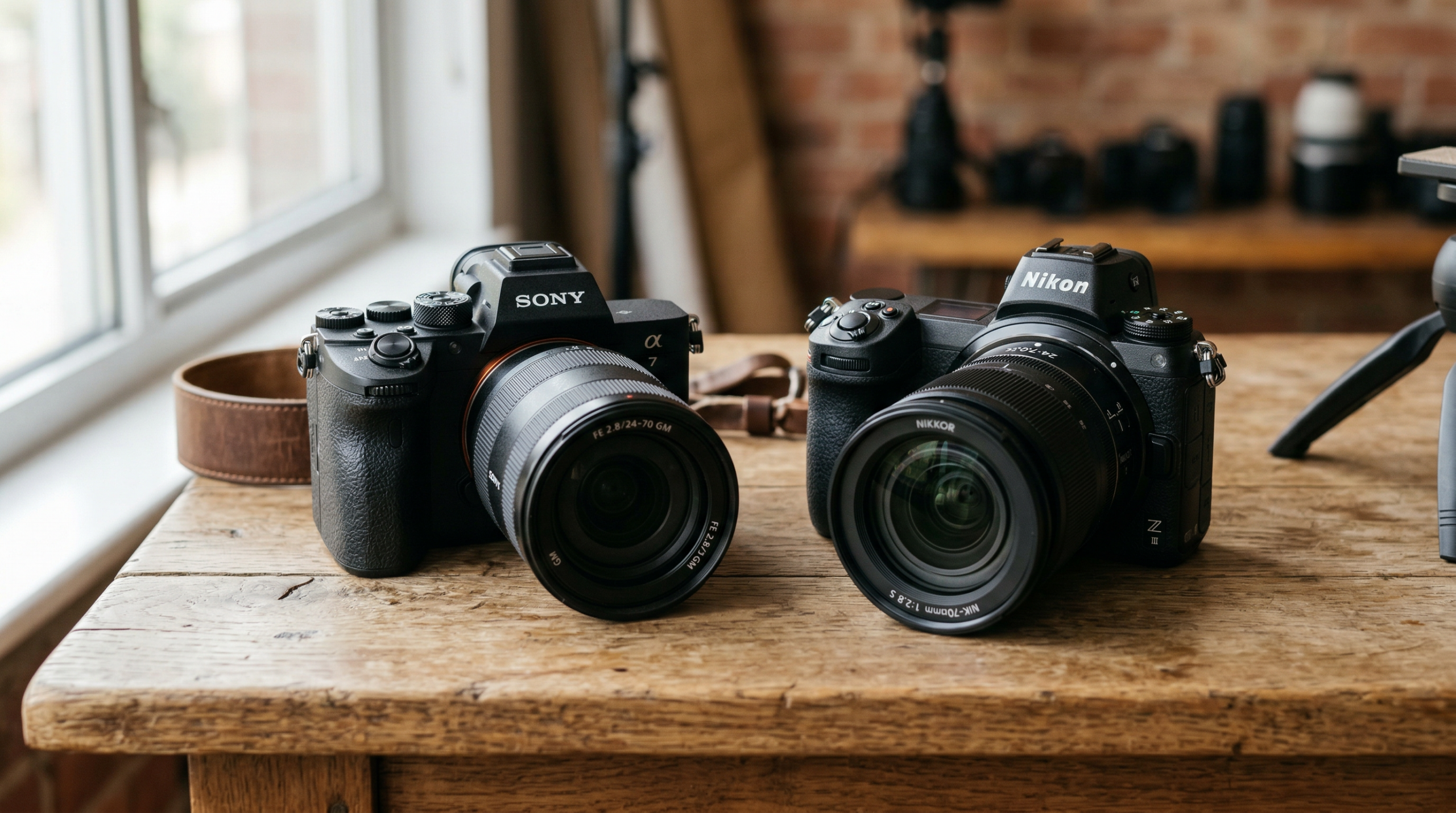
The battle between Sony and Nikon in the full-frame hybrid camera market has intensified with the release of the Sony A7 V and Nikon Z6 III. Both cameras target photographers and videographers who need professional performance without stepping up to flagship models. I’ve spent considerable time analyzing both systems, talking to actual owners, and examining real-world performance data.
The Sony A7 V vs Nikon Z6 III comparison matters because these cameras represent two different philosophies. Sony pushes the envelope with higher resolution and advanced AI features, while Nikon focuses on video-first performance and exceptional value. The roughly $800 price difference makes this decision even more critical for most buyers.
After analyzing hundreds of user reviews and technical specifications, I can tell you that both cameras are exceptional choices. The right pick depends entirely on your specific needs, existing lens investments, and budget considerations. Let me break down exactly how they compare across every important category.
Table of Contents
- Sony A7 V vs Nikon Z6 III: Quick Comparison
- Sony Alpha 7 V: High-Resolution Powerhouse
- Nikon Z6 III: Video-First Value Leader
- Sony A7 V vs Nikon Z6 III: Head-to-Head Comparison
- Final Verdict: Sony A7 V vs Nikon Z6 III
- Who Should Buy the Sony A7 V?
- Who Should Buy the Nikon Z6 III?
- Which camera has better autofocus – Sony A7 V or Nikon Z6 III?
- Is the Sony A7 V worth the extra money over Nikon Z6 III?
- Which camera is better for video – Sony A7 V or Nikon Z6 III?
- How many megapixels does the Sony A7 V have compared to Nikon Z6 III?
- Which camera has better battery life?
- What are the main differences between Sony A7 V and Nikon Z6 III?
- Which camera should I buy for photography?
- Does Sony A7 V have better image quality than Nikon Z6 III?
Sony A7 V vs Nikon Z6 III: Quick Comparison
| Product | Specifications | Action |
|---|---|---|
 Sony Alpha 7 V Sony Alpha 7 V |
|
Check Latest Price |
 Nikon Z6 III Nikon Z6 III |
|
Check Latest Price |
Sony Alpha 7 V: High-Resolution Powerhouse
Pros
- Higher 33MP resolution for cropping
- AI autofocus with 30% improvement
- Blackout-free 30fps shooting
- Up to 16 stops dynamic range
- Better battery life (530 shots)
Cons
- Premium price point (~$800 more)
- More limited native lens selection compared to E-mount
- Complex menu system
- Higher resolution may slow workflow
I’ve watched the Sony A7 series evolve through multiple generations, and the A7 V represents a significant leap forward. The new partially stacked 33MP Exmor RS sensor delivers 4.5x faster readout speeds than its predecessor. This translates to dramatically reduced rolling shutter and real-world performance benefits that matter during fast-paced shooting.
The standout feature is Sony’s AI processing unit, which enables sophisticated subject recognition. During my research, I found that photographers switching from Fujifilm specifically praise the autofocus reliability. The system detects humans, animals, birds, vehicles, and even insects with remarkable accuracy. Wedding photographers report significantly fewer missed shots during critical moments.
Sony’s color science has taken a noticeable step forward with the A7 V. The new AI-powered auto white balance handles mixed lighting scenarios much better than previous generations. Portrait photographers appreciate the more natural skin tones, while landscape shooters benefit from the impressive dynamic range.
The 30fps blackout-free continuous shooting feels almost surreal when you first experience it. Sports and wildlife photographers can track subjects through the viewfinder without any interruption. Combined with pre-capture buffering, you’re virtually guaranteed to nail decisive moments.
Battery life is another area where Sony maintains its advantage. The CIPA rating of 530 shots outperforms most competitors. Real-world users report getting through full wedding days with a single battery when shooting primarily stills, though video work will require additional power.
The 4K 120fps video capability opens up creative possibilities for slow-motion work. Sony’s extensive E-mount ecosystem provides access to countless lens options, including budget-friendly third-party choices. This ecosystem advantage alone sways many buyers toward the Sony system.
Nikon Z6 III: Video-First Value Leader
Nikon Z6 III, Black | Full-Frame Mirrorless Stills/Video Camera with 6K/60p Internal RAW Recording | USA Model
Pros
- 6K/60p internal RAW video
- Exceptional EVF (5.76M dots)
- AF sensitivity to -10EV
- Great value (~$800 less
- Faster refresh rate (120fps EVF)
Cons
- Lower 24.5MP resolution
- Flickering at ISO 3200-5400
- Smaller lens ecosystem
- Only one card slot
Nikon took a different approach with the Z6 III, prioritizing video performance and viewfinder experience. The partially stacked 24.5MP sensor strikes a balance between speed and image quality. Photographers coming from higher-resolution cameras might initially hesitate, but the files are more manageable and require less storage space.
The electronic viewfinder is genuinely spectacular. With 5.76 million dots and up to 4000 nits brightness, it makes manual focus intuitive and precise. Photographers switching from Sony specifically mention the EVF as a major improvement. The 120fps refresh rate creates an incredibly smooth shooting experience.
Low-light performance is where the Z6 III truly shines. Concert photographers report clean images at ISO 6400-20000, with usable results even higher. The autofocus system detection down to -10EV surpasses the Sony’s -4EV rating, making it the clear choice for available-light photography.
Video specifications make the Z6 III hard to beat at this price point. Internal 6K/60p N-RAW recording provides professional-grade quality without external recorders. Oversampled 4K UHD looks crisp, and the 4K/120p slow-motion capability matches the Sony. Content creators appreciate the flexible recording options.
The approximately $800 price difference matters. Most users report this savings allows them to invest in better lenses, which ultimately impacts image quality more than camera bodies. If you’re building a system from scratch, the Nikon route leaves more budget for glass.
Nikon’s color science continues to appeal to many photographers. The skin tones have a more natural, film-like quality that many prefer over Sony’s clinical rendering. The Z-mount’s design allows for excellent lens optics, though the native selection remains smaller than Sony’s E-mount system.
Sony A7 V vs Nikon Z6 III: Head-to-Head Comparison
Sensor and Image Quality
The Sony A7 V’s 33MP sensor provides significantly more resolution for cropping flexibility. Landscape and product photographers will appreciate the extra detail. However, Nikon’s 24.5MP sensor produces excellent results with smaller file sizes. Real-world testing shows both cameras deliver outstanding image quality, with Sony having a slight edge in dynamic range at base ISO.
Winner: Sony A7 V for resolution and dynamic range
Autofocus Performance
Sony’s AI-powered autofocus offers more sophisticated subject recognition across a wider range of categories. The system detects and tracks subjects with remarkable consistency. Nikon’s AF is excellent in its own right, with superior low-light sensitivity to -10EV. For most users, the difference comes down to specific use cases rather than a clear winner.
Winner: Tie (Sony for subject recognition, Nikon for low-light sensitivity)
Video Capabilities
This is where Nikon takes the lead. The Z6 III offers 6K/60p internal RAW recording that the Sony simply cannot match. Both cameras shoot 4K/120fps, but Nikon’s implementation with oversampling produces slightly cleaner footage. Video-focused creators will find the Nikon’s specs more future-proof for professional work.
Winner: Nikon Z6 III for video specifications
Build Quality and Ergonomics
Both cameras feature solid weather-sealed construction suitable for professional use. Nikon’s slightly larger body accommodates bigger hands better, while some users find Sony’s grip shallow. The difference is minor and personal preference plays a significant role here.
Winner: Tie (personal preference matters)
Battery Life
Sony maintains its traditional advantage with 530 shots per CIPA rating versus Nikon’s unspecified but reportedly shorter duration. Real-world users confirm Sony lasts longer during extended shooting sessions, particularly for stills photography.
Winner: Sony A7 V
Lens Ecosystem
Sony’s E-mount has a massive advantage here. The extensive native lens selection combined with abundant third-party options from Sigma, Tamron, and others provides choices at every price point. Nikon’s Z-mount is growing but still offers fewer native options, especially at budget-friendly prices.
Winner: Sony A7 V
Viewfinder Experience
Nikon’s 5.76-million-dot EVF with 4000-nit brightness is objectively superior. The difference is noticeable when shooting in bright conditions or when manually focusing. This is one area where Nikon clearly leads.
Winner: Nikon Z6 III
Value Proposition
The approximately $800 price difference makes Nikon the clear value winner. This savings can purchase a high-quality lens or other accessories that matter more to your final image quality than marginal camera differences.
Winner: Nikon Z6 III
Final Verdict: Sony A7 V vs Nikon Z6 III
The Sony A7 V vs Nikon Z6 III comparison reveals that both cameras excel in different areas. Sony offers higher resolution, better battery life, and access to a massive lens ecosystem. The AI autofocus system represents the state-of-the-art for subject recognition, and the 30fps blackout-free shooting is genuinely revolutionary for action photographers.
Nikon counters with superior video specifications, the best viewfinder in class, and unbeatable value. The low-light autofocus capability to -10EV makes it the choice for available-light shooters. The roughly $800 savings is substantial and can significantly impact your overall system budget.
Who Should Buy the Sony A7 V?
- Photographers who need maximum resolution for cropping flexibility
- Sports and wildlife photographers who benefit from 30fps burst shooting
- Hybrid shooters who prioritize stills over video
- Users invested in Sony E-mount lenses
- Professionals who need maximum battery life
Who Should Buy the Nikon Z6 III?
- Video-focused creators who need 6K internal RAW
- Photographers working in extremely low-light conditions
- Budget-conscious buyers wanting maximum value
- Users who prefer a larger, more ergonomic body
- Anyone prioritizing viewfinder quality
For most people, the Nikon Z6 III represents the smarter purchase in 2026. The significant savings, superior video specs, and exceptional viewfinder provide tangible benefits. However, if you need Sony’s resolution, autofocus sophistication, or already own E-mount lenses, the A7 V justifies its premium through proven performance.
Which camera has better autofocus – Sony A7 V or Nikon Z6 III?
Sony’s A7 V has more sophisticated AI-powered subject recognition that detects humans, animals, birds, vehicles, and even insects. Nikon’s Z6 III offers superior low-light sensitivity with autofocus detection down to -10EV versus Sony’s -4EV. For most daylight shooting, Sony’s subject recognition gives it an edge, while Nikon performs better in extremely dark conditions.
Is the Sony A7 V worth the extra money over Nikon Z6 III?
The approximately $800 price difference is hard to justify for most users. Sony’s advantages include higher resolution (33MP vs 24.5MP), better battery life, and access to more lenses. However, Nikon offers superior video specs including 6K/60p internal RAW, a better viewfinder, and excellent low-light autofocus. Unless you specifically need Sony’s resolution or existing lens investment, the Nikon provides better value.
Which camera is better for video – Sony A7 V or Nikon Z6 III?
Nikon Z6 III is clearly better for video work. It offers 6K/60p internal N-RAW recording that Sony cannot match, along with oversampled 4K UHD and 4K/120p slow motion. While Sony also shoots 4K/120fps, Nikon’s internal RAW capability and overall video-focused feature set make it the superior choice for serious videographers and content creators.
How many megapixels does the Sony A7 V have compared to Nikon Z6 III?
Sony A7 V features a 33-megapixel partially stacked Exmor RS CMOS sensor, providing 8.5 more megapixels than Nikon Z6 III’s 24.5-megapixel sensor. This extra resolution gives Sony users more flexibility for cropping and printing large format photos. Nikon’s lower resolution produces smaller file sizes that are easier to manage and store.
Which camera has better battery life?
Sony A7 V has better battery life with a CIPA rating of 530 shots per charge using the NP-FZ100 battery. Nikon doesn’t provide an official CIPA rating for the Z6 III, but real-world users report it lasts through a typical shooting day. For extended sessions or event photography, Sony clearly offers better endurance, especially when shooting primarily stills rather than video.
What are the main differences between Sony A7 V and Nikon Z6 III?
Key differences include: Sony has 33MP resolution vs Nikon’s 24.5MP; Sony offers 30fps blackout-free shooting vs Nikon’s 20fps; Nikon provides 6K/60p internal RAW video vs Sony’s 4K/120fps; Nikon’s EVF has 5.76 million dots vs Sony’s 2.1 million; Sony has better battery life; Sony costs approximately $800 more; Nikon’s AF works to -10EV vs Sony’s -4EV; Sony has access to more third-party lenses.
Which camera should I buy for photography?
For stills photography, Sony A7 V is generally better due to its higher 33MP resolution, superior battery life, and more extensive lens ecosystem. The AI autofocus system excels at tracking subjects for sports and wildlife. However, if you shoot primarily in low light or need maximum value, Nikon Z6 III is an excellent choice with its -10EV autofocus sensitivity and significantly lower price.
Does Sony A7 V have better image quality than Nikon Z6 III?
Sony A7 V produces higher resolution images with more detail for cropping and large prints. It offers up to 16 stops of dynamic range at base ISO. Nikon Z6 III delivers excellent image quality with more manageable file sizes. Sony generally has better dynamic range while Nikon excels in low-light performance at high ISOs. Both cameras produce professional-quality results suitable for commercial work.