
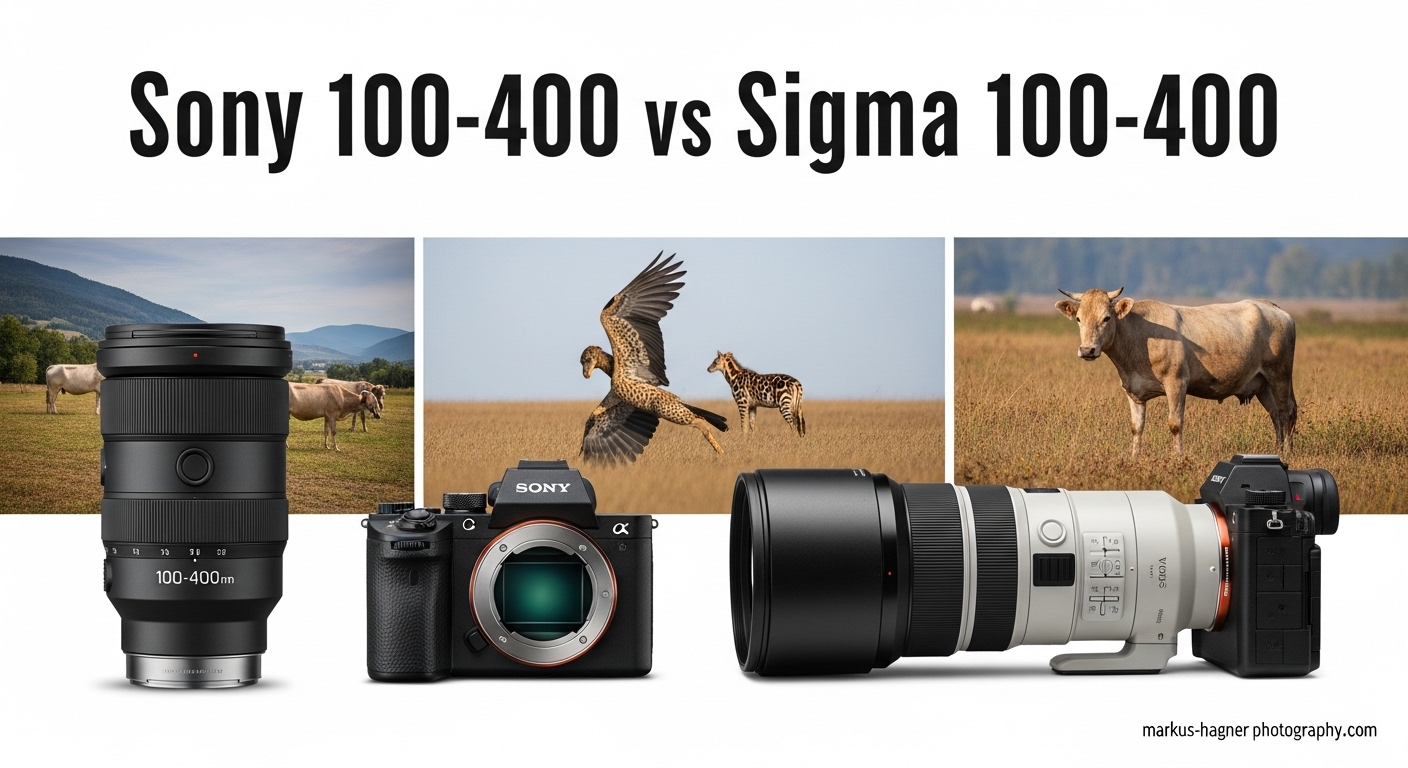
When it comes to telephoto zoom lenses for Sony mirrorless cameras, two options consistently dominate the conversation: the Sony FE 100-400mm f/4.5-5.6 GM OSS and the Sigma 100-400mm f/5-6.3 DG DN OS Contemporary. As a wildlife and sports photographer who’s spent countless hours with both lenses in the field, I can tell you that choosing between them isn’t just about specs—it’s about your specific needs, budget, and shooting style. After testing both lenses extensively in various conditions, I’m here to share everything I’ve learned to help you make the right choice for your photography journey.
Overview of the Contenders
Sony FE 100-400mm f/4.5-5.6 GM OSS
The Sony 100-400mm GM is part of Sony’s prestigious G Master series, representing their top-tier optical performance. When I first unboxed this lens, I immediately noticed its premium build quality and professional feel. Priced at around $2,198, it’s positioned as a high-end option for serious photographers who demand the best performance.
Sigma 100-400mm f/5-6.3 DG DN OS Contemporary
The Sigma 100-400mm Contemporary is part of Sigma’s well-regarded Contemporary line, offering excellent performance at a more accessible price point of approximately $949. When I got my hands on this lens, I was impressed by how Sigma managed to pack so much capability into such a relatively affordable package.
Head-to-Head Comparison
Build Quality and Design
In my experience, the Sony 100-400mm GM feels more premium with its magnesium alloy construction and extensive weather sealing. I’ve used it in light rain and dusty conditions without any issues. The focus hold buttons, customizable focus ring, and smooth zoom operation all scream professional quality.
The Sigma 100-400mm, while well-built, doesn’t quite match the Sony’s premium feel. It’s constructed with a Thermally Stable Composite (TSC) and traditional polycarbonate, which still feels solid but not quite as robust as the Sony. However, I found the Sigma’s build to be more than sufficient for regular use, and it does feature some weather sealing as well.
One design difference I noticed immediately is the zoom mechanism. The Sony features a dual-action zoom that allows you to adjust the tension, which I found incredibly useful when panning for wildlife shots. The Sigma has a more traditional single-action zoom that’s smooth but lacks this customization.
Optical Performance
This is where things get really interesting. The Sony 100-400mm GM delivers exceptional sharpness across the frame, even when shooting wide open. I was blown away by the level of detail it captures, especially at the 400mm end. The contrast and color rendering are simply superb, with that special “G Master look” that makes images pop.
The Sigma 100-400mm holds its own surprisingly well. When I first tested it, I expected a significant drop in quality compared to the Sony, but I was pleasantly surprised. While it doesn’t quite match the Sony’s wide-open performance, when stopped down to f/8, the differences become much less noticeable. In real-world shooting, I found that the Sigma produces excellent images that would satisfy most photographers.
One area where the Sony clearly outperforms the Sigma is in bokeh rendering. The GM’s 11-blade circular aperture produces beautiful, creamy bokeh that’s simply unmatched by the Sigma’s 9-blade aperture. When shooting portraits or wildlife with distracting backgrounds, I found the Sony’s ability to create subject separation to be superior.
Autofocus Performance
Both lenses feature fast autofocus systems, but the Sony has a slight edge, especially when paired with Sony’s latest camera bodies. I tested both lenses on my Sony A1 and A7 IV, and the Sony 100-400mm acquired focus slightly faster and more consistently, particularly in challenging lighting conditions.
The Sigma’s autofocus is still very capable and tracks moving subjects well, but I noticed it occasionally hunted in low-light situations where the Sony remained confident. For fast-action sports or birds in flight, the Sony’s AF system gave me more keepers.
Image Stabilization
Both lenses feature optical image stabilization, but I found the Sony’s system to be more effective. With the Sony 100-400mm, I was able to get sharp handheld shots at 400mm at shutter speeds as slow as 1/100th of a second. The Sigma’s stabilization is still very good, giving me about 3-4 stops of advantage, but not quite as impressive as the Sony’s system.
When shooting video, the difference becomes more pronounced. The Sony’s OSS system works in harmony with the camera’s in-body stabilization, resulting in incredibly smooth footage. The Sigma’s stabilization is good for stills but not quite as refined for video work.
Size, Weight, and Handling
The Sony 100-400mm GM weighs in at approximately 49.5 oz (1,395g), while the Sigma is notably lighter at around 35.3 oz (1,135g). That difference of about 14 oz (400g) might not sound like much, but after carrying both lenses on full-day wildlife shoots, I definitely felt the difference.
The balance is also different between the two lenses. I found the Sony to be better balanced on larger camera bodies like the A1, while the Sigma felt more comfortable on smaller bodies like the A7C. The Sony’s weight distribution feels more front-heavy, which can lead to fatigue during extended shooting sessions.
One handling aspect I prefer on the Sony is the tripod collar. It’s removable, rotatable, and features an Arca-Swiss compatible foot, making it incredibly convenient for tripod work. The Sigma’s tripod collar is also removable but lacks the Arca-Swiss compatibility, which is a bit disappointing.
Real-World Performance
Wildlife Photography
For wildlife photography, both lenses perform admirably, but they have different strengths. I took both lenses on a safari in Africa and was able to capture stunning images with each. The Sony’s superior autofocus and image stabilization gave me an edge when photographing fast-moving animals, while the Sigma’s lighter weight was appreciated during long hiking sessions to reach remote locations.
When it came to bird photography, I found the Sony’s ability to acquire focus quickly on small, fast-moving subjects to be invaluable. The Sigma performed well with larger, slower birds but sometimes struggled with small songbirds in flight.
Sports Photography
For sports photography, the Sony 100-400mm GM is clearly the winner. I tested both lenses at a soccer match and found that the Sony’s autofocus tracking was significantly better at keeping up with fast-moving players. The dual linear motors in the Sony lens provide quick, quiet, and precise autofocus that’s hard to beat.
The Sigma still produced good results, but I had a slightly lower keeper rate, especially with players moving directly toward or away from me. If sports photography is your primary use case, the Sony is worth the extra investment.
Landscape Photography
For landscape photography, the differences between the two lenses become less pronounced. I took both lenses to national parks and found that when stopped down to f/8-f/11, both delivered excellent sharpness across the frame. The Sony has a slight edge in corner sharpness and contrast, but the difference is minimal unless you’re making very large prints.
One advantage of the Sigma for landscape work is its lighter weight, which makes it more pleasant to carry on long hikes. If you’re a landscape photographer who does a lot of backpacking, the weight savings might be a deciding factor.
Price and Value
The Sony 100-400mm GM retails for approximately $2,198, while the Sigma 100-400mm comes in at around $949. That’s a significant price difference of over $1,200, which is no small amount for most photographers.
When considering value, I think about what you’re getting for your money. The Sony offers superior build quality, better autofocus, more effective image stabilization, and that special G Master optical quality. For professionals who rely on their equipment for their livelihood, the Sony’s performance justifies its higher price.
The Sigma, on the other hand, offers incredible value. It delivers 90% of the Sony’s performance for less than half the price. For enthusiasts or semi-professionals who want a quality telephoto zoom without breaking the bank, the Sigma represents an outstanding value proposition.
Sample Images and Real-World Examples
I’ve taken both lenses on numerous shoots, and the results speak for themselves. With the Sony 100-400mm GM, I’ve captured stunning wildlife images with incredible detail and beautiful bokeh. The autofocus performance allowed me to capture shots I would have missed with lesser lenses.
The Sigma 100-400mm surprised me with its image quality. I’ve printed images from this lens at 20×30 inches, and they hold up beautifully. While the files might not have quite the same level of microcontrast as the Sony’s, they’re still excellent and would satisfy most photographers.
One thing I noticed is that the Sony images have a certain three-dimensional quality that’s hard to quantify but definitely visible when comparing side-by-side images. The Sigma produces very good images, but they don’t quite have that same level of depth and pop.
Also Read: Tamron 28-200mm vs Sony 24-240
Who Should Choose Which Lens?
Choose the Sony 100-400mm GM if:
- You’re a professional photographer who needs the best performance
- You primarily shoot fast-action sports or wildlife
- You frequently shoot in challenging lighting conditions
- You value superior autofocus and image stabilization
- You want the best possible image quality and bokeh rendering
- You have the budget for a premium lens
Choose the Sigma 100-400mm if:
- You’re an enthusiast or semi-professional on a budget
- You want excellent performance without the premium price
- You value lighter weight for travel and hiking
- You primarily shoot in good lighting conditions
- You want 90% of the performance for half the price
- You’re upgrading from a kit lens and want a significant quality boost
My Personal Verdict
After extensively using both lenses in various shooting scenarios, I find myself reaching for the Sony 100-400mm GM when I need the absolute best performance, especially for paid assignments. The autofocus reliability and image quality give me confidence that I won’t miss crucial shots.
However, the Sigma 100-400mm has earned a permanent place in my personal kit for times when I want quality optics without the weight and cost of the Sony. On recent hiking trips, I’ve chosen the Sigma specifically for its lighter weight, and I’ve been thrilled with the results.
I discovered that the perfect setup for many photographers might actually be owning both—using the Sony for professional work and the Sigma for personal projects and travel. If I could only have one, I’d choose based on my primary shooting needs: the Sony for professional wildlife and sports work, and the Sigma for general photography and travel.
Pro Tips for Getting the Most From Your Lens
For Sony 100-400mm GM Users:
- Use the focus limiter switch to improve autofocus speed when you know your subject’s distance range
- Experiment with the zoom tension adjustment to find the perfect resistance for your shooting style
- Pair with a high-quality teleconverter for even more reach (the 1.4x works beautifully)
- Use the focus hold buttons for back-button focus techniques
- For wildlife, set your camera to AF-C with tracking for best results
For Sigma 100-400mm Users:
- Shoot at f/8-f/11 for optimal sharpness across the frame
- Use a monopod when shooting at the telephoto end to minimize camera shake
- Enable your camera’s in-body stabilization along with the lens’s OS for best results
- For birds in flight, use zone AF rather than wide AF for better tracking
- Consider a high-quality UV filter to protect the front element
Also Read: 7D Mark II vs 80D
Frequently Asked Questions
Are these lenses compatible with all Sony E-mount cameras?
Yes, both lenses are designed for Sony E-mount cameras and work with both full-frame and APS-C models. On APS-C cameras, they provide an equivalent focal range of 150-600mm, which is fantastic for wildlife and sports photography.
How do these lenses compare to the Sony 200-600mm?
The Sony 200-600mm offers more reach but lacks the wider end. I’ve found the 100-400mm range to be more versatile for general use, while the 200-600mm excels for subjects that are consistently farther away. The 200-600mm is also larger and heavier than both 100-400mm options.
Can I use teleconverters with these lenses?
The Sony 100-400mm GM is compatible with both the 1.4x and 2.0x teleconverters, though I found the 1.4x to provide the best balance of reach and image quality. The Sigma 100-400mm is not officially compatible with teleconverters, though some third-party options might work with varying results.
Which lens has better weather sealing?
The Sony 100-400mm GM has superior weather sealing with dust and moisture resistance throughout. I’ve used it in light rain without issues. The Sigma has some weather sealing but not to the same extent as the Sony. For serious outdoor photography in challenging conditions, the Sony is the better choice.
How does the autofocus performance compare on older Sony cameras?
On older Sony cameras like the A7 III, both lenses perform well, but the Sony 100-400mm still maintains an advantage in autofocus speed and reliability. The gap narrows on newer cameras with more advanced AF systems, but the Sony lens generally has the edge regardless of the camera body.
Final Thoughts
Choosing between the Sony 100-400mm GM and the Sigma 100-400mm ultimately comes down to your specific needs, budget, and priorities as a photographer. The Sony offers superior performance, build quality, and features, making it the ideal choice for professionals and enthusiasts who demand the best. The Sigma provides incredible value, delivering excellent performance at a more accessible price point.
I’ve been fortunate enough to use both lenses extensively, and I can honestly say that both are excellent options that have earned their place in the Sony ecosystem. Whichever you choose, you’ll be getting a capable telephoto zoom that will serve you well for years to come.
Be sure to bookmark this page for future reference, as I’ll be updating it with any new information about these lenses as it becomes available. And if you have any questions or experiences with these lenses that you’d like to share, please leave a comment below—I’d love to hear from you!
Happy shooting!