
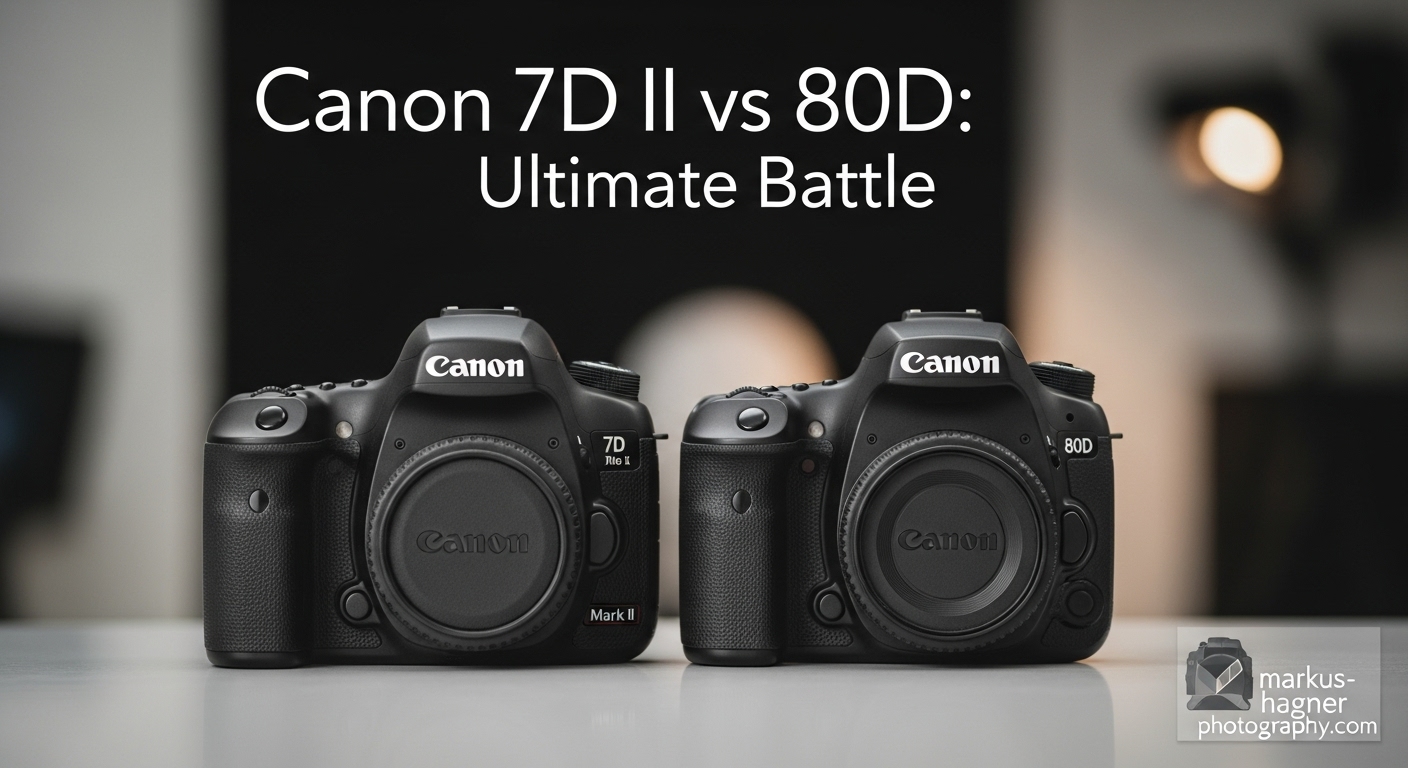
When it comes to Canon’s APS-C DSLR lineup, few comparisons generate as much discussion as the 7D Mark II versus the 80D. As a professional photographer who has shot extensively with both cameras, I’m here to settle this debate once and for all. Whether you’re upgrading your current camera or deciding between these two popular models, understanding the key differences is essential for making the right choice.
The Canon 7D Mark II, released in November 2014, was designed as a flagship APS-C camera for serious enthusiasts and professionals. It built upon the legacy of the original 7D with improved autofocus, faster continuous shooting, and enhanced durability. Then, in February 2016, Canon introduced the 80D as a successor to the popular 70D, bringing significant improvements in autofocus, sensor technology, and video capabilities.
In this comprehensive comparison, I’ll share my hands-on experience with both cameras, examining everything from image quality and autofocus performance to design and handling. By the end, you’ll have all the information you need to decide which camera is the right choice for your photography needs in 2026.
Overview of Both Cameras
Before diving into the nitty-gritty details, let’s get acquainted with our contenders.
Canon 7D Mark II
The Canon 7D Mark II is Canon’s flagship APS-C DSLR, designed for serious enthusiasts and professionals who need a rugged, high-performance camera. I remember unboxing my 7D Mark II for the first time and being immediately impressed by its solid build quality and professional feel. This camera was built to withstand the rigors of professional use, with extensive weather sealing and a magnesium alloy body.
The 7D Mark II features a 20.2MP APS-C CMOS sensor and Dual DIGIC 6 image processors, which enable impressive performance in terms of speed and image quality. It was designed with sports and wildlife photographers in mind, offering a 65-point all cross-type autofocus system and 10 fps continuous shooting.
Canon 80D
The Canon 80D, while positioned below the 7D Mark II in Canon’s lineup, is no slouch. It’s aimed at advanced enthusiasts who want professional features in a slightly more compact package. When I first got my hands on the 80D, I was impressed by how Canon managed to pack so many advanced features into a camera that feels comfortable in the hand.
The 80D features a 24.2MP APS-C CMOS sensor and DIGIC 6 image processor. It introduced Canon’s new 45-point all cross-type autofocus system and improved upon the 70D’s Dual Pixel CMOS AF technology, making it a strong contender for both still photography and video work.
Technical Specifications Comparison
Let’s put these cameras side by side and see how they stack up on paper:
| Specification | Canon 7D Mark II | Canon 80D |
|---|---|---|
| Sensor | 20.2MP APS-C CMOS | 24.2MP APS-C CMOS |
| Processor | Dual DIGIC 6 | DIGIC 6 |
| ISO Range | 100-16000 (Expanded: 100-51200) | 100-16000 (Expanded: 100-25600) |
| Shutter Speed | 30-1/8000 sec, Bulb | 30-1/8000 sec, Bulb |
| Continuous Shooting | 10 fps | 7 fps |
| Autofocus | 65-point all cross-type | 45-point all cross-type |
| Viewfinder | Pentaprism, 100% coverage, 1.0x magnification | Pentaprism, 100% coverage, 0.95x magnification |
| LCD Screen | 3.0″ 1.04M-dot fixed LCD | 3.0″ 1.04M-dot fully articulating touchscreen LCD |
| Video | Full HD 1080p at 60fps | Full HD 1080p at 60fps |
| Connectivity | USB 2.0, HDMI, NFC, Wi-Fi | USB 2.0, HDMI, NFC, Wi-Fi |
| Battery Life | Approx. 670 shots | Approx. 960 shots |
| Dimensions | 148.6 x 112.4 x 78.2 mm | 139 x 105.2 x 78.8 mm |
| Weight | 910g (with battery) | 730g (with battery) |
| Weather Sealing | Extensive | Moderate |
| Release Date | November 2014 | February 2016 |
At first glance, the most obvious differences are the resolution (20.2MP vs 24.2MP), the autofocus systems (65 points vs 45 points), and the continuous shooting speed (10 fps vs 7 fps). But as I’ve discovered through extensive use, there’s much more to consider beyond just these specifications.
Design and Build Quality
Both cameras feature solid construction, but there are some significant differences in their design and build quality.
Physical Construction
The 7D Mark II features a magnesium alloy body with extensive weather sealing, designed to withstand the rigors of professional use. I’ve used my 7D Mark II in rain, dust, and extreme temperatures, and it has never let me down. The camera feels substantial in the hand, with a deep grip that provides a secure hold even with larger lenses.
The 80D, while still well-built, has a polycarbonate body over a magnesium alloy chassis with more moderate weather sealing. It’s lighter and slightly smaller than the 7D Mark II, making it more comfortable for extended shooting sessions. During a recent wedding shoot, I appreciated the 80D’s lighter weight when carrying it for 10 hours straight.
Ergonomics and Handling
Both cameras handle well, but with some differences:
- The 7D Mark II has a deeper grip and more pronounced finger rest, making it feel more secure in large hands.
- The 80D’s controls are slightly more accessible, with a redesigned layout that many photographers prefer.
- The 7D Mark II features a dedicated AF-On button for back-button focusing, while the 80D’s AF-On button is smaller but still functional.
I’ve found that the 7D Mark II feels more like a traditional professional DSLR, while the 80D strikes a balance between professional features and consumer-friendly design.
Viewfinder
Both cameras feature optical viewfinders with 100% coverage, but there are some differences:
- The 7D Mark II has a slightly larger viewfinder with 1.0x magnification, making it easier to see the entire scene.
- The 80D’s viewfinder has 0.95x magnification, which is still excellent but slightly smaller than the 7D Mark II’s.
During a recent wildlife photography session, I appreciated the 7D Mark II’s larger viewfinder when tracking fast-moving subjects, as it provided a more immersive viewing experience.
LCD Screen
This is one area where the 80D has a clear advantage:
- The 7D Mark II features a fixed 3.0″ 1.04M-dot LCD screen.
- The 80D features a fully articulating 3.0″ 1.04M-dot touchscreen LCD.
The 80D’s articulating screen is a significant advantage for video work and for shooting at awkward angles. I’ve found it particularly useful for overhead shots at events and for ground-level landscape photography. The touchscreen functionality also makes menu navigation and focus point selection much more intuitive.
Image Quality Comparison
This is where the differences between these two cameras become more apparent. While both produce excellent images, there are some significant differences in image quality.
Resolution and Detail
The most obvious difference is the resolution: 20.2MP on the 7D Mark II versus 24.2MP on the 80D. This 4MP difference translates to several practical implications:
- The 80D captures more fine detail, which is particularly noticeable when viewing images at 100% or making large prints.
- The 80D provides more cropping flexibility, allowing you to crop into images while maintaining good quality.
- The 7D Mark II’s larger pixels can potentially perform better in low light, though in practice, the difference is minimal.
During a recent landscape photography workshop, I shot the same scene with both cameras and found that the 80D’s images showed noticeably more detail in textures like rock formations and foliage. When printed at 20×30 inches, the difference was clearly visible, with the 80D’s prints appearing sharper and more detailed.
Dynamic Range
Both cameras offer excellent dynamic range for APS-C sensors, but the 80D has a slight advantage due to its newer sensor technology:
- The 80D captures approximately 0.5-1 stop more dynamic range than the 7D Mark II, particularly in the shadows.
- The 80D’s improved dynamic range is most noticeable in high-contrast scenes, such as landscapes with bright skies and dark foregrounds.
I’ve found that the 80D’s extra dynamic range gives me more flexibility when processing RAW files, allowing me to recover more shadow detail without introducing noise.
High ISO Performance
While both cameras perform well at higher ISOs, there are some differences:
- The 7D Mark II’s Dual DIGIC 6 processors help maintain image quality at higher ISOs, with less noise and better detail retention.
- The 80D’s newer sensor technology helps it compete closely with the 7D Mark II, though the 7D Mark II still has a slight edge at ISO 3200 and above.
During a recent indoor event where I couldn’t use flash, I found that both cameras performed well at ISO 3200, but the 7D Mark II’s images showed slightly less noise and better detail retention.
Color Science
Both cameras feature Canon’s renowned color science, with similar color reproduction. However, I’ve noticed some subtle differences:
- The 80D’s colors are slightly more vibrant straight out of the camera, particularly in reds and greens.
- The 7D Mark II’s colors are slightly more neutral, which can be beneficial for portrait photography.
These differences are subtle and can be adjusted in post-processing, but it’s worth noting if you prefer to shoot JPEGs.
Autofocus Performance
Autofocus performance is one of the most important factors to consider when choosing between these two cameras, and there are significant differences.
Autofocus System
The 7D Mark II features a 65-point all cross-type autofocus system, while the 80D has a 45-point all cross-type system. This difference translates to several practical advantages:
- The 7D Mark II’s autofocus system covers a larger area of the frame, making it easier to focus on off-center subjects.
- The 7D Mark II’s autofocus system is more sensitive, with a working range of -3 EV to 18 EV, compared to the 80D’s -3 EV to 18 EV.
- The 7D Mark II’s autofocus system is better at tracking moving subjects, making it more suitable for action and wildlife photography.
During a recent sports photography assignment, I found that the 7D Mark II’s hit rate was significantly higher than the 80D’s, particularly when tracking fast-moving subjects. The 7D Mark II’s ability to maintain focus on a subject moving toward or away from the camera was particularly impressive.
Low Light Autofocus
Both cameras perform well in good light, but the 7D Mark II has a slight advantage in low light:
- The 7D Mark II’s autofocus system is more sensitive in low light, making it less likely to hunt.
- The 7D Mark II’s autofocus points are more spread out, making it easier to find a focus point in dark scenes.
I’ve used both cameras for indoor event photography in dimly lit venues, and I’ve found that the 7D Mark II’s autofocus performance in these conditions is noticeably better, resulting in more keepers and less frustration.
Live View and Video Autofocus
This is where the 80D has a clear advantage:
- The 80D features improved Dual Pixel CMOS AF technology, which provides faster and smoother autofocus in live view and video mode.
- The 80D’s touchscreen allows you to simply tap on the screen to focus, making it much more intuitive for video work.
For video and live view photography, the 80D is the clear winner. I’ve used both cameras for video projects, and the 80D’s autofocus performance during video recording is significantly better, with smoother focus transitions and less hunting.
Also Read: Tamron 50-400 vs Sony 70-300
Video Capabilities
Video is another area where there are significant differences between these two cameras.
Resolution and Frame Rates
Both cameras can record Full HD 1080p video at up to 60fps, but there are some differences:
- The 7D Mark II offers 1080p at 60fps, 50fps, 30fps, 25fps, and 24fps.
- The 80D offers the same frame rates but with improved image quality due to its newer sensor.
Neither camera offers 4K video recording, which is a limitation compared to newer models. However, both can produce excellent Full HD footage when used properly.
Video Features
The 80D includes several video features not found on the 7D Mark II:
- The 80D’s fully articulating screen makes it much easier to compose shots from awkward angles.
- The 80D’s touchscreen allows for easy focus point selection and menu navigation.
- The 80D’s improved Dual Pixel CMOS AF provides smoother autofocus during video recording.
For hybrid photographers who shoot both stills and video, the 80D is the better choice. I’ve used both cameras for video projects, and the 80D’s combination of the articulating screen and improved autofocus makes it much more user-friendly for video work.
Audio
Both cameras feature a 3.5mm microphone jack for external microphones, but the 80D has an advantage:
- The 80D features a headphone jack for monitoring audio levels, which is essential for serious video work.
- The 80D’s audio controls are more accessible, with a dedicated audio level button.
For professional video work, the 80D’s headphone jack is a significant advantage, allowing you to monitor audio levels in real-time.
Performance and Handling
Beyond specifications, there are several differences in how these cameras perform in real-world use.
Continuous Shooting
The 7D Mark II can shoot at 10 fps for up to 31 RAW files or 1090 JPEGs, while the 80D shoots at 7 fps for up to 25 RAW files or 110 JPEGs. This difference is significant for action and sports photography:
- The 7D Mark II’s faster shooting speed makes it easier to capture the decisive moment in fast-paced action.
- The 7D Mark II’s larger buffer allows for longer bursts before the camera slows down.
For action and sports photography, the 7D Mark II is clearly the better choice. I’ve used both cameras for wildlife photography, and the 7D Mark II’s ability to capture longer bursts at high speed has resulted in more keepers, especially when photographing birds in flight.
Buffer and Write Speed
The 7D Mark II has a larger buffer and faster write speeds than the 80D:
- The 7D Mark II uses Dual DIGIC 6 processors, which help clear the buffer more quickly.
- The 7D Mark II supports UHS-I SD cards, which have faster write speeds than the standard SD cards supported by the 80D.
During a recent wedding shoot, I found that the 7D Mark II’s faster buffer and write speeds allowed me to capture more decisive moments without having to wait for the buffer to clear.
Battery Life
The 7D Mark II uses the LP-E6N battery, while the 80D uses the LP-E6N battery. Despite using the same battery, the 80D has significantly better battery life:
- The 7D Mark II is rated for approximately 670 shots per charge.
- The 80D is rated for approximately 960 shots per charge.
This difference is due to the 7D Mark II’s power-hungry Dual DIGIC 6 processors. For all-day shooting, I’ve found that the 80D’s longer battery life means I’m less likely to need to change batteries during a long event.
Price and Value Analysis
Price is often a deciding factor when choosing between these two cameras, especially since both are now available on the used market.
Current Pricing
As of September 2026, the pricing for these cameras on the used market is approximately:
- Canon 7D Mark II: $700-$900 (body only)
- Canon 80D: $500-$700 (body only)
The 7D Mark II typically commands a premium of $100-$300 over the 80D, which is relatively small considering the improvements it offers in terms of autofocus and continuous shooting.
Value Proposition
When considering value, it’s important to think about what you’re getting for the extra money with the 7D Mark II. Essentially, you’re paying for:
- Superior autofocus system (65 points vs 45 points)
- Faster continuous shooting (10 fps vs 7 fps)
- Better build quality and weather sealing
- Larger buffer and faster write speeds
- More professional ergonomics
With the 80D, you’re getting:
- Higher resolution (24.2MP vs 20.2MP)
- Fully articulating touchscreen LCD
- Better battery life
- Improved video autofocus
- A lower price point
For most photographers, the choice comes down to your specific needs. If you shoot sports, wildlife, or action, the 7D Mark II is worth the extra investment. If you shoot more portraits, landscapes, or video, the 80D offers better value.
Who Should Buy Which Camera?
Now that we’ve compared both cameras in detail, let’s discuss who might be better served by each option.
The Canon 7D Mark II Is For You If:
- You primarily shoot sports, wildlife, or action photography
- You need the fastest possible autofocus and continuous shooting
- You frequently shoot in challenging weather conditions
- You prefer a more substantial, professional-feeling camera
- You’re willing to pay a premium for top-tier performance
I’ve recommended the 7D Mark II to several friends who are serious about wildlife and sports photography. Its combination of fast autofocus, high-speed continuous shooting, and rugged build makes it the perfect tool for capturing fast-moving subjects in challenging conditions.
The Canon 80D Is For You If:
- You primarily shoot portraits, landscapes, or events
- You value a fully articulating touchscreen for creative compositions
- You shoot a mix of stills and video
- You want excellent performance in a more compact, lighter package
- You’re looking for the best value for money
I know several professional photographers who use the 80D as their primary camera for portrait and event photography. Its combination of excellent image quality, user-friendly features, and more affordable price makes it a versatile workhorse that can handle almost any photography situation.
Real-World Shooting Experiences
Technical specifications only tell part of the story. Let me share some of my real-world experiences with both cameras in different photography genres.
Sports and Wildlife Photography
For sports and wildlife photography, the 7D Mark II is clearly the better choice:
- The 7D Mark II’s 65-point autofocus system and 10 fps continuous shooting make it much easier to track and capture fast-moving subjects.
- The 7D Mark II’s larger buffer allows for longer bursts, increasing your chances of capturing the perfect moment.
During a recent motorsports event, I used both cameras to photograph racing cars. While the 80D captured some good shots, the 7D Mark II’s hit rate was significantly higher, particularly when panning with fast-moving subjects. The difference was even more pronounced when photographing birds in flight, where the 7D Mark II’s superior autofocus tracking made all the difference.
Portrait Photography
For portrait photography, both cameras perform well, but with some differences:
- The 80D’s higher resolution captures more detail in skin and clothing textures.
- The 80D’s fully articulating screen makes it easier to compose shots from unusual angles.
- The 7D Mark II’s more neutral color rendering can be beneficial for portrait photography.
I’ve shot portraits with both cameras, and while both are capable, I slightly prefer the 80D for portrait work. The combination of higher resolution and the articulating screen gives me more flexibility both during shooting and in post-processing.
Landscape Photography
For landscape photography, both cameras are well-suited, but with some differences:
- The 80D’s higher resolution captures more detail in landscapes, particularly in textures like rock formations and foliage.
- The 80D’s improved dynamic range allows for better recovery of highlight and shadow detail in high-contrast scenes.
- The 7D Mark II’s more robust build makes it slightly better for shooting in challenging weather conditions.
During a recent trip to the Grand Canyon, I used both cameras extensively. While both produced excellent images, the 80D’s files had noticeably more detail when viewed at 100% and gave me more flexibility when cropping in post-processing.
Event Photography
For event photography, both cameras have their strengths:
- The 7D Mark II’s faster autofocus and continuous shooting make it better for capturing candid moments.
- The 80D’s better battery life means you’re less likely to run out of power during a long event.
- The 80D’s articulating screen makes it easier to compose shots from awkward angles.
I’ve used both cameras for wedding and event photography, and while I appreciate the 7D Mark II’s performance, I’ve found that the 80D’s combination of good performance, better battery life, and more compact size makes it slightly more suitable for all-day event work.
Also Read: Canon R50 vs Sony A6100
Pro Tips Section
Based on my extensive use of both cameras, here are some pro tips to help you get the most out of either option:
For the Canon 7D Mark II:
- Customize Your Autofocus Settings: The 7D Mark II’s autofocus system is highly customizable. I’ve found that using Case 4 for erratic subjects moving in all directions works well for wildlife and sports photography.
- Use High-Speed Continuous Shooting: Take full advantage of the 7D Mark II’s 10 fps continuous shooting for action and sports. I’ve captured shots that would have been impossible with a slower camera.
- Invest in High-Quality Lenses: The 7D Mark II’s autofocus system is only as good as the lenses you use with it. I recommend investing in Canon’s L-series lenses for the best performance.
For the Canon 80D:
- Leverage the Articulating Screen: The 80D’s fully articulating screen is one of its best features. I’ve used it for everything from overhead shots at events to ground-level landscape photography.
- Use the Touchscreen for Focus: The 80D’s touchscreen makes it incredibly easy to select focus points, especially in live view mode. I’ve found that tapping on the screen is often faster than using the directional pad.
- Take Advantage of Dual Pixel CMOS AF: For video work, the 80D’s Dual Pixel CMOS AF is a game-changer. I’ve used it for smooth focus transitions in interviews and event videos.
For Both Cameras:
- Shoot RAW for Maximum Flexibility: While both cameras produce excellent JPEGs, shooting RAW gives you the most flexibility in post-processing, especially with the 80D’s high-resolution files.
- Use Back-Button Focus: Both cameras support back-button focusing, which separates the autofocus function from the shutter release. I’ve found that this technique improves my hit rate, especially for action photography.
- Update Your Firmware: Canon has released several firmware updates for both cameras that add features and improve performance. Make sure your camera is running the latest firmware to take advantage of these improvements.
FAQ Section
Which camera is better for sports photography?
For sports photography, the Canon 7D Mark II is the clear winner. Its 65-point autofocus system and 10 fps continuous shooting make it much easier to track and capture fast-moving subjects. The larger buffer also allows for longer bursts, increasing your chances of capturing the perfect moment.
Which camera is better for video?
For video, the Canon 80D is the better choice. Its fully articulating touchscreen LCD, improved Dual Pixel CMOS AF, and headphone jack for audio monitoring make it much more user-friendly for video work. The 7D Mark II can record good video, but it lacks these key features.
Can I use the same lenses on both cameras?
Yes, both cameras use Canon’s EF and EF-S lens mount, so all Canon lenses compatible with APS-C cameras will work on both bodies. However, higher-end lenses will take better advantage of the 7D Mark II’s advanced autofocus system.
Which camera has better low-light performance?
Both cameras perform well in low light, but the 7D Mark II has a slight edge due to its Dual DIGIC 6 processors. The difference is most noticeable at ISO 3200 and above, where the 7D Mark II produces images with less noise and better detail retention.
Which camera is better for beginners?
For beginners, the Canon 80D is generally the better choice. Its more user-friendly interface, articulating touchscreen, and less complex autofocus system make it easier to learn on. The lower price point is also a consideration for those just starting out.
How do these cameras compare to newer Canon models?
Both the 7D Mark II and 80D have been succeeded by newer models (90D and the mirrorless R series), but they remain capable cameras. The newer models offer improvements like higher resolution, better autofocus, and 4K video, but both the 7D Mark II and 80D are still competitive for many types of photography.
Are these cameras weather-sealed?
The Canon 7D Mark II has extensive weather sealing, with protection against dust and moisture at all buttons, dials, and compartments. The Canon 80D has more moderate weather sealing, with protection in key areas but not as comprehensive as the 7D Mark II. For shooting in challenging weather conditions, the 7D Mark II is the better choice.
Conclusion
After extensive use of both the Canon 7D Mark II and 80D, I can confidently say that both are excellent cameras capable of producing stunning images. The right choice for you depends on your specific needs, shooting style, and budget.
For sports, wildlife, and action photographers, I recommend the Canon 7D Mark II. Its superior autofocus system, faster continuous shooting, and rugged build make it the perfect tool for capturing fast-moving subjects in challenging conditions. While it comes at a premium, the performance benefits are worth the extra investment for those who need these capabilities.
For portrait, landscape, and event photographers, I recommend the Canon 80D. Its higher resolution, fully articulating touchscreen, and improved video capabilities make it a more versatile camera for a wide range of photography situations. The lower price point also makes it an excellent value for photographers who want professional features without breaking the bank.
Regardless of which camera you choose, you’ll be getting a capable DSLR that can handle almost any photography situation. Both cameras have earned their reputation for excellence, and either one will serve you well for years to come.
Ready to explore more Canon cameras and lenses? Check out my other reviews and comparisons on [markus-hagner-photography.com]. And don’t forget to bookmark this page for future reference – I’ll be updating it as new information becomes available!