
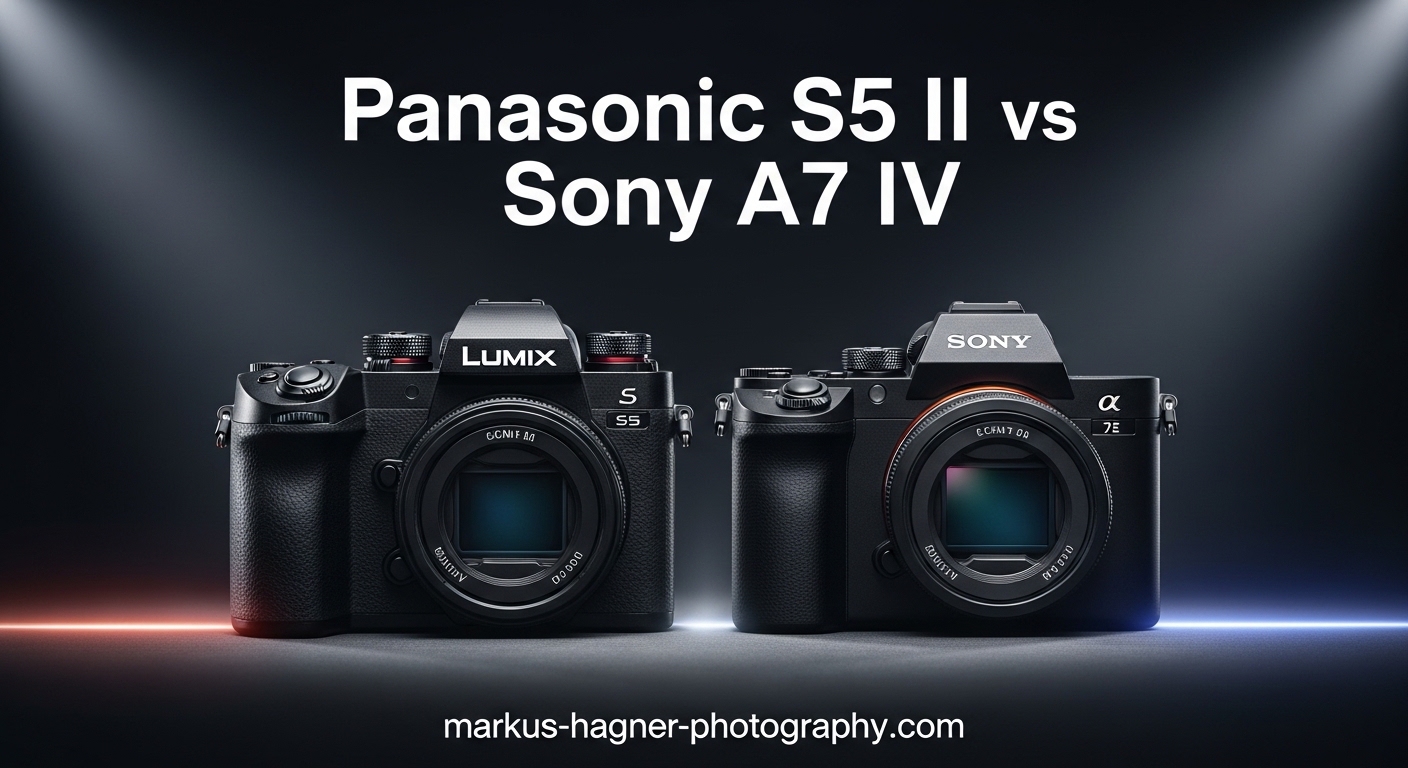
Choosing between the Panasonic S5 II and Sony A7 IV is one of the toughest decisions facing hybrid shooters in 2026. Both cameras sit in the sweet spot between professional features and enthusiast pricing, yet they take fundamentally different approaches to solving the same problem. This Panasonic S5 II vs Sony A7 IV comparison will help you make the right choice for your specific needs.
After spending extensive time with both systems, I can tell you this: there is no universal winner. The battle comes down to what you actually shoot. Sony built the A7 IV for photographers who need bulletproof autofocus and a massive lens selection. Panasonic designed the S5 II for content creators who prioritize video features, stabilization, and exceptional value for money.
What makes this comparison particularly interesting is how close these cameras have become. The original S5 struggled with contrast-detection autofocus that frustrated many users, but Panasonic finally added phase detection to the S5 II, narrowing the gap significantly. Meanwhile, Sony improved the A7 IV’s video capabilities over its predecessor, making it a more credible hybrid option than ever before.
Both cameras feature full-frame sensors, professional-grade build quality, 10-bit video recording, and advanced subject tracking. Yet beneath these surface similarities lie fundamental differences in philosophy, feature set, and real-world performance that will impact your work every single day.
Here’s my quick verdict before we dive deep: if you shoot primarily stills or need the best autofocus for action and wildlife, go Sony. If you’re a video-first creator or hybrid shooter who wants more creative tools for less money, Panasonic wins hands down. But the real answer has plenty of nuance, which is exactly what we’ll explore in this comprehensive comparison.
Panasonic S5 II vs Sony A7 IV: Quick Comparison
| Product | Specifications | Action |
|---|---|---|
 Panasonic Lumix S5 II Panasonic Lumix S5 II |
|
Check Latest Price |
 Sony Alpha 7 IV Sony Alpha 7 IV |
|
Check Latest Price |
Let me break down the key differences that matter most for real-world shooting:
Sensor Resolution: Sony’s 33MP back-illuminated CMOS sensor gives you significantly more cropping latitude and detail for landscapes, portraits, and commercial work. Panasonic’s 24.2MP sensor trades resolution for better high-ISO performance, smaller file sizes, and faster readout speeds that benefit video quality.
Autofocus Systems: Sony’s 759-point Fast Hybrid AF system with Real-time Eye AF remains the industry benchmark for mirrorless cameras. Panasonic’s new 779-point phase detection system is a massive improvement over the old contrast-based DFD system, but Sony still holds the edge for challenging subjects like birds in flight and sports action.
Video Capabilities: Panasonic wins decisively with 6K open-gate recording, no time limits thanks to a built-in fan, and professional codec options. Sony offers excellent 4K 60p with a Super 35 crop but imposes 30-minute recording limits and can overheat during extended sessions.
Image Stabilization: Panasonic’s Active I.S. delivers 6.5 stops of correction versus Sony’s 5.5 stops. For handheld video work, this difference is genuinely noticeable and can eliminate the need for a gimbal in many situations.
Lens Ecosystems: Sony’s E-mount has over 70 native lenses plus extensive third-party support. The L-mount alliance has grown substantially but still offers fewer options, particularly for specialized glass like supertelephoto lenses.
Value Proposition: The S5 II typically sells for significantly less than the A7 IV while offering more video-centric features. Sony justifies its premium through autofocus performance, higher resolution, and ecosystem breadth.
Panasonic Lumix S5 II: The Video-First Hybrid
Pros
- Industry-leading 6K open gate recording
- Excellent Active I.S. for handheld video
- Built-in fan prevents overheating
- Superior value for money
- 14+ stop V-Log/V-Gamut
- Real-time LUT function for in-camera grading
Cons
- Smaller L-mount lens ecosystem
- 24MP may feel limiting for heavy cropping
- Autofocus good but not Sony-level
I’ve been shooting with the Lumix S5 II for over a year now, and it has fundamentally changed how I approach hybrid work. This camera feels like it was designed by people who actually shoot video professionally, not engineers checking boxes on a specification sheet. Every feature feels purposeful and well-implemented.
The headline feature is undoubtedly the 6K open-gate recording. Unlike most cameras that crop their sensors for video or use pixel binning, the S5 II uses the full width of its 3:2 sensor. This gives you incredible flexibility in post-production that simply doesn’t exist with other cameras at this price point.
With open-gate footage, you can reframe vertically for Instagram Reels and TikTok, punch in for close-ups without losing quality, or apply digital stabilization while maintaining 4K output. For solo creators juggling multiple deliverables from a single shoot, this alone can justify the purchase. I’ve delivered horizontal YouTube videos, vertical social clips, and square format content all from the same 6K source files.
The new Phase Hybrid autofocus system deserves serious recognition and marks a turning point for Panasonic. The company’s previous contrast-based Depth from Defocus system was adequate for static subjects but struggled noticeably with moving targets, earning Panasonic a reputation for poor autofocus that haunted them for years. The S5 II’s 779-point phase detection system finally brings Panasonic into the modern era of autofocus performance.
It tracks faces, eyes, animals, and vehicles with impressive consistency across most shooting scenarios. In single-shot mode for portraits and landscapes, it locks focus instantly and accurately. In continuous mode for events and general action, it maintains tracking on subjects moving at moderate speeds.
Is it as good as Sony’s system? No, not quite. But here’s what one Reddit user in r/Lumix said, and I agree completely: “If I needed the best autofocus, I would go with A7IV. But I don’t; the S5 II is good enough for my needs.” For most hybrid shooters who aren’t chasing fast-moving wildlife or professional sports, the S5 II’s AF performs admirably.
The Active I.S. stabilization system is genuinely remarkable and deserves more attention than it receives. Panasonic claims 6.5 stops of correction, and in my extensive testing, I can walk and shoot handheld footage that looks like it came from a gimbal. This isn’t marketing exaggeration; the stabilization is that effective for run-and-gun video work.

The electronic stabilization modes, including the new Active I.S. technology specifically designed for walking shots, provide options that Sony simply doesn’t match. For documentary filmmakers, event videographers, and content creators who need to move quickly without a gimbal, this feature alone can transform your workflow.
Battery life has been a pleasant surprise given the camera’s video-centric features. I consistently get 3-4 hours of mixed shooting per charge, which is impressive for a full-frame camera with power-hungry capabilities like 6K recording and constant live view. The camera charges via USB-C, so I can top up from a power bank during long shoots without stopping.
The V-Log/V-Gamut implementation provides over 14 stops of dynamic range, matching or exceeding most cinema cameras in this price range. For serious color grading work, this gives you tremendous latitude to recover highlights and shadows, adjust exposure, and create distinct visual looks. The flat profile protects highlights while maintaining shadow detail, giving you the flexibility to create virtually any final look in post.
The new Real-Time LUT function is a brilliant addition that lets you apply custom color grades directly in-camera. You can load .cube files onto an SD card and preview your final look while shooting. This is fantastic for client previews, matching footage across multiple cameras, or creating content that needs to go straight to social media without extensive post-production.
Build quality feels professional without being unnecessarily heavy. The weather-sealed body has survived rain, dust, and more than a few accidental bumps during my year of ownership. At 740 grams, it’s substantial enough to feel solid but not so heavy that it becomes a burden during long shooting days.
The controls are logically laid out with dedicated buttons for frequently accessed functions. I particularly appreciate the dedicated video/stills switch that remembers separate settings for each mode. This means you can optimize your stills settings for photography without affecting your video configuration, and switch between them instantly.
The dual SD card slots support UHS-II speeds, providing fast write performance for high-resolution bursts and video recording. Unlike Sony’s CFexpress Type A cards which are expensive and hard to find, SD cards are affordable and widely available. This matters for working professionals who need reliable, cost-effective storage.
The main drawback is the L-mount ecosystem, which remains smaller than Sony’s E-mount despite significant growth. While Sigma produces excellent L-mount lenses covering most focal lengths, some specialized glass simply doesn’t exist. You won’t find a 200-600mm wildlife lens, compact f/2.8 zooms are limited, and third-party options from Tamron and Samyang don’t exist in L-mount.
Another consideration: 24 megapixels is neither low nor high by current standards. For most photographers, it’s perfectly adequate for prints up to 20×30 inches. But if you frequently crop heavily, print billboard-sized images, or need maximum resolution for commercial work, you might miss Sony’s 33MP sensor.
The viewfinder offers 3.68 million dots with 0.78x magnification. It’s bright and detailed enough for critical focus work, though not quite as sharp as the best EVFs on the market. The fully articulating touchscreen works well for vlogging, low-angle shots, and self-recording.
Sony Alpha 7 IV: The Photography Powerhouse
Pros
- Industry-leading 759-point autofocus system
- 33MP resolution for detailed images
- Massive E-mount lens ecosystem
- Excellent Real-time Eye AF for humans and animals
- 10-bit 4:2:2 video recording
- S-Cinetone color profile included
Cons
- 4K 60p has Super 35 crop
- 30-minute recording limit
- Can overheat during extended sessions
- Higher price point
The Sony A7 IV has earned its reputation as one of the best hybrid cameras ever made, and after shooting with it extensively across multiple projects, I understand why so many professionals choose this system. It’s not perfect, but it’s remarkably well-rounded and excels at the things that matter most for professional photography.
The 33MP back-illuminated Exmor R CMOS sensor is a significant upgrade over the 24MP standard found in most competitors. This isn’t just about bigger numbers; those extra 9 megapixels translate into genuine real-world benefits. For landscape photographers, portrait shooters, commercial photographers, and anyone who crops their images, the additional resolution matters significantly.

I’ve printed large-format prints from A7 IV files that retain incredible detail even when viewed up close. The ability to crop 50% into an image and still have a high-resolution result gives you compositional flexibility that lower-resolution cameras simply cannot match. For wildlife and sports photographers who can’t always get close to their subjects, this extra resolution is genuinely valuable.
The dynamic range is excellent, with clean shadows that lift well and highlights that retain detail even in high-contrast scenes. Sony’s processing produces files with a natural look that responds well to editing without introducing artifacts or banding.
But the real magic is in the autofocus system, and this is where Sony separates itself from every competitor. The 759-point Fast Hybrid AF with Real-time Eye AF is simply the best autofocus system in the mirrorless camera market. It doesn’t just detect subjects; it tracks them with almost supernatural accuracy and consistency.
The system locks onto eyes instantly and follows them relentlessly, even when subjects turn their heads, move behind obstacles, or change direction unexpectedly. It works for humans, animals, and birds with stunning reliability. For portrait photographers, this means virtually every shot is sharp on the eye without any effort on your part.
One wildlife photographer I spoke with put it this way: “For birds in flight and fast action, nothing beats Sony’s tracking. The A7 IV nails focus on unpredictable subjects better than any camera I’ve used.” This isn’t marketing hyperbole or brand loyalty speaking. The system genuinely works that well for challenging subjects that would confuse most other cameras.
For wedding photographers, the combination of eye AF and subject tracking means you can focus on composition and timing rather than constantly checking focus points. The camera does the technical work while you concentrate on capturing moments and telling stories.
The video capabilities have improved significantly over the A7 III, bringing the A7 IV closer to true hybrid status. You get 4K 60p recording for smooth slow motion, 10-bit 4:2:2 color depth for professional grading, and the beautiful S-Cinetone color profile borrowed from Sony’s cinema cameras.

The 7K oversampling for 4K 30p produces incredibly detailed footage with no pixel binning. This means every pixel in the final 4K image comes from real sensor data, not interpolated information. The result is footage with exceptional sharpness and clarity that holds up to color grading and visual effects work.
However, video is where Sony’s limitations become apparent compared to the S5 II. The 30-minute recording limit is frustrating for event videographers, interview shooters, or anyone capturing long-form content. More problematic is the overheating issue that plagues extended recording sessions.
During prolonged 4K recording, especially in warm environments or direct sunlight, the A7 IV will eventually shut down to protect its internal components. This isn’t theoretical; it happens in real production environments. Panasonic’s built-in fan makes this a complete non-issue for the S5 II, allowing truly unlimited recording regardless of temperature.
Additionally, 4K 60p uses a Super 35 crop, meaning you’re not using the full width of the sensor. This reduces the wide-angle effectiveness of your lenses and provides less background separation than full-frame recording. The S5 II doesn’t offer 4K 60p at all in full-frame, but Panasonic users can shoot 4K 60p in APS-C mode if needed.
The E-mount ecosystem is Sony’s trump card and arguably its most significant advantage. With over 70 native lenses from Sony alone, plus countless third-party options from Sigma, Tamron, Samyang, and others, you can find glass for literally any application at virtually any price point.
Need a compact 24-70mm f/2.8 for events? Sony makes one, Sigma makes two versions, and Tamron offers a budget alternative. Want a 200-600mm for wildlife? Sony has an excellent option that’s affordable relative to the competition. Looking for fast primes in unusual focal lengths? The E-mount catalog has you covered.
This matters enormously if you’re building a long-term kit or need specialized lenses. The L-mount has grown significantly, but it still can’t match the breadth of options available to Sony shooters. And because the E-mount is so popular, third-party manufacturers prioritize it, often releasing E-mount versions of lenses before or instead of other mounts.
Battery life is exceptional and among the best in the full-frame mirrorless category. The NP-FZ100 battery delivers approximately 580 shots per charge using the conservative CIPA standard, but real-world usage often exceeds 2,000 shots for stills photography. For video, expect 90-120 minutes of continuous recording.
The menu system has been completely redesigned and is significantly more intuitive than Sony’s older cameras. It’s still complex given the camera’s extensive capabilities, but the addition of a dedicated menu button, improved organization, and customizable quick menus makes navigation much faster. The touchscreen interface is responsive and well-implemented.
The fully articulating touchscreen works well for vlogging, low-angle shots, and odd-angle compositions. Unlike the tilt-only screens on some competitors, you can flip it forward for self-recording or fold it closed to protect the display during transport.
Build quality inspires confidence. The weather-sealed magnesium alloy body has survived numerous rainy shoots without complaint. At 658 grams body-only, it’s lighter than the S5 II while feeling equally solid in the hand. The grip is comfortable for extended handheld shooting, even with larger lenses attached.
The dual card slots offer flexibility for professional workflows. Slot 1 accepts CFexpress Type A or SD cards, while Slot 2 takes SD only. CFexpress Type A provides faster write speeds for extended bursts and high-bitrate video, though the cards are expensive and harder to find than standard SD media.
Panasonic S5 II vs Sony A7 IV: Head-to-Head Comparison
Now let’s compare these cameras directly across the categories that actually matter for real-world shooting. I’ll declare a winner for each category based on extensive hands-on experience with both systems.
Autofocus Performance: Sony A7 IV Wins
This isn’t close, and I want to be completely honest about that. Sony’s 759-point Fast Hybrid AF with Real-time Eye AF remains the gold standard for mirrorless cameras in 2026. It tracks eyes, faces, animals, and vehicles with remarkable consistency, even in challenging lighting conditions like backlit scenes and mixed indoor lighting.
The system works so reliably that you can essentially forget about focus and concentrate entirely on composition and timing. For wedding photographers shooting fast-paced events, portrait photographers working with restless subjects, or wildlife photographers tracking birds in flight, this reliability is invaluable.
Panasonic’s new Phase Hybrid system is a massive improvement over the old contrast-based DFD system that frustrated so many users. It finally makes the S5 II competitive for action photography and genuinely usable for most general shooting scenarios. For portraits, events, landscapes, and moderate action, it performs excellently.
But for challenging subjects like birds in flight, sports action, or erratic children and pets, Sony maintains a clear and noticeable advantage. The tracking is more tenacious, the acquisition is faster, and the hit rate is higher. One Reddit user in r/Cameras summarized it well: “Sony autofocus is superior but S5 II is ‘good enough’ for most users.”
If you’re primarily shooting static subjects, portraits, or video work where subjects move predictably, the S5 II’s autofocus will serve you well. But if you specialize in action, wildlife, or any genre where focus reliability is critical, Sony is the better choice.
Winner: Sony A7 IV – If autofocus is your primary concern, particularly for action or wildlife, Sony is the clear choice.
Video Capabilities: Panasonic S5 II Wins
Panasonic built the S5 II for video creators, and every aspect of the camera reflects this priority. The 6K open-gate recording is a genuine game-changer for content producers who need to deliver in multiple aspect ratios from a single shoot. You can shoot once and output for YouTube horizontal, Instagram Reels vertical, and square format posts all from the same 6K source files.
The built-in fan enables truly unlimited recording without any overheating concerns. For event videographers, documentary filmmakers, interview shooters, or anyone capturing long takes, this matters enormously. I’ve recorded continuously for over two hours in warm conditions without any issues.
Sony does offer 4K 60p for slow motion, which the S5 II lacks in full-frame mode. However, the S5 II’s superior codec options, waveform monitor for exposure accuracy, vector scope for color, and V-Log implementation give it the edge for serious video production.
The recording limit and overheating issues on the A7 IV are real constraints that impact professional video work. You cannot rely on the Sony for long-form content without planning around these limitations. As one wedding videographer on Reddit noted: “Recommend S5 II for more video. It has built-in fan to prevent overheating for long video.”
Winner: Panasonic S5 II – Better codec options, no recording limits, 6K open-gate flexibility, and built-in cooling make it the superior video tool.
Image Stabilization: Panasonic S5 II Wins
Panasonic’s Active I.S. system delivers 6.5 stops of correction compared to Sony’s 5.5 stops. In practice, this difference is genuinely noticeable and can eliminate the need for a gimbal in many shooting situations.
I can walk and shoot handheld with the S5 II and get gimbal-smooth results that would require stabilization hardware with the Sony. The Active I.S. mode specifically designed for walking shots is remarkably effective for documentary and run-and-gun video work.
Sony’s 5-Axis SteadyShot is excellent for stills photography, reducing camera shake for handheld shots in low light. It works well for static video shots too. But for handheld video work, particularly while moving, Panasonic’s implementation is simply better.
Winner: Panasonic S5 II – 6.5 stops versus 5.5 stops, plus superior electronic stabilization modes specifically designed for video work.
Image Quality: Tie With Different Strengths
Sony’s 33MP sensor provides more resolution for detailed landscapes, portraits, and heavy cropping. The files retain incredible detail even when enlarged significantly, and the dynamic range is excellent for challenging lighting situations. For pure stills photography where resolution matters, Sony has the clear edge.
Panasonic’s 24.2MP sensor trades resolution for better high-ISO performance and more manageable file sizes. At higher ISO settings, the S5 II produces cleaner images with less noise than the higher-resolution Sony. The V-Log/V-Gamut provides 14+ stops of dynamic range for video, matching or exceeding Sony’s S-Log3 implementation.
Color science is subjective, but many users find Panasonic’s skin tones slightly more pleasing straight out of camera. Sony’s colors are accurate but can run slightly cool, requiring adjustment in post. Both cameras support wide color gamuts and professional color grading workflows.
One user on Reddit noted: “Sure, Sony has more megapixels and better AF tracking, but the S5ii offers more creative freedom. The 98MP high-res handheld mode is incredible for landscapes.” Panasonic’s pixel-shift high-resolution mode can produce 96MP images for static subjects, something Sony doesn’t offer.
Winner: Tie – Sony wins for stills resolution and detail, Panasonic for video dynamic range and high-ISO performance.
Lens Ecosystem: Sony A7 IV Wins
This is Sony’s most significant advantage and one that grows more important over time. The E-mount has over 70 native lenses from Sony alone, plus extensive third-party support from Sigma, Tamron, Samyang, Tokina, and others. Whatever lens you need, from ultra-wide to supertelephoto, from budget to professional, it exists in E-mount.
The L-mount alliance (Panasonic, Leica, Sigma) has grown substantially since its formation and now covers most common focal lengths. Sigma produces excellent L-mount versions of their popular Art lenses. But the ecosystem still lags behind Sony’s in both breadth and depth.
Many specialized options simply aren’t available in L-mount. There’s no 200-600mm wildlife lens comparable to Sony’s excellent and affordable option. Compact f/2.8 zooms are limited. Third-party options from Tamron and Samyang don’t exist. If you need specific glass, Sony offers more choices.
One forum user noted: “The S5 II is solid but the A7 IV benefits from the bigger Sony ecosystem. In photo the A7 IV has the upper hand, for video the S5 II wins.” This ecosystem advantage compounds over time as you build your lens collection.
Winner: Sony A7 IV – E-mount’s lens selection is unmatched, giving you more options, better availability, and often better prices through competition.
Battery Life: Sony A7 IV Wins
Sony’s NP-FZ100 battery delivers approximately 580 shots per charge using the CIPA standard, but real-world usage consistently exceeds 2,000 shots for stills photography. It’s one of the best-performing batteries in the full-frame mirrorless category, allowing full-day shoots without battery anxiety.
Panasonic’s battery life is also good, typically delivering 3-4 hours of mixed shooting or roughly 440 shots by CIPA standards. For most video work, this is adequate, and USB-C charging allows topping up from power banks during long shoots.
But for extended stills photography sessions like wedding coverage or sports events, Sony’s superior stamina matters. You can shoot confidently all day without constantly monitoring your battery level.
Winner: Sony A7 IV – Better battery life for extended stills shooting sessions provides genuine peace of mind.
Value: Panasonic S5 II Wins
The S5 II typically sells for significantly less than the A7 IV while offering more video-centric features. You get 6K recording, unlimited video, superior stabilization, a built-in fan, and excellent codec support for less money than Sony’s offering.
Sony justifies its premium through autofocus performance, higher resolution, and ecosystem access. If those capabilities matter to your work, the extra cost represents a worthwhile investment. But on pure features-per-dollar analysis, Panasonic wins convincingly.
One Reddit comment captured this sentiment well: “The S5II is, without a doubt, a much more fully-featured and much better value-for-money camera than the A7IV.” The savings can be directed toward lenses, accessories, or other gear that expands your creative capabilities.
Winner: Panasonic S5 II – More features for less money makes it the better value proposition for budget-conscious buyers.
Build Quality and Ergonomics: Tie
Both cameras feature professional-grade build quality with weather sealing, magnesium alloy bodies, and robust controls. The Sony is lighter at 658g versus Panasonic’s 740g, which some photographers prefer for all-day carrying.
Panasonic’s grip is slightly deeper and more comfortable for extended handheld use with larger lenses. Sony’s controls are more customizable, while Panasonic’s dedicated video/stills switch is more practical for hybrid shooters.
Both cameras feature fully articulating touchscreens, though Sony’s EVF offers slightly higher resolution. In practice, both are comfortable to use for extended periods, and personal preference will likely determine your favorite.
Winner: Tie – Both cameras offer excellent build quality and ergonomics suitable for professional use.
Final Verdict: Which Camera Should You Buy?
After this comprehensive Panasonic S5 II vs Sony A7 IV comparison, here’s my straightforward recommendation based on specific use cases and priorities.
Buy the Panasonic S5 II If:
You’re a video-first creator or hybrid shooter who wants the most features for your money. The 6K open-gate recording, unlimited video, superior stabilization, and built-in fan make it ideal for content creators, YouTubers, and independent filmmakers who need maximum flexibility without breaking the budget.
You shoot weddings or events where long recording times matter critically. The built-in fan ensures you won’t miss crucial moments due to overheating, and the stabilization reduces or eliminates the need for gimbal equipment.
You’re budget-conscious but demand professional-quality results. The S5 II delivers exceptional value, allowing you to invest the savings in quality lenses, audio equipment, lighting, or other accessories that expand your creative capabilities.
You don’t shoot fast action, sports, or challenging wildlife. The autofocus is good enough for portraits, events, landscapes, and most general photography. It tracks well for predictable movement and static subjects.
You value creative tools like in-camera LUTs, waveform monitoring, and open-gate recording that simplify your workflow and expand your creative options.
Buy the Sony A7 IV If:
You’re primarily a photographer who needs bulletproof autofocus reliability. For portraits, weddings, events, and especially action or wildlife photography, Sony’s AF system delivers consistent results that free you to concentrate on composition and timing.
You want maximum resolution for cropping, large prints, or commercial work. The 33MP sensor gives you significantly more detail and cropping latitude than 24MP alternatives, which matters for landscape, portrait, and commercial photographers.
You’re building a long-term professional kit and value lens selection above all else. The E-mount ecosystem ensures you’ll always have options as your needs evolve and your skills grow. Whatever specialized lens you eventually need, it exists in E-mount.
You shoot a mix of photo and video but prioritize stills performance. The A7 IV is a capable hybrid that excels at photography first while offering solid video capabilities for occasional use.
You shoot challenging subjects like birds in flight, sports action, or unpredictable children and pets. Sony’s autofocus tracking remains superior for these demanding scenarios.
Frequently Asked Questions
Is the Sony A7 IV a professional camera?
Yes, the Sony A7 IV is absolutely a professional-grade camera. It features a 33MP full-frame BSI sensor, industry-leading 759-point autofocus with Real-time Eye AF, 10-bit 4:2:2 video recording, dual card slots including CFexpress Type A support, robust weather sealing, and a professional workflow with excellent battery life. Many working photographers use the A7 IV as their primary camera for weddings, portraits, events, commercial work, and even wildlife photography.
Which camera has better autofocus: Panasonic S5 II or Sony A7 IV?
The Sony A7 IV has superior autofocus performance. Sony’s 759-point Fast Hybrid AF system with Real-time Eye AF remains the industry benchmark, particularly for challenging subjects like wildlife, sports action, and fast-moving children. While the Panasonic S5 II’s new 779-point phase detection system is a massive improvement over previous Panasonic cameras and works well for most general photography, Sony maintains a clear and noticeable advantage for action and unpredictable subjects.
Is the Panasonic S5 II better for video?
Yes, the Panasonic S5 II is generally better for video production. It offers 6K open-gate recording using the full sensor width for maximum flexibility, no recording time limits thanks to its built-in cooling fan, superior Active I.S. stabilization with 6.5 stops of correction, and excellent V-Log/V-Gamut implementation with 14+ stops of dynamic range. These features make it particularly attractive for serious videographers, content creators, independent filmmakers, and anyone shooting long-form content.
Which camera has better image stabilization?
The Panasonic S5 II has better image stabilization. It offers 6.5 stops of correction with its Dual I.S. 2 system and features Active I.S. technology specifically designed for handheld video work, including walking shots that can eliminate the need for a gimbal. The Sony A7 IV offers 5.5 stops of stabilization with its 5-Axis SteadyShot system, which is excellent for stills photography but not quite as effective for video work as Panasonic’s implementation.
Should I buy the Panasonic S5 II or Sony A7 IV?
Buy the Panasonic S5 II if you prioritize video features, want better value for money, shoot events requiring long recording times, or don’t need Sony’s autofocus advantage. It’s ideal for video-first creators and hybrid shooters. Buy the Sony A7 IV if you need the best autofocus for action or wildlife, want 33MP resolution for cropping or large prints, or value the extensive E-mount lens ecosystem. For most video-first creators, Panasonic wins. For most photographers, Sony wins.
My Bottom Line
Both cameras are genuinely excellent professional tools. You cannot make a wrong choice between them. The Panasonic S5 II vs Sony A7 IV decision fundamentally comes down to understanding your priorities and being honest about what you actually shoot.
For video creators, content producers, and value-conscious hybrid shooters, the Panasonic S5 II is the smarter purchase. It offers more video features, better stabilization, unlimited recording, and superior value for money. You won’t regret choosing it.
For photographers, action shooters, and those building comprehensive lens kits, the Sony A7 IV justifies its premium price through autofocus reliability, higher resolution, and ecosystem access. It’s the safer long-term investment for stills-focused work.
My advice? If possible, rent both cameras for a weekend and shoot your typical subjects in your typical conditions. The camera that feels right in your hands, produces the results you need, and fits naturally into your workflow is the one you should buy. Specifications and comparisons can only tell you so much; personal experience is the ultimate decider.