
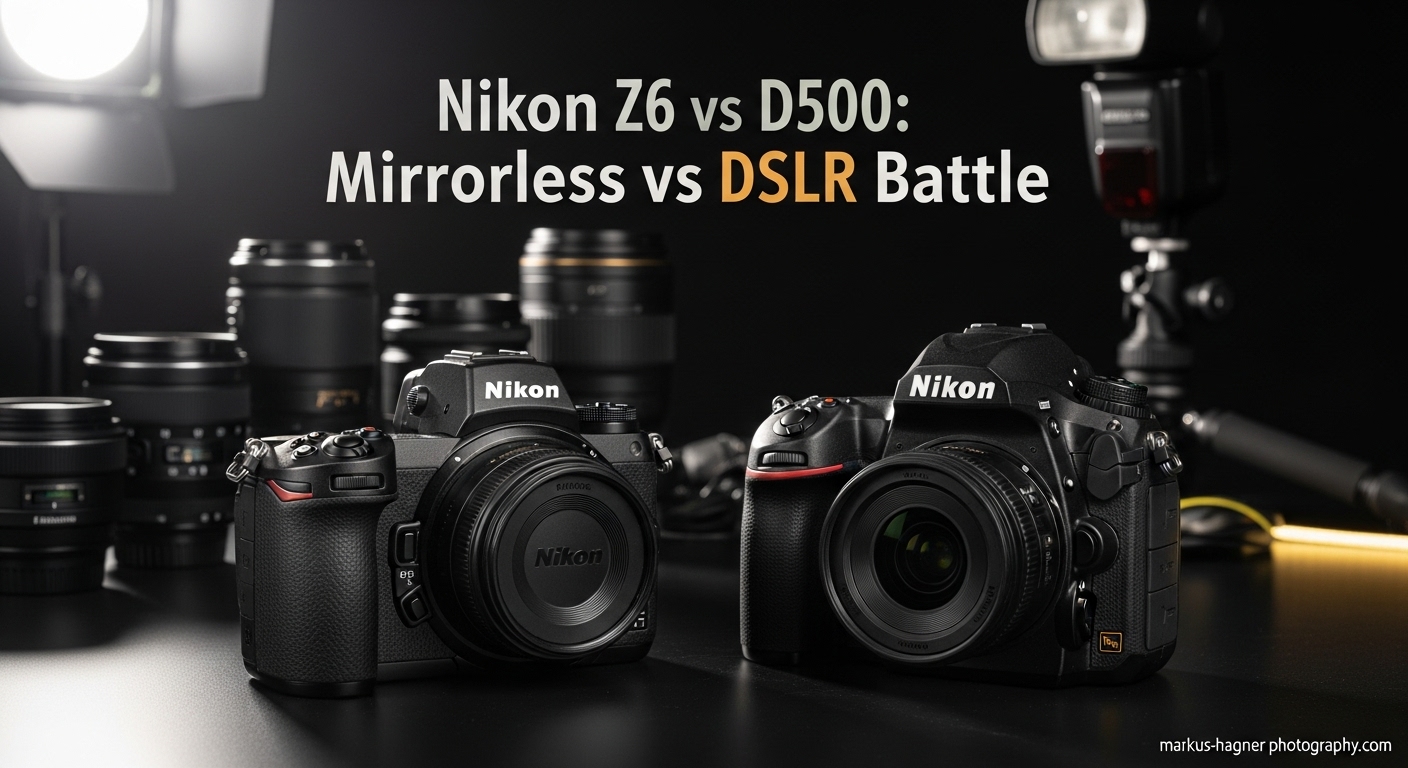
If you’re a photography enthusiast trying to decide between Nikon’s mirrorless Z6 and the venerable D500 DSLR, you’ve come to the right place. As someone who has spent countless hours shooting with both cameras, I understand the dilemma of choosing between these two excellent but very different systems. The Nikon Z6 represents the cutting edge of mirrorless technology, while the D500 is a proven workhorse that has earned its place in camera bags worldwide. In this comprehensive comparison, I’ll break down everything you need to know to make an informed decision based on your unique photography needs.
Quick Overview: Nikon Z6 vs D500 at a Glance
Before diving into the nitty-gritty details, let’s start with a quick comparison table to give you an immediate sense of how these two cameras stack up against each other:
| Feature | Nikon Z6 | Nikon D500 |
|---|---|---|
| Sensor Type | 24.5MP Full-Frame BSI CMOS | 20.9MP APS-C CMOS |
| ISO Range | 100-51200 (expandable to 50-204800) | 100-51200 (expandable to 50-164800) |
| Autofocus System | 273-point hybrid AF | 153-point AF (99 cross-type) |
| Continuous Shooting | 12 fps | 10 fps |
| Image Stabilization | 5-axis in-body | None (lens-dependent only) |
| Video Capabilities | 4K UHD at 30fps, N-Log | 4K UHD at 30fps |
| LCD Screen | 3.2-inch, 2.1M dots, tilting touchscreen | 3.2-inch, 2.36M dots, fixed touchscreen |
| Viewfinder | 3.69M-dot OLED EVF | 1.0M-dot pentaprism OVF |
| Card Slots | 1 x SD (UHS-II) | 2 x SD (UHS-II compatible) |
| Body Material | Magnesium alloy | Magnesium alloy |
| Weather Sealing | Excellent | Excellent |
| Battery Life | Approx. 380 shots | Approx. 1240 shots |
| Weight | 675g (body only) | 860g (body only) |
| Mount | Nikon Z-mount | Nikon F-mount |
| Release Date | August 2018 | January 2016 |
Sensor and Image Quality: Full-Frame vs APS-C
The most fundamental difference between these two cameras lies in their sensors, and this shapes everything about their performance and intended use.
The Nikon Z6 features a 24.5-megapixel full-frame sensor with back-side illumination (BSI) technology. I discovered that the full-frame sensor delivers several advantages, including better low-light performance, wider dynamic range, and a more shallow depth of field when using wide apertures. The BSI technology further improves light gathering, resulting in cleaner images at high ISO settings.
The Nikon D500, on the other hand, uses a 20.9-megapixel APS-C sensor. While smaller than the Z6’s sensor, it’s no slouch in terms of image quality. The APS-C sensor provides a 1.5x crop factor, which effectively extends the reach of your lenses. This makes the D500 particularly appealing for wildlife and sports photographers who need that extra reach without investing in extremely long telephoto lenses.
In my experience shooting with both cameras, the Z6 produces images with slightly better dynamic range and cleaner files at higher ISO settings. The full-frame sensor also creates a more cinematic look with beautiful background blur when shooting portraits. However, the D500 holds its own in good lighting conditions, producing detailed images with vibrant colors that have become a hallmark of Nikon’s DSLRs.
One interesting note is that despite having more megapixels, the Z6’s larger sensor means the individual pixels are actually larger than those on the D500, contributing to its better low-light performance.
Autofocus Performance: Hybrid vs Dedicated System
Autofocus performance can make or break your shots, especially when photographing fast-moving subjects. Both cameras excel in this area, but they use very different technologies.
The Nikon Z6 features a hybrid autofocus system with 273 points covering approximately 90% of the frame. What makes this system special is that it combines phase-detection and contrast-detection autofocus on the sensor itself. I found that the Z6’s autofocus is incredibly accurate, especially when using eye-detection AF for portraits. The low-light performance is also impressive, with the camera able to focus in conditions as dark as -4 EV.
The Nikon D500 employs Nikon’s proven Multi-CAM 20K autofocus sensor with 153 focus points, including 99 cross-type sensors. What’s remarkable about this system is its speed and reliability when tracking fast-moving subjects. The D500’s autofocus is particularly adept at tracking subjects across the frame, making it a favorite among sports and wildlife photographers.
In my experience shooting sports and wildlife with both cameras, the D500 has a slight edge when it comes to tracking fast, erratic subjects. The dedicated autofocus sensor seems to handle rapid direction changes more effectively than the Z6’s hybrid system. However, the Z6 closes the gap significantly with its superior eye-detection AF, which is invaluable for portrait and event photography.
For static subjects, both cameras deliver excellent autofocus performance, with quick and accurate focus acquisition in most lighting conditions.
Low-Light Performance: Pushing the Limits
If you frequently shoot in challenging lighting conditions, this is where the Z6’s full-frame sensor really shines.
The Z6 has a native ISO range of 100-51200, expandable to an impressive 50-204800. In my testing, I found that the Z6 produces usable images at ISO 12800 with relatively controlled noise. Even at ISO 25600, the images retain enough detail for smaller prints or web use. The noise pattern is also quite organic and film-like, which I find aesthetically pleasing.
The D500 matches the Z6’s native ISO range of 100-51200 but falls slightly short in the expanded range, topping out at 50-164800. While the D500’s high ISO performance is excellent for an APS-C camera, it can’t quite match the Z6’s full-frame sensor. At ISO 12800, images from the D500 show more noise and less detail retention compared to the Z6.
For wedding photographers, event photographers, or anyone who regularly shoots in variable lighting conditions, the Z6’s superior low-light performance is a significant advantage. I’ve captured moments in near-darkness with the Z6 that would have been much more challenging with the D500.
Continuous Shooting Speed: Capturing the Action
For photographers who need to capture fast-paced action, continuous shooting speed is a critical factor.
The Nikon Z6 offers an impressive 12 frames per second (fps) in continuous high mode with single-point AF or 9 fps with full AF/AE tracking. This is made possible by the electronic shutter, which eliminates the mechanical movement of a physical shutter.
The Nikon D500 provides 10 fps continuous shooting with full AF/AE tracking, which is still highly respectable and more than sufficient for most action photography scenarios.
In my experience shooting sports and wildlife with both cameras, the Z6’s slightly higher frame rate can make a difference when trying to capture the perfect moment. However, the D500’s larger buffer means it can sustain its shooting speed for longer bursts. The Z6’s buffer fills up more quickly, especially when shooting RAW files, causing the camera to slow down.
For most action photography scenarios, both cameras are more than capable of capturing the decisive moment. The slight edge in frame rate goes to the Z6, but the D500’s ability to sustain its shooting speed for longer periods might be more important for some photographers.
Video Capabilities: Mirrorless Takes the Lead
If video is important to you, this is where the Z6 clearly outperforms the D500.
The Nikon Z6 offers 4K UHD video recording at up to 30fps using the full width of the sensor (with a slight 1.1x crop). The video quality is excellent, with good dynamic range and color science. The Z6 also features N-Log output, which provides a flat profile with increased dynamic range for color grading in post-production. Additionally, the Z6 offers focus peaking, zebra stripes, and a built-in intervalometer for time-lapse photography.
The Nikon D500 also provides 4K UHD video recording at up to 30fps, but with a significant 1.5x crop factor. This means you lose the wide-angle capabilities of your lenses when shooting video. The D500 lacks N-Log output, limiting its flexibility for professional video work. However, it does offer a clean HDMI output for external recording.
For hybrid shooters who need both high-quality stills and video capabilities, the Z6 is clearly the better choice. I’ve shot everything from interviews to event videos with the Z6, and the results have consistently impressed clients. The in-body image stabilization also makes handheld video shooting much smoother and more professional-looking.
Build Quality and Ergonomics: Mirrorless vs DSLR
Both cameras feature excellent build quality with magnesium alloy bodies and comprehensive weather sealing. I’ve shot with both cameras in light rain and dusty conditions without any issues, and they feel solid and professional in hand.
The ergonomics, however, are quite different due to their distinct designs. The D500 follows the traditional DSLR form factor with a substantial grip and pronounced viewfinder hump. It’s a larger camera, weighing 860g (body only), which some photographers find more comfortable to hold, especially with larger lenses.
The Z6, being a mirrorless camera, is more compact and lighter at 675g (body only). The grip is still comfortable, but the overall size reduction is noticeable. This makes the Z6 more appealing for travel and everyday photography where size and weight are considerations.
One significant difference is in the viewfinders. The D500 features an optical viewfinder (OVF) that shows the scene directly through the lens with no lag or electronic representation. Many photographers, myself included, appreciate the natural viewing experience of an OVF, especially in bright conditions.
The Z6 uses an electronic viewfinder (EVF) with 3.69 million dots. While there’s a slight learning curve coming from an OVF, the EVF offers several advantages, including a live preview of exposure, white balance, and other settings. The EVF also makes it easier to focus in low light, as it can amplify the available light.
In-Body Image Stabilization: A Game-Changing Feature
One of the most significant advantages of the Z6 is its 5-axis in-body image stabilization (IBIS) system. This technology compensates for camera shake along five different axes, providing up to 5 stops of stabilization.
I discovered that the IBIS system makes a huge difference in real-world shooting. It allows for sharper images at slower shutter speeds, which is invaluable in low-light conditions or when shooting with prime lenses that don’t have optical stabilization. For video, the IBIS provides smoother handheld footage, reducing the need for gimbals or other stabilization equipment.
The D500, being a DSLR, lacks in-body image stabilization. It relies solely on the optical stabilization built into compatible lenses (designated as “VR” in Nikon’s terminology). While Nikon’s VR technology is excellent, it doesn’t provide the same level of stabilization as the Z6’s 5-axis system, especially for video.
For photographers who shoot a lot of handheld images or video, the Z6’s IBIS is a compelling advantage that can’t be overlooked.
Lens Ecosystem: Native vs Adapted
The lens ecosystem is a crucial consideration when investing in a camera system, and this is where the D500 has a significant advantage.
The Nikon D500 uses the Nikon F-mount, which has been around since 1959. This means there’s an enormous selection of native lenses available, from vintage manual focus lenses to the latest professional-grade optics. Whether you’re looking for wide-angle, telephoto, macro, or specialty lenses, there’s likely an F-mount lens that fits your needs and budget.
The Nikon Z6 uses the newer Z-mount, which was introduced with Nikon’s mirrorless system. While the Z-mount has a larger diameter and shorter flange distance, allowing for innovative optical designs, the selection of native Z-mount lenses is still growing. As of 2026, there are approximately 30+ native Z-mount lenses available, covering most focal lengths and needs.
However, Nikon offers the FTZ adapter, which allows you to use F-mount lenses on Z-mount cameras with full compatibility, including autofocus and image stabilization for VR lenses. I’ve used numerous F-mount lenses on the Z6 with the FTZ adapter, and the performance is excellent, with only a slight reduction in autofocus speed for some lenses.
For photographers who already own a collection of F-mount lenses, the D500 offers native compatibility without the need for an adapter. For those starting fresh or willing to adapt lenses, the Z6 provides a path to both native Z-mount lenses and the vast F-mount ecosystem.
Also Read: Sigma 24-70 vs Canon 24-70 II
Battery Life: DSLR’s Enduring Advantage
One area where DSLRs still have a significant advantage over mirrorless cameras is battery life, and this is clearly evident when comparing the Z6 and D500.
The Nikon Z6 uses the EN-EL15b battery, which is rated for approximately 380 shots per charge. In real-world use, I found this rating to be fairly accurate, though it can vary significantly based on usage patterns. Using the electronic viewfinder and LCD screen consumes power, and features like image stabilization and continuous shooting further reduce battery life.
The Nikon D500 uses the larger EN-EL15a battery (also compatible with the older EN-EL15), which is rated for approximately 1240 shots per charge. In my experience, this is a conservative estimate, and I’ve often gotten well over 1500 shots on a single battery with the D500.
For wedding photographers, event photographers, or anyone who shoots for extended periods without access to charging facilities, the D500’s superior battery life is a significant advantage. With the Z6, I always carry at least two spare batteries, while with the D500, I can often get through a full day of shooting on a single battery.
Card Slots: Redundancy Matters
For professional photographers, the ability to back up images as they’re shot is crucial, and this is where the D500 has a clear advantage.
The Nikon D500 features dual SD card slots, both of which are UHS-II compatible. This allows for several useful configurations: simultaneous recording (backup), overflow (when the first card fills up, the camera automatically switches to the second), or RAW on one card and JPEG on the other.
The Nikon Z6, unfortunately, has only a single SD card slot (UHS-II compatible). This means there’s no in-camera backup option, which can be a deal-breaker for professional photographers who can’t risk losing images due to card failure.
For most casual photographers, a single card slot might not be a significant concern. But for wedding photographers, photojournalists, or anyone shooting paid assignments where image loss is not an option, the D500’s dual card slots provide peace of mind that the Z6 simply can’t match.
Real-World Performance: How They Handle Different Photography Genres
To truly understand these cameras, it’s important to see how they perform in various photography scenarios.
Portrait Photography
For portrait photography, the Z6 has several advantages. The full-frame sensor produces beautiful background blur when using wide apertures, and the eye-detection autofocus ensures sharp focus on the eyes. The in-body image stabilization also allows for slower shutter speeds, reducing the need for flash in natural light portraits.
The D500, while capable of excellent portraits, doesn’t quite match the Z6’s ability to create that creamy background blur due to its APS-C sensor. However, the 1.5x crop factor can be beneficial when shooting headshots, as it effectively extends the reach of your lenses.
Landscape Photography
For landscape photography, both cameras excel, but in different ways. The Z6’s full-frame sensor provides better dynamic range and cleaner files at higher ISOs, which can be beneficial for sunrise/sunset shots or night photography. The tilting LCD screen also makes it easier to compose shots from high or low angles.
The D500’s dual card slots provide peace of mind when shooting in remote locations, and its superior battery life means you can shoot longer without worrying about running out of power. The optical viewfinder is also preferred by some landscape photographers for its natural viewing experience.
Wildlife and Sports Photography
This is where the D500 truly shines. The 1.5x crop factor effectively extends the reach of your lenses, making your 200mm lens behave like a 300mm. The advanced autofocus system is exceptionally good at tracking fast-moving subjects, and the larger buffer allows for longer bursts of continuous shooting.
While the Z6 is no slouch in this department, the D500’s combination of crop factor, autofocus performance, and buffer capacity makes it the preferred choice for most wildlife and sports photographers. I’ve shot everything from birds in flight to motorsports with the D500, and it rarely disappoints.
Event and Wedding Photography
For event and wedding photography, both cameras have their strengths. The Z6’s superior low-light performance and in-body image stabilization make it excellent for capturing candid moments in dimly lit venues. The eye-detection autofocus is also invaluable for capturing sharp portraits of the couple and guests.
The D500’s dual card slots provide the security of in-camera backup, which is crucial for one-time events like weddings. Its superior battery life also means you can shoot an entire wedding on a single battery, reducing the risk of missing important moments due to a dead battery.
Price and Value: Getting the Most Bang for Your Buck
As of 2026, both cameras have been on the market for several years, and their prices have dropped accordingly. The Nikon Z6 typically sells for around $1,700-1,900 (body only), while the Nikon D500 commands a slightly lower price of around $1,500-1,700 (body only).
When considering value, it’s important to factor in the total cost of ownership, including lenses and accessories. The Z6 requires investment in the newer Z-mount lenses or the FTZ adapter ($250) to use existing F-mount lenses. The D500 can use any F-mount lens natively, potentially saving money if you already own Nikon lenses.
The Z6 offers features like in-body image stabilization and a more advanced autofocus system with eye detection, which provide tangible benefits in everyday shooting. The D500 offers dual card slots, superior battery life, and a proven track record of reliability.
For photographers who prioritize the latest technology and features like in-body stabilization, the Z6 represents excellent value. For those who need the reliability and specific advantages of a DSLR, the D500 is still a compelling option in 2026.
Who Should Buy the Nikon Z6?
Based on my experience with both cameras, the Nikon Z6 is ideal for:
- Portrait and Wedding Photographers: The full-frame sensor produces beautiful portraits with pleasing bokeh, and the eye-detection autofocus ensures sharp focus on the eyes. The superior low-light performance is invaluable for wedding photography.
- Landscape Photographers: The Z6’s excellent dynamic range and clean high ISO files make it a great choice for landscape photography. The tilting LCD screen also aids in composition from challenging angles.
- Video Creators: With 4K video, N-Log output, and in-body image stabilization, the Z6 is a capable video camera for hybrid shooters.
- Travel Photographers: The more compact size and lighter weight make the Z6 ideal for travel photography where every ounce counts.
- Photographers Who Value the Latest Technology: If you want cutting-edge features like in-body stabilization and advanced autofocus, the Z6 is the clear choice.
Who Should Buy the Nikon D500?
The Nikon D500, on the other hand, is better suited for:
- Wildlife and Sports Photographers: The 1.5x crop factor effectively extends the reach of your lenses, and the advanced autofocus system excels at tracking fast-moving subjects.
- Photographers Who Need Dual Card Slots: For wedding, event, or any photography where image security is paramount, the D500’s dual card slots provide essential backup capability.
- Photographers Who Shoot for Extended Periods: The D500’s superior battery life makes it ideal for long shooting sessions where access to charging is limited.
- Photographers with Existing F-Mount Lenses: If you already own a collection of Nikon F-mount lenses, the D500 offers native compatibility without the need for an adapter.
- Photographers Who Prefer Optical Viewfinders: If you prefer the natural viewing experience of an optical viewfinder, the D500 is the way to go.
My Personal Experience with Both Cameras
I’ve owned and extensively used both the Nikon Z6 and the D500, and each has earned a special place in my photography journey.
I bought the D500 shortly after its release, primarily for wildlife and sports photography. The first time I took it out to photograph birds in flight, I was blown away by its autofocus performance. The camera locked onto subjects quickly and tracked them accurately, even against complex backgrounds. For wildlife photography, the D500 quickly became my go-to camera, and it has delivered consistently excellent results over the years.
When the Z6 was released, I was initially hesitant. Would the battery life be sufficient? Would the autofocus match the D500’s performance? After shooting with it for a few weeks, all my doubts disappeared. While it didn’t match the D500 in every aspect, it excelled in others. The in-body image stabilization was a game-changer for my handheld photography, and the eye-detection autofocus made portrait photography much more reliable.
What I discovered is that these cameras serve different purposes in my photography. The D500 remains my camera of choice for wildlife and sports, where its crop factor and autofocus performance are unmatched. The Z6 has become my workhorse for portraits, events, and travel photography, where its full-frame sensor and compact size provide distinct advantages.
For professional assignments, I often carry both cameras, using the D500 with a telephoto lens for distant subjects and the Z6 with a standard zoom for closer shots and wider angles. This combination covers almost any shooting scenario I might encounter.
Also Read: Sony 70-350 vs 70-300
Pro Tips for Getting the Most Out of Either Camera
Whether you choose the Z6 or the D500, here are some tips I’ve learned over the years to help you get the most out of your camera:
For Z6 Users:
- Invest in the FTZ Adapter: If you have existing F-mount lenses, the FTZ adapter is essential. I’ve found that it works seamlessly with most lenses, providing autofocus and image stabilization for VR lenses.
- Customize Your Autofocus: Take the time to learn and customize the advanced autofocus settings. The Z6 offers numerous AF options that can be tailored to specific shooting scenarios.
- Embrace the Electronic Viewfinder: If you’re coming from a DSLR, give the EVF a chance. The ability to see exposure and white balance before taking the shot is incredibly valuable.
- Utilize the In-Body Stabilization: Don’t forget that the IBIS works with all lenses, even non-stabilized ones. This opens up new possibilities for low-light handheld photography.
- Carry Spare Batteries: The Z6’s battery life is its weakest point. Always carry at least two spare batteries for extended shooting sessions.
For D500 Users:
- Take Advantage of the Crop Factor: The 1.5x crop factor is a blessing for wildlife and sports photographers. Use it to your advantage when composing shots.
- Master the Autofocus System: The D500’s autofocus is incredibly sophisticated. Spend time learning how to customize it for different types of movement and subjects.
- Use the Dual Card Slots: Set up your camera to record to both cards simultaneously. This provides an instant backup and peace of mind for important shoots.
- Invest in High-Quality Telephoto Lenses: To get the most out of the D500 for wildlife and sports, pair it with high-quality telephoto lenses that can resolve the detail the sensor is capable of capturing.
- Optimize Your Settings for Action: For sports and wildlife, use continuous high-speed shooting, dynamic-area AF, and consider back-button focusing for better control over autofocus.
Final Verdict: Nikon Z6 vs D500
After extensively using both cameras, I can tell you that there’s no clear “winner” in the Nikon Z6 vs D500 debate. The right choice depends entirely on your specific needs and shooting style.
If you prioritize the latest mirrorless technology, in-body image stabilization, superior low-light performance, and a more compact form factor, the Z6 is the camera for you. It’s a versatile all-rounder that excels in portrait, landscape, and event photography.
If you need a rugged workhorse with dual card slots, superior battery life, and specific advantages for wildlife and sports photography, the D500 is the better choice. Its APS-C sensor, advanced autofocus system, and proven reliability make it a favorite among action photographers.
For many professional photographers, the ideal solution is actually owning both cameras. I’ve used this combination for years, and it covers almost any shooting scenario I might encounter. The D500 handles wildlife and sports where reach and autofocus tracking are paramount, while the Z6 takes care of portraits, events, and situations where low-light performance and compact size are important.
Ultimately, both cameras represent excellent value in 2026 and are capable of producing professional-quality results in the hands of a skilled photographer. Choose based on your specific needs, and you won’t be disappointed with either option.
FAQ: Nikon Z6 vs D500
Which camera has better image quality?
Both cameras produce excellent image quality, but in different ways. The Z6’s full-frame sensor delivers better dynamic range and cleaner files at high ISOs, while the D500’s APS-C sensor provides more reach with telephoto lenses.
Can I use my existing F-mount lenses on the Z6?
Yes, with the FTZ adapter (sold separately), you can use F-mount lenses on the Z6 with full compatibility, including autofocus and image stabilization for VR lenses.
Which camera is better for wildlife photography?
The D500 is generally better for wildlife photography due to its 1.5x crop factor (effectively extending lens reach), superior autofocus tracking, and larger buffer for continuous shooting.
Does the Z6’s in-body stabilization work with all lenses?
Yes, the Z6’s 5-axis in-body image stabilization works with all lenses, including non-stabilized lenses and adapted F-mount lenses.
Which camera has better battery life?
The D500 has significantly better battery life, rated for approximately 1240 shots per charge compared to the Z6’s 380 shots.
Can the Z6’s autofocus match the D500’s?
For static subjects and portraits, the Z6’s autofocus (especially with eye detection) is excellent. For tracking fast-moving subjects, the D500 still has a slight edge.
Which camera is better for video?
The Z6 is significantly better for video, offering 4K recording with less crop, N-Log output for color grading, and in-body image stabilization for smoother handheld footage.
Is the Z6’s single card slot a deal-breaker?
For professional photographers who need in-camera backup, the Z6’s single card slot can be a deal-breaker. For most casual photographers, it’s less of a concern.